National Poetry Day, day seven

OK, story time. In high school, I attended a summer music camp several times, and then in college, I served there as a camp counselor. This was almost your canonical summer camp, with cabins in the woods and campfires and singalongs and all that stuff, but for music students.

When I was heading into my senior year, I developed a big crush on a bassoon player there, and I tried flirting, which failed badly because I’m terrible at flirting. She was pretty and she had this hippie thing going on that I liked enormously, though, and when I actually conversed with her about stuff, we became pretty good friends, and we exchanged letters during the next couple of school years. All in all, typical. The first letter in the chain came from her, and she was the type to put pretty doodles and jot down poems on the outside of her envelopes, the first of which was the first stanza of this poem by Thoreau.

For that reason, I’ve loved this poem ever since.

Like any writing, poetry should have a personal dimension to it. I can trace many of my favorite books to times and places that are dear to me, for one reason or another; why shouldn’t it be so with poetry?

To the Maiden in the East,
by Henry David Thoreau

Low in the eastern sky
Is set thy glancing eye;
And though its gracious light
Ne’er riseth to my sight,
Yet every star that climbs
Above the gnarled limbs
    Of yonder hill,
Conveys thy gentle will.

Believe I knew thy thought,
And that the zephyrs brought
Thy kindest wishes through,
As mine they bear to you,
That some attentive cloud
Did pause amid the crowd
     Over my head,
While gentle things were said.

Believe the thrushes sung,
And that the flower-bells rung,
That herbs exhaled their scent,
And beasts knew what was meant,
The trees a welcome waved,
And lakes their margins laved,
     When thy free mind
To my retreat did wind.

It was a summer eve,
The air did gently heave
While yet a low-hung cloud
Thy eastern skies did shroud;
The lightning’s silent gleam,
Startling my drowsy dream,
     Seemed like the flash
Under thy dark eyelash.

Still will I strive to be
As if thou wert with me;
Whatever path I take,
It shall be for thy sake,
Of gentle slope and wide,
As thou wert by my side,
     Without a root
To trip thy gentle foot.

I ‘ll walk with gentle pace,
And choose the smoothest place
And careful dip the oar,
And shun the winding shore,
And gently steer my boat
Where water-lilies float,
     And cardinal flowers
Stand in their sylvan bowers.

(Oh, and that girl? The bassoon player? We’re friends on Facebook and she’s still really cool; she works in ecology. And as luck would have it, I still ended up spending my life with a double-reed player.)
Share This Post

Something for Thursday

A small suite of film music today, from Ridley Scott’s underrated film Kingdom of Heaven. (The film is underrated because this is one of those films where the “Director’s Cut” is actually a vastly different, and distinctly superior, product to the version that was originally released in theaters.) I love the music from this movie, and the film remains my favorite thing that Ridley Scott has ever done.

Share This Post

National Poetry Month, day six

Sometimes there’s a poem whose verse is wonderful, but with whose message you disagree. Such is the case here, for me. Walt Whitman was one of the great poets of all time — in fact, he was probably one of the greatest human artists of all time, in any field — but this poem falters for me.

I first heard this poem read by a faculty member when I was at Wartburg College — I think it was my senior year — when our school’s beloved physics professor, Dr. Donald Roiseland, passed away after a fight with cancer. I heard this poem at his memorial service, and I thought “Well, that was lovely,” and went about my day. Later I dug out my collection of Whitman and looked the poem up…and when I read it back to myself, I wondered about it.

The poem seems to be arguing that the scientific way of looking at things is somehow lacking, and that it removes the beauty inherent in our universe by burying it under numbers and graphs and charts and diagrams; that to hear what science has to say about the world is dispiriting and that one should atone by going out and looking silently upon the world’s beauty.

Well…I have a problem with that, and I have a feeling that Richard Feynman, Carl Sagan, Neil DeGrasse Tyson, Jacques Cousteau, and many others would as well. The learned astronomer has not abandoned the beauty of the world; the learned astronomer has exposed more of it.

I think Whitman can be forgiven his view here, given the time in which he lived, but still…I wish he’d have been able to attend upon some of the beauty in those diagrams and charts and figures.

When I Heard the Learn’d Astronomer
by Walt Whitman

When I heard the learn’d astronomer,
When the proofs, the figures, were ranged in columns before me,
When I was shown the charts and diagrams, to add, divide, and measure them,
When I sitting heard the astronomer where he lectured with much applause in the lecture-room,
How soon unaccountable I became tired and sick,
Till rising and gliding out I wander’d off by myself,
In the mystical moist night-air, and from time to time,
Look’d up in perfect silence at the stars.

Share This Post

National Poetry Month, day five

I find prose poems interesting. At first they seem formless, and one wonders why the poet didn’t just write a straight-up story or paragraph, but as you read a good prose poem, the melding of the two forms clarifies. This poem is a good example: it starts as simple description of a small town, but then, the speaker enters a fantasy that spins out as he drives through the town and out the other side. There are echoes of history and Shakespeare in here, all suggesting the kind of life one might live in a small town where the bronze Civil War general stands above the little park in the village center.

Passing Through a Small Town
by David Shumate

Here the highways cross. One heads north. One heads east
and west. On the corner of the square adjacent to the
courthouse a bronze plaque marks the place where two Civil
War generals faced one another and the weaker surrendered.
A few pedestrians pass. A beauty parlor sign blinks. As I turn
to head west, I become the schoolteacher living above the
barber shop. Polishing my shoes each evening. Gazing at the
square below. In time I befriend the waitress at the cafe and
she winks as she pours my coffee. Soon people begin to
talk. And for good reason. I become so distracted I teach my
students that Cleopatra lost her head during the French
Revolution and that Leonardo perfected the railroad at the
height of the Rennaissance. One day her former lover returns
from the army and creates a scene at the school. That evening
she confesses she cannot decide between us. But still we spend
one last night together. By the time I pass the grain elevators
on the edge of town I am myself again. The deep scars of love
already beginning to heal.

(Text via.)

Share This Post

Shakshuka!

The Wife and I have become big fans of the Alton Brown-hosted cooking competition show Cutthroat Kitchen, and not just for its gonzo competition stuff but because it also has actually broadened our food horizons a bit, whenever the challenge dish is something we haven’t heard of before. Such an example came up a few weeks ago, when Brown tasked his competitor chefs with making a dish called shakshuka.

Being unfamiliar with the dish, I googled it and discovered that it’s a dish of Middle Eastern origin, in which a rich tomato sauce is made and then eggs are poached on top of it. I was intrigued by this on a number of levels: I love eggs, I love tomato sauce, and I love Middle Eastern cuisine, and when I started looking at recipes, I realized that this dish is well within my ability to cook. So cook it I did! I used this recipe from Epicurious.com, and…the results were mixed.

We enjoyed the dish more than enough to put it on the “Make it again!” list, but there were some areas of concern. First, the recipe calls for way too much salt, so I’ll be correcting this massively when I make the dish again. Second, the recipe’s stated cook-time for the eggs was too long to our taste, resulting in hard-cooked eggs. I’m not sure if we want runny eggs, but hard-cooked was a little too much. But still: for a first-time-attempt, the dish turned out well and I’m looking forward to trying it again.

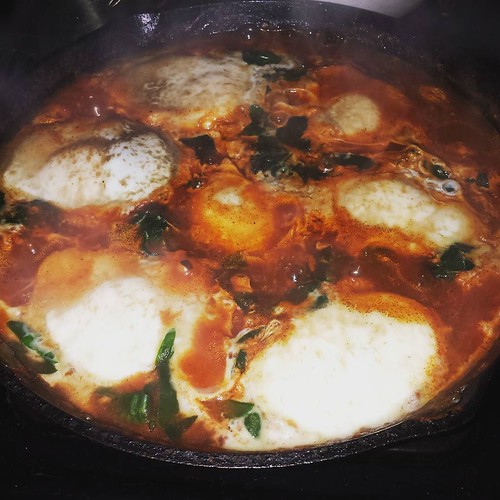
Here’s my finished product:

Shakshuka: well, this was good but not a home run. Recipe called for too much salt and too long a cook on the eggs, with predictable results. Still, the dish was tasty enough to make again, with some tweaks. #yum #shakshuka

Good stuff, but next time it’ll be great stuff!

(Oh, and I omitted the bay leaf, because seriously, f*** bay leaf. Those things are useless.)

Share This Post

National Poetry Month, day four

I found this poem in the collection Good Poems for Hard Times, edited by Garrison Keillor. It’s a moody poem, not at all optimistic, as it hinges upon an unmet person at an awful time in their lives. It casts Ithaca as a cold, bleak place — and assuming that the author means Ithaca, NY, this is not my experience at all, but there’s nothing about my experience that trumps another’s. And besides, perhaps author Leonard Nathan isn’t actually referring to Ithaca, NY but calling back to the mythic Ithaca of Odysseus and his long journey home.

Toast
by Leonard Nathan

There was a woman in Ithaca
who cried softly all night
in the next room and helpless
I fell in love with her under the blanket
of snow that settled on all the roofs
of the town, filling up
every dark depression.

Next morning
in the motel coffee shop
I studied all the made-up faces
of women. Was it the middle-aged blonde
who kidded the waitress
or the young brunette lifting
her cup like a toast?

Love, whoever you are,
your courage was my companion
for many cold towns
after the betrayal of Ithaca,
and when I order coffee
in a strange place, still
I say, lifting, this is for you.

More on Leonard Nathan.

Share This Post

National Poetry Month, day three

An unabashed love poem by Christina Rosetti. This is one of the more heartbreaking poems I know, because it unflinchingly stares at the certainty that all love must end, and that the inevitable ending provides those left behind with terrible choices about how to approach memory.

Remember
by Christina Rosetti

Remember me when I am gone away,
   Gone far away into the silent land;
   When you can no more hold me by the hand,
Nor I half turn to go yet turning stay.
Remember me when no more day by day
   You tell me of our future that you plann’d:
   Only remember me; you understand
It will be late to counsel then or pray.

Yet if you should forget me for a while
   And afterwards remember, do not grieve:
   For if the darkness and corruption leave
A vestige of the thoughts that once I had,
Better by far you should forget and smile
   Than that you should remember and be sad.

Share This Post

Symphony Saturday

All right, we got a barn-burner here. Seriously, you’ll be needing good speakers and you’ll be wanting to turn them UP, especially for the last movement. Today it’s the Symphony No. 3 in C minor by Camille Saint-Saens, better known as the “Organ” Symphony. This is one of the great warhorse-works in all classical music, and there’s a reason for that.

This symphony is, quite simply, awesome. It’s amazing. With all respect (well, some respect, anyway) to Tchaikovsky’s 1812 Overture, this symphony is the musical equivalent of a fireworks show. Maybe not all the way through, obviously — it opens with an ethereal chord followed by a meditative passage before the tempo quickens, and there’s a wonderful slow movement, but when that final section arrives, with that first gigantic chord in the organ, well, that’s when the clouds disperse.

I first heard this work in excerpt form at EPCOT, of all places, as parts of it are used (along with other French works) in the Impressions de France film in the French pavilion. I bought a recording of the symphony within months, and it has been a favorite piece of mine ever since. In fact, my college roommate and I used to use the last movement as background motivational music whenever we were getting dressed for a band or orchestra concert (we were in both). Toward the end, when the entire brass section gets to just let it all loose, the effect is one of the most thrilling in all of classical music.

The Organ Symphony was written in 1886 for the Royal Philharmonic Society in London, although Saint-Saens dedicated the work to Franz Liszt after that great composer’s passing. The Symphony’s structure is slightly odd: it seems like it’s in four movements, but the first two movements and the last two are played without break, so in reality, the work is in two sections. It’s easier to refer to the four movements, though, so that’s the convention I follow here.

Here is the Organ Symphony by Camille Saint-Saens. And seriously, turn this thing up — and check out the timpanist in the symphony’s closing seconds. That guy is getting every ounce of pleasure out of every single drumbeat!


Share This Post