I suppose that I’m like many a classical music lover when it comes to Gustav Holst: aside from The Planets, I really don’t know much about him at all. I’m a bit better off than most, by virtue of having been in the concert band in high school and college, so I’m familiar with Holst’s two Suites for Military Band (which I should feature at some point anyway, because they’re terrific), but really, that’s about it. Holst was fairly prolific, and his work had many influences: Wagnerian opera, English folksong, Indian mythology, and more. His music, in my experience, rarely fits into a simple box, and his melodic gift is a subtle one that doesn’t always leave the listener with tunes stuck in the ear. For many reasons Holst’s output has been almost completely outshone by The Planets, which is the case with the sacred work I feature today.
Holst wrote The Hymn of Jesus in 1917, not long after the completion of The Planets, and listeners familiar with the more famous work may hear its echoes in the present one. It opens with a solo trombone playing a plainchant melody, and then the work grows until Holst’s plan becomes clear. For a relatively short work–only about 22 minutes in length–he deploys a large group of forces, with the orchestra supplemented by two choirs and a female choir all by itself. He also seems to have specified that the two “main” choirs be separated spatially, I assume for sonic reasons that could really only be appreciated in live performance.
The Hymn of Jesus is solemn and meditative and at times almost ecstatic. Its musical language constantly suggests the music of the ancient church, music that predates our system of Western tuning. All the vocal work is by choir; there are no soloists here, and repeated use of ostinato passages combines with the generally “angelic” sound of the choir to give the work a largely liturgical and at the same time otherworldly feeling. This is music that suggests a cathedral, with its great stone vaults, rising all about you.
For a very deep dive into this piece, check out this article; for now, here is The Hymn of Jesus by Gustav Holst.
Richard Feynman was an American physicist who contributed greatly to the field of quantum mechanics, eventually winning a Nobel Prize for his work. He also worked on the atomic bomb project and wrote a number of books about his colorful life and his views on science and technology, and in his time he was nearly as well-known a scientist as Carl Sagan. Toward the end of his life he notably served on the panel that investigated the explosion of the space shuttle Challenger, most notably bringing focus to a hypothesis that a failed O-ring seal led to the shuttle’s demise–a hypothesis which went on to become the generally accepted idea of the disaster’s cause.
Feynman’s memoir Surely You’re Joking, Mr. Feynman! (Adventures of a Curious Character) is a collection of anecdotes from Feynman’s life, drawn from recorded conversations he had with a friend, Ralph Leighton. The book is a fun, entertaining, and lively look at various episodes from Feynman’s life, though there are sober moments throughout, such as Feynman’s experiences with the educational system in Brazil, which is the passage I quote below.
But we’ll return to Feynman in a moment. First, though, the thing that made me think of this passage at all.
I recently saw a video on social media, shared by someone who has an axe to grind with the way arithmetic is taught to children these days under the guidelines of the “Common Core” curriculum. The video was a split-screen of a multiplication problem. I don’t recall the exact problem, but it was something along the lines of 36×52.
On the left side of the video, there was a teacher and she was teaching her students (who we never see, so I have no idea what age group or learning level she was teaching) to solve this particular problem. Having never undergone the Common Core pedagogy, I can only summarize it in unfair terms: she was saying things like “OK, we start by figuring out how many groups of tens we have, and then we draw a big box so we can start to group it all together.” But on the right side of the video, someone (we don’t see who, we only see their hand holding a pencil) solves the math problem using the method familiar to probably most people: “2 times 6 is 12, put a 2 down here, carry the one, 2 times 3 plus the one we carried, put a 7 down here….” And so on. The person on the right whips through the calculation and has the answer before the teacher on the left has even started processing through the problem.
The point of the video, obviously, is to show how much more obviously superior the “old” way of teaching arithmetic is to the “new” way. Of course, anyone looking at this knows, or should know, that the video is utterly dishonest. Showing a person who has developed a proficiency on one hand is not remotely an indictment of showing someone teaching the thing on the other, for one thing. For another, I can remember by grade school math classes, and I can tell you with a high degree of confidence that the proficiency demonstrated by someone just whipping off the correct answer using the “Multiply the ones digit, carry the tens digit, multiply the tens and add what was carried, lather rinse repeat” method did not come as a result of a few minutes’ instruction by a math teacher followed by an hour of doodle time. We spent days on that shit, and we got to take home page upon page of homework problems to practice the concept: “All right, we’ve spent an hour doing multiplications, so tonight do problems 1-50 in your workbook.”
(An honest admission: more often than not I did enough problems to assure myself that I knew what I was doing, and then I blew off the rest. This strategy was not always successful, in several ways. First, I got caught by teachers not having done all the problems; second, my self-assessment as to my grasp of the material was not always as accurate as I hoped.)
A fair version of this video would show a teacher doing the Common Core method on one side and a teacher actually teaching the old method on the other, but I strongly suspect that wouldn’t be as compelling, would it? Or maybe an adult doing the problem who learned via the Common Core method versus an adult who learned via the “old” method…but I expect that wouldn’t be all that interesting, either. As always it would boil down to who was faster with math. I knew plenty of kids who weren’t very fast doing sums in their heads, versus others who could glance at a problem and tell you the answer without even opening their pencil box. Again, this would not demonstrate anything at all.
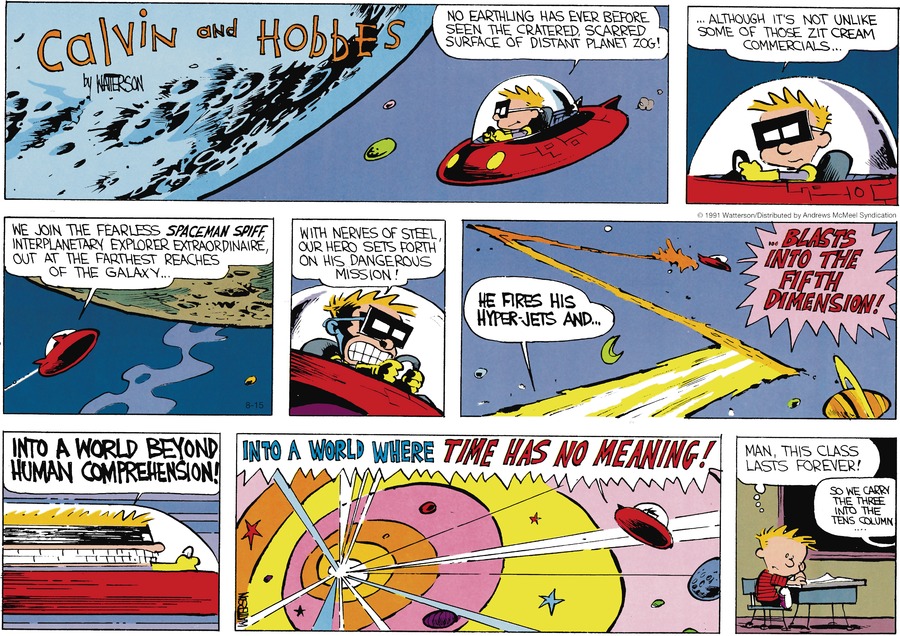
(As I’ve been working on this post, this Sunday’s Calvin and Hobbes repeat from many years ago managed to be relevant here:
Yes, that’s what it felt like.
But here’s the thing with the Common Core method as I understand it, versus the “old” method (and I promise we’re getting to a book excerpt eventually): the “old” method was a teaching of a rote algorithmic process to arrive at an answer. You learned multiplication first by being drilled until you know all your single-digit products: 7 times 9, 4 times 5, et cetera. Then you used those to work through a process that would give an answer. That’s what an algorithm is, after all: a sequence of steps that, executed correctly, will yield the same result, each and every time. Kids in my day were being taught algorithms to complete multiplication assignments.
Today, though, it’s clear to me that the idea is to teach a more conceptual approach, a way to think about what numbers are, what they mean, and what is actually happening mathematically when one does multiplication. (Or division, or whatever.) We were taught a process whereby we could calculate 36 times 52, but it appears to me that kids today are being taught what it means to multiply 36 by 52. Those are not the same thing. In my day, the “conceptual” stuff would come into play with annoying word problems (“Suzie has to give one toothpick to 52 kids every day for 36 days, how many toothpicks does Suzie need?”), but even that was more an applicative thing than a conceptual thing.
My father, who taught mathematics in college, got frustrated a lot of the time when students would arrive in his collegiate classes with good algorithmic skills but little ability to conceptualize just what it all meant in terms of mathematical concepts. In calculus classes he’d ask “What’s the derivative of x,” and students would say, “Oh, the derivative of x is [insert whatever the derivative is].” Then he’s ask, “Good! Now what does that mean?”
Crickets.
And that is where we get to Dr. Feynman. One of the chapters in Surely You’re Joking, Mr. Feynman relates Feynman’s experiences in traveling to Brazil to see science education in action in that country, which at the time of his visit was just starting to really develop. Here is Dr. Feynman:
In regard to education in Brazil, I had a very interesting experience. I was teaching a group of students who would ultimately become teachers, since at that time there were not many opportunities in Brazil for a highly trained person in science. These students had already had many course, and this was to be their most advanced course in electricity and magnetism–Maxwell’s equations, and so on.
The university was located in various office buildings throughout the city, and the course I taught met in a building which overlooked the bay.
I discovered a very strange phenomenon: I could ask a question, which the students would answer immediately. But the next time I would ask the question–the same subject, and the same question, as far as I could tell–they couldn’t answer it at all! For instance, one time I was talking about polarized light, and I gave them all some strips of polaroid.
Polaroid passes only light whose electric vector is in a certain direction, so I explained how you could tell which way the light is polarized from whether the polaroid is dark or light.
We first took two strips of polaroid and rotated them until they let the most light through. From doing that we could tell that the two strips were now admitting light polarized in the same direction–what passed through one piece of polaroid could also pass through the other. But then I asked them how one could tell the absolute direction of polarization, for a single piece of polaroid.
They hadn’t any idea.
I knew this took a certain amount of ingenuity, so I gave them a hint: “Look at the light reflected from the bay outside.”
Nobody said anything.
Then I said, “Have you ever heard of Brewster’s Angle?”
“Yes, sir! Brewster’s Angle is the angle at which light reflected from a medium with an index of refraction is completely polarized.”
“And which way is the light polarized when it’s reflected?”
“The light os polarized perpendicular to the plane of reflection, sir.” Even now, I have to think about it; they knew it cold! They even knew the tangent of the angle equals the index!
I said, “Well?”
Still nothing. They had just told me that light reflected from a medium with an idex, such as the bay outside, was polarized; they had even told me which way it was polarized.
I said, “Look at the bay outside, through the polaroid. Now turn the polarois.”
“Ooh, it’s polarized!” they said.
After a lot of investigation, I finally figured out that the students had memorized everything, but they didn’t know what anything meant. When they heard “light that is reflected from a medium with an index,” they didn’t know that it meant a material such as water. They didn’t know that the “direction of the light” is the direction in which you see something when you’re looking at it, and so on. Everything was entirely memorized, yet nothing had been translated into meaningful words. So if I asked, “What is Brewster’s Angle?” I’m going into the computer with the right keywords. But if I say, “Look at the water,” nothing happens–they don’t have anything under “Look at the water”!
[Feynman has several more experiences like this, after which he is to give a talk to students, professors, administrators, and government officials about his year in Brazil’s science education system.]
The lecture hall was full. I started out by defining science as understanding the behavior of nature. Then I asked, “What is a good reason for reaching science? Of course, no country can consider itself civilized unless…yak, yak, yak.” They were all sitting there nodding, because I know that’s the way they think.
Then I say, “That, of course, is absurd, because why should we feel we have to keep up with another country? We have to do it for a good reason, a sensible reason; not just because other countries do.” Then I talked about the utility of science, and its contribution to the improvement of the human condition, and all that–I really teased them a little bit.
Then I say, “The main purpose of my talk is to demonstrate that no science is being taught in Brazil!”
I can see them stir, thinking, “What? No science? This is absolutely crazy! We have all these classes.”
So I tell them that one of the first things to strike me when I came to Brazil was to see elementary school kids in bookstores, buying physics books. There are so many kids learning physics in Brazil, beginning much earlier than kids so in the United States, that it’s amazing you don’t find many physicists in Brazil–why is that? So many kids are working so hard, and nothing comes of it.
Then I gave the analogy of a Greek scholar who loves the Greek language, who knows that in his own country there aren’t many children studying Greek. But he comes to another country, where he is delighted to find everybody studying Greek–even the smaller kids in the elementary schools. He goes to the examination of a student who is coming to get his degree in Greek, and asks him, “What are Socrates’s ideas on the relationship between Truth and Beauty?”–and the student can’t answer. Then he asks the student, “What did Socrates say to Plato in the Third Symposium?” and the student lights up and goes, “Brrrrrrr-up”–he tells you everything, word for word, that Socrates said, in beautiful Greek.
But what Socrates was talking about in the Third Symposium was the relationship between Truth and Beauty!
What this Greek scholar discovers is, the students in another country learn Greek by first learning to pronounce the letters, then the words, and then sentences and paragraphs. They can recite, word for word, what Socrates said, without realizing that those Gr eek words actually mean somthing. To the student they are all artificial sounds. Nobody has every translated them into words the students can understand.
I said, “That’s how it looks to me, when I see you teaching the kids ‘science’ here in Brazil.”
This, it seems to me, is largely the difference between teaching the “old” way of arithmetic, with its rote memorization of times-tables and all that “Multiply the tens digit, carry the other number into the hundreds column” stuff, and the likely approach to however the Common Core method works. It’s teaching what is actually happening in the mathematics, as opposed to teaching a method that can be robotized.
Here’s some bonus Richard Feynman content, by the way: Ever wonder how a train stays on the tracks? Feynman answers, and it’s not the answer everyone thinks:
There’s something to be said for rock dance anthems that have great tunes, a fantastic beat, amazing rhythm…and, well, if the lyrics make sense I guess that’s a bonus, but let’s be honest: when you’re looking for something to play loud on the drive home from work on a Friday, something really good and loud and thumping, you don’t really need lyrics that make sense, do you?
Enter The Killers and their huge 2008 hit, “Human”.
“Are we human? or are we dancer? My sign is vital, my hands are warm And I’m on my knees looking for the answer. Are we human, or are we dancer?”
See? That makes no sense.
And when I listen to the song, I don’t care a single bit, which I think is rather the point. Singer Brandon Flowers is quoted as saying, in response to people not understanding the “Are we human, or are we dancer” thing (not “are we dancers“, note):
“It’s supposed to be a dance song, it goes with the chorus,” he says. “If you can’t put that together, you’re an idiot. I just don’t get why there’s a confusion about it.”
But really, who cares? From a live performance at London’s Albert Hall, here are The Killers with “Human”.
A spectacular set of rings around a black hole has been captured using NASA’s Chandra X-ray Observatory and Neil Gehrels Swift Observatory. The X-ray images of the giant rings have revealed new information about dust located in our Galaxy, using a similar principle to the X-rays performed in doctor’s offices and airports.
The black hole is part of a binary system called V404 Cygni, located about 7,800 light-years away from Earth. The black hole is actively pulling material away from a companion star — with about half the mass of the Sun — into a disk around the invisible object. This material glows in X-rays, so astronomers refer to these systems as “X-ray binaries.
…
In a new composite image, X-rays from Chandra (light blue) have been combined with optical data from the Pan-STARRS telescope on Hawaii that show the stars in the field of view.
A very short work today! Less than three minutes, courtesy Soviet composer Dimitri Shostakovich.
In 1943 Shostakovich entered a contest to write a new national anthem for the Soviet Union. Apparently he did not win, but he was able to repurpose his material for that project seventeen years later, for use at a war memorial dedication in the city of Novorossiysk. According to what I have found on this piece, the work Shostakovich presented for the war memorial has been played continuously there ever since. Wow.
The piece is only a few minutes long, starting off quietly before building and building to a fairly thundering climax that isn’t hard to imagine being central to a patriotic tableau of some sort. I’d never heard it before today, but if you has asked me to imagine what a Russian/Soviet “Land of Hope and Glory” tune would sound like, this is what I would have thought of: a slow, stately melody of obvious nationalism that nevertheless broods.
Here is Shostakovich’s Novorossiysk Chimes (Flame of Eternal Glory).
What passes for an exciting weekend morning ’round these parts.
Actually, they may have been on to something. Our morning errands are complete, as I write this it’s mid-afternoon, it’s hot enough outside to not be conducive to sitting on the deck, so I may as well go take a nap.
Last week, Dusty Hill died. He was the bass player for ZZ Top.
ZZ Top is one of those bands that has been a part of the soundtrack of my life pretty much ever since early-adolescence, when I first became aware of rock music. They’re one of those acts that seems like they’ve been around forever, partly owing to their look: famous for their long beards, they cultivated an air of being old when they were still quite young. But there’s also a timeless quality to their music, which plays equally at ease on a classic rock station and an 80s throwback station, and more.
ZZ Top was always known most for its look: black suits and very long beards. They never updated that look at all. ZZ Top was not one of those “chameleon” kinds of acts that shifted with the times; their musical style and their look was always the same. They knew what they wanted to do, who they wanted to be, and the kind of music they wanted to make. And they made a lot of very fine music, too! Maybe they’re not quite at the level of, say, a Bob Seger or Tom Petty and the Heartbreakers, but ZZ Top is every bit as essential to knowing the last forty years or so of popular music in America. (ZZ Top’s own history began in 1969, so they’ve been a thing for more than fifty years.)
By never much changing while maintaining a high standard of excellence, ZZ Top managed to seem like they’d been around forever and always will. They always had that air of “grizzled old veterans of rock”, even if they were only in their mid-30s when I first encountered them, with their big hit, “Legs”.
My favorite ZZ Top song is one of their less-known ones, a power ballad from the Afterburner album. “Rough Boy” is really quite a lovely song, with lyrics suggesting a boy trying to impress a girl even though he’s, well, ‘rough’. Those lyrics go well with Billy Gibbons’s raspy tenor, and the verses alternate with some frankly beautiful guitar playing.
Here are three videos: first the song itself as recorded (and later remastered) for the original album, and then a live version in which the band is joined by guitar legend Jeff Beck. And finally there’s an example of one of my favorite new genres, the “reaction” video, in which a listener with an open mind listens to “Rough Boy” for the very first time ever. (The reaction video is great, but her experience is slightly marred by the fact that she’s also watching the song’s official video for MTV, which is, I must admit, one of the weirder videos out there, and it’s a video whose content has almost nothing to do with the song itself. But her enthusiasm is real; I love these reaction videos!)
And Dusty Hill: Thanks for the music. It will live long!
Looks like the shoe is finally dropping in Buffalo and WNY, regarding the future of the region’s NFL franchise: the team’s owners, Terry and Kim Pegula, are floating the idea of a new stadium to replace the team’s existing venue, which would be publicly funded to the tune of over $1,000,000,000.
Hold on, let me count the zeroes to make sure I have that right…thousand, million, billion. Yup, that’s right.
Newer reports have the team citing possible other locations for the franchise if the stadium doesn’t happen. Locations like Austin, Texas.
My position on this is simple: I am against any public funding for stadiums at all. None. Not one penny.
A sports team is an investment on the part of billionaires that in almost every case ends up making many more billions for those owners. If someone who is worth a billion dollars wants something that costs a billion dollars, well, let them put up their own money for it. The notion that the public should put up the money so the owner can reap further billions is ludicrous.
And don’t come at me with “Stadiums spur development!” and “Stadiums create jobs!” We all know this is complete nonsense. Study after study after study has confirmed it. I live less than a mile from the local stadium, and believe me when I tell you, the area around the stadium is not a hotbed of massive economic development. There’s about half a dozen bars, a convenience store that was a 7-11 once, a Tim Hortons, and one of those really seedy motels where people who, ahem, are required to register their whereabouts and living arrangements with the local constabulary (and whose presence might be communicated to local parents) go to live.
I consider spending a billion dollars on a single project that will literally benefit a small number of people and enhance the profits for literally one family, and I think of things like…local schools. Parks. Water and electrical infrastructure. Libraries. Museums and arts projects. Streetlights. (This last one sounds prosaic, but I think of it every time I drive through another city that has streetlights on its main expressways. Buffalo does not.)
On a larger point, I am sick of living in an economy which is largely organized around the precept that the natural and preferred course of money is ever, ever relentlessly upward. The idea of giving money to people at the bottom of the economic spectrum is seen as socialist nonsense, but the idea of public money being spent in gigantic amounts so that a single married couple can pocket more millions in profits before eventually selling their investment for a gargantuan return is never even questioned.
When sports stadium talk comes up, I think of Atlanta, Georgia. In the early 1990s, an aging facility–Atlanta Fulton County Stadium–served both the NFL’s Atlanta Falcons and MLB’s Atlanta Braves. The state of Georgia funded the building of the Georgia Dome for the Falcons, which opened in 1992, and the Braves got their new park, Turner Field, four years later when the stadium build for the 1996 Summer Olympics was converted to ballpark status.
In the last few years, both of those venues, built not just in my lifetime but in my adulthood, have been replaced, and for all the usual reasons cited, each and every one of which could be reduced to one very simple reason: the teams’ owners could make more money if they had new venues.
And now here come the Pegulas, the owners of the Bills. When they bought the team they tabled new stadium talk for several years, even though everyone around here knew the subject would come up, if not by them then by the NFL itself (which is an organization that is made to further the football-related investment goals of the owners). As the team is finally good again after many years of not being good, it’s clear that the Pegulas basically wanted to wait until the local mood was favorable toward the Bills again. It’s no accident that the year after the team went 13-3 and nearly made the Super Bowl that the owners are shaking the money tree for a new stadium.
Where will it be built? Current discussion is a new stadium pretty much across the street from the current one, so at least we seem to have abandoned the notion of building it in downtown Buffalo. But still: local money? Over a billion dollars of it?
This local citizen says no. And if the Bills move to Austin (or Toronto, or San Antonio, or Portland, or anywhere else), this local citizen says, “Thanks for the memories, good luck.” I saw the point being made all over social media the last couple days that the Bills “bring Upstate NY together” and that the Bills shape the local mood, and that losing the Bills would be an irrevocable blow to the local psyche. This seems deeply unhealthy to me. Plenty of successful and fine cities exist in this country with no major sports teams. It is my firm belief that we can have a very nice and vibrant city, with all of the things that nice and vibrant cities have, without major-league sports teams. I like sports and I get excited by the prospect of Josh Allen leading the Bills to a championship too, and I’d like to see the hockey team stop being awful and win a Stanley Cup…but I’d hate to lose the Philharmonic, the Albright-Knox, Shea’s, or our waterfront much, more more. I’d hate to see local schools get worse and for jobs and people to keep migrating away.
Regional identity, self-image, self-worth, and major economic policy should not be based on the existence and/or the performance of local sports teams.
If the Pegulas want it, let them build it. And if they can’t afford it, well–Terry Pegula once boasted that if he needed more money he’d just drill another well.