Last week a local person graciously cited me as a creative person worth following online, which was a compliment I greatly appreciated! But what really took me back was the description:
That’s when it hit me: Last month marked twenty years of me blogging.
I launched Byzantium’s Shores on BlogSpot back in February of 2002. I almost made it to twenty years of maintaining that same exact blog, but last year I went ahead and pulled the trigger on migrating to this space, because owning one’s own space online is really the way to go as corporate interests become more and more vested in controlling the content that is posted in the spaces that they own (and then, oddly, entrust the moderation of said content to badly-programmed AI bots that confuse tone and do things like require a certain popular commenter to take down a post the AI had labeled as “hate speech”, when all it did was post verbatim an official statement by the 45th President).
Looking back at 2002 and my road to blogging, some of it seems pretty clear and some of it is kind of foggy, like anything would be when viewed from so long a distance. I’d been a prolific poster on a few Usenet newsgroups at the time, but I was already chafing at wanting to write about stuff that wasn’t really on topic for those few newsgroups where I was a regular. Then a Google search for an old friend’s name turned up an interesting-looking website of his, which looked like basically an online journal, and shortly after that, I remember reading an article in an issue of TIME or NEWSWEEK about this new thing: “blogs”, short for “web log”, which are exactly what my friend was doing. He was maintaining an online journal and writing his occasional thoughts about…things.
I started looking around for blogs–
(OK, an aside here: I have ALWAYS hated the word ‘blog’. Can’t stand it. It’s the word we’ve settled on, but I really wish we’d called them e-journals instead. That would fit better with e-mail and e-books, and connotatively, ‘e-journaling’ sounds a bit less nerdy than ‘blogging’.)
–and after I figured out how to set one up, using Blogger and its hosting site BlogSpot, off I went.
Functionality back then was really bare-bones. Permanent links to posts were a total crapshoot as to whether they’d work or not. There was no photo hosting of any kind, and back then “hotlinking” photos on other sites was a big no-no. Google was still several years away from buying Blogger, so the service didn’t have very deep pockets. Unless you knew at least a little about HTML, you were locked into a few basic templates and you couldn’t even change your typeface on your blog. Unless you paid Blogger for the “pro” version, every blog had a toolbar with ads splashed across the top.
Here’s one of the first blogs I ever followed, back in the day. This one closed up shop a year and a half after I started blogging, and I’m honestly a bit surprised that it still exists online at all. I found that one, if memory serves, via a “Randomly Featured Blogs” sidebar that would show up on the main Blogger site. Blogs at the time were so new that you pretty much found new ones by following links back and forth and bookmarking the ones you wanted to keep reading when you found them. If you really liked another blog, you’d put it on your “blogroll”, the list of links to other blogs that you maintained on yours. The more times you got listed on others’ blogrolls, and the more times popular blogs linked yours, the more traffic you’d get. There was a “process” to “going viral” back then.
I didn’t post under my real name initially, as this was still the era–a waning era, to be sure, but it was still the thinking–that you shouldn’t share your real name online. Gradually this became less and less workable and less and less of a big deal, so the old screen name “Jaquandor” is now pretty much of a personal anachronism that dates back to my AOL days of posting on Usenet.
The tone of blogging back then was wild and wooly. When I started, 9-11 was less than six months in the past; I’m not even sure that the dust had even stopped settling, literally, at the World Trade Center site. As the nation reeled from that attack and as other powers started pushing for a war that was cast as a response to that attack (but I think we all know by now had almost nothing to do with it, along with another war that was a response but instead led to twenty years of bungling), so the online discussion turned mainly to matters of politics and war. Even then the general political tone polarized quite a bit, with bloggers skeptical of the war on one side, and bloggers vociferously for the war on the other.
I read a lot on both sides back then, and when I say that the folks for the war were for the war, I mean, they were FOR that war. They wanted it badly. There were times when I could almost sense their glee when the first bombs started falling. My own feelings on the war were mixed at first, but I quickly soured on the whole idea as it became clear that the whole thing was an exercise in chest-thumping triumphalism (“Mission Accomplished!”, the banner read, after just weeks of combat in a large independent country) and masculinity-run-amok.
The “blogosphere” at the time was an eerie forerunner of what we see in a lot of social media today, in a more prolix era, a time when people weren’t limited to 280 characters, or even 280 words. Anyone who remembers a blogger named Steven Den Beste will remember some really wordy screeds cheerleading the war. Den Beste was a strange dude whom I found weirdly compelling, kind of an intellectual tire-fire from which I couldn’t divert attention. He was a former engineer who retired to a blogging-from-his-apartment lifestyle, and he would often start his very long posts in an interesting fashion, describing some issue in science or from his old engineering life or whatever. This was always kind of interesting, until he’d inevitably reveal how the thing he was talking about was really a metaphor to support yet another argument of his for why bombing Iraq back to the days of Nebuchadnezzar was really the best thing for the region. Den Beste would later abandon politics on his own site and recast his blog as an anime-fandom blog, though he contributed more and more political screeds to other sites. He often insisted that he didn’t like labels and that he had no real political “home”, but as the years went by, it was increasingly clear that he was a mainstream right-winger. I eventually stopped reading Den Beste entirely when he expressed feelings of schadenfreude toward those who felt that George Zimmerman’s acquittal in killing Trayvon Martin was a travesty. A year or two ago I suddenly remember Steven Den Beste and searched his name, wondering if he was still out there cranking out anime reviews. Turns out he died in 2016.
I don’t mention him now to throw rocks at him, but Steven Den Beste is one of my main memories of the tone of the “early” blogosphere (which I preferred to call “Blogistan”), at least on the national or worldwide scale. He even linked me a couple of times, once with bemusement when I responded with what I hoped was obviously fake outrage at his negative review of Attack of the Clones. I think he got it: his link to my response was something like “Kelly Sedinger comments here, and he might want to calm down a little!” If nothing else, Den Beste was more than willing to engage people who thought he was full of crap. Again, I don’t intend to single him out negatively, but I mention him at length precisely because he was a memorable voice back then, in a time when even then there were a lot of voices, many of which were saying the same things in the same ways.
Blogging had a more local focus as well, and once we resettled in the Buffalo area after our brief stay in the Syracuse region in 2002-2003, I started connecting with local bloggers, some of whom focused on politics and others who focused on other things. A small but fun community arose, and we even had several meet-ups out in the “real world”, the first of which was at a brewery-bar in downtown Buffalo. The local blogs brought up local issues, and national issues, and not just politics as well: I remember debates about the merits of various styles of pizza, which of the Democratic candidates in 2008 might be able to win, what the Bass Pro plaza in downtown Buffalo should be like (what a hoot!), and so on. If that sounds like all the kinds of things you see now on Facebook and Twitter, well…there’s a reason for that, isn’t there? But the Buffalo blogging community was a cool one, and though many of those folks have long since abandoned their blogs, they’re still online in social media and I still follow many of them.
People like to scoff at the idea of an online “community” being any kind of community at all, but…when Little Quinn died, a bunch of people I only knew online showed up at his wake to pay respects. I will always remember that.
Blogging now, in 2022, has changed and has remained the same, in a lot of strange ways. Facebook and Twitter have taken over many of its main functions, and for people who still want to do long-form work that is ill-suited to those platforms, there are paid platforms for monetization like Patreon, Substack, and others. The essence of blogging is still out there but is largely decentralized. Maybe that’s a good thing, as blogs never really seemed to break through into the general awareness in the way that Facebook and Twitter and others later would, even if a lot of that functionality still exists. Locally I remember that a few times a year the Buffalo News would report on blogs, and each time the tone was pretty much the same: “Hey, there are these things called ‘blogs’! What are they? Let’s find out!” And the article would feature a few local bloggers. I was never one of them. Yes, this annoyed me.
It is interesting to see the “essence” of blogging come back, albeit in the form of paywalled newsletters and content-aggregators like Substack and the rest. I’m of mixed mind on this, to be honest. People should be able to get paid for their work, but I do miss the wild-and-wooly nature of the “early Blogosphere”, which was kind of a free-for-fall. And I continue to be irritated that the paid-content model is almost entirely subscription based. There are many times when I’ll find something I’m interested in reading…but I am not interested in signing up for a year of access for a single article in which I may be interested. This is not just a problem with paywalled news sites; I’m now seeing it on sites that are basically all but blogs in name. Just this week there’s been an in-depth article making the local rounds about the now-infamous “13 seconds” in the recent Bills-Chiefs playoff game; this morning I went to check that article, only to find that after reading ten paragraphs, the rest is cut off by a “This article is for paid subscribers only” notice. Look, content-creators of the world, I have to be honest: never say “never” and all that, but I have not once, to this point in my life, found a paywalled article online that I wanted to read so badly that I upped for a subscription to a site. The solution here is some kind of pay-by-the-article micropayment system, which is often suggested but so far never created. One waits and hopes.
Blogging also cemented overalls as a major piece of my online identity, as it were! Blogger finally added photo-hosting services sometime in the mid-aughts, so I added a profile pic, in which I had happened to be wearing overalls. The photo was a terrible one (no, I don’t think I still have it, and no, if I find it I won’t share it), which I took using an old Polaroid Instamatic camera and then scanned in using our old flatbed scanner (geez, just typing that description of the process makes my eyes glaze over!), and someone joked about me resembling an axe-murderer! (It was a terrible picture! But it was my first attempt at such a thing, and if anyone knows how much I hated having my picture taken as a kid, that was a really big corner to turn.)
So anyway, here I am, still blogging away, now on ForgottenStars.net, still holding forth on many of the same topics as always, along hopefully with some new ones. When I started blogging, I was still eight or nine years away from really starting work on Stardancer, after a few “trunk” novels (one of which I posted online as a blog itself before taking it down a while back). It was four living spaces ago, The Daughter was still in her “terrible twos”, The Wife and I were only approaching five years of marriage, and a whole lot of friends and life and stuff ago.
A lot of people have come, gone, and come again in the time I’ve been blogging. Some I discovered at some point and have followed ever since (her, her, him, him) Many bloggers have given up the habit but are still friends online; many more have vanished completely. Some I have sadly outlived (Messrs. Mannion and Teachout, for example). I remember regular readers who fell away over time–I hope this was a function of life and not a shift in my writing!–like a woman who lived in Winnipeg and another named Michelle who was a fellow candle in the dark in a time when the Star Wars Prequel Trilogy was still deeply unappreciated. And if my blog has never been widely read, at least I also have never much had to deal with obnoxious trolls.
And to think, when I started Byzantium’s Shores in February 2002, I figured that maybe, maybe!, I’d have about a year’s worth of things to say before I wrapped that little sub-hobby up and moved on. Little did I know. As ever, I continue marching on, for however long I feel like doing this.
…and if you’ve been reading (or have read me at any point along the way), I thank you!
In recent weeks in New York, the masks have been coming off. The Governor dropped her mask mandate several weeks ago (minus a couple of exceptions), and most counties have followed suit. My employer, The Store, kept its own masking policy for employees in place…until yesterday, when masks were made “optional” for employees who are fully vaccinated and boosted.
I’m still exercising my option to wear the mask, and I plan to keep doing so until the policy is revised to forbid them.
Why? Well, I set out my reasons for simply not minding masks back in September, and my opinion has not changed. I do not hate wearing the thing. Most times I forget it’s even on after a few minutes, and at this point I feel weird without it. But it’s not just that: I like being at an even lower risk of either contracting or giving someone else COVID. And moreover, I like the fact that I have not had a cold in more than two years.
I’m not a sickly person in general, but in “normal” years I could usually count on getting “the bug that’s going around” a couple times a year. From the first scratchy throat to the final cough clearing up would usually take around a week to ten days, and while it wasn’t debilitating, it wasn’t fun, either. And with masking and maintaining a healthy distance from most folks, I haven’t had a single cold since sometime in 2019. I like that.
And you know what else I like? I still like not being told to smile. I live in a world that overvalues the smile, with the expectation that everybody must have a giant permagrin at all times. The removal of masks has reminded me of this, as one of the biggest selling points is “Now I can see everybody smiling!” With a mask on, I smile as much as I ever did…but with the mask, my nonsmiling moments aren’t nearly as frequently assumed to be angry moments.
Honestly, I’ve reached a point where noses and mouths look odd to me. I’m fine looking people in the eye, not having my mood judged, and not having spent money on NyQuil or Mucinex since Josh Allen was a rookie. So yeah, I’ll be keeping my mask on a while longer, if you don’t mind.
Actually, I’ll do it if you do mind…and really, that might be another incentive to keep wearing it. I mean, if you saw Ron DeSantis yelling at some kids to take their masks off the other day…well, screw that guy and anyone who thinks like that.
March 4 was the original date mandated by the US Constitution for the commencement of Presidential terms, which means that March 4 was Inauguration Day. This was later changed with the 20th Amendment, which moved the Presidential term of office’s beginning to noon on January 20, and there it has remained ever since.
This means that today is the 181st anniversary of perhaps the most infamous of Inaugural ceremonies (well, prior to the one that unfolded on January 20, 2017, that is). I’m talking about the swearing in of President William Henry Harrison.
President William Henry Harrison. His legacy, unfortunately, lives on mostly as the answer to questions in Trivial Pursuit and JEOPARDY!.
President Harrison was the paternal grandfather of a later President, Benjamin Harrison, and he was also the last President born initially as a subject to the British Empire. Until Ronald Reagan, Harrison was the oldest man ever elected President. But what happened at that inauguration on March 4, 1841 that was so infamous?
He gave the longest Inaugural Address in history. It was over 8000 words long, it took him two hours to deliver, and he refused to dress warmly for the weather, which was cold and damp.
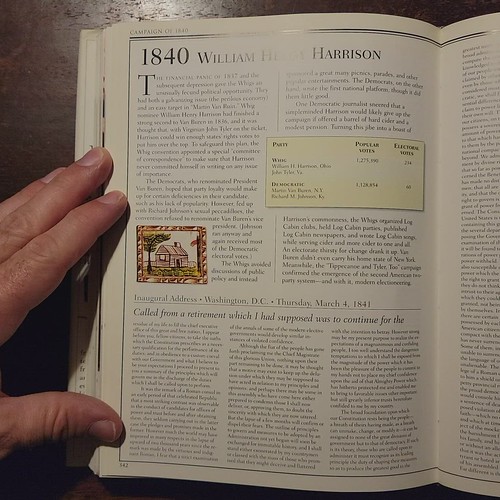
I own a book of Presidential history that includes the texts of all the Inaugural addresses (up to, I think, Barack Obama’s first), and here’s the text of President Harrison’s speech:
Imagine standing there for two hours in wet cold drizzle listening to this! Imagine standing there for two hours in wet cold drizzle, with no overcoat, delivering this speech! A stemwinder, it ain’t.
And from this, Harrison went on to a very long (three hour) parade, and then he attended Inaugural Balls late into the night. So of course…he caught cold.
The cold became pneumonia.
President Harrison became, one month later, the first President to die in office. This resulted in a Constitutional crisis because the Founding Fathers hadn’t specified exactly how presidential succession, outside of an election, was supposed to work. (Quite honestly, there’s really way too much ambiguity in our nation’s founding documents for me to worship the guys who wrote them all that fervently, but that’s just me.)
Harrison’s successor, John Tyler, is also mainly known for being a trivia answer: the first Vice President to become President, a President who was elected to the Confederate Congress later on, and–as of this writing, anyway–a President who was born in 1790 but who, thanks to an apparent habit of men in his line to father children late in life, has a living grandson to this day.
More recently, I noticed several years ago, when I was obsessively listening to Lin-Manuel Miranda’s great musical Hamilton obsessively, that for scansion purposes, “William Henry Harrison” has the same number of syllables as “Alexander Hamilton”! This has led me to try to get Mr. Miranda’s attention on Twitter now and again:
So far, Mr. Miranda has resisted my suggestion…but I know it has to be eating away at him! It just has to!
The Telnyuk Sisters are a Ukrainian folk rock duo. I know nothing about them beyond what I’ve read on their Wikipedia page…but I’ve listened to a bit of their music today, just a bit, via their YouTube channel.
I’m deliberately not posting information about this group or even translations of the titles or lyrics, because that’s not the point. The point is: This is the spirit of what Putin is trying to conquer.
Rice Krispie treat training, apparentlyZzzzzz.Zzzzzz, times two
Rosa not pictured, because she can be hard to get nice pictures of! She keeps a lower profile and when she’s around she’s acting weird. I’ll keep trying, though!
Composer Aleksandr Shymko was born in 1977 in Borschiv, Ukraine. He has led a distinguished artistic and academic career, composing prolifically. And that is just about all I know about him. I haven’t even been able to find any substantial information about the work featured here today…but it is an effectively emotional work, about twenty-six minutes long and cast in four movements. The Neoromantic sound has an almost chant-like, liturgical feel to it, and it’s deeply meditative even in its more intense moments.
Much is being lost right now as Shymko’s country finds itself in a war it did not deserve and did not want.
Here is Alcion by Aleksandr Shymko. The movements are titled: “Beyond Words”, “One Hour to Live”, “The End of Sorrow”, and “On the Edge of Everything”.
(NOTE: As this review heavily references ON HER MAJESTY’S SECRET SERVICE, I have revised and reposted my long essay about that film as well.)
After a series of production false-starts, headaches, and then a global pandemic, No Time To Die, the twenty-fifth James Bond film and the last one featuring Daniel Craig as Agent 007, finally arrived in late 2021. For a while it seemed like the movie would never get here: Craig’s reluctance to return after the grueling SPECTRE shoot, and then a troubled development phase with scripts being reworked and writers and the original director coming and going, and then delays in filming when Craig himself got hurt on set.
And all of that happened before the COVID-19 pandemic pushed the film’s release…and then pushed it again…and again, to the point where for a time there was serious talk of the movie being issued directly to one of the streaming platforms instead of getting a theatrical release at all. This didn’t happen, obviously–but for a while, No Time To Die felt like some kind of mythical beast, often referenced but never actually seen. Six years elapsed between 2015’s SPECTRE and 2021’s at-long-last release of No Time To Die, a span only equaled by the gap between 1989’s Licence to Kill and 1995’s GoldenEye, when the Bond series as a whole was derailed by some legal issues.
Was the wait worth it?
It depends on who you ask. Some James Bond fans hate this movie, with some intensity. I know this because I am married to one of them.
On the flip side of that coin, some James Bond fans react to No Time To Die as if it were specifically crafted to hit the sweet spot on each and every one of their emotional buttons as James Bond fans. I know this because I am one of them.
The most common objection to No Time To Die that I’ve heard cited by the film’s detractors is that this movie just goes too far. While all of Daniel Craig’s Bond films deviate from the classic “Bond formula”, this one goes so far from the established tropes of Bond that it ceases to be a Bond movie at all. Here we get a Bond who is grappling with emotional issues, who has left MI6 entirely, he is in love, he has been hurt, he has history, he has demons, and he has a kid.
And, of course, there is the movie’s biggest deviation from Bond formula, and you don’t get bigger than this: No Time To Die tells us that James Bond is mortal.
For many fans, this is simply too much.
And I respect that. I don’t agree with it, but I do respect it.
All through the Craig run, I wondered–along with many others–when we’d get back to the “classic” kind of James Bond adventures. We had the reboot, but surely we’d eventually get Craig to the old formula: an adventure in the pre-credit sequence, followed by a villainous figure starting some nefarious stuff. Bond would get a briefing from M on what little info they had, and then he’d go out into the field–getting some gadgets from Q at some point in the first act–and he’d do actual spy stuff. He’d meet “the girl”, or maybe two, and he’d bed one or both, and he’d slowly put together the bad guy’s plot before finally thwarting it in a big action finale with explosions and cool fisticuffs and whatnot.
You know the drill. Point is, I think we all expected Daniel Craig’s James Bond to get to that kind of movie–and yet, all through Craig’s run, he always seemed to flirt with that formula but never quite get there.
Maybe we expected it after Casino Royale, but then Quantum of Solace picked up right where that film left off, with Bond still chasing that film’s threads and reeling from Vesper’s death. Then Skyfall started off that way, with a banger of a pre-credit sequence, but that film deviated too with Bond being shot and disappearing for a while and reappearing and so on, before the adventure unfolded that took him into his roots. When Skyfall ended with Bond standing in the new M’s office, with that leather-padded door and saying that he was ready to get to work, I thought, “OK, next time out, James get a briefing and sent out on a proper mission!”
And then…Spectre thwarted the expectations again, in a movie that is a lot more derided than I generally like, though I can understand some of the frustrations around it. And then Spectre had Bond turn away from MI6 and go away with “the girl”, leaving us with a starting point for No Time To Die. We were never going to get a “standard” Bond film with this one, either, and what was more, Spectre did some retconning of the three movies before it to tie it all together into a single story, which NTTD would then have to wrap up. So in five movies made over fifteen years or so, we never once got Daniel Craig in a “standard” James Bond movie.
In my recent series of posts ranking all the Bond movies, I noted that I tend to prefer the “outlier” Bond flicks over the “standard formula” ones: “I especially love the ones that acknowledge that James Bond really, truly does have an emotional life of his own and that he gets personally invested sometimes.”
Maybe five films in a row of this is a bit much, but it seems to me that to follow up four movies that really were all about James Bond as a human character, establishing his history and using a consistent theme across all of these films of the present being shaped by our previous choices (and those of our forebears), to ignore all of that and just give Bond an old-school formula adventure, would have been a crime of storytelling. This is for thematic reasons, as well as reasons of continuity.
A common thematic thread has wound its way through all of Daniel Craig’s Bond films: the actions of our families informs our own actions, and their actions influence our lives in ways we can barely appreciate, long after they are gone. It makes total sense to me that the last Craig film would tie all of that together. This is, of course, another break with Bond tradition, where one adventure has little, if anything, to do with the next. But here we don’t just have a final adventure, but a wrap-up, a summation, a capstone adventure that draws on what has gone before–all of what has gone before.
Consider the film’s opening: we see the traditional gunbarrel sequence, but instead of the stylized cartoon blood and the gunbarrel fading to the dot that eventually irises us into the scene, the gunbarrel itself irises us there, which uses established Bondian film language to tell us, before anything happens in the story, that this is different, that we’re seeing something new. And new it is: a flashback to a strange man in a ceramic mask, on his way to murder Madeleine Swann’s family. This sequence is scary and intense, and it establishes Madeleine’s connection to Saffin, this strange assassin who decides to rescue Madeleine after he has killed her mother. The visuals in this sequence are stark, cold, almost black-and-white, which makes our eventual cut to the present day all the more surprising. Adult Madeleine is on holiday with James Bond, who has left MI6.
We don’t know how much time has passed since the end of Spectre, but it can’t be too long. Bond and Madeleine are in the relationship, but they’re still feeling each other out, still trying to figure out where each one stands against the backdrop of tragedy in both their backstories. Madeleine has brought Bond to a town in Italy where the locals have a custom of writing their sins on slips of paper, setting them aflame, and tossing them into the air. (These visuals are gorgeous–if nothing else, No Time To Die is one of the most visually beautiful films I’ve ever seen.)
Madeleine has another motive for bringing James here: she knows that his first love, the one he lost, the one whose death haunts him and whose betrayal damaged him, is buried in the cemetery in this town. She wants James to visit her grave and put that part of his past behind him. The film is already deep into acknowledging the pain and history in this particular incarnation of James Bond. Imagine a James Bond film not just showing “the girl” from the last film, but also mentioning the importance of “the girl” from four movies ago! Imagine, say, Octopussy opening with Bond and Melina from For Your Eyes Only talking about Mary Goodnight from The Man With The Golden Gun. Absurd? Maybe, in that approach to James Bond.
The Craig films are different.
It turns out that SPECTRE has already anticipated Bond’s visit to Vesper Lynd’s grave, and they’ve planted a bomb there. It goes off, but doesn’t kill Bond; instead a group of SPECTRE goons attack, and Bond grabs Madeleine and makes a typically Bondian escape, although Bond is blaming Madeleine for the attack: remember, she is not ignorant of SPECTRE. Her own father was a major figure for them, and to Bond, she must be involved, because how else would they have known that Bond was there? As Bond says: “We all have our little secrets. We just haven’t gotten to yours yet.” They make their escape, but Bond, furious, puts Madeleine on a train and leaves her, disappearing into the crowd.
Now, consider that: at some point between each James Bond movie and the next one, there must be a scene where Bond breaks up with “the girl”. One time we actually got an acknoweldgement of this fact, in Tomorrow Never Dies, when Bond had to go seduce a former lover in hopes of gaining intel on an enemy. (Damn, how I wish that movie hadn’t killed Paris Carver off! She was a potentially interesting character and the idea of watching Bond try to win back over a former “Bond girl” was a great one. Alas! How extravagant Purvis and Wade are, tossing great ideas aside like that!)
Fade to the opening credits, the amazing Billie Eilish song, and a precredits sequence that visually calls back to Casino Royale, Dr. No, and…On Her Majesty’s Secret Service.
And that brings me to the heart of the matter.
Just after No Time To Die cuts from Madeleine Swann’s childhood to the present, but before SPECTRE’s attack at Vesper’s grave, there’s a brief scene where Bond and Madeleine are driving through the Italian mountains overlooking the Mediterranean, in the Aston Martin DB-V, and this exchange takes place:
MADELEINE: Can you go faster?
BOND: We don’t need to go faster. We have all the time in the world.
When Daniel Craig said those words as I watched No Time To Die the first time, I said audibly, “Oh no, don’t say that!”
But Bond did say that, and as if to accentuate the point, at this moment in the film we cut back to sweeping shots of the Aston-Martin on those soaring Italian roads–as Hans Zimmer’s score rises with nothing more than a full-on quote of John Barry’s original orchestral arrangement of the song “We Have All The Time In The World”, the love theme from On Her Majesty’s Secret Service.
As I watched No Time To Die, I realized that the film was almost a love letter to OHMSS, in a way that no Bond film has ever been. With its various call-backs to that film, with its structural similarities and tones, with its approach to Bond as a character…well, NTTD seems almost calibrated to hit the same emotional buttons that OHMSS pushes. I suspect that how well one responds to this film can be partly determined by how one responds to the earlier one. As I’m one record as considering OHMSS not just the best Bond movie by a significant margin but also one of the great movies of all time, it follows that NTTD felt like it was almost made for me.
And that’s a strange sensation, I have to admit.
NTTD doesn’t remake OHMSS or retell its story (though we’ve already seen elements of it in previous films–remember the health clinic high in the Alps, in Spectre? That alone had me wondering about how big an influence OHMSS has been on writers Purvis and Wade), but NTTD does allow OHMSS to echo throughout its own story. Like OHMSS, NTTD gives us a weary James Bond who is pretty tired of the whole business. This was one of the more interesting aspects of OHMSS, and it’s an aspect that doesn’t get commented on much, so I think a lot of people simply miss it, which is a shame. It certainly helps understand some of the acting choices George Lazenby makes when you consider that his Bond is tiring of the spy gig. But I digress….
The point is, James Bond has a very real emotional life in NTTD, a very real emotional journey. It begins with Bond trying to make peace with some personal demons, but that effort is thwarted by a SPECTRE attack, and Bond’s response it to pile more baggage on top of the old. So, when we rejoin the story after the opening credits and the passage of five years of story time, Bond has retired and is living in the Caribbean, not really doing much of anything at all. This echoes OHMSS‘s first act, in which Bond has been trying to track down Ernst Stavro Blofeld for two years, with little success, to the point that when we join Bond in that film, he’s not really trying all that hard to be a good spy (to the point of lazily losing track of his own gun twice).
Meanwhile, as NTTD gets rolling, a somewhat labyrinthine plot involving a nanotech-driven bioweapon unfolds, into which Bond will eventually get drawn, not at first by an MI6 in need of its best agent–because M has apparently made peace with Bond’s departure to the point of appointing a new Agent 007 (the quite wonderful Nomi, played by Lashana Lynch), but because his old friend Felix Leiter asks for his help. I actually like the twisting plot; my formative years in the spy genre were in the heyday of Robert Ludlum, Tom Clancy, Nelson DeMille, and other writers who cranked out 600-page doorstops with plot twists on every page, so I’m always on board with a spy story that’s just a bit too hard to follow at times. I will admit that NTTD could have benefitted from a more clear explanation of the bioweapon, but the info is there in the movie, and it made more sense on the rewatch. For these reasons, though–the complex plot and the dense emotional story unfolding around it–I have zero problem with NTTD‘s generous running time.
OHMSS echoes throughout NTTD in other ways, many of them not immediately obvious. Both films depict a complex relationship between Bond and M, with M’s frustration with Bond bubbling over a few times, but never at the cost of M’s respect for Bond’s abilities. In the earlier film Bond’s frustration drives him to the point of resignation (fortunately thwarted by a clever bit of failed dictation by Miss Moneypenny, an action that is praised by both Bond and M), whereas in NTTD Bond, having already resigned, is now being pulled back into the mess which is in no small part M’s fault for having pursued the development of the bioweapon in the first place. Late in OHMSS, Bond is forbidden to go after Blofeld; in NTTD, M is similarly reluctant to bring Bond back into the fold, for personal reasons. In both films Bond is committed to a moral view that he feels is being compromised by his superiors, leading to confrontational scenes in both films.
(By the way, OHMSS detractors really need to watch the scene between Bond and M after the adventures in the Alps and Tracy’s capture. Lazenby portrays Bond like a tightly-coiled spring ready to explode, and he’s perfect there. Again, I digress….)
There’s a scene toward the end of the third act in NTTD when Bond and M finally get themselves onto the same page again, and here Hans Zimmer makes another interesting musical choice that thrilled me when I realized it in the theater: he quotes, as underscore to this scene, the main theme from OHMSS. At that moment James Bond is officially back on Her Majesty’s Secret Service.
Of course, the most important parallel that NTTD shares with OHMSS is that it gives James Bond a love story. While OHMSS propels Bond into its love story by a chance encounter with a woman broken to the point of suicide, NTTD‘s continues a love story that began in the previous film by bringing Bond to the point of commitment and then yanking that away (partially his own fault, because he makes no effort to listen to Madeleine’s protestations of innocence after the attack at Vesper’s grave, protestations that would later be confirmed by Blofeld himself). Even though five years have passed, Bond is still carrying the torch for Madeleine, and even though he has sworn to never see her again, events push them together, and that’s when Bond meets Mathilde.
Madeleine’s daughter.
Whose eyes look very much like James Bond’s.
NTTD makes two story choices that Bond fans can either accept, and therefore like this movie, or reject, and therefore hate it. This is the first of the two: it makes James Bond a father.
Now, in itself, how surprising is this? With all of his sexual exploits through the years, you have to figure that James Bond, well, “slipped one past the goalie” at least once. Right? This is never admitted or granted or mentioned at all, until now. It’s kind of like finding out in Star Trek II that James T. Kirk has an adult son, which probably makes sense given how frequently Kirk “got the girl” in the Original Series. But here is James Bond, meeting his five-year-old daughter (though Madeleine won’t confirm this until the very end).
Is it right for James Bond to be a father? That turns out to be a bridge too far for a lot of fans. It doesn’t bother me, exactly, though it does take a bit of getting used to. Again I have to return to considering the nature of Daniel Craig’s entire run of Bond films, and not just think about this one in a vacuum. All of Craig’s run is informed by Bond being haunted by choices and actions of his ancestors, and by the secret lives of those around him. His becoming a father is probably the best distillation of this constant emotional undercurrent of these movies, and it gives Bond the very best motivation for wanting to succeed and then be done with it all.
This is another of the parallels with OHMSS: Bond’s coming to terms with the fact that he does want a normal life with love in it, and that his profession isn’t compatible with this. In OHMSS, Bond admits to Tracy that he’ll need to find a different living if he wants to be with her, and in NTTD, James Bond is deeply aware of this already.
In fact, Daniel Craig’s James Bond has always chafed against the constraints of the job, and he has always taken a fatalistic view of how it can all end. By the time NTTD rolls around, Bond has seen the possibility of something else…but then there was this exchange, way back in the first act of Casino Royale, that seemed at the time just a bit of pith, but now seems prescient:
M: I knew it was too early to promote you.
Bond: Well, I understand that Double-O’s have a very short life expectancy, so your mistake will be short-lived.
And that brings me to NTTD‘s other deal-breaking (for some) story choice: the acknowledgment that James Bond is, in fact, mortal.
There’s a thing about characters like James Bond: episodic characters who have lots of episodic, unrelated adventures. Eventually the constant drumbeat of one adventure after another, each unrelated to the last and to the next, gets a bit unsatisfying, so in nearly every case of such characters–think Sherlock Holmes, Tarzan, John Carter, Dr. House, et cetera–some kind of continuity creeps in. Old enemies and old flames resurface, and gradually a life, a larger story, emerges. The same thing happened with James Bond, particularly in Ian Fleming’s original novels. And if you acknowledge a character’s larger story, you eventually have to acknowledge, somehow, their mortality. You can get around this a little, by having killing their previous life in some way (see the ending of House MD for a good example; House doesn’t die, but his career is as dead as Old Marley), or you can actually kill the character.
NTTD takes the latter course.
And for some, again, this is an unforgivable move for a James Bond story. I’m not really sure why, because this type of story–the weary hero’s final adventure, after which they die–is not new at all. See Robin and Marian, or Logan, for good examples. Especially the latter film, which I remember being almost universally hailed, with no one sobbing that “You can’t kill Wolverine!”
NTTD takes the emotional course of OHMSS and reverses it, because it knows that James Bond simply cannot have a permanent happy ending. All he can have is moments of happiness that pass quickly: he can wrap up the mission and bed “the girl”, and then he’s off to the next mission, the next adventure. This is not a new thing with Bond; the “hero who can never find true happiness” is a trope as old as time. Sherlock Holmes is one, and this was used to good effect in the movie Young Sherlock Holmes; the afore-mentioned Captain Kirk from Star Trek may be another example. And James Bond is that kind of hero as well.
The few times that he does seem on the cusp of some kind of permanent happiness–with Vesper, with Tracy–it ends horribly. So it must here: he loves Madeleine and he has a daughter with her, and maybe he could even make it off Saffin’s island in the end before the missiles hit, but he’s infected with Saffin’s bioweapon, which Saffin has programmed to kill Madeleine and Mathilde, so Bond knows that even if he survives, he can never touch Madeleine or Mathilde again. It’s a perfect dilemma, leaving Bond with choosing either a life where he can never be with those he loves, or simply choosing death. So…he chooses.
It’s quite simple, really: if you have a hero who can’t have permanent happiness, and then you bring that hero to the brink of permanent happiness, there really are only two ways to go. OHMSS went one way. NTTD goes the other.
Bond’s actual death scene is exactly what I would have envisioned for a James Bond death scene: Agent 007 sacrificing himself to save the world. His demise is very quick, but he gets to say his goodbyes to Madeleine, almost heartbreakingly via radio–they tell each other they love each other, and Madeleine finally admits that yes, Mathilde “has your eyes,” meaning, Mathilde truly is Bond’s daughter–and then it goes full-circle in giving Bond one more time to say those most heartbreaking of words in Bond history, but this time with a more optimistic twist: he says to Madeleine, “You have all the time in the world.” He is looking up as he says it, slightly smiling, as if thinking of the weird beauty in the sky above him as the missiles deploy their warheads and then rain down upon him. He closes his eyes as the fireball hits…and that’s it.
NTTD doesn’t linger on this moment: Bond is consumed by the flames, then we see a few long shots of Saffin’s island installation being destroyed, and then a fade to London, to MI6, after the mission is over. M has gathered together Q, Miss Moneypenny, Nomi, and his assistant Bill Tanner for a quick remembrance of Bond via a Jack London quote and a shared whiskey (neither shaken nor stirred), and then we cut to Madeleine and Mathilde, driving along another mountainous coast–maybe the same one from the film’s beginning. Hans Zimmer quotes “We Have All The Time In The World” again, as Madeleine looks at Mathilde and says, “I’m going to tell you a story about a man. His name was Bond…James Bond.” Mathilde smiles, and then their car–the Aston Martin!–disappears into a tunnel, and as the camera pulls out in front, the car and the tunnel recede, in a cunning reversal of the traditional gun-barrel opening of these films.
And the credits roll, with Louis Armstrong’s original recording of “We Have All The Time In The World” bringing it all to a close. But where OHMSS ended with an instrumental of that song being cut off by an almost unpleasant-sounding rendition of The James Bond Theme, reinforcing the fact that Bond and Tracy did not have all the time in the world, no such cut-off happens now. Bond is gone, but he has made good his promise. Madeleine and Mathilde really do have all the time in the world.
So ultiamtely No Time To Die echoes On Her Majesty’s Secret Service all the way to the end, and it does so with love and respect. I can’t not love this movie, because I value its craft, its storytelling choices, its pacing, all of it. It doesn’t stop at calling back to OHMSS, either: Felix Leiter’s betrayal and fate call back to Fleming’s original book of Live and Let Die as well as the film Licence to Kill, and Bond’s dispatching of Leiter’s assassin is reminscent of Roger Moore’s most ruthless moment, when he confronts an assassin in a similarly precarious position in For Your Eyes Only.
In terms of the villains, NTTD has an impressive Rogue’s Gallery going on, led by Rami Malek’s Lyutsifer Saffin, who is as coldly cunning as Bond villains get. (I don’t think he necessarily needed to be depicted as being disfigured, though.) With Saffin, Craig’s Bond gets his first real shot at a bad guy with a “Destroy the World” plot and a secret base built in a remote location. The evil scientist who invented Heracles, the nanotech bioweapon, is a wonderfully slimy toad of a character, and Christoph Waltz’s one scene as Blofeld is an excellent scene. I wondered during the film’s making if it would be weird, having Blofeld around but with a new “main” villain; NTTD makes this work pretty well.
As for allies, Jeffrey Wright’s Felix Leiter has pretty much become the iconic version of that character (apologies to the great Jack Lord). Lashana Lynch’s Agent 007 is slick and professionally capable, Ben Whishaw and Naomie Harris are excellent again as Q and Miss Moneypenny. Ralph Fiennes can be M for as long as he wants the role, as far as I’m concerned; Lea Seydoux sells me on the idea of another woman who James Bond loves. And there’s the joyous turn by Ana de Armas as Paloma, the CIA agent sent to help Bond in a sequence that is far too short.
Ultimately, though, No Time To Die rests on Daniel Craig’s shoulders, and he picks the film up and carries it. At no point does he feel like he’s mailing it in; I buy his weariness, his desire for closure, his humor, and his acceptance of the end at the end. He even gets to joke around a bit in this movie, getting a Roger Moore-esque quip after dispatching one bad guy in a delightfully gruesome Bondian way, and mugging for the camera when Paloma grabs him by the hand and pulls him out of frame when they first meet. All of Daniel Craig’s films have to convince us that James Bond is a man who feels things, and Daniel Craig brings those goods, each and every time.
On the technical side, No Time To Die is a triumph. It is loaded with beautiful compostions, even during action sequences, and the action sequences are always easy to follow, no matter how much mayhem is happening onscreen. (Craig’s second outing, Quantum of Solace, is much criticized for the downright incomprehensibility of its action scenes.) The score is by Hans Zimmer, a composer whose work I tend to love or dislike in equal measure, and he is mostly up to the task here, especially in the film’s moments of drama. I’m not as big a fan of his action music, but that’s always been the case with Zimmer’s work for me. I was glad to hear a more prominent use of melody in Zimmer’s score, since Zimmer has largely been eschewing melody in favor of stacked chords and soundscapes in his film music over the last decade or so.
I loved No Time To Die, even if I understand why a lot of people do not. After all, this movie literally kills James Bond…and then, at its very end, the last thing onscreen after the credits is the traditional promise:
Well…how is that going to work?
There are a few choices that I can see. Either the next Bond incarnation will acknowledge the Craig run, or it won’t. If the latter, there will likely be a reboot of some nature: maybe a full reboot where everything is done brand-new again from the ground up, like Casino Royale did, or maybe a “light” reboot where, say, Fiennes and Harris return with a new Bond without mentioning these adventures. I’ve also seen suggestions of making Bond into a series of period films, setting James Bond back in the milieu of the 1960s. In all honesty, I’m not sure I want that…or any reboot, partial or full. The Craig run represents a complete body of work, in a way that no other previous Bonds do with their respective runs (Lazenby excepted, since his run was one film, admittedly great). To simply plug in a new Bond and return to episodic adventures of the traditional sort would feel, at least to me, a bit cheap.
Maybe the best way is to acknowledge the Craig run…but then, how do you have a new James Bond at all, if you admit to having killed the last one? Well, there’s an old fan theory that all the movies up to Casino Royale weren’t telling the adventures of a single character, but rather the adventures of five different characters, each of whom assumes the name of James Bond and the number 007 at some point. In other words, James Bond is a code name assigned to an agent upon promotion to that level.
So…maybe they recruit a new agent, promote him, and give him a code name inspired by a real agent, now deceased, who served with distinction. Now you have a new “James Bond” with a new backstory, a new history, and none of the old baggage. Maybe the new “Bond” can develop a crush on Moneypenny, and maybe she hates him and only tolerates him, in a reversal of their old flirtatious relationship. (And there’s nothing here that even insists that the new “James Bond” be white, or a man!)
Maybe, maybe, maybe. How would fans embrace this? I don’t know. A lot might bail, to be honest, in the same way that a lot of Sherlock Holmes purists reject utterly the recent Benedict Cumberbatch or Jonny Lee Miller modern-day versions of the character. But speaking for myself, I just don’t see a return to the Bond formula of old, a formula that we haven’t even really seen executed on screen in more than twenty years, as if nothing in the interim has happened. In addition to the Craig run, there are the Mission: Impossible films to look to, with their format of new adventures for Ethan Hunt and his team, but also admissions with each mission of the cumulative effects of the previous missions.
I don’t have any idea what’s coming, obviously. But I do know that when Daniel Craig took over as James Bond, Barbara Broccoli and Eon Productions seized an opportunity to rethink James Bond fromt he ground up. They now have the chance to do it again. Let’s see what they do.
But in the meantime…thank you, Daniel Craig. Your James Bond was something special.
This song has been firmly lodged in my head for two weeks, ever since we saw it featured in a particularly good (and funny) scene on Derry Girls. Apparently this song features in a kind of line dance in which people sit in a long row and mimic motions of rowing a boat and then, later, rocking it.
“Rock the Boat” was recorded by the Hues Corporation and nearly disappeared without a trace before disco clubs seized on the song months later, and its infectious beat and its pleasing repetition of lyrics. There are also some neat vocal harmonies and rhythmic tricks in the song, like bars with extra beats in them.
Here is “Rock the Boat” by the Hues Corporation…and if this song is stuck in your head for days afterward, I accept responsibility but I feel no remorse!
Writing longhand with a fountain pen, in a puffy shirt and vintage overalls. If this picture only included a dog and/or a cat, this would be my ideal.
I have recently finally started to unravel the plot of Forgotten Stars V: The Final Frontier (not the actual title), much to my pleasure. This one has been giving me fits, to the point that I’ve been seriously considering making the shift from Pantser to Plotter. This is because the key turns out to have been…plotting.
OK, an aside if you’re not familiar with the terms ‘pantser’ and ‘plotter’. Some writers plot everything out, writing extensive story outlines of varying degrees of complexity from writer to writer, in order to get the story shaped before they ever start drafting. The idea then is that the drafting can go quickly, according to plan.
‘Pantsers’, on the other hand, don’t do this. They write ‘by the seat of their pants’, basically starting at Chapter One with some characters and maybe a situation and charging full speed ahead. Such writers feel constrained or even handcuffed by the use of outlines, preferring to discover organically what happens along the way.
I’ve always been mostly a pantser, with the proviso that I eventually get to a point in many of my novels (OK, all of them) when I’m not able to figure out the story’s development beyond a certain point. This usually comes up sometime between halfway through Act II and the beginning of Act III. At this point…I turn plotter, because by this point I’ve got my story started and revved up to the point where a plot is actually going to help. In the past, when I’ve plotted before drafting, I’ve always run into a much better story idea sometime along the way, so why waste my time plotting a story that I know will deviate wildly from the original plot?
Lately I’ve been plotting the last 2/5, roughly, of Forgotten Stars V, and I’ve really managed to hack open the plot to the point where at last I’m getting it all to work out nicely. In the future I probably need to react a bit more quickly, recognizing faster when I’ve reached the point where I need to step away from Scrivener and instead pick up the pen and paper for plotting. (I plot best using pen and paper; it slows my process down enough that I can think it through.)
But that’s not the only thing I do in these cases. There’s something else, and even though I’ve done it on each thing I’ve written on which I’ve eventually blocked up a bit–including stuff y’all haven’t even read yet!–I never really recognized this step in the process until this time through it. So this is my big advice for pantsers, if they find themselves oddly blocked:
The key probably lies in what you’ve already written, so go back and re-read the book to that point. You very well might have the answer staring you in the face.
If you’ve read any science fiction or fantasy, you’ve probably noticed that those genres can seem like dense piles of almost random stuff mentioned in the beginning chapters, as ancient heroes and cities and empires and wizards and historical figures and other things get mentioned, name-checked, hinted around, and so on. Think of all the name-dropping that happens at the beginning of The Lord of the Rings, or even in Star Wars. I do the same kind of thing, sticking all kinds of weird details in my stuff, because weird background stuff that never gets mentioned much again is a great way of making your world seem larger.
But here’s the thing: there may be a detail you’ve tossed in there for no other reason than it sounds cool, that ends up being the key to unlocking your plot and giving it the conclusion it deserves. I call this “The Usual Suspects” syndrome, from the classic story of how Casablanca got one of the great endings of all time.
(Spoilers for Casablanca, by the way.)
Casablanca famously went into production without the script really being quite finished, so as the film got closer and closer to having to shoot the ending, the pressure amped up on Julius and Philip Epstein, the film’s writers. The question was: How can they get Rick off the hook for killing Major Strasser, with Captain Renault just standing there, watching the whole thing? What’s Rick’s “out”? It turns out that they had already given themselves that out in the film’s first minutes, in which they established that in Vichy-controlled Casablanca, Captain Renault didn’t always take his duties very seriously; in response to various Resistance activities, Renault simply orders his men to “round up the usual suspects”. In short, his whole job is largely theater. Renault isn’t anti-Nazi at first, but he’s not particularly for them, either. As he notes, “I have no conviction, if that’s what you mean. I blow with the wind, and for now, the prevailing wind happens to be from Vichy.”
But the Epsteins still needed a way for Rick to get out of trouble for killing the villainous Major Strasser. The classic story is that they were out for a drive in LA one night when suddenly they both had the same epiphany, looking at each other and saying at the same time, “Round up the usual suspects!” And that’s what happens: Major Strasser is killed, only Rick and Captain Renault are present, tension abides…Renault’s men arrive, and Renault says, “Major Strasser’s been shot!” Looks are exchanged–Rick to Renault and back again–and we wonder what Renault will do. Will he say, “Arrest Rick, he killed the major”? No. He says, “Round up the usual suspects.”
And just like that, the story is resolved. Because the writers remembered a small detail they had thrown into their script early on, probably for character and humor reasons. It turns out to be the key to the film’s satisfying ending.
So go back and re-read your draft if you’re stuck, folks. Because the key to getting yourself unstuck may well be in there. As it was with the current book! Maybe someday when it’s been released I’ll flesh it out a bit in this space….
Some chamber music today, by the great Black composer Florence Price, whose work keeps rising in acclaim these days. I’ve featured Price’s music before in this space, and I plan to continue doing so! Her work, blending European classical forms and idioms with Black spirituals and folk-songs, is always fascinating.
In this case, we have Price’s Piano Quintet in A minor. In this piece the echoes of Black music stand out to great effect, not just in the melodies but in the harmonies and the rhythms, which are almost jazzy in their use of syncopations and resolutions that happen on the off-beats. The work is in four movements that share interconnected thematic material, giving the entire work a cohesion that would make any composer proud. The piece abounds in dance-like rhythms and excellent writing for strings and piano. I love that Florence Price is having a cultural moment. Her work deeply deserves it.
Here is the Piano Quintet in A minor by Florence Price.