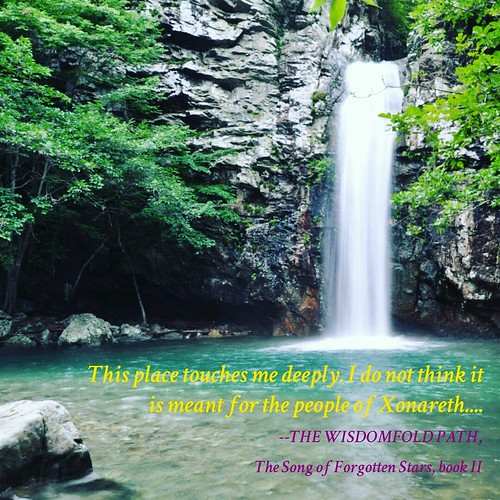
One day more, folks!
Here are the final teaser images for THE WISDOMFOLD PATH!
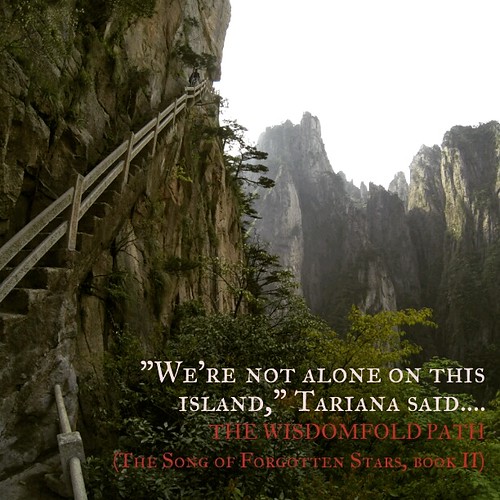


We’re almost there!

The official site of Kelly Sedinger: Reader, writer, photographer, and dreamer
And you know what? Even then I don’t think it’s right to say that it’s a waste of time, because it’s your time.
Even so, not everyone approaches writing the same way. If you just enjoy spinning your own stories and you have no real aim for them other than to please yourself, then hey, why not indulge a bit of fanfic? There are less-productive hobbies to have, and I suspect that for a lot of folks who write fanfic, the act of doing so scratches the same kind of itch that, say, playing a role-playing game does for others. It indulges a human need for story and for interaction with a fictional universe in a way that is, for those who enjoy writing, sometimes deeply satisfying.
I wrote fanfic for years, too, and I have my own thoughts on the subject, because I think fan-fiction can be useful as a learning tool for writing original stories later on.
One of my favorite podcasts is Functional Nerds, a podcast featuring writer Patrick Hester and musician John Anealio. The podcast generally features interviews with writers or other kinds of content creators in the SF, fantasy, and horror worlds, and I strongly recommend it. A favorite installment of mine featured author Mary Robinette Kowal as the guest, and she spent a lot of that particular podcast talking about writing and how to teach it. The general thrust of the episode, as framed by an early question by Anealio, was in breaking writing down into specific parts or facets. Lots of times when writers are asked what the best way to learn to write is, they’ll appeal to a Zen-like approach and say that you just have to sit down and do it. And that’s true, to an extent…but as a musician, Anealio looks at art in terms of more basic things. All music students, no matter what instrument they play, start off by learning scales, because scales are the basic building blocks of Western music, and every musician continues practicing scales for the rest of their lives.
So he asked Kowal this question: “What are the ‘scales’ of writing, and how do you practice them?”
Kowal indicated that she rejects the “holistic” approach to learning to write, and describes a number of ways one can break down the task of writing in order to focus on one particular area: description, characterization, and so on. I think that fanfic can serve the same kind of purpose, especially for people who want to write stories in a fantasy or science-fiction universe.
With fanfic, the basic world-building work is already done. If you write a Star Trek story, you know what your ground-rules are. You know that there’s a United Federation of Planets, and a Klingon Empire, and a Romulan Empire, and there are Ferengi about and that starships can go as fast as “Warp 10” and that Vulcans are a civilization organized around principles of logic and that Dr. McCoy’s first name is Leonard and that Jim Kirk was born in Iowa and so on. There’s a lot of heavy lifting that you simply do not need to do.
Or suppose you want to write your own Lord of the Rings stories, set in Middle Earth. Well, here you’ve got the maps and the races and even the languages already laid out. And ditto any other fictional universe or setting or other fanfic enterprise.
Writing fanfic was not a waste of time for me because I taught myself a lot of things about story construction, about pacing, and structure in those tales. Dialogue? Check. Making characters sound distinct, and making them “true” to themselves? Absolutely! I couldn’t very well have Mr. Spock having a temper-tantrum (at least, not without explaining it), or have Indiana Jones show up in a 1980s-era space tale, or James Bond suddenly be a wise-cracking, sarcastic buffoon. Anyone who takes their fanfic seriously wants it to feel authentic, right? And that takes work and consideration of the universe and what’s known about the people in it.
Now, I wasn’t thinking along those lines when I was writing them. My pseudo-Star Wars tales weren’t “exercises”, in my mind; I was just having fun writing. But you can’t write without learning about writing, and it turns out that ideas that start out as fanfic ideas can often have the serial numbers filed off and repurposed. After all, that’s a big part of what I did for Stardancer.
No, I do not consider fanfic a waste of time. Do I still write it? Not really, although I can’t rule it out – I did, after all, write a pretty darn good (if I do say so myself) “Very Special Christmas Episode” of Firefly a few years back, which I re-post on my personal blog every year. Yes, I might have achieved more, earlier, had I focused on original work before stepping beyond fanfic, but then, I might not. I did learn a good deal, though, and ultimately, all that fanfic I wrote cultivated in me a deep sense that writing is, even when it’s hardest and even when I’m working at it as hard as I work at anything else, play. Writing as play, in the best sense of the word. Fanfic is where I developed my sense that writing should give me the same feeling that I had on those Saturday afternoons when, as a kid, I and some other friends would pretend that the refrigerator boxes in their garage were spaceships.
Yes, you learn technical skills from fanfic, and I think it’s worth indulging on that basis alone. But you also connect with story and you play with it. And dammit, writing should be play! It took me a long time to realize this, but I finally did. Writing is where I scratch the itch that was once served by those afore-mentioned refrigerator boxes. Writing is where I find the kind of mental place where once I played with action figures and toy spaceships. Remember how annoying it was when you and some friends would be really into a play session of some make-believe or another, and Mom would come along and interrupt and snap you out of the illusion you’d created in your mind? Well, that’s the exact same feeling as having the phone ring during a really good writing session.
So, go ahead and write your fan fiction. If that’s the only writing you ever do, but you have a blast doing it…then you win. And if you do eventually start writing your own work, bringing to it the same sense of fun and play that you had when you were really engaging your earlier fan fiction…then you win!
Annnnd, here it is! The second of the two sample chapters I’ll be posting from THE WISDOMFOLD PATH. (You did check out Chapter One, didn’t you? Hmmmm? Well, if not, this would be a darn good time to do that!)
The book goes LIVE just two weeks from today, folks!
Chapter two, below the fold.
Continue reading “THE WISDOMFOLD PATH, Chapter Two!”
All right, folks, here it is: Chapter One of THE WISDOMFOLD PATH. Chapter Two will appear tomorrow, and the book itself launches two weeks from tomorrow, on November 10! It’s coming!!!
(And make sure to check out the cover art, if you haven’t already!)
Here we go! (Below the fold, of course.)
Continue reading “THE WISDOMFOLD PATH, Chapter One!”
That’s right, folks…it’s time for the official cover reveal for THE WISDOMFOLD PATH! Check it out, below the fold!
Continue reading “COVER REVEAL!!!”
Yes, that’s right: NaNoWriMo (National Novel-Writing Month) is just around the corner! It’s that wonderful time of year when thousands of writers around the world spend their Novembers chasing the goal of averaging 1,667 words a day. I will be participating for my fourth consecutive year, and my record is two wins and one not-win (last year). I wrote this post for Byzantium’s Shores a couple of years back, conveying my advice for achieving NaNoWriMo success, and while certain facts in the post have changed (i.e., what I’m working on this year), the advice has not.
So here it is.
National Novel Writing Month, or “NaNoWriMo” as it’s usually called, starts one week from today. This year will mark my third go-round, after completing the goal the last two years. However, oddly enough, even though I cleared the NaNoWriMo goal of 50000 words in November both times, I still haven’t finished either manuscript!
The first year was Deliverance, eh? (not the actual title), a supernatural thriller involving a kayaking trip in the wilds of northern Canada. I still like this story and have every intention of returning to it at some point. I set it aside because it reached a point where I wasn’t sure how to proceed and I didn’t like the direction I had taken, and then I decided that it was time to write Princesses In SPACE!!! II (not the actual title), because it was about that time that I knew that if I wanted the Princesses series to be a thing, I needed to get going on a second book ASAP. So the kayak-trip-from-hell book is safely awaiting a revisit, maybe in another year or two. after I write Princesses III and a sequel to GhostCop (not the actual title).
Last year I used NaNoWriMo to finish GhostCop and then resume work on Lighthouse Boy, which has again been set aside so I can continue working on the Princesses series. I’ve discovered over the last couple of years that while I can be prolific and always have something in the hopper, I can really only work on one project at a time, whether it be editing an existing manuscript or cranking out a new one. It’s just the way my mind works best, on these sorts of things; I tend to focus strongly on one thing, be it editing or composing, and trying to do both never works as I invariably end up gravitating toward one or the other. So I don’t even try anymore. I have time for Lighthouse Boy, anyway, since my current notion is to finish it and then serialize it as a series of cheap e-books. I suspect that doing something like that will be better accomplished once I’ve established my “brand” a bit, which means getting at least the first two Princesses books out there and at least launching the GhostCop series.
But anyway, NaNoWriMo isn’t really about finishing, anyway. It can be, but my experience is that it’s more about the work. It’s about setting a high goal and working toward it, relentlessly, and with some camaraderie that can’t always be found in real life. Fifty thousand words in one month is absolutely doable, but it’s also not the easiest target to reach if you’re not used to it, and it’s particularly devilish that the challenge comes in a month with only 30 days and one of the major holidays of our year. (Well, for now, anyway, since we seem hell-bent as a culture on making Thanksgiving about as relevant a holiday as Columbus Day, but that’s a rant for another time.) NaNoWriMo is about producing a big chunk of work, regardless of worrying about if it’s good or not. So, in that vein, if you’re considering participating in NaNoWriMo this year, here are my thoughts on how to best approach it for success:
1. Know what you’re going to write.
Have your mind made up so as soon as you sit down at the keyboard on November 1, you can charge out of drydock, thrusters on full. Don’t sit down at the keyboard and then try to decide what story you’re going to tell.
Now, “Know what you’re going to write” has some wiggle-room. I’m the type of writer called a “pantser”, meaning, I write by the seat of my pants. I don’t outline entire novels prior to writing, and if I do any outlining at all, it’s merely a scene or two in advance just so I can work out the timing and sequence of events in my head in the very near term. Other than that, I rarely have any great idea where the story is going.
Perhaps, however, you’re an outliner. You like to have a detailed outline ready to go, or maybe you like to figure out your characters in gory detail prior to writing. Lots of writers spend lots of time doing this kind of prep work — outlines, character sketches, that sort of thing — and if you’re one of them, have as much of that done as possible before November 1. November is not a time for prep work, if you’re doing NaNoWriMo.
2. Choose your style, and the simpler, the better.
Remember, NaNoWriMo is about producing a lot of words in a specific timeframe. Therefore, it’s not really the best time in the world for experimenting with your literary style. If your default style is toward the florid but you’ve had a hankering for writing a crime novel in a kind of Dashiell Hammett style, maybe November isn’t the right time. Likewise, NaNoWriMo really is not the time to write your near-future dystopian tragedy in rhyming Iambic pentameter.
3. Give your internal editor the month off.
Again, you’re looking to cover a lot of ground in November. You can edit later. There just isn’t time for revision, unless you realize that your story has gone well-and-truly off the rails and that you simply must backtrack to Albuquerque so you can take that left turn you missed. If you have to do this, fine, but don’t delete the work you’ve done. Leave it in there. Move it to the end of the file, past a couple of page breaks, but those words are still work you did. When it comes time to verify your wordcount at the end of the month, all Na NoWriMo will do is count your words. Nobody is going to read your work to make sure it’s coherent.
So: if you really have made a story error, by all means, go back and take another stab at it, without deleting what you’ve already produced. Generally, though, NaNoWriMo is not the time to try and make every sentence sing and put every word in its exact place.
4. Know when you are going to write.
This might actually be the most important thing. If you’ve been noodling around with writing for a long time but new to the crunch of NaNoWriMo, you’ll likely be very surprised at the amount of work and time involved in producing 1667 words in one day, much less every day for thirty days. Plan your writing time, right from Day One. It’s important. Know when you are going to write. If you normally get up at 7:00 every morning, maybe get up at 6:15 and write until seven. If there’s usually an hour after dinner when you’re unoccupied, set that aside for writing. On Sundays, maybe join the football game in progress after 2:00 instead of insisting on watching the whole thing. You have to budget your time, because while the NaNoWriMo goal of 50000 words in thirty days is doable, falling behind is also very doable, and getting caught up once you’re behind by even a day or two is a lot less doable. Make every effort to start the month ahead, so that if you need to take a day or two later on to produce less than 1667 words, you can afford it.
It’s good that this year NaNoWriMo starts on a Saturday (unless, of course, your job doesn’t give you Saturdays off). Getting off to a strong start is essential, and with two weekend days to launch, the schedule is quite conducive to it. Take advantage! Don’t tell yourself that you can make it up with a couple of 5000 word marathon sessions at some point, because quite frankly, you won’t.
What NaNoWriMo really helps is to train the brain — mindhack, if you will — to see writing as a job that can be approached in discrete chunks, as opposed to some mystical process driven by the capricious magic of some Muse. Believe me, there’s enough magic and mystery in writing already, so it can also be seen as a job where a daily word count is similar to a pro painter’s “Get this many square feet of the wall painted today”.
5. Don’t let friends and family guilt you about your focus this month.
Luckily, this has never been a problem for me, but I know it has for others (there’s a long thread about it on one of the NaNoWriMo message boards). If anyone gives you shit about writing, be firm in claiming this time for yourself. If they press, tell them that you have set a personal goal for yourself and you are working toward it. Would they guilt you if the goal you set was, say, running a marathon and you were doing a lot of training? I’m guessing not. Well, it’s the same thing. A personal goal that needs met is still a personal goal, no matter what. And if the other person is mocking of your personal goal? Well…I can’t really offer advice there, except to note that mocking someone’s goals, dreams, and efforts to make those things come true isn’t really something that should be endured from a “loved” one.
6. Interact with other people pursuing the same goal!
NaNoWriMo is a fairly big deal. The website has a lot of separate forums, from genre forums to forums for people of similar age groups to regional forums so you can connect with people in your area. Some areas even have “meet-ups”, where you can actually go and hang out with other writers who are having their own sessions. I’ve never done that (in this area, the meet-ups always seem to be held in the Northtowns, which is a bummer), but I wouldn’t mind someday. Find NaNoWriMo people on whatever social media you use — Twitter and Instagram have a lot of them — and share thoughts and success stories and kudos and cheers and vexing frustrations. Writing can be lonely, but it doesn’t have to be.
7. Don’t lose the story.
It’s about telling a story, after all. So go ahead and tell it!
UPDATE: My project this year is, once again, “Lighthouse Boy” (not the actual title). Over the last few months I have literally started the book over from the very beginning, but a lot of what happens in the book — at least the first third of it — is the same as what happened in previous drafts, so that should make the work easier.
If you’re doing NaNoWriMo, what are you working on?
(Oh, and my user name is “Jaquandor”, for those who want to “buddy up” or whatever it is they call it.)
My proof copy of The Wisdomfold Path arrived over the weekend, and opening it up to Page One, I discovered:

This is why we go through our proof copies, folks.
(The good news? As soon as I get the tweaks made and re-proofed, I’ll start doing things like…the COVER REVEAL! Hopefully next week! It’s coming, folks, it’s really coming!)