On Character, part the second

Hello, all! Time for another post on characters and how to approach them…or how I approach them…or, in this case, how another writer approached them.

So let’s talk about Calvin and Hobbes.

This legendary comic strip is still well known today, despite that fact that its creator, Bill Watterson, ended it nearly twenty years ago (in fact, this coming December 31 will mark the 20th anniversary of the final strip of Calvin and Hobbes). Watterson created a bunch of interesting and memorable characters, and at the center of it all was six-year-old Calvin and his beloved stuffed tiger, who in Calvin’s presence (and only in Calvin’s presence) was a living, breathing being.

Calvin was not very well-behaved. He wasn’t focused in school, he engaged in all manner of shenanigans that got him in trouble constantly, and he wasn’t terribly nice to the little girl down the street. In these particulars, he probably wasn’t all that different from a lot of six-year-old little boys, and while it’s tempting to read into Calvin’s psychology (and yes, you can find a lot of such commentary online), it’s best to realize that it’s all fiction and that Calvin likely is the star of a comedy strip, and not a real kid desperately in need of a truckload of Ritalin.

Watterson does not depict Calvin solely by his negative qualities, though, and it’s telling that those negative qualities seem to only come out when Calvin is forced to engage with other people. Ultimately Calvin is something of a loner, and when he’s allowed to do his own thing, he is depicted as an amazingly creative and imaginative little boy. Mostly this drives everyone around him to distraction, but occasionally people notice that it’s a good thing. There’s one strip that has Calvin imagining that he is A GOD, creating a world out of nothing…and then we cut to his parents in the last panel. Dad says, “Have you seen how absorbed Calvin is with those Tinkertoys? He’s making whole worlds in there!” And his Mom replies, “I’ll bet he grows up to be an architect.” (Of course, they don’t know that Calvin is imagining wreaking his evil vengeance upon the world as a God of the Underworld, but what they won’t know won’t hurt them.)

I read an article some months ago — which I didn’t bookmark and now I can’t find to save my life — that seemed to argue, if I recall correctly, that Watterson erred in ending an early story arc in the C&H run. This arc had Calvin’s Uncle Max (his father’s brother) come to visit, during which time he stuck around and made some commentary on Calvin’s tendency to being a loner and attachment to an “imaginary” friend and so on. The article argued (and again, I may have this very wrong) that Uncle Max represented an opportunity to show Calvin’s continued “growth” in some way. Watterson, on the other hand, recognized Max as a storytelling mistake. In his Tenth Anniversary book, Watterson wrote this about Uncle Max:

I regret introducing Uncle Max into the strip. At the time, I thought a new character related to the family would open up story possibilities: the family could go visit Max, and so on. After the story ran, I realized that I hadn’t established much identity for Max, and that he didn’t bring out anything new in Calvin. The character, I concluded, was redundant. It was also very awkward that Max could not address Calvin’s parents by name, and this should have tipped me off that the strip was not designed for the parents to have outside adult relationships. Max is gone.

That’s pretty insightful. A good character isn’t a good character in and of him or herself. A good character isn’t just well-developed and realistic and memorable and all those other things. A good character must serve the story and fit into the story’s world and tone. A character who doesn’t do those things is not a good character. Unfortunately for Watterson, he realized his error with Uncle Max after the character had already appeared in print, so he couldn’t just strike him from the record, could he? So now, Uncle Max is a real thing, complete with fan speculations and whatnot. (Someone out there has a pet theory that Uncle Max and “Lyman”, a disappeared-character of similar appearance from Garfield, are the same person. I am not making that up, either.)

Max doesn’t fit in the Calvin and Hobbes universe because about the only thing he can offer in terms of storytelling possibilities is a new setting for Calvin’s adventures as a loner, and that’s a pretty lame reason to have yet another outside person to be flummoxed by Calvin’s oddities. The person arguing that Max could have been a key, in some way, to Calvin maturing over time was missing a very huge point.

However, something else interesting happened as the strip neared its conclusion. Watterson eventually did allow a single outside character, and only one outside character, into Calvin’s world. He did this on an extremely limited basis (this character did not suddenly see Hobbes as a real tiger), but this storyline — one of my favorites in the entire run — was the only time I can remember an outside person interacting with Calvin on Calvin’s terms. That person was Rosalyn, Calvin’s embattled babysitter.

Rosalyn was a recurring character whose appearance on the scene always meant funny things were afoot. Her story arcs would run over the course of several days as each time Calvin did something else to get in trouble, make Rosalyn’s night miserable, and amuse the readers with all manner of hijinks. Rosalyn was also smart as a whip; having recognized the inherent lucrative nature of being the only neighborhood babysitter willing to supervise Calvin, she priced her services accordingly, much to the chagrin of Calvin’s dad, who knew that he was getting taken advantage of and could literally do nothing about it.

The last time Rosalyn showed up, the story started in pretty typical fashion. We know what’s going to happen: Rosalyn is going to threaten Calvin with doom if he misbehaves, and he’s going to misbehave anyway, and the night is doomed.
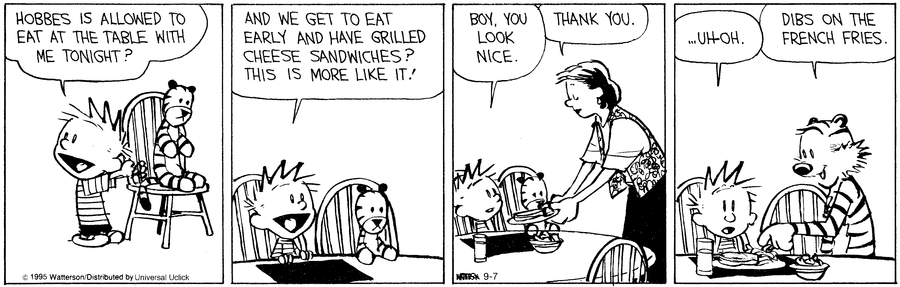
ch150907

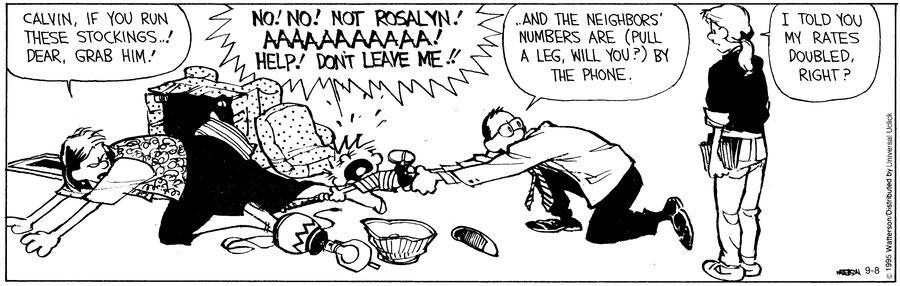
ch150908

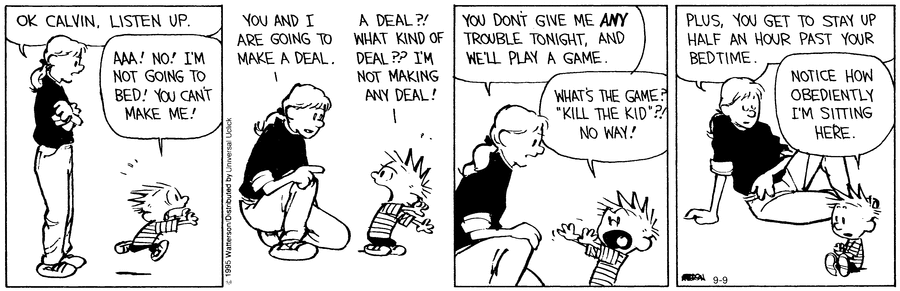
However, things go slightly differently, as Rosalyn has a different plan:
ch150909

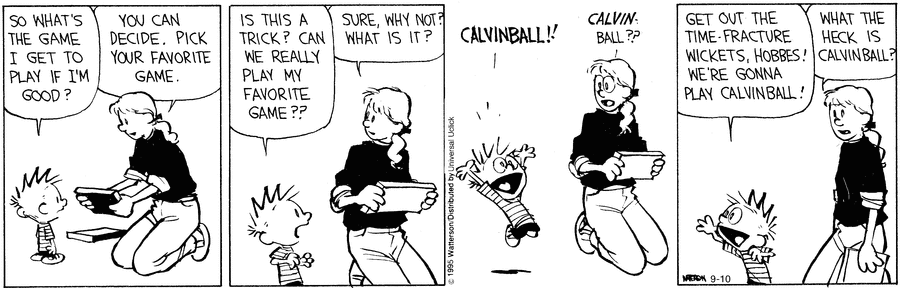
Calvin actually meets his end of this bargain (and God bless Watterson’s memory of how big an incentive it can be for a kid, being allowed to stay up late, even just half an hour), and Rosalyn meets hers: allowing Calvin to pick his favorite game to play. Now, she is undoubtedly expecting him to pick Sorry! or Monopoly or some such board game, but of course, Calvin picks Calvinball.
ch150910

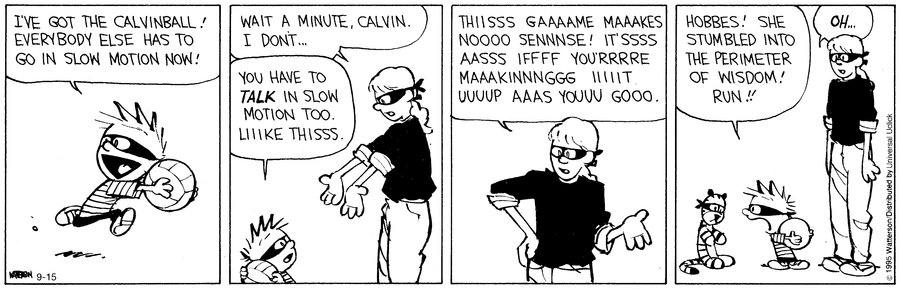
Calvinball, for those possibly unfamiliar with the strip, is a game whose one and only rule is the rules are never the same each time out. Rosalyn, of course, has absolutely no idea what to expect, but into the game she goes, quickly picking up the “rules”:
ch150915 ch150916

Rosalyn is actually engaging Calvin on his own terms here, and again, as far as I can recall this is the only time this happens with any outside person at all in the history of the strip. It’s really quite fascinating, since by its nature, Calvin and Hobbes is really fairly static in terms of character development for its entire run. Yes, we see different aspects of Calvin’s character over the years, but he never really changes, and that’s as much a necessity of the medium as anything else. (How much did Charlie Brown or Lucy ever change? Or Dagwood? Or Garfield? Or….) But here, we see definite change in one key way: Calvin finds a way (without looking) to connect with Rosalyn, and she finds a way to connect with him. As this story progresses, the water balloon is there, ready to be thrown at someone, and I remember thinking at the time that the water balloon was going to the source of Calvin getting in trouble this time, but then Rosalyn uses the “rules” of Calvinball to her advantage:

ch150918

There’s a wonderful coda to this storyline when Calvin’s parents get home and ask how things went, and Rosalyn says something like “Fine! Calvin did his homework, we played a game, and he went to bed,” to which Dad replies, “I’m in no mood for jokes!” He’s utterly convinced, you see, that this night will be like all the others and he’s coming home to an angry babysitter and his misbehaving kid.

(By the way, if you want to read this entire storyline — I don’t include each installment here — start here and click forward. There’s a Sunday strip in there that does not pertain to the Rosalyn storyline.)

Now, is Rosalyn a great character? Not particularly, because like everyone else, we only get to see her through the prism of Calvin and his reactions to her, but she does make possible some great moments along the way. Watterson wisely used her sparingly, noting that each time she showed up there was a sense that he had to outdo himself. With this story, Rosalyn does something no one else has done: she has entered Calvin’s world. It’s telling that this was the last time Rosalyn appeared before the strip ended. I don’t know if Bill Watterson wanted to have someone pull off this feat before he wrapped things up, but for my money, Rosalyn was really the only character who could have done this. For one thing, it’s completely unexpected, but for another, it’s done in the perfect way.

One last observation on this: Watterson also wisely knew what he could do with his characters when. This is important. He couldn’t have this story be the first one when Rosalyn showed up, because then there would be an underlying sympathy for her every time thereafter. This story could only be the last Rosalyn story. Likewise, the James Bond stories can’t start with On Her Majesty’s Secret Service, and Macbeth can’t start with Macbeth having usurped the throne, and so on. The audience has to be prepared to go where the characters are going, and if the characters go there before the audience is — or even can be — ready, then the story is going to feel forced and false.

And with that, I’ll have done. Thanks for hanging in there, and hey! Over the next few weeks, I’ll start dripping out some real concrete information and teaser stuff pertaining to The Wisdomfold Path! November 10 is coming, folks!


Share This Post

How Things Are Going!

Good afternoon, Dear Readers! I know, I haven’t posted here in a bit. I’m going to try and start having content appear here more regularly, starting with the post right below this one. How about that!

Anyway, here’s a brief rundown of where things stand right now:

  1. Preparations for The Wisdomfold Path‘s November release are trucking right along! The wonderful artist who does the cover illustrations has finished her work for the book, so now I can really start working on the cover design and the back-cover blurb. The blurb seems to be something that always gives me headaches; I struggled with the blurb for Stardancer and I’m struggling with the blurb for Wisdomfold Path, so I expect to see that trend continue. Hopefully by the time I get to the last book in this series I can take a page from the Harry Potter books and just have the blurb be, “Here’s the last book.”
  2. One beta-reader gave good marks to GhostCop, which is nice. I need to line up a few other readers for that one soon. I also need to come up with a real title to that book. This is deeply vexing to me.
  3. I’m slowly getting more and more familiar with Scrivener! It is NOT an easy program to learn, but oddly, once you learn enough of it, it IS fairly easy to USE. I also suspect that I will find it easier to use once I get past this phase of having to import projects from other sources — i.e., when I actually use it from start to finish.

That’s about all. As I said, expect some more regularity of content here — especially as The Wisdomfold Path‘s release nears! November is right around the corner, folks!


Share This Post

On Character, part the first

Writers love to rabbit on and on all day about their characters and how they develop their characters and how they decide what characters do and all that kind of thing. I, of course, am no different. This will, though, require more than one post, hence “part the first”.

So, where to start?

Well, with someone else’s thoughts on characters, of course! In this case, screenwriter William Goldman.

This is occasioned by a post by blogger Lance Mannion, in which he reviews the movie The Ghost and the Darkness. I never actually saw this film, but I know of it; it is a historical adventure movie about the two man-eating lions that terrorized the British railroad crews in Africa many years ago, and the struggles the railroad chief had with killing them. (The lions themselves, after being killed, were stuffed and are now on display in a Chicago museum, believe it or not…and they are a bit scary. But this post isn’t about the lions; it’s about Goldman’s thoughts on the characters in the movie.

The Ghost and the Darkness is not terribly highly regarded, either by critics or by Goldman himself. My impression is that it’s not seen as a bad movie, but mainly as a meh movie. Goldman has some very definite thoughts as to why this is, and he lays some of that blame at his own feet in the chapter on this movie in his book Which Lie Did I Tell? (which, by the way, I consider essential reading for fiction writers, even if they’re not writing for film).

By way of background before I excerpt Goldman: it took the railroad chief, a man named Patterson, nine months to kill the two lions, and he mainly did it by waiting and sitting vigil at night and laying traps and that sort of thing. Goldman’s problem, in scripting a movie about the lions of Tsavo (where this all happened), was that the real story doesn’t make for compelling film. So Goldman had to add a second, entirely fictional, character whom he dubbed “Redbeard”, to add excitement and drama to the story.

Here, now, is William Goldman.

Redbeard was always and forever only this: a plot point. I needed, for today’s audience, to make Patterson, my hero, more heroic. So I came up with what I thought would be a suitable device.

Redbeard would be a professional who came, did his job, moved on when the job was over. There were, in point of face, people who lived that way. Hunting was popular among the very rich, and there were men for hire if you were a Russian prince and wanted to shoot in America. Or Africa. Or the mountains of India. You hired them for weeks or months, and they saw you get the best chance at game. Protected you in the bargain.

What made Redbeard different was he was a legend even to other professionals. In other words, the greatest hunter in the world.

In the very first draft, his part was relatively small. Patterson was in terrible trouble. The lions had stopped the railroad. Redbeard entered, sized up the situation. Now, I couldn’t have him win immediately, because that would have denigrated the lions. So…he came up with the notion of putting Patterson high up, all alone, in a clearing, on a rickety wooden support. Patterson is alone and helpless. Redbeard is in the area. The Ghost [one of the lions, the other being The Darkness] comes. Then the Ghost attacks, Redbeard wounds it, together they kill it and triumph.

The point now was for the audience to relax. The cavalry had come to the rescue.

Then, the next morning, when Redbeard is eaten, Patterson, poor helpless fellow, would be alone against The Darkness, what chance could he possibly have if even Redbeard had failed?

The fact is this: Redbeard worked as a device.

My problem, Doctor, was he worked too well. In all the succeeding drafts, the powers that be wanted more of him. Obviously, they saw a costarring part. Fine for them.

Biiiig problem for me.

Let me try and explain why.

[In this telling, Redbeard sounds similar to Quint, the grizzled fisherman in JAWS. Or, that’s how he should have been. Reading on….]

One of the great exchanges in movie history — I don’t mean ‘great’ in the sense of Shakespearean, because screenwriting isn’t about that; I mean ‘great’ in the sense of being supremely helpful, of defining character — anyway, it’s in Casablanca, by the Epsteins and Howard Koch. Probably you remember the moment. Bogart is talking to Claude Rains in front of his club.

RAINS: And what in heaven’s name brings you to Casablanca?

BOGART: My health. I came to Casablanca for the waters.

RAINS: Waters? What waters? We’re in the desert.

BOGART: I was misinformed.

Let’s talk about this for a moment. First of all, it is wonderfully elegant dialogue. Witty, plus it makes you laugh out loud. I wish to God I’d written lines as glorious as “I was misinformed.”

But what does it tell us? Well, it could be telling us that Rick is geographically challenged, coming to the desert for a water cure. But I think “I was misinformed” tells us he knew exactly where he was.

What it tells us is this: Don’t ask. What is tells us is: Bad things happened, it’s dark down there, and I will die before I tell you. A lot of that comes from the dialogue, a lot from the speaker of the dialogue.

The character of Rick, of course, is very old — he is the Byronic hero, the tall dark handsome man with a past. Most movie stars — actors, not comedians — have essentially all played the same role. And they have to always face front, never turn sideways–

Because, you see, there’s nothing to them. Try and make them full, try and make them real, and guess what? They disappear.

Let me rewrite that exchange for you now. Let’s say Rains is talking not to Bogart, but to Dooley Wilson.

RAINS: And what in heaven’s name brought Rick to Casablanca?

DOOLEY: You don’t want to know.

RAINS: But I do, I asked the question.

DOOLEY: His life turned to shit, Claude. He hated his job, but he should never have sold insurance in the first place. And then his wife, she died having their hid, who died too. He got so depressed, y’know? [This continues a bit…snipping it down.]

Think about what that does to one of the greatest of all Hollywood movies. It makes Rick a wimp. It makes him a loser. Kills the flick, ruins it, destroys it, makes it an Adam Sandler flick. Never forget the following:

Hollywood heroes must have mystery.

OK, Back to Billy’s little Redbeard problem. I had written a Byronic hero. He’s Shane. The village is in trouble, he rides in, saves it, rides out. For that very great Western directed by the very great George Stevens, it is crucial that we know nothing about the guy. Ever.

The bigger Redbeard’s part became, the more risk for me, because the more you expose that character to the sunlight, the more he starts to fade.

Skipping forward a little, Michael Douglas comes on board as a producer and to play the Great Hunter role, originally named “Redbeard”. This is where Goldman finds things going awry:

The first thing that went was the name.

No big deal, you are probably thinking, and of course, you are correct. It is not a big deal. Except writers are nuts — that is a law in the State of California as you no doubt know — and we love the names we give our made-up friends and acquaintances. A lot of us can’t even start until we know our people’s names.

I loved “Redbeard.” I thought it was a terrific name; and I thought it was helpful in trying to make the guy mythic. Just that single word, those two syllables and you were talking about someone whose exploits had filled the nights beside a thousand campfires.

I lucked into the name Remington pretty quickly. Sold myself that if not as good, at least it didn’t suck. Still the one word, and there was the echo of the gun that was so famous in settling the Wild West.

Sigh of relief.

Then, sharply, I was into nightmare.

Michael wanted Remington to have a history.


This next scene is one of the worst things I’ve ever written. I actually remember my stomach cramping when I did it. It comes the first night Michael Douglas has arrived to save the day. In the background, a bunch of warriors are getting ready  to jump around and give themselves courage. Douglas is talking to Kilmer and Samuel, who is the narrator of the film, a native helping Patterson as best he can. Another native comes up and indicates to Remington that they are ready. Remington leaves and the camp doctor, who has also been present, comments that Remington is indeed a strange man. Here is what Samuel replies to that — get ready, hold your noses.

SAMUEL: Two great tribes of his country fought a terrible civil war for many years.

VAL KILMER: And his side lost?

SAMUEL: Everything. Land and family. The very young ones and the very old ones. All lost. He buried his family and left his country forever. Now he hunts all over the world but he always returns here. He says Africa is the last good place.

Remember my made-up speech about Bogart taking a course in nightclub management? Same thing here. This is what that speech and ensuing references to Remington’s past do to this legendary figure: They make Remington a wimp. They make him a loser. He’s just another whiny asshole who went to pieces when the gods pissed on him. “Oh, you cannot know the depth of my pain” is what that seems to be saying to the audience. Well, if I’m in that audience, what I think is this: Fuck you. I know people who are dying of cancer, I know people who are close to vegetables, and guess what — they play it as it lays.

This little speech may not seem like much but not only does it cast a pall over everything that follows, it destroys the fabric of the piece. Every ensuing mention of Remington and children and loss is all so treacly you want to whoopsie. Never forget the following:

Movie stars must have mystery.

Now, Goldman is primarily concerned with movie characters here, and while there are different concerns when writing for movies as opposed to writing novels or plays or teevee or whatever, storytelling is still storytelling. You’ve got to do right by your characters and you’ve got to do right by your audience, whether they’re sitting in the dark watching your tale or sitting by the sea reading it. Every character has a backstory, but there really are times when it’s best to not delve too deeply into it. (This is one reason I’m a little nervous about the idea of one of these one-shot Star Wars movies being a “Young Han Solo” story.)

I will, of course, return to the subject of characters in the future. This was only a start, dear readers!


Share This Post

New Story!!!

Well, it’s not actually a NEW story, as I wrote it nearly ten years ago, but for this site’s purposes, it’s new! I had actually forgotten about it, which is odd considering I actually won a fiction contest with it. I was reminded of it, though, by the recent relevance of President William McKinley in the news. Intrigued? Sure you are! Read Twelve Presidents now!

Share This Post

Starting Over: Go Ahead!

Writer Rae Oestreich (whom you should totally be following on Twitter) has a fascinating post up about when you have to restart a novel you’ve been working on for a while…and then restart it again…and possibly even restart it again.

Sometimes, you restart your novel many, many times before you feel like you’ve got it absolutely right. Personally, I believe that’s okay. Why? Because I’ve been working on my WIP, The Hollow Men, for two years, now. I’m on draft eight (or nine-ish? Possibly ten; I’ve lost count), and out of those eight drafts (current one included) I’ve only completed the novel twice.
Two complete drafts and six unfinished ones. Let that sit for you.

Her reasons for all those restarts lie in her perfectionism as a writer. I’m a perfectionist too, with the caveat that I’m generally able to temper my perfectionism for at least the time I’m cranking out the first draft. That’s not to say that I’m a complete slob during that point, but during first-draft composition I’m looking to get the story itself shaped out, so my perfectionism is focused on that. I don’t start looking at business involving character consistency and theme and everything else until I have the basic scaffolding, the story, in place.

But I have restarted works from the ground up. In fact, as I write this, my current WIP is, yet again, The Amazing Adventures of Lighthouse Boy (not the actual title). This is, I believe, my third start with this book. Why?

Well, there are a lot of reasons why a project get shelved. Perfectionism, and the sense that the project simply isn’t right at some fundamental level, is a big one. That’s why I shelved this book the first time. As a dedicated “pantser” when it comes to plotting, I believed very strongly that my characters had, in fact, got to where they needed to be. My problem was with what was happening next. I found myself with this deeply odd sensation that the events that were about to transpire were both the logical end of what had come before, and terribly goofy events that didn’t make any sense at all. Very strange! “Based on this state of affairs, which feels like the right state of affairs, THIS should happen next. But I don’t want THIS to happen next, because THIS is the wrong time for THIS to happen.”

So what did I do? What I usually do when I feel I’ve gone awry: I reverse course, backtracking in the manuscript to the most recent point when I felt things were going indisputably correctly (my most recent Manuscript Restore point, as it were), and taking another whack at things. I did this a few times and kept winding up with the feeling that it was almost right, but not quite. This didn’t work, and I ended up just putting the book aside while I went on to work on something else.

What then, you might ask. Well, I put Lighthouse Boy on the back burner for a good, long while. I got Stardancer ready for publication, I did a round of edits on The Wisdomfold Path, I did a round of edits on Ghostcop (not the actual title), and I wrote the first draft of Forgotten Stars III: Hey Look, More Stars! (also not the actual title). Now I’m back to working on Lighthouse, and I found myself with the same problems again as I considered the state in which I left my story. There was something fundamentally wrong with the thing, which I couldn’t put my finger on, until I was looking at the maps I had drawn for my fictional land of Old Eldra, and that’s when it hit me.

See, here’s the thing that I suspect many an author, but especially those writing imaginary-world fantasy, has discovered: geography is terribly underrated as a driver of plot. Very few books can get away with the types of geographic shenanigans perpetrated by The Simpsons, where you have mountains the size of the Matterhorn just miles away from the ocean, and where “East Springfield” is three times the size of Texas. In stories, the realities of your physical locations determine things, and that’s true with imaginary-world fantasy as well. I had already drawn my maps, and thus, things could only happen a certain way if I wanted my characters to visit a certain series of locations in a certain sequence.

The answer was clear: I had to start over, with a whole new map. So I literally re-drew the maps. I didn’t change anything radical, but I did move some places around. There are hills where once were mountains. One town just became a lot more important, and another has been reduced to little more than a trading post. The biggest change, though, was that my main character’s first major destination changed. In the book, he has to get to a certain place. I simply made it so the place he has to get to is twice as far away as the original place he had to get to, the first couple times I wrote the book. Twice the necessary journey will mean twice the hardship. (Meaning: Enter the smarmy thief who didn’t even appear in the first couple iterations!)

And then I started writing again. I’m keeping all the old chapters, because there’s a lot of material in them that will be preserved as I move forward. Hopefully things will proceed more logically this time, but as always, the proof will be in the doing. We’ll see. My next obstacle will be that I’ll be writing this draft at the same time that I am trying to get editing work done on Wisdomfold Path (coming in November, wow!), Ghostcop, and Forgotten Stars III. And I already have new ideas starting to percolate for other stories! Ye Gods, what’s a writer to do, but keep writing!

Ultimately, there’s no shame in rewriting or starting over. But before you do, make sure you think deeply about what issue will be best addressed by starting over. When you get to the point of starting over, you’re mainly conceding that there is something wrong with the current project at the conceptual level. There is no shame in this, either. It happens. Just get it fixed, and move on!

Share This Post

THE WISDOMFOLD PATH teaser!!!

I’ve republished STARDANCER this week on Kindle, and published it anew on Nook. The new version (no new material inside the book, just some corrections of typos) includes a teaser for Book II, THE WISDOMFOLD PATH. Since there are readers who might be interested in this but who won’t want to repurchase the book — not that I’ll stop you! — I reproduce that teaser below.

[ahem]

Six months have passed since the Arrilori Visitors arrived on Xonareth. While they still work to find a way home, they are also becoming more and more accustomed to what they hope will be their temporary home. Even as winter settles over the two last cities of Xonareth, and even as the new King and Queen struggle with the fact that the cities’ sources of power will fail within a few years, they still find time and opportunity for celebration, in the form of a party for Princess Tariana’s seventeenth birthday. As they enjoy the festivities, little do they know that a new threat is arising….

“What now?” Margeth asked. “Are we staying to watch another game, or what?”

Tariana shrugged. “What do you want to do?”

“There’s dancing back that way,” Margeth replied.

“You know I’m not a good dancer!” Tariana laughed.

“Who said you had to be good?”

And in that way Margeth won that particular debate, and they headed off down another path toward another clearing. Ahead of them they could see light of shifting color through the trees, and they could hear music and feel the beat of its rhythm. In this clearing was a ring-shaped pond with four bridges leading to an island in the pond’s center. At the center of the island stood a wooden stage, and on that stage was a band which performed loud, fast-paced music. Their music was accompanied by a shimmering lightshow which strobed and pulsed in time with the rhythm.

Margeth was fascinated by the music, but Tariana’s attention was on the youths all around. They were so involved with the music, dancing and singing and holding hands and – Tariana tried not to stare at the number of couples scattered about, kissing – being together. This is what it is to be my age, Tariana thought.

“You should be careful here,” Corporal Brand said. “There are a lot of people around!”

“Don’t worry,” Tariana replied. “I’m sure we’ll be fine—oohhh!

Suddenly she was splashed with water, which was thrown into the air by two teenage boys who had broken into a fight and ended up falling in the moat. Tariana ducked back as Corporal Brand and one of the Kingsguard guards moved in and broke up the fight, dragging the two ruffians out of the water. Both were glaring at each other, and one – the angrier, apparently – tried making another attack at the other, but he couldn’t break free from Brand’s grasp.

“Stop it!” Brand shouted. “Stop it now! Calm down! STOP!”

The fracas started to capture the attention of the teenagers on the dance island, and gradually they all turned to see what was going on. Even the band stopped playing after about a minute of watching their audience slowly swing the other way. Tariana stepped back, and she felt her cheeks turning red already. Luckily, it was fairly dark.

“Lights!” Brand barked. “Now!”

So much for that. The light fixtures for the band’s illumination show switched to full illumination, bathing the entire dance area with harsh white light.

“How dare you fight in the presence of the Arrilori!” Brand shook the one kid by his collar, and then he glared at the other as if to do the same thing to him, but with his eyes.

“Corporal!” Tariana protested. “They didn’t even know I was here.”

“It doesn’t matter! They know what this event is, and they know where they are!” He shook the kid again. “You are on the Council Island, and you are attending on the Arrilori Visitors! This is how you behave?”

“She’s not even your girlfriend anymore,” said the other boy. “You need to get past it!”

“Shut up!” Brand snarled. “When I need your input I’ll ask for it.”

“Whatever,” the other boy said.

Now Tariana recovered her wits and her dignity somewhat, and stepped forward.

“Corporal,” she said, laying a hand on his shoulder. “I think the fact that everyone is watching is embarrassment enough.” She looked at the boy in the Corporal’s grasp. His cheeks were still red, but not so much now from anger at the other boy. “You’re fighting over a girl?” she asked.

He looked down at the ground and said nothing.

“I’m just a person,” Tariana said. “You’re fighting over a girl?”

“Yeah,” the boy said. “He was kissing her.”

“I’m not sure I understand,” Tariana said. “If a girl you liked was kissing someone else…why are you mad at him, and not her?”

The boy’s expression turned comical as he tried to think, and apparently failed. He looked at Tariana as if she had addressed him in some unknown language.

“Go home and calm down,” she said. “It’s bad enough all of these people got to watch you do this, right?” She pointed to all the kids on the dancing island. The boy winced, and lowered his eyes again. “Corporal?”

Corporal Brand nodded and released the boy. “Take them home,” he said to the other Kingsguard.

“Yes sir,” the Kingsguard replied, and then escorted the two ruffians away.

“And don’t lose a friend over this!” Tariana called after them.

“That’s it?” Margeth asked.

“They’ll be humiliated at school,” Tariana said. “Believe me, it’ll be worse than anything Corporal Brand might have done to them.”

“Don’t be so sure about that,” Brand grumbled. “Now what?”

“Well,” Margeth said, “I was enjoying that music.” She called over to the island. “Excuse me! Could you start playing again?”

People turned and looked at the bandmembers, who then looked at each other and shrugged. The percussion player began pounding a beat again, and the music finally resumed. Tariana smiled at Brand. “You see? Now I’d like to see what a dance is like.”

“All right,” Brand replied, and he and the other Kingsguard remaining escorted Tariana and Margeth across the bridge and onto the dance island, where aside from the band playing, nothing was returning to normal. All the kids there were still standing in place, staring at the two Arrilori Visitors. The band segued into a ballad, but still no one returned to dancing.

“We’re not…bug-eyed aliens or anything,” Tariana said.

“Maybe if you dance, they’ll dance too,” Margeth offered.

“I’m not going to dance by myself!” Tariana said. “That would look stupid!”

Corporal Brand cleared his throat. “May I be of assistance, miss?” He offered his hand to Tariana, and her eyes widened.

“You can dance?”

“Not really,” Brand said. “But it’s a slow one, so I can fake it. I think.” He shrugged. “How hard can it be?”

Tariana smiled, and even as she felt a thousand pairs of eyes on her, she took his hand and began to dance with her Kingsguard protector, or at least attempt to dance with him, as she had little idea of how to do it, herself. It suddenly occurred to her how strange it was that Mother had never included this in her list of Skills Every Princess And Eventual Queen Must Know. It seemed to Tariana that dances at formal cotillions was a regular feature of royal life, but maybe that was just something she’d got from the storybooks.

Their dancing was awkward and uncomfortable and the Corporal stepped on Tariana’s toes as much as she stepped on his. But it had the desired effect, as the youths all gradually returned to dancing themselves. Wherever they danced, Tariana discovered that others were smiling at them and giving them – giving her – thumbs up. Soon the song ended, and the band switched to a higher-tempo song. At that point a thought occurred to Tariana, and she giggled.

“What is it?” Brand asked.

“Oh, nothing,” Tariana thought. “Just…I’m a Stardancer, but I can’t dance.”

He gave her a quizzical look, and she just shook her head. “It’s nothing.” She glanced at the band and the kids who were taking to the faster song. “Maybe we shouldn’t press our luck on this,” Tariana said.

“Oh, I entirely agree,” Corporal Brand replied. “It was my pleasure, miss.”

“I hope so!” Tariana said with a laugh. “Where’s Margeth – oh, there she is!”

Margeth was dancing away with Otona, whom she had somehow found in the midst of this entire crowd. Otona grinned and waved at Tariana, who waved back. “Otona’s here?” she said. “I wonder if–” She began to look around, although she didn’t really expect to see him standing right there.

“Can I help you look for someone?” Corporal Brand asked.

“No,” Tariana replied. “No, I…no.”

He nodded and stepped back to allow Tariana to start walking through the crowd of dancers. It didn’t take long to circulate through the entire dancing island – it wasn’t quite as big as it had looked from the other side of the moat – but Gharanas wasn’t here. He could be anywhere on the Council Island, and wherever she went she would find more hundreds of people. She could walk and walk and walk and never find anyone she knew.

But of course, she did.

“I don’t think he’s here,” Jorja said.

She had cut her hair short and colored it black, so it took Tariana a second to recognize her. Jorja had once been a girlfriend of Gharanas’s. She was the youngest daughter of Star House Crassa. Her mother, Lady Troyelle, was on the Starhollow Council and had a history with Lady Aafilia which had, as far as they could tell, not always been entirely pleasant.

Tariana blinked. “I’m sorry?”

“He isn’t here.” Jorja looked around at her three friends who were with her. Tariana had seen these girls before, but she knew none of them by name. “You all remember Lady Tariana of Star House Arrilori, don’t you?”

“We do,” said one of them.

“Oh yes!” said another.

“How nice to see you again, My Lady.”

“I’m sorry,” Tariana said. “I’m not sure what you meant before.”

“Gharanas,” Jorja said. “You’re looking for him, aren’t you? I don’t think he’s here.”

“How do you know that?”

“Because he told me he probably wasn’t coming tonight.”

This was one moment when Tariana was glad for all of Mother’s teachings on royal decorum. It was a very useful skill, being able to maintain her composure when she felt like she had been kicked in her stomach.

“Oh,” Tariana said.

“His mother and my mother had business this morning,” Jorja said. “He came over a little after his mother did, because he wanted to say goodbye before he left.”

“He went back to Chrodeliss?” Tariana asked. Every ounce of her energy was now devoted to keeping the fact that her heart was sinking like a rock dropped into a pond from showing on her face.

“He said he was,” Jorja replied. “He’s not much of a liar, so I believe him.”

“Oh.” Tariana bit her lip. She wasn’t going to be able to keep this up much longer. “Thank you, I guess.” She smiled. “I hope you’re enjoying yourselves.”

Jorja shrugged and looked at her friends. “I liked my birthdate party better,” she said. “That was last month.”

“I didn’t know,” Tariana said. Dignity…dignity….

“I just wanted a small party with a few friends,” Jorja said. “But this is nice, if you like this sort of thing. I’m sure you’re used to it.”

“Well,” Tariana said. “I hope you had a good time, but I think I should be moving on. Enjoy yourselves and thank you for coming.” She managed a smile. “I like your hair, by the way.”

“It was our pleasure!” Jorja said. “And thank you for noticing my hair.” Tariana thought she heard one of Jorja’s friends snigger, but she wasn’t sure. It might have been the music. Tariana thought that Jorja and her friends would leave, but then Jorja stepped forward and laid a hand on her shoulder. “I’m sorry, your…highness? What do we call you, anyway?”

“What is it?” Tariana asked.

“You do know why Gharanas didn’t come, don’t you?”

Tariana stared at Jorja for a long moment. Why was she saying this? Why did she care?

“Oh, you really don’t understand it, do you.” Jorja shook her head. “You were a Princess where you came from, so all this must be new to you. I should have been able to tell by your dancing.” She leaned in closer, so Tariana alone could hear. “Gharanas didn’t come because he’s who he is, and you’re who you are. Think about that.”

And then Jorja turned and walked away, rejoined by her friends. Tariana’s thoughts moved in what felt like a dozen different directions: sadness because Gharanas had not come. Anger, because he had not come and he’d said goodbye to Jorja and not to her. And confusion at Jorja’s words, which both made no sense and all the sense in the world.

“Your hair looks ghastly,” Tariana muttered.

“Miss?” It was Corporal Brand. “Did you still want to go somewhere else?”

“Yes,” Tariana said. “Someplace quiet.” I need to cry, and I don’t want to be seen doing it.

“Very well.” He motioned to the other Kingsguard, who came over and helped him escort Tariana toward one of the bridges across the moat. Margeth was still dancing with Otona, and had now made the acquaintance of a few others. Tariana stopped to look at her and wondered if she should bring her along. She’s having fun, she thought. No sense ruining that just because I’m not.

Tariana was halfway across the bridge when all the lights went out.

THE SONG OF FORGOTTEN STARS
Book II:
THE WISDOMFOLD PATH

Coming November 2015!

Share This Post

A Few Things!

A couple of items of possible interest:

Item the FIRST: I’ve been working on getting Stardancer available on more platforms than just the Kindle, and I can now report initial success: the book is now available for Nook, right here! Zap! Pow!!

Item the SECOND: Now that Stardancer is no longer Kindle-exclusive, I can also repost sample chapters. To that end, Chapters 1 through 3 are now available on Wattpad!

Item the THIRD: I always dreamed of having success to the level of being a guest on The Daily Show with Jon Stewart. Sadly, that can no longer happen (although we’ll see how this Trevor Noah fellow does), but I can still imagine! And what I can imagine, I can write. Hence, this guest post of mine on writer Briana Mae Morgan’s blog. Check it out!

That’s about it for right now. More stuff in the hopper, though! Stay tuned, Star Warriors!


Share This Post

Cover Reveals

…but not mine! (Not yet, anyway.)

Two author-folk for whom I have quite a bit of admiration revealed the covers for their new novels this weekend. Huzzah for them!

First up is Carrie Morgan, with her cover art for her novel The Road Back From Broken.

Road is the story of Jacob “Fitz” Fitzgerald, a U.S. Army sergeant whose struggles with alcohol, post-traumatic stress and survivor’s guilt have estranged him from his wife and son. When a DUI car accident leaves Fitz facing the possibility of losing both his Army career and his family, he realizes that his relationship with his family can be healed only by confronting the very memories he wants to forget and by coming to terms with his role in the death of a comrade killed in an IED attack.

The other author to reveal her cover is Briana Mae Morgan, who is writing a YA post-apocalyptic novel about the aftermath of a devastating plague and two young people struggling to survive it. Check out her cover for Blood and Water!

Seventeen-year-old Jay Harris lives in a world struck down by a deadly virus. His parents are dead, along with half the planet. When Jay’s sister Maia falls ill, he must find a cure before he loses her, too. But unbeknownst to Maia, Jay is also sick… and he’s running out of time to save them both.

I look forward to both books. Congratulations to both authors!


Share This Post

Tools of the Trade

Back at it! #amwriting #overalls #Carhartt

What writer doesn’t like talking about process? Let’s talk process! Specifically, the tools I use.

For years, I’ve been a dedicated OpenOffice user. My reasons for this, at the outset, were anything but high-minded devotion to the open-source software model. No, it was purely self-serving: Around 2003 or 2004, I was still using Microsoft Office for Windows 95, which was increasingly out-of-date and lacking in newest features. If I recall correctly, the feature Office for Windows 95 that bugged me the most by its simply not being there was support for a mouse’s scroll wheel, but I may be wrong. In any event, I decided that it was time to update my office software, and at the same time, I learned of the existence of OpenOffice. After reading up on it a bit, and determining that it would suffice for my needs and the price was right, I made the switch, and I’ve used OpenOffice as my main writing software ever since.

Until now.

And not only have I made the switch from OpenOffice, but I have now adopted not one but two primary writing programs.

Why would I do this?

In general, I have never been unhappy with OpenOffice, and I still recommend it to anyone looking for a free office suite. However, there were aspects of its functionality that I discovered weren’t ideal, especially as I started ramping up to the publication of Stardancer. Formatting is very important, and if you’re independently publishing, the task of formatting falls squarely on you. This became a source of a number of headaches – all minor, thankfully, but still not easy to navigate. First, most of the tutorials you find out there on how to format your manuscripts for Kindle Direct Publishing or for CreateSpace assume that you are using Word, and thus they provide instructions for Word only, which means that you then have to do some research to figure out how to get the same effect out of OpenOffice. That brings me to the second problem I discovered: the processes for formatting correctly in OpenOffice are often not nearly as easy as the processes to accomplish the same tasks in Word.

Here’s an example: one standard of formatting manuscripts for submission to publishing markets is that you don’t use “smart” quotation marks (the ones that curl one way at the start of a quote and curl the reverse way at the end of it); you use “dumb” quotes which are just little straight marks that don’t quote at all. This being the case, I’ve been in the habit for years of using dumb quotes in all my writing, and in fact, I didn’t even think about it until I got my proof copy of Stardancer in the mail, opened it up, and recoiled in horror from the dumb quotes in the book. I’m honestly not entirely sure why the standard for submission format is dumb quotes, but the fact is, that in print, dumb quotes look like shit. So I had to change the dumb quotes to smart quotes – every single one of them in the book.

Now, I remember doing this in Microsoft Word, years ago. There, it’s strangely easy. You change the setting to “Use smart quotes” or whatever it is, and then you do a find-and-replace, with a quote in the “Find” field and an identical quote in the “replace with” field. Somehow Word knows to go through and swap all the dumb quotes for smart ones, and it gets them right, putting the left-quotes and right-quotes where they should be. You then do the same thing with a single quote in the find-and-replace box, and Word goes through and swaps out every apostrophe of single quote you have. This is some terrific functionality.

Unfortunately, this functionality doesn’t exist in OpenOffice, so you have to engage a more cumbersome process of using the additional fields in the find-and-replace tool. You have to use “regular expressions” and you have to pretty much do a separate operation for every right-quote and every left-quote. It’s also easy to screw this operation up, which can result in some bad things that you then have to root out.

The quotes thing is one issue, but there were a number of similar issues with OpenOffice that made formatting for self-publishing a right pain in the arse. Now, moving forward, I’ve pretty much stopped using dumb quotes, but that doesn’t help the manuscripts that already exist which still need to see the light of day. But when most instructions for getting things done ignore the platform I’m using, and when a lot of these tasks are more cumbersome than I want them to be, something’s gotta change. I’m planning to release a lot more stuff into the wild over the next few years, and OpenOffice isn’t ideal for my needs.

Further, I’ve learned that OpenOffice will likely not be seeing as much updating and revision in the future, for various licensing reasons that I don’t entirely understand, while a newer open-source suite called LibreOffice, which is originally an offshoot of OpenOffice, will likely see a great deal more innovation moving forward. Here’s an article that explains the situation, and here’s an article that outlines some key differences in functionality between the two suites. I’ve already adopted LibreOffice as my office productivity suite of choice. Here’s what LibreOffice’s word processor looks like:

libreoffice screenshot

Now, thus far I haven’t noticed a whole lot of difference, since LibreOffice and OpenOffice share common ancestry. But there are some nice touches that I do like a lot: your word count is always visible in the bottom toolbar, for example, and the find-and-replace tool shows up as a new toolbar in the footer, as opposed to a pop-up window that obscures the work. LibreOffice uses the same file formats as OpenOffice, and to my eye, its Writer program has a much cleaner look. Sadly, LibreOffice’s quotes-fixing works pretty much the same way OpenOffice’s did, which is why I’ve adopted another program for writing and producing books and such.

That program is Scrivener.

[Insert sound of giant weight hitting the earth here.]

If you’re a writer, and if you share the fact that you’re a writer online and interact with other writer-folks on social media, very quickly you will start hearing about a program called Scrivener. Scrivener changes lives. It revolutionizes. It makes everything better. Scrivener is the Disney World of writing programs: it’s the happiest place on Earth, man.

Downloading Scrivener felt like the start of a long, dark path! #amwriting

At least, that’s what I’m told. I’ve been using it for nearly a month, which means that I’m about to exhaust my free trial of the program, at which point I’ll have to decide if I want to pony up $40 to buy the program outright. (You get a thirty-day trial with Scrivener. What’s cool is that the thirty days are non-consecutive; if you use it for the first time on Friday and then you don’t use it again until the next Friday, you’ve only lost 2 of your 30 days, not 7.) So, how’s it going?

Well, the first time I used it, I stared at it for five minutes before recoiling in horror and turning it off. Then, figuring that I needed to actually give it a shot, I launched it again and this time played with the tutorial it comes with. This helped, but not terribly much. I still spent the first few days of my Scrivener use staring at it and wondering how on Earth anyone could possibly use this program to do actual work.

I’m generally a start-and-stop kind of writer. I start writing, I write, and then I stop. I work in linear fashion, only retracing my steps when I need to: if the Muse tells me that I’ve made an error previously, either an error of omission or of simply writing the wrong thing. And I don’t outline. I just don’t, except for in certain very specific circumstances, and then in very limited fashion. I like to launch a writing program and start writing.

But here’s Scrivener, with its cork board and its “binder” and its “inspector” and…oh, the features, man! It’s like if you took someone who has only ever driven a 1975 Chevy Nova and then dropped them in the middle of downtown Pittsburgh with the keys to a 2015 Subaru Outback and said, “OK, get yourself home.” Sure, the steering wheel and the pedals and the shifter would look the same, but our marooned driver would almost certainly look around the dash and say, “Huh-whuh?!” That’s kind of how I felt about Scrivener, and even after nearly a month of getting used to it, I still find myself hopelessly confused by some of its features.

Here’s a screenshot of Scrivener, when you’re in its native writing environment:

scrivener screenshot

But that’s not all! Here’s the corkboard:

scrivener screenshot 2

Like I said, I really haven’t even begun digging into the various things Scrivener does. But I can say this: Scrivener allows a writer to take a more wide-angle view of their story’s structure, if they are so inclined. By use of the corkboard and the binder (that sidebar on the right that shows all the various chapters and whatnot), you can really see how your story is put together, and you can make changes thusly. Again, I’m not sold on all this as being useful to me, but then, I’m still very new to this program.

I do know other writers who are very much committed to outlining and who will produce detailed outlines of their entire novels (or stories or screenplays or whatever), and then they will write a scene at a time, and sometimes they will work on scenes in nonlinear fashion: ”Let’s see, what am I in the mood to work on today? Well, I need to do the scene where Our Hero confronts the villain in the Carbon-Freezing Chamber, without knowing yet that the villain is actually his father…I think I’ll write that today!” Scrivener makes doing that very easy, as you can lay everything out in terms of structure before you start actually producing copy, and then it’s all just bricklaying. This is interesting, but it’s not the way I work, at all.

However, this attention to structure does make it a lot easier to hop around for reference. Many’s the time when I’ll be happily writing along in, say, Chapter 16 of one of the Forgotten Stars books and I’ll realize I need to look something up that happened in Chapter 12. Scrivener puts Chapter 12 a single mouseclick away, which is quite useful.

Scrivener is also highly useful in that it will archive research materials and images and that kind of thing. For the Lighthouse book, I have a number of maps I drew and then digitized (by way of photographing them with my camera – the things we can do these days!), and instead of having to keep an Image Viewer program up and running, I just import those into the Scrivener project for that novel and presto! They’re available at a single mouseclick, too.

What I really like Scrivener for thus far, though, is the formatting. You can cheerfully write along and then have Scrivener automatically format your manuscript into submission style, if you want – or have it compile your manuscript into an EPUB file, which for independent writers like me is pretty dang huge. This is the main reason I got the program in the first place: because of a problem I noticed with the Kindle edition of Stardancer.

Every Kindle book is required to have a Table of Contents, so readers can get back and forth easily. And Stardancer has one. The problem is that its Table is in the book itself. This is because when I published it on Kindle, I used CreateSpace’s automated process whereby they take the files you uploaded for the physical book and base the Kindle MOBI file on them. This worked, for the most part, except for the Table of Contents. In most Kindle books, when you tap the icon in the upper left corner as you read inside a book, the resulting drop-down menu includes a Table of Contents right there, so you can access any chapter as you like. The original version of Stardancer doesn’t have this, and it bothered me. I tried figuring out how to solve the problem using OpenOffice, but this was simply not feasible. Hell, I’m not sure if the problem even can be solved using OpenOffice. Scrivener, however, is designed with the needs of independent writers at least partially in mind, and its compiler made an EPUB file which I was then able to easily convert to MOBI using another program called Calibre. (That’s all I’ve used Calibre for, which is why I’m not much talking about it here. It’s a pretty powerful program, though, and should definitely be in the indie writer’s arsenal.)

Scrivener is a powerful and impressive program. It’s also highly confusing at first, and using it effectively may require some writers to change the way they look at their own work. It’s not perfect for me, by any means. Sure, the corkboard thing looks cool, but I’m generally not one to move scenes around much, so I’m not sure how much mileage I’ll get out of that. The program’s autocorrect lacks one key bit of functionality, too: My most common typo is double-capitalization, like THis. Every other program I’ve ever used automatically fixes those, so I rarely notice that I did it. Scrivener doesn’t fix those, unfortunately; maybe a future revision will. (And maybe I simply haven’t figured out how to make Scrivener do that.)

But Scrivener does have a nifty drop-down menu whereby you can toggle every single dumb quote in your manuscript to a smart quote, and back again if you so desire!

HOLY SHIT SCRIVENER CAN DO THIS AUTOMATICALLY 😍😍😍😍😍 #amwriting

Hey, sometimes it’s the little things. And I really dig the Fullscreen mode, which really puts your current writing front-and-center:

scrivener screenshot 3

I’m not in love with Scrivener, but hey, who knows. So far I’ve been using it on pre-existing projects and manuscripts, and that’s a pattern that will remain in place for a while. Maybe my views will shift farther in its favor as I learn more about it, use it more, and most importantly, use it to create an entire project from scratch.

But at the very least, they will be getting my forty bucks.

You win, folks. Scrivener is acceptible. #amwriting #scrivener #ronburgundy #AnchormanQuotesFTW

Share This Post

Ooooh! Exciting stuff ahead!!

Hey there, folks! Just dropping by (in what I hope will be a more frequent thing) to discuss what’s going on in my World of Writing.

1. I’m still preparing for my “relaunch” of Stardancer, which will take place later this month. The book will no longer be a Kindle exclusive, which means that I’ll be able to also publish in on Smashwords, and I may also post several chapters to Wattpad. It’s time to stretch the wings a bit.

1a. When I republish Stardancer, the book will now include a small snippet of The Wisdomfold Path, as a teaser. If you’ve already bought Stardancer, worry not — I’ll be posting the same snippet here at some point soon as well. Also, as I get closer to the Wisdomfold Path launch in November, sample chapters from that book will go up on Wattpad as well.

1b. I will, at some point over the next month or two, set up a mechanism for ordering signed copies of my books directly through this site, if such a thing is desired. It will likely involve Paypal exclusively. I’m kicking around the idea of getting a PO box for correspondence and such, but I want to see what kind of market exists before I go to that much trouble. I have also ordered business cards, and a small number of bookmarks to tease The Wisdomfold Path.

2. I’ve started going through the existing chapters of The Adventures of Lighthouse Boy. I still think this book is likely to take years to come to fruition — remember, my goal here is a long, convoluted, Alexandre Dumas-style adventure — but I’m dipping into it again. I’ve already completely rewritten the first chapter. Wheeeee! This is a fun book that I want to be as rollicking and fun as possible. I may serialize this one on Wattpad in its entirety, when it’s finished. I’m thinking that sometime in the latter half of 2017 might be a logical time for that to happen. (At this point I do not have any inkling as to the actual title of this book. I never let the lack of a title stop me from attacking a story.)

3. I’ve completed the first-round edits for GhostCop (not the actual title), and beta-readers will soon be having a look at that one. My early goal for publishing that one is Summer 2016. (I also don’t have a title for this one yet, and that’s more of a problem since I want to release it in less than a year. I did think up one possible title, but the problem there is that I don’t like that title all that much.)

4. This will get its own post, but I’ve recently switched my writing software. More on that to come.

Onward and upward! Zap! Pow!!


Share This Post