Your First Draft is NOT Crap!!!

first draft

There seems to be a common school of thought among writers, at least so far as I’ve seen, that holds that your first draft of anything – story, novel, poem, whatever – is always bad. But I gotta be honest here, folks: I don’t like the idea that your first draft is crap. In fact, I dislike this notion with some intensity.

Actually…I hate it. Hate hate hate it.

Your first draft is not crap. It just isn’t. Is it “publishable”? Almost certainly not. Is it “ready”? Almost certainly not. But…is it crap?

Almost certainly not.

Look, when you write, you pour a lot of yourself out onto the page. How can that be “crap”? And even if there a lot of things that need fixing, either in terms of phrasing or pacing or characterization or any other concern one might have about a piece of writing…there’s still a lot that’s good, right? Unless you quite literally replace every word in your first draft during your edit, your first draft is not “crap”. Neither is it “junk”, or “bad”.

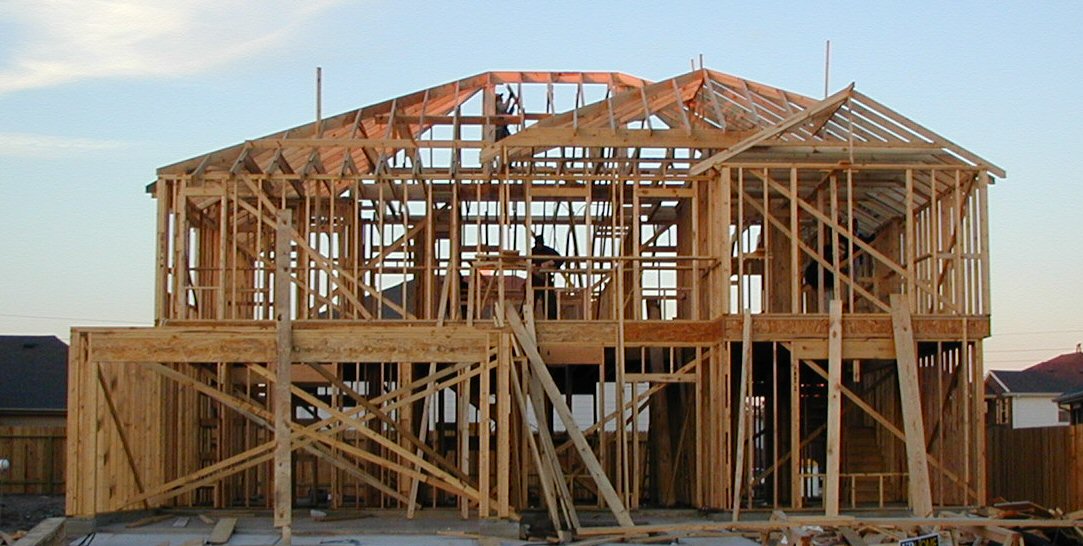
I think that what’s called for here is a different metaphor. So: if we think of a finished book as a building, then this is what your first draft is:
OLYMPUS DIGITAL CAMERA

That’s right. It’s not crap; it’s an unfinished building. You still have to put up walls and run plumbing and electrical and install window frames and put up the glass windows and doors and you have to paint the walls and finish the exterior and trim out the woodwork and lay carpet and all the other stuff that comes with building a building. But a building without a frame is a pile of stuff from Home Depot, and that’s not much use to anybody. Without the frame, there is no building; it’s the frame that defines the building.

Your first draft is pretty much the same. Without a first draft, you don’t have a story because you don’t have a sense of things. You don’t have a clear idea your arc or what it is that your characters are trying to accomplish or what problem they’re trying to solve. You don’t know what it is they need to learn, or how they need to change, or what things are going to happen to change them. Without the first draft to give you some idea of the story’s structure, you don’t know what kind of story it is.

So a first draft is not a pile of crap, and it does not suck. It’s an incomplete framework. You’d never try to live in a house that was just a frame on a lot, and you wouldn’t want to read a story that’s in its first-draft stage. But that’s not because the first draft sucks! It’s because the first draft is missing things, like drywall and paint and plumbing and electrical and windows and doors and trim work. There’s a reason that carpenters talk about “rough carpentry” and “finish carpentry”: the rough carpentry is the framing and basic layout, and the finish work is what makes the thing a house or a store or an office building or whatever. No carpenter ever says, “Your frame should be crap!” because that’s not how they look at these things.

That’s the way it should be for writers, in my opinion. Even the terminology is compatible: rough carpentry, rough draft. Finish carpentry, finishing work on the story. This seems to me a much more productive and healthy way to look at one’s writings-in-progress. When you finish a rough draft, you haven’t produced something that sucks; you’ve produced the frame of an eventual finished story.

Now, obviously this analogy isn’t perfect. Sometimes when we do the finish work on a rough draft for a 30-chapter novel, we might find ourselves condensing things to the point where we literally get rid of chapters 3, 5, 10, and 22. An architect supervising the construction of a 30-story building, however, isn’t going to wait until the frame is built and then decide, “OK, we’re actually going to ditch the third, fifth, tenth, and twenty-second floors.” But no analogy is perfect, and even an imperfect analogy using carpentry as its motif has got to be better than one that uses poo, right?

Share This Post

A Brief Trip Around Writing Blogistan

Here are some things that I’ve seen around the neighborhood of the Blogistan Writing Community:

  1. Briana Morgan released her first book, Blood and Water, a month or two back (I read several chapters of it in draft, and if the final version — which is on my To Read list — is as good, it’s a keeper), and now she is selling signed copies. (Note to self: Get off arse and start offering signed copies!)
  2. Ksenia Anske (whose site needs to be on your “Visit several times weekly” list now) has thoughts on how writers shoot themselves in the foot by not making their books discoverable.
  3. Shelly Muncaster has reasons for not doing NaNoWriMo. She makes an important point: NaNoWriMo might not be for you. If you’re genuinely vexed by it, there is zero shame in not participating! NaNoWriMo should be a source of fun and good work and camaraderie, not for beating oneself up.
  4. EJ Fisch discusses, amongst other things, how she has used her workspace in her day job as a way of marketing herself as a writer. This reminds me of something I read in a book years ago, which was assigned reading for a sales job I had. (I was terrible at it and eventually got fired, but that’s a tale for another time.) The guy writing the book discussed how he put his sales award certificates and photos of himself meeting various dignitaries on the wall behind his desk, so his prospects could see them as he talked with them. He was using his own walls as sales space. Always a good idea! I’m not sure how well I could do this sort of thing at my workplace — my own workspace is very tiny, with almost no wall space to speak of — but it’s worth thinking about.
  5. SK Waller (one of the first writing-peeps I ever met, over ten years ago, in the course of blogging!), had some observations on how trying NaNoWriMo impacted her own usual process. She’s not a plow-ahead-and-revise-later type of writer, so she had some trouble getting out of the block. (She did eventually win, though!)

That’s about all for now. Moving forward, I’ll try to do more of this sort of thing. Excelsior, Stardancers!


Share This Post

Stuff!!!

No updates in a few weeks! But it’s been a really busy month. Here are some notes on recent antics in my world:

  1. Remember, THE WISDOMFOLD PATH is out! I haven’t finished the Nook formatting yet, but I hope to have that done in the next few days. Got you copy yet? No? GET WITH IT, PEOPLE!!!
  2. I redesigned Byzantium’s Shores, my personal blog. The old template was looking increasingly clunky in my eyes, so I finally cleaned it up a bit. Also, now that NaNoWriMo is over and the book is launched and whatnot, I should be able to post more reliably there.
  3. We took a vacation in New York City! That pretty much killed my writing time for six days, but I figured that would happen, so I accounted for it. I did get some work done on the trip, enough so as to not completely lose momentum. I’ve been posting photos of the trip to Flickr, with blog posts over on Byzantium’s Shores annotating the journey. Follow along!
  4. Regarding NaNoWriMo: I am now 2-2 in my NaNo participation: two wins each of the first two years, and two losses the last couple of years. Ouch! I expected this year to be tough, but I was pretty much on target right up until the last day or two before we embarked for NYC, so I feel pretty good that I would have made 50000 words with no problem had that trip not happened. And NaNoWriMo, as much as I love you and look forward to you each year, I love travel with my family more! (And besides, the whole point isn’t to beat yourself up about making 50K anyway. The point is to show prospective writers how the whole “goal-setting” thing works.)
  5. What’s up now? Well, this month there’s Christmas and the new Star Wars movie (which I continue to believe should have been released next May, because Star Wars movies should always come out in May), and it’s time to start revising Forgotten Stars III, which I can already safely say is going to be a lot harder than reworking the first two books. The first draft isn’t exactly a mess, but I’ve had time to think a lot about certain aspects of that book since I finished the draft, and…well, there’s a ton of heavy lifting ahead, so much so that I’m a little worried about making next November’s hopeful release date.

That’s about all for right this second. More stuff to come, though! I actually have some posts already written and awaiting their loading here. Stay tuned, Stardancers!

Excelsior!


Share This Post

On Fanfic, and on Writing as Play

Pew! Pew! Pew!
So there was a thing the other day on Twitter in which a lot of writers were suddenly defending the idea of writing fan fiction. I didn’t understand why at first, but as far as I can tell, someone wrote an article somewhere – I think for a teen-oriented publication of some sort, whether print or web I don’t know – attacking the idea of writing fanfic. Now, I did not read the article in question, or even track it down, because…well, I’m not so interested in refuting specific points. I’d rather just generally say that no, writing fanfic is not a complete waste of time, except in one kind of scenario that I can think of. And that is simply this: if you are talented enough to write your own stories from scratch, and you have the desire to write your own stories from scratch, but you instead choose to write fanfic instead.

And you know what? Even then I don’t think it’s right to say that it’s a waste of time, because it’s your time.

Even so, not everyone approaches writing the same way. If you just enjoy spinning your own stories and you have no real aim for them other than to please yourself, then hey, why not indulge a bit of fanfic? There are less-productive hobbies to have, and I suspect that for a lot of folks who write fanfic, the act of doing so scratches the same kind of itch that, say, playing a role-playing game does for others. It indulges a human need for story and for interaction with a fictional universe in a way that is, for those who enjoy writing, sometimes deeply satisfying.

I wrote fanfic for years, too, and I have my own thoughts on the subject, because I think fan-fiction can be useful as a learning tool for writing original stories later on.

One of my favorite podcasts is Functional Nerds, a podcast featuring writer Patrick Hester and musician John Anealio. The podcast generally features interviews with writers or other kinds of content creators in the SF, fantasy, and horror worlds, and I strongly recommend it. A favorite installment of mine featured author Mary Robinette Kowal as the guest, and she spent a lot of that particular podcast talking about writing and how to teach it. The general thrust of the episode, as framed by an early question by Anealio, was in breaking writing down into specific parts or facets. Lots of times when writers are asked what the best way to learn to write is, they’ll appeal to a Zen-like approach and say that you just have to sit down and do it. And that’s true, to an extent…but as a musician, Anealio looks at art in terms of more basic things. All music students, no matter what instrument they play, start off by learning scales, because scales are the basic building blocks of Western music, and every musician continues practicing scales for the rest of their lives.

So he asked Kowal this question: “What are the ‘scales’ of writing, and how do you practice them?”

Kowal indicated that she rejects the “holistic” approach to learning to write, and describes a number of ways one can break down the task of writing in order to focus on one particular area: description, characterization, and so on. I think that fanfic can serve the same kind of purpose, especially for people who want to write stories in a fantasy or science-fiction universe.

With fanfic, the basic world-building work is already done. If you write a Star Trek story, you know what your ground-rules are. You know that there’s a United Federation of Planets, and a Klingon Empire, and a Romulan Empire, and there are Ferengi about and that starships can go as fast as “Warp 10” and that Vulcans are a civilization organized around principles of logic and that Dr. McCoy’s first name is Leonard and that Jim Kirk was born in Iowa and so on. There’s a lot of heavy lifting that you simply do not need to do.

Or suppose you want to write your own Lord of the Rings stories, set in Middle Earth. Well, here you’ve got the maps and the races and even the languages already laid out. And ditto any other fictional universe or setting or other fanfic enterprise.

Writing fanfic was not a waste of time for me because I taught myself a lot of things about story construction, about pacing, and structure in those tales. Dialogue? Check. Making characters sound distinct, and making them “true” to themselves? Absolutely! I couldn’t very well have Mr. Spock having a temper-tantrum (at least, not without explaining it), or have Indiana Jones show up in a 1980s-era space tale, or James Bond suddenly be a wise-cracking, sarcastic buffoon. Anyone who takes their fanfic seriously wants it to feel authentic, right? And that takes work and consideration of the universe and what’s known about the people in it.

Now, I wasn’t thinking along those lines when I was writing them. My pseudo-Star Wars tales weren’t “exercises”, in my mind; I was just having fun writing. But you can’t write without learning about writing, and it turns out that ideas that start out as fanfic ideas can often have the serial numbers filed off and repurposed. After all, that’s a big part of what I did for Stardancer.

No, I do not consider fanfic a waste of time. Do I still write it? Not really, although I can’t rule it out – I did, after all, write a pretty darn good (if I do say so myself) “Very Special Christmas Episode” of Firefly a few years back, which I re-post on my personal blog every year. Yes, I might have achieved more, earlier, had I focused on original work before stepping beyond fanfic, but then, I might not. I did learn a good deal, though, and ultimately, all that fanfic I wrote cultivated in me a deep sense that writing is, even when it’s hardest and even when I’m working at it as hard as I work at anything else, play. Writing as play, in the best sense of the word. Fanfic is where I developed my sense that writing should give me the same feeling that I had on those Saturday afternoons when, as a kid, I and some other friends would pretend that the refrigerator boxes in their garage were spaceships.

Yes, you learn technical skills from fanfic, and I think it’s worth indulging on that basis alone. But you also connect with story and you play with it. And dammit, writing should be play! It took me a long time to realize this, but I finally did. Writing is where I scratch the itch that was once served by those afore-mentioned refrigerator boxes. Writing is where I find the kind of mental place where once I played with action figures and toy spaceships. Remember how annoying it was when you and some friends would be really into a play session of some make-believe or another, and Mom would come along and interrupt and snap you out of the illusion you’d created in your mind? Well, that’s the exact same feeling as having the phone ring during a really good writing session.

So, go ahead and write your fan fiction. If that’s the only writing you ever do, but you have a blast doing it…then you win. And if you do eventually start writing your own work, bringing to it the same sense of fun and play that you had when you were really engaging your earlier fan fiction…then you win!

Share This Post