
2024 in Books (January through June)

As with the 2024 in Movies post, I’m starting this on December 31, 2023 and will fill it in as I go throughout the year. [And as with the Movies post, I’m changing my mind and posting this halfway through the year! I’m so unpredictable! You never know what I’m gonna do! Ahem….] These are in the order I read them.

::  Three Rocks: The Story of Ernie Bushmiller, the Man Who Created “Nancy”, Bill Griffith. This graphic novel biography of Ernie Bushmiller is a wonderful volume, serving as both a warm testament to a creator of one of the 20th century’s enduring comics characters, but also as something of a history of the newspaper comics industry itself in the 20th century. Griffith’s art is superb and he demonstrates real affinity and even love for Nancy, a comic strip that is easy to dismiss but whose cleverness and sophistication are there to be found by anyone attuned to it. I loved this book.

::  Stargazing: Contemplate the Cosmos to Find Inner Peace, Swapna Krishna. Lovely small book for beginning stargazers, but it takes the tack of stargazing as a path to meditative peace and tranquility in one’s life. I didn’t find much new here, but I liked its approach and the book itself is a lovely little volume.

::  The SUGAR AND SPIKE Archives, vol. 1., Sheldon Mayer. This is one of the high-quality archival books DC Comics has done over the years for its various properties. I had never heard of Sugar and Spike until I was at a recent Nickel City Con, perusing a comics dealer’s table, and I commented how I love the DC Archives editions. He said that they tend to sell very well for him, but then he noted that nobody seemed interested yet in Sugar and Spike. I had no idea, but I picked it up, looked through it, and said, “What the hell!” Then it sat on my shelf for a couple of years. Oops. Now I’ve finally read it, and it’s an utter delight. Sugar and Spike are toddlers who live next door to each other and become best friends on their various adventures (most of which end up with them sitting time-out in the corner). The idea of the comic is that they speak baby-talk to each other, but it’s a real language that only babies and toddlers can understand; the comic also has a healthy respect for the internal logic of a toddler’s world. In terms of respecting the logic of the main characters’ age group, I rank Sugar and Spike with Calvin and Hobbes and Cul de Sac.

::  Late in the Day: Poems 2010-2014, Ursula K. Le Guin. This slim volume of poetry is quite wonderful, as one would expect from Le Guin. Le Guin writes with a kind of meditative glow in these poems, and as with all the best poetry, you get the sense of flowing from one word to the next even as you know that each word is carefully selected for best effect. I will be retuning to this one.

::  The Great Gatsby, F. Scott Fitzgerald. I read this classic way back in high school (though I don’t remember why, as it was not required!) and I remember enjoying it, but I didn’t really remember much about it, so I finally re-read it at the very end of 2023. I do still love it for its depiction of a group of relatively unsavory characters and the way their lives intersect in New York and Long Island during the Jazz Age, with its loosening social mores. There’s a pervasive sense throughout the book that no one really should be living like this, and yet they are, and they are forming obsessions and loves and hatreds even in the midst of all the partying and drinking that’s going on. Maybe the characters in Gatsby don’t come off well because they’re mostly trying to keep up with the world around them…and when the tragic denouement finally arrives, it’s not entirely expected but it’s also not the least bit surprising.

::  The Venetian’s Wife, Nick Bantock. I confess that I am a huge Bantock fan; I love his art and the way he manages to seamlessly blend his art and his writing into something vibrant and engaging. That said, I do think that sometimes he loses focus and his stories don’t always have satisfying endings. This book, epistolary in nature like the Griffin and Sabine series, is captivating until Bantock starts to near his climax, which arrives with surprisingly little build. The ending is disappointing, but I did enjoy the journey greatly.

::  Lost Spells, by Robert McFarlane (words) and Jackie Morris (art). Utterly captivating collection of poems about specific denizens of our forests (fox, birch tree, and so on), with equally captivating art. The book took on a meditative feel as I read it, almost like a liturgy. It’s not for nothing that Macfarlane calls his poems “spells”. The book is a follow-up to an earlier volume I now need to seek out. I bought this on sight at a bookstore in Ithaca a couple of years ago, and something about it really does put me in mind of that wonderful city and region.

::  The Librarian of Auschwitz: The Graphic Novel, by Antonio Iturbe (original novel), Salva Rubio (adaptation), Loreto Aroca (art). An occasionally harrowing tale of a young Jewish girl and her family who are sent to Auschwitz. They manage to defy the odds there by being assigned to a special camp that is maintained just to keep the Red Cross from becoming aware of the real work of the camp, and the book tells their story and the story of the people of this camp who try to resist in small ways. I was unaware that this is an adaptation when I checked it out of the library, but the existing graphic novel, while expertly made and drawn, does feel too short to me. Maybe the story needed a bit more breathing room…but it was still worth reading.

::  The Innocent Wayfaring, Marchette Chute. This was apparently my mother’s favorite book when she was a kid, and some years ago she gifted The Daughter with a copy she had tracked down. It had been on my TBR for quite a while, and I finally got to it…after Mom died. Seriously, people, try to read your loved ones’ favorite books while they’re still here. As for the book itself, I greatly enjoyed this tale of a young English girl in medieval times who wants no part of a life of embroidery and staid marriage to some lord, and who therefore does the only reasonable thing and runs away with her pet monkey. A dated prose style, as one should expect from a book written in the 1940s, but Chute wrote with wit and style.

::  Promise of Blood (The Powder Mage Trilogy, Book 1), Brian McClellan. This is the entry novel in a trilogy of fantasy novels in the “flintlock fantasy” subgenre. I haven’t read much flintlock fantasy at all, but I greatly enjoy it when I encounter it in the wild. (I wonder if Pirates of the Caribbean would qualify as “flintlock fantasy”?) The book opens in the days immediately following a revolution in the kingdom of Adro, where the military has risen up and deposed the king. As the story progresses, we follow a few of the leaders of that revolution as they grapple with the difficulties of establishing a new state while the neighboring realms see a fallen kingdom ripe for the picking. If you like magic systems, this one’s pretty good; the book doesn’t bog down in explaining all the magic, and it’s fun to read an epic fantasy novel with pistols and rifles along with the wizardry and strange creatures. Fun book.

::  White Fang by Jack London. I honestly don’t know what I’ve read so very little Jack London in my life: The Call of the Wild, and a couple of short stories. That’s it. This book is rather like The Call of the Wild in reverse, following a dog-wolf pup from birth in the wild to domesticated home life, and the journey is not the least bit peaceful or gentle. London does not shrink from depicting the harshness of this world or its brutality, particularly when the humans show up. Nevertheless, it’s a powerful read. I’m thinking I’ll be reading The Sea Wolf sooner than later.

::  Spock, Messiah!. I actually did a Booktube about this one. It’s a weird book that isn’t weird enough. (As I prepare to post this, I’m not sure I ever got the video posted…erm…hmmm. Stand by.)

::  Rocannon’s World by Ursula K. Le Guin. Another slim sci-fi novel, of roughly the same vintage as Spock, Messiah!, this one is by a great author, though. And it shows. This is a “technological human stranded on a non-tech world” story, and it’s a grand one, with adventure and hardship throughout. Apparently this is set in a larger universe within Le Guin’s work, but I’ve read few of Le Guin’s novels, so I’m not sure how it all ties together.

::  The Lost Art of Reading Nature Signs: Use Outdoor Clues to Find Your Way, Predict the Weather, Find Water, Track Animals, and Other Forgotten Skills, by Tristan Gooley. I bought this at Odyssey Bookstore in Ithaca, the first year they opened, and after starting it that year, I finally went back and got through it this year. This is a wonderful book! I read it very slowly, basically just a few pages a day; Gooley packs a lot into this book, and at times it almost feels like one of those lengthy discourses Sherlock Holmes always gives when he explains how a bunch of details nobody would notice add up to identifying the killer or whatever. Gooley shows how various details in nature will help you find your way through it, and it’s all deeply fascinating; you can’t help looking for some of what he talks about when you’re out in the woods or strolling through a meadow. I have since bought two more books by Gooley.

::  Casino Royale is, naturally, the very first James Bond book. I read this as part of a long-term effort to get through all of Ian Fleming, and then to maybe read some of the non-Fleming Bond books that followed. CR is an able introduction, even if it is surprisingly low-key and economic if you’re used to Bond as a larger-than-life figure who has huge adventures. If you saw the 2006 film, much of this book’s story is in there, though the film makes poker the card game instead of baccarat, which is honestly not nearly as well-known a game these days (unless you’ve watched lots of James Bond movies), but the film invents a lot to surround the story of the novel. It’s fun seeing Bond’s starting point here.

::  Live and Let Die is the second Fleming Bond novel (the movies did not follow the book order in any way. I read this way back in high school but never since, so I barely remembered any of it. I was surprised to see how much of this book actually does turn up in the Roger Moore film. LALD is a mixed bag: you can feel Fleming’s skills as a writer starting to take over as he is figuring out what kind of character Bond is, and Bond himself comes off as a more sharply-drawn character here. But the sexism is still on display, and the racism is off the charts, particularly when Fleming decides to write some kind of phonetic approximation of how Black people speak, so you get a lot stuff like “Sho is, Boss!” The main attraction at this point is the kinetic energy of Fleming’s writing; he really moves things along, for the most part.

::  Kind of a Big Deal by Saul Austerlitz is about the movie Anchorman. Part making-of, part cultural-impact analysis, this book really hinges on your appreciation for the movie. I adore Anchorman, so I loved this book. If you hate Anchorman, I don’t imagine you’ll like this too much. Austerlitz does go a bit over the top in places in his praise for the film, but I’m generally fine with that. I tend to think we’ve all gone a bit too far in muting our enthusiasms, anyway.

::  After re-reading Caleb Carr’s The Alienist and Angel of Darkness in 2023, I was looking forward to reading Surrender, New York this year. Those first two books are epic mystery tales set in late-19th century New York City, and they are wonderful period novels featuring a memorable “Great Detective” in Dr. Laszlo Kreisler, an expert in the new field of “psychiatry”. Surrender, New York takes place in the same universe, but a hundred years later, so the feel is as if a Scotland Yard novel set in the present day posits that Sherlock Holmes existed and his adventures have some historical influence. Sadly, this novel doesn’t reach the same heights as the previous two. The characters aren’t as engaging, and the mystery plods on and on without the historical interest of the earlier novels to help engage the passages where the story isn’t really developing. I had a hard time with this one. (I may re-read it in a few years, because this was a time when I had the vague sense that maybe I wasn’t quite seeing the book’s forest because the trees were in the way.)

A few days after I wrote the above, Caleb Carr died of cancer. I always hoped he’d return to Dr. Kreisler and fin-du-siecle New York. Alas, it wasn’t to be.

::  You know the genre where a novel (or a movie, or whatever) takes us into a big luxury hotel and follows the stories of some of the guests and the staff and how they interact and how some people have deep secrets and how all this stirs together to get the pot boiling? Now imagine that the luxury hotel is actually a big starship that travels from one star system to the next, and you have Floating Hotel by Grace Curtis. I found this book uneven: parts of it are really engaging and wonderful, while others–and it depends on which staff member or guest we’re focusing on–had me skimming just to get the gist of things. The larger plot starts to emerge about halfway through, but even after that point the book is uneven.

::  In Beyond the Mapped Stars by Rosalyn Eves, a young woman in late-1800s Utah has a passion for astronomy and the stars, but it’s not really a time when young women are encouraged to do much beyond stay home and do all the domestic stuff while the men work. The novel follows this young woman’s adventures as she strives to get from Utah to Colorado where she will be able to see that year’s total solar eclipse. It’s a quick and breezy read, for the most part, but my enjoyment was tempered by the fact that the young woman isn’t just that, but she’s also a Mormon. Nothing against that, per se, but…oh, how to put this…I’ve known a number of Mormons in my life, and one thing I’ve noticed about almost all of them is a certain desire–in fact, they almost feel it a duty of theirs–to stick up for their religion, in a way that goes well beyond the duty for missionary work that their faith requires. A lot of Beyond the Mapped Stars feels less like a novel than an individual Mormon’s ongoing monologue of “We’re perfectly normal! Really!” And quite a bit of this is confirmed in the writer’s Author’s Note at the end.

::  Peter H. Gleick’s The Three Ages of Water: Prehistoric Past, Imperiled Present, and a Hope for the Future is a fascinating and important book about the single most important resource our planet has for our continued existence. Gleick traces the history of human management of water, from our earliest settlements near water to our increasing efforts over the millennia to bring the water to us. He discusses the various mistakes we’ve made in our use of water and the ways these mistakes have led us to serious issues that will increasingly confront us, moving forward. Gleick firmly comes down as believing that water should be seen as a right, and not just another resource to be profited upon, and he prescribes a number of policy suggestions to ensure that all people have access to sufficient water in the future as our climate continues to change.

::  I must admit that if I wasn’t a big fan of BBC TV’s The Repair Shop, I almost certainly would never have read The Sun Over the Mountains: A Story of Hope, Healing, and Restoration by Suzie Fletcher. Fletcher is the leather repair expert on The Repair Shop; more than that, she is a master saddler and an equestrian expert, and any time anything leather comes into the shop, she’s involved. I knew that Fletcher had lived many years in the United States before she returned to Britain, and I knew that she had had a husband who had died of cancer before her return. Here she tells that entire story, and it’s a much darker story than I ever knew. Fletcher’s husband was handsome, a very hard worker, and…an abusive manipulator. Fletcher tells her own story unflinchingly, never shying away from the question “Why didn’t you leave?!”, to which the answer is almost always, “It just isn’t that easy.” Very little of this book has to do with The Repair Shop, but that’s fine. I’m glad Fletcher wrote this, even if she probably did so as a form of self-therapy than for any other reason.

::  Jeoffry: The Poet’s Cat by Oliver Soden is a fictionalized biography of the cat immortalized by poet Christopher Smart in the poem “For I Will Consider My Cat Jeoffry”. Obviously nothing is known about the cat other than what Smart wrote, but Soden employs a lot of historical and literary research to recreate what that cat’s life might have been like. It’s fascinating and sometimes even moving, but the life of a cat in 1700s London would not have been a particularly happy one.

::  I re-read Brian Hayes’s Infrastructure: A Field Guide to the Industrial Landscape after I spotted it in the library while looking for something else. This book is a bit out of date now, but it’s still a grand tour of the infrastructure that makes our civilization work: how power plants are built and why they’re put where they are, the concerns facing water and waste distribution networks, how our communications and power systems work, and so on.

::  Ben Riggs’s Slaying the Dragon: A Secret History of Dungeons and Dragons is a really good book about…the history of Dungeons and Dragons. Yes, that’s easy to note. However, it’s more about the history of the company TSR and the way it was run constantly by people who had no business running a company at all, so much so that it’s amazing D&D survived its managers to become one of the cornerstones of role-playing gaming, which is one of the biggest new entertainment developments of the last 50-60 years. This book is less about D&D as a phenomenon on its own than I might have liked, but it’s still a very entertaining and engaging read that any geek worth their salt should enjoy. I especially like how Riggs spends all of about a page and a half discussing what colossal nonsense the panic about D&D and its “connection to Satanism” in the 80s was, and he stops to mock the absurd TV-movie Mazes and Monsters.

That’s all the reading for the first half of 2024. It’s been an interesting year for books thus far!

Share This Post

New video!!!

I guess the title says it all, huh? I bought some books, and here I unpack them. Because unpacking books is a blast! Everybody should unpack books!

Share This Post

On the Romance of Old Maps

Roger wrote a lovely post the other day about old maps:

When I was growing up, my grandfather, McKinley Green, gave me the maps included in his subscription to National Geographic magazine.

I still have many of those old maps he provided from about 1958 to 1971 when I went to college. For a time, I thought to throw them out. But there’s a fascinating thing about these documents. They become historical relics.

Remember Czechoslovakia and Yugoslavia, which are now multiple countries? East and West Germany, now one nation? British Guyana and British Honduras, now Guyana and Belize, respectively?

I, too, love old maps, because they go from being a depiction of the world to being a depiction of the way humans used to view the world, and that in itself is informative. It shows how far we’ve come, for instance, to look at a map of a heavily-colonized Africa from a century ago to a map of an Africa where, for good or ill at any one point of time, the nations there are self-determining.

Old maps aren’t just about history; they can even be political items in themselves. Witness this sub-story from an episode of The West Wing, which has all the scenes from this little subplot edited together:

Setting aside the notion of why President Bartlet would want to hang a map of the Holy Land in 1709 in a West Wing office in the first place, the question raised here–would the map’s presence there imply anything regarding official American Israel policy–is a good one.

One of my favorite reference books is a tome I boosted from one of the Discard piles way back in 1989 or so, when I had my first part-time job working in the Technical Services department of the library at St. Bonaventure University. It’s simply titled, Historical Atlas, and that’s exactly what it is.

The book was pretty beat-up around the edges when I liberated it. I assume that the book was being discarded because it had been replaced with a volume that was more up-to-date. I’ve determined that there was at least a ninth edition of Shepherd’s book. Obviously his work was updated by other individuals, as Shepherd himself died in 1934.

The book is loaded with fascinating historical maps: Europe in the age of exploration, for instance, or near-view maps of a typical medieval cloister, or maps of the trade routes to Asia in the Renaissance, and more. The maps within this book aren’t just informative, they are beautiful to behold.

What’s interesting, in the “meta” sense, is that these maps have become historical items in several ways. These maps always depicted the world as it was at some point, so they don’t age in quite the same way that a new NatGeo map does; historical maps serve as a retroactive freezing of one moment in time, after all. But they also capture how history was done, decades ago; these maps demonstrate what was prioritized for historians and how they looked at the world back in those days. These maps capture history in a double way: not just depicting history, but the history of history.

Here are several of the maps from Historical Atlas:

Finally, a nod to the greatest old map I have ever seen, because you don’t just see it, you walk through it: the Mapparium at the Christian Science headquarters in Boston, MA. Now, setting aside the rather odd set of beliefs that lie at the heart of Christian Science, the Mapparium itself is a stunning exhibit. It is literally a walk-through globe, three stories high, with the maps painted on individually backlit panes of stained glass. You take this all in from a glass walkway that crosses the globe along an equatorial diameter. The effect is deeply affecting (and not just because the acoustics inside the Mapparium make all whispers audible anywhere you stand); there’s something about standing inside a truly proportional representation of our world that’s incredibly moving. The Mapparium is, however, another example of a depiction of a world gone by; the maps have not been updated since the thing was built in the 1930s, so you still see places like French Indochina and the still-uncolonized Africa.

Of course, the best old maps are the ones that lead to treasure, but that’s a-whole-nother thing!

Share This Post

Whoa….

I’ll have more to say later at some point, but I’ve just read one of the earliest Star Trek novels, a 1974 book called Spock, Messiah!. And it is both super weird and not weird enough.

I need to think about this one.

That is all

Share This Post

From the Books, for International Women’s Day

This is a repost from a couple of years ago. I chose to repost this, about a book by astronomer Sara Seager, because it has lodged in my brain since I read it.

I generally try to avoid reading grief memoirs, for various reasons that mainly boil down to…well, I’ve had enough grief in my life already and I know that more is on the way someday*, and it’s a subject I don’t much enjoy plumbing any more than I have to. But sometimes I find a grief memoir that piques my interest and I read it anyway. Smallest Lights is such a book, and I am very glad that I read it. It’s so much more than a grief memoir, really. It’s about science and love and life and death and love again and parenthood and dealing with autism.

The Smallest Lights in the Universe, Sara Seager

It’s also beautifully written.

Not every planet has a star. Some aren’t part of a solar system. They are alone. We call them rogue planets.

Because rogue planets aren’t the subjects of stars, they aren’t anchored in space. They don’t orbit. Rogue planets wander, drifting in the current of an endless ocean. They have neither the light nor the heat that stars provide. We know of one rogue planet, PSO J318.5-22–right now, it’s up there, it’s out there–lurching across the galaxy like a rudderless ship, wrapped in perpetual darkness. Its surface is swept by constant storms. It likely rains on PSO J318.5-22, but it wouldn’t rain water there. Its black skies would more likely unleash bands of molten iron.

It can be hard to picture, a planet where it rains liquid metal in the dark, but rogue planets aren’t science fiction. We haven’t imagined them or dreamed them. Astrophysicists like me have found them. They are real places on our celestial maps. There might be thousands of billions of more conventional exoplanets–planets that orbit stars other than the sun–in the Milky Way alone, circling our galaxy’s hundreds of billions of stars. But amid that nearly infinite, perfect order, in the emptiness between countless pushes and pulls, there are also the lost ones: rogue planets. PSO J318.5-22 is as real as Earth.

There were days when I woke up and couldn’t see much difference between there and here.

Sara Seager is an astrophysicist at MIT whose main body of work involves exoplanets, their discovery around other stars, and analyzing them for signs of life. Among other things, if you wonder how on Earth (literally!) we can look for life on planets lightyears away that nobody in our lifetime (or, likely, in our great-grandchildrens’ lifetimes) will ever see directly, this book will give you some hints as to how that search is currently going. (It involves ingenious analysis of light coming from those planets. It really is amazing, when you think about it, the degree to which light energy is the main carrier of information in this universe of ours.)

In her book, Seager discusses her own work and the degree to which her work has shaped her personal life, and how her personal life has shaped her work in return. Her first husband was a man of considerable energy, whom she met on a canoeing trip; their courtship progressed on more canoeing trips all over the place. But he developed cancer, which eventually killed him at a terribly and unfairly young age. Thus this brilliant astrophysicist, whose work is an important part of the current growth of human knowledge of our universe, finds herself a single parent attending meetings of the local widow’s club, figuring out the nature of this new world she’s been thrust into. It’s the cruelest of ironies, I suppose, that this woman whose life’s work is understanding the universe and seeking other worlds suddenly finds herself in a new world, one that’s familiar to people who have known deep grief, where everything is the same and yet everything is deeply different.

Throughout Seager’s book, I found myself frequently hit in the heart by some of her observations:

:: Everybody dies instantly. It’s the dying that happens either quickly or over a long period of time. Mike spent a long time dying: eighteen months separated his diagnosis and his death.

:: There have been lessons I have chosen not to teach. Not all knowledge is power; not all things are worth knowing. Max and Alex [her sons] never saw Mike’s body. They did not see him leave the house.

:: [On the Widow’s club] All of our children had become friends. They didn’t gather because their fathers had died; they gathered because it was fun. There is a reason every children’s book is written from the perspective of the child. Children don’t care about adult concerns. We think of children as helpless when they are the embodiment of resilience, more impervious to outside forces than we could ever be again. Despite their suffering, our kids still knew pure joy.

:: Sometimes you need darkness to see. Sometimes you need light.

:: I don’t think it’s an accident that there’s a mirror at the heart of every telescope. If we want to find another Earth, that means we want to find another us. We think we’re worth knowing. We want to be a light in somebody else’s sky. And so long as we keep looking for each other, we will never be alone.

I love that last one (which actually closes the book, so apologies for the ‘spoiler’). Seager casts loneliness not in terms of presence but in terms of action: we’re only truly lonely when we accept that we are alone and stop seeking others to enrich our lives. True loneliness, really being alone, comes of a permanent turning inward, of looking down and not up. And really, how else would someone who loves the stars see things?

The Smallest Lights in the Universe is a wonderful book that stands in stark contrast, it seems to me, to the view of science as cold and mechanical and mathematical, an enterprise that somehow forgets about emotion and wonder. No less a genius than Walt Whitman expressed this view, in “When I Heard the Learn’d Astronomer”. But the numbers and the proofs surely don’t have to get in the way of the wonder; rather they inform it and give it focus. Science is not an impediment to love and life. Science is a part of those things. Sara Seager’s book shows us how.

Share This Post

A Small Haul

This year I have imposed a new rule: I will buy no books until our annual trip to Ithaca in the fall. I really really need to read up on my own library! I will make a couple of exceptions for special events, like Nickel City Con in June, where I’ll most likely want to buy some graphic novels. But other than that, I’m not buying books until October.

Unless, of course, something really unusual happens, like, say…the folks at Taschen offering a sale in which a bunch of their titles are 85% off.

Taschen makes gorgeous books. They are the creme de la creme of the “coffee table book”, just stunning volumes on many topics (mostly the arts) that are amazing objects in themselves, as well as just being high-quality all the way around. And the prices align with that quality: it’s not unusual for a Taschen book to cost hundreds of dollars (here’s a case in point). So when I got the email that Taschen was having a huge sale, I had to look. I consoled myself with the knowledge that they probably wouldn’t be marking down any titles that I actually wanted, but at least I could look, right?

Ahem.

Something like $150 later, the box containing these arrived. And that box was heavy. That James Bond book? That one alone probably weighs at least twenty pounds. The Audrey Hepburn book is also a weighty tome. I had to get the Star Wars book, obviously, especially since I already own the companion volume that chronicles the Original Trilogy. And what budding photographer doesn’t need a nice history of photography? Especially one that is produced under the auspices of the George Eastman House, a museum in Rochester that is devoted to photography (and a place I did not even know about)?

Another thing I’ve noticed about my book-selection tendencies nowadays is that I’m leaning more heavily toward books that are beautiful in themselves as well as selecting for content. More on that later sometime, though….

Share This Post

From the Books: On Jeff Smith, problematic people, food, and memory (a repost)

This is a repost that first appeared three years ago, on the old blog. I’m reposting it now, because of the season and because I’ve been thinking today, prompted by discussions elsewhere, about problematic people and what to do with their work. I also have the subject of food and memory on my mind, particularly this year, as this will be the first Christmas of my life without my mother’s “cheesy potatoes”, which are basically potatoes au gratin. Yes, I’ve looked around at some recipes, and yes, I’ve found some that sound good that will probably be pretty close. But will they be close enough? Of course not. Mom’s not making them.

As I write this, it’s 4:45pm and the light is fading. The long darkness is settling, and even for someone like me for whom “belief” is deeply difficult, it’s hard not to think of that darkness being pierced by the most unlikely of births….

 Back when I was in college, I decided that I needed to start learning to cook. One of the cornerstones of that effort was to buy all the cookbooks by Jeff Smith, also known by his PBS brand name “The Frugal Gourmet”, and read them cover to cover while also cooking quite a few of the recipes. I learned a hell of a lot about cooking in that way (“Hot wok, cold oil, foods won’t stick!”), and while I think Smith’s notions about food and peacekeeping were a bit out there (one of his last cookbooks has a very odd passage in which he envisions Bill Clinton and Saddam Hussein cooking together), I very much agree with his insights about food and memory. There’s a reason why, when a beloved elder dies, a lot of times those left behind despair over being able to replicate their best dishes. “It’s good,” we say. “I’ve got it pretty close, but there was something she did that I can’t quite get my finger on.”

I still own most of Smith’s output to this day, and a few of his recipes are in my permanent rotation. I have never stopped reading them or even watching some of his shows which have shown up on YouTube, even though…

Sigh.

Smith, it turned out, was really not the kindly pastoral gentleman he portrayed on his shows. I don’t really want to get into that here, but suffice it to say that there were accusations of sexual improprieties in the late 90s that brought his career to a slamming, screeching halt. If you search around the Internet, you can find other testimonials about Smith that are, shall we say, less than flattering. He may have spent many years not even living with his wife (speculations as to why that may have been abound), and he seems to have been an unpleasant fixture in the Seattle food scene toward the end of his life. Again, I don’t want to get into that.

It all comes back as we have discussions in society today, quite repeatedly, about what we do when people we admire, especially the creative folks whose works have touched and shaped us, turn out to not only be very human, but very disappointingly human, at that. JK Rowling turns out to be transphobic to a deeply creepy degree. Isaac Asimov…well, rumors abounded about his conduct at science fiction conventions for years, and they don’t seem to have gone away despite his being dead for nearly thirty years. Marion Zimmer Bradley’s private life was appalling, and Orson Scott Card turns out to be deeply homophobic. Michael Jackson.

We all have to struggle with to what degree our artistic heroes were real people who committed acts ranging from missteps to simply awful deeds. I’ve known this for years, since I obsessively read about music history as a kid. My favorite composer, Hector Berlioz, was an addict and a manipulative stalker weirdo. Robert Schumann obsessively pursued a girl who today would be a minor and basically forced her to give up almost all of her own musical career outside of helping to perform and advance his works. (Clara Schumann was, by all accounts, an amazingly talented woman who might well have become a beloved composer in her own right, had husband Robert not dominated her so completely.) Richard Wagner? Well, as David Dubal writes in The Essential Canon of Classical Music, in reference to Wagner’s “Siegfried Idyll”, a gorgeous piece he wrote as a wedding gift for his wife, “That this man, capable of such emotion, was enraged at Bismarck for not burning Paris to the ground will always tantalize and disturb.”

So…back to Jeff Smith, among whose cookbooks is the one pictured above, a quite wonderful volume of Christmas recipes and ruminations about our modern Christmas. (Well, not quite our modern Christmas! This book is almost thirty years old.) Smith presents an entire Christmas menu, based on those present at the Nativity: dishes for Joseph, for Mary, for the Innkeeper (whom Smith believed has gotten kind of a bum rap over the years) and the tax collector. There are dishes for the Wise Men, for the angels, and even for the donkey (who gets “Straw and Hay”, which is now one of my best pasta dishes). The book has cookie recipes, recipes for mincemeat pie and two kinds of fruitcake–I want to like fruitcake but I can never get there!–and more. He finally presents several complete Christmas dinner menus…and the photographs throughout are wonderfully colorful, as well. There’s a reason I love this cookbook: it’s the kind of cookbook you can thumb through with pleasure, in addition to having good insights on food.

In the middle of the book comes this section, about Christmas traditions. This has been one of my favorite pieces of Christmas writing ever since I bought this book in the 90s, and if it is coming from someone who would later turn out to be quite a lot less than the sum of his parts, well…that’s frankly the case with most art, isn’t it? It’s up to us to decide how much these things bother us, and which things are our personal dealbreakers.


Our Family Christmas

From THE FRUGAL GOURMET CELEBRATES CHRISTMAS


Our family traditions came about in much the same way as did your family traditions…they just sort of happened.

Patty and I originally made a prime rib of beef for Christmas, and then the boys came along. Somehow Patty got into the roast goose routine, and we enjoyed that for years. As the boys grew, we began to celebrate one of the Christmas menus that follow, and then on Christmas Day I would prepare a full Norwegian smorgasbord with baked beans, potato salad, several different kinds of herring, luncheon meats, special breads, fish balls in cream sauce, cold salmon or lox, lefse, Christmas bread, and, of course, the leftover roast beef or goose from the night before. We still do that.

Last year I did a Swedish meal of pickled pork. The Paulina Market in Chicago makes a Swedish pickled fresh ham that is just terrific. So, now we all have a new favorite dinner. The boys side with the goose, Patty with the roast beef, and I go for the pickled ham. Now what do we do?

One year I suggested to Jason that we make some changes in our Christmas dinners. Try something new. He was quite young at the time, but his response meant that we had established some family traditions that he wanted to maintain. I was so touched by his insight that I wrote the following letter to him, a letter that was circulated by the Roman Catholic parish in Chicago. You will probably recognize your own family in this letter.

My dear Jason,

I probably came very close to violating the meaning of tradition when I suggested that we try something a bit different this year. You are happily bound up in memories of Christmases past, and I expect that I will hear you say, “Dad, can’t we have real dressing? I mean the old kind. After all, it is Christmas!”

You are right, son, it is Christmas. And on the day of the Mass, the feast of Christ, I should not go around breaking family traditions.

But I must consider anew the meaning of the Feast of the Christmas, and I think you and I should think about it together.

The term feast is very much involved with the meaning of memory. We feast because we remember certain events in our lives; sometimes wonderful events, sometimes painful events. That seems to be the way it has been with man- and womankind for a long time.

Christmas for me as a child was very different from our Christmas now. We would travel to greet my father’s family at his mother’s house, your great-grandmother, Nettie Smith. Oh how sad I feel that you did not know this tough old girl. She was a member of the state legislature and she was a left-winger from the start. But in the kitchen she was just terrible. She cooked turkey in the Old Testament style, burning the poor thing on the altar until smoke drifted up to heaven. Then, to the table it would come, though it was so dessicated, so dried out, so tasteless, that I could not understand why someone else in the family did not cook the bird instead. You know why they did not? Because it was job traditionally reserved for Gramma. To this day, when I eat dried-out turkey, I think of her…and how much I miss her.

Christmas morning in my family was wonderful. World War II was in the midst of every event, and candy and sugar were hard to find. One Yule morning my mother, your Grandma Smith, brought us to the table and presented us with marzipan candy shaped like eggs and bacon. My brother, Greg, sister, Judy, and I were amazed that Mom could find such things.

Some of our Christmas traditions are a bit strange, I will admit. But they are our traditions, our family. Each year we carefully unpack the papier-mache manger figures we made together when you and Channing were tiny children. And each year we spend precious time gluing the poor shepherd boy back together. Would it not be much more practical simply to go out and buy a new creche, a new king, a new Christ child? Ah, now, my boy, we are speaking of utter heresy, of violations against the meaning of our past…and I suppose therefore, our future.

A true feast actually has nothing to do with what you eat…but with what you remember. Many families in this nation have no traditions at all, few roots, and thus, few feasts. I am for feasting and celebrating in such a way that we will always remember we are a family. Sometimes I know that it is tough having me for a father, since I always want to add sherry to a gravy that you find perfectly in order already. Or I want to put mushrooms in a dressing, and you claim that they taste like dirt.

So, now, back to the kitchen. We have much to prepare before the star grows bright over the manger and you and I come to the creche, dazed by what we find, but carrying two gravies. One with mushrooms, and one without.

I love you,

Dad


Christmas is as much a time of memory as it is of anything else, and food is memory.


Share This Post

From the Books: ALL THE BEAUTY IN THE WORLD

(image credit)

I’m currently reading a book called All the Beauty in the World, by Patrick Bringley. The book is a memoir of Bringley’s tenure as a guard at the Metropolitan Museum of Art in New York City, a job he took in the wake of his older brother’s death from cancer.

Not visiting the Met is the one regret I have from our trip to NYC in 2015, and a high priority next time we go. Maybe regret is too strong a word, as we weren’t in NYC long enough to do everything we’d have wanted to do. We were only there for four days, after all–and four days in NYC isn’t even a “scratch the surface” length of time.

I checked this book out last time I was was at the library, one of those “This looks interesting” pickups that your library makes so wonderfully possible. So far–I’m about a third of the way through it–the book is quite good, but I just read a passage that I loved so much that I’m going to quote it here. This passage is literally the last thing I read in the book. Here Bringley is describing the fruits of all his people-watching while on the job.

There is no one way that visitors experience the museum, but there are a few typical ways. Like anything else, people watching is something one can get better at; and once I commit myself to mastering the art of it, so to speak, I learn to pick out exemplary characters among the thousands I see every day. There is the Sightseer–a father in his local high school’s windbreaker, camera around his neck, on the hunt for whatever’s mot famous. He has no special interest in art, but it doesn’t mean that he’s blind to what he sees. In fact, he loudly says, “I mean, the frames alone!” several times while admiring the workmanship in the old master wing. He listens carefully as his school-age children relate what they’re learning in Global History. But he surprised and disappointed to learn that the Met–which he conceives as a kind of Art Hall of Fame–doesn’t have nay Leonardo da Vincis. Nevertheless, he leaves the museum enthused.

There is the Dinosaur Hunter–a mother with small children who cranes her neck to peer around corners, panicked by each new piece of evidence that this museum only has art. It is a first visit to New York, a big deal for her and her family; they’re staying in Times Square. And she just sort of assumed that a famous museum would have a T. rex or an interactive laser display or something to entertain the kids. But she resolves to make the most of it, and a guard pulls her aside to recommend the mummies and the knights in shining armor. She gets a kick out of this guard, who says goofy stuff to her kids, and she walks away ready to report that New Yorkers are very nice.

There are three distinct types of Lovers. The first is the Art Lover–a quiet, intent-looking person who’s traveled from another city to see an exhibition that got a great write-up in The New Yorker. Her face doesn’t move much but her mind is furiously churning as she inches through the galleries like a tortoise among hares. Then there is the Lover of the Met itself, a local who’s known it as a secular church for as long as he can remember. In his youth, he paid a few dollars each visit; now he can spring for the basic, no-frills membership. Though his job has nothing to do with big ideas or beautiful things, he lives in this city because here they feel at his fingertips. Finally there are the Lovebirds, who flutter through the galleries, alighting in spaces where silences aren’t awkward and strong emotions feel natural.

There are several different kinds of visitors who can’t keep their mitts off statues, sarcophagi, antique chairs, and anything with drawers. For the most part, people are good about not touching paintings, but anything else, forget it. If you dusted the Met for prints, you’d have countless suspects. Some can’t help themselves: the cold, cold marble calls to them and before they know it, they’ve caressed. Others lock on to their targets with premeditation, a certain too purposeful quality in their gait allowing me to detect their motive and jump in between. Finally, there are visitors who simply don’t know the rules, who haven’t thought through the various questions about old and fragile art that all lead to one answer: “Don’t touch.” When I stop a middle school kid from climbing into the lap of an ancient Venus one day, he apologizes and looks around thoughtfully. “So all of this broken stuff,” he says, surveying a battlefield of headless and noseless and limbless ancient statuary, “did it all break in here?”

There are also singular individuals who catch my eye. An old man bends horizontally down on his walker, exhausted by the effort of looking, and his wife bends her head to whisper in his ear. For several long minutes she minutely describes the medieval reliquaries that, for want of energy, he will have to miss. Finished, she helps to right him, and they inch along their way.

A mother at the American Wing fountain hands her child two coins: “One wish for yourself,” she says, “and another, just as big, for someone else.” I have never heard this before and immediately know I will say it to my children one day.

Two elderly, white-haired ladies are dressed exactly alike. On closer inspection, they are identical twins. On even closer inspection, there is one difference between them: a string bow tie worn by one but not the other.

Sometimes I will be watching such a person for a minute or more when an uncanny thing happens. All of a sudden, the visitor will turn on their heel, walk in my direction, and ask me a question.

What’s the question? I don’t know. That’s where I stopped reading.

Share This Post

From the Books: “Make the Bread, Buy the Butter” (a repost)

From the archives:

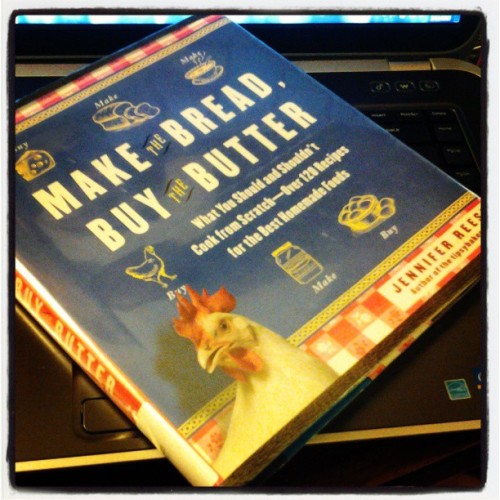
I don’t own this book yet. But I’ve had it checked out of the library a majority of the weeks it’s been in the collection, which means that it’s well past time for me to get off my ass and buy a copy, innit? Anyway, Jennifer Reese‘s Make the Bread, Buy the Butter (subtitled What You Should and Shouldn’t Cook From Scratch) is a terrific cookbook. Not just a collection of recipes, it’s a chronicle of one woman’s quest to take more of a do-it-yourself (DIY) approach to her family’s food preparation, and the discoveries she made along the way that there are some things that you certainly should make for yourself (either because it’s easier, or cheaper, or just plain better, or all three), and that there are other things that you’re just fine buying for yourself at the store.

I haven’t done a whole lot of cooking out of the book yet (one new wrinkle is The Wife’s adoption of a gluten-free diet, which has us going in other food directions currently), but there are a lot of good insights here on food and making it yourself and the fact that sometimes it’s just fine to not do things from scratch. The book is full of frank observations, like this:

If bay leaf didn’t exist, would anyone miss it? I’ve never tasted anything and thought, This stew is just crying out for bay leaf. But I keep buying and using it nonetheless.

And Reese’s explorations are hard-core. This isn’t just about making your own breads or spice mixes or your own peanut butter. She writes about keeping — and killing — her own chickens, and keeping goats. She writes about making her own hot dogs (her conclusion? Just buy ’em.). And she writes thusly about a dish that’s wonderful when made at home, but may or may not be worth all the effort: fried chicken.

One rainy Sunday a few years ago, Isabel, Owen, and I decided to pass the afternoon by watching a DVD of The Fellowship of the Ring, that movie about hobbits and elves and Orcs that we’d been hearing about. One hundred and seventy-eight minutes later, during which we neither moved nor spoke, we looked at each other, eyes glazed. We walked straight to the car, drove to the video store, and rented The Two Towers and The Return of the King. It was getting on dusk when I pulled into the Kentucky Fried Chicken down the hill and bought dinner.

My kids were shocked. Happy, but shocked. What was going on with Mom? KFC? I wondered that myself. But we were hungry and the chicken was hot and we had five more hours of Viggo Mortensen to watch. Fifteen minutes after I pulled into the KFC, we were back on the sofa with the bucket on the coffee table, eating mediocre chicken and mashed potatoes and biscuits and watching The Two Towers. It was one of the happiest nights of my adult life and my children still get dreamy and nostalgic talking about it.

Not long ago, I cooked a grand fried chicken dinner out of Ad Hoc At Home by Thomas Keller. I bought the book based on rave reviews of Keller’s chicken, which is brined and air-dried before it is dipped in multiple coatings and fried. The effort paid off; the recipe did not disappoint. TO go with that incredible chicken — because you can’t serve fried chicken without fixins — I mashed potatoes and baked biscuits. There was a salad in there somewhere, too. Frying chicken is messy and nerve-racking because oil spatters and spits and stings your forearms and you have to do it at the last minute, which is also when you’re mashing potatoes and pulling biscuits out of the oven and pouring glasses of water and calling to everyone that dinner is ready. Leave it in the pan too long, and the chicken is ruined; take it out too soon and it’s a health hazard. You really have to be up for the logistical challenge.

And fried chicken comes with baggage: You expect fried chicken to be so good that people lick their fingers. Literally. You expect people to linger at the table and loosen their belts, lean back in their chairs, tell stories, pull out a bottle of corn likker. You expect people to somehow recognize that this isn’t a meal like all other meals.

Sometimes all of that will happen.

Sometimes it will not.

By the time we sat down, I was bleak with exhaustion, everyone was ravenous, and we put away that chicken in about ten minutes flat. The coating formed a crispy sheath around meat that, thanks to brining, was juicy and flavorful through to the bone. The potatoes were a celestial cloud of starch and butter; the biscuits, perfection. But I don’t remember a thing anyone said; I don’t remember anyone lingering at the table or thanking me or recognizing that the meal was special or iconic or hanging around afterward to drink corn likker. One of these days I will forget the evening ever happened. I suspect Mark and the children already have. But that night we ate KFC on the sofa and watched The Two Towers? That, we will never forget.

Sometimes I have to remind myself that the symbols of wholesome domestic happiness — hot biscuits, a platter of home-fried free-range chicken, a family sitting around a table — are not domestic happiness. The family sitting in front of the TV with the bucket may be experiencing more joy and grace and love. Or, of course, they may not be.

Should you make your own fried chicken or buy KFC? Reese says there’s no easy answer to that, and I tend to agree. I’ve made my own fried chicken, and had a good time doing it. And you can probably tell by my self-photos that I’ve had my share of KFC.

I need to buy this book…and even after I do, I’ll probably keep checking it out periodically, just to keep its circulation numbers up.

Share This Post

“It isn’t fair, it isn’t right” (From the Books)

A literary anniversary went by last week, and I do want to mark its passing: on June 26, 1948, seventy-five years ago, The New Yorker published a new story by author Shirley Jackson. By this time Jackson was an established writer, albeit early on in her career, and her June, 1948 appearance in The New Yorker is the event that put her on the literary map, so to speak. And what an event that story’s publication was: that story became one of the most controversial ever published by that magazine, and to this day the story is a classic of the horror genre, which is even more notable as it does not contain one bit of supernatural behavior in it. No, this story is a simple one of the horror of human interactions and human adherence to tradition, and most disturbingly, the oh so human way of managing to put human life into a position of secondary, or even tertiary, importance.

The story is “The Lottery”. You can read it here. I recommend doing so; it’s a great work that has lost none of its ability to disturb in all its years. It’s not a long read, and I wouldn’t dream of spoiling it, if you haven’t read it.

Jackson would later write a lecture about her experiences with the reaction to “The Lottery”. I don’t know where or when she actually delivered this lecture, but it’s been anthologized in a book called Come Along With Me, which anthologizes several of her stories, a couple of lectures, and a novel draft on which she was working at the time of her untimely death in 1965.

Here is a portion of that lecture:

On the morning of June 28, 1948, I walked down to the post office in our little Vermont town to pick up the mail. I was quite casual about it, as I recall–I opened the box, took out a couple of bills and a letter or two, talked to the postmaster for a few minutes, and left, never supposing that it was the last time for months that I was to pick up the mail without an active feeling of panic. By the next week I had had to change my mailbox to the largest one in the post office, and casual conversation with the postmaster was out of the question, because he wasn’t speaking to me. June 28, 1948 was the day The New Yorker came out with a story of mine in it. It was not my first published story, nor my last, but I have been assured over and over that if it had been the only story I ever wrote or published, there would be people who would not forget my name.

I had written the story three weeks before, on a bright June morning when summer seemed to have come at last, with blue skies and warm sun and no heavenly signs to warn me that my morning’s work was anything but just another story. The idea had come to me while I was pushing my daughter up the hill in her stroller–it was, as I say, a warm morning, and the hill was steep, and beside my daughter the stroller held the day’s groceries–and perhaps the effort of that last fifty yards up the hill put an edge to the story; at any rate, I had the idea fairly clearly in my mind when I put my daughter in her playpen and the frozen vegetables in the refrigerator, and, writing the story, I found that it went quickly and easily, moving from beginning to end without pause. As a matter of fact, when I read it over later and decided that except for one or two minor corrections, it needed no changes, and the story I finally typed up and sent off to my agent the next day was almost word for word the original draft. This, as any writer of stories can tell you, is not a usual thing. All I know is that when I came to read the story over I felt strongly that I didn’t want to fuss with it. I didn’t think it was perfect, but I didn’t want to fuss with it. It was, I thought, a serious, straightforward story, and I was pleased and a little surpised at the ease with which it had been written; I was reasonably proud of it, and hoped that my agent would sell it to some magazine and I would have the gratification of seeing it in print.

My agent did not care for the story, but–as she said in her note at the time–her job was to sell it, not to like it. She sent it at once to The New Yorker, and about a week after the story had been written I received a telephone call from the fiction editor of The New Yorker; ti was quite clear that he did not really care for the story, either, but The New Yorker was going to buy it. He asked for one change–that the date mentioned in the story be changed to coincide with the date of the issue of the magazine in which the story would appear, and I said of course. He then asked, hesitantly, if I had any particular interpretation of my own for the story; Mr. Harold Ross, then the editor of The New Yorker, was not altogether sure that he understood the story, and wondered if I would care to enlarge upon its meaning. I said no. Mr. Ross, he said, thought that the story might be puzzling to some people, and in case anyone telephoned the magazine, as sometimes happened, or wrote in asking about the story, was there anything in particular I wanted them to say? No, I said, nothing in particular; it was just a story I wrote.

I had no more preparation than that. I went on picking up the mail every morning, pushing my daughter up and down the hill in her stroller, anticipating pleasurably the check from The New Yorker, and shopping for groceries. The weather stayed nice and it looked as though it was going to be a good summer. Then, on June 28, The New Yorker came out with my story.

What ensues is an encapsulation of Jackson’s reaction to the reactions to her story, which roughly fall into general groups: those who wonder if the events described in the story are based on reality, those who think the story is disturbing fiction, and…well, those pretty much are the two camps. Jackson’s story even inspired a number of “Cancel my subscription!” reactions. One particular such demand is phrased quite well:

Heretofore mine has been almost a stockholder’s pride in The New Yorker. I shared my copy with my friends as I do the other possessions which I most enjoy. When your latest issue arrived, my new distaste kept me from removing the brown paper wrapping, and into the wastebasket it went. Since I can’t conceive that I’ll develop interest in it again, save the results of your efforts that indignity every week and cancel my subscription immediately.

Ouch.

The New Yorker did a retrospective of reader reaction to “The Lottery” ten years ago, which you can find here; one interesting tidbit is that the magazine did not always label its fiction and nonfiction pieces, so perhaps the befuddlement of some readers who couldn’t determine on their own that “The Lottery” was just a story with no basis in the daily life of any small town in America is to be excused. I don’t know, I wasn’t there. But surely these events would have been common knowledge if they were real, yes? I mean, wouldn’t everyone know about that small town in such-and-such a state where every year they got everyone in the town together and held a lottery to choose one of its denizens for–wait. That would be spoiling it, if you haven’t read “The Lottery”.

Share This Post