Time for some Christmas comedy!
This one is not safe for work.
Probably neither is this one.


The official site of Kelly Sedinger: Reader, writer, photographer, and dreamer
Sorry to be so late with today’s selection, but it was a very busy day at work. Here is the Carol Symphony by Victor Hely-Hutchinson.
We’re heading into the time of this yearly feature when I start playing more and more of the favorites I use every year…and for this I do not apologize, because Christmas is partly about old favorites!
Here’s something interesting: a short (20 minutes) documentary I found about the kid-sized monorails that were used in some large department stores, usually in the toy sections, in the mid-to-late 20th century. These monorails–suspended from an overhead rail, as opposed to riding atop the rail–would take kids on a circular trip around an entire department store floor (or, in a couple cases, a part of a shopping mall).
I actually rode the one in Portland, OR’s Meier&Frank store downtown, probably sometime in Christmas 1979 or 1980, the last two Christmases we lived there. It was a fun ride, though short; as I recall, that floor of the store was divided into the toy section proper and then, on the other side of a partition, was something called “Santaland” or something like that, a walk-through Christmas display thing that culminated in Santa himself. The train would pass through an opening into the wonderfully-decorated Santaland area, which was kept dark and lit with Christmas lights and many trees and animatronic figures.
I am honestly not the least bit certain how much of this my brain is making up from the distance of 40-whatever years, but that thing was fun, and it’s a shame they’re all gone now.
Cool stuff! I want an adult version of that.
And because I don’t want this post to not be musical at all, here’s something that fits: the March of the Toys by Victor Herbert.

This was an early view out a small window as we flew in the early morning from Buffalo to Atlanta. Then we flew from Atlanta to Los Angeles. And then we flew from Los Angeles to Honolulu.
I don’t know if I’ll make that specific itinerary ever again, but I’m sure as hell someday making that my final destination again.
Just twelve days left to the big day, huh? Hard to believe! It still feels to me like Christmas is a month away…but it’s not.
Anyway, here’s an album: Carols from Clare, in which the Clare College Singers and Orchestra, conducted by the great John Rutter, perform a quite lovely program of traditional carols in interesting settings. You really can’t go wrong with choral performances with John Rutter at the helm.
After mentioning Ralph Vaughan Williams yesterday, let’s listen to a bit of Gustav Holst today. Holst was born a couple years after RVW, so the two were roughly contemporaneous, and the two of them form pillars in England’s great musical “rising” at the end of Romanticism and the beginning of Modernism. (Sir Edward Elgar predated them both.) Holst, unlike RVW, is known primarily for a single work, the juggernaut symphonic suite The Planets; but Holst, like RVW, wrote a great deal of fine music for orchestra, choir, and others. Holst’s two Suites for Military Band are a mainstay of wind ensemble literature…but for the average classical music listener, Holst pretty much begins and ends with The Planets.
That’s somewhat ironic, because Holst is also quoted as saying the following:
If nobody likes your work, you have to go on just for the sake of the work. And you’re in no danger of letting the public make you repeat yourself. Every artist ought to pray that he may not be “a success”. If he’s a failure he stands a good chance of concentrating upon the best work of which he’s capable.
It’s a pity that one work has overshadowed the rest of his output, because Holst’s music is far more rewarding than just the single work that everybody knows. Here are two examples of his settings: Christmas Day and In the Bleak Midwinter. Both feature wonderful choral writing, which you’d never know Holst could do if all you know by him is The Planets.
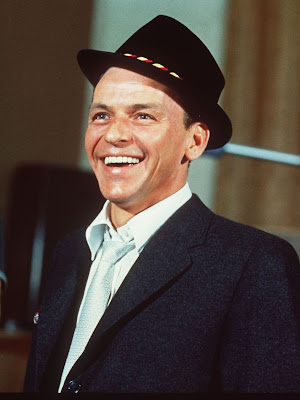

Sheila O’Malley has a typically lovely post about Frank Sinatra, whose birthday is today. I started composing a comment on her site, but then I realized that my thoughts were getting away from me, so I decided to bring it over here. Sinatra has been a part of my universe for as long as I can remember; my parents owned a bunch of his records, which were on constant rotation in my childhood. I remember his distinctive sound, sometimes clear and sometimes with just a hint of rasp (depending on what he wanted to express), his sense of rhythm (he could make a song swing without any assisting percussion at all), his lyricism, and his unfailing sense of how to land the emotional beats of a song. This last gift is rare indeed, and it’s interesting to me that I’m featuring two singers so highly gifted in that regard on the same day (scroll down to today’s Daily Dose of Christmas post). And of course he wasn’t just a singer; Sinatra was also a very fine actor with a lot of range. He was in a lot of movies and he won an Oscar along the way and he still might be underrated as such.
The earliest of his roles that I’ve seen is Anchors Aweigh, in which he plays a Navy sailor who is very young and naive, who has to be instructed by his older buddy Gene Kelly in the ways of the world (meaning, how to flirt without seeming weird about it…in the late-1940s meaning of ‘flirting’). Somehow he pulls this off without getting blown off the screen by Kelly; in fact, the two men have a partnership in that movie that elevates it. Anchors Aweigh isn’t quite one of the immortal musicals–it’s no Singin’ in the Rain–but it’s damned close.
Just eight years later Sinatra put his dramatic skills on display in a dark turn as Private Maggio in From Here to Eternity, a movie that hit me between the eyes when I watched it in high school. I was channel-flipping lazily, and I happened to land on the opening credits; next thing I knew it was two hours later and the movie was over and I hadn’t touched the remote the entire time. Sinatra plays the cocky, arrogant young hothead whose actions end up costing him everything. There are some weird stories–legends, actually–about how Sinatra got the role in the first place, but it doesn’t really matter how he got it. The man ended up winning a Best Supporting Actor Oscar for it, and there’s a reason for that. Last time I watched From Here to Eternity I found it every bit as gripping as I did when I accidentally watched it as a sixteen-year-old.
Sinatra would bounce in and out of musicals a lot, and his dramatic turns always seemed to be in the crime genre. There was a teevee movie in the 70s called Contract on Cherry Street that I remember, and there’s his amazing performance in The Manchurian Candidate. He even turned up in the 1980s in an episode of Magnum PI, a show that often leavened its generally light-hearted tone with detours into espionage thrillers and, in the case of Sinatra’s episode, pure noir.
Maybe it’s easy to discount Frank Sinatra a little because of the genres in which he worked or the popular forms he pursued, but for my money, you can’t tell the story of American art in the 20th century without talking about Frank Sinatra.
Sheila starts her post with this quote (possibly aprocryphal) by Bing Crosby: “Frank is a singer who comes along once in a lifetime, but why did he have to come along in mine?” I can’t read that quote without thinking of High Society, a movie that was also a favorite of both my parents. It’s a musical remake of The Philadelphia Story, with Crosby as C.K. Dexter Haven (the romantic lead who is pining for Grace Kelly), and Sinatra as Mike Connor, the gossip rag reporter sent to cover Kelly’s impending nuptials. (Those roles were originated by Cary Grant and James Stewart, with Katherine Hepburn in the later-Grace Kelly part.) High Society is a fun movie, though this story is really better told in the original, as parts of the script had to be set aside to make room for the musical numbers, and…well, I have to agree with my sister, who once said on a Christmas Eve when one of Crosby’s Christmas movies was on and we’d all taken in a few beers, “Whoever thought to cast Bing Crosby as a romantic lead was out of their mind.”
Well, I don’t know about that, but it’s always struck me as very strange that this movie has Bing Crosby and Frank Sinatra together, and it gives them exactly one number together…and that number had to be added at the last minute when the producers suddenly realized that they had Crosby and Sinatra in the same movie with no shared numbers. Astonishing! Can you imagine such a thing? Almost making an entire movie with two of the 20th century’s greatest American singers in it and only realizing near the end that you’ve given them zero duets? That’s like having Babe Ruth and Mickey Mantle on the same team, but benching one of them at all times. Luckily for High Society, that one number is a hell of a number:
Of course, I can’t write about Sinatra without discussing his singing a little bit. Many years ago I read an interview with one of my personal musical heroes, the great Chicago Symphony orchestra trumpet player Adolph Herseht, in which among many other things he recommended that young trumpet players (among others) listen to great vocalists like Frank Sinatra, on the basis that all music, even for instrumentalists, starts with the human voice, and I remember Herseth citing Sinatra for always telling a story with his singing. That is absolutely true.
I’ll close this with my favorite track from my favorite Sinatra album, Frank Sinatra Sings for Only the Lonely. Just listen to Sinatra’s absolute control in this song! He fades away at the end, fading fading fading (“Answer, echoes, dying dying dying,” Tennyson might write), but his pitch never wavers, which is something that requires enormous technical skill: singing (or playing, if you’re on an instrument) a note correctly, and making it sound full, while also making it piano or pianissimo is a skill that many musicians don’t realize they need until well into their careers. And I’ll have to write sometime about my father’s favorite Sinatra song…but that needs a post of its own.
Time for some sacred music. I feature the first work here, by Ralph Vaughan Williams most years: his Fantasia on Christmas Carols is a well-known work that is heard often in classical music settings this time of year. It’s quite a wonderful work, brining chorus and orchestra together in a lovely way that honors the season. This is music that makes you think of high marble church halls.
Vaughan Williams would later write a cantata called Hodie, centered also on Christmas texts involving the nativity of Jesus. Hodie has never been one of RVW’s most popular works. He wrote it very late in his life, and it was his last major orchestral-choral work.
Hodie (which translates as ‘this day’ and is pronounced ‘HO-dee-ay’) was a product of Vaughan Williams’s old age, but it flows with a vitality, force and inventiveness. Written in 1953-4 and first performed at the Three Choirs Festival in Worchester Cathedral in 1954, it is one of the most serene compositions Vaughan Williams ever wrote, sounding at times otherworldly.
The composer had always wanted to write a large-scale Christmas work, and here he fused the religious spirit of the festival with British overtones, with associations to English countryside carols. Vaughan Williams used no specific folk tunes in this work, but by this point in his career he had so synthesized their character that his folk tune-like themes sound fully authentic.
The texts, taken in this case from the Bible, Milton and Thomas Hardy among other sources, are skilfully selected to reflect both the Christmas theme and the different aspects of the composer’s personal style. The work is linked together by narration of the Nativity from the Gospels by choristers accompanied by organ – a compositional device used by Bach in his Passions, for which Vaughan Williams had a deep love. (via)
As I write this, I am hearing Hodie for the first time. It’s striking me as vibrant at times, serene at others–and quite redolent of the RVW I’ve been listening to for years.
I just saw this on Facebook:

And I thought, “What a great prompt!”
And then I thought, “That’s such a good prompt that I’ll bet I’ve used it before.” And, sure enough!
Well, I can use a prompt again, can’t I? Why, yes, I can!
Here’s what I wrote two years ago, regarding Johnny Cash’s voice:
There was always something special about Johnny Cash’s voice that I could never put my finger on. It really shouldn’t work, that gravelly baritone that doesn’t always home in on the exact pitch the way a singer should. Sliding into a pitch instead of hitting it dead on is a standard device of country singing (Reba McIntyre and Garth Brooks are canonical examples of this technique), but what Cash does is…more than that. Sometimes he sounds like he’s perfectly content to waver in the vicinity of the actual pitch without actually getting there. If you heard a young music student singing like that, you’d question their ability. When you hear Johnny Cash doing it, you know that you’re listening to a master who is doing exactly as he wishes with his voice.
I stand by that.
(I’m hoping that embeds the entire playlist comprising the entire album.)
One of the most insanely busy weeks of work for me each year ends today, huzzah! Unfortunately that means that for our purposes here, all I have time for is a quick YouTube search and a couple of the resulting pieces of music. I know that I’ve featured Norwegian Christmas music in the past, and I may have checked out some Swedish Christmas music too. So: You’re up, Finland!
Here are some selections from the search results under “Finnish Christmas music”. (It’s cool stuff, actually!)
https://www.youtube.com/watch?v=sG0sMzP6dbo
Hyvää joulua!!!
The official site of Kelly Sedinger: Reader, writer, photographer, and dreamer
