Untitled Post

On the day before the Hugos were awarded to various luminaries in SF-dom, I got my latest rejection slip in the mail from F&SF. This was not surprising, really. The story in question — “Stains” — is a psychological horror story with a very muted supernatural element, inspired by Poe’s “The Tell-tale Heart”. F&SF doesn’t seem to print many stories like it. So why did I send it there at all? Well, for a number of reasons. First, there is F&SF‘s track record for response times: my responses from them (all rejections, by the way) have always come within ten days of submission, allowing me to get the thing out to another market. Second, there is the matter of word-limits. I am almost incapable of writing a story in under nine thousand words, and most of mine gravitate to novellette length (twelve to fifteen thousand words, roughly). There just aren’t that many markets for short fiction willing to handle those kinds of lengths, so I pretty much submit to all the ones that do. I suppose I could figure out how to write actual short stories, thus giving myself more markets to submit to and (theoretically) increasing my chances for publication, but somehow that doesn’t seem right. I would rather write the stories that I have to write, in the manner that I have to write them, than try to shoehorn myself into some other category. (One proviso: I don’t think that I am overly wordy in my fiction. When I edit my stories for submission, I can get pretty draconian. I always remove at least ten percent of the original wordage, and in one case I actually excised twenty-five percent. That particular story came closest to being published, with an editor holding onto it for nearly six months while he tried to find a spot in his publication for it. Alas, ’twas not to be….)

So, what’s next for “Stains”? Tomorrow it’s off to Alfred Hitchcock’s Mystery Magazine.

Share This Post

Untitled Post

Congratulations to all the lucky folks who won one of these at ConJose (the World Science Fiction Convention, held at San Jose) on Sunday night. I’d love to win one of these someday, but I think I’d rather win the Bram Stoker since I write more horror than fantasy (and I write no science fiction currently). I’d also like to actually be published, which is probably a prerequisite of sorts. Sigh….

Share This Post

Untitled Post

The Buffalo Philharmonic Orchestra has released its first recording under the Naxos label. The CD is a disc of three orchestral works by American composer Frederick Converse (1871-1940), a composer of whom I had never heard until I learned of this recording, which is part of Naxos’s effort to explore the rich history of American classical music beyond the usual “big names”. It’s also thrilling to see my hometown orchestra finally appearing on recordings that are nationally available.

Share This Post

Untitled Post

This is the text of a post I made to the Usenet newsgroup rec.music.movies back in March, about Howard Shore’s Oscar-winning score to Lord of the Rings: Fellowship of the Ring. I’ve linked to the article on the Google Groups Archive, but I wanted to have a copy here on Byzantium’s Shores as well.

Now that Howard Shore has won his Oscar for Lord of the Rings: The Fellowship of the Ring, I should like to explore for a moment the score’s remarkable qualities.

It seems at first to be precisely the kind of score one would expect for a large-scale epic fantasy, and in many ways it is. It is full of gigantic orchestral passages, fanfarish heroics, darkly scored passages with lots of low brass for the villains, big choral passages, ethereal choral passages, and melodies both happy and melancholy. Shore’s work is deftly done in all those regards and more. While his orchestral and choral writing are indisputably splendid, with Shore directing his massive resources with consummate craftsmanship and aplomb, the score is hardly unique in that regard; instead his work here stands squarely in the tradition of Goldsmith, Williams, Herrmann, Rozsa, Korngold and all the other great composers of epic scores. What makes this score so remarkable, especially in this day of frequently substanceless bombast, is its construction: its symphonic and leitmotifistic cohesion in which many themes are interrelated and manipulated with a constant eye and ear for Story.

When the track-listing for the LOTR:FOTR CD was made public, the striking detail was that most of the track titles were actual chapter titles from the book. And then, in his Oscar acceptance speech, Shore specifically noted “the words of Tolkien”. These are not coincidences. The LOTR film project is tied to its literary forebear to a much greater degree than most other notable book-to-film translations, and this turns out to be the key to Shore’s work on the LOTR score. Shore uses his music not just to create mood but to reflect Tolkien’s themes and stories. In fact, while Shore’s score almost perfectly enhances Peter Jackson’s film, it is Tolkien’s story that dictates how Shore uses his themes.

Consider, first, what can probably be called the score’s “main theme”: the theme for the Fellowship of the Ring itself. In its boldest form, it is a fairly obvious heroic theme, and it is heard in full at the film’s most overtly heroic moments: when the Fellowship is first formed at Rivendell, and when Aragorn and Frodo leap the bottomless gap in the Mines of Moria. These are moments of undeniable triumph, and the use of the Fellowship theme there is entirely appropriate. What makes the theme interesting is in how it is formed. Shore gives us very brief snippets of it throughout the score up to the Fellowship’s official formation, musically depicting the slow coming-together of the Fellowship’s core. And then, after Gandalf’s fall in Moria, the Fellowship’s theme is never heard in full again. It is quoted as the Fellowship leaves Lothlorien by a single horn, so soft as to almost be offstage. We hear it again a few moments later, louder but no more complete. The musical symbolism is clear: the Fellowship itself is incomplete, and the lack of balance in the theme foreshadows the eventual final breaking of the Fellowship. We next hear it partially quoted as Aragorn, Legolas and Gimli pledge to go after Merry and Pippin. However, the theme immediately seques into the score’s other main theme, that of the Hobbits.

The Hobbit theme is first heard when we first lay eyes on the Shire, and the theme is similar in contour to the second phrase of the Fellowship theme. That interrelatedness of the Fellowship and the Hobbit themes allows Shore to effortlessly switch between the two, and this similarity – the way the middle section of the Fellowship theme echoes the Hobbit theme – musically depicts the fact that the Hobbits are central to the mission of the Fellowship itself. Shore is musically illustrating Tolkien’s conceit that a race long-ignored is about to step to the fore of the crucial moment in Middle-Earth’s history.

It is also important that the Hobbit theme is first heard when we actually see the Shire, but not when we first see a Hobbit in the film: in the Prologue we see Bilbo finding the Ring, but the Hobbit theme is not heard until we see Frodo in the Shire. Thus Shore tells us several things musically: that it is Frodo, not Bilbo, who is to form the central focus of the Fellowship, and that the Hobbits are bound up very closely with their homeland. Hobbits, Tolkien tells us, rarely leave the Shire; in fact, they rarely leave their own communities within the Shire. Thus it is that when we first hear the Hobbit theme it is played as a folk-tune on a fiddle over a playfully tapping drum-rhythm. The next notable use of the Hobbit theme comes at Rivendell. Shore does this to convey a sense of homecoming – Tolkien calls Rivendell “The Last Homely House” – but Shore scores the theme for solo clarinet, the purest sounding of instruments, and gives it some extra ornamentation, enough of a variation to make the theme sound somewhat different. The sense of homecoming is fleeting, and we know from the music that it is not to be permanent.

As noted above, the Fellowship theme at the end of the film yields to a lush string statement of the Hobbit theme. This is an obvious musical depiction of the separation of the Fellowship; but the strong relation between the two themes allows Shore to make the transition from the former to the latter without some kind of “bridge” section, highlighting the sense of separation to an even greater degree. Thus it is that at the film’s end the Hobbit theme plays, in its saddest incarnation, as Sam and Frodo head down into Mordor. But even then, Shore gives us something more: underneath it can be heard the same tapping drum rhythm from the theme’s first statement. Shore is here depicting that it is more than Hobbit against Sauron; it is the Shire against Mordor.

The interrelation of themes in Shore’s LOTR score is not limited to the Fellowship and the Hobbit themes. There is a militaristic theme for Saruman and his Uruk-Hai, and this theme opens with three notes (C-B-C), very similar to the notes that open the Fellowship theme (C-b-flat-C). Where the Fellowship theme uses the major-second interval and solid rhythms to create a sense of heroism, the Saruman theme uses the minor-second and an off-center syncopated rhythm to create a sense of malice. Why would these two themes be so related? Because the C-B-C motif, the germ from which both themes are grown, can be said to be the “Man” motif. It is no accident that the first full statement of the Fellowship theme is not heard until the arrival of Men at Rivendell. A scene with Gandalf and Elrond makes clear that the fate of Middle Earth is now in the hands of Men, for good or ill. Thus two themes for the key men in the story, one good and one evil. It is further worth noting that we do hear a variant of the Fellowship theme, in a minor key, when Gandalf rides to Isengard to confer with Saruman. Shore is musically foreshadowing the betrayal. He is telling us, through music, that Gandalf’s trust in this particular man is misplaced and will come to ill.

So Shore gives strong, thematically-based depictions of the story’s two most prominent races. His treatment of the other two is more muted, more impressionistic. This is also perfectly in keeping with the story. There is no theme per se for the Elves; instead there is a kind of tone-painting that is ethereal in nature, hinting musically that the Elves are outside the history of Middle Earth. Shore employs shimmering strings and soprano vocalists to suggest the almost alien nature of the Elves. Their music is entirely different from nearly everything else in the score. But Shore also recognizes that the film’s two Elvish locales, Rivendell and Lothlorien, are very different in character, and thus while he takes a similar approach to each they both still sound very different. Lothlorien has a darker, earthier sound with hints of Middle-Eastern flavor, and Shore even goes so far as to employ a different soprano vocalist for the Lothlorien music, one with a different sound than Enya. The difference in tone is carefully considered, as is the entire decision to not define the Elves with a single theme of their own. He is musically reinforcing Tolkien’s conceit that the Age of the Elves is ending. The Elves are, to a certain extent, “outside” of Tolkien’s history, and thus their music by Shore is “outside” of his symphonic conception.

Something similar can be said for the fourth race, the Dwarves. Of them we only see Gimli alive; the rest is hinted at through the shattered remnants of the Mines of Moria. Here Shore employs very low sounds – men’s chorus, low strings and brass, et cetera – and he takes a leaf from Wagner and uses anvil-like percussion. Like the Elves, there is no Dwarf-theme per se; this allows Shore to compose Dwarvish music that feels incomplete. This is most striking when the music swells as Gandalf illuminates the Great Hall of Moria, but even then we don’t get a full melody. The story tells of empty, cavernous spaces; thus Shore creates music that is empty and cavernous. And he does so brilliantly before moving onto frenetic action music for the escape from Moria.

Finally, there is the Ring theme itself. Shore does not use the Ring theme nearly as often as one might expect; we hear it several times in the Prologue, primarily as the Ring’s journeys from one “owner” to the next are detailed. Its most striking use occurs late in the film as the Fellowship rows past the Gates of Argonath. Aragorn points the great statues out to Frodo, and the symbolism of the exiled King of Gondor coming home is hard to miss; so why is the Ring motif used instead of, say, the Fellowship theme or perhaps some other permutation of the “Man” motif for Aragorn’s return? Because Shore knows his story, and he knows that Aragorn’s return home is not to be – at least, not yet. He knows that soon Aragorn will have to turn west and go to Rohan (in “The Two Towers”), while the Ring’s journey to its home will continue. Thus it is the Ring theme that we hear. Once again, Shore’s sense of Story guides and

illuminates his themes and how he uses them.

And to think of the at-least six hours of “Lord of the Rings” score that Shore still has ahead of him to compose. Music for the Ents, for the Riders of Rohan, for Minas Tirith, for the Stairs of Cirith Ungol, for Shelob and her lair, for the Cracks of Doom, for the Battle at Helm’s Deep, for the Gray Havens….bring it on, Mr. Shore.

Share This Post
Untitled Post

Author Neil Gaiman can be heard here on Minnesota Public Radio discussing his new book, Coraline, writing for comics, the difference between writing “journalism” and writing fiction, writing horror in the post-September 11 world, his future projects, the linguistic problems faced by a writer from Britain who now lives and works in the United States, and fly-fishing. (Well, not fly-fishing, but he does discuss all those other things. It’s a fine interview, twenty-four minutes long, by a writer who I am admiring more each time I read him.)

Share This Post

Untitled Post

Are you ready for some FOOTBALL???

In celebration of Major League Baseball’s avoidance yesterday of a work-stoppage that would have crippled the game, I will now offer my NFL predictions for the 2002 season, which kicks off one week from tomorrow. I love football, and it is in large part because of football that my favorite time of year is autumn and early winter. This is what I expect to happen this season. (BTW, I am no expert on the subject. I don’t participate in a Fantasy league; I don’t watch SportsCenter at all, since we don’t have cable; and I don’t subscribe to Sports Illustrated. Basically, I expect at least fifty percent of what I say here to end up being wrong. So, at the end of the season when the Arizona Cardinals are playing the Cincinnati Bengals in the Super Bowl, don’t write to laugh at me.)

In question-and-answer format:

:: Will the New England Patriots repeat?

No.

Not only do I not expect that Patriots to repeat as Super Bowl champions, I don’t even expect them to repeat as division champions. Yes, the 2001 Patriots were a great story, the scrappy bunch of no-names led by a no-name quarterback to the Super Bowl championship after a 1-3 start, in the process beating a heavily-favored offensive juggernaut in the big game. But before we strike the mold for Bill Belichick’s bust at Canton, let’s consider the astonishing amount of luck that the Patriots enjoyed on the way there. They were able to capitalize on down-the-stretch swoons by three division rivals (the Dolphins, Jets, and Colts); they got an amazing break thanks to an obscure rule in holding on to defeat the division doormat (my beloved Bills); they got another amazing break thanks to an obscure rule in holding on to defeat a team which had outplayed them in a snowy playoff game in their own park (the Raiders); they went to the AFC Championship Game against a team whose premiere running back was not ready to play and whose quarterback has been a model of inconsistency throughout his career (the Steelers, Jerome Bettis and Kordell Stewart); and in the Super Bowl they were lucky enough that their opponent’s head coach decided, for reasons passing understanding, not to respond to their defensive-back heavy scheme with a power running game that his team was more than capable of executing (the Rams and Mike Martz). The Patriots went on the most amazing lucky streak in NFL history last season, but any person who has ever set foot in a casino will tell you that sooner or later lucky streaks end. The Patriots are a decent team — I expect them to make the playoffs again — but they won’t be hoisting the Lombardi Trophy again.

:: Are the Rams still the “Greatest Show on Turf”?

Yes, I suppose they are — unless either Kurt Warner or Marshall Faulk is injured and misses a significant amount of playing time, in which case the door will be wide open for at least three other teams to march through and seize their NFC title from them.

:: So, if the Rams falter, who will be the best in the NFC?

There is a logjam in the NFC this year. On paper, the Rams are still the best, but as Chris Berman says: “That’s why they play the games.” The Eagles, Packers, 49ers, and Bears could all usurp the Rams’ spot.

:: Can Bill Cowher win the big one?

Lord, I hope so.

:: Could this year’s Super Bowl teams both hail from the same state?

Yes. There could very well be an all-California or an all-Pennsylvania Super Bowl this year. (In fact, I’m picking one of these two to happen. Keep reading.)

:: Is Steve Spurrier going to be the answer in Washington?

I don’t know; maybe he will, maybe he won’t. I don’t think he’s going to revolutionize things, and I don’t expect him to have the Redskins performing miracles this year. Keep in mind, Spurrier won’t really be able to use his recruiting skills to lure talent to his team, as he did at Florida; the NFL’s commitment to parity will make that quite hard, as will the mechanics of the draft. Plus, he won’t have five or six games against the Northeastern Florida Typewriter Repair College Butterflies each year to post scores of 93-3 and pad his record. I do think that Spurrier could turn things around in Washington, given three or four years to do it — that’s how long it took the last really big name from the college ranks, Jimmy Johnson, to turn his team around. This, however, assumes that Daniel Snyder is willing to give him that much time, which is something I would never bet on.

:: Will the Buffalo Bills be a better team this year?

Yes. This is the good news: it was a big offseason for the Bills. They landed Drew Bledsoe, finally acquiring a franchise quarterback which they have lacked since Jim Kelly retired. (Enough, Flutie fans! Doug Flutie is not a franchise quarterback, not now and not ever.) After years of ignoring the offensive line, they finally realized how bad things were up front and used their top draft-pick, the fourth overall, on Mike Williams. They also upgraded their receiving corps, their special teams, and their linebacking corps. The 2002 Bills could easily double their win total from 2001.

And that, sadly, is the bad news, because even if the Bills double their win total from 2001, they will still post double-digit losses. Their offensive line will be vastly improved, but still very young; their defensive line is also very young and very thin. Some observers think that the Bills may actually challenge for the playoffs, but I still think they are a year away. I’m expecting a 6-10 finish from the Bills this year.

:: So who will win the divisions and the wild-card berths this year?

My predictions are as follows:

AFC East: Miami

AFC North: Pittsburgh

AFC South: Tennessee

AFC West: Oakland

AFC wildcards: New England, Denver

NFC East: Philadelphia

NFC North: Green Bay

NFC South: Tampa Bay

NFC West: St. Louis

NFC wildcards: San Francisco, Chicago

:: Who will win the Super Bowl?

OK, here is my prediction, which is almost certainly wrong: the Pittsburgh Steelers will win Super Bowl XXXVII, defeating their fellow Pennsylvanians, the Philadelphia Eagles.

Share This Post

Untitled Post

OK, I think I’ve got the template looking the way I want it. The “tile” background fits the “Byzantium” inspiration for the site, and I’ve added a small rose as a divider between posts (which I think looks better than a hard return, anyway). The new images appear courtesy of the Absolute Web Graphics Archive, a free-graphics site that I was fortunate enough to discover last night.

Share This Post

Untitled Post

Earlier this week I saw the film Road To Perdition, and the next day I read the graphic novel on which the film is based. SPOILERS follow.

The film and the graphic novel are both fascinating works of gangland fiction, and they are actually much more different than one might expect. In fact, the storylines of each are only roughly similar — sharing a few scenes, but in general diverging greatly — and the themes of each are very different. Anyone coming to either the film or the book with expectations based on the other will be quite surprised. Pleasantly so, I think.

The film, as Roger Ebert notes in his review, is steeped in the feel of Greek tragedy. The subtext of the film is centered wholly on the dynamic between fathers and sons, with Paul Newman as the patriarch of the crime family and Tom Hanks as his most trusted enforcer, whom he loves as a son. The problems arise from Newman’s actual son, a weaselly and cowardly man who manipulates events to come out in his favor, setting the Hanks character — Michael Sullivan — up to be murdered. The plot fails, but Mr. Rooney (Paul Newman) has no choice but to stand by his real son and foresake the adoptive one, even though emotionally the adoptive one is a far truer son than the real one. Watching the film, I was reminded somewhat incongruously of the part of the Arthurian legend when King Arthur’s illegitimate son, Mordred, comes along and sets in motion the collapse of Camelot.

The dynamic between the father figure of Paul Newman and his two sons is likewise reflected in Tom Hanks and his two sons, one of whom he seems to love more than the other — until the one he seems to love more is murdered. There are scenes in the film that show Sullivan (Hanks) and his surviving son, Michael Jr., trying to connect with one another, including one particularly moving scene where the child actually asks if his father loved the brother more. Sullivan denies it, but he is forced to make an admission about his surviving son and his hopes for his future that is heartbreaking in its simplicity and seeming impossibility. He does not want Michael to grow up to be like him, but we get the feeling that it is already coming to pass. As Ebert notes, this sense of fate being played out is palpable throughout the film, whose theme seems to be that cycles exist in families that are immutable, unbreakable. As we watch the film’s events transpire, we hope that Michael Jr. will not be forced to become like Michael Sr. — that he will not have to kill — but we almost know that he will, and we wait for it to happen. Thus, it feels almost like divine intervention when, in the end, he does not. The film ends on an unexpectedly hopeful note, because the cycle has been broken and now Michael Jr. may grow up along a different path.

Much of this father-son subtext is absent in the graphic novel, however; the theme of the novel seems to be atonement. There is a great deal more religious imagery in the novel, with Michael Sr. finding a Catholic church and confessing his sins after each time that he kills. “God made Irishmen pale,” Michael Jr. says, narrating his tale, “but not as pale as those priests who came out after Papa had unburdened his soul to them.” The book is much more concerned with the possibility of men like Michael Sr., even while wreaking such terrible violence, still being absolved of their sins and going to Heaven than is the film, in which everyone seems totally accepting of the inevitability of Hell. Likewise, the concern of Michael Sr. that his son never have to kill is not much present in the novel, because about halfway through the novel Michael Jr. does kill. So the focus becomes not on breaking the familial cycle of fate, but on gaining atonement and absolution. The novel’s final denouement reveals Michael Jr.’s fate as an adult, whereas the film ends with Michael Jr. still as a child facing an uncertain future.

There are other, more mechanical differences between the film and the novel. The novel’s story is more of a historical, “true crime” type of story, drawn from actual events; thus the “Rooney” crime family from an un-named city in the film is actually based on the novel’s historically accurate Looney Gang, from the Tri-Cities (the Quad Cities, before Bettendorf was added). The action in the film is much more centralized on the enmity between Sullivan and Connor Rooney, whereas in the novel Sullivan is going after the entire Looney clan — including the father, who was actually the one who betrayed him. More historical events are used in the book, including Eliot Ness’s raid on a New Mexico hideout of Al Capone’s, and the burning of an illegal riverboat casino. And the biggest difference between the book and the graphic novel is that the film’s photographer hitman, played by Jude Law, does not exist in the book. Thus the book avoids what I found to be the film’s biggest flaw: the fact that, when everything else has been resolved, the film’s last fifteen minutes or so boil down to waiting for Jude Law to reappear. The book does not totally avoid the deus ex machina, but it doesn’t crank as noticeably as in the film.

Both the film and the graphic novel are impressive visually; the film’s atmosphere of cold dampness was so pervasive that I don’t recall ever being quite so glad to exit a theater into sunshine, and the novel’s illustrations — by Richard Piers Rayner — are superb black-and-white images that look like woodcuts, and have a not-insignificant similarity to the style of illustration used by Goseki Kojima in the brilliant Lone Wolf and Cub manga on which the entire story was partly based in the first place. (The novel’s epigram is a quote by Kazuo Koike, the writer of Lone Wolf and Cub.)

“The book is better than the movie” is often proferred as an immutable truth, but it’s not always so. In the case of Road To Perdition, both are interesting and complementary of each other.

Share This Post

Untitled Post

Baritone William Warfield died earlier this week. He was most noted for his portrayal of Joe in Showboat and Porgy in Porgy and Bess. I didn’t know much about him until I heard this obituary on NPR. Isn’t it amazing how many remarkable people pass through this world, and we never know a thing about them until they are gone?

Share This Post

Untitled Post

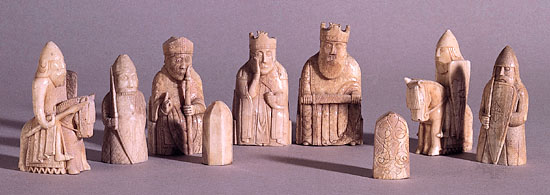
UPDATE to yesterday’s IMAGE:

The image that I selected of the Isle of Lewis chessmen appears to be a tad temperamental — it’s not always loading as it should. To see that image, try clicking this link. Otherwise, here are a few extra images of Lewis chessmen, including a very nice image of one of the Kings in the sets.


Share This Post

ForgottenStars.net

The official site of Kelly Sedinger: Reader, writer, photographer, and dreamer

Skip to content ↓