Happy Saturday, y’all! Here are some links from things I’ve seen this week.
:: First, a very somber one. By now we’ve all heard about the horrible gun-related mishap that took place on a film set, in which the film’s cinematographer, Halyna Hutchins, was actually killed. Sheila O’Malley posted about it, and she wisely centers Hutchins and her work, as opposed to centering the gun or, as some other outlets did, Alec Baldwin. This should not have happened, and a life was snuffed out because of it.
:: Shutting Down the Manufactured Critical Race Theory “Debate”. Good piece on the staggering levels of intellectual dishonesty in the American right’s recent adoption of Critical Race Theory as their bogeyman du jour. Aside from being an interesting piece in its own right, this little factoid, illustrating Alabama’s evolution on racial issues to the point where they are now entering the year 1911, floored me:
First, ALABAMA! This is the state whose rampant racism and entrenched Jim Crow segregation laws prompted Rev. Dr. Martin Luther King, Jr. to organize civil rights protests there and pen “Letter from Birmingham Jail;” a state whose Constitution included a ban on interracial marriage until a statewide vote in 2000; and a state whose governors, including Ivey, are still sworn in with the same Bible used to inaugurate Jefferson Davis as the president of the Confederacy.
Wow. Imagine using that Bible as if it’s some kind of beloved totem. That we allowed the creation of a mythology about the South’s honorable devotion to the Lost Cause will surely endure as one of America’s biggest historical errors.
:: Why America Fell Out of Love With the Pedestrian Mall. Many cities, in the 60s and 70s and 80s, invested heavily in closing sections of their downtown cores to automobile traffic in favor of the “pedestrian mall”, in hopes that a hybrid of the “mall” concept married with downtown infrastructure could somehow assist cities in combating their financial losses from the rise of suburbs and enclosed malls. Buffalo did this too, and in recent years has been slowly re-opening that section of downtown to cars, after the pedestrian mall did nothing to stop downtown’s devolution into a wind-swept swath of concrete, shuttered storefronts, and concourses devoid of people. Pedestrian malls can be successful, but they need some very specific conditions to thrive, which the author lays out. A good example of one that works is the Commons in Ithaca (a beloved locale of mine). It’s a perfect illustration of the author’s conditions for success: the Commons is not too large, comprising only a few blocks; there’s a dense population of youth in Ithaca, with two major universities there; and Ithaca by its nature is not conducive to urban sprawl (it’s a small city to begin with, and it is geographically hemmed in by steep hills, deep gorges, and a big lake to the north). Of course, the author is from Cornell, so obviously he knows Ithaca.
:: Walking America, part four: Buffalo. A fascinating photo essay (that started as a series of Instagram posts, well worth checking out) by someone who walked pretty much from one side of Buffalo’s city limits to the other. I’m glad that he picked up on both poles in Buffalo’s general civic mood these days: “We’ve been through the ringer”, and “We’re comin’ out OK.”
As anyone who has been through a tragedy, or an addiction, or been on the losing side of whatever knows, survival requires eventually moving on. You can only worry so much what others think about you. At some point you just have to laugh it off and remember to live as you want to live.
That is what Buffalo feels likes now. A city fully in recovery.
I saw this pic on someone’s Instagram story last week and it made me laugh, because when it comes to food, I think I may be part-Southerner, in a lot of ways.
I have no idea whose IG account this is from! If you recognize it, let me know and I’ll credit!
The first pot of chili of the season is a big deal for me! I love chili. I love making it. I love how easy it is to make. I love how versatile chili is in the way you serve it. You can do so much with the leftovers over and above eating re-heated bowls of chili for the next four days. So yes, as a Northerner*, I get it!
Now, I make no claim that my way of making chili is “authentic” or “definitive”. Chili is like pizza or sandwiches: subject to enormous variety in how it’s made, from ingredients to flavor profile to cooking techniques used. I don’t even make one kind of chili! I have a recipe that I recently found to my liking (after trying several over the last few years) for White Chicken Chili, and I also love Cincinnati Chili, which is its own thing entirely, being at its root more of a thick chili-like meat sauce with Middle Eastern flavors enhancing sweetness rather than spiciness.
By way of some food history, here’s an excerpt from what Jeff Smith**, the “Frugal Gourmet”, wrote about chili in his cookbook The Frugal Gourmet Cooks American:
Most Americans think that the wonderful rich, beefy, and beany dish that we call chili came from some other culture. Mexico, perhaps, or Spain. Not so. I am afraid that both Mexico and Spain refuse to have anything to do with what we call good old American chili. One Mexican cookbook even goes so far as to scornfully describe chili as “A detestable food with a false Mexican name sold in the United States from Texas to New York City.” Hey, watch that! The rest of the country loves chili, too!
The original dish is truly American, though I have found that a lot of Americans in different locales think that it was invented in their backyard. After much research (two days) I have come to the following unquestionable decision. Chili was invented in San Antonio, Texas, in 1840. It was a blend of dried beef, beef fat, chili powder and spices, and salt. It was pressed into a brick and it was so potent that it would not spoil quickly. It was then taken by the prospectors to the California gold fields. There it could be reconstituted with water and cooked with beans. It was very much like the pemmican that had been used in earlier times but with spices added….
San Antonio has the distinct privilege in history of laying claim to “Chili Queens”. These ladies had little carts and tables and would appear late in the evening and sell chili and whatnot…I expect more whatnot was sold than chili. They were forced to close down in 1943 due to city health regulations of some sort…mostly sort.
I would have thought that all of Texas would have been involved in wonderful chili. But in 1890, when chili arrived in McKinney, a town just north of Dallas, all blazes broke loose. It seems that some wayward ministers claimed that chili was “the soup of the devil–food as hot as hell’s brimstone.” I wonder if these clergy ever bothered to taste a good pot of chili.
Well, isn’t that to be expected. Show me something, anything, being enjoyed by someone, and I’ll show you some tight-assed cleric who thinks it’s evil or the Devil’s work or some bullshit.
Anyway, I fully expect that most of you have your own method for making chili. I don’t say “recipe”, because I honestly believe that one should have a basic chili method that is so ingrained that the idea of referring to a recipe is simply nonsensical. Here is mine. Now, while I note above that I do make other kinds of chili, this is what I make when I simply say that I’m going to make “a pot of chili”.
This is a dish for the crockpot. We own two; for this I use our smaller one. I have no idea what the size is in terms of quarts. Into the crockpot (spray it first with cooking spray!) go the following:
1 can crushed tomatoes (28oz)
1 can diced tomatoes (15oz)
1 can black beans (rinsed)
1 can dark red kidney beans (rinsed)
1 can “chili” beans in sauce (not rinsed; I like Bush’s)
Half (or so) of one bottle of commercial chili sauce (I buy my store brand)
Hot sauce. No idea the measurement. I pour a bunch in and taste it. This is how hot sauce should always be used in recipes. If a recipe specifies an amount of hot sauce, ignore it.
I try to buy the “No salt added” versions of those first four canned ingredients, but it’s not a deal-breaker.
Here’s what all this looks like, if you want to see a picture of a crockpot full of cans of stuff that’s red:
Chili stuff. In the crockpot.
Obviously you can use a can of whole tomatoes, if you like your tomatoes in bigger chunks, and obviously you can change up the beans. I like a blend of beans and I like a lot of beans in my chili.
Meanwhile, into the frying pan goes:
1 onion, diced
However much garlic seems reasonable, and then double that
1 lb ground meat
Several tablespoons chili powder
(Sometimes I add 1 bell pepper, diced, if I have it on hand. Today I do not.)
Well…hold on. That all doesn’t go in at once. Heat up the pan, then add a few tablespoons oil and then the aromatic veggies. (Add the oil to the hot pan. As long as we’re talking about the Frugal Gourmet, remember his rule: “Hot pan, cold oil, foods won’t stick.” This actually works.) I like to saute the onion, garlic, and optional bell pepper on a high heat for a minute, and then reduce the heat to medium to sweat the veggies for a few additional minutes before I add in the ground meat.
Now: what ground meat to use? Sure, you can use ground beef or pork or whatever, but I prefer hot (or spicy) pork breakfast sausage (Bob Evans is a fine brand, and I’m not just saying that because The Wife and I both worked for Bob Evans at points in our lives), because you get more flavor this way. Remember Alton Brown’s commandment for stews: Never miss an opportunity to add flavor! Get it in there and start breaking it up with your spatula, splitting the chunks up as you go. Oh, and a minute or so after the meat’s in there and has started browning? Dump in the chili powder. A lot of it. The color of the stuff in the pan should noticeably change.
I generally stop breaking up my meat chunks when they’re about the size of a marble, because I like the meat in my chili to be in large pieces. (I’ve even done chili with stew beef, which is quite tasty. If you do that, flour and brown the meat before anything else, then set aside and re-introduce to the pan after you’ve sweated the aromatics.)
Here’s what the action in the frying pan looks like:
The frying pan part of making chili. And really, why don’t chefs wear overalls? I always wonder this. They’re perfect attire for cooking: protective, lots of pockets for stuff, and you can even hang a towel from the hammer loop.
Then what? Well, it’s obvious: Put the frying pan stuff in the crockpot with the rest of the stuff.
Into the pot!Stir! Stir! Stir! (Actually, you don’t have to get super-aggressive about mixing the stuff up. Just a few gentle folding stirs should do it.)
Stir it up, lid it up, set the pot on low for, I dunno, six or seven hours. I like to crank it to high in the last hour, but that’s just me. The Wife makes fun of me for this (“How can I tell you if I like it? You served me a bowl of molten lava!”), but I’ve seen her send back way too many bowls of soup in restaurants for not being hot enough, and I am not making that mistake. Top it with cheese, or not. Sour cream, or not. Guacamole, or not. Chili is the pizza of stuff-that-comes-in-bowls, when it comes to versatility. (Stay in your lane, pizza! I don’t care if Steve Martin’s first movie The Jerk has a joke about the local “Pizza In A Cup” place.)
I’m writing this post, by the way, while we’re still two hours out from eating, so I don’t have a picture of a bowl of chili yet. Stay tuned. My stuff works great for chili dogs, though! And poured atop a bed of Fritos! And though I’ve never tried it, I always think it would taste good as an omelet filling.
And that’s how I make chili. Believe me, folks: a crockpot filling the house with wonderful aromas, be it chili or something else (the natives are already starting to clamor for Mississippi Roast!), is one of the finer pleasures that the autumnal time of year can give.
* By “Northerner”, do we mean anyone north of the Mason-Dixon line, or more along the lines of the Northeast? Because Buffalo is more a Great Lakes area. That’s a thought for another time, I suppose.
** Yes, I know. But I still own his books, I learned a whole damned lot about cooking from his books and his shows, and he’s been dead for years. I grant that he was a problematic sumbitch and will not litigate it here.
Almost exclusively the discussion hewed to one side of this argument: that it is, in fact, deeply silly to suggest that a reader is insulting an author by leaving a book unfinished, for whatever reason. One writer and book commenter and critic and reader after another came forth to insist that no, as a reader, you absolutely should stop reading books that for whatever reason aren’t clicking for you. You owe the author nothing, and there is utterly no insult to an author simply because one reader didn’t connect with a book.
In short, everyone piled on the writer of this tweet, and given the formulation of the position stated therein, that’s probably correct. I myself do not hesitate to leave books unfinished if I am not enjoying them.
However!
(There’s always a “however”, isn’t there?)
In this case, the writer behind the tweet above, Victoria Richards, is merely paraphrasing the headline above in the article she links in her tweet. Reading that piece, I found myself agreeing–at least a bit. The actual point the article’s author, Rupert Hawksley (a writer with whom I am unfamiliar), is a bit more nuanced.
A bit.
Yes, the headline reads “It’s an insult to authors to not finish each and every book you start,” but when we dig in we find something else:
Earlier this week, the novelist Mark Billingham caused a minor stir when he suggested that readers should throw a book “across the room angrily” if it hasn’t gripped them in the first 20 pages. Speaking at the Cheltenham Literature Festival, Billingham said that he gives up on about half of the books he starts because “life’s too short … There are so many great books out there.”
Plenty of others agree with him. Hilary Rose, writing in The Times, explained that she “bitterly regret[s] not heeding Billingham’s life lesson sooner”. Crime writer Linwood Barclay added: “Think of it this way. If the first three bites of your meal taste terrible, you don’t need to keep on eating, expecting it will get better.” Well, no, though I’d point out that if the starter was disappointing, you might still stick around for the main. Plenty of iffy prawn cocktails have been followed by an excellent steak.
Reading is, for the most part, a private pursuit; it’s unlikely many of us would seriously change our habits based on the advice of others. Whatever works for you, I suppose. Still, I have found the discussion this week dispiriting and, dare I say it, a bit childish. The idea that we read simply to be entertained – as an easy form of escapism – seems to underpin all the arguments for giving up on a book: “I couldn’t get into it”, “it didn’t grip me”, “too slow”. But entertainment, surely, isn’t the only reason why people read – or indeed why authors write.
Reading should challenge and confound us; it should take us into the minds and lives of those we don’t like or find hard to understand. This may not always be gripping but it is often rewarding. We owe it to writers to give them a full hearing before passing judgement – and finishing a book is the only way to do this. To give an author just 20 pages of your time is insulting.
That last bit is key: We owe it to writers to give them a full hearing before passing judgement–and finishing a book is the only way to do this. To give an author just 20 pages of your time is insulting.
Also of note is the way Hawksley starts: he is responding to someone who has said that a reader should fling a book angrily aside if they’re not enjoying it just twenty pages in. Now, there’s no link there to substantiate the quote, so it seems to me that Hawksley is framing a stronger-than-necessary response to an argument that is, the way he depicts it, also a bit strange.
All I can do here is offer my testimony as a reader myself. I stop reading books (what the kids today call “DNFing”, with DNF standing for “Did Not Finish”) probably around a quarter of the time. That is to say, I suspect that I DNF around a quarter of the books that I start. Why? Well, there are many reasons! There’s the “It didn’t grab me” thing, which is a thing, I have to admit. There might be other factors involved: I’ve had to DNF books that came due at the library before I could get all the way through. (This may, in fact, be the main reason I DNF stuff. Sometimes I’ll make a note that I was liking the book and check it out again; other times I won’t bother.) And sometimes there are other reasons for DNFing a book. I’ve had a few instances of starting a book just in time for the author to, well, show their ass on the Internet by saying something awful. I don’t like to do that, but I can’t really enjoy a book knowing that the author has just exposed themselves as a big jerk.
Here’s what I don’t do, though: I never pass judgment on a book that I did not finish. A cursory glance at my Goodreads account makes it look like I like all the books I read, but that’s not quite it: I won’t review a book I didn’t finish (I have a DNF shelf on Goodreads for my own record-keeping, and it has only seven titles on it), and I don’t finish what I’m not enjoying. This seems fair to me.
I also very rarely conclude that a book isn’t good. When I DNF a book for a reason involving the book itself, it’s because of that dreaded “it didn’t grab me”…but even so, I don’t read too much into that at all. I’m more likely to say “This wasn’t doing it for me right now, but maybe it will some other time.” And that is always possible. Many of my favorite books of all time are books that I couldn’t finish the first time I tried reading them. I see a DNF for this reason as not being a statement of any kind about the book, or me, or me and the book. It’s just “Meh, this isn’t what I feel like reading right now.”
That original author’s statement about flinging the book aside angrily if you’re not grabbed in 20 pages? Isn’t that a little weird? How can 20 pages possibly be enough to know if a book has “grabbed” you? And why be angry at a book that simply hasn’t engaged your emotions on this particular day? In fact, the books that make me angry might be the ones I’m more inclined to finish, for whatever bizarre reason. It doesn’t happen often, but I will note that I wish, from the vantage point of experience and time, that I had chucked The Fountainhead and Atlas Shrugged against the nearest wall. But even in those cases, I doubt I’d have done so a mere twenty pages in.
Ultimately I think readers and authors put way too much stock in a book’s need to “grab your attention”. The advice is constant: “You have to grab your reader! You have to command their attention from the first line! If they have the slightest reason to put your book aside, you’re done!” Sometimes you hear this stuff from editors and agents, but those are special cases: their jobs involve reading more stories or novels than any human can reasonably process in a week, so of course they’re going to reject books within a few pages, if that. But what of that? What does that mean? Again: merely that the book didn’t click with that person at that time.
So, in the end, I think the only real insult to an author comes when you judge a book harshly without having finished it. You should come to a book with the most open mind possible, but it is simply unreasonable to expect that in every single case a reader will be prepared to go where the author wants to take them. You never know until you try, I guess…but don’t worry about insulting the author. Especially if you bought their book, because then, well, they’ve already got your money.
That certain night, the night we met
There was magic abroad in the air
There were angels dining at the Ritz
And a nightingale sang in Berkeley Square….
I have nothing much to add by way of discussion; sometimes it’s good to just get out of the music’s way. Here’s Tori Amos.
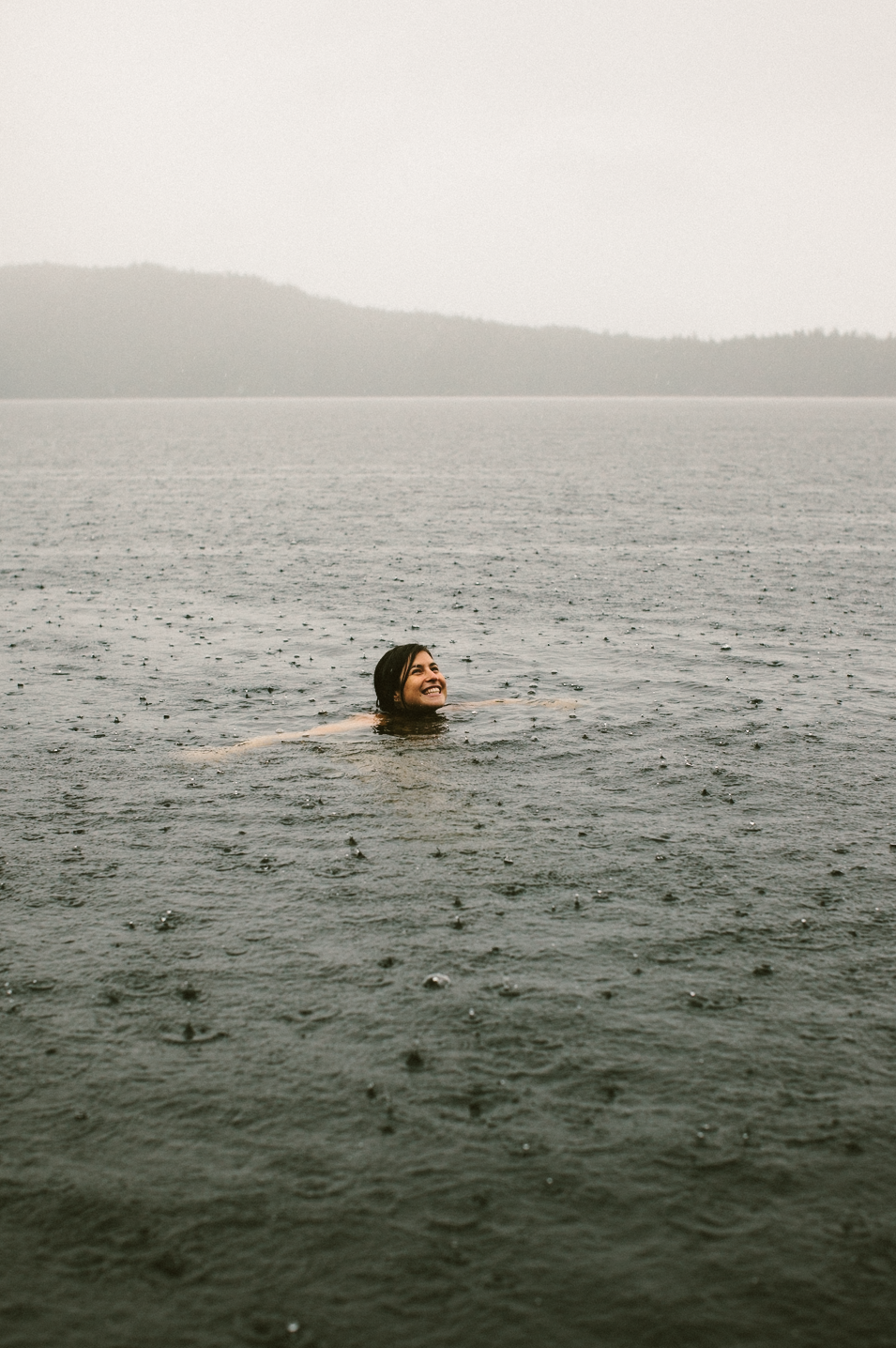
Swimming in the rain. Via benchandcompass.tumblr.com
Sometimes people cite the lack of browsing as a reason why it sucks that the independent bookstore has fallen on hard times in these, the Days of Amazon and other online retailers. And that’s true: one of the great joys for me, as a bookish person, is wandering through the shelves of this bookstore or that, seeing what random things I may find that I didn’t even know I wanted (while likely carrying around a stack of things I already knew I wanted). Well, indie bookstores seem to be rebounding of late, but there’s another place where you can get your Serendipitous Finds Whilst Lazily Browsing game on, and those places are libraries.
A couple weekends ago I had occasion to be in the Hamburg, NY public library. It’s a lovely place, recently renovated and a member branch of the Buffalo and Erie County Public Library, so my library card works there, too! I wasn’t planning to leave that day with six books under my arm, but that’s what happened. Among them was Why Se Swim by Bonnie Tsui.
Tsui is an Asian-American journalist who has written on issues of interest to that community, including a book called American Chinatown that was a bestseller and won an award for Asian-American journalism. (I have not read it, but on the strength of Why We Swim, I may.) Why We Swim is her second book, and it is quite simply exactly what its title suggests: a look at why human beings, evolutionarily descended from sea creatures but no longer of the sea, are so strongly compelled to the water. Swimming is one of the most common things we do as humans, despite the fact that this obsession with the water so often brings us to harm. We keep coming back. Why?
There are a number of basic reasons, Tsui argues, and she boils them down the sections of her book. We firstly swim for survival, and she opens here with an examination of an Icelandic fisherman who survived alone the capsizing of the fishing boat on which he worked. He swam three miles through icy seas after his mates either froze or drowned, and he lived to tell his tale and become a folk hero for the people of Iceland.
Next Tsui discusses how swimming heals us and how swimming regularly contributes to our overall fitness. She writes about the effects of regular swimming in cold water and how some competitive endurance swimmers turned to their activity after suffering illnesses or injuries.
We also swim for community, and Tsui describes impromptu swim clubs that formed after the fall of Baghdad in the Iraq war. She also discusses the sad history that racism played in the destruction and dismantling of public swimming pools in American cities, during the decades of white flight from urban centers for the suburbs. It’s another example of the fact that no matter how hard we try in America, we can never get far from our deplorable history of racism and the racist motivations behind some of our oldest public policy choices.
These are all practical reasons for swimming, but Tsui saves the most profound reasons for the latter portions of Why We Swim. Water is almost a psychological need for humans. She reports that hospital patients report better sensations of well-being when the decor of their rooms includes water imagery, and she notes that Henry David Thoreau included a great deal of swimming in his treks to Walden Pond and the woods where he went to live deliberately. The water calls to us and guides us, even if we are no longer a part of it; we recognize that some part of us comes from there.
In this passage, Tsui relates a bit of personal history in how swimming played a part in forging connections with her family-to-be. The book is full of beautiful passages like this.
Once upon a time, I fell in love with a family and a lake. In the ritual of swimming, the connection of one body to another, of one person to another, there is flow of a different sort to be found.
The first summer we were together, Matt took me to visit his grandparents at their cottage on the northern shores of Lake George, five hours north of New York City. Ted and Shirley met on a swimming raft on that lake, in 1939, and got married after the war. Their safe harbor was the tiny hamlet of Silver Bay and the grand old YMCA resort that had been there since 1899. Matt and I were young ourselves on that visit, just out of college, and would not be married for another eight years. But that liquid-mercury lake–framed by evergreens in the picture-postcard view from the screen-in back porch–would be a touchstone from the first.
Everyone in the family had a particular way of crossing the lake. Grandpa Ted had a special affection for tooling around in fishing boats. He owned three in his life: The Ultimate Folly I, II, and III, each larger and more elaborate than the last. No one could remember him having ever actually caught a fish.
Uncle Chris, all six feet five of him, folded himself into a kayak before paddling across. Matt’s mom, Robin, loved to float around in a rubber dinghy–she wasn’t a frequent lake crosser, but she was a spirited shore dabbler. Her husband, Jan, a marine surveyor, traversed the waters on a windsurfer and, later, on a stand-up paddleboard. Uncle George, a National Outdoor Leadership School instructor and all-around outdoorsman, like to sail; Matt’s little brother, Jesse, had just earned a license to pilot the thirteen-foot Boston Whaler.
One morning over breakfast and his daily crossword puzzle, Grandpa Ted casually mentioned that he and his friends used to swim the mile from Silver Bay across the lake to Diver’s Rock, for generations the spot where children have made a heart-stopping jump into the water. “That was the thing to do back then, like swimming the English Channel,” he said, his eyes sliding over to me before returning to the crossword, each completed square lettered in unwavering ink. “If you said you’d swum across the lake that day, that was something.”
My ears perked up. I smiled back at him. This was something I knew how to do, and he knew it. I loved the idea of joining the generations of lake crossers before me, in a way that was me. He was handing me a personal invitation.
That afternoon, we pushed off from Silver Bay, Matt swimming and me beside him, paddling Grandma Shirley’s old blue kayak, so he wouldn’t get run over by speedboats.
We made our way past the sailboats and motorboats bobbing in the harbor; past the raft at Bay Beach, where Ted and Shirley first set eyes on each other; past the tiny island of Scotch Bonnet, where Matt’s parents were married; past a man in a boat who yelled at us through a megaphone, “Swimming in the lake is hazardous to your health,” what with all the boats and Jet Skis racing about. Forty-five minutes later, we arrived at Diver’s Rock, the stone-faced cliff where each member of Matt’s family has made the jump. It was a veritable water tour of his family history at Lake George.
After we performed the solemn ceremony of jumping off the ledge, it was my turn to swim back across the lake. I tried not to think of the speedboats and trusted my man in the blue kayak to keep me safe. When I beached myself on the shores of Silver Bay, I felt initiated. I thought I finally understood something about what the place meant to Marr and to the company of lake crossers before us.
Eight years later, we continued our Lake George swim, the day after our wedding, with forty of our closest friends in the flotilla. Both sets of our maternal grandparents were there to witness it, and I suppose you could say that I swam from one family into another. We returned, year after year. Even after we moved across the country to San Francisco, we kept going back–sometimes in fall or winter, mostly in summer. There have been variations on the swim. One New Year’s Day, our bare feet stinging in the snow, Matt and I held the first and only meeting of the Silver Bay Polar Bear Swim Club (total members: two).
In the years since, Grandpa has gone. Jesse, too. When we go back now, it’s the fireflies and the stars that get me every time. Much of modern life is filtered out through the dense trees and mountains on the winding approach to the lake. Those winking lights, bobbing along the ground and filling up the night sky with their impossible density, send a signal. It’s a reminder to slow up and be awake to the real connections we have while we have them.
…
Pablo Neruda wrote Twenty Love Poems and a Song of Despair, published when he was just nineteen; he uses aquatic imagery to depict the intoxicating gorgeousness of being in love, the loss of control when we’re immersed in it. The ninth poem in the collection, “Drunk with Pines,” is my favorite, for its vivid conjuring of a pair of swimmers caught together in the outer waves; two passionate, parallel bodies, one yielding to the other, “like a fish infinitely fastened to my soul.”
What are these if not stories of love?
Why We Swim is a wonderful book that made me think, most of all, of the fact that I really do miss swimming. I could claim that there’s not much opportunity for swimming around these parts, but come on: I live in a city that’s near one of the Great Lakes. That notion doesn’t pass the smell test, does it? I don’t remember a time when I wasn’t aware of at least some way of how to swim, when I was uncomfortable in the water. I remember public pools like the one in Hillsboro, OR, where one summer I had diving lessons; I remember pools at the colleges where my father taught. I remember sandy-bottomed ocean beaches and rocky-bottomed lakes, lakes full of seaweed and other lakes where the water was warmer than the morning air, even in August. Lakes, two oceans, and rivers whose names I don’t remember. Small streams that don’t even have names. All of it, water.
I was good at swimming in grade school, sufficiently so that my school’s swim team coach would occasionally say to me, “Hey, goin’ out for swim team this year?” I always laughed and said no. I assume he was kidding around with me.
Thing is, that’s one decision I’d like back…because now, I’m not so sure he was joking. And what a thing that would have been….
Jean Sibelius wrote The Bard in 1913, when he was entering the late period of his compositional life. The work has little by the way of orchestral fireworks; while there is power, this is no showpiece. It is instead a work of surprising introspective depth in its short running time (about seven minutes, give or take, depending on the conductor). The mood is hushed and meditative, and somehow manages to stay hushed and meditative, even when it does crescendo toward the end.
The inspiration for this work isn’t easy to tease out. Some think it was perhaps a movement from another larger work that Sibelius decided to hold back; some have suggested a particular poem as an inspiration, which apparently the composer himself denied. There does not seem to be any direct literary inspiration to The Bard, nor does the work suggest a pastoral inspiration from the natural landscapes of Sibelius’s beloved Finland.
Perhaps Sibelius meant the work to be mainly abstract, only giving it a name out of habit…or perhaps he meant it to be more of a work of feeling than to have any particularly strong connection to some extramusical source of meaning. I don’t know, but I do know that The Bard is mystically effective in suggesting the kind of wisdom that one would expect from the itinerant poets of old. It may take a few listens to penetrate into the heart of this work: it’s not a piece that leaves a particular tune or melody lingering in the ear, like Finlandia, but its mood is what lingers. And that is almost precisely Sibelius’s point.
Yes, it appears that our most recent stretch of warm days is finally over, which means temperatures in the forecast that don’t break above 60 degrees, and even cooler nights. It’s been a long time coming, folks…I’m even hearing that in what I’m sure will be surprising to absolutely nobody, this may end up being the warmest October ever, at least in my neck of the woods. On the anniversary this past week of 2006’s “Surprise storm”, in which lake-effect snow pounded Buffalo, wrecking thousands of trees that hadn’t dropped all their leaves yet, we were in shorts because it was 75 out.
Since The Wife has been working remotely at home for over a year, at times she has had to allow Carla to hang out in her home office with her as she works. Carla does have a crate, as does Cane, but we don’t like to crate Carla for long periods of time. (Retired racing greyhounds are used to their crates and even like them.)
The Wife has a particular soft blanket that she likes to use as a wrap for those cold times in her office, but Carla has, in the grand tradition of our domesticated pets, decided that this blanket is hers, and she loves sleeping on it. So much so that the few attempts I made to have Carla hang out in my library while I read or write on weekends met with failure.
After thinking on this a bit, I wondered: maybe I needed a soft blanket of my own! Maybe that would be what I needed to convince Carla to become my Faithful Library Companion dog! Maybe, just maybe!
The Family thought this was jealousy on my part, but I deny this. I will only note that…today I am writing this post from my library, whilst Carla sleeps on her–no, my new soft yellow blanket. No jealousy or manipulation here! Just a sleeping doggo on a rainy Saturday as I write.
Paddy Moloney, the great front-man for the Celtic band The Chieftains, has died. He was 83.
In my musical life, Paddy Moloney ranks very high. Very high. When I list musical figures who shaped my world and the way it sounds in my heart, Paddy Moloney is right up there with John Williams, Hector Berlioz, Sergei Rachmaninoff, Leonard Bernstein, Annie Lennox, and Sam Cooke. I can tell you when I first heard each one of those artists, and I can tell you when I first heard Paddy Moloney and The Chieftains.
I don’t know why I remember this with such clarity, but remember it, I do. It was late in my high school career, maybe my senior year, or it was in my first college year, when I was home. We had taken a day trip like we often did to Erie, PA, and a shopping mall there. After the hours at the mall, there was another store in an outparcel that my parents wanted to visit, but I opted to sit in the car, reading and listening to Erie’s classical music station. At this time, living in Allegany, NY, classical music on the radio was a rare luxury that involved driving an hour in any direction. Before the Internet, before cell phones.
At this point in the day, there wasn’t actual classical music playing on that station. Instead there was a weekly program called Thistle and Shamrock, that featured something called “Celtic” music. I had no idea what this music was. I would later learn that it was a larger genre that included an artist whom I had discovered not long before, a singer named Enya (wait a minute! If this is post-Enya, then this is during my college years, because I remember with equal clarity when I first heard Enya: in the record store in a shopping mall in LaCrosse, WI, where we stopped on a college visiting trip. Thanks, memory!). But it took all of five minutes of listening to Thistle and Shamrock (hosted to this day by Fiona Ritchie) to realize that Celtic music was much, much, much more than the New Age-tinged dreaminess of Enya.
I would later buy a Chieftains CD as part of one of my orders to the BMG Classical CD Club (the less said about my experiences with fiscal insanity that were driven by my several memberships in BMG, the better). The CD was Celtic Wedding, and from that one disc sprang a love of Celtic music that has lasted me in all the days from that to this. This genre ranks just behind classical and film music in my heart, and I often find that a rough mood is soothed by listening to some wonderfully melodic and rhythmic Celtic music. All of this came from hearing The Chieftains, and Paddy Moloney.
Paddy Moloney, and by extension The Chieftains, were extremely versatile and dedicated to exploring every byway of Celtic music they could. Albums were coming out constantly, sometimes more than one a year, and the focus was always something new. There was a holiday album that nevertheless broke new ground, and there were duet albums with the likes of Van Morrison. Moloney and friends were not content to keep to the British Isles, either: they did albums with Canadian artists, and that Celtic Wedding album actually explored the Celtic music of Brittany. They did an album of Celtic-inspired music from the northern regions of Spain, and they did several albums with Country-Western stars, since a lot of the original settlers of the hills of Appalachia were actually descended from Scots and Celtic peoples, meaning that the folk music that eventually became a part of Country music in America sprang originally from older Celtic material. The Chieftains appeared in film scores
Paddy Moloney was a great ambassador for music, a constant force of admirable curiosity and of good cheer, and he was also a fantastic musician in his own right. The music world is poorer for his loss, but immeasurably richer for his having been here at all. As am I.
Thank you, Paddy Moloney. I hope ye were in Heaven a half hour ‘afore the Devil knew ye were dead!
And now, some music.
Share This Post
ForgottenStars.net
The official site of Kelly Sedinger: Reader, writer, photographer, and dreamer