That duck is on a mission, and no wrought-iron fence is gonna keep him from having his revenge!!!
But…revenge against whom, you might ask? Well, because my brain is a steel trap for completely random stuff in the hopes that many years hence it may trigger an association, it occurred to me that the duck’s escape from its prison is possibly the tiniest nugget of backstory for my personal favorite installment of The Far Side ever.
Gary Larson once commented on this particular installment in one of his books that he likes this one because it makes you wonder what kind of weird, sordid past a Professor and a talking duck could share. And we still don’t know, but look out, Professor Jenkins! Your waterfowl* nemesis has escaped! Run! Far away! Yes, book passage on a ship! He’ll never track you down there!!!
* Thank you, Spell Check, for gently reminding me that it’s not spelled “waterfoul”.
I’m in Hour Two of a twelve-hour long suspension from Twitter because I broke one of its rules. The suspension happened very quickly, so obviously I didn’t manage to render my thought in poetic enough fashion to not trigger Twitter’s content bots against violent content or something. I deleted the tweet, but the 12-hours are still imposed. Oh well!
Not that big a deal, and if you’re wondering what got under my skin, it was a series of things Green Bay Packers quarterback Aaron Rodgers said about his current COVID status and how mean the NFL is to not consider his essential-oils-and-homeopathic-bullshit regimen as “immunization” equivalent to being fully vaccinated. He started off with saying something like “I’m going to be done in by Woke People and by Cancel Culture.” Now, I’ve recently adopted the personal policy of filing such citations of “Wokeness” and “Cancel Culture” under the same category as when people claim to be “Politically Incorrect”: After that, I stop listening to whatever it is they’re saying.
But one bit of dumbassery Rodgers said did manage to actually tweak me. He was babbling about “his own research” and “his own immunization regimen” and a whole lot of crap, but then he was quoted as saying something about how “liberals hated vaccines when 45 was President but as soon as Biden took over they loved them”. This is so mastadonical in its rhetorical turd status that I couldn’t help myself, so I fired off a tweet expressing my hope that Mr. Rodgers tear his ACL as soon as he steps on the field next.
Yeah, not my best hour. Shouldn’t have said it. I grant that.
But it’s still complete bullshit.
I’m no expert on all the details, but my understanding is that Operation Warp Speed, the program spearheaded by the 45 administration to facilitate vaccine development, was pretty much a success. There’s a reason why all those vaccines were ready to go not long after Joe Biden’s inauguration. No one with half a brain seriously credits the Biden Administration with the entirety of the US vaccine response.
And there was a time when the right (and I assume now that Aaron Rodgers is one of those) believed the same thing. There was a brief time when they were really trying to push giving credit to 45 for the vaccines. Someone, I think it was Geraldo Rivera, said something like “Let’s call it the Trump Treatment!” The idea that the American left would be suddenly vaccine-hesitant if 45 had won re-election and everything else had been the same is a pleasant fiction, but there’s no doubt that if 45 had won a second term and everything else had been the same, FOX News and everyone else would be trumpeting the vaccines as one of the greatest humanitarian triumphs in history, all because of the greatness of President 45. We know this because they actually did start talking like this, before they collectively decided that no, the real victory lay in pulling back on their pro-vaccine talk, instead defending the honor of Ivermectin and amplifying anti-vaccine voices as much as they could (while privately making sure that each and every person working for FOX News is vaccinated).
In short, Aaron Rodgers is a deluded dope who has no idea what he’s talking about. But on Twitter, you can’t wish him a season-ending injury. OK. Message received, Twitter.
But this site right here is my site and I get to say whatever I want on my site, so: Hey, Aaron Rodgers! I hope you blow your knee out!
So I’m trying something new with this post.. I am actually dictating this into my phone’s keyboard app so we’ll see how this works.
I’ve noticed over the years that my favorite sports movies aren’t exactly about sports at all…at least, not in the way we usually think of sports movies. I’m not really into the “chasing the championship” kinds of movies, like Hoosiers; for me the best sports movies always illustrate the world of sports without necessarily pursuing a “quest for the trophy” story. I’m thinking movies like Field of Dreams or Bull Durham.
I missed Moneyball when it came out, but I was highly impressed when I finally watched it. It illustrates one baseball general manager’s work to overcome the unfair nature of Major League Baseball’s economic system, in which small-market teams with little TV revenue are trying, and often failing, to compete with the deep pockets of the New York Yankees. It’s a good movie that packs a lot of data and what should be boring talkiness into a compelling drama. (It’s co-written by Aaron Sorkin and Stephen Zaillian, which is one reason I think it works so well: the presence of another excellent writer helps put Sorkin’s good points on display while hiding his more annoying tendencies.)
Moneyball features a meditative score by Mychael Danna, but what always catches my ear in this movie is the title song, which I have just discovered isn’t even a part of Danna’s work, but a song by an instrumental rock band called This Will Destroy You. The song, called “The Mighty Rio Grande”, is long and dreamlike, meditative and rhythmic and driving. It fits well with the decidedly un-romantic nature of Moneyball‘s approach to baseball: there’s something slow and methodical about baseball, but a look at its use of numbers and statistics reveals a kind of industrial heart to what is generally seen as a pastoral game.
It’s fitting that Moneyball ends with Billy Beane, having turned down a rich offer to be GM of the Red Sox, driving through the drab industrial landscape of outer Oakland.
Here is “The Mighty Rio Grande” by This Will Destroy You.
(Oh, I stopped the dictation thing after the first paragraph. Nifty capability and I do plan to get better at it, but for now I got a bit too “um” and “er” and “uhhh” for my own good. Still, moving forward and all that!)
You may remember that I recently bought a soft yellow blanket in my ongoing effort to shift Carla’s allegiances. It’s a work in progress, naturally, but The Wife used my blanket in her home office yesterday when she was babysitting Carla, and if nothing else, Carla seems to be really taking to the blanket:
Late today with this post! Anyway, I have several pieces that I’m in the process of writing about, but none of those are ready, so for now, here’s an overture from one of Richard Wagner’s early operas, Der Fliegende Hollander (The Flying Dutchman). This was Wagner’s first major success, paving the way for everything that came after. I’ve never listened to the entire opera, but the overture is evocative in that great Wagnerian way: thrilling and adventurous, and at times romantically lyrical.
At some point last year a Facebook ad appeared in my feed for Renaissance-festival style shirts. I saw them, thought, “Wow, I’d like one of those!”, and I bought one.
Cool shirt! Note the steampunk watch around my neck.
And then I waited…and waited…and waited. Took forever, to the point where I figured I’d been scammed. But no: it just took, well, forever! The shirt came, and I loved it.
Flash forward to this year, when I decided to buy another one, when I saw a different ad. However, this time instead of just pulling the trigger on the spot, I actually threw the question out into FB and the Twitterverse, because I actually know some people who know stuff about Renfest clothing and whatnot. The verdict was pretty unanimous: do not buy the stuff from some random FB ad. There are plenty of reputable dealers of Renfest-style clothing online. After fielding some references, I ordered a shirt from Renstore.com.
In typical fashion, my thinking was to get a white shirt to go with my black (well, charcoal gray) one. In also typical fashion, I ended up ignoring my initial wish for a white shirt and bought a blue one instead. This I ended up wearing on our yearly Ithaca jaunt, and I like the way that shirt looks so much that a couple weeks ago I went ahead and pulled the trigger on the white one.
Is this a bit on the eclectic side? You bet it is…but hey. I think I’m just about at the point in life where the outside world gets zero vote here. If I want to look like a strange blend of cottagecore-meets-Julien-the-local-barrelmaker, well, that’s just what I’m going to do.
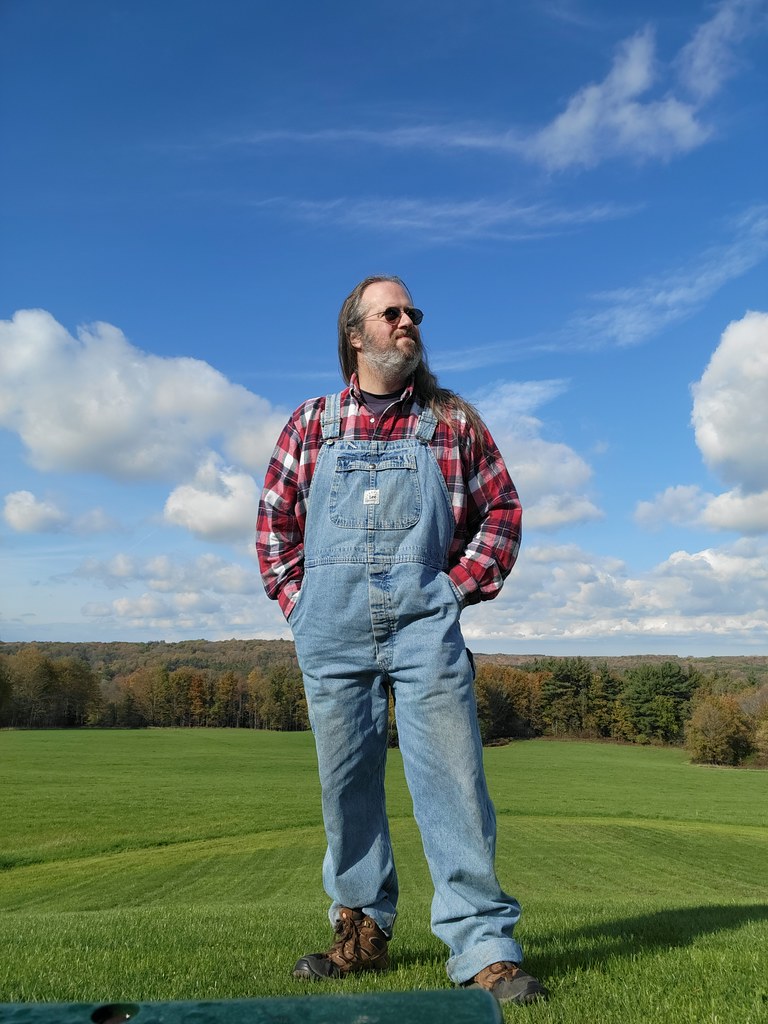
This might well be my favorite look now.
By the way: that pair of overalls? That’s the pair I’ve owned the longest. I bought those in 1994 or 1995, not long after I got the job at Pizza Hut that…well, no, it wasn’t a great job and I should have done something else with my time, but I also don’t regret the lessons I learned while working that job. But anyway, even though I have since loaded my collection with a lot of pairs of vintage overalls (some of which are soon to be featured in this space!), there’s something to be said for buying an article of clothing brand new and living with it until it’s vintage. This makes me happy.
You probably didn’t realize you wanted to hear a suite of music from The Lord of the Rings arranged for solo piano, but thankfully, I realized that you needed to hear it!
Here you go:
This arrangement is really quite well done, and at points it really highlights some aspects of Howard Shore’s original orchestral work that’s easy to miss, such as the shift in the initial Shire music from the bouncy, Percy Grainger-esque folk sound to the more lyrical tone that follows as we get to know our Hobbit heroes better and get more acquainted with the deeper nature of their pastoral character. A fun listen!
Punctuated by long nights and scented by benign smoke and wet leaves, the period between first frost and December is my favorite part of the year. The furnace is pressed into service by 5 a.m., and I, now be-sweatered and -socked from rising until bedtime, begin yawning before 6:45 p.m., but the rest is a sort of everyday magic, from the perfect circles bored into the pumpkins by what I imagine to be a stout but agreeable-enough nocturnal animal to the prehistoric trumpeting of the sandhill cranes as they gather in ever-widening circles over our home before beginning their journey away from the prairie; from the slant of the afternoon sun on the living room floor to the color of the sky when I collect the mail; from best-of booklists to seasonal menus… I adore autumn.
I make no secret of my love for autumn. While I enjoy a lot of summer activities, I always feel a certain disconnect during summer. We’re culturally wired to worship summer, but I tend to keep summer at arm’s length. Warmth is nice, to a point; hot gets unpleasant. And there’s too damned much sunlight in summer! I know that sounds weird in our sun-drenched culture, but I like nighttime, I like moonlight and stars and the flicker of firelight when it’s the only light to be had. I don’t like sunrise before 7am, and I really really really don’t like that it’s light enough to read outside at 10pm.
No, I don’t hate summer. But I’m always glad to see it in the rear-view mirror.
Fall? The time of crisp mornings, earlier sunsets? When the winter stars start to peek over the horizon? The time of lovely flannel and sweaters and overalls after multiple months of boring shorts and t-shirts? The time of color and of apples? Of spooky tales? Of huddling around the fire, and not just sitting near it? Yeah, autumn is the stuff.
This year the transition has been significantly warmer than usual, and the traditional fall color hasn’t been its usual self to this point. By this point we’re usually “past peak”, but this year…heck, maybe we won’t even peak at all. But there’s still a lot of beauty out there.
Here are a few images from just the other day, taken at Knox Farm State Park and from the Mill Road Overlook in East Aurora.
From Knox Farm:
From the Mill Road overlook:
I live in a beautiful place, and this is its most beautiful time of year.
It’s Halloween week, and if you don’t think classical music can do “scary”, well then…you’ve never really listened much. Here are a couple of works that put the darkness of the universe on full display. I don’t think it’s a coincidence that both these pieces are by Russian composers. I’m always wary of nationalistic stereotypes, but there’s just something about Russians when it comes to brooding fatalism. I genuinely think they do that better than anyone else.
First up is Modest Mussorgsky. Mussorgsky lived an unusually tortured life as a composer, and when he died in 1881 at just 42 years old, he left behind great piles of manuscripts, his work in such disarray that definitive versions of his pieces have been the object of scholarly work ever since. The versions of his work that ushered his name into musical immortality came via the pen of Nikolai Rimsky-Korsakov, whose “assistance” with preserving Mussorgsky’s work has come to be seen as almost outright tampering. David Dubal, in The Essential Canon of Classical Music, offers this summation of Mussorgsky:
Mussorgsky was severely self-destructive, and his early death was inevitable. His reliance on instinct was an aspect of his personality, as if technical knowledge would limit his search for “truth”. He was far more than an artist who merely lacked discipline: he was incapable of surviving for long in the real world of naked, shattering truth. Like Tolstoy, he was wracked by the violence and heartbreaking injustice inflicted on millions of Russian serfs. Unlike Rimsky-Korsakov, Balakirev, and Borodin, he could not find refuge in Romantic nationalism. He saw strife and bitterness as few of his class did–he acknowledged and faced it. Nothing in Musorgsky’s art is personal; he dissolved his entire being into the agonized fate of the Russian people, and he saw no hope for the future.
Small wonder that a work so fundamentally terrifying as A Night on Bald Mountain sprang from his pen, then. It is a work of sadistic hedonism, a Bacchanalia of the profane and evil. A Night on Bald Mountain became famous via Rimsky-Korsakov’s arrangement/orchestration, and its most famous appearance in popular culture was as one of the selections in Walt Disney’s Fantasia, where it was paired with Schubert’s Ave Maria in closing the film’s program.
A different kind of Russian brooding comes from Sergei Rachmaninoff. Rachmaninoff yields to no one in brooding, a quality which would shine to wondrous effect in some of his greatest music.
Again, David Dubal:
During the war years [World War I], Rachmaninoff, always on the brink of depression, learned to control his black moods. To the poetess Marietta Shaginian, his chief confidante through these years, he wrote, “Here am I, spiritually sick…I am afraid of everything–mice, rats, beetles, oxen, murderers. I am frightened when a strong wind blows and howls…when I hear raindrops on the window pane; I am afraid of the darkness, etc. I don’t like old attics and I’m even willing to admit there are goblins around.”
Where A Night on Bald Mountain depicts a terrifying Witches’ Sabbath, with its demonic orgy, Rachmaninoff’s Isle of the Dead depicts the long, slow, sad trip to the underworld, starting softly with the boat rocking against the current. Rachmaninoff uses a 5/8 time signature to great effect, using the not-quite-familiar 5-beat bar to suggest that there is something vaguely unfamiliar, something not-quite-right, about this slow trek across calm, black water. Through all this Rachmaninoff employs snatches of melody, including the Dies irae chant that haunted him throughout his life, that lead to some of the saddest sounding lyricism in his entire output. There is a section in the middle of this work that is as intensely lyrical as anything Rachmaninoff wrote, complete with the kind of ever-yearning-upward thing that Rachmaninoff was so good at. (If I ever write my Love Letter to Rachmaninoff’s Second Symphony, this will be a point to which I return frequently.) But here, when we reach the apex of that section a stormy section soon follows, and given the piece’s overall mood, it’s hard not to hear this as someone trying desperately to cling to life, only to be pulled back toward the inevitable long abyss.
This is not scary music in terms of Things That Bump In The Night, but it is unnerving in its depiction of the cold darkness that awaits everyone and how, in the end, all we will have is the slow rocking of that boat as it takes us to the Isle of the Dead.
Share This Post
ForgottenStars.net
The official site of Kelly Sedinger: Reader, writer, photographer, and dreamer