As I noted a while back (before The Virus took hold of our collective imaginations), I’m spending a lot of 2020 digging into the world of Ludwig van Beethoven. I’m currently reading a “life and works” book about him, and I plan to read a few more books about him before this year is out. One thing I learned that I didn’t know is that while most of Beethoven’s works carry opus numbers, not all of them did. Some of these are works that only survived in fragmentary form, while others are youthful works that an adult Beethoven–whose main source of income was the publishing and printing of his works–kept out of the public eye, likely because he considered them his ‘student’ works. These were gathered and numbered in the 20th century under the designation Werke ohne Opuszahl, or “Works without opus number”, abbreviated as “WoO”. As I’ve been listening to more Beethoven of late, I’ve listened to a number of these WoO works, and I present two here.
First is a piece of chamber music: the Piano Quartet No.3 in C Major (WoO 36, no. 3). A piano quartet is basically a string quartet with the second violin removed and a piano substituted. Piano quartets are generally uncommon, and the three Quartets in the WoO 36 group are the only ones he composed. In fact, they were never published until after his death, and Beethoven wrote the three Piano Quartets when he was only 15. They show a heavy influence of Mozart, and according to my reading, they even use some of Mozart’s thematic material, although I couldn’t tell you where. The work is charming and, well, pleasant in the most wonderfully Classical way. And he wrote this when he was fifteen. Yikes!
And if Beethoven at 15 was impressive, let’s turn back the clock to when he was just 12. This is, by all accounts, the first published piece Beethoven ever wrote, when he had undertaken lessons with Christian Neefe, one of the most prominent musicians in his hometown of Bonn, Germany. As an exercise, Neefe had assigned his young student to write a series of variations on a march by a composer named Ernst Dressler, and this seven-minute work is the result. It’s not particularly profound, but one can definitely tell that this was a twelve-year-old with a keen ear and a strong sense for thematic possibilities.
More Beethoven to come! We’re only just getting started.
Here’s a bit of film music, by the underheard (at least by me) composer Basil Poledouris. This, from the movie The Hunt for Red October, is “The Hymn To Red October”. This cue opens the film as we get our first glimpse of the giant Russian submarine that will dominate the story. Poledouris gives the cue, with the Russian hymn, a certain soaring naval quality that works wonderfully.
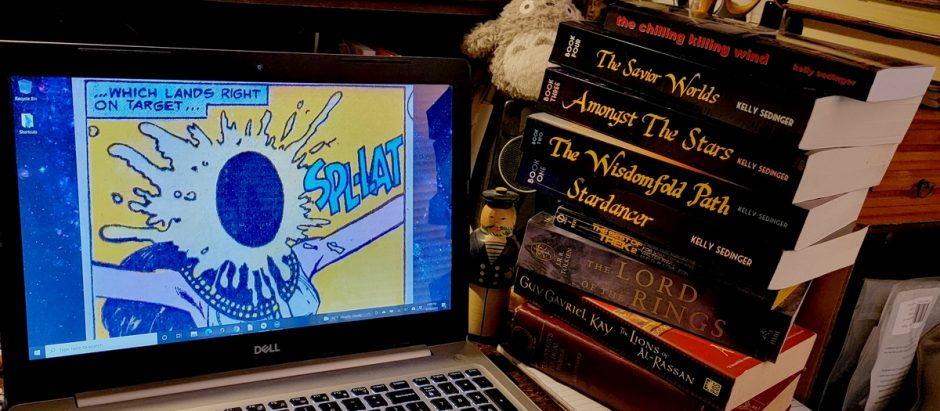
Well, on the day the world “went viral” in the worst way possible, my hard drive died, remember? So into Best Buy and the Geek Squad the thing went. Now the computer is home and has a spiffy new solid-state hard drive, which I’m told is better for speed because there are no moving parts. The tradeoff is less storage capacity, but I’m fine with that as I have several external hard drives, two cloud-storage accounts, and a bunch of flash-drives. I’m good.
Of more concern, obviously, is the unfolding disaster of the Coronavirus. We’re doing fine thus far at Casa Jaquandor. I’m still working, which is good because my workplace (grocery store, for those who don’t remember) is exceedingly unlikely to be forced to close because of this event. The Daughter is working at her fast-food job, which is going fine, because they’re takeout-only, and The Wife is now working at home for her banking job. So far, so good. Short of me being able to work from home too, I think we’re in as good a position to ride this out safely (whilst still pulling in our incomes) as is likely to exist. Of course, that this state of affairs constitutes a really good position for riding this crisis out is a statement in itself, but that’s a thought for another time. For now, we’re doing well, thought I must admit to being a bit on the ragged side right now, because the flip side of having a pretty safe job in a pandemic is that we’ve been getting our asses kicked for…about a week now. Ouch!
So, more to come soon. For now, since I missed both Tone Poem Tuesday and St. Patrick’s Day, here’s the United States Marine Band playing “Irish Tune from County Derry,” arranged by the great Percy Grainger.
In the “When it rains, it pours!” department, my poor laptop has suffered the dreaded “Hard Drive Not Found” ailment. It’s going to the shop later today, but for now all I got is my phone, and as much as I love my phone, I am decidedly NOT a big fan of it as a device for writing anything longer than a tweet. So, radio silence here starts now. Hopefully it’ll just be a few days!
Carl Maria von Weber is one of those composers who is better known to historians of music than to actual listeners of it, which always seems to me a pity. His work represents a crucial step in the development of German opera between the Classical era of Mozart and Beethoven and the full-blown Romanticism of Richard Wagner. Weber’s final work was an opera called Oberon, for which he worked himself sick (maybe even hastening his own death) to learn English so he could most effectively set the libretto, which was in that language. Oberon has never become an operatic standard the way Weber’s earlier masterpiece, Der Freischutz, did, although several excerpts from Oberon have become commonplace in the concert hall. According to David Dubal’s The Essential Canon of Classical Music, Oberon‘s fate is due to serious deficiencies in its libretto. I honestly have no idea if that’s the case or not, but I do know that plenty of operas see rare stagings because of libretto concerns: either the stories and plots are ridiculous, or the demands on the singers are too bizarre, or the staging demands are so outlandish as to be unfeasible. Quite a few operas exist in this weird nether-state, with wonderful scores written by great composers that sadly languish in obscurity because the non-musical aspects of the operas aren’t up to snuff. One wonders if the current trend to concert performances of operas might help to give some of these works a fresh hearing.
In the meantime, here is the wonderful overture to Oberon. Note its dreamy opening, with that slow horn-call melody, which gradually becomes a vigorous and adventurous piece. If I heard that at the beginning of an opera, I’d certainly be intrigued to hear more!
Since St. Patrick’s Day is approaching, I thought I’d listen to some Irish and Celtic music while at work today. A good starting point for such a mood is always The Chieftains, so I looked up one of my favorite albums of theirs, Fire in the Kitchen. This isn’t exactly considered an “official” Chieftains album, as its selections were all recorded on the spur-of-the-moment as they toured in Canada and appeared with a number of that country’s notable Celtic acts, but it is quite a wonderful album anyway. One of my favorite tracks is this haunting rendition of “My Bonny Lies O’er the Ocean”, sung hauntingly by a woman named Laura Smith.
It suddenly occurred to me that I know nothing at all about Laura Smith, so I looked her up.
A change of pace today, I think. Over on Twitter today we were discussing the great 1980s geek comedy Real Genius, in the context of Sheila O’Malley‘s piece about director Martha Coolidge. Real Genius somehow wasn’t a big hit when it came out in 1985 or so, but it should have been, and it is rightly seen nowadays as a classic comedy film of the era. Its story involves super-geniuses in the physics department at a California university and what they do when it turns out that their research project, a super-powered laser, is actually a stealth project for the Defense Department, and its humor is warm and witty and the movie creates a world all its own, eschewing a lot of the usual tropes and stereotypes about nerdy, awkward young people. All that is great; it’s a fantastic movie! But in terms of music, it’s for the most part a typical 1980s-pop song “score”, but again with a lot of good choices made in terms of the songs used. It certainly nailed the song for the end credits, the cheerfully goofy “Everybody Wants To Rule The World” by Tears For Fears, which fits the film’s mood and subject matter nearly perfectly. Tears For Fears was one of those quintessential 1980s bands, fronted by two odd-looking dudes who played synth-heavy pop music that was often oddly infectious.
So here is Tears For Fears, with “Everybody Wants To Rule The World”.
This year has all manner of potential to be…well, roughly on par with its several immediate predecessors, but let’s try not to focus on that entirely, OK? Let us instead focus occasionally, for the remainder of the year, on the fact that 2020 will see the two-hundred-fiftieth anniversary of the birth of one of the towering figures in all human art, Ludwig van Beethoven.
I’m planning on going down quite the Beethoven rabbit hole this year. I won’t feature him every week in this space; sometimes he’ll appear on Something for Thursday, sometimes he’ll have a post of his own, and sometimes he might not even appear on this blog for a week or two at a time. But I plan to make old Ludwig quite the presence here for the remainder of the year, leading up to his actual birthdate on December 16.
For today, we will lead off Ten Months of Beethoven with the overture to his one and only opera, Fidelio. This opera springs from Beethoven’s eternal concerns about human freedom and liberty, as well as the devotion of love to those causes. In the opera, a woman named Leonore decides to free her husband from his unjust imprisonment, and in so doing, she adopts the costume and identity of a young man named Fidelio. Beethoven’s process in composing this opera was typically strained and tortured; he labored over versions of the opera for years and he eventually produced not one but four overtures for the piece, finally settling on this final version, which is shot through with lyrical excitement and light.
Aaron Copland wrote of Beethoven:
Beethoven brought three startling innovations to music: first, he altered out very conception of the art by emphasizing the psychological element implicit in the language of sounds. Secondly, his own stormy and explosive temperament was, in part, responsible for a dramatization of the whole art of music…Both of these elements–the psychological orientation and the instinct for drama–are inextricably linked in my mind with his third and possibly most original achievement: the creation of musical forms dynamically conceived on a scale never before attempted and of an inevitability that is irresistible.”
Here is the Fidelio overture by Ludwig van Beethoven.
Concluding a celebration of Black History Month by way of music, we have a selection performed by musical prodigy Philippa Duke Schuyler. Schuyler lived from 1931 to 1967. She was an enormously gifted musician who spent much of her youth touring and performing. She later grew disillusioned with her status as a racial symbol, and she took to a career in journalism and performing overseas. Sadly she was killed while covering action in Vietnam, when the helicopter she was in crashed. Schuyler’s name lives on, attached to a middle school for talented and gifted students in Brooklyn.
Here is Philippa Schuyler performing Bach. In recordings like this you can hear worlds meeting, hundreds of years apart.
Leonard Nimoy died five years ago today. Here’s the post I wrote on that occasion.
When The Wife and I were on our honeymoon, one of the stops was the Boston Museum of Science. I’m always a fan of science museums. During our visit, we saw a movie in their OmniMax theater. I don’t remember what the movie was, to be honest, but I do recall a bit at the beginning of the show, when the lights dimmed and a voice sounded over the speakers, which said something like this:
Good afternoon! The movie will begin shortly, but before it does, we need to properly calibrate our theater’s sound systems for use. To do this, we have enlisted the aid of a person who grew up in this very neighborhood. You may find his voice familiar. This was followed by a beat of silence, and then another voice said:
Hello. Who put the BOMP in the BOMP shoo BOMP shoo BOMP; who put the RAM in the RAMALAMADINGDONG. The second voice, the “local kid made good”, was Leonard Nimoy’s. I think most folks in the audience recognized that voice before he actually said “This is Leonard Nimoy”; his voice was, actually, one of the most familiar I ever knew. Gravelly and distinguished, that voice was, and Nimoy knew how to use it, which words to emphasize and where to pause just ever-so-slightly for effect.
I don’t remember a time when I wasn’t aware of Leonard Nimoy on some level. More precisely, I should say that I don’t remember a time when I didn’t know who Mr. Spock was. I remember Star Trek episodes very early on, all the way back to the first house I ever lived in. Trek was my sister’s thing, but I remember vague images from it. The most specific one I have is at the end of an episode called “Friday’s Child”, when, at the end, all is well and the female guest star’s character has given birth, and observing Dr. McCoy making baby talk to the kid, Spock asks why baby talk is a thing at all.
A lot can be said about Nimoy and Spock, and a lot has been said about Nimoy and Spock over the years. Most fascinating to me was Spock’s arc through the six “Original Crew” movies, from his attempt in The Motion Picture to purge himself of emotion to his own resolution of the “Kobayashi Maru” test to his rescue to his work to put his own brain back together (interesting that no fewer than three major Trek stories, one episode and two movies, devoted large amounts of time to putting Spock’s brain and mind back together), and finally to the confident, competent officer we saw in The Undiscovered Country. In that film, when Kirk and McCoy get in serious trouble and are arrested, Spock just calmly assumes command and immediately begins the investigation to find the evidence to free them. Through that film, Spock acts with a calm acceptance that the truth will come out, that they will find the evidence, and that they will find it by searching for it calmly and logically. It is of a piece with his line in the film about the need for faith, to trust that “the Universe will unfold as it should”.
My personal favorite Spock moment comes at the end of what is certainly one of the very best Trek episodes ever, “The City on the Edge of Forever”. Knowing that if he allows Edith Keeler to live, the future will change and Starfleet and the Federation will never happen, Kirk stops McCoy from pulling her out of the path of the oncoming car. McCoy rages at Kirk:
“You deliberately stopped me. Jim! I could have saved her! Do you know what you just did?!”
And Spock — ever calm, ever logical, ever accepting of what must be — simply says:
“He knows, Doctor. He knows.”
Nimoy knows that he can’t express sadness in that line. He cannot express heartbreak or the awfulness of the choice that Kirk has just had to make, and all the same, Nimoy conveys that Spock knows these things. He knows these things, he knows that they are real, and he does not belittle them in any way.
Since I’ve no memories at all of a time before Star Trek, it’s fair to say that it — along with Star Wars, obviously — are the biggest influences of mine in terms of my notion of what the world will look like, hundreds or thousands of years in the future. Will we always face problems and struggles and very real difficulties? Absolutely. But I don’t believe in dystopia. I cannot, will not believe that there is a future in the offing when the world is wrecked and everything is in ashes and only a very few are living well while the rest of humanity exists in dimly-lit squalor. I cannot, will not believe that, and that’s why I cannot, will not write it.
I believe that whatever difficulties and challenges we eventually face, we will do it from a brightly-lit viewpoint where it’s always clear how far we’ve already come. I believe that when we take to the stars, our ships will be beautiful and that they will explore with grace, and that we will confront our futures with logic and science as well as warmth and a twinkle in the eye that’s always there.
Why do I believe those things? In large part, because of a teevee show and some movies that Leonard Nimoy starred in.
After his long and prosperous life, Leonard Nimoy now belongs to the past. But he’ll always be a part of my future…my “Undiscovered Country”.