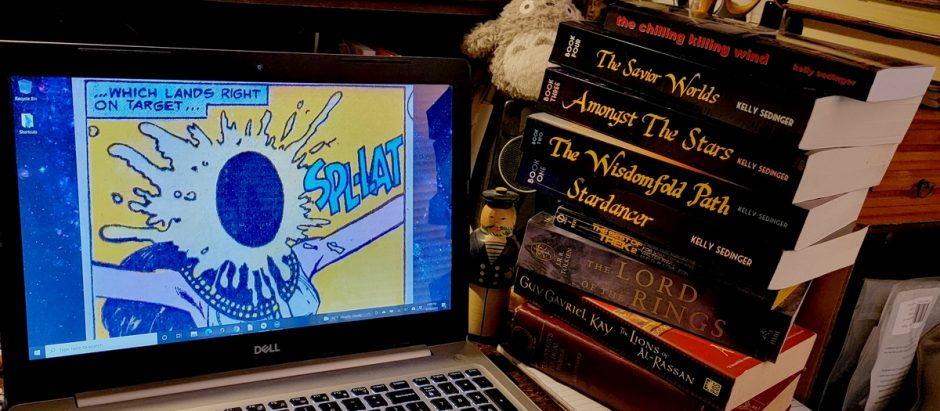
It’s April Fools Day! I’m not a huge fan of this day as a celebration of pranking people, seeing if you can embarrass them or get them to believe some false news story or the like. But I’d be all for a day in which we celebrate laughter and All Things Funny, whether it’s sophisticated wordplay or gonzo silliness or a good old pie in the face. Here are a few things that always hit my funny bone:
(Here, on an episode of Cheers, Sam finds that his bar has been bricked in as a prank by Gary of Gary’s Old Town Tavern…but all is well because he’s got an Irish band coming….)
And here, because National Poetry Month is starting today, is a poem about laughter by Ella Wheeler Wilcox.
Momus, God Of Laughter
Though with the gods the world is cumbered,
Gods unnamed, and gods unnumbered,
Never god was known to be
Who had not his devotee.
So I dedicate to mine,
Here in verse, my temple-shrine.
‘Tis not Ares – mighty Mars,
Who can give success in wars;
‘Tis not Morpheus, who doth keep
Guard above us while we sleep;
‘Tis not Venus, she whose duty
‘Tis to give us love and beauty.
Hail to these, and others, after
Momus, gleesome god of laughter.
Quirinus would guard my health,
Plutus would insure me wealth;
Mercury looks after trade,
Hera smiles on youth and maid.
All are kind, I own their worth,
After Momus, god of mirth.
Though Apollo, out of spite,
Hides away his face of light,
Though Minerva looks askance,
Deigning me no smiling glance,
Kings and queens may envy me
While I claim the god of glee.
Wisdom wearies, Love has wings —
Wealth makes burdens, Pleasure stings,
Glory proves a thorny crown —
So all gifts the gods throw down
Bring their pains and troubles after;
All save Momus, god of laughter.
He alone gives constant joy,
Hail to Momus, happy boy!
I’ll be posting about poetry off and on throughout the month. I don’t promise a post every day, but most days.
William Goldman, accepting his Oscar for BUTCH CASSIDY AND THE SUNDANCE KID. From Nationalpost.com.
William Goldman died last year. He lived a long and brilliant life as one of the finest screenwriters, penning such films as All the President’s Men, Butch Cassidy and the Sundance Kid, Marathon Man, and what might be his most beloved work, The Princess Bride. That last is doubly special because not only is the movie wonderful, but it’s an adaptation of a novel of Goldman’s as well. The novel works wonderfully on its own, and Goldman’s adaptation isn’t just a slavish transliteration of the book to the screen, but rather a loving creation all its own, that has its own focus and its own way of making use of its own medium to tell its story.
Goldman tends to be beloved of storytellers in many mediums, and not just because he was a great storyteller himself. He was also great at writing about storytelling, and this is borne out in two books of his that I consider essential reading for anyone interested in writing, or in film, or in the general enterprise of storytelling to begin with. Those books are Adventures in the Screen Trade and Which Lie Did I Tell?.
Here is a wonderful anecdote from the making of Marathon Man, a thriller Goldman wrote (again, adapting an earlier novel of his) about the pursuit of a Nazi war criminal. The film starred Laurence Olivier, Dustin Hoffman, and Roy Scheider. Here is Goldman:
Last Olivier story.
He and Roy Scheider were rehearsing a scene. In the story they are very close to voilence, but both are still trying to figure out what the other one knows. The dialog went like this:
OLIVIER: We must talk. Truthfully. Are you to be trusted?–
SCHEIDER: –No–
OLIVIER: –Was that the truth? Or are you trying to upset me?–
SCHEIDER: –I know why you’re here—and I know that sooner or later you’re going to go to the bank–
OLIVIER: –perhaps I have already been.
Schlesinger [director John Schlesinger] interrupted them. He said, “Larry, that’s supposed to go fast, and after Roy says the line about the bank, you’re taking a pause before ‘Perhaps I have already been.’ Don’t take the pause.”
Olivier said “Of course,” and they started into the dialog again. And then he stopped. “I have a problem about not taking the pause.”
We waited.
“I’m trying to find out information. Roy says, ‘I know why you’re here.’ And I need to find out what that means. Then Roy says, “I know…” And I’m listening. Then he says, ‘I know that sooner or later…’ And I’m still listening. Now he says, ‘I know that sooner or later you’re going to go…’ And I’m still listening. Finally he says, ‘I know that sooner or later you’re going to go to the bank.’ That pause I’m taking is to give me time to register the information about the bank.”
“I understand,” Schlesinger said, “But we’ve got to get rid of the pause.”
Olivier turned to me, then. “Bill,” he said, “could I suggest an alteration in the line? Would it be all right if I changed it so that the line went, ‘I know that you’re going to go to the bank sooner or later?’ You see, then I could register the word bank while he was saying ‘sooner or later’ and I wouldn’t need the pause.”
Obviously it was fine with me and the line was altered and we went on without the pause. And probably this two minutes of rehearsal explained at length doesn’t seem like much put down in black and white.
But that moment—when the actor of the century asked me would I mind if he switched six words around—is the most memorable incident of my movie career. Olivier. Calling me “Bill.” Olivier. Asking me would I mind.
That’s high cotton….
Goldman knows, in Which Lie?, that The Princess Bride might well be the project of his most likely to carry his name into Time. He writes lovingly about that film, focusing in the end on the sad story of Andre the Giant, who so wonderfully played Fezzik in the movie. Andre died a few years later, and was greatly mourned. Here is part of Goldman’s tribute:
Andre would never come out and say that wrestling might not be legit. He fought 300 plus times a year for about 20 years, and all he ever admitted was that he didn’t like being in the ring with someone he thought might be on drugs. When he was in his prime, men who weighed 250 or 300 pounds would hurl themselves on him from the top rope and he would catch them and not budge.
But even seven years ago his body was beginning to betray him. There is a scene at the end of The Princess Bride where Robin Wright—and yes she is that beautiful—jumped out of a castle window, and Andre was to catch her at the bottom.
The shot was set up for Roin to be lifted just above camera range and then dropped in Andre’s arms. Maybe a foot. Maybe two. But not much and Robin was never that heavy.
The first take, she was dropped and he caught her—and gasped, suddenly white like paper, and almost fell to his knees. His back was bad. And getting worse, and soon there would be surgery.
Andre once said to Billy Crystal, “We do not live long, the big and the small.”
Alas.
Next, two bits of inspiration, because every book on storytelling should make people feel better about this most ancient of human enterprises (I suppose there’s one human enterprise that’s older than storytelling, but who knows—stories had to play a part in that one, too). This comes at the end of Adventures in the Screen Trade:
I think there’s a wave of talent rising now. Thousands upon thousands of young men and women who literally love film. I realize this is a book about Hollywood, so obviously there has to be a happy ending. Only I’m not tacking this on. I believe that wave is upon us and that it’s not going to be stopped. And to all that talent, let me say, where the hell have you been and I wish you joy…
…and may you ignore the critics when they attack you, and pay no attention to their praise…
…and may you please remember when your scenes are sludge, that screenplays are structure…
…and may you have peers as willing to improve your project as you must be; treat them kindly, for they will save your ass many times over…
…and may you always remember “it’s only a movie” but never forget that there are lots worse things than movies—like politicians…
…and may you be lucky enough and skilled enough to make some glorious moments for all those people sitting out there in the dark, as earlier craftsmen created such moments for you…
…and finally and most of all…
…may all your scars
be little ones….
And finally, this. It’s a sidebar at the very end of Adventures in the Screen Trade.
Writing Time
The one thing I think all writers like to talk about is their work habits. When do you write? For how long? Where? Endless questions. So I want to spend a minute now on the basic problem facing us all: doing it.
When I began, at twenty-four, the work always came out in a burst. The Temple of Gold took less than three weeks. A year later, Your Turn to Curtsy, My Turn to Bow, less than two. And in between, nothing much happened that bettered the human condition, just going to the movies, a double feature a day, sometimes two, everything on 42nd Street or the Thalia on West 95th. Two years basically wasted until the next book, which was Soldier in the Rain.
I was having a career, God yes. Three novels published by age twenty-eight, two of them million-copy sellers in paperback, the third into a movie.
What I wasn’t having was a life.
I never had a real job so whenever I wanted to write, I could. Morning, night, all night if I watned—and I suspect it I had continued that way, I was heading for disaster.
There is no wrong when it comes to work habits. It doesn’t matter if you use a Mac or a quill pen. There is no best way to go about storytelling. Bergman writes from ten to three and in ten weeks, he’s got a screenplay. Graham Greene, another hero, counted words. Yes, you read that right, he counted each and every word until he reached his magic number—three hundred. And when he got there, guess what, he quit for the day, in the middle of a sentence or not.
They had the one thing writers need most: discipline.
My great editor, Hiram Haydn, was a very busy man. He started or ran publishing houses, had a wife and a bunch of kids, was editor of The American Scholar.
And wrote novels.
He was my editor from Soldier in the Rain through The Princess Bride, was a wondrous father figure for me. Once we were talking about a novel of his, The Hands of Esau, that he was so close to finishing, and I asked him how long since he began it and he said probably eight years.
How do you stay the same person for that long, I wondered?
You just do the best you can, he replied. You hope.
When do you write?
Sunday morning, he said. Every Sunday morning.
That was the only time available to him. The rest of his life was kids and work and family and commuting and meetings and dealing with crazy writers; Sunday morning was all he could carve out, so he played it as it laid.
You have to protect your writing time, he said then.
That’s the best basic advice I can give to any writer. You have to protect your writing time. You have to protect it to the death.
I think it should always be the same time. Each day, each night, each whatever. Can be half an hour, more when you’re on a roll, probably shouldn’t be less. I know a brilliant young writer who has zero problem writing. Her problem is sitting. Her computer is surrounded by a mine field and she will come up with the most amazing reasons not to try to cross it. And no, she is neither crazy nor along in her problem–
because the easiest thing to do on earth is not write.
The need for a schedule is simple: You’ll have hours, days, when you just sit there, but eventually, you come to know that your writing time is not and things begin to happen as you sit there.
And if you manage to suck it up, if you decide you must get your stories down, then there is one other thing that’s crucial: don’t talk about it. Tell no one.
Once others know, they will look at you strangely, they will question you, they will ask you terrible questions–
–how’s it coming?
–is it fun?
–when is it going to be finished?
–I bet it’s fun
–when can I see it?
You don’t need those words buzzing around your ears. So keep the start of your career secret. Keep the time sacred.
Remember: nobody made you be a writer.
Now, I myself am pretty firmly a member of Team Write Every Day, but you can’t always do that and you shouldn’t feel shame if you can’t do that. But in that case, the best compromise is Goldman’s Team Write At The Same Time Each Day/Week/Whatever, because there’s another, shorter term for members of Team Write When You Feel Like It. That term is nonwriters.
One last bit. In discussing the script to Casablanca in Which Lie Did I Tell?, Goldman says as an aside, “I wish to God I’d written lines as glorious as ‘I was misinformed.’”
Well, here’s the thing about that. Casablanca famously boasts that wonderful last line, “Louis, I think this is the beginning of a beautiful friendship.” That is an amazing final line, and I consider it one of the two greatest last lines in movie history.
The other? It’s by William Goldman. Here’s the scene, after the Grandpa has finished reading the book to The Kid:
THE KID: Grandpa?
The Old Man stops, turns.
THE KID: Maybe you could come over and read it again to me tomorrow.
GRANDFATHER: (a beat) As you wish.
And his smile is enough. As The Grandfather steps out the
door, tipping his hat–
FINAL FADE OUT.
THE END.
Posted inWriters, Writing|Comments Off on Remembering William Goldman
William Goldman died last year. He lived a long and brilliant life as one of the finest screenwriters, penning such films as All the President’s Men, Butch Cassidy and the Sundance Kid, Marathon Man, and what might be his most beloved work, The Princess Bride. That last is doubly special because not only is the movie wonderful, but it’s an adaptation of a novel of Goldman’s as well. The novel works wonderfully on its own, and Goldman’s adaptation isn’t just a slavish transliteration of the book to the screen, but rather a loving creation all its own, that has its own focus and its own way of making use of its own medium to tell its story.
Goldman tends to be beloved of storytellers in many mediums, and not just because he was a great storyteller himself. He was also great at writing about storytelling, and this is borne out in two books of his that I consider essential reading for anyone interested in writing, or in film, or in the general enterprise of storytelling to begin with. Those books are Adventures in the Screen Trade and Which Lie Did I Tell?.
Here is a wonderful anecdote from the making of Marathon Man, a thriller Goldman wrote (again, adapting an earlier novel of his) about the pursuit of a Nazi war criminal. The film starred Laurence Olivier, Dustin Hoffman, and Roy Scheider. Here is Goldman:
Last Olivier story.
He and Roy Scheider were rehearsing a scene. In the story they are very close to voilence, but both are still trying to figure out what the other one knows. The dialog went like this:
OLIVIER: We must talk. Truthfully. Are you to be trusted?–
SCHEIDER: –No–
OLIVIER: –Was that the truth? Or are you trying to upset me?–
SCHEIDER: –I know why you’re here—and I know that sooner or later you’re going to go to the bank–
OLIVIER: –perhaps I have already been.
Schlesinger [director John Schlesinger] interrupted them. He said, “Larry, that’s supposed to go fast, and after Roy says the line about the bank, you’re taking a pause before ‘Perhaps I have already been.’ Don’t take the pause.”
Olivier said “Of course,” and they started into the dialog again. And then he stopped. “I have a problem about not taking the pause.”
We waited.
“I’m trying to find out information. Roy says, ‘I know why you’re here.’ And I need to find out what that means. Then Roy says, “I know…” And I’m listening. Then he says, ‘I know that sooner or later…’ And I’m still listening. Now he says, ‘I know that sooner or later you’re going to go…’ And I’m still listening. Finally he says, ‘I know that sooner or later you’re going to go to the bank.’ That pause I’m taking is to give me time to register the information about the bank.”
“I understand,” Schlesinger said, “But we’ve got to get rid of the pause.”
Olivier turned to me, then. “Bill,” he said, “could I suggest an alteration in the line? Would it be all right if I changed it so that the line went, ‘I know that you’re going to go to the bank sooner or later?’ You see, then I could register the word bank while he was saying ‘sooner or later’ and I wouldn’t need the pause.”
Obviously it was fine with me and the line was altered and we went on without the pause. And probably this two minutes of rehearsal explained at length doesn’t seem like much put down in black and white.
But that moment—when the actor of the century asked me would I mind if he switched six words around—is the most memorable incident of my movie career. Olivier. Calling me “Bill.” Olivier. Asking me would I mind.
That’s high cotton….
Goldman knows, in Which Lie?, that The Princess Bride might well be the project of his most likely to carry his name into Time. He writes lovingly about that film, focusing in the end on the sad story of Andre the Giant, who so wonderfully played Fezzik in the movie. Andre died a few years later, and was greatly mourned. Here is part of Goldman’s tribute:
Andre would never come out and say that wrestling might not be legit. He fought 300 plus times a year for about 20 years, and all he ever admitted was that he didn’t like being in the ring with someone he thought might be on drugs. When he was in his prime, men who weighed 250 or 300 pounds would hurl themselves on him from the top rope and he would catch them and not budge.
But even seven years ago his body was beginning to betray him. There is a scene at the end of The Princess Bride where Robin Wright—and yes she is that beautiful—jumped out of a castle window, and Andre was to catch her at the bottom.
The shot was set up for Roin to be lifted just above camera range and then dropped in Andre’s arms. Maybe a foot. Maybe two. But not much and Robin was never that heavy.
The first take, she was dropped and he caught her—and gasped, suddenly white like paper, and almost fell to his knees. His back was bad. And getting worse, and soon there would be surgery.
Andre once said to Billy Crystal, “We do not live long, the big and the small.”
Alas.
Next, two bits of inspiration, because every book on storytelling should make people feel better about this most ancient of human enterprises (I suppose there’s one human enterprise that’s older than storytelling, but who knows—stories had to play a part in that one, too). This comes at the end of Adventures in the Screen Trade:
I think there’s a wave of talent rising now. Thousands upon thousands of young men and women who literally love film. I realize this is a book about Hollywood, so obviously there has to be a happy ending. Only I’m not tacking this on. I believe that wave is upon us and that it’s not going to be stopped. And to all that talent, let me say, where the hell have you been and I wish you joy…
…and may you ignore the critics when they attack you, and pay no attention to their praise…
…and may you please remember when your scenes are sludge, that screenplays are structure…
…and may you have peers as willing to improve your project as you must be; treat them kindly, for they will save your ass many times over…
…and may you always remember “it’s only a movie” but never forget that there are lots worse things than movies—like politicians…
…and may you be lucky enough and skilled enough to make some glorious moments for all those people sitting out there in the dark, as earlier craftsmen created such moments for you…
…and finally and most of all…
…may all your scars
be little ones….
And finally, this. It’s a sidebar at the very end of Adventures in the Screen Trade.
Writing Time
The one thing I think all writers like to talk about is their work habits. When do you write? For how long? Where? Endless questions. So I want to spend a minute now on the basic problem facing us all: doing it.
When I began, at twenty-four, the work always came out in a burst. The Temple of Gold took less than three weeks. A year later, Your Turn to Curtsy, My Turn to Bow, less than two. And in between, nothing much happened that bettered the human condition, just going to the movies, a double feature a day, sometimes two, everything on 42nd Street or the Thalia on West 95th. Two years basically wasted until the next book, which was Soldier in the Rain.
I was having a career, God yes. Three novels published by age twenty-eight, two of them million-copy sellers in paperback, the third into a movie.
What I wasn’t having was a life.
I never had a real job so whenever I wanted to write, I could. Morning, night, all night if I watned—and I suspect it I had continued that way, I was heading for disaster.
There is no wrong when it comes to work habits. It doesn’t matter if you use a Mac or a quill pen. There is no best way to go about storytelling. Bergman writes from ten to three and in ten weeks, he’s got a screenplay. Graham Greene, another hero, counted words. Yes, you read that right, he counted each and every word until he reached his magic number—three hundred. And when he got there, guess what, he quit for the day, in the middle of a sentence or not.
They had the one thing writers need most: discipline.
My great editor, Hiram Haydn, was a very busy man. He started or ran publishing houses, had a wife and a bunch of kids, was editor of The American Scholar.
And wrote novels.
He was my editor from Soldier in the Rain through The Princess Bride, was a wondrous father figure for me. Once we were talking about a novel of his, The Hands of Esau, that he was so close to finishing, and I asked him how long since he began it and he said probably eight years.
How do you stay the same person for that long, I wondered?
You just do the best you can, he replied. You hope.
When do you write?
Sunday morning, he said. Every Sunday morning.
That was the only time available to him. The rest of his life was kids and work and family and commuting and meetings and dealing with crazy writers; Sunday morning was all he could carve out, so he played it as it laid.
You have to protect your writing time, he said then.
That’s the best basic advice I can give to any writer. You have to protect your writing time. You have to protect it to the death.
I think it should always be the same time. Each day, each night, each whatever. Can be half an hour, more when you’re on a roll, probably shouldn’t be less. I know a brilliant young writer who has zero problem writing. Her problem is sitting. Her computer is surrounded by a mine field and she will come up with the most amazing reasons not to try to cross it. And no, she is neither crazy nor along in her problem–
because the easiest thing to do on earth is not write.
The need for a schedule is simple: You’ll have hours, days, when you just sit there, but eventually, you come to know that your writing time is not and things begin to happen as you sit there.
And if you manage to suck it up, if you decide you must get your stories down, then there is one other thing that’s crucial: don’t talk about it. Tell no one.
Once others know, they will look at you strangely, they will question you, they will ask you terrible questions–
–how’s it coming?
–is it fun?
–when is it going to be finished?
–I bet it’s fun
–when can I see it?
You don’t need those words buzzing around your ears. So keep the start of your career secret. Keep the time sacred.
Remember: nobody made you be a writer.
Now, I myself am pretty firmly a member of Team Write Every Day, but you can’t always do that and you shouldn’t feel shame if you can’t do that. But in that case, the best compromise is Goldman’s Team Write At The Same Time Each Day/Week/Whatever, because there’s another, shorter term for members of Team Write When You Feel Like It. That term is nonwriters.
One last bit. In discussing the script to Casablanca in Which Lie Did I Tell?, Goldman says as an aside, “I wish to God I’d written lines as glorious as ‘I was misinformed.’”
Well, here’s the thing about that. Casablanca famously boasts that wonderful last line, “Louis, I think this is the beginning of a beautiful friendship.” That is an amazing final line, and I consider it one of the two greatest last lines in movie history.
The other? It’s by William Goldman. Here’s the scene, after the Grandpa has finished reading the book to The Kid:
THE KID: Grandpa?
The Old Man stops, turns.
THE KID: Maybe you could come over and read it again to me tomorrow.
GRANDFATHER: (a beat) As you wish.
And his smile is enough. As The Grandfather steps out the
door, tipping his hat–
Our song challenge continues, and this week it’s A Song You’d Like Played At Your Wedding. Well, my wedding was twenty-two years ago, so here’s a song that was played at my wedding. The Wife and I danced our first dance to this song. Here are the Righteous Brothers with “Unchained Melody”.
I heard this work on the radio this past Sunday, and I made a note to look up what it was. Sadly I didn’t remember to do that until Monday, when St. Patrick’s Day was already over, because it turns out to be In Ireland, a rhapsody for flute, harp, and orchestra by Sir Herbert Hamilton Harty. Harty was an Irish composer who wrote in the post-Romantic vein, but he had the misfortune to live in a time when Romanticism was well and truly a thing of the past, so as Modernism was taking hold, composers like Harty were often forgotten. This is a pity, because his music is dramatic and picturesque. Not everything can be remembered, but not everything deserves to be forgotten, either.
I saw this joke on Tumblr. I can’t credit it because it’s got over 12,000 notes (which means that it’s been passed around that many times and tracing it back to the originator is an exercise in futility). I paired the joke with the painting because, hey, neat painting.