Q: How do you fix a brass instrument?
A: With a tuba glue!
Q: How do you fix a brass instrument?
A: With a tuba glue!
So there’s a meme going around the various social media sites in which you pick three fictional characters to depict yourself. Here are my three:

One of the most beautiful songs I know: “Scythe Song” by Dougie Maclean. The song is about the long work involved in learning to do a thing and do it well, and the way you need to ideally spend time in the company of a master of the thing you’re trying to learn, and how when you know how to do a thing well, it becomes something you feel rather than something you do.
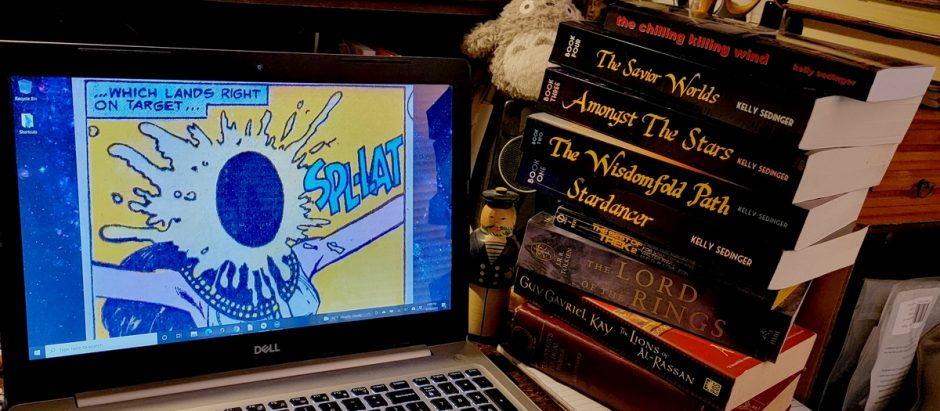
This past weekend was Buffalo Comicon! And yes, we attended. Lots of fun was had by all, and some geeky stuff was acquired, as you might expect. My haul included the following items:


I’d like to have my own vendor table at a future con, once I have enough books available to make it work. I’m probably a year or two away, but I’ll get there! As for other Cons in Buffalo…well, I’m wondering if the local con market isn’t getting oversaturated. A new Comicon just launched to compete with Buffalo Comicon, and there are several other cons as well (Eeriecon, UB Con, et cetera). Of course, I’d love to see Buffalo gear up and host a Worldcon. They held Worldcon in Spokane two years ago, so Buffalo has got to be able to do it!
I hated Debussy for years, but I started coming around a decade or so ago, when I began to appreciate his atmospherics more than I had before. La mer is, quite simply, a musical depiction of the sea, in three parts:
“From dawn to noon on the sea” or “From dawn to midday on the sea” – very slow – animate little by little (B minor)
“Play of the Waves” – allegro (with a very versatile rhythm) – animated (C sharp minor)
“Dialogue of the wind and the sea” or “Dialogue between wind and waves” – animated and tumultuous – give up very slightly (C sharp minor)
Debussy’s intent is not at all to meditate on humans and their relationship with the sea, but on the sea itself. Like a lot of Debussy, the work is haunting and evocative, sweeping the listener along on a series of orchestral “images”.
Here is La mer.
Let’s back up in time a little bit, shall we? I just heard this captivating piece a week or two ago on the radio. Luigi Boccherini was a cellist and composer during the Classical period, roughly contemporary with Franz Joseph Haydn. He was highly prolific, but his music was neglected for many, many years, overshadowed by the likes of Haydn and Mozart. In all honestly, I’m not sure if I’ve ever heard anything by Boccherini aside from this piece. He composed when the orchestra was still very small and evolving into something more than a large chamber ensemble, which gives this symphony the chamber-like air that it has. In fact, when I joined the work in progress, I wasn’t even sure if it was a symphony at all, or a guitar concerto, or some other chamber hybrid work. It is, however, like all fine works of the classical era, a beguiling and even refreshing listen.
I’ve been posting an awful lot of classical music lately, so…let’s go with something from one of the great musicals! Here’s “There’s No Business Like Show Business”, from Annie Get Your Gun.
Closely related to the tone poem is the Concert overture, which is the forerunner of the tone poem in many ways. Also a single movement work, a concert overture was often intended to kick off a program of symphonic music, much in the way a standard overture does for an opera. Here is one of the finest such concert overtures: the Academic Festival Overture by Brahms.
Brahms composed this work as a “thank you” gesture to the University of Breslau, after the school awarded him an honorary degree. Displaying humor that’s fairly rare for Brahms, the work is mainly a collection of light-hearted tunes and even drinking songs, richly orchestrated in vigorous fashion. I can never help, when I hear this piece, wishing that Brahms had managed to tap into this part of his own psyche a little more often. Alas!
I took this photos last year when we visited NYC at Thanksgiving.


Our country was deeply wounded that day, and I’m not sure how well we’re healing. Sometimes I wonder if we’re healing at all. But making something beautiful out of a scar is a good place to start.


