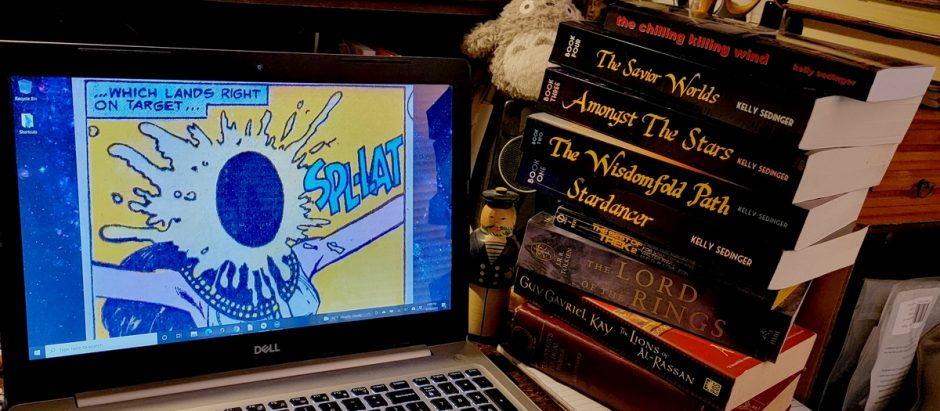
Courtesy Sarah Gailey, who — among other awesomeness — likes to occasionally regale Twitter with bad jokes:
I read a book about Stockholm Syndrome the other day.
It started off bad, but I ended up loving it!
Courtesy Sarah Gailey, who — among other awesomeness — likes to occasionally regale Twitter with bad jokes:
I read a book about Stockholm Syndrome the other day.
It started off bad, but I ended up loving it!
Tony Bennett is 90 years old! Wow. Here’s some Tony Bennett, because…Tony Bennett!
One maddening thing about every single Presidential election cycle is the inevitable cries of “We need a third party!” I always find this concept generically annoying, not because I’m in love with my own party (believe me, there have been many times when I wanted to junk-punch the Democratic Party and/or some of its component parts), but because the two-party system is simply baked into our political system. No, the system wasn’t designed for only two major parties, and the Founding Fathers didn’t especially want only two major political parties, but you can’t always foresee the future, and this is what we got: a system that by its very nature allows only two major parties.
This is all explained very effectively by blogger Christoper Bird, who is very astute about American politics. (This is interesting because he’s Canadian. Oh, and that blog is something of a group effort, but he’s the Big Cheese there and posts as MGK.)
So, first this (it’s a slideshow, so you’ll have to, well, slide your way through it):
And then, as follow-up, this (just normal scrolling now):
1. A lot of responses of "well excuse me I believe I will vote THIRD PARTY" and my response to that is always pic.twitter.com/bqmh7u8ykv
— Aaron Bird, Sir (@mightygodking) July 24, 2016
2. The nature of first-past-the-post systems makes third party voting actively detrimental to the goals of people inclined to do it.
— Aaron Bird, Sir (@mightygodking) July 24, 2016
3. If you're disinclined to vote for either candidate *equally*, then sure, third-party voting makes sense. But you almost surely aren't.
— Aaron Bird, Sir (@mightygodking) July 24, 2016
4. You, like almost everybody, are probably closer in policy preferences to one of the candidates than the other.
— Aaron Bird, Sir (@mightygodking) July 24, 2016
5. For sake of argument, let's say you're likely closer to Clinton than Trump. (If not, why are you reading this? Go watch monster trucks.)
— Aaron Bird, Sir (@mightygodking) July 24, 2016
6. Now let's say "you" is actually "a subset of voters like you, say 1% of the electorate."
— Aaron Bird, Sir (@mightygodking) July 24, 2016
7. If you vote third-party instead of Clinton, there is a set of possible outcomes. *None of them include the third party winning.*
— Aaron Bird, Sir (@mightygodking) July 24, 2016
8. Because FPTP systems are two-party systems, by definition. It's not because of corporate collusion. It's because of *math*.
— Aaron Bird, Sir (@mightygodking) July 24, 2016
9. You are not the first person in history to say "well gosh how about a third party." This is not an original thought you have had.
— Aaron Bird, Sir (@mightygodking) July 24, 2016
10. The reason third parties don't work in FPTP systems is because the system creates two parties with broad bases.
— Aaron Bird, Sir (@mightygodking) July 24, 2016
11. Aside: Canada is a two-party state (the Tories and Liberals) with two smaller parties that split left-wing votes https://t.co/QD303rYeq3
— Aaron Bird, Sir (@mightygodking) July 24, 2016
12. Anyway, mathematically speaking, it makes sense for parties to capture as much of the popular vote as possible.
— Aaron Bird, Sir (@mightygodking) July 24, 2016
13. So FPTP usually creates a political landscape with both parties trying to ensure the support of "51% of the electorate" as possible.
— Aaron Bird, Sir (@mightygodking) July 24, 2016
14. Whatever the reason, conservatives usually all line up in one major party; liberals are more inclined to subdivide.
— Aaron Bird, Sir (@mightygodking) July 25, 2016
15. (This is pretty reliable for FPTP systems across the world, incidentally. It happens again and again.)
— Aaron Bird, Sir (@mightygodking) July 25, 2016
16. (Australia is the major outlier, and their "two" right parties are really just one party for all intents and purposes.)
— Aaron Bird, Sir (@mightygodking) July 25, 2016
17. The result of this is a steady worldwide progression towards more conservative policies, because *conservatives don't split their vote*.
— Aaron Bird, Sir (@mightygodking) July 25, 2016
18. Because conservatives vote with "their" party reliably, the conservative party in Country X With FPTP caters to their preferences more.
— Aaron Bird, Sir (@mightygodking) July 25, 2016
19. And because center-left parties across the world know that the far left is not a reliable vote, they dismiss them to chase the center.
— Aaron Bird, Sir (@mightygodking) July 25, 2016
20. So: if you're voting Green because you don't like Hillary, my posit to you is this:
— Aaron Bird, Sir (@mightygodking) July 25, 2016
21. Voting Green will mean the following things WILL happen.
— Aaron Bird, Sir (@mightygodking) July 25, 2016
22. Firstly, the Democrats are less likely to win, because a voter who is largely aligned with their policy goals isn't voting for them.
— Aaron Bird, Sir (@mightygodking) July 25, 2016
23. Which in turn means: secondly, you increase the odds of a Trump victory, which I assume you *don't* want even more.
— Aaron Bird, Sir (@mightygodking) July 25, 2016
24. Thirdly, if Hillary *does* win, she will be less likely to pursue policies you *would* like, because *you did not vote for her.*
— Aaron Bird, Sir (@mightygodking) July 25, 2016
25. So, by voting third party, you're making every outcome you actually want *less likely*. Which is why voting third party is stupid.
— Aaron Bird, Sir (@mightygodking) July 25, 2016
26. The one thing you *will* get from voting third party, to be sure, is a feeling of satisfaction. (Remember what I said about narcissism?)
— Aaron Bird, Sir (@mightygodking) July 25, 2016
27. Anyway that's enough, I wanna watch wrestling now, Bayley is wrestling and that's very exciting
— Aaron Bird, Sir (@mightygodking) July 25, 2016
Comments on this post are deactivated.
So let’s try something new! I already have Symphony Saturday, but symphonies are far from the only worthy form used by classical composers. There is plenty of music that is symphonic without being an actual symphony, so in this series we’ll explore that wonderful world. One major difference is that while I’ve arranged the Symphony Saturday posts roughly in the chronological order of the works’ composition, I’m not going to do that here. We’re just going to jump through time a lot, and hopefully hear some wonderful things along the way.
So, what is a “tone poem” anyway? Glad you asked! Tone Poem is a term that is often used interchangeably with symphonic poem or any number of other similar terms, denoting a single-movement work, usually intended to be illustrative or at least suggestive of some extra-musical work, be it a particular story or poem or legend or something else. Tone poems tend to be free in their form, usually eschewing the more strict notions of form that most symphonies (particularly sonata-allegro form). As such, tone poems really found their chief flowering from roughly 1830 to 1920, during the Romantic period and the post-Romantic period that followed.
We’ll start off with a work I’d never heard before the other day when I wrote this, by a composer I’d never heard of until I tracked down this list of tone poems. Mieczyslaw Karlowicz was a Polish composer who lived from 1876 to 1909, when he was killed in an avalanche while skiing. The tone poem here, Stanislaw and Anna of Oswiecim, is dense music clearly in the tradition of Wagner and Strauss, but with its own thrilling lyricism. The work is based on a local legend involving the illicit love affair between a brother and sister (more here). It’s amazing how often the great works of art draw inspiration from tragic stories of doomed and forbidden love.
Last week, two friends of ours from our college days happened to come to WNY for a visit, taking advantage of a week with their kids away at a mission trip of some sort to come see Niagara Falls and some other stuff in the Buffalo area. That’s why my posting was nonexistent last week. It was really nice to catch up with old friends, and it was also nice to play tour guide and get a look at this region of mine through eyes that had never seen this stuff before. It’s really easy to get wrapped up in the constant day-in-and-day-out minutiae of what’s wrong with Buffalo and WNY, but it really isn’t all bad. At all. I can happily report that this region made a very favorable impression on one couple from Iowa, especially downtown Buffalo, which resulted in the words “We don’t have anything like this in Des Moines!” being said a lot.
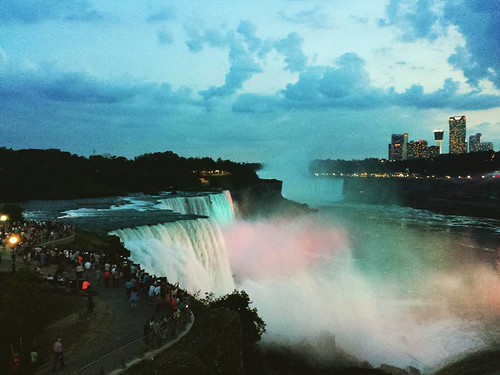
Anyway, we went to Niagara Falls one night for fireworks, which we watched from the American observation platform. Our initial vantage point was OK, but we wanted to move farther out on the platform, and there were just too many people there…until it rained for ten minutes, making half the people bolt for cover. We just waited it out, and then we moved down to where we wanted to be. When the rain cleared out ten minutes later (and it wasn’t even a soaking downpour, just a gentle summer rain that came and went), we had the spot we wanted.
We also attended Food Truck Tuesday at Larkin Square, a new-ish development in the city where a once-moribund area of warehouses has started transforming into something cool, and we hung out at Canalside, the unfinished-but-inviting waterfront development. I came away from Canalside still thinking that it needs more. It feels like a great start. Here’s hoping for more stuff down there! (And I finally got to see the Sharkgirl statue! Every other time I’ve been to Canalside since her ‘installation’, she’s been inside for cleaning.)
Some photos….




Tchaikovsky wrote one symphony that he did not give a number. This work is quite different from his other symphonies, in that not only is it not numbered, but it is a programmatic work that carries a title: Manfred. In terms of order of composition, Manfred falls between the Fourth and Fifth Symphonies, which is why it’s featured in this spot, this week.
I had never heard the Manfred Symphony until just a couple of weeks ago. It is a strange work, to be sure — it has moments of absolute brilliance, and it also has moments that make clear some of Tchaikovsky’s later dissatisfaction with it. The brilliant moments, though, are so brilliant that on balance I end up truly enjoying this piece, and wondering why it seems to languish in obscurity, compared with Tchaikovsky’s other symphonies.
From what I’ve read, the work has never really overcome its programmatic elements, some of which led Tchaikovsky into structural problems. (Or so say the critics.) The result is a work that is at times disjointed and inorganic, especially in its final movement. I’m honestly not sure about all that, but I do know that the work is also technically difficult, occasionally requiring virtuoso skill from its players, and it also calls for a very large orchestra, which contributes to the fact that it is not played all that often outside of recording studios. Opinion on Manfred seems largely divided.
Most interesting to me is the story of the work’s genesis. Mily Balakirev had a program, based on Byron’s poem Manfred, which he wanted to see composed into a symphony. He first tried to entice Hector Berlioz himself to do the job, after hearing Berlioz’s wonderful Harold in Italy, but Berlioz demurred, citing his age and ill health. (As Berlioz had a year left to live, he seems to have been quite correct.) The program ended up finding its way to Tchaikovsky’s hands, and Tchaikovsky composed it. The reaction to the work was divided from the outset, and Tchaikovsky himself considered destroying parts of it:
He found progress difficult, but by August 1885 he declared “this will perhaps be the best of my symphonic compositions.” By the time of the première in March 1886, he was qualifying that “because of its difficulty, impracticability and complexity it is doomed to failure and to be ignored,” and by 1888 he declared that “it is an abominable piece, and that I loathe it deeply, with the one exception of the first movement.”
The work’s program is as follows:
1.Lento lugubre – Moderato con animo
Manfred wanders in the Alps. Wearied by the fateful questions of life, tormented by the burning anguish of helplessness and by the memory of his criminal past, he feels cruel tortures to the soul. Manfred penetrates deeply into the secrets of magic and communicates imperiously with the mighty powers of hell, but neither these, nor anyone in the world can give him the oblivion which is the single thing he vainly seeks and begs for. A recollection of the lost Astarte, whom he once loved passionately, devours and gnaws at his heart and there is neither limit nor end to the boundless suffering of Manfred.
2.Vivace con spirito
The Alpine fairy appears to Manfred in the rainbow from the spray of the waterfall.
3.Andante con moto
Pastoral – picture of the simple, poor, free life of the mountain dwellers.
4.Allegro con fuoco
Underground devils of Ahriman. Infernal orgy. The appearance of Manfred amid the Bacchanal. Summoning and appearance of the shade of Astarte. He is forgiven. Death of Manfred.
And here is the symphony itself. Let me know what you think!
I know, I know — complete lack of posting of late! As usual, sorry about that. Nothing bad is going on — quite the opposite, actually! I’m writing and working and this week we’ve been spending time at night with a couple of good friends from our college days who decided that it was high-time they saw Niagara Falls and some other nifty stuff ’round here, so I actually have not even been at the computer much. And that’s a good thing! It’s been a tiring week, but in a way that is recharging some other batteries. That doesn’t mean we can’t have some music, though!
I know I’ve featured the Polovtsian Dances by Alexander Borodin before, but I don’t know how long it’s been and hey, I love this music so much that I don’t care if I featured it last week! I’ve been on a big Borodin kick of late, so much so that I’m wondering why it took me this long to really lock onto him. I’ve been vaguely aware of Borodin for years, but only recently has be really pushed through into my consciousness, and I am very glad that he did. Here is how David Dubal describes Borodin in his book The Essential Canon of Classical Music:
With such a short life of so many demands, Borodin composed little. His music is the most lyrical in spirit of the Russian Five, and his melodies possess a delicate “oriental” atmosphere. His compositions have a special sweetness as well as a legendary character. In highly charged and picturesque music, Borodin idealized the savage life of the Russian steppes. His pieces have the allure of blazing Tartar blades and Arabian steeds in the heat of battle. It is music that leaps forward and seductively whispers mysterious romances in the slow movements.
This particular performance of the Polovtsian Dances is taken from a production of Borodin’s opera Prince Igor, and the choreography of this production is as captivating as Borodin’s music itself. I’m happy to note that this entire production of the opera is also available online, and I’m really thinking that I need to watch it. (And if you hate opera, it’s OK — the only singing here is by a chorus.)
Here are the Polovtsian Dances from Prince Igor, by Alexander Borodin.
Over coffee the other morning, this was my view:

We now reach the later period of Tchaikovsky’s career as a symphonist, which is where things go from “good”, “solid”, and “promising” to “great”. This is the Symphony No. 4 in F minor.
I have to confess that I didn’t always like this symphony all that much, but I have warmed substantially to it over the last few years. Tchaikovsky’s music is, in a lot of cases, best understood in the light of the events of his life at the time he was composing. This symphony, which has some of the most anguished passages I know, sprang from Tchaikovsky’s suicidal days after his ill-advised marriage and the beginning of the great relationship of his life, his patronage by the wealthy Nadezhda von Meck. This symphony begins with a passage he referred to as “Fate knocking at the door”, which is a phrase that has also been used to describe the opening motif of Beethoven’s Fifth Symphony, and indeed Tchaikovsky seems to have taken that earlier great work as a major inspiration:
Of course my symphony has a program, but of a kind impossible to formulate in words… Was it not the purpose of the symphony as a musical form to express that for which there are no words, but which surges from the soul and demands expression? Basically, my symphony is patterned after Beethoven’s Fifth. Not Beethoven’s musical ideas, but his fundamental notion… The Beethoven Fifth has a program. There can be no doubt what he wishes to express. The same idea underlies my own symphony, and if you have not understood me, then the only conclusion to be drawn is that I am not a Beethoven, which I myself have never doubted. I will add only that there is not a single line in my symphony which I have not felt deeply, and which does not echo true and sincere emotions.
He would dedicate this symphony to Madame von Meck, who prized it highly when he played it for her on the piano. Doubtless she was moved by the work’s feel of constant emotional struggle and turmoil, and was then brought to a state of intense excitement by the finale, which sounds in its closing passages as though the orchestra is going to levitate, so great is the energy being expended.
Here is Tchaikovksy’s Symphony No. 4 in F minor. (Pay special attention to the conductor at the 12:00 mark. I’m always amazed this doesn’t happen more often!)


