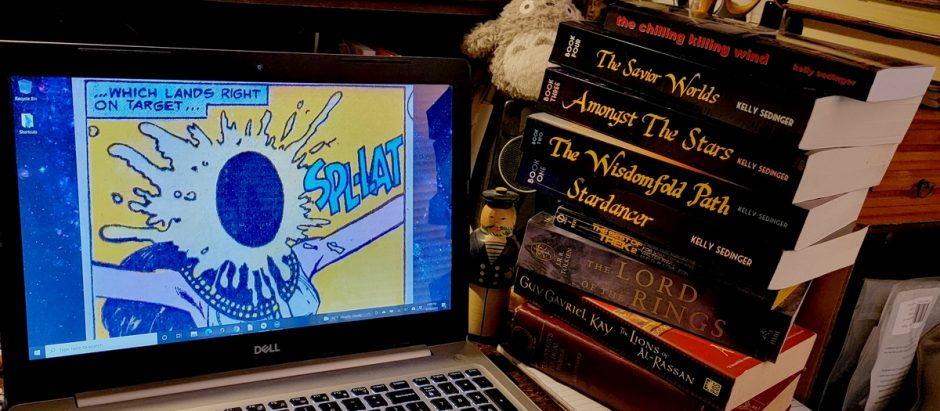
A panda walks into a bar and says, “I’ll have a rum…
…
…
…
…
…
…
…
…
…
…
…
…
…
…
…
…
…and coke, please.”
The bartender says, “OK, but why the big pause?”
The panda holds up his hands. “I was born with them.”
A panda walks into a bar and says, “I’ll have a rum…
…
…
…
…
…
…
…
…
…
…
…
…
…
…
…
…
…and coke, please.”
The bartender says, “OK, but why the big pause?”
The panda holds up his hands. “I was born with them.”
Even despite the movie’s gaping historical inaccuracies and Kevin Costner’s less-than-robust attempt at a British accent, I still like the movie Robin Hood: Prince of Thieves. I especially love its sweeping score by Michael Kamen, who is to my mind one of the more underrated film composers of the last few decades. His death — eleven years ago, and the same year as Jerry Goldsmith’s and Elmer Bernstein’s passings — was especially cruel, because he should have had a few decades’ worth of music left inside him. I’ll always wonder what we might have heard.
Anyway, some kind soul uploaded the entire score album to Robin Hood: Prince of Thieves to YouTube (minus the wildly overplayed Bryan Adams song), so here it is. Enjoy!
Rosemi Mederos posted this to her Instagram last night, depicting her reaction to THE WISDOMFOLD PATH.

I make no apologies!

More commentary to come, but for now…WOW!
We’re LIVE, folks! The Song of Forgotten Stars, book II: THE WISDOMFOLD PATH is now available for purchase! It’s in paperback first, and the ebook formats will come in two weeks.
I’m planning to come up with a mechanism for ordering signed copies from me directly; I’ll likely have this ready to go in December. But for now…IT’S A BOOK, folks!!!
One day more, folks!
Here are the final teaser images for THE WISDOMFOLD PATH!


We’re almost there!
I’ve been meaning to dust off this once-regular feature of mine, in which I take time each Saturday to explore the world of that grandest of classical music forms, the symphony — and what better time than right now?
During the 19th century, Italy did not have a great symphonic tradition as did other nations in Europe. In Italy, opera was by far the most popular form of musical composition, and practically zero symphonies by Italian composers of the Romantic era have entered the standard symphonic repertoire. This is not to say that there were no Italian symphonists during that era, however.
Giovanni Sgambati achieved some renown for his piano music, but he also wrote two symphonies, the first of which is the subject of this post. Listening to the work, it is easy to hear the heavy Germanic influence that Sgambati felt. He was an eager champion of German and Austrian music in Rome, and this symphony, with its decidedly Teutonic feel and sound, definitely shows that. It is clear that Sgambati felt more attuned to the line from Beethoven to Brahms than that from Cherubini to Verdi. The work does not feature the kind of lyricism one might expect from an Italian, but it is full of the kind of Germanic writing that is notable in many a symphony from the north.
Sgambati’s Symphony No. 1, like many an obscure work, deserves to be heard more than it is. Enjoy!
Saw this yesterday and posted it to Facebook. It made me laugh.

“Sorry, but I’m dealing with a lot of pressure at work!”
–When a barometer complains
Thinking of dreams lately…and those that dream them….


