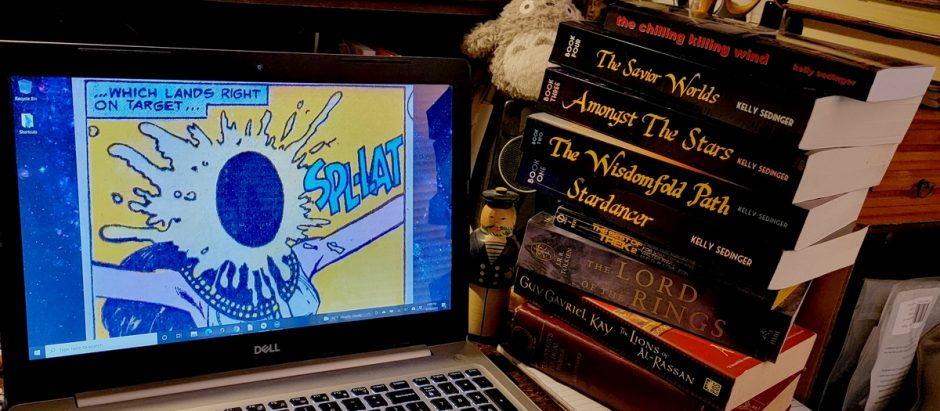

It was only a matter of time. PJ is gonna f*** Jeffy up.
Further photographic documentation of my reign of terror!


The sky last night, when we came out of the place we had dinner:


Sometimes you need something big and epic, so here is Trevor Jones conducting a suite of his themes from The Last of the Mohicans.
Should we get rid of the dollar bill in favor of a coin?
And what changes would you make to US currency in general?
Below the jump: some thoughts on the minimum wage. Long and liberal, so beware.
(Note on structure for this post: there is no real “through-line” in terms of my “argument” here. This really is a collection of thoughts, not all of them as closely-intertwined as others.)
After a lot of protesting and virtual “striking”, fast food workers have won a number of victories, most notably the State of New York recommending a raise in the minimum wage in their industry to $15 an hour. Now, there are some provisos that get overlooked in commentary on this: first, that wage is to be phased in over six years, so nobody’s going to be making $15 an hour for making cheeseburgers until 2021, and second, the wage increase only applies to businesses over a certain size threshold (something like thirty locations). So this will hit the McDonald’s and Burger Kings and Subways of the world, but not the small local chains like Tom Wahl’s and Ted’s Hot Dogs.
But it’s a start.
Random thoughts, then:
:: Good for them. I am happy for any worker who benefits from this. I am a firm believer that anything that helps people at the lower end of the economic pool rise up a bit is a good thing.
:: I am also thrilled at the prospect that maybe the pendulum is starting to swing in this country away from what we’ve made our central core of economic priorities since roughly 1980. Our prevailing notion regarding the economy has been to embrace “trickle down”, and we’ve spent nearly 40 years cutting taxes and regulations in an effort to create an economy where virtually all the gains, all the big benefits, all the money are relentlessly funneled to the top. I hope that this minimum wage increase for a specific industry is just the start of something.
:: Of course, for this to be the start of something – the beginning of a swing back toward an economic model where benefits are focused more on the middle and bottom than relentlessly funneled to the top – an awful lot of people have to start looking at things differently. Sadly, this seems to include a lot of people who are in the middle and bottom of the pool. I’m referring here to the constant undercurrent of resentment people seem to feel toward others who are doing better than they are.
We’re all familiar with the concept of “keeping up with the Joneses”, but what I’m noticing now is a kind of insidious reversal of that concept. We all seem to have fewer Joneses with whom we feel we need to keep up, and we feel a constant sense that our grip on what we have is…well, if not exactly weakening, then there’s a sense that what we have could be ripped from our grasp at any moment. So we’re less worried about “keeping up with the Joneses”, and more worried about “keeping ahead of the Smiths”. Each concept is harmful in its own way, but I think the latter might be more dangerous.
“Keeping ahead of the Smiths” leads to jealousy and envy. It leads to literal resentment of when someone else has something that we feel they don’t deserve, and it seems to be an even stronger impulse when it’s something we don’t have that they suddenly do. I don’t know where or when this odd impulse became so engrained in the American psyche, but I definitely believe it’s there. I see this impulse at work whenever voters spread vicious rhetoric about how awful public school teachers are to make the money they make, and I certainly see it at work now.
“Maybe I should go apply at McDonald’s,” I hear a lot these days. Or “Gee, I’ve never made fifteen bucks an hour.” The latter is often coupled with a description of the jobs one has done, obviously intended to make clear that my work should pay more than theirs. And these sentiments aren’t brand new, either, born of shock that burgerflippers (said with appropriate voice filled with disdain) are going to make that kind of money. I once heard a counter clerk at a store complain bitterly that her husband made twice what she did at his union job, even though all he did was [insert mential task here]. I find such sentiments irritating, because first of all, I myself have never been angry that someone else makes more than me at a certain job.
Seriously, I’ve never understood that point. These things are inherently unfair. Minimum wage when I started working at my very first summer job, when I was 17 years old, was $3.35 an hour. It went up to $5.25 a few years later, and there it stayed for a good, long time. When I started moving into management with Pizza Hut, the highest wage I attained was somewhere around $6.50 an hour. So what?
Also, I remember what happened every time the minimum wage went up. The already-existing employees who were making less than the new minimum would get brought up to the new minimum, while employees already above the minimum would get a raise of some sort. However, this always resulted in complaints: “Why am I only getting a raise of fifty cents an hour? I’m making a buck fifty more than minimum now, and after this I’ll only be making seventy-five cents more!” These arguments always struck me as odd. Your pay was going up, wasn’t it? Did it really matter that you stayed ahead of the minimum by the same margin as before? Was “keeping ahead of the Smiths” really that important?
Ultimately, though, this whole issue reveals just how completely Labor in this country has allowed itself to be trampled, and how thoroughly everyone, from the cashier at Home Depot all the way up, has bought into the concept that our companies must be willing to pay no more than what they determine we are worth. That is mind-boggling to me. We’ve completely bought into the idea that the key economic factor holding everyone back from ultimate prosperity is taxes. Every time a tax increase is proposed, well, get ready for some fur to fly. I invariably hear commentary from someone saying “I haven’t had a raise in three years, but now I gotta pay more in taxes!” Setting aside the amount of the new tax levy itself, doesn’t it ever occur to anyone to say, “Hey! How come I haven’t had a raise in three years?”
To my way of thinking, as I look at the numbers that demonstrate a wildly growing level of inequality in America, our economic self-perception is seriously out of whack. We have bought completely into the notion that the Free Markets are the best engine for all this, and never mind that throughout history the most “Free Market”-dedicated eras resulted in massive inequality of the type we’re seeing now. We have bought completely into the idea that the market will eventually bring its benefits upon us, and that it’s taxes that are the big problem. After nearly forty years of unending tax-cutting and deregulating, however, all we have to show for it is wages that are stuck in neutral and money flowing ever, ever, ever upward in a pattern that can only be described as redistributive (albeit in the exact opposite way that that term is usually deployed by libertarian-types). The biggest problem most Americans face, economically, is not what the government is taking out of our paychecks. It is what our employers are not putting into them in the first place.
So why, then, so much resentment toward a group of workers who banded together and through various means of legal redress seem to have won a kind of victory for themselves? Why are so many people so eager to see in this another screwing of themselves by the system, instead of an example of what might be done elsewhere? If you’re so convinced that your line of work is deserving of better pay, than why not band together and do your own self-advocation?
Well, I’m not really sure. Part of it, I suppose, has to do with America’s infatuation with the Individual, and the idea that we are singularly capable of, and ultimately responsible for, achieving things. That’s probably at least partly why I hear so much “I never made fifteen bucks, why should they?” My answer to that is, “Why didn’t you, and why shouldn’t they?” That’s why I always hear so much condemnation of public schoolteachers, and it’s also why we always manage to denigrate factory workers for striking for more money (or for keeping the money they make) even while we complain about the sorry state of American manufacturing.
We do too much worrying in this country of keeping up with the Joneses and ahead of the Smiths. There’s this creepy undercurrent of American thought that tells us that someone doing better than we are really shouldn’t be, and that’s a pretty lousy way to look at life. Maybe we should stop viewing our lives through the prism of how the Joneses and Smiths are doing, and maybe start admitting that if the Joneses and Smiths all do well, maybe it will help us.
:: Side issue: I’ve also seen some rejoinders along the lines that now companies will simply automate more. There’s a picture-meme-thing going around Facebook of what is apparently a McDonald’s someplace where there are no order takers, just a bank of self-order kiosks. “See! They’ll just replace you with machines! Maybe you should have been happy with your $7.25 an hour!!!”
This is simply dumb, of course. Anyone who thinks that such automation isn’t coming down the pike already, because McDonald’s is perfectly happy to pay $7.25 but feels their hand is forced at $15, is simply delusional. And that brings up my biggest worry for the future, which just manages to push Global Warming into the second spot.
Eventually, there simply isn’t going to be enough work for humans to do. We are going to get so good at automating things that there simply will not be enough jobs to be filled by humans. I am nowhere near good enough a futurist, in terms of imagination, to see what kind of society this will lead us to create, but I truly believe that our entire economic way of life, based on work, is going to end somehow. Either we’ll start inventing work, literal “busy work”, just to prop up the idea that we’re all supposed to work jobs for money and then buy the stuff we need, or we’ll move into some sort of post-work economy. I have no idea what that’s going to look like, and the notion of that transition scares me, because it doesn’t seem to me that we make such transitions easily.
It will also be interesting to see what happens specifically to the American psyche once we start settling into a post-work world, when there isn’t enough work to go around. Our country is built to what often seems to me an absurd degree on the idea that it’s our work that makes us who we are. Americans work harder for less, and take less time off than anybody else, and somehow we’ve elevated that aspect of our character to a particular spot of pride. This always strikes me as deeply odd, but I don’t think we’re going to shake off that “Work! Work! WORK!” mentality of ours, in which we’re still expected to be available and answer e-mails on the few vacations we take, and in which we wear the number of hours we work over 40 as a badge of honor, until the ongoing march of technological innovation forces us to do so.
This is another reason why I reject Libertarianism so strenuously. In a world where so much of the work is automated that an ever-shrinking number of people are paid to do what’s left, the idea that the unfettered functioning of a market will be the best way to accomplish anything at all is downright silly. It’s also for that reason that I think that things like single-payer healthcare are going to have to happen, eventually. We won’t have a choice in the matter, if we want people to have healthcare. (And yes, we will want people to have healthcare.)
:: By the way, “hard work” has entirely too strong a grip on our collective imagination. It’s utterly absurd that the United States is one of just a handful of countries in the world, and virtually alone amongst large industrial countries, that doesn’t mandate paid vacation time. Other countries that are not the most affluent nation in the history of the planet have made this happen, but somehow we always manage to claim poverty when the idea is floated here.
:: In fact, this is yet another example of our ongoing national failure to allow the experiences of other countries to inform our own policy choices. Other countries have figured out how to have better healthcare for all citizens than we provide, and pay less to do it; other countries have figured out how to have a significantly higher minimum wage than we do, and yet not have burgers cost the equivalent of twenty bucks; other countries have figured out how to have better national transportation and better this and better that. We’re always told that these things can’t possibly work here, for reasons that never make any sense to me; the USA simply cannot be an outlier on everything, so much so that ideas that work elsewhere are doomed to failure here. And I’m roundly sick to death of any argument against something that boils down to some odd, abstract, almost-metaphysical appeal to “freedom”.
:: Every time some kind of regulation like this comes along, companies and industry groups start screaming “Poverty!” and trotting out the exact same objections. It will destroy their industry, it will destroy jobs, it will crush entire economies in its wake. We hear this every single time the minimum wage is increased at all. We heard this when the ADA was passed. We heard it when the ACA was passed. Hell, we heard it from restaurant and bar owners as cities and states nationwide passed rigorous anti-smoking laws, and we heard it from the direct marketing people when the government created its Do Not Call List. We hear this objections every time out, and never do they come true. At all. So I will not be listening to any such protestations in the future. Business America has gone to that well a few too many times for me.
Of course, there will be some business closures that are cited as examples why this matter of policy is a bad idea. But guess what? There are always business closures – or, at least, business decisions that adversely affect consumers or employees – that are blamed on some new policy or other, such as how every medical insurance company has been able, the last few years, to cite the ACA for raising prices. My general view is that companies are going to do what they plan to do anyway, and if some government regulation comes down the pike that they can blame, so be it.
So yes, McDonald’s may decide that because of this wage increase, locations that have been underperforming will be closed. In general, though, those locations were likely doomed anyway.
A couple of links: Local blogger Alan Bendenko discussed this subject on a local podcast last week, and here’s a wealthy person who says that the pitchforks are coming. Maybe they are, maybe they aren’t. It’s hard not seeing people banding together to fight for better pay as a warning shot, though.
(I’m deactivating comments to this post, by the way.)
In 2009, the Buffalo Bills were in need of pass rush on their defensive line, and they had the ninth overall pick in that year’s draft, which pretty much gave them the pick of the litter in terms of defensive talent. They selected a guy named Aaron Maybin, who had just finished a very impressive year at Penn State. Maybin was supposed to be the next great defensive talent, but it turned out that he wasn’t. In fact, his career in Buffalo went so poorly that he was gone a few years later, after pocketing an immense amount of money. (This was before the current CBA, with its structured contracts for rookies.) Fans hated Maybin for his perceived lack of production and/or effort; fans derided the Bills for once again managing to bungle what should have been a golden opportunity to draft a fine player. In all honesty, as a fan at the time, I fell in both camps.
Maybin landed on a couple other NFL rosters over the next few years, and he had what looked like a decent season for the Jets, although a case can be made that his good sack numbers that year reflect the quality of the Jets’ defensive backfield that year (which was awesome). But Maybin still never caught on anywhere as a productive regular player, let alone a star, and he’s been OOF — Out Of Football — for a few years now, mostly forgotten except by masochistic Bills fans who like to bring up the name, every once in a while, of one the biggest draft busts in franchise history.
In today’s Buffalo News, however, writer Tim Graham has a remarkable story on Maybin’s life since football and the factors that shaped his experience within the game. It’s a pretty amazing piece, and I highly recommend reading it.
The Bills drafted Maybin 11th overall in 2009. Two years, one vainglorious rap song, several flamboyant hairstyles and zero sacks later, the Bills cut him. He was out of the NFL after four seasons.
Maybin isn’t solely to blame. Rare are the instances when an athlete’s inability to meet grand expectations is his fault alone.
Maybin, after all, led the 2011 New York Jets in sacks and tied for fifth among all NFL players in forced fumbles. He retired with an offer from the Indianapolis Colts on the table.
But with the Bills, he was miscast, mismanaged and misunderstood. He was unfinished when he arrived, and still unfinished when the Bills discarded him.
I’ve seen my feelings on football shift significantly over the last five years or so. I admit that it’s easy to take a second look at one’s fandom when the favorite team is constantly bad; maybe if the Bills had been a regular playoff team or even a Super Bowl contender, I’d be a lot more of a fan right now. But maybe not. It seems to me that football’s ugly side has really come out in recent years, from the constant fleecing of taxpayers for the building of stadiums* to the way the game tends to leave its former players with lasting brain damage. I find myself more and more sympathetic to the increasing numbers of players who have walked away from football, while seemingly in their prime and with millions of dollars potentially left to earn.
The fact is, we tend to view our teams as singular entities with interchangeable parts called “players”. Graham’s article on Maybin serves as a valuable reminder that the “parts” are, in fact, human beings, and as such, they bring all their various challenges and difficulties and quirks along with them. In Maybin’s case, it’s a good dose of poor decision-making, coupled with some hard-ball contract negotiating by the team, coupled with life experiences that add to the difficulties. Maybin also had great physical difficulty simply gaining weight to be the proper size for an NFL player, and he happened to be struggling with all of this at a time when the franchise was experiencing massive turnover in the front office and in the coaching staff. All that can wreak havoc with a young player who is still trying to grow and learn the game, and to me, it’s no surprise at all that Maybin eventually decided that he just wasn’t all that emotionally invested in football at all.
What is Maybin doing now? He’s a painter.
Maybin’s garage is full of finished canvases, leaning on each other in rows.
There are portraits of Nelson Mandela, Muhammad Ali, Joe Paterno and Tupac Shakur, unhinged erotica, challenging images of gladiatorial sport and slavery, inner-city reflections on death, oppression and strife.
“All my painting I do from the soul, and very rarely does somebody understand it,” Maybin said. “But everything you see me create came from me.
“The beauty in art is that it has so many interpretations. I just want you to feel something to the point of starting a conversation.”
I’m not equipped to say whether he’s a good one or not, but I do like what I’ve seen of his art. We often hear that there is life after football, but it seems to me that sports fans don’t always like to admit that there is life instead of football, too. In fact, there are times when I think that fans should not only realize that there is life instead of football for the players, but there is life instead of football for the fans. Yes, I hated Aaron Maybin as a player.
And then I realized what a colossally stupid reason that is to hate someone.
* Want to know how insane the stadium thing is? Take the case of Atlanta, where the football Falcons will begin play in a new stadium in 2017, replacing their existing stadium which opened in 1992. That’s twenty-five years. And the baseball Braves? They’re moving that same year to their new ballpark, replacing a stadium that opened in 1997. They didn’t even get a combined FIFTY YEARS out of their existing facilities. That is batshit crazy.
All right, you get two jokes today because I forgot to post a joke last week.
Joke the First: Why does a milking stool only have three legs?
Because the cow has the udder!
(hat tip to Roger, who e-mailed me that one)
Joke the second: Two antennas met on a roof, fell in love, and got married. The ceremony was just OK, but the reception was awesome!


