Well, there’s one “Aerial Dancer” off the streets….
Well, thank God that’s over.
Seriously, this was just a terrible season of MasterChef. There were some fun moments and some contestants I liked enormously, but as the season ground on, it really took on an air of relentlessly shuffling toward a preordained conclusion: the coronation of Courtney. That’s pretty much exactly what happened.
Look, I wasn’t there and obviously didn’t taste the food, so it’s entirely possible that Courtney really did get through the entire season of MasterChef competition without ever making a single misstep. But the constant adoration piled upon her by the judges, coupled with her unimaginably irritating displays of self-love, got more and more annoying with each successive episode, culminating in last night’s finale. Joe Bastianich, of all people, turned in the most incoherent commentary of praise for Courtney of the season when he praised a dessert that Gordon Ramsay panned, saying that her dish of meringue cookies with some sauce and cherries with a bit of salt added “pushed the limits of a dessert”. Umm…OK, Joe. The whole thing reeked of desperation on Joe’s part to continue the season-long tongue-bath of the most irritating contestant in the show’s history. (And that’s saying something. You know I love you, Joe, but ye Gods.)
Of course, none of that might have even come to pass had my favorite contestant, the borderline-manic Leslie, not mistaken salt for sugar in his final cake. Oops. (Although this confuses me — would a cup of salt instead of a cup of sugar result in a cake that one can chew thoughtfully and then swallow with a look of puzzlement, as Gordon Ramsay did? I’ve no idea, but it seems to me it should have resulted in a case of “GAHHH get this out of my mouth ptoooie!”
Anyway, as I say, thank God that’s over. This does mean, however, that we’re going to see Courtney sporting her insufferable Dolores Umbridge-in-her-twenties act at least once next season, so there’s an episode I’ll make sure to attend with lots of reading material. I’d also like to see the show get away from the team competitions, particularly the ones where they run a kitchen someplace. I watch Hell’s Kitchen to see chefs trying to run a kitchen; I don’t care if any of these “home cooks” can run a kitchen. But if they’re going to have team competitions, I’d like the losing captain to not be able to save themselves from elimination. That’s pretty bogus, and it did provide the moment the cemented Courtney as an asshole in my opinion this year, when she saved herself after helming the losing team; she said something like, “Well, our problem was clearly not the fine leadership I provided, so I’m saving myself.” Ugh.
So anyway, there’s that. Not the best year for MasterChef, alas. Not every season can have the greatness that is Monti Carlo, but still — did I have to endure the cooking competition show’s answer to Boston Rob?
(Don’t forget to delurk, people! Say hello! Say something!)
Share This Post
Unlurkify thyselves!
I haven’t done this in a while, so here goes: it’s Delurking Week! Say something. For the next few days I’ll open things up to anonymous comments (although if spammers start swarming, I may need to cut things off early). I’ll still leave the moderation on and CAPTCHA thingie on, though. One can’t be too careful.
Say hello!
(No politics, please — just spread some good cheer. Thanks!)
Share This Post
What a bunch of A-holes.
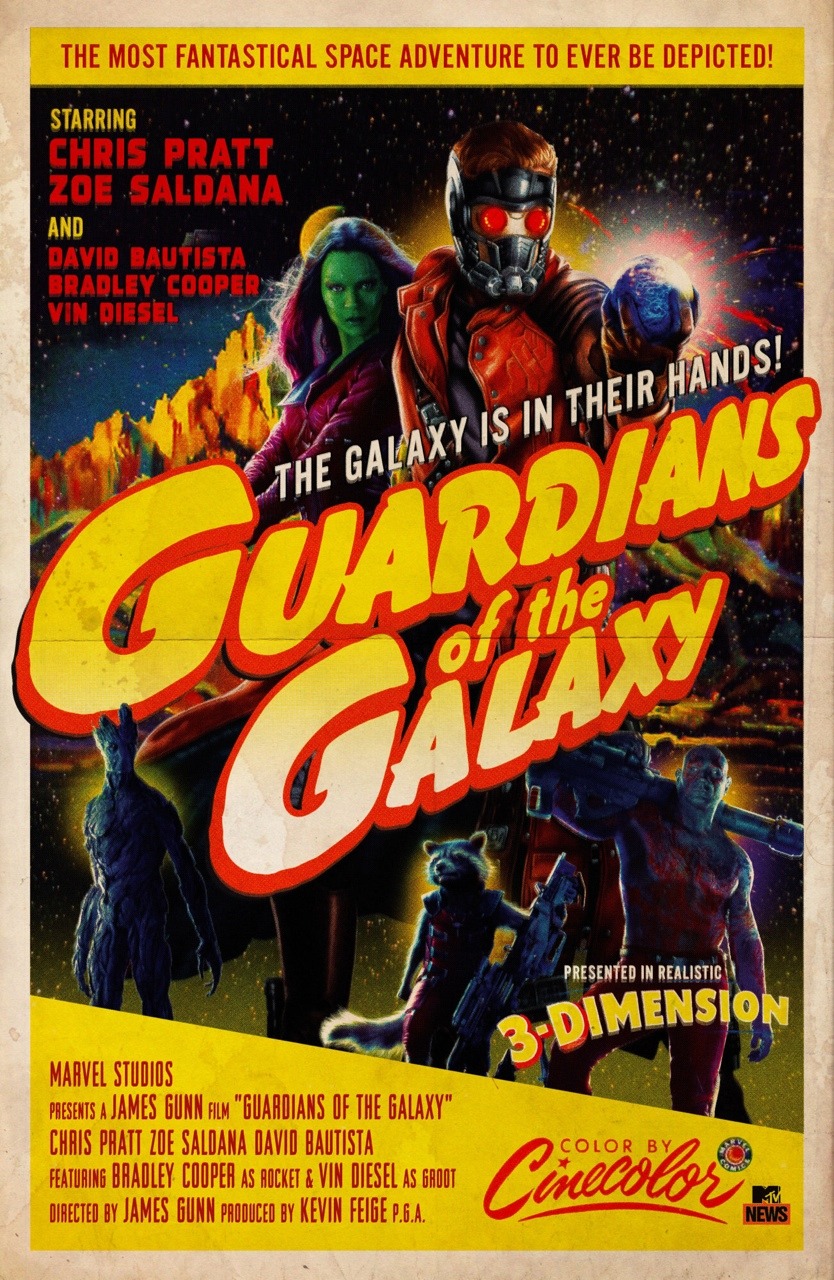
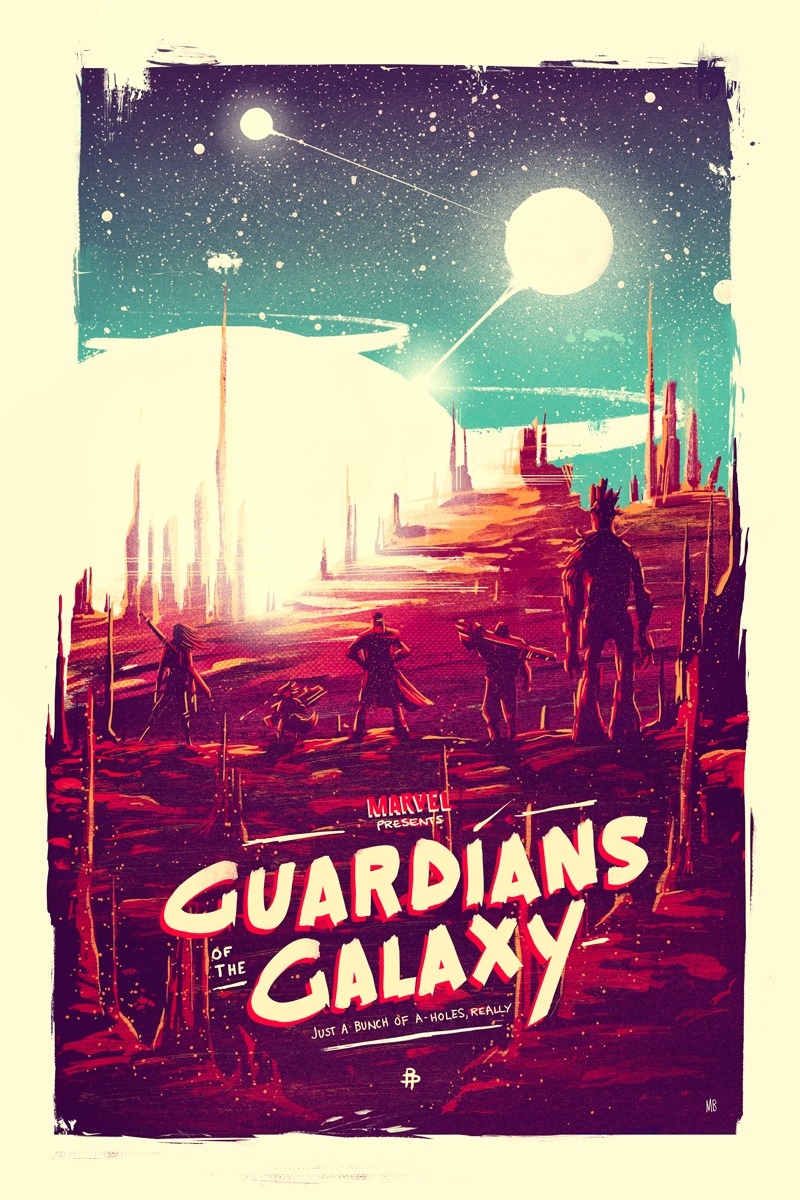
If I were to offer a capsule review of Guardians of the Galaxy, it would be this: It’s the first movie that I have seen twice in a theater since Star Wars Episode III: Revenge of the Sith. That means something, folks. I don’t get to the movies very often anymore, because it’s become a significant enough expense that it has to be something I most definitely want to see. Yes, there have been movies I’ve wanted to see again, but until now, none of them actually managed to get me to again.
Guardians of the Galaxy did.
Like many a person who went to see this movie, I never really heard of the Guardians of the Galaxy until I learned that this movie was in production. I did read some of the comics on a catch-up basis, and I enjoyed them, although I admit that I was a bit confused as to how this property would translate to the screen, especially being a part of the Marvel Cinematic Universe.
OK, for those out there not up on this jargon at all, here’s a brief explanation. Marvel Comics, like DC Comics before it, had a bunch of successful comics featuring popular superheroes. They quickly realized that they could make their entire line more successful if they had their superheroes team up with one another on occasion, which meant therefore that the Fantastic Four existed in the same “world” as Spider Man. Over time, the Marvel Universe got really big, with lots of heroes and hero-teams doing heroic stuff all over the place.
Interestingly, some of these titles had their own internal “mythologies” that were also part of the larger mythology, and there were differences in focus, too. Spider Man pretty much stuck to New York City most of the time, but then you had the X-Men occasionally going off to space, and the Fantastic Four facing giant cosmic threats, and so on. The Marvel Cinematic Universe is a filmed approach to this same notion, albeit with scaled down numbers of characters. Here, too, you have different things going on: Iron Man seems to exist in the techno-spy-thriller arena, whereas with Thor we have a hybrid of Norse myth and space opera. And with Guardians of the Galaxy, that’s straight-up space opera.
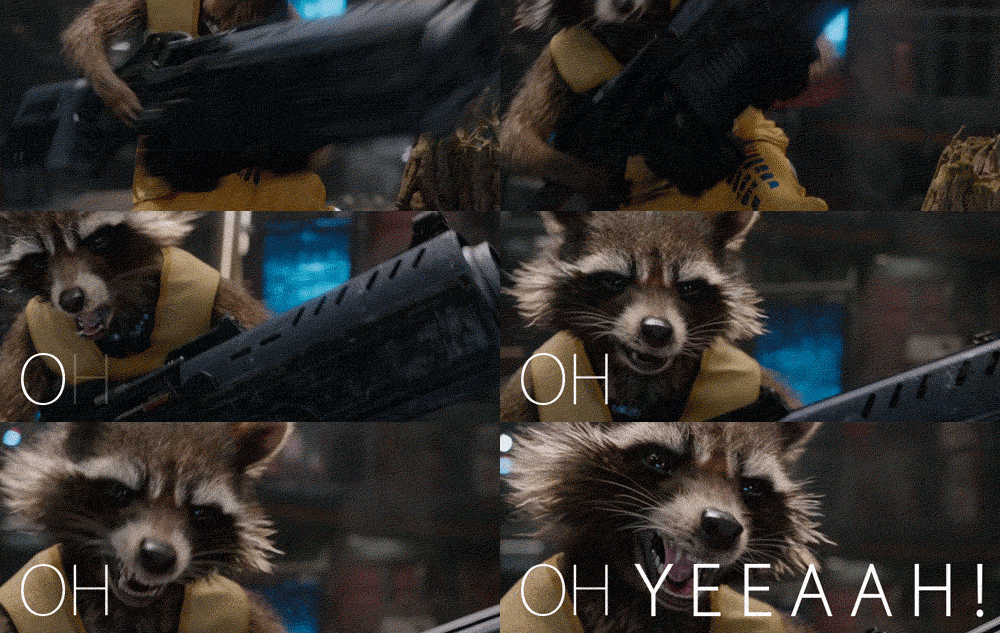
So that’s why I gravitated to Guardians of the Galaxy, obviously: because it’s a space opera, straight-up. Aliens, spaceships, ray guns, lost artifacts on deserted planets, space prisons, a bad guy who apparently sits on a rock in space as he plans, a peaceful happy planet under threat of annihilation by a villainous alien who has found a cataclysmic weapon. To quote the movie’s talking raccoon, “Oh, yeah.”
And yes, this is a movie that sends you out into the night quoting a talking raccoon.
When I was reading comics, the X-Men titles were written by Chris Claremont, who was good at creating a big sense of scale with very high stakes in his stories. Guardians of the Galaxy, as a franchise and now as a movie, seems to me best described as a good Chris Claremont story…as directed by Chuck Jones. Guardians of the Galaxy is full of heart and good cheer, creating a cast of flawed characters who have their own reasons for feeling like outcasts, and who then have to come together in order to save everybody else. What this film does in terms of its characters is a pretty amazing achievement.
The tone is struck early on. Before we even get the flipping-comic-pages Marvel logo, there’s a scene in which a ten-year-old boy has to say goodbye to his dying mother minutes before a spaceship comes to whisk him away. After that we cut to this same kid, now an adult, landing on a mysterious, damp, and rocky planet. He’s clearly looking for something, but before he does, he has one bit of business to attend to. He puts on a pair of earphones from 1985, clips an old Walkman to his belt, presses “play”, and as the strains of “Come and Get Your Love” by Redbone take over, he enters the cave in a sequence that feels partially reminiscent of the opening sequence of Raiders of the Lost Ark, only our hero, Peter Quill (who reasons we won’t find out until the very end of the movie also calls himself “Starlord”) seeks out the artifact he’s been hired to find. Only he does it in dance-step to the song, kicking rodents out of the way to the beat and then grabbing one to use as a prop microphone. That’s what kind of movie this is: a space opera about a thieving outlaw whose emotional center is the mixtape his mother gave him years before.

Guardians of the Galaxy does very little exposition that isn’t part of something else happening, which is part of how it seems shorter than it is. The film has very few infodumps, and really, it only tells you exactly what you need to know to understand what’s going on. Other than that, it’s illuminating to look back at the end and realize just how much the filmmakers have held back. Is Groot’s species ever named? His planet of origin? Rocket cries that he didn’t ask to “be made”, but who made him? We’re never told. Do we need to be? Probably not, because who hasn’t known what it’s like to carry around a burden that’s all your own, that nobody else understands?
A lesser movie might have given long flashbacks to some, or all, of the characters. We might have seen Peter Quill growing up on Yondu’s ship. We might have seen something of a raccoon being made sentient and, therefore, a freak. We might have seen where Groot comes from, and we might have seen Drax’s family being killed. We don’t see any of those things, because the film’s script keeps its eyes on the prize the whole way. That’s not to say the story isn’t complex, because it is, but the story is very tightly constructed. Each thing leads logically to the next thing that happens, and each character’s motivations are mostly clear. There is some muddiness, mainly in the villains’ backgrounds and motivations. No one, in any of the Marvelverse films, has yet asked the million dollar question, “What does Thanos want with all the Infinity Stones?” I imagine we’ll get there eventually.
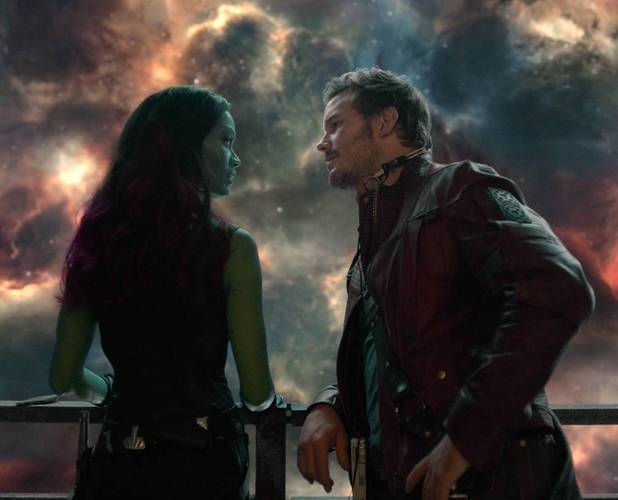
What this film has to do, along with all the other Marvelverse movies, is set itself into that larger universe where this smaller story is a part of something much bigger that’s going on. The Marvelverse films all seem to be slowly laying the foundation for an eventual cataclysmic encounter with Thanos, and I wonder how that’s going to go – is there a Really Big Movie slated for, say, 2019, in which everybody shows up? I suppose we’ll see. For now, we’ve got this one. One thing that was always so great about Marvel comics is that they always acknowledged, at their best, that they took place in a larger world, with which the main characters or heroes had to interact. That was always what informed their desire to do good, motivating all the world-saving they did. And there is a larger world in this movie, with real lives that intersect with those of our main heroes.
What I ultimately liked most about Guardians is that it tells a story depicting a cheerful world. The main planetary setting is bright and sunny, and even some of the other “darker” locations aren’t entirely dystopic horror shows. This movie, along with the two recent Star Trek films (even with their faults) make me wonder, and hope, if a shift toward a brighter tone of storytelling may be in the offing.
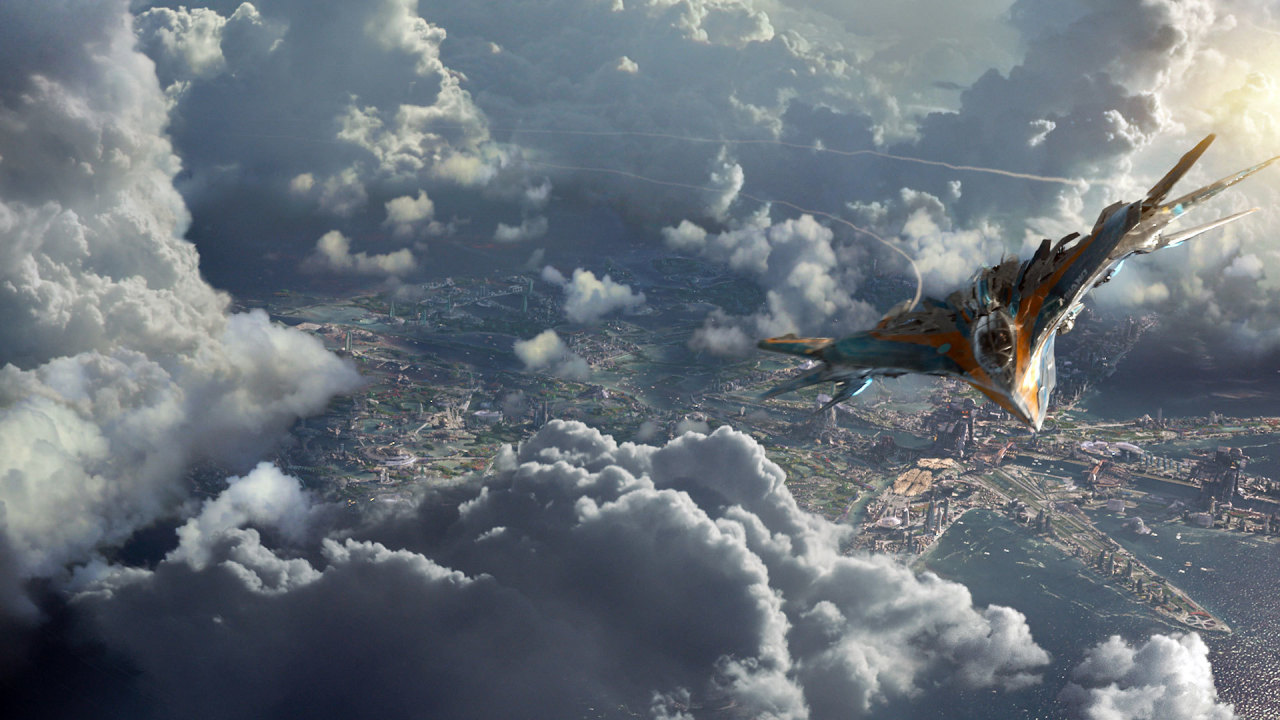
Guardians of the Galaxy is ultimately, for me, a movie that gets everything just about completely right. It’s hard for me to find a real flaw in it, at least, anything that really stands out. I love how the team comes together – the criminals that get arrested together end up staying together out of sheer desperation, only admitting toward the end that there’s any kind of factor involving liking one another. Peter Quill becomes a leader without ever having any Big Moment In Which He Confronts His Own Darker Nature, which I appreciate. That’s what this movie does so well: it’s a nearly perfect example of what might be the most often-cited bit of advice for writers.
Show, don’t tell.
Guardians of the Galaxy shows things. It doesn’t slam on the brakes to tell you things.
A few random thoughts:
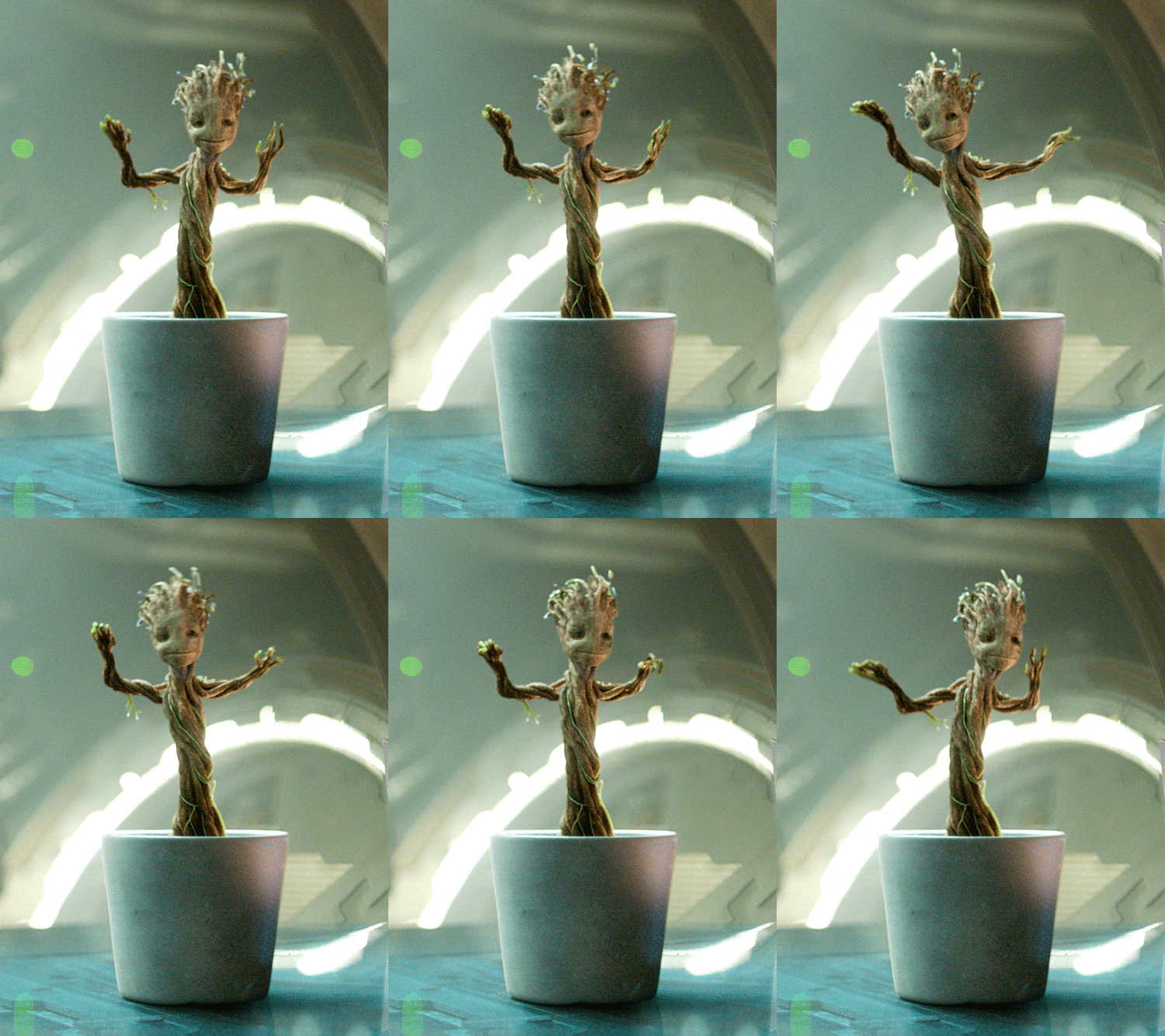
:: People who whine about “soulless CGI effects” whilst pining for the good old days of rubber costumes and model spaceships really need to shut up after this film, which proves, I think, that effects themselves either have “soul” or don’t on the basis of the screenplay, and not the effects. The most emotional moments in this movie involve a purely digital character whose dialogue consists of just five words. From now on, if you want to talk about soulless CGI, there’s the door. Talk about soulless writing.
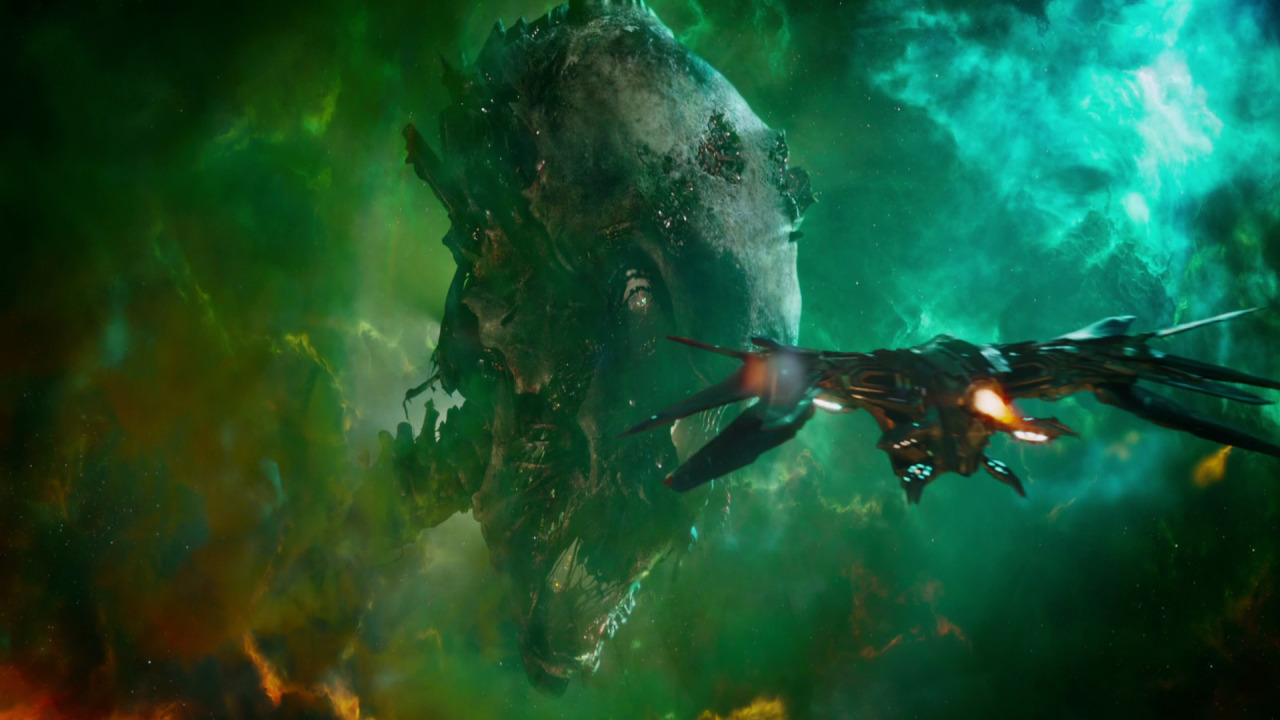
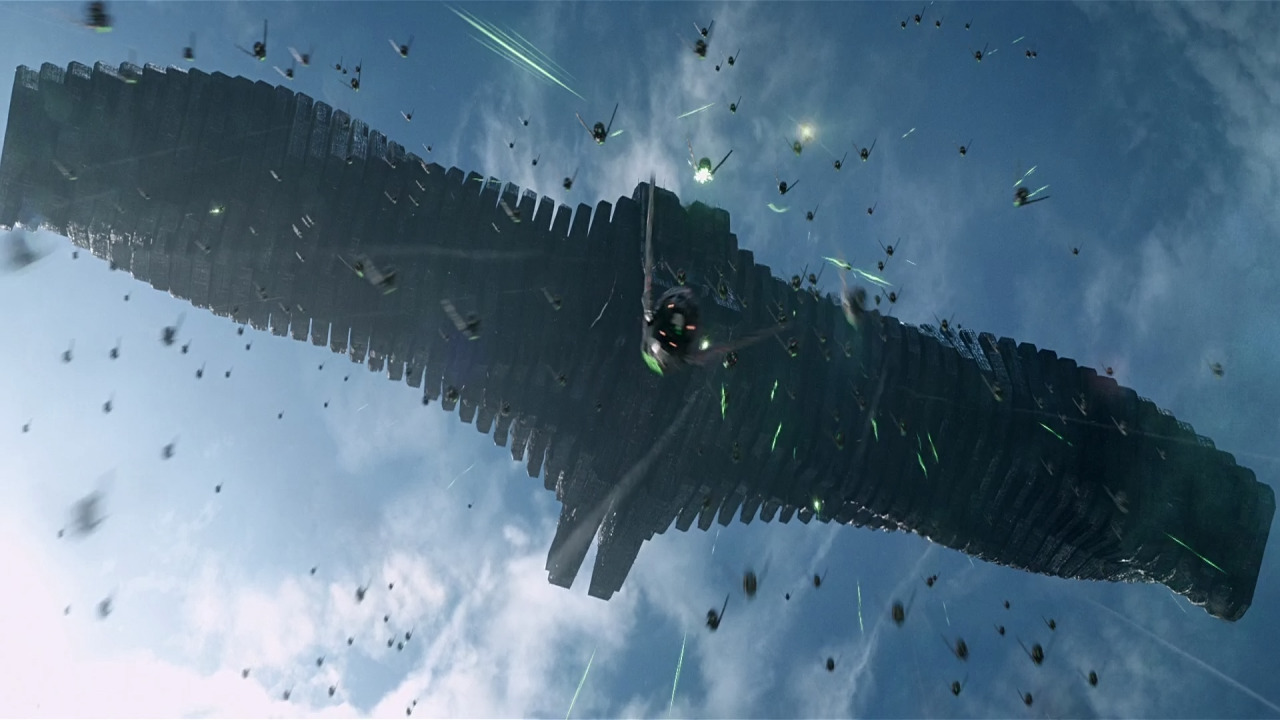
:: Space opera movies should be a visual treat, and this one is. It has a look all its own, with swirling clouds of space gas and ships with neat geometry.
:: There are a couple of scenes where Rocket responds to Groot as if he’s said something other than “I am Groot”, which makes me wonder – is this like a Han-and-Chewie thing, where Han can totally understand Chewie’s grunts? Is Groot actually saying things, or is Rocket just plugging in meaning where he sees fit? Interesting.
:: Tyler Bates’s score didn’t impress me the first time I heard it (before I saw the film), but when heard in the proper film order, with the classic rock songs mixed in, it becomes a very entertaining listen indeed. This isn’t great film music by any means, but it’s fun to hear. Those songs are perfectly chosen, by the way; each one hits the mood dead-on when it comes up in the movie. If you want to program a playlist for the score and songs in proper order, someone on the FSM boards figured this out. I knew there was a reason I still visit that site a couple times a week!
:: Great details abound in this movie. When the Guardians do their stereotypical “slow heroic walk down the corridor”, Gamora is yawning, Rocket is adjusting his nethers. Also, there are so many tiny character moments that add up to great stuff. Frequently these involve Rocket, such as when he throws a damp blanket on Drax’s self-pity, a favor which Drax returns at the end of the film when Rocket is suffering his own brand of heartbreak. And notice Rocket’s response: it’s like he’s never had his fur stroked at all, which he probably hasn’t. When Gamora starts to dance, it’s not a full-fledged dance, just a slight rhythmic swaying. And when Peter gives Yondu the orb, it’s interesting to me that Yondu waited as long as he did to see what was inside. Judging by his smile, he seems to have known – and not only that, he seems to be just a little bit pleased. Yondu is presented as some kind of father figure to Quill, and there’s something in his smile that says, “Yeah, that little shit turned out all right.”
:: Yondu’s pretty interesting on his own, and that’s something I always liked about the Marvel comics: the way the heroes could fight the villains one issue and have to team up with them the next. The line between hero and villain is more interesting when it’s moving around, isn’t it?
:: So where do the Guardians of the Galaxy go from here? In all honesty, I hope they stay where they are: out on the far-flung frontiers of the Marvel Universe, only having the briefest and most tangential contact with the rest of it, if any at all. It’s a big Galaxy, after all; somebody’s got to guard it!
Share This Post

I’m not interested in being “normal”.
Some Random Pictures From Tumblr
Costa Del Terry! Pegulaville! Marina del Kim! Otisburg….Otisburg?!
Lots of football news of late. Not all of it is depressing, but quite a lot of it is.
:: The most positive story is that, pending NFL approval, Terry and Kim Pegula are set to become the new owners of the Buffalo Bills. This is, well, huge. Worrying about the team’s future viability in Buffalo has been one of this region’s favorite pastimes for years, going all the way back to the late 1990s, and maybe even earlier than that. Ralph Wilson fueled some of this by deftly “convincing” local officials to pony up lots of money to renovate county-owned Ralph Wilson Stadium, and by stalwartly insisting right up until the end of his life that he had no secret backup plan to secure the team in Buffalo. Wilson maintained until he died that the team would be put up for sale to the highest bidder, and that’s what happened.
It didn’t help, in the late 1990s, that a bunch of NFL teams really did move for more lucrative cities: the LA Rams went to St. Louis, the LA Raiders went back to Oakland, and the Cleveland Browns moved to Baltimore. That last, however, did give the league enough pause to promise Cleveland an expansion franchise in a couple of years, and they even went so far as to declare the newly moved team a new franchise in terms of the NFL record books, so the Ravens can’t count Jim Brown among their historic greats. Nobody ever thought the NFL would make any such motion to keeping football in Buffalo, and then the team started playing one game a year in Toronto, supposedly to help make money, but which felt like the first step in what would be a long, slow move.
The Pegulas are enormously wealthy, having made their fortune in the natural gas industry. Interestingly, no one around here had even heard of the Pegulas, despite their ties to the region, before Pegula announced his desire to buy the Buffalo Sabres a few years ago. It was the scenario that only the most optimistic people dared voice: “Oh, I don’t worry about the team. When Ralph dies I’m sure some rich guy who used to live here will step up and buy them to keep them here.” Well, that’s pretty much what happened.
Is it a good thing that the Bills are staying? Sure it is. I’m not nearly as convinced that the team is as essential to the local mindset as some are. If the Bills moved, it would be a body blow to the psyche around here, but things would heal, in time, as they always do. I don’t think the team leaving would be anywhere near as bad a blow to the economy as many do, but it wouldn’t be good news, certainly. It is nice to know that people around here no longer need worry about that. The Pegulas’ ownership of the Sabres has been a bit rocky thus far, and there’s the fact that their fortune springs from fracking for gas, which is less than environmentally sound. But, for good or ill, the Bills are here. My personal fandom may be on the wane, but that doesn’t mean I wish for them to leave and break the hearts of a lot of people I know. I do wish that the football team didn’t command so large a presence in our community’s emotional life, but that’s the way it is.
:: I see that Penn State students still think that they and their football team were the real victims. I couldn’t invent a more perfect example of the degree to which a sport’s emotional hold over its fans can become toxic if I tried.
Someone on Metafilter pointed out the following: “In NCAA math, l’affair Sandusky (2-year bowl ban, 20 scholarships) is now officially less egregious than Reggie Bush taking money (2-year bowl ban, 30 scholarships).” Child molestation is second to a player taking money he shouldn’t have taken. But then, that shouldn’t be surprising, because…
:: …Then there’s Ray Rice, whose wife-beating was originally judged by the NFL to be not-so-bad a violation of its internal morality as smoking marijuana. Of course, then the rest of the video got released, forcing the NFL’s hand because of public relations reasons.
It interests me to see the NFL taking such a hit over this one, to the extent that Roger Goodell himself is feeling a lot of heat. Quite well he should, since it’s absurd to think that the NFL was genuinely surprised to see the entire video recording or Ray Rice punching his wife. (I continue to be confused as to why no charges have been filed in this matter. Obviously I’m no expert, but in a case like this, can it really be that if his wife declines to press charges, none will be filed? Is that really how it works? “We have video of a crime being committed, but the victim says ‘No’, so we don’t pursue it”?!)
One person said on Twitter that it’s important to remember that the NFL didn’t act when they saw the video, they only reacted when you saw the video. That’s right, and it’s saddening, but again, not terribly surprising. What I think happened here is that Goodell figured the national media would pretty much do the same thing they did when he “investigated” the New England Patriots during the Spygate scandal: just say “OK, Mr. Goodell, thank you for your time” in response to his “I’ve investigated and handed down a punishment and we’re done here.” This time, though, it wasn’t the national media that was driving the story, but rather TMZ, an outfit somewhat notorious for not really giving a shit.
I hate that it takes a woman being beaten to make it happen, but I’m always happy to see the NFL’s image get tarnished a bit. The league holds too much power and mystique in this country, for what is essentially a rich kid’s club.
:: The Bills are 1-0 and hosts Miami Sunday. Go Bills, squish the fish! (I know, they’re not fish. “Pummel the mammals” doesn’t do it.)
Share This Post
Something for Thursday: In Memory
It’s amazing how banal it can be, when we learn the world has changed. I was sitting in a Tim Hortons drive-thru.
The following piece of music is the first music I was able to listen to after those events. I performed this piece with the concert band in college, as a freshman. It’s a deeply powerful and meditative work that always seems to me an exploration of death and the vigor with which life struggles against it, with hints of liturgy and hymn throughout. I actually uploaded this piece some years ago, but when I consolidated some accounts, this piece went away, so here it is again: “Elegy”, by Mark Camphouse, performed by the United States Marine Band.
The following is a story I wrote a month or so after 9-11-01. I repost it here every year on this date.
There is never any rest for me, the Ferryman of the Dead.
I pole my barge across the black waters and up to the pier. So many wait this time, many more than usual. I wonder what has happened, what event has sent me this many. “Come aboard,” I say. “I will take your coin for passage.” One by one they file past me, each handing to me the coin that they never knew they had. It is the coin which determines where they shall be taken to rest, its metal shaped and determined by life. The coins of these dead are gold, every one of them purest gold. Six thousand come aboard my barge, and each has passage for the farthest and greatest of destinations. In that moment I know that something truly dark has happened; the gold coins are always forged in moments of darkness. I am the Ferryman. I can give them no answers to what lies behind their haunted, questioning eyes. I can only take them on this, the last of all journeys.
When they are all aboard I take up the pole and push away from the pier. The barge always feels the same, no matter how many stand upon its decks. Whether six or six thousand, it is all the same to me. I guide us out onto the River Styx. Some of the people look worried, but there is no need for fear. This river can do them no harm. They are already dead.
This is to be a long journey, I know – it always is, to this destination. As I guide the barge through the black waters, I look on the faces of those who have come to me. As different as these people all look, they all have the same expressions of shock, disbelief, and withering sadness. Here is a man of business, talking into a cell phone. He is trying to call someone, anyone, who will tell him that it’s all a dream, that it didn’t happen, that he didn’t die in a blast of fire, smoke, glass and steel. There is a mother who is explaining to her daughter that they won’t be going to Disneyland after all. And there, a group of firemen stand together, realizing that soon they will meet all their brothers-in-arms who have gone into the infernos before them. So many now – colleagues once in business and now colleagues in death, people who have never before met but now have the gravest thing in common. As the current takes hold, I look back at the pier. There are more gathering there. There are always more. They will wait. Time does not exist for the dead.
“Please,” a young man says as he turns to me, “I have to go home to my daughters.”
“You are going home now,” I reply. “To the home where all eventually return.” Two black rocks slide past on either side, the rocks that mark the passage of the circling Styx.
“This can’t be,” a woman cries out. “My mother needs me.”
“She will be with you soon enough.”
“When?” Her voice pleads, and yet there is no solace that is mine to give.
“I cannot say,” I reply. “The Ferryman has no hand in Fate.”
The tears come then, tears from the six thousand that run over the gunwales and into the river which has been fed by tears for centuries. All tears are born in the River Styx.
“Where will you take us?” someone asks.
“To the place you are promised,” I answer. I recall the words of a poet: Will there be beds for all who seek? Yea, beds for all who come.
One our left we approach the Hills of the Damned, an endless stretch of shattered lands which reach away into the blackness. The waters echo with the cries of all those who have been taken to the Hills for the agony they have brought on the living. I consider the bag of six thousand gold coins, and I realize that I will have to journey to the Hills this day. There will be a person, perhaps more, who will pay me with a coin of black tin; but not on this journey. As the hills recede behind us, the unending cries of the damned become fainter and fainter until they are drowned out by the lapping of the waters upon the sides of the boat and the marker stones that we pass. The six thousand fall silent, each realizing that it is not a dream. I would offer solace, but as ever I cannot. I am the Ferryman.
We come around a particularly dark bend, and before us lies a very wide expanse of water, as if the Styx has become an ocean – which in some sense it probably has. And beyond that expanse are the thousands of twinkling lights that I have come to know so well. One man, a fireman, sees them too. “What is that?” he asks.
“It is the City of Dead Works,” I reply. The lights of the city glow on the horizon, and every one of the six thousand turns toward them as the Styx impels us onward. As we come ever closer to the city, the glittering lights reflect off the black water.
“I don’t understand,” someone else says. “The City of Dead Works?”
“Aye,” I reply. “Behold!”
From behind us, golden light: the Sun of the Dead is rising as it always does when the dead come near the City. Above us the firmament is turning purple, then blue; soon the light of the Sun will illuminate the City of Dead Works. As the sky lightens, the true scope of that city becomes plain: it stretches away into the land, farther than any eye could see. Not even the highest-soaring raven, cavorting in the breezes and zephyrs of the dead, could take it all in. It is bigger by far than any one city ever built by the hand of men, because it encompasses some part of all of them. Perhaps it is bigger than all of the cities ever built. Now the sun’s first rays come up behind us, and the first buildings can be seen down by the water.
“That one looks Egyptian,” a woman says.
“The Great Library of Alexandria,” I tell her. “Once the greatest repository of learning the world had ever seen, now only a memory to the living and a reality only to the dead.”
A man points to a building high upon a rock. I nod.
“The Temple of Solomon,” I say.
“There are ships in the harbor,” says another. Thus for him I name the ships: Arizona, Indianapolis, Lusitania, Bismarck, Wilhelm Gustloff, Cap Arcona. And many, many others. I scan over the impossibly vast city and spot Dresden, as it was; and beside it the cities of Hiroshima and Nagasaki. And how many smaller villages, tucked into the hills beyond the City? None can say. The Sun of the Dead shines upon those hills now, and the great stone statues in the likeness of Siddhartha Gautama.
“I don’t understand,” a young man says. “Why this City? Why here?”
I only shake my head as we continue to float by the City. I do not point out the fairly small, nondescript office building that sits near the water. It is not a particularly remarkable building; nor was it, really, until the fuse was lit. The six thousand almost don’t recognize it.
Almost.
Not one word is uttered as we slide past the Alfred Murrah Federal Building. Then we turn away from the City of Dead Works, and head again down the waters of the Styx toward distant hills and the place where these people will join their brethren.
“Who lives in that city?” It is a priest in a fireman’s coat.
“No one lives there,” I tell him. “The City of Dead Works is not for people. It is for the buildings and the ships. It is for the books and the music, the sculptures and the paintings which are gone forever. It is for everything destroyed by craven people in the name of foolish wars, for everything judged forfeit in the face of transitory desires.”
The Styx takes us into the Golden Hills. Soon we will be there, and the six thousand will go where they belong. And then the Styx will complete its circle, taking me back to the pier where more dead await.
“We will be there soon,” I say. “Soon we will be at the Elysian Fields, where all heroes go – for that is what you all are. It is what you have bought with your lives, with the shaping of your coins into gold.” No one replies. We near the last bend now, and before us lie the Elysian Fields, where peace reigns and where heroes dwell; where all is light and voices are always raised in song. The Sun of the Dead shines warmly on Elysium.
But they do not see it. They, the six thousand, all gaze back behind us upon the City of Dead Works. It will soon be behind us forever as we round the last bend of the River Styx into Elysium. I know they all need one last look upon that City, and I do not grudge them that. For myself, I do not look back; the eyes of the Ferryman are ever forward. But I know. I know that the City of Dead Works is different now. I know that it has changed. I know that the people who come with me now to Elysium, the dead around me, look back on the two soaring towers of steel that now rise above the City where there had been no towers before.
I know these things.
I am the Ferryman of the Dead.
Share This Post

A Random Wednesday Conversation Starter
Overdyed Overalls
So, over the years, my obsession with overalls has led me to the realization that they’re not really known for color. There really aren’t a lot of options: blue, mostly. Hickory stripe, too. White is also an option, but the problem with white is that it’s used almost exclusively in “painters” overalls, which for some reason means that the bib pocket is an odd triangular shape, which doesn’t thrill me all that much.
When I branched out into Carhartts, that yielded a few new colors: black, a couple shades of brown (although I don’t own the lighter shade of brown yet), and a hunter-green pair. This last took some searching, as Carhartt doesn’t make the hunter green anymore. Key used to make overalls in a fabric called “herringbone”, for which I’ve been prowling eBay, but what I’ve really wanted was a nice pair of overalls in a burgundy red.
Which eventually led me to remember this old blog post by a fellow traveler in the world of overalls, and I thought, “Hmmmm…I could do that!” For some reason, I never thought of just dyeing a pair into a new color. Whenever I saw some different color of overalls out there in the world, I always assumed for some reason that the company made those for a while but then they stopped…not unlike this pair of Key overalls Anne Hathaway rocked in the movie Love and Other Drugs:
I figured, at some point Key actually made overalls like that, and hey, for all I know, maybe they did. I own a pair of black Dickies that are essentially overdyed hickory striped overalls.
But after learning, and remembering, about overdyeing, I set out this weekend to do just that. I used three hickory-striped pairs, which looked liked this to start with:
My dyes are from Dharma Trading, and I followed their instructions for tub-dyeing. I did two colors: Maroon (two pairs) and Forest Green (one). I was hoping for a burgundy outcome on the maroon pairs; the idea is that the white stripes take on the dye color while the blue just darkens a bit. The entire process took a few hours, from immersion…
…to rinsing.