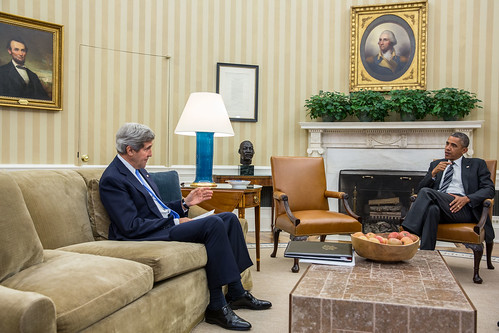
Where are all the wall sconces that Bartlet had?


P072913CK-0285, originally uploaded by The White House.

Regular readers know that I’m a big fan of photography relating to the office of the President of the United States, which is why I’m a huge fan of the Official White House Flickr Stream, and likely would be no matter who the occupant of the office itself.

That said, after looking at these photos of President Obama’s Oval Office for four-and-a-half years now, how is it possible that I never noticed, until this photo right here, that Godawful blue lamp? That thing is terrible!

You can’t see it here, but there’s a matching one on the endtable to the President’s left. Jeez, what an awful lamp. I can’t not see them now, every time I look at an Oval Office photo.

OK, moving on.

Share This Post

The rules for reading

I discovered this article sitting in my ‘Blog Fodder’ bookmark folder, and I figured I should address the topic. It’s about reading, and the rules we adopt for how we go about reading. Here are the rules the author posts (I snip the explanatory content, so please go read the article for more!)

1. Always stop at the end of a chapter. Always.

I really try to do this. Failing this, if the book has longish chapters and I’m really tired and I know I’m not gonna make it another ten pages, I’ll read to the next line break. Books that never use line breaks or section breaks tend to really madden me. The most infuriating case of this that I recall off the top of my head is The Illuminatus Trilogy, where the authors completely shift topics, locations, and whatnot from one paragraph to the next, no break whatsoever. But I do look for logical breaking points.

2. Use specific bookmarks.

I don’t use specific bookmarks for specific purposes or books, but I do have several that I use regularly; one is my old Borders Rewards card, with which I simply cannot bear to part. I carry a piece of Borders with me, always! (Hey, I spent many a wonderful hour in Borders.)

2a. No dog-earing, bending, or folding of pages.

I agree with this wholeheartedly. My librarian mother drilled this into me at a very early age, and I’ve never once rebelled against this since. I hate dog-earing pages, and it bugs me to no end.

2b. Weirdly enough, spine-breaking is fine, just don’t get too crazy with it.

Enhhhhh…I’m not a fan of spine breaking. I know it happens, but I really try to avoid it, as much as possible. The only exceptions are cookbooks, which I want to lie as flat as possible while I’m cooking, but you know what? Lots of times I won’t even break the spine with those.

3. Always read two books at once.

More than that, if I can! The trick is to vary the genres, or have one non-fic and one fiction going at once. Graphic novels can be fit into the reading schedule in this way, too. I only read one book at a time if one particular book sweeps my imagination away.

4. No (or minimal) writing in books.

Agreed. I used to write all manner of marginalia in my academic books at school, such as all my various philosophy books. Now I can’t abide the practice. The only acceptable writing is a note to the receiver in the frontispiece, if the book is a gift. Otherwise, no writing!

5. Rereads must be earned because there are too many great books out there to read an okay one twice.

I’d agree with this. I don’t do a whole lot of complete re-reads, but I will dip into books now and again to refresh my memory on passages. Guy Gavriel Kay, Christopher Moore, JRR Tolkien, and JK Rowling are on my list of re-read authors. Carl Sagan, too. Maybe a few others. In general, I approach re-reads as I do anything else: “What am I in the mood to read right now?”

What other rules do I have? Well:

6. Not finishing a book is OK.

Seriously, I just don’t have time to read everything, and if a book isn’t working for me, it’s OK to stop and move on to something else.

7. It is always better to take more books on a trip than you think you’ll possibly have time to read.

Because how do you know how much time you’re gonna have?!

8. Having a favorite genre is fine. Getting stuck in that genre is bad.

Variety is a spice. Or something. You can look it up.

What are your rule for reading?

Share This Post

Sentential Links

Linkin’ my way around Blogistan….

:: Today, I had the image of a chalkboard in mind. Remember, at the end of the day, when it was covered with what had been written, erased, written over? Throughout the day, new information on top of old, learning, more and more. Then, at the end of the day, it would be wiped clean with a wet sponge. It was best if you took time and did it in straight lines, leaving few streaks and a nice, orderly clean board ready for the next day. (Nostalgia note: I don’t particularly miss chalkboards, but I do miss the sound that chalk made on the slate as it wrote. I remember when I’d get a chance to write at the chalkboard and I’d wonder, “Why is Mrs. Pnakovich’s writing so amazing on this thing, and mine looks like crap?” Years of practice, obviously….)

:: Enough, DC. Every character doesn’t have to be 1970s Spider-Man, hunted and feared. Enough having heroes kill, or being made to look like they killed. Enough secret government agencies dedicated to controlling/fighting/eliminating heroes. Enough fear and distrust by the press and public when these guys have saved the world seven times over. Enough.

Let. Heroes. Be. Heroes.

:: Being the terrible blogger that I am, I have totally neglected mentioning the fact that we got a cat this year.

:: Fan fictions are hard for me to let live outside of my imaginations. I’m basically playing with someone else’s characters for a while, whom I think I know but don’t really. (I couldn’t agree more, which is why when I committed acts of fan fiction way back when, I didn’t even use the names of the characters — I gave them new names and reworked them in directions I wanted them to go. This blog belongs to one of my Instagram contacts.)

:: She will not mourn this empty bed. (Another Instagram blogger. I’ve met a lot of writers there. We’re all chasing the dream!)

:: A question I’m always asked is why don’t I put my writing “out there” more? The answer is: Because I am, essentially, a weenie. You can judge me now. Go ahead. I’ll wait. (Nah. No judgment here!)

:: Nobody comes to the ballpark to see a closer, no matter how good he is. Not even fans of the team he pitches for want to see him pitch because his appearance means their team isn’t winning handily going into the eighth and ninth innings. They’re glad to see him, but they’d rather their team was up 6-2 at this point than 2-1. If the closer comes in with his team up 6-2, that means the game is in the process of being lost! And while there are plenty of ways a 2-1 game can be exciting, the closer isn’t really part of it. His job is to put an end to the excitement. (Hmmmmm. See, I don’t know about this. There are times when you desperately want to see your closer out there. Especially if your team doesn’t have a closer. Believe me, if the Pirates had had a real honest-to-God closer in 1992, I would have been thanking every God, Goddess, and eldritch power that has ever existed to see him take the mound in the ninth inning of Game Seven of that year’s NLCS. Because the inning that ensued, as the closer-less, bullpen-by-committee Pirates — forced to try to ride the weary arm of Doug Drabek one more inning before handing a bases-loaded jam to Stan Belinda, who had all of 18 saves that year — surrendered both their 2-0 lead and, with it, that year’s National League pennant, is to this day the single most gut-wrenching thing I’ve ever seen in sports. And I’m a Buffalo Bills fan who had to endure Wide-Right just eighteen months earlier.)

:: I’m ready for bed, but more importantly I am excited about tomorrow. I think that is what success really is, at least to me. To go to sleep happy and tired and excited about nothing in particular but the possibility ahead. Some folks never get to feel that, or gave it up long ago. I’m still on that horse. It’s worth it.

More next week!

Share This Post

Sunday Burst of Weird and Awesome

Oddities and Awesome abound!

:: Remember those old “Deep Thoughts by Jack Handey” humor bits on Saturday Night Live? I always figured that they were written by staff writers and just put up under a generic name. I didn’t realize, until last week when I bookmarked this article, that Jack Handey is a real guy. Wow.

(Yes, this makes me feel like an idiot.)

:: A different hypothesis about vampirism. Wow!

:: A Chinese bakery’s plan to use drones to deliver cakes has been shut down. This is very likely a bad idea for obvious reasons, but me being me, I can’t be totally dismissive of cakes or pies flying through the air. As someone is quoted: “What if a cake fell on a passer-by from the sky?” Indeed.

(BTW, the headline on that story is figurative, not literal. This also disappoints me.)

More next week!

Share This Post

It was the best of times, it was the worst of times….

I saw, via Facebook, this fascinating article by Stephen King about opening lines. It’s very much worth reading, as is the follow-up article that solicits favorite opening lines from twenty-one writers.

Stephen King: There are all sorts of theories and ideas about what constitutes a good opening line. It’s tricky thing, and tough to talk about because I don’t think conceptually while I work on a first draft — I just write. To get scientific about it is a little like trying to catch moonbeams in a jar.

But there’s one thing I’m sure about. An opening line should invite the reader to begin the story. It should say: Listen. Come in here. You want to know about this.

How can a writer extend an appealing invitation — one that’s difficult, even, to refuse?

From the second article:

“Where’s Papa going with that axe?” said Fern to her mother as they were setting the table for breakfast. –E B White, Charlotte’s Web

Not the way you’d think a children’s book about a pig would open, and it instantly sets the central fear at the heart of this story: death.

I’ve been mulling this over a bit. The fact is, a great first line doesn’t really make me want to keep reading; nor does a bad one make me stop. I’ve read all manner of books that I love whose first lines I honestly don’t recall, and I’ve read books I didn’t care for whose first lines I do. So it’s not quite a cut-and-dried as all that. But a good first line is still preferable to a bad one or a lackluster one, and a good first line does reveal an author at work who has put some very real thought into things.

Great opening lines I remember? Well, I tend to think in terms of entire opening passages, rather than opening sentences. The way JRR Tolkien opens The Hobbit is utterly masterful: “In a hole in the ground, there lived a hobbit.” Right up front, we’re in the world of strange beings we haven’t heard of, who live in their subterranean world. He goes on to establish more of what a hobbit is and what they do in terms of living in holes, and by the end of the second paragraph, he’s got me hooked. And of course, there’s the famous opening paragraph to A Tale of Two Cities:

IT WAS the best of times, it was the worst of times, it was the age of wisdom, it was the age of foolishness, it was the epoch of belief, it was the epoch of incredulity, it was the season of Light, it was the season of Darkness, it was the spring of hope, it was the winter of despair, we had everything before us, we had nothing before us, we were all going direct to Heaven, we were all going direct the other way — in short, the period was so far like the present period, that some of its noisiest authorities insisted on its being received, for good or for evil, in the superlative degree of comparison only.

In science fiction, Simon R. Green’s Deathstalker has a wonderful beginning, even if the rest of the book doesn’t quite measure up. But for my money, my favorite opening line of all time doesn’t even come from a novel or other work of fiction. It is the way Carl Sagan brings us into Cosmos:

The Cosmos is all that is, or ever was, or ever will be.

Just thirteen words, and Sagan establishes that we are going to be talking about everything, and that the wonder is to be found everywhere. Amazing.

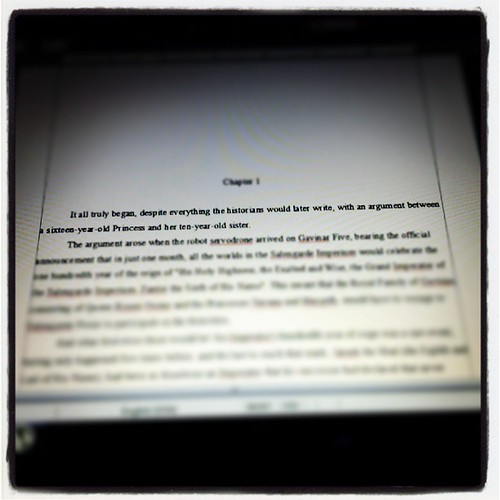
I was interested to read that Stephen King works very hard on his first lines, right up front, before moving on to the rest of the book. Yes, he’s Stephen King and I’m me, so what do I know, but I do the exact opposite: I charge in full-speed ahead and don’t pay any attention to the opening line until I’m into the editing phase. In the case of Princesses In SPACE!!! (not the actual title), I didn’t have an opening line until well into the first round of edits. I mean, I did have an opening line, but I came up with a different one.

And, for those curious, here it is:

The first line of "Princesses In SPACE!!!" (not the actual title). #AmWriting

How does it work? Well, I suppose we’ll see.

Share This Post

Star Trek Into Frustration

Well, despite my initial intentions to not see the new Star Trek movie until the DVD came out, a number of factors intervened: the fact that we went on vacation (and seeing a movie on vacation is always fun), and The Daughter’s crush on Benedict Cumberbatch. So, off we went to see the movie. I expected that my reaction would be similar to that I had for the first one, and sure enough, it was. I loved watching it. It’s a tremendously entertaining movie, expertly paced, wonderfully shot, beautifully acted. It scratched my ever-present itch for Explodey Spaceshippy Goodness, just like the last one.

And it frustrated the hell out of me on the script end, just like the last one.

On the design end, this bunch of filmmakers is getting so much right. I love the look of the world they’re in; I love that it’s not ‘dystopia as far as the eye can see’, as is so often the case in SF these days. I love the look of the ships, and I don’t even mind JJ Abrams’s somewhat-infamous lens flares. This movie, as much as the last one, looks the part, and it does a really nice way of bringing those old 1960s-era costume designs into a future in a way that doesn’t look completely ridiculous.

Also, the cast continues to be superb. About the only weak link I’ve found thus far is the fellow who plays Sulu, and really, how could you tell, given how little he has to do? This group has real honest-to-God chemistry, and watching them interact is most of the fun.

So why is the script so maddening?

Let’s just get my little “Star Trek fanboy” complaints out of the way first. I know, I know, “This ain’t your daddy’s Star Trek!” But the producers keep saying that basically, yes, it is; it’s the exact same universe, but time went in a different direction, so different stuff happens. So as nifty as the visual is, I can’t get behind the Enterprise hiding at the bottom of an ocean. I can’t get behind starships going to warp speed while in a planetary atmosphere. (They did this in Star Trek IV: The Voyage Home as well, and yes, it bugged me then, too.) And I can’t get behind two starships having a firefight while in warp.

And…Khan.

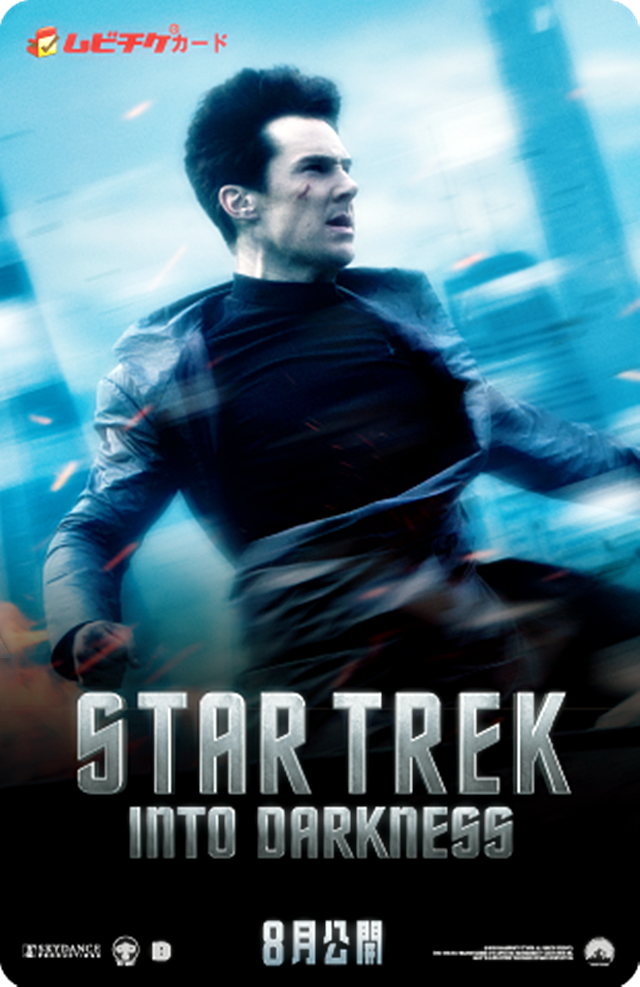
I really don’t know what the whole purpose of using Khan in this movie was, except to use Khan in a movie. It’s very strange. Benedict Cumberbatch turns in a frankly wonderful performance of the scenery-chewing villain (although he’s so flamboyantly chewing the scenery that I was disappointed that the film put him in an all-black costume, instead of clothing him more interestingly). But the script – but Roberto Orci, Alex Kurtzman, and Damon Lindelof – does absolutely none of its own heavy lifting. When we finally get to Cumberbatch’s big reveal – “My name is KHAN!”, complete with rumble in the soundtrack’s bass – it’s clear that Orci, Kurtzman, and Lindelof aren’t interested in creating their own emotional space here. What they’re after is mining the original. We’re meant to feel something, some kind of dread, when we learn that we’re dealing with KHAN here. But the script doesn’t bother to earn that moment. The proper response there would be for Kirk to blink and say, “Is that supposed to mean something to me?”

Ultimately, the script for this movie is really lazy. It’s lazy in the way it brings Khan in for no real reason other than that he comes with a built-in story that doesn’t need to be explained or elucidated, and it’s lazy in the way it converts Khan into a mad killing machine. The original Khan was a charismatic leader, almost a genetically-enhanced Hitler. He was megalomaniacal and wanted to rule a world that he made in his own image; we see none of that in this movie’s Khan. He pays very brief lip service to his followers, but as they all spend the entire movie in suspended animation, that’s all we know of that. There’s no real sense to what, if anything, really drives Khan to do the things he does, other than a vague “I’m mad at the world!” kind of thing, which is pretty much what Eric Bana had as the bad guy in the last Trek movie. Of course, Cumberbatch is leaps-and-bounds better than Bana as an actor, so he’s able to imbue his Khan with menace that Nero never had, but ultimately, it’s a case of “So what?”

(Brief pause here to note that I’ve always had problems with Star Trek II: The Wrath of Khan on kind of the same basis. Yes, it’s a great movie – although I do not think it the best of the Original Series movies, even though popular culture insists that it is – but I’ve always had trouble with the way it takes the interesting set-up of the original “Space Seed” episode, which ends with Khan and friends being left on a wild and untamed planet, and reduces it to, “Nothing came of that and now Khan is furious and insane”. More interesting, I think, to see what kind of society Khan would have built if he’d had the chance. Wrath does pay lip service to this, when one of Khan’s underlings tries to talk him out of his “Hunt down Jim Kirk” plan – “You have a ship! You have Genesis! You can have whatever you want!” – but that goes nowhere. Wrath uses a great villain to great effect, and yet I always feel that it was a wasted opportunity. Of course, this is hindsight, when back in 1982, if Wrath didn’t do well, Trek as a whole would have likely died on the vine.)

I’ve heard Into Darkness praised for its subplot about the militarization of society and the rise of a security state, but I’m wondering – just what is the justification for all this? In the real world, real events happen that jolt society in those directions. Where is the 9-11 event in Star Trek Into Darkness? We don’t know, so Admiral Marcus’s plot ultimately boils down to more scenery-chewing villainy. Orci, Kurtzman, and Lindelof give us yet more villains whose motivations are barely enough to motivate them to get out of bed in the morning, much less wreak galactic havoc.

“This ain’t your daddy’s Star Trek!” Well, if that’s the case, then why is the entire movie little more than a giant re-creation and inversion of the emotional beats at the end of The Wrath of Khan? Because that’s what this movie is, to the point of recycling dialogue and visual cues. It’s incredibly lazy writing, and it wastes all the strengths in this production. There’s this odd air surrounding the Trek reboot that longtime Trek fans shouldn’t criticize it because it’s a reboot, because it’s new, because it’s made for people now who don’t know anything about Trek as it was. That’s pretty stupid and insulting, though; if not for all those years of Trek fans, there wouldn’t be anything to reboot in the first place, and since these two films are so hell-bent on offering fan service that is almost entirely derived from The Wrath of Khan, it’s extremely disingenuous for the producers to then claim “But it’s a reboot!” Because it’s not a reboot.

Battlestar Galactica is a reboot. You can argue about whether it’s done well or not – I think it is, but I know others who aren’t fans of it and prefer the original – but there is no connection at all between the 1978 show and the 2004 one. They aren’t different timelines in the same universe, they’re completely different shows, and they are about completely different things. Yes, the latter does have a few bits of fanservice here and there (the original theme of the 1978 show being the Caprica National Anthem, for example), but that’s it. That’s how you do a reboot. What Trek is doing is lazy tribute, which isn’t the same thing.

And since they’re not doing reboot but rather tribute, I can criticize them on getting so much stuff wrong. Like starships firing at warp or hiding underwater. And like continuing to get the central relationships of Trek completely wrong by once again insisting that it’s “Kirk and Spock” and not “Kirk, Spock, and McCoy“. God, that annoys the hell out of me. Dr. McCoy is just a supporting player this time around, only there to pop in with a useful plot bit a few times, such as his utterly inexplicable “Hmmm, I think I’ll inject this dead tribble with this guy’s blood!” experiment.

Which brings me to my biggest frustration: Orci, Kurtzman, and Lindelof don’t seem to grasp for one second the implications of the science fiction world they are creating. Consider that at the end of this movie, we can (a) use the transporter to beam ourselves across thousands of light years (so why do we need ships anymore?), and (b) we can bring people back from the dead by injecting them with Khan’s genetically-engineered blood. Either one of these would be a leap forward for our species in a way that would be like cavemen skipping over fire and the wheel and going straight to medieval architecture. But here, these are just plot points. (Yes, original Trek made similar mistakes – say, even if the Genesis project failed, there was still some awfully interesting stuff learned in the R&D phase, right? – but we’re not talking about the sins of original Trek right now.)

So I guess I fall once again into the position of hoping that Trek continues with different writers. Damon Lindelof is a terrible writer, anyway – Prometheus was embarrassing, and Lindelof clearly has gone all-in with his belief that if you just never explain anything logically at all, lots of folks will take that as profundity – and Orci and Kurtzman aren’t a hell of a lot better. Maybe they can be around for a dialog polish, but they continue to fail to understand their own characters and the universe they’re working in, and they write plots more than character-driven stories.

I want a Trek where James T. Kirk has some agency, where he figures things out and takes control. I want a Trek where Spock doesn’t take advantage of a guy’s moment of death to give himself the ultimate snuff film. (Watch the scene where Pike dies and tell me that’s not what’s going on when Spock mind-melds with him, especially later on when Spock admits it. God, that was a skeevy moment.) I want a Trek where Vulcans aren’t just a bunch of people repressing their emotions. I want a Trek where things happen in logical sequence arising out of what’s gone before, as opposed to things happening because that’s what’s gotta happen next. I want a Trek where things like this don’t happen:

KIRK dies. MCCOY is sad.

But then, in the best bit of resurrectional timing since Jesus himself, the dead tribble purrs.

MCCOY realizes how to bring KIRK back to life!

As much as I think Chris Pine does a great job with what he’s given, I want an end to this idea of Kirk as adolescent screw-up with loads of potential if he could just realize it. I have seen that story literally hundreds of times. What was always interesting to me about James T. Kirk was that he excelled as a young man because he was more competent than anyone else. He wasn’t some renegade maverick disregarding the rules; Jim Kirk was a genius who always figured out ways to make the rules work for him. These writers seem to think we need to see Kirk grow into his role, whereas the fact is, he was always there. I’m not sure I can see Chris Pine’s Kirk ever giving this speech, and you know whose fault that is? It’s not Chris Pine’s.


Again: I love the cast, love the look, love the music. I even loved a lot of the dialog, and I find Spock’s relationship with Uhura an intriguing element. Scotty was terrific this time out. There are a lot of elements in place on this version of Trek that are wonderful, so I pray that next time out, the script lives up to them instead of just putting them through the paces of a plot that basically boils down to fanservice.

Share This Post

Something for Thursday

I suddenly thought of this piece the other day, after quite literally not having thought of it in nearly twenty years. I listened to it a lot in college, and then it dropped off my radar completely, for some reason. Sir Edward Elgar is often pigeonholed into the notion of a stuffy Brit who wrote stuffy music for the “stiff upper lip, Keep Calm and Carry On” generation, but in truth, he wrote a lot of passionate, dramatic, Romantic music, and he was as fine a tone painter as anyone, as this concert overture demonstrates. He wrote this work out of inspirations he received whilst on a family holiday to Italy. Here is “Alassio (In the South)”.

Share This Post

ForgottenStars.net

The official site of Kelly Sedinger: Reader, writer, photographer, and dreamer

Skip to content ↓