March Madness explained by invoking Star Wars:
Of course, the fact that a geek like this has to ask why Luke has a grenade on Hoth with which he blows up an Imperial Walker is disappointing. Come on, pay at least some attention to the movie.
(via)


The official site of Kelly Sedinger: Reader, writer, photographer, and dreamer
March Madness explained by invoking Star Wars:
(via)

Whaddaya mean, you’re not gonna click these links? Everybody likes links! All the cool kids are clicking them!

:: I’m absolutely spellbound watching creatures eat their lunch.
Which, most of the time, consists of other creatures. (I used to read composer Alex Shapiro’s blog all the time, and then I lapsed for a long time. Not sure why, because her blog is captivating. And I also finally got around to buying her album, as an MP3 download from Amazon. I’d like to report on the entire album, but as I write this, I’m on my third consecutive listen to the second track, “Bioplasm”, which is eleven minutes long. Anyhow, her music and her blog chronicle the lifecycles of her Puget Sound island.)
:: So when you get stuck just know, there is no Dr. House for writing. At times we’re all Frank Burns.
:: I was thinking of the different places my family traveled on Spring Break. I remember a few.
He shook his head.
“Humph. You wish! We’re not over the Civil War.”
More next week, huzzah!
Work on Princesses In SPACE!!! Into Darkness (not the actual title) continues, but I’m not enamored of my record in terms of daily output. I’ve taken to allowing my Self-Motivation Circuit to leave messages on my daily output spreadsheet, and thus far, the SMC is not impressed.

No, the SMC does not think I’m doing a bang-up job. Two zero-word days in two weeks, and not only am I missing my current quote (1000 words a day) a majority of the time, but I’m not even hitting my previous quota (500 words a day) a non-trivial amount of the time! This is, as they say, Not Inspiring.
However, notice that I did have a bit of a bounce-back yesterday! The SMC would go lighter on me now, right?

Sigh.
Back to work.
Oddities and Awesome abound!
:: This is probably one of those things that everybody’s seen but me already, but as it is in fact new to me, here’s the Tarantula Song.

(Stolen from Tumblr)
:: Want to know how to make the Star Wars blaster sound effect? Sure you do!
Those of us who were occasionally bullied in grade school (for me it was during my younger years, much less so in my older ones, and even then I didn’t get bullied a whole lot, but it did happen) might remember scenarios in which the bigger kid is picking on the smaller, and doing stuff like cornering him someplace alone, and refusing to let him pass, and maybe punching him a bit in the stomach or shoulder. Maybe it gets worse, like dumping the kid’s books while he’s in the bathroom. Whatever it is — it’s the canonical style of bullying, what people my age tend to think of when they hear the word.
Remember what the bully always said on those rare occasions when a teacher or other adult just happened to show up, coming ’round the corner at just the right time? “I was just kidding around with him!”
“I was just playin’!”
“I wasn’t gonna hurt him or anything, we were just playin’!”
“I was just joking with him!”
That’s what I think of whenever some comedian says something really awful, gets called on it, and then starts in with the “I was just telling a joke!” defense.
I think that an uncomfortably large amount of comedy these days springs from the same mental space from which bullying comes. And that, no matter what the comedians might wish, is their problem, not mine.

Lynn is nonplussed by the existence of Bronies:
I cannot understand adult My Little Pony fandom, especially adult male Pony fandom, known as “bronies”. I can sort of understand adult female Pony fandom but guys being interested in the activities of cute, pastel colored ponies… well, frankly, it’s just a wee bit creepy. Not that there’s anything wrong with that. You can be as creepy as you want as long as you’re not hurting anyone. Viva la diversity!
But I suppose I’m stuck on the old-fashioned, out-dated 60’s notion of “real manhood.” Neither John Wayne nor Captain Kirk would have ever been caught playing with cute pastel Ponies. And, come to think of it, neither would have Captain Picard.
For those not keeping score, ‘Bronies’ are male fans of My Little Pony. For those who still aren’t keeping score, yes, you read that right. My Little Pony. The little colorful ponies who are generally seen as the equine analog of the Care Bears.
Lynn’s view is not unusual. I’ve come to know Lynn pretty well after years of online interaction, so I’m pretty confident that when she says she finds it a ‘wee bit creepy’, that’s pretty much what she means: “OK, I’m not gonna lie, that’s kinda weird. But whatever floats your boat.” She’s nowhere near as irritated by Brony existence as some other people I’ve seen online. A recall a while back when I went on one of my rare visits to the FSM message boards and found someone there going off on an extended rant about how Bronies are literally pedophiles.
My reaction to learning the existence of Bronies was twofold: “Huh, OK, whatever” and “Why would anyone of adult age be a fan of those?” Well, apparently the Brony ‘phenomenon’ is centered mainly on the current incarnation of the Ponies on teevee, via the show My Little Pony: Friendship is Magic. Having never once seen an episode of this, I had to look up the following on Wikipedia:
The show has been critically praised for its humor and moral outlook. Despite the target demographic of young girls, Friendship Is Magic has, in addition, gained a large following of older viewers, predominately teenagers and adults, largely male, who call themselves “bronies”. Reasons for this unintended appreciation include Faust and her team’s creative writing and characterization, the expressive Flash-based animation style, themes that older audiences can appreciate, and a reciprocal relationship between Hasbro, the creators, and the fans. Elements of the show have become part of the remix culture and have formed the basis for a variety of Internet memes. As a result in part of this unexpected cross-demographic audience interest, the series has become a major commercial success, becoming the most highly rated original production in the Hub’s broadcast history.
So apparently it’s a kid’s show that has been crafted in such a way as to have appeal to older age groups. This is, I suppose, not at all unlike other successful cartoon franchises of long-standing — Looney Tunes, for example, or Tom and Jerry. Again, I’ve never seen any of this, so I can’t personally vouch for it. But I do have a good friend who also happens to be quite the MLP fan, and she strongly recommended that I watch some of Friendship is Magic, describing the show’s sense of humor as ‘delightfully twisted’. I have to admit that I am curious about this, and also that the main reason I haven’t is the same reason I haven’t got around to watching Farscape or the rest of Battlestar Galactica or [insert thing I haven’t seen yet]. I just haven’t got round to it.
I don’t rule out the possibility of me actually liking MLP: Friendship is Magic, either. As kid-stuff goes, I am a huge fan of the show Arthur. Now there‘s a fun show with a ‘delightfully twisted’ sense of humor.
The whole ‘Brony’ thing interests me, though, as a larger part of fandom. I consider myself a fan of lots of stuff, and readers here can probably attest to a lot of it. Star Wars, Star Trek, Firefly, Quentin Tarantino, The Lord of the Rings, Guy Gavriel Kay…yes, I have my fandoms. And yet, I don’t really associate with any other fans of such things, at least not in areas such as online forums which are intended for interaction of fans. I exercise my fandom here, on this blog. And through that, I do meet other folks, and interact with them; but doing so in this way, rather than on dedicated sites, seems to me to allow for a wider connection with fans of things that I like. And it also heightens the likelihood that they are not fans of other stuff that I like, which is fine…but on dedicated sites and such, it can be a bit of a shock.
Back when I actively posted on the FSM boards, and Usenet before them, the conversations pretty much stuck to film music. This led to the phenomenon of discovering that someone with whom I had previously thought I was simpatico with on all things is actually almost completely different from me on everything. Talking passionately about the music of John Williams with someone, only to find out that they are a deeply conservative Republican? In Blogistan, this does not come as a shock at all. But on a dedicated site, it can be a jolt.
I ultimately don’t participate in those kinds of forums because of issues like this. Not because I’m trying to avoid people who aren’t exactly like me, but because when the conversation is that limited to a single topic, no matter how strong the passion can show and how deep the conversation on that topic, you almost never get a good feel for the other person beyond that particular fandom. This was one of the things that drew me to blogging in the first place, way back when: Usenet was just less and less satisfying. If I wanted to talk film music, there was that group. If I wanted to talk books, I had to go to another group — and the denizens of that group weren’t the same as the first. It was this compartmentalizing of fandom that I found so irritating: that I had to remember to which group I was talking about what. As soon as I discovered that I could set up my own spot where I could talk about what I wanted when I wanted, no matter if anyone was listening or not, that was that.
There’s also the fact that people may like the same stuff you do, but in different ways. Fact is, there probably are Bronies who are drawn to it for less than savory reasons. I remember years ago when I discovered other fans of pies in the face AND overalls online — in separate communities — and then realized that they’re fetish communities, with all the gradations that go with such things (meaning, some of which were hard-core). Again, fine if that’s your thing, but not for me, thank you very much. I quickly realized that I had little to no basis on which to interact with those folks, and that was that.
Fandom is an odd thing. It’s personal, but it also makes us crave connections, doesn’t it? So I suppose ultimately the question becomes, what kind of connections do we want. Speaking solely for myself, I don’t want connections that are based on a single shared passion for one particular thing. But, as in all things, that’s just me.
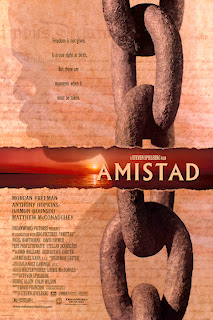

I’ve only seen this movie once, and I liked it, but not really enough to watch it again. At the time I remember finding it well-made, well-acted, and all, but a bit on the slow-moving side and generally not too involving. But at the end of the film, when the court case in the story (regarding the status of a group of Africans, on their way to being sold into slavery, who rise up while still on the slave ship from Africa) reaches the Supreme Court, we get to hear a long speech by former President John Quincy Adams (played by Sir Anthony Hopkins), that I’ve watched, in itself, many times on YouTube. It’s a terrific speech, and like all great speeches, the most emotionally resonant part comes at the end.
The other night I was talking with my friend, Cinque [the slave, played by Djimon Honsou]. He was over at my place, and we were out in the greenhouse together. And he was explaining to me how when a member of the Mende — that’s his people — how when a member of the Mende encounters a situation where there appears no hope at all, he invokes his ancestors. It’s a tradition. See, the Mende believe that if one can summon the spirits of one’s ancestors, then they have never left, and the wisdom and strength they fathered and inspired will come to his aid.
James Madison, Alexander Hamilton, Benjamin Franklin, Thomas Jefferson, George Washington, John Adams: We’ve long resisted asking you for guidance. Perhaps we have feared in doing so we might acknowledge that our individuality which we so, so revere is not entirely our own. Perhaps we’ve feared an appeal to you might be taken for weakness. But, we’ve come to understand, finally, that this is not so. We understand now, we’ve been made to understand, and to embrace the understanding that who we are is who we were.
“Who we are is who we were.” That’s very true, isn’t it? Like it or not, for good or ill, we are in many ways the sum of the experiences of our forebears. And so will our children be, of us.
Here’s the entire speech:
I haven’t done a ‘lazy linkage’ kind of post in a while (of course, Sentential Links and the Sunday Burst are that sort of thing, I suppose), so here’s a bit of ‘lazy linkage’!
:: Neal Asher on tracking word counts in writing.
I upped this to 2,000 and still found it too easy, but then this was all my words, so next I discounted journal entries, blog posts, and stuff I put on message boards (yes, I even counted the words in them) and reset my target to 2,000 words of fiction. This is what I’ve stuck to ever since. When I get started each day I read through and correct the previous day’s 2,000 words, then start on the next. As I reach that figure I try to simply stop, and not go on until reaching a natural break. If you just stop while you know what you’re going to write next, it’s easier to get going again the next day.
I should try that…the ‘not trying to get to a natural breaking point’ idea. I should say, I have tried it, but I often wind up staring at the screen and thinking, “Where the hell was I going with this?” So now I’ll just leave a little note in parentheses, indicating what’s to happen next, like this:
“It was you!” she exclaimed.
[The murderer is the butler. Later, having solved the crime, the two Princesses have hot fudge sundaes followed by a pillow fight.]
:: Charles Stross on why he doesn’t self-publish:
Anyway: this is why I don’t self-publish. Yes, I could do it. But it’d suck up a huge amount of time I would prefer to spend doing what I enjoy (writing) and force me to do stuff I do not enjoy (reading contracts, accounting, managing other people). The only sane way to do it would be to hire someone else to do all the boring crap on my behalf. And do you know what we call people who do that? We call them publishers.
I do think about self-publishing from time to time. For me, it’s a notion of last resort, for these reasons: I don’t want to spend the necessary time doing all the marketing, design, and all that jazz. If it comes to that, I will, because I frankly believe very strongly in the book I wrote and the one I’m writing and I also believe very strongly that I’m going to get better at this (based on the fact that I can look at my writings from years past and see that I already am better at this). But I won’t do that unless absolutely no one out there is willing to do the heavy lifting for me.
:: Phil Plait sums up some new cosmological findings. They are mindblowing. Go read it! As he concludes:
I still hear some people say that science takes the wonder out of life. Those people are utterly and completely wrong.
Science takes us to the wonder.
:: Ten small changes you can make to help avoid another Steubenville.
:: In the early to mid-1990s, I became quite the rabid baseball fan, falling deeply in love with that game. I’ve fallen away from it for many reasons, which always makes me a little sad, because I remain convinced that of all the major sports, baseball is the most inherently beautiful.
Anyway, any baseball fan from that era likely remembers the awful day in 1993 — now twenty years ago — when horrible news came out of the Cleveland Indians’ spring training. Two of their players, pitchers Steve Olin and Tim Crews, were killed in a boating accident, and only by some incredible quirk of fate did Bobby Ojeda avoid the same fate. For a franchise that was on the upswing, the accident was an absolute punch in the gut. Today, I read a deeply sad but well-written article about that accident and the lives it altered forever.
The cloudless sky, the shining sun and the still waters betray the truth of what happened here.
This is where the world lost you, Tim, and you, Steve. On Little Lake Nellie in Clermont, Fla. This is where you boarded a black power boat shortly after sundown on March 22, 1993, hoping the bass would be biting on that overcast evening. This is where you saw the headlights flashing from the shore, alerting you that the rest of your friends had arrived. This is where you hit the gas, Tim, not knowing that, in the blackness of a night with a new moon, the 18-foot, open-air Skeeter had drifted out toward the unlit dock on the opposite shore — a 185-foot-long wooden structure that extended far into the water. This is where the boat slammed, head-high, into the end of that dock.
This is where life met death.
The baseball world couldn’t fathom what happened here, because ballplayers aren’t supposed to die. Not during Spring Training, when optimism is abundant and nobody frets over standings or statistics. Not when they have young, growing families waiting for them on dry land.
That’s why baseball fans remember the names Tim Crews and Steve Olin. They remember the way your Cleveland Indians teammates wrestled with the emotional intensity of that 1993 season. The way Bob Ojeda, who had been with you on the boat and survived only because he happened to be slouching at the moment of impact, dealt with survivor’s guilt and suicidal thoughts before returning to the team later that year.
What they don’t know, what they can’t know, is what it’s been like for your families to live with the losses. What it was like for your wives to explain to their children that Daddy wasn’t coming back. What it was like — what it is like — for them to wonder what their lives would be like today, if only you were still here.
Twenty years. You’ve missed so much.
You know what’s really odd? While writing this, something jogged in my memory, and I realized that I once linked, for another site, an article for the tenth anniversary of the Little Lake Nellie accident. I wonder if I’ll still be here in ten years, to link someone’s observation of the thirtieth anniversary of it.
The official site of Kelly Sedinger: Reader, writer, photographer, and dreamer


