Chris asks: What’s your favorite vegetarian recipe? (If it’s good, I’d actually love to know the ingredients, not just the name. 🙂 )
First of all, I have to admit that I’m not entirely sure what’s ‘vegetarian’. I would tend to consider something vegetarian if no animals were killed for the production of the item, which means, I consider vegetarianism to be quite compatible with eating dairy products. That said, I love a pizza with no meat on it. One of my favorite pizzas has garlic and olive oil spread on the crust, topped with mozzarella cheese, and then sliced tomatoes and banana peppers. I think that pizza without meat is awfully great.
And of course, salads. Love salads. You can go in lots of directions.
And fried rice or noodle stir-fries, with lots of good veggies thrown in. I’m discovering that I like quite a few veggies either raw or cooked in stir-fry fashion (i.e., cooked on high heat very quickly). My latest discovery is that stir-fried or quick-cooked string beans make me happy. Yay!
Vegetarian sandwiches are cool, and you don’t have to pile them with salad-type veggies, either. PB&J is vegetarian, yes? Or PB and potato chips? Yum! And a favorite sandwich of mine is cream cheese and sliced strawberries on thick, toasted, whole-grain bread.
Ooooh, and beans! Love beans. I absolutely adore beans. I think beans are wonderful. I tend to include meat in my chili just out of habit, but increasingly it occurs to me that if I just add a fourth can of beans, why would I even need the meat at all? Beans are awesome!
Here are some problem areas: are eggs ‘vegetarian’? I struggle with the dividing lines thereof.
One vegetable I want to experiment with this winter (when I do more baking) is eggplant. Ultimately, I don’t do a whole lot with specific recipes yet, in terms of vegetarianism. My approach has been to gradually incorporate more vegetables in my diet, in keeping with Michael Pollan’s advice: “Eat food, not too much, mostly plants.” But as I explore this stuff more, I will post recipes and various discoveries as I go!
Chris also asks: And, if you could have one – just one – superhero ability, which would it be and why?
Flight. Wouldn’t it be amazing to fly!
Jeremy asks: My question is: Would you rather invent a true blue rose or the next best smart phone? Why?
I had to do some Googling for this one. It turns out that, as roses evolved, they are incapable of producing a true blue color in their petals, because of the genetics involved. So, of course, people have been trying for years to force the issue and create a rose that will blossom true blue. The things you learn!
And frankly, I’d rather do that than come up with the next great smart phone (or whatever other electronic gizmo). The first true blue rose can only happen once, but there will always be a next great smart phone, or laptop, or tablet, or whatever.
Unless…unless what Jeremy is asking is, would I want to create the first great whatever-the-next-thing-is. If I want to create the first iPad or iPod…or the first Macintosh…or so on. But even so…I’ll take the rose. As William Blake wrote:
To see a world in a grain of sand,
And a heaven in a wild flower,
Hold infinity in the palm of your hand,
And eternity in an hour.
Actually, I’m not sure that applies…but I like that poem, anyway.
OK, it’s time to start answering the queries from the most recent iteration of Ask Me Anything! (Speaking of which, I’m not closing out for queries yet, so feel free to ask, at the afore-linked post.) I’m going to start with a query that was actually not posed in connection with Ask Me Anything!, because I’m tricksy that way, folks. But the question came up a couple weeks ago on Twitter, and I promised to answer it as a blog post because that would be a better place to go into things in a bit more depth. As the question came when it did, I’m counting it as an Ask Me Anything! submission. The question was:
I don’t currently have any Jerry Goldsmith in my music collection. What should I get?
Ahhh, Jerry Goldsmith. He was one of the giants of film music, producing a huge body of work: I’m guessing well over 300 scores over a career that lasted more than 40 years. Some of his scores are outright classics of the genre, and a great many more are fine works that provide hours of good listening. And yes, in my opinion, he did write a few duds…as would anyone as prolific as he was. But if you haven’t heard any Goldsmith in detail, where should one start? Here is a short list of possible ‘gateway’ Goldsmith scores.
Star Trek: The Motion Picture
I lead off with this one because this is how I discovered Jerry Goldsmith. It was one of the very first film music records I bought, and I listened the hell out of it, eventually wearing it out and doing a lot of mental comparison of it to John Williams’s two Star Wars scores at the time. (Yes, ST:TMP came out before The Empire Strikes Back, but I didn’t get the record until a year later, after I’d already bought TESB.)
The Trek score starts off bold and brassy, in a way that suggested Star Wars, but it was a quicker theme, more militaristic in nature, and then there’s a pretty amazing cue that accompanies the Klingon investigation of this strange cloud that ends up destroying them. The score is very different from Star Wars, and it was my first foray into science fiction that was more about a ‘sense of wonder at the unknown’ than the swashbuckling adventure that was more the thing with Star Wars. Goldsmith’s work here is full of wonderful tone-painting as he takes us musically into the heart of the V’Ger cloud.
And frankly, only Goldsmith’s music is what saves the first Enterprise fly-by from being a self-indulgent mess.
Total Recall
For me, this might be the last truly great score of Goldsmith’s career. It stands at the opposite end of the spectrum from his ST:TMP score, being for a more adventurously bold SF movie than the one from eleven years prior. And it’s a muscular pulse-pounder of a score that nevertheless includes some real moments of Sfnal wonder.
The Wind and the Lion
Goldsmith was more than an SF or action composer; he also scored quite a few films like this period adventure piece featuring Sean Connery and Candice Bergen. (As well as Brian Keith as Teddy Roosevelt, and a young, pre-Dallas Steve Kanaly as an Army officer.) This score became one of my favorites the very first time I heard it, with its gorgeous, sumptuous melodies that were evocative of Rimsky-Korsakov’s Scheherazade and its stunning action writing. This is Jerry Goldsmtih at his very, very best. I’m not sure, but I might well consider this to be his masterpiece.
The Omen
And then there is the score for which Goldsmith won his only Oscar. (This is something that eternally vexes his fans, and one does wish that Goldsmith had received more such honor in his life, but in general, he tended to fall victim to the fact that there were only so many Oscars to go around.) If you want to hear some really deliciously creepy Biblical horror music, complete with a main title called “Ave Satani”, this score is your huckleberry. It’s amazing. (And if you like this, I’d also recommend the other two scores in the Omen trilogy. For the most part, the Goldsmith scores are the best things in this trilogy, and a quick scan of his filmography reveals that Goldsmith may have scored more crappy movies than any other composer, ever.)
Chinatown
When I say that I might consider The Wind and the Lion to be Goldsmith’s masterpiece, I am mainly given pause by his score to Chinatown. This score is one of the legends of film music. Goldsmith wasn’t the first choice to write the film’s music, and was brought in under a severe deadline crunch after the original score was deemed lackluster. (This happens far more often in film music than you might suspect.) The result was that Goldsmith had just ten days to rescore the film. So what he did was to write a noir score, essentially in a theme-and-variations approach (which turned out to be his usual calling card), for a very small ensemble, including some modern sounds like a prepared piano.
What came from his pen was a chamber work that only scores about 25 of the movie’s more than 120 minutes, but with astonishing clarity and purpose, starting right from the mournful main theme. I can’t get over the level of genius and skill behind Goldsmith’s Chinatown score, and it’s probably only my general taste for big and lush orchestral music that compels me to give the nod to The Wind and the Lion.
The Secret of NIMH
I once castigated a film music writer for stating that the music Goldsmith wrote for the late-90s Disney flick Mulan constituted the ‘best score for an animated film, ever’, and I stand by that. Just off the top of my head I can name a dozen animated films with more memorable music than Mulan, and setting that argument aside, I put The Secret of NIMH forward as Exhibit A in my argument that Mulan not only isn’t the ‘finest score ever for an animated film’, it’s not even the finest score written by Jerry Goldsmith for an animated film.
The Secret of NIMH is Goldsmith at his impressionistic best. His compositional influences don’t tend to be as obvious as John Williams’s, but you can definitely sometimes hear Maurice Ravel inside Goldsmith, trying to get out, and NIMH is one of the scores where you can hear it the most. This is just amazing music.
Legend
Here’s an odd case. Legend had a wonderful score by Jerry Goldsmith, until the film was altered severely for release in the United States, all the way to replacing Goldsmith’s music with an electronic score by Tangerine Dream. I don’t recall that I’ve ever seen the movie, so I can’t speak to the quality of that decision, but I do know that the Goldsmith score is mostly wonderful.
Goldsmith fans tend to regard this is a towering masterwork of his, but I have a hard time going quite that far, even as chock full of more of the Ravelian impressionism and tone-painting that typifies The Secret of NIMH. My problem is with the use of synthesizers. Goldsmith has always been willing to employ electronics in his scores, and most of the time, he gets it just right, often managing to incorporate the electronics into the orchestral tapestry in such a way that it just seems to belong there. In Legend, however, the synths tend to stand out like a sore thumb, and there are times when the sounds produced are downright unpleasant to the point of being distracting. The good parts of the Legend score are so good, though!
Powder
In all honesty, I didn’t like this movie, and also in all honesty, Goldsmith’s output after Total Recall tends to leave me awfully cold. Powder is one of the rare post-1990 scores of his that connects with me. I don’t have anything terribly analytical to say about it, except to note that it’s a very moving and sad score.
Now, there are other Goldsmith scores that might serve as exploratory scores: Stagecoach, perhaps. Lots of people love Rudy (although not me — Rudy is ground zero of Goldsmith’s post-1990 tendency to just take a single melody and drive it into the ground to the point that I’m sick of it). There’s good stuff in The 13th Warrior, although I do think that score is awfully repetitive as well. After TMP, Goldsmith would return to Star Trek to do the scores for V: The Final Frontier, First Contact, Insurrection, and Nemesis. Of these, the first two are worth exploring (TFF is actually very good, while First Contact boasts one of Goldsmith’s very finest melodies in the stately theme that signifies the maturing of the human species that results from the first contact with an alien species), while the others are…well, not. (Especially avoid Nemesis, which I consider to be Goldsmith’s worst score.) Some film music fans used to kvetch, back when I regularly interacted with such, that it was just damned bad that Goldsmith didn’t get a crack at the Lord of the Rings films, but frankly, if First Knight was indicative of what an epic fantasy Goldsmith score would have been like…I’m fine with that. I’ve never liked that score. But despite my complaining above, Mulan is really a solid work. It’s just not as good as NIMH, which is genius.
So there you have it. I’m omitting a ton of scores, but how could I do otherwise? The man wrote so much, and a lot of it is great, great music!
:: Ten Incredible Sea Forts. I love these…the first one looks like it could be a setting in a dystopic, future-Earth-where-global-warming-has-flooded-everyplace story; the second looks like something out of a James Bond movie. The rest are cool, too.
:: Snell pinpoints the true location of the Batcave. It’s…not where I expected. (I have to be honest, though, I mentally rebel against the idea of Gotham being anywhere on the Atlantic coast. In my head, as Metropolis is a stand-in for NYC, Gotham is a stand-in for Chicago. It just is, and forevermore will be. But really, fictional cities suck and mess everything up…said the guy who has set a bunch of his short stories, unpublished as they may be, in the fictional city of New Mowbray, MI, which is located on the eastern shores of Lake Michigan…and which is not unlike another Great Lakes city, farther to the east, at the end of Lake Erie….)
Hey, folks, one last reminder that I’m still soliciting questions, queries, and interrogatives for the August 2012 edition of Ask Me Anything!. Just drop in in comments on this post, or on Twitter, or on Facebook, or in e-mail. Heck, you can try Morse code, but I wouldn’t vouch for its reliability these days. I’ve got some good queries already, so go ahead and throw in some more!
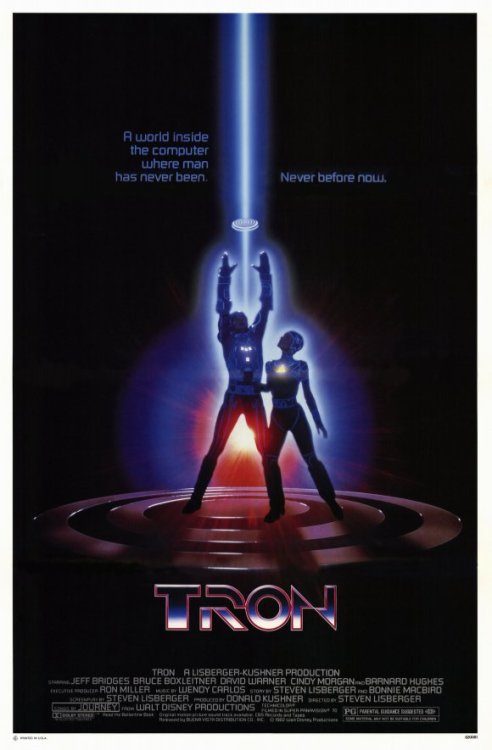
The first time I realized that there was something of a ‘geek subculture’ was when the movie TRON came out. The big ‘tentpole’ movies of geekdom — Star Wars, Superman, The Empire Strikes Back, Raiders of the Lost Ark, ET — everybody saw those. Not so much with TRON, which was pretty much ignored that year, except by me; I saw it and assumed that everyone else did, too. But when I mentioned it to classmates, not one of them had bothered. They had all assumed it was just a piece of, well, geek fluff.
TRON isn’t a perfect movie, but it’s a fun one, and it’s deeply imaginative in its depiction of ‘the world inside the computer’, where programs take on the personalities of their ‘Users’. For all the ballyhooed use of computer graphics in its effects, the film’s production design is surprisingly old-school, using photographic effects of the time, but there is still a lot of amazing eye-candy in the movie. (And the lightcycle sequence is, for my money, one of the iconic action sequences of the period.)
Early in the film, a program from an accounting firm is being escorted into the Game Grid, which is where programs are gathered and forced to engage in forms of cyber-gladiator games. Here we meet Crom, a program who won’t be around much, because he’s doughy and nerdy and….
Crom: Look. This… is all a mistake. I’m just a compound interest program. I work at a savings and loan! I can’t play these video games!
Guard: Sure you can, pal. Look like a natural athlete if I ever saw one.
Crom: Who, me? Are you kidding? No, I run out to check on T-bill rates, I get outta breath. Hey, look, you guys are gonna make my user, Mr. Henderson, very angry. He’s a full-branch manager.
Guard: Great. Another religious nut.
It interests me that belief in the Users is portrayed amongst the bad guys as a strange religion, but that’s the way it had to have started, right? The Master Control Program didn’t always exist. I wouldn’t mind knowing the story of its rise to power…but that’ll be a thought for another day. Anyway, I’m glad that over the years, TRON has been embraced more than it was back in 1982. But I’m also glad that I was on board at the beginning.
Antique stores: “ZOMG, look at all the wonderful treasures of yesteryear!” or “ZOMG, look at all the old crap!”?
Extra credit: For those in either camp, what’s the best thing you’ve ever acquired at an antique store? Regular readers will know that I’m in Camp One, but I know a lot of folks who are in Camp Two.
As much as I love Carl Sagan, I have to admit that I never warmed to his one and only novel, a science-fiction first contact story he called Contact. I tried reading it a couple of times, and each time I only got about a hundred pages in before I stopped. I just don’t think that Sagan was really cut out for novel writing, no matter how great his gifts may have been for science writing. But in 1997, a movie adaptation of the book arrived in theaters, starring Jodie Foster and Matthew McConnaughey and directed by Robert Zemeckis. The movie was six months too late for Sagan to have seen it, alas.
I’ve had a somewhat uneasy relationship with Contact ever since it came out. On balance I like it a lot…but I don’t love it, and in truth, I never really have. I’ve never been entirely successful in putting my finger on what it is about Contact that vexes me, but after recently watching the film again on NetFlix, I think I have it: the movie is too unfocused. When the film is concentrated on telling its story and attending to that central story, it is a fine, fine piece of work. But too often I get the impression that Robert Zemeckis got distracted, often by something shiny, and there are way too many times in the movie that the story gets lost so we can follow something shiny.
Contact tells the story of Ellie Arroway, an astronomer whom we meet as a young child, operating her HAM radio under the guidance of her father. They have a wall map of the United States, on which she marks her radio contacts with push pins; after talking to someone in Pensacola, Dad comments that it’s her farthest contact yet. Ellie asks if a radio could talk to the Moon, or to Mars…or to her mother, who is apparently dead. Dad responds, “I don’t think they’ll ever make a radio that can reach that far.”
Grown-up Ellie (Jodie Foster) turns out to be an astronomer, as noted, who is using her research time at the Arecibo Radio Telescope to look for, as she says, “little green men”: she is dedicating her career and scientific energies to SETI (Search for Extra-Terrestrial Intelligence). This leads to her meeting a former priest (Palmer Joss, played by Matthew McConnaughey), who despite being religious and spiritual where she is not, attracts her on a number of levels, and it also leads to run-ins with an older male scientist named David Drumlin (Tom Skeritt) who is snide and condescending to Ellie as he regards her chosen field of specialty as an utter waste of time. After a number of obstacles to her career – mostly owing to funding difficulties, as convincing people to part with money for something like SETI tends to be difficult – Ellie finally has a breakthrough when, while working at the Very Large Array in New Mexico, her radio telescopes detect an unmistakable alien signal. The rest of the film follows the implications of such a discovery.
Or, rather, the rest of the film should do that, and when it does, it’s incredibly effective and thought-provoking and loaded with the grand “sensawunda” of all the best science fiction. The problem with the movie is that it too often wanders into less interesting stuff, or its steps away from subtlety to drive its points home with a jackhammer, or it does things that forcibly eject me from the world of the film.
Taking the less interesting stuff first: Ellie Arroway is too often portrayed in the film as the feminine voice of reason in a crowd of over-bearing, pompous, or downright dim men. Science and engineering are male-dominated fields, and it’s a well-established fact that women in those fields tend to have a tougher going just to overcome gender biases. The problem with Contact‘s approach isn’t so much that it points this out, but that it’s about other things, and thus it can’t really delve too intelligently into those topics which really do deserve higher scrutiny. Thus we have Ellie being treated like an outsider on her own project, or Drumlin stepping up to claim ownership over a project he’s derided consistently up until the moment it proved fruitful. Ellie is constantly on the defensive in the movie, and I think it hurts the narrative because the film can’t just gear up and take us where it wants to go. Instead we have to keep talking about God.
And God is where subtlety just isn’t something that interests Robert Zemeckis. Contact is full of discussions of religion versus science, but the feeling is never that anything is really being debated; what happens is that opposite sides’ viewpoints are stated, and restated, and stated again. Ellie goes to a reception in Washington, where her first order of business upon approaching Palmer Joss is to immediately launch into a discussion on religion, without any preamble or preliminary; more than that, though, the script treats all such conversations – and many that aren’t on the topic of religion at all – as though Ellie has a sizable axe to grind, while everyone else (just about all of whom are male) is calm and collected in their disagreement. Coupling that with the several instances in the film where Ellie is betrayed by men – Drumlin’s taking of the credit, Joss’s posing of a question at the hearings when he knows that the answer is going to doom Ellie’s chances of being the one selected to go in ‘the machine’ – and the film seems to depict Ellie as someone who doesn’t so much achieve a lot but whom is given things, table-scrap like, by the men in her life. It’s an odd kind of feeling.
It also bothers me that the film ends right when it gets most interesting, and it feels to me like it takes the easy way out. To me, the most interesting thing is, What would human society be like once we know that we are not alone in this Universe? We may know next to nothing about who is out there, but surely knowing once and for all, without speculation, that there is someone or something living out there would be a staggering revelation for the human species. Unfortunately, the film doesn’t do much with this notion – in fact, it backs away from it. We get lots of intrigue involving the contents of the message that is received from space, and then the construction of the transport “machine”, and so on. And this is all very compelling and entertaining…but at the end, the film gives us the old “Did it really happen?” gambit, reducing a momentous scientific discovery to something that will appeal to some people and not to others. Not unlike, say, the belief in God.
(Again, I don’t know to what degree the film’s story tracks that of the novel.)
I always find that the film deflates in its last fifteen minutes or so, after Ellie returns from her journey only to learn that, so far as anyone here knows, she never went anywhere. This leads to a Congressional hearing (which really drives home the film’s theme of “one woman versus a whole bunch of mean men”), at the end of which one Representative says, “Are we supposed to take your story…on faith?” And yes, he really pauses and puts big emphasis on those last two words, just in case we missed the irony of a scientist committed to objective observation being forced to admit the necessity of faith. Again, subtle, this is not. The movie does try to have it both ways by showing two government folks discussion the fact that the machine’s video recorder recorded eighteen hours of static (had nothing happened at all, there would have been about two seconds’ worth). But this is to be kept secret, apparently. They might as well seal all this information in a crate and store it in the warehouse next to the Ark of the Covenant.
And the movie ends, on this state of affairs. What happens now, though? Does some kind of new religion start to accrete around Ellie and her scientific beliefs? Does Ellie somehow become an evangelist for a new blossoming of a scientific worldview? Does her experience have any effect on the human tension between science and religion? We never get any suggestions or speculations. All we get is the rolling of the credits. Contact tells a good story, but it stops just as its important story is just beginning.
Finally, I just have to note that all the cameos in the movie annoy the crap out of me. This was when Robert Zemeckis had just discovered that he could put people into lots of interesting situations, digitally; remember, he’d had Forrest Gump consorting with Presidents Kennedy, Johnson, and Nixon. So here we get loads of real-life CNN personalities, and even President Bill Clinton, with the film taking quotes from actual Clinton newscasts and editing them so that it sounds like he’s discussing the events of the movie. It’s incredibly distracting. Instead of being drawn further into the story, I find myself trying to think of what event Clinton was actually discussing in the speeches that were repurposed for this movie. Things like having Rob Lowe play a Christian conservative leader named “Richard Rank” are incredibly distracting, because of course it makes me think of Ralph Reed. Shoehorning in mention of the mass suicide of the Heaven’s Gate cult, which had happened just months before the movie came out, is another example. Zemeckis seems to want his movie to seem ‘real’ and relevant, but all this stuff has the exact opposite effect on me: it forces me to keep the story at arm’s length.
Ultimately, I want to love Contact, because of my love and admiration for Carl Sagan, for the subject matter of the story, and for the view of the Universe as a place of wonder and of science as humanity’s greatest achievement. And there really is a lot to love about Contact. But the movie spends so much time getting in its own way that I inevitably end up just admiring it a lot.
Share This Post
ForgottenStars.net
The official site of Kelly Sedinger: Reader, writer, photographer, and dreamer