Stop SOPA

Would I be able to write this blog in a world where the Internet is governed by SOPA? I honestly don’t know. I strongly suspect that I would, but it would be a lot less interesting. I also strongly suspect that a good many posts here wouldn’t be possible, and that a good many things I’ve done in this space would result in this blog being ‘blacked out’ because of dreaded ‘piracy’.

Stop this bill. The Web is too important to be hobbled in this way. We’ve already burned the Library of Alexandria once. Let’s not do anything like that again!

Share This Post

A lifetime of sitting in the dark

I was nine years old, and I wandered into the living room to find my mother watching some show on PBS. It was a show about movies – there would be a clip of a new movie that was out, and these two guys would then talk a bit about whether the movie was any good or not. One of these guys was a thin, lanky guy. The other was a squat, fat guy. The thin guy was named Gene. The fat guy was named Roger.

“What’s this?” I asked.

“It’s called Sneak Previews,” my mother answered. “Those two men are film critics. They tell us if movies are good or not.”

“Oh.”

And I watched the thing. I didn’t know anything about movies, but these two guys were interesting to watch. Another year or two later, their show was off PBS, which struck me as a bummer…but they turned up again, in a syndicated show that was on, like many syndicated shows, at whatever time some station or other felt like putting it on. No matter, it was fun seeing these two guys, Gene and Roger – who worked for newspapers in Chicago – talk about movies.

So I watched Gene Siskel and Roger Ebert for years, off and on, right up until Siskel’s deeply saddening death in 1998. Then I watched Ebert and Richard Roeper (a good enough fellow, but no substitute for Siskel) for a few more years, until we no longer had cable and thus the show was beyond my grasp. And then, a few years after that, Ebert himself started to have health issues, which eventually resulted in unsuccessful surgeries that have famously left him unable to speak or eat (he takes meals through a G-tube, which is something I understand all too well, thanks to Little Quinn).

Siskel and Ebert were, in my view, one of the great duos in the history of anything. Those two had such astonishing chemistry together, that it was a joy to watch them agree positively on a movie, an even bigger joy to see them agree negatively on a movie (seriously, watching the two of them tag-team on a bad movie was always great), and the biggest joy of all when they disagreed. Then you could see some fireworks. I remember Ebert being astonished at Siskel’s thumbs-down review of Scorsese’s Casino; “Thumbs down?!” Ebert yelped. And there was another time – I can’t remember the movie – where Ebert liked it and Siskel did not, and Ebert said something like “I don’t think you wanted to like this movie”, a suggestion that seemed to physically hurt the usually more acerbic Siskel. “I love to like pictures!” he protested.

One time on Late Night with David Letterman, there was a segment that had Mujibur and Sirajul, the two Indian owners of a local store, reporting to Dave from somewhere in the country. And Dave says, “If you two are out there, who’s watching the store? Can we send a cameraman to see who’s in charge at the store?” So a cameraman goes into the store, to reveal a very stern-looking Siskel and Ebert. OK, I guess you had to be there.

Anyway, Ebert has been writing about the movies for decades now, and he is, by nearly any measure, the critic whose work I find the most illuminating and the most evocative. I’ve been reading him nearly almost as long as I’ve been watching him on teevee, and for a number of years, his annual review collections were required book purchasing of mine. Now he has produced a memoir, which he has titled Life Itself.

Ebert’s health struggles in recent years are well-known, and it’s been truly fascinating to watch him take to blogging in the wake of the loss of his physical voice, a medium he had initially viewed with suspicion but which allowed his authorial voice to finally blossom to its greatest strength. Ebert has always been a fine writer, but oddly, his disability-due-to-cancer has, for many, made him even better. Maybe it’s similar to that old saw about how when you lose one sense, the others somehow make substantial gains in acuity.

Reading his blog, I’ve mostly been struck by Ebert’s ongoing zest for life, even when there were occasional posts that took an especially elegiac tone that made me wonder if he was preparing for his own departure from this world. Ebert is still with us, though, and now we have Life Itself.

The book is more a series of vignettes than a straight telling of Ebert’s life. The vignettes are more or less in chronological order, but Ebert seems to be more exploring various themes in his life than the chronology of events. The book is something of a memory album that gives an impression of a life, which seems to me a good way to structure a biography. Sometimes when I read biographies, I get a sense of “plot” that couldn’t possibly be there. Ebert is well aware that life is plotless, and that many of the things that shape the paths of our lives for good or ill are often accidental, a function of our coming into the circle of this person instead of that person, or even something so prosaic as taking this flight instead of that one.

It’s telling that the book gives more of a sense of his development as a writer than as a critic; I suspect that Ebert believes that he would have been a writer no matter what, and it was just an accident of various circumstances that led to him writing about movies for the last forty years. There’s no “Through all my life the cinema has grounded my being” or anything like that; Ebert grew up as a talented kid who liked going to movies with his buddies on Saturdays. I love when he recounts his first reviews of avant garde films; finding himself in confusion as to what the films were about, he took the approach of simply recounting his experience in watching the film. This is an approach that has gone on to inform his entire approach to movie reviewing and film criticism.

Sometimes, in the course of his blogging over the last few years, a tone has crept into Ebert’s writing – that he seems to deny whenever it is pointed out, but it is there – that he is, in long form, saying goodbye to his life. I deeply hope that this is not the case. Ebert is, for me, to film as Carl Sagan is to science, and he’ll be missed by me in equal measure when he is gone.

Here are some excerpts from Life Itself.

On Mike Royko:

At about six p.m. On New Year’s Day of 1967, only two lights on the fourth floor were burning – mine and Mike Royko’s. It was too early for the graveyard shift to come in. Royko walked over to the Sun-Times to see who else was working. A historic snowstorm was beginning. He asked me how I was getting home. I said I’d take the train. He said he had his old man’s Checker car and would drop me at the L station. He had to make a stop at a twenty-four hour drug store right where the L crossed North Avenue.

Royko at thirty-five was already the city’s most famous newspaperman, known for compelx emoitons evoked with unadorned prose in short paragraphs. Growing up as the son of a saloon keeper, he knew how the city worked from the precinct level up, and had first attracted attention while covering city hall. He was ten years older than me and had started at the old City News Bureau, the copperative supported by all the dailies that provided front-line coverage of the police and fire departments. Underpaid and overworked kids worked under the hand of its editor, Arnold Dornfeld, who sat beneath a sign reading: If your mother says she loves you, check it out. When I met him he’d been writing his Daily News column for two years. It was his writing about Mayor Richard J. Daley that took the city hall word clout and made it national. He chainsmoked Pall Malls and spoke in a gravelly poker player’s voice. He drank too much, which to me was an accomplishment.

That snowy night the all-night drugstore was crowded. “Come on, kid,” he said. “Let’s have a drink at the eye-opener place.” He told me what an eye-opener was. “This place opens early. The working guys around here, they stop in for a quick shot on their way to the L.” It was a bar under the tracks so tiny that the bartender could serve everyone without leaving his stool. “Two blackberry brandies and short beers,” he said. He told me, “Blackberry brandy is good for hangovers. You never get charged for a beer chaser.” I sipped the brandy, and a warm glow filled my stomach. It may have been the first straight shot of anything I’d ever tasted. I’d been in Chicago four months and I was sitting under the L tracks with Mike Royko in the eye-opener place. I was a newspaperman. A blackhawks game was playing on WGN radio. The team scored, and again, and again. This at last was life.

“Jeez, they’re scoring like crazy!” I said, after the third goal in less than a minute.

“Where you from, kid?”

“Urbana,” I said.

“Ever seen a hockey game?”

“No.”

“That’s what I thought, you asshole. Those are the game highlights.”

On books:

Chaz [Ebert’s wife] and I have lived for twenty years in a commodious Chicago town house. This house is not empty. Chaz and I have added, I dunno, maybe three or four thousand books, untold numbers of movies and albums, lots of art, rows of photographs, rooms full of comfortable furniture, a Buddha from Thailand, exercise equipment, carved elephants from India, African chairs and statues, and who knows what else. Of course I cannot do without a single one of these possessions, including more or less every book I have owned since I was seven, starting with Huckleberry Finn. I still have all the Penrod books, and every time I look at them, I’m reminded of Tarkington’s inventory of Penrod’s pants pockets. After reading it a third time, as a boy, I jammed my pockets with a pocketknife, a Yo-Yo, marbles, a compass, a stapler, an oddly-shaped rock, a hardball, a ball of rubber bands, and three jawbreakers. These, in an ostensible search for a nickel, I emptied out on the counter of Henry Rusk’s grocery, so that Harry Rusk could see that I was a Real Boy.

My books are a subject of much discussion. They pour from shelves onto tables, chairs, and the floor, and Chaz observes that I haven’t read many of them and I never will. You just never know. One day I may nee to read Finnegans Wake, the Icelandic sagas, Churchill’s history of the Second World War, the complete Tintin in French, forty-seven novels by Simenon, and By Love Possessed. That 1957 bestseller by James Gould Cozzens was eviscerated in a famous essay by Dwight Macdonald, who read through that year’s list of fiction bestsellers and surface with a scowl. I remember reading the novel late into the night when I was fourteen, stirring restlessly with the desire to be possessed by love.

I cannot throw out these books. Some are enchanted because I have personally turned all their pages and read every word. They’re shrines to my past hours. Perhaps half were new when they came to my life, but most were used, and I remember where I found every one. The set of Kipling at the Book Nook on Green Street in Champaign. The scandalous The English Governess in a shady bookstore on the Left Bank in 1965 (two dollars, today ninety-one). The Shaw plays from Cranford’s on Long Street in Cape Twon, where Irving Freeman claimed he had half a million books. Like an alcoholic trying to walk past a bar, you should see me trying to walk past a used bookstore. Other books I can’t throw away because, well, they’re books, and you can’t throw away a book. Not even a cookbook from which we have prepared only a single recipe, for it is a meal preserved, in printed form. The very sight of Quick and Easy Chinese Cooking by Kenneth H.C. Lo quickens my pulse. Its pages are stained by broth, sherry, soy sauce, and chicken fat, and so thoroughly did I master it that I once sought out Ken Lo’s Memories of China on Ebury Street in London and laid eyes on the great man himself, dining alone in a little room near the entrance. A book like that, you’re not gonna throw away.

On his wife:

I sense from the first that Chaz was the woman I would marry, and I know after twenty years that my feelings were true. She had been with me in sickness and in health, certainly far more sickness than we could have anticipated. I will be with her, strengthened by her example. She continues to make my life possible, and her presence fills me with love and a deep security. That’s what a marriage is for. Now I know.

On Siskel:

One of the things I miss about Gene Siskel is that he’s not around to make jokes about my current condition. He would instinctively know that at this point I wouldn’t be sensitive, having accepted and grown comfortable with my maimed appearance. He wouldn’t have started joking too soon. His jokes would have the saving grace of being funny. Here’s one I’m pretty sure he would have come up with: “Well, there’s one good thing about Roger’s surgery. At least he no longer needs a bookmark to find his chin.”

On movies:

I have seen untold numbers of movies and forgotten most of them, I hope, but I remember those worth remembering, and they are all on the same shelf in my mind. There is no such thing as an old film. There is a sense in which old movies are cut free from time. I look at silent movies sometimes and do not feel I am looking at old films; I feel I am looking at a Now that has been captured. Time in a bottle. When I first looked at silent films, the performers seemed quaint and dated. Now they seem more contemporary. The main thing wrong with a movie that is ten years old is that it isn’t thirty years old. After the hairstyles and the costumes stop being dated and start being history, we can tell if the movie itself is timeless.

What kinds of movies do I like the best? If I had to make a generalization, I would say that many of my favorite movies are about Good People. It doesn’t matter if the ending is happy or sad. It doesn’t matter if the characters win or lose. The only true ending is death. Any other movie ending is arbitrary. If a movie ends with a kiss, we’re supposed to be happy. But then if a piano falls on the kissing couple, or a taxi mows them down, we’re supposed to be sad. What difference does it make? The best movies aren’t about what happens to the characters. They’re about the example that they set.

Casablanca is about people who do the right thing. The Third Man is about two people who do the right thing and can never speak to each other as a result. The secret of The Silence of the Lambs is buried so deeply that you may have to give this some thought, but its secret is that Hannibal Lecter is a Good Person. He is the helpless victim of his unspeakable depravities, yes, but to the limited degree that he can act independently of them, he tries to do the right thing.

…

What I miss, though, is the wonder. People my age can remember walking into a movie palace where the ceiling was far overhead, and balconies and mezzanines reached away into the shadows. We remember the sound of a thousand people laughing all at once. And screens the size of billboards, so every seat in the house was a good seat. “I lost it at the movies,” Pauline Kael said, and we all knew just what she meant.

When you go to the movies every day, it sometimes seems as if the movies are more mediocre than ever, more craven and cowardly, more skilfully manufactured to pander to the lowest tastes instead of educating them. Then you see something absolutely miraculous, and on your way out you look distracted, as if you had just experienced some kind of a vision.

May Ebert’s spot in the balcony remain reserved for years to come.

Share This Post

Photos from the White House

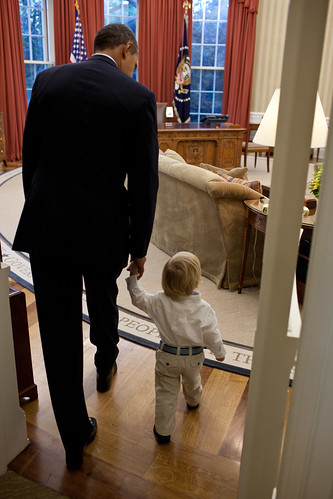
I really love the White House Flickr photostream, and I hope that even if there’s a new President in a little over a year (which I don’t hope happens at all, but if it does) that the next administration keeps doing this. White House photography just fascinates me, no matter who the President is. Here’s a random selection of photos that I particularly like (this service only began with the Obama administration):

P101411PS-0743

P111111LJ-0553

P111711PS-0855

P112111LJ-0076

P112611PS-0462

P112411PS-0067

P101111CK-0186

P101111PS-0155

P101211CK-0207

P101311PS-1306

P101711PS-0577

P092011PS-0280

P092911PS-0344

P090811PS-0325

P091111CK-0217

P080211PS-0051

P070111PS-0353

P071211PS-1084

P072511PS-0543

P072011PS-0740

P062211PS-0611

Seriously, I could post a hundred more of these. I love this stuff.

And man, does the President keep a clean desk or what? Ye Gods! He’s got so little stuff on his desk that if he wants to do some of his own computer work, he has to go to an adjoining office!

Share This Post

Go team!

I don’t really have a whole lot to say about football right now, except for a couple of random observations:

:: Thank God that Tebow-mania is over for a while.

:: Of course, if ending Tebow-mania comes at the price of seeing St. Tom lift another Lombardi trophy, then I’m not sure it’s worth it.

:: Go Giants and Ravens.

:: Note to future NFL teams: don’t win any more than 14 games in the regular season. Six teams have won 15 or more games, and of those, only the first two — the 1984 49ers and the 1985 Bears — won the Super Bowl. Of the others, only the 2007 Patriots even made the Super Bowl, and they lost. The other three — 1998 Vikings, 2004 Steelers, 2011 Packers — didn’t even get there.

That’s about it. Two more chances for someone to end St. Tom’s season with a loss. Let’s go!

Share This Post

Sentential Links

Linkage….

:: There’s a sense that a lot of us have that our public policy ought to be aiming to produce large gains for everyone. You often hear that for one reason or another the United States “can’t afford” this or that. We “can’t afford” to pay people Social Security benefits. We “can’t afford” to build high-speed trains. We “can’t afford” to give everyone early childhood education. But why can’t we afford this stuff? Are we a poor country? No, we’re not. We’re one of the richest countries that’s ever existed. Are we a poorer country than we used to be? No, we’re not. But a very large share of the gains we’ve made over the past three decades have gone to a relatively small number of people. If the gains had been broadly shared, then the burden of paying for that basic infrastructure and public services would have to be very broadly shared. But the gains have been very concentrated, and so if we’re going to afford that stuff, a large share of the revenue has to come from the people who’ve gotten the money.

That’s not envy, that’s math.

:: I could use a little Essence of Yo in my life! (I have never been able to make a yo-yo work. That is all.)

:: I will no longer be talking to Ron Paul supporters about Ron Paul. Paulites are like ultra-conservatives who believe in magic. Or they’re just dumbass college kids who want marijuana legalized enough to not pay attention to the monstrous amount of racism and sexism this man spouts. I’m done with them. “Educate yourself” they always tell me. I have no choice but to assume this is meant as irony. (The most loud-mouthed Paul supporter I know is a college student who is also a 9-11 conspiracy theorist. I don’t bother with Paulites anymore, except to occasionally wander into a pro-Paul discussion, ask something like “So what’s the excuse-of-the-day for Paul’s racist newsletters?” and then wander off without waiting to see what the answer is. Great fun!)

:: Too terrified to hurl themselves from a bridge or put a shotgun in their mouths or even take up smoking, they at least hope that each day is the day that a bag of sodium-laden chips triggers a massive stroke, after which would come blessed emptiness. But even rides on the carousel of death are now denied to them by their cruel creator. (Making fun of Funky Winkerbean is one of life’s finer pleasures.)

:: To those who pontificate anxiously that the Internet keeps us separate and isolated from one another: You literally do not know what you are talking about. This PSA has been brought to you by Sheil-babe. (Preach it!)

More next week!

Share This Post

Sunday Burst of Weird and Awesome!

Oddities and Awesome abound!

::  No. No no a thousand times NO.

::  Charles Stross predicts the future, part one and part two. Fascinating reading, even if I personally find his vision of the future a little…depressing.

::  A bit of ‘inside baseball’ on this one…but fine Buffalo blogger (whom I’ve known for years now) Alan Bedenko has been waging a somewhat mercurial campaign against Buffalo News food critic Janice Okun, whose writing tends to be harmlessly facile. The campaign seems a bit odd to me, but then, one would hope for better food writing in the region’s most prominent regular publication, and that we don’t have it seems to reinforce notions of Buffalo being a parochial backwater locale where the restaurant scene is too dominated by the likes of Applebee’s. But whatever…a month ago, Alan wrote a post in which he noted that some odd factual claims by the owner of a restaurant Okun reviewed went unchecked, with hilarious results. Somehow — and there’s no doubt Alan didn’t expect this — he scratched the surface of something whose underbelly is very seedy indeed, and the comments on that post have been raging ever since. It’s quite a thing to behold.

More next week!

Share This Post

Shut up, Joe. Just SHUT UP.

Warning: rant ahead!

My God, would someone in Joe Paterno’s family just step up and shuffle the old fool off to a nursing home so he can babble at the walls or something? Doddering Old Joe has just come out with his latest explanation of where things went wrong:

Joe Paterno, in the midst of treatments for lung cancer, made his first public statements since being fired after 46 seasons at Penn State, telling The Washington Post he did not know how to deal with the situation when he received a report that his former defensive coordinator was accused of abusing a boy in the shower at the Penn State football facility.

“I didn’t know exactly how to handle it and I was afraid to do something that might jeopardize what the university procedure was,” he told The Post in an extensive interview at his home in State College, Pa. “So I backed away and turned it over to some other people, people I thought would have a little more expertise than I did. It didn’t work out that way.”

…

Paterno said that until assistant coach Mike McQueary, in 2002, approached him, he had “no inkling” of a possible dark side to Sandusky, according to The Post.

“He (McQueary) told me what he saw, and I said, what? He said it, well, looked like inappropriate, or fondling, I’m not quite sure exactly how he put it. I said you did what you had to do. It’s my job now to figure out what we want to do,” Paterno told The Post.

“So I sat around. It was a Saturday. Waited till Sunday because I wanted to make sure I knew what I was doing. And then I called my superiors and I said, ‘Hey, we got a problem, I think. Would you guys look into it?’ Cause I didn’t know, you know. We never had, until that point, 58 years I think, I had never had to deal with something like that. And I didn’t feel adequate.”

Paterno affirmed reports that McQueary was not specific in describing what he allegedly saw, and he told The Post that even if he did, “I don’t know that it would have done any good, because I never heard of, of, rape and a man. So I just did what I thought was best. I talked to people that I thought would be, if there was a problem, that would be following up on it.”

I cannot believe this. Once again it’s “I just punted it upstairs”. He didn’t know what to do? Is there anyone out there who thinks that this is really that hard a question? He “was afraid to do something that might jeopardize what the University procedure was“? Is he kidding? He was Joe F***ing Paterno. I’m willing to bet that even if he somehow screwed up some PSU ‘special procedure for reporting crimes‘, nobody — not one person — would have complained or called him on it. He would not have gotten in trouble in any way. Why?

Because he was Joe F***ing Paterno, that’s why.

We’re talking about a man who was (and, in some camps, continues to be) worshiped for some inexplicable reason. Does anyone think for one second that Paterno would have received even so much as a mildly-stern talking-to had he somehow “broken PSU procedure” in the course of reporting a possible felony committed against a child?

Somebody, please, shut Doddering Old Joe up.

Share This Post

“Greetings, Programs!”

“The Grid – a digital frontier. I tried to picture clusters of information as they moved through the computer. What did they look like? Ships? motorcycles? Were the circuits like freeways? I kept dreaming of a world I thought I’d never see. And then, one day….”

“You got in!”

“That’s right, man! I got in.”

The first time I realized, as a kid, that there were limits to how far my interests intersected with most of the other kids was when a movie came out in 1982 called TRON.

I was, probably, the ‘nerd’ in school, although I wasn’t walking around with my button-downed shirt tucked into my too-high pants and my writing instruments tucked into a pocket protector. I didn’t wear a tie to school. (I actually loathe neckties, I didn’t learn to tie one until I was 24, and I only own exactly one necktie right now whose location in the bedroom I don’t even know and have not worn since a job interview in 2003. But that’s another topic.) I didn’t know a blessed thing about sports, so when it came time to play football or softball in gym class, I’d have to have the games explained to me.

But even so, to be in fifth and sixth grade in the early 1980s meant that we were all, nerds and jocks, part of “Star Wars nation”. By this I mean that, for the most part, we all saw the same movies, so even if I had no input on conversations of the weekend’s football games, I could still join in with speculations on whether or not Han Solo would return from his carbonite prison, or talk about how bad-ass Indiana Jones was, and so on. I had a friend who was as big a fan of the James Bond movies as I was, so we had those. And so on.

But along came TRON, which I wanted to see because it looked freakishly cool. And I did see it that summer, planning to discuss it with all my friends that fall when I saw them again (TRON was a summer movie). To me, TRON was the obvious next thing in the line from Jaws to Star Wars to Close Encounters to The Empire Strikes Back to Raiders of the Lost Ark to ET. However, to my dismay, not one of my friends saw TRON. I remember a couple of abortive “Hey, did you see TRON?” conversations, all of which ended with something like, “Is that the weird movie inside the computer” or something? Yes. Yes, it was. At the time I was known for various reasons as the resident ‘computer nerd’, so it stood to reason that I’d like the computer movie. But computers weren’t ubiquitous just yet.

(Now, in truth, I wasn’t that big of a computer geek. I loved them, and I dabbled, but I never really had the determination to dig as deeply into computers as I could have, and anyway, a few years later my nascent fascination for computers took a big developmental hit when I got bitten by a beast called music. There’s an alternate me, though, in some other universe, in which I became one hell of a hacker who eventually wrote programs for NASA. And there’s still another alternate me, I would wager, that also became a hacker but for shadowy governments and groups based in Eastern Europe. That guy sports a goatee and likes to sit in quite contemplation, steepling his fingers together as be mulls over what manner of mayhem he wishes to unleash upon cyberspace this week.)

Now, this wasn’t exactly a traumatic experience. OK, the other kids didn’t see TRON. No biggie. I didn’t watch football, they didn’t see TRON or appreciate Star Trek. It was OK. But not until college would I find other fellow travelers who’d seen and liked TRON. The movie was my first intimation of a thing that might later be called “geek culture”, but at the time, it was an underground thing. The geeks hadn’t taken over the world just yet, and in truth, back then it didn’t much feel like they would. So into my memory banks went TRON, filed under “Things I Like That Not A Lot Of Other People Did”. I certainly never figured that TRON would get a sequel, even though the innards of the ENCOM system seemed like such fertile ground for exploration.

Thus, imagine my surprise when a sequel, to be called TRON Legacy, was announced.

I suppose it was inevitable, given Hollywood’s current fetish for remakes and reboots and other ways of working with old properties instead of developing new ones. Lots of times, these kinds of projects make me roll my eyes, but others make me think, “Hmmmm, why not?” (And I’d be outright lying if I didn’t admit that a part of me is just waiting for Firefly to get old enough for someone in a suit in Hollywood to say, “Hey, howzabout we reboot that?” Of course, with my luck, Joss Whedon will have no involvement and Roland Emmerich will direct a script by Roberto Orci and Alex Kurtzman.)

I liked what I saw of the trailers to TRON Legacy, which seemed to be implying a grittier “World Inside the Computer” than the original, with a look that was unmistakably TRON but also slightly Matrix-influenced. And, even though the movie itself got generally mixed reviews, I found myself really enjoying it. Really enjoying it. TRON Legacy was, for me, like scratching a spot that I didn’t realize was itchy until I touched it.

In terms of story, TRON Legacy really doesn’t break a whole lot of new ground. It gives us the kid (Sam Flynn) with the absentee father (Kevin Flynn) who has a lot of issues with responsibility and a willingness to flaunt danger, but who is called upon to embark on a Quest of sorts when he receives an odd piece of information that may bear on his father’s fate. In Sam’s case, Kevin Flynn’s old friend Alan Bradley tells him that he’s just received a message from Kevin Flynn’s old video game arcade, a place that has been shut down for years. Sam goes there, finds a hidden door that leads to a secret computer lab set-up, and when he starts tinkering around, a laser-imager-thing fires up, pulling Sam into “the Grid”, as the System is known.

The Grid, in the movie, is clearly the World Inside the Computer from the first film, fast-forwarded twenty-eight years or so. The script used terms like “Grid” instead of other terms that we might expect, such as “The Net”, which seems to cover over a conceptual point that the film never really addresses: how the World Inside the Computer of TRON would be given the surging of Moore’s Law and of the development of the Internet. Maybe a future sequel (one is said to already be in development) would look into this sort of thing: what would viruses be like in the World Inside the Computer? And how would Programs – depicted as people in the System – be affected by things like DRM? But maybe this sort of thing would be too esoteric.

TRON, though, didn’t really deal with computer issues either, even for the computers of the 1980s. There was never really a sense of how bad things would be for humans – ‘Users’ – if the Master Control Program succeeded in taking over the entire system. Ultimately, the World Inside the Computer was a setting for a not-terribly-original story of plucky heroes defying the odds against a tyrannical villain; what was unique was the film’s look and the paraphernalia of the story. A lack of originality in the original story can be overlooked, if at the same time we’re watching things like Recognizers, Sailships, and, of course, light-cycles. All this is, of course, mainly because TRON purported to be inspired by the just-starting-to-snowball computer revolution, but what really inspired TRON was the then-in-full-swing video arcade game craze.

TRON Legacy shows us a World Inside the Computer where things have gone wrong since the original events that, at the time, were thought to be setting the stage for a Golden Age in that world. What happened? Why? And how does it involve Kevin Flynn, and by extension, his son Sam? This is the story of the film, which involves some of the programs from the original film, mainly Flynn’s alter-ego program CLU. (Now, CLU had been executed – ‘derezzed’, short for ‘deresolution’, in TRON lingo – in the original film, so either Flynn had a backup CLU or this is CLU 2.0. The film doesn’t say, but there’s an interesting question to be explored in the TRONiverse regarding the ontological status of backups, which would literally be identical copies of programs! In a way, they’d be more perfect than clones, wouldn’t they? Bring on TRON Episode III: Attack of the Backup Copies!)

TRON Legacy makes no real effort, as I note above, to ‘update’ the TRONiverse in a way that reflects what we now know about computers. Instead, it goes on its way, creating its own terminologies for the System. Thus we have a subplot involving Flynn’s inadvertent creation of a sentient ‘race’ of programs, which are then summarily destroyed by CLU; what kinds of programs would those be, anyway? TRON Legacy studiously avoids drawing parallels between what happens in the Grid and what happens in our own computers, so again, we have a story that’s unfolding in an amazing-looking world that’s more organic and less stylized than the blocky, 8-bit-looking world of TRON. TRON Legacy is visually stunning, there’s no doubt about that. One stylistic tic of the film that I noticed in a big way is the symmetrical construction of a good many of the big, establishing shots. If you like symmetry in your movie visuals, TRON Legacy is your movie. Another is that the film is firmly entrenched in the much-derided “teal and orange” tradition which is currently at sway in movies. I’m of mixed mind on this. On the one hand, I’m tired of the limited color scheme in movies today. But on the other, it works very well in TRON Legacy, seeming like an extension of the original film’s blue-and-red.

So what about that story, then? In terms of the dressings of the Grid, there’s not a lot new – it all simply looks a lot better now. The light-cycle sequence in the new film is amazing, and there are more battle scenes involving the discs that Programs wear on their backs. There is a love story and there is a redemption story and there is the whole father-and-son story, which has double parallels because Kevin Flynn is not just Sam’s father, but in a very real way, he is CLU’s father as well. Jeff Bridges plays Flynn this time out as equal parts Obi Wan Kenobi and The Dude, to good effect, saying things like “It’s amazing how productive doing nothing can be.” We’re not entirely sure how he’s managed to survive twenty-plus years in the Grid, but it doesn’t really matter. Bridges does double-duty, actually, also playing CLU with scenery-chewing malevolence. (He’s also been digitally ‘enyouthened’, to make up a word on the spot, thus solving the problem of having CLU look like the Jeff Bridges of 1982 – or at least more like that than the Bridges of 2010.)

Sam Flynn is a pretty interesting character, too. On the one hand, he’s your standard ‘young man with daddy issues and trouble with responsibility’, but he’s not sullen or bitter, which is nice. It would have been too easy to have Sam brooding his way through the film, but he doesn’t; he engages with the world, partly accepting it and partly disbelieving it.

The performance of the film, though, belongs to Olivia Wilde as Quorra, Kevin Flynn’s main ally in the Grid. She is a blend of strength and intelligence and raw naivete, a program who serves a User incarnated before her, and who learns more about the world of the Users than anyone in the film should probably know. She shows up almost out of the blue, to help Sam, and we soon learn that she is Kevin Flynn’s closest ally in the Grid – his only ally in the Grid, actually. She is also deeply interested in the world of the Users, having read the books that Kevin Flynn has surrounded himself with in his Grid apartment, but not quite understanding certain details:

QUORRA: Between you and me, Jules Verne is my favorite. Do you know Jules Verne?

SAM: Sure.

QUORRA: What’s he like?

At the end of the film, Sam Flynn is able to bring Quorra with him into the ‘real world’, the world of the Users, and as the film closes, he is driving along on his motorcycle with Quorra clinging to his back as she looks with wonder on the sunset for the first time. Wilde does something here that amazes me: she doesn’t so the slack-jawed stare that you might expect. Instead, she takes in the sunset, and then she turns back forward to lower her face and bury it in Sam’s back, in a gesture of intimacy that’s probably best saved for the back of a motorcycle. But even as she lowers her face, her eyes again flick upward and around, to see what she might see. She can’t decide what to look at, but she doesn’t want to stop looking, even as she acts on feelings for the son of her hero. Wilde’s performance in TRON Legacy is pitch-perfect, and it is her character that is key to the whole film. Quorra’s journey is the longest one in the film, and Wilde’s portrayal of her quiet joy upon reaching her journey’s goal is absolutely wonderful.

The music for the original TRON was provided by pioneering synthesizer composer Wendy Carlos. Given that film’s video game subtext, the music was crafted to sound like video game music (and then was used in the actual TRON video game, which was, incidentally, a pretty awesome damned arcade game in itself!). TRON Legacy‘s deepening of the textures of its world calls for more intricate music, and it is provided by techno group Daft Punk, in what is frankly one of the finer electronic scores I’ve heard for a movie. It is otherworldly, sometimes rhythmically pounding and at other times dreamy, but almost always melodic and haunting. This is the kind of film music that makes me laugh when I hear other film music fans talk about how that particular art’s better days are farther and farther in our past.

I would not contend that TRON Legacy is a great film. But it is a slick and extremely well-constructed entertainment.

Share This Post

Page One: The Dark Phoenix Saga (Uncanny X-Men)

My main era of comics reading was in the mid to late 1980s, spanning roughly the latter half of seventh grade until the end of my senior year, when I decided to pretty much stop reading comics on the basis that there was no way I was going to be able to afford all my monthly titles whilst in school.

For the most part I was a Marvel fan. There were titles that I didn’t much care for, but I really grooved on The Uncanny X-Men from the first time I read it (issue #183 or thereabouts, my first issue being one in which Peter Rasputin has to tell Kitty Pryde about a girl he’d met on an alien planet). My entrance into the Marvel Universe was pretty much of the “jump in, buy comics, read ’em and put it all together in my head” variety, but back then, you could do that. Sure, the Marvel Universe had tons of continuity going on, but it was still fairly manageable without resorting to lots of reference stuff.

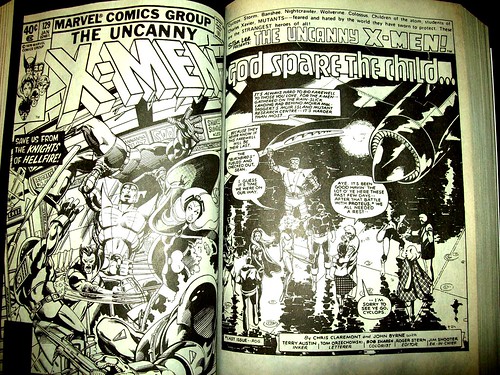
So, a couple of years after I started reading comics a lot, Marvel produced a trade paperback of something called “The Dark Phoenix Saga” from The Uncanny X-Men‘s issues 129 to 137. I knew enough about this storyline to know that it was already considered something of a classic of the genre, and I knew that Jean Grey’s death was an event that was still showing repercussions throughout the Marvel Universe. Now I was going to find out how that death had come to pass.

That original trade paperback of mine is long gone, but I have since reacquired the “Dark Phoenix Saga” as part of one of Marvel’s “Essential” compilations, which nicely and cheaply reprints lots of issues into a nice thick volume (albeit keeping the cost down by printing in black-and-white). I plowed through this entire volume a while back, and a lot of it comprised stories I didn’t know, particularly the ten or fifteen issues leading up to the start of the “Dark Phoenix Saga”, and a couple of issues that showed the aftermath.

The faults in Chris Claremont’s stories tend to stand out quite a bit more in omnibus editions. Now, to be fair, I’m not sure if some of the most annoying style tics of his were actually tics of his or if he was directed by editors to do some of these things, but we’re talking about Wolverine constantly pointing out his unbreakable claws, Cyclops constantly referring to his ruby-quartz visor, and so on and so forth. Or how it sometimes seems as though two or three pages of every twenty-two page issue is given to summing up stuff that happened before. And over time, Claremont’s focuses on character interactions and complex webs of interrelationships tends to start to feel like soap opera; I remember one commentator describing his run on Uncanny X-Men as “Dallas with capes”.

And yeah, that’s all true. But it worked a lot better when you were reading these issues one at a time, once a month. And now, reading the omnibuses, those flaws aren’t really all that distracting, when Claremont is firing on all cylinders…as he is in the “Dark Phoenix Saga”.

This story starts out small. The X-Men are recovering a bit from a pretty tough battle, and there are apparently some conflicts of personality within the team (this is how things seem if you start here and not before). Professor X returns from somewhere (I don’t recall where he was), and almost immediately, they detect two new mutants, one in Chicago and one in New York City. (The X-Men are always scanning for new mutants, so they might intercede and help them learn to deal with their mutancy in a world that is hostile to mutants.)

From such humble beginnings — tired team, investigating two new mutants — this story takes us on an ever-widening story whose scope gets bigger and bigger and bigger until, by the time we get to the final three issues or so of the “Dark Phoenix Saga”, we’ve got full-blown space opera going on, leading to a showdown amongst ruins on the dark side of the Moon. And along the way there is a love story, seeds planted for future tales (this is where we meet Kitty Pryde, after all), and the slow but inexorable rise of Jean Grey’s power until she can no longer control it.

Claremont — along with artist Byrne — presents one of the most cinematic stories I’ve ever read in a comic. In a real way, most of the comics stories of today — and the comics movies — can trace some piece of lineage, in terms of storytelling style, back to the “Dark Phoenix Saga”. This is one of the stories that I would likely cite if someone ever asked me what stories they should read if they want to see superhero comics at their very best.

And now I want to read the bloody thing again!

Share This Post

ForgottenStars.net

The official site of Kelly Sedinger: Reader, writer, photographer, and dreamer

Skip to content ↓