A very brief note on comments

Hey folks, I’m noticing a tiny little service bug with the comments here. I have it set up so that each new comment is forwarded to my G-mail account, which is how I learn of their existence. Within each e-mailed comment, there are links to publish, delete, or mark comments as spam. I usually just click “Publish”, and the comment goes through.

I’ve noticed a few times over the last week, though, that sometimes I click “Publish”, and the “Comment Published” pop-up screen shows up — but the comment doesn’t go anywhere. I don’t discover this until I actually sign onto Blogger and see a notification of unmoderated comments, and this find out that the comment I’d thought I’d published earlier is still sitting there in Limbo.

So, if you comment and later notice that it’s been an oddly long period of time and your comment hasn’t appeared, that’s likely what’s happening.

Share This Post

Sunday Burst of Weird and AWESOME!

Oddities and Awesome abound! These are all Halloween related or in honor of Halloween.

:: The kinda-classic early 80s animated movie Heavy Metal strings together an anthology of stories, all loosely connected by the common thread of a glowing green ball that does lots of bad things to people. This is the film’s most effective sequence, from the horror standpoint.

:: SamuraiFrog takes pumpkin carving seriously. Check ’em out.

:: Also check out Sheila O’Malley’s montage of her costumes throughout the years. My reactions went kind of like this: “OK. Nice. Cool. Nifty. Nice. Ha, that’s funny. Nice. OK…wait, what?!”

:: And of course:

More next week, folks!

Share This Post

Oh, come on….

white trash repairs - The Key to Power Failure
see more There I Fixed It

You know, it’s not a hard job to do. A new plug will run you about $4 at Home Depot (or around $15 if you want the “professional” one). Replacing a plug on a wire takes about fifteen minutes, and the only tools you really need are a screwdriver and a sharp-bladed knife.

I can’t believe someone did this.

Share This Post

Search Engine Tomfoolery

Back in the hazy days of the early settlement of Blogistan, it was a common thing to post about weird search engine queries that led folks to our respective blogs. You don’t see this much anymore, mainly because most such meme-things tend to fall aside eventually and because after you’ve been blogging a while, there’s a natural raising of the bar for how weird a query has to be before you take any real notice of it.

So, congrats to the person who landed here looking for “people driving topless in overalls”. Sorry you didn’t find what you were seeking, but…well, let me know if you find it!

Share This Post

Ultracalifragilisticexpialidocious!

See what I did there? It’s “ultra”. One step up from “super”. Take that, Mary Poppins!

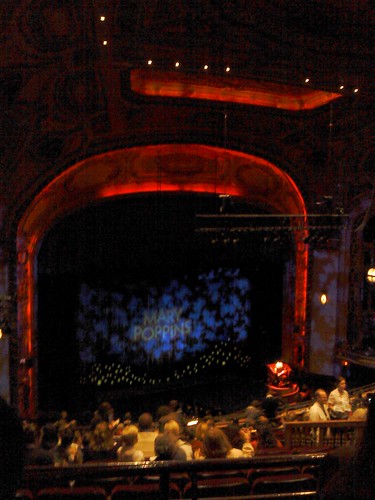
Which brings me to the topic here: Mary Poppins, the stage musical, which we were lucky enough to see live at Shea’s Buffalo a couple of weeks ago. (Thanks to tickets provided by the lovely Jennifer Smith, who always manages to make the magic happen!)

I love going to see shows and we don’t get to see nearly enough of them, so I was excited to go to this one. I haven’t been in Shea’s in seven years — last time was for a play The Daughter’s preschool class attended — and before that, not since 1999 when we went to see Phantom of the Opera. That’s too long. Now, some of that time, we didn’t even live in Buffalo, and other times, finances made going to see shows about as possible as launching ourselves to Mars. Nowadays, though, going to Shea’s to see a show or two isn’t off the table as an option. (If only there would be a full-scale touring revival of Les Miz…!)

But as excited as I was, I was also a bit nervous about this one. Mary Poppins is one of my favorite Disney films of all, and while it’s rightly seen as a classic, it tends to be seen as more of a classic family or children’s movie than one of the truly great movie musicals, which is what it is (in addition to the other things). I was somewhat fearful of the translation of a beloved movie to the stage.

For the most part, though, this fear was laid aside. The stage show, it turns out, is not a simple transposition of movie to stage show with a couple of new numbers inserted; instead, it goes its own way at several points. The film was, after all, merely based on a series of children’s books written in the 1920s; thus, the stage show was able to retain quite a few of the movie’s best songs, but was also able to incorporate the new ones by using material from the source books that the film didn’t. This made for a show that was both familiar and different.

The bare bones of the story is the same: a well-to-do — but not rich — family in London is in need of a nanny for its two nice, well-meaning, but not terribly well-behaved children. Nannies have apparently come and gone, but it’s not until a very special nanny comes along that the kids meet their match. That nanny’s name is Mary Poppins, and she’s the type of nanny who makes entrances by flying in on the handle of her umbrella and toting around a satchel that contains things like six-foot-tall coat racks. Mary takes quick charge of the kids, showing them somehow that cleaning one’s room can be fun (no, I’ve never bought into her logic on this one, either) and showing them around London where they have some very odd adventures.

Along the way — and this is the real point of departure from the movie — we get a good look at the trials and tribulations of the parents, George and Winifred, both of whom are having existential struggles of their own. George is worried about providing for his family, while Winifred is worried about her role as the mother. George works at the bank, as in the film and books, where he suffers flashes of idealism but often buckles down before authority. Frankly, a lot of this material struck me as being fairly dull, and I would have preferred the more whimsically odd bank of the film, where young Michael inadvertently causes a run on the bank and where the story’s ultimate moment of epiphany comes from a humorless character suddenly getting a joke. Unfortunately, that joke (“I once met a man with a wooden leg named Smith.” “What’s the name of his other leg?”) is not in the stage show. Nor is the wonderful sequence involving Uncle Albert, a man who laughs so much that he levitates to the ceiling when he laughs and then can’t get down.

The stage show blends many of the wonderful songs from the film with a more modernized kind of storyline, occasionally with odd results. When young Michael opines of one particularly nasty nanny that “She probably ate her young”, it was a funny line — but it also had me thinking, “Oh, come now, no kid in Victorian England is going to talk like that.” The denouement of that particular storyline — when George’s earlier decision to give a loan to a guy who looks like a waste of money turns out to have been a brilliant business decision — felt so predetermined as to seem almost fake. It had none of the effectiveness of George’s epiphany in the film, when he loses his job at the bank and realizes that his family is more important, anyway. I really missed how “Let’s Go Fly a Kite” is transformed from the number where George finally plays with his children, into a number for Bert the chimneysweep.

Also, the complex lyrics of the original songs (by the amazing Sherman Brothers) occasionally seem out-of-place in a more modern type of story as this. I kept thinking of the first song of the film, in which Winifred sings of her work as a suffragette. Of course, would kids these days even know what a suffragette was? Probably not. But the show’s setting suffers a bit, thus.

Technically, though, Mary Poppins works wonderfully. I loved the set design, with the Banks house looking like a giant dollhouse that literally opens up to fill the stage, and other stage effects such as the scene changes that take place as seamlessly as any I can remember. The two show-stopping numbers — “Supercalifragilisticexpialidocious” and “Step In Time” — both brought the house down, and my favorite Mary Poppins song, “Feed the Birds”, survived the translation to stage just beautifully. Another number, taking place in a London park and involving naked Greek statues come to life, was — well, I found it a bit distracting, because from my balcony seat, I kept thinking, “Is that statue really naked? Is there a guy wearing a costume with a marble phallus really dancing around on the stage right now?!”

(Oh, come on. If you saw the show, you were thinking it, too!)

The focus is on the Sherman Bros. songs, while the new songs (“Practically Perfect” and “Anything Can Happen” among them) work nicely enough. But there’s never any mystery as to what we really want to hear, is there?

As for Shea’s Buffalo itself, well, it’s such a beautiful theater. Just a wonderful place. I love the ambience, the ornate atmosphere, the pre-show music on the Mighty Wurlitzer organ, everything about it. Although I did think that the concessions folks, selling candy and soft drinks during intermission, missed an opportunity to tie in their wares to the feature attraction. Wouldn’t you agree that when selling M&Ms at a theater where Mary Poppins is playing, the price should be “tuppence a bag”?

Share This Post

Something for Thursday

I’ll be using this again in a post sometime, but for now, here’s a nice piece of music for our upcoming Halloween. Hector Berlioz’s Symphonie fantastique was intended by the composer to tell a story, detailing an artist’s captivation by a woman (represented by a recurring melody he called the idee fixe that is heard in each movement) and his eventual descent into madness as, in the last two movements, he takes opium and begins to suffer demonic hallucinations. In the last movement, he envisions his lover as a witch, leading a horrible kind of celebration in which our hero has visions of death and other horrors. I’ll provide a more detailed annotation of the Symphonie fantastique at some point in the future, but for now, here is the last movement of the work, “The Dream of the Witches’ Sabbath”.

(The Idee fixe is heard in the clarinet twice, first at the 1:33 mark, and then again at 1:52. A bit later on, Berlioz invokes the famous Dies irae melody, more than once. I normally don’t like posting symphonic movements outside of the context of the larger work, but it’s Halloween….)

Share This Post

A helpful hint

If you ever use the construction “I’m not a _____, but….”, rethink what you’re saying before you say it publicly. “I’m not a bigot, but Muslims at the airport scare me” is an asshole thing to say. And so is “I don’t hate fat people, but boy howdy, I sure don’t want to have to look at them!”.

OK, that’s not an exact quote, but it’s pretty much what Maura Kelly says in that piece. I’m sure she struggled hard to find the right words to get her point across; how sad that the point she actually got across was not the one she thought she was getting across. But then, it’s so often amazing to see an asshole shouting from the rooftops without ever realizing that what they’re shouting up there is actually, “Hey! Everybody! I’m an asshole!”

Share This Post

A man stands up

I saw someone on another blog yesterday comment that “you can’t equate not supporting gay marriage with hating gays”. I thought that a very odd statement: “I don’t hate gays, you see! I just don’t want them to marry. Or serve in the military. Or [insert behavior X here]. Or….” The notion is ludicrous, in my mind; I can’t imagine a motive for being anti-gay marriage or anti-gay anything that doesn’t involve some level of hatred for homosexuality and those who practice it, no matter how uncomfortable certain anti-gay folks might be with the characterization of their hatred. Since anti-gay sentiment is almost exclusively focused on the political right in this country, I checked out the famously insane platform of the Texas Republican Party, and well, if you can read this excerpt and not see hate dripping from the pores of those who wrote it, well, you’re frankly delusional.

Far more heartening is this manifesto, by an Episcopal Bishop.

I have made a decision. I will no longer debate the issue of homosexuality in the church with anyone. I will no longer engage the biblical ignorance that emanates from so many right-wing Christians about how the Bible condemns homosexuality, as if that point of view still has any credibility. I will no longer discuss with them or listen to them tell me how homosexuality is “an abomination to God,” about how homosexuality is a “chosen lifestyle,” or about how through prayer and “spiritual counseling” homosexual persons can be “cured.” Those arguments are no longer worthy of my time or energy. I will no longer dignify by listening to the thoughts of those who advocate “reparative therapy,” as if homosexual persons are somehow broken and need to be repaired. I will no longer talk to those who believe that the unity of the church can or should be achieved by rejecting the presence of, or at least at the expense of, gay and lesbian people. I will no longer take the time to refute the unlearned and undocumentable claims of certain world religious leaders who call homosexuality “deviant.” I will no longer listen to that pious sentimentality that certain Christian leaders continue to employ, which suggests some version of that strange and overtly dishonest phrase that “we love the sinner but hate the sin.” That statement is, I have concluded, nothing more than a self-serving lie designed to cover the fact that these people hate homosexual persons and fear homosexuality itself, but somehow know that hatred is incompatible with the Christ they claim to profess, so they adopt this face-saving and absolutely false statement.

I’ve pretty much reached the same point, myself.

Share This Post

“The pointy end goes in the other man.”

Screenwriting great William Goldman has opined in the past that the hardest films to get right are comedies and adventure films. An adventure film that gets things right is one of the finest things in life, I’ve always believed. One such film — which I hold to be terribly underrated, and a potential classic of the adventure genre — is the 1998 swashbuckler The Mask of Zorro. This has been a favorite of The Wife and mine ever since she and I saw it in the theater during its initial run, and we watched it with The Daughter just a week ago. We hadn’t seen it in some years — I had it on VHS, but I don’t have it on DVD — and I had forgotten just what a rock solid entertainment it is.

What struck me right at the outset about The Mask of Zorro is that it doesn’t do either of the “expected” things for a big-budget flick that pretty much reintroduced a very old character to young audiences who likely had no idea who Zorro was. The film didn’t just follow the adventures of an already-existent Zorro, but neither did it dwell on a long and boring origin story. Origin stories are really tough to pull off; to often, the film spends half its time on the origin and then has to compress the rest of the tale into the second half. Sometimes this works — Superman and Spiderman both pulled it off, mainly by making the origin stuff so good — but a lot of times it doesn’t.

The Mask of Zorro escapes the horns of this dilemma by skirting between them: we open in medias res, with Zorro in full strength, pulling off a daring exploit and escaping. But he is an older Zorro, played by Anthony Hopkins (in what is a typically outstanding Anthony Hopkins performance), and he is ready to retire as Zorro, thinking that he has won and is ready to settle into his private life as Don Diego de la Vega. However, his arch-enemy, Don Rafael, has learned who he is and goes to arrest him. In the ensuing melee, de la Vega’s wife is killed, and we get hints of an old love triangle between these three, even though it is never explained outright. De la Vega is taken prisoner, but Don Rafael decides to levy an even harsher punishment: he takes de la Vega’s infant daughter Elena to raise as his own.

Twenty years later, de la Vega escapes from prison and is about to murder Don Rafael when he discovers that his daughter, now a grown woman, is back in California. His desire for revenge is stymied, until he comes across a much younger man, a drunken thief named Alejandro Murietta (Antonio Banderas), who has his own scores to settle and whom de la Vega can enlist to his aid and train as the new Zorro. Lots of derring-do ensues: Don Rafael’s plot to become ruler of California; de la Vega’s training of Alejandro; Elena’s attraction to the masked outlaw she meets in passing and her growing suspicion that her past is muddier than she has known before; a soldier from the American army who is very nearly psychotic; and ultimately, de la Vega’s twenty-year quest for revenge against the man who took everything from him.

What makes The Mask of Zorro so great, from a story standpoint, is the fact that there isn’t a single unmotivated character in the film. Everybody has something that they’re trying to achieve, something they’re working toward; therefore, everyone in the film has a reason for the things they do. I never once get the feeling of plot machinery cranking away in this movie; every character wants something, and even in the cases of the villains, they want things beyond the typical “villain” things like power and money. It’s always good when there is personal history between hero and villain, and yet, too many adventure films fail to take this easy step toward making their characters more three-dimensional.

The other big reasons why The Mask of Zorro works so well are the usual suspects: the performances are uniformly excellent, the pacing and editing are outstanding, James Horner’s score is a blast, and Martin Campbell’s direction is top-notch. The film is also notable for its lack of computer-aided action sequences; those who place value in old-school stuff like stuntmen and choreography will find much to love in The Mask of Zorro.

It’s one of the best action films of the 1990s, and much better than the more famous (and more popular) The Mummy.

Share This Post

ForgottenStars.net

The official site of Kelly Sedinger: Reader, writer, photographer, and dreamer

Skip to content ↓