

I was offline a chunk of the last few days, so no Sentential Links this week. We’ll return next week. Other content will come as the day warrants. Tune in!
Sunday Burst of Weirdness

[I’ve been away for a few days, enjoying some downtime away from work. Today I’m back to routine.]
Oddities abound!
:: I don’t talk much about things “jumping the shark”, although it’s a pretty useful metaphor. My prime difficulty is that although I remember Fonzie jumping that shark on Happy Days, I was too young — the episode aired days before my sixth birthday — to recognize the Fonz’s shark-jumping as the entire series’s metaphorical shark-jumping. However, a few years later, my tastes had refined a bit — not completely, but a bit — and I was able to recognize a second moment from which Happy Days never recovered, in my eyes.
It’s an episode where Potsie’s got a problem: he’s doing very poorly in school, specifically an Anatomy class, because he’s failing left and right (owing, apparently, to the teacher’s lousy methods or some such). He reaches the point of declaring his intention to drop out, but then his friends come to his rescue, finding a way to help him pass the test, which he does with flying colors. And how did he pass this exam on the human circulatory system? Well:
To this day I can remember thinking to myself, “Yeah, this show’s pretty much done now.” This aired when I was almost eight years old. O the wisdom I gained in those two years!
:: Seen on the shelves at a mini-mart near Ithaca, NY yesterday:

I know that the name of a product has little, if anything, to do with what it tastes like, but I am so not about to drink something called “Porkslap”.
That’s about all. I wasn’t online as much this past week.
Share This Post
And now the awarding of Experience Points!


This kind of thing thrills me deeply: a guy in England has discovered the largest hoard of Anglo-Saxon gold ever found. There’s so much of interest in a story like this, even beyond the amazing nature of the find itself (and one of my life goals is to go to the UK someday and go to lots of museums to see all these old Anglo-Saxon relics). The guy who found the gold is referred to as a “metal detectorist”. There is an actual, official definition of “treasure” in the UK, and whether a found pile of gold is a treasure or not is determined by the coroner. That must be nice — “Hey, we have a call for you, but guess what! It’s not a body!”
Link via MeFi, with a discussion thread with more information (as well as the typical MeFi wordplay, such as “This thread is useless without picts”). Here is a photoset of the Staffordshire Hoard.
Share This Post
Something for Thursday
Rand-McNally 2, Sportswriters 0
What is it with sports commentators and their inability to talk about geography? In today’s example, we have FOX Sports’s Adam Schein talking about the Arizona Cardinals. One narrative for years regarding the Cardinals — besides the fact that they have historically sucked, until last year — is that they almost always lose when playing East Coast teams. This past week…well, here’s Schein:
I couldn’t believe how many talking heads declared the NFC champion Cardinals dead after a home loss to a good 49ers team. This was the single-most foolish notion flooding the airwaves. The Cards eradicated the stereotype they can’t play in the Northeast by dominating the Jaguars on offense, defense and special teams.
Yup, the Cardinals beat the Jaguars pretty handily. But wait! Schein is indicating that the Jaguars, who play in Jacksonville, Florida, are a Northeast team! Maybe Miss South Carolina was on to something when she said that most US Americans don’t have maps.
Share This Post
Into the Hole
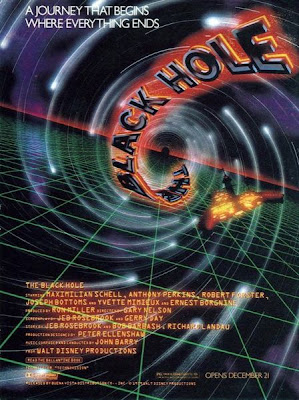

Hey, remember the movie The Black Hole? I ran across a clip of it on YouTube the other day, and I’ve been thinking a bit about it. Maybe I should track down a DVD at some point. (Spoilers here, but the movie’s 30 years old, so….)
The fine folks at Disney made The Black Hole in 1979. It was their entry in the “Hey, the kids do sure like that Star Wars, so we needs ourselves a space movie too!” sweepstakes that resulted in lots of space opera stuff, some of it not bad (Battlestar Galactica), some of it campy but fun (Battle Beyond the Stars), some of it weird (Moonraker), and, naturally, some of it downright awful (Starcrash). So in 1979, along came The Black Hole, which flopped at the box office. I suspect that word-of-mouth wasn’t that great, and maybe by then the whole space-flick thing was getting a little tiring anyway and besides everybody knew that the real thing, in the form of The Empire Strikes Back, was less than a year away.
But The Black Hole isn’t bad. Neither is it all that good. It’s solidly in the middle, occasionally approaching “good”, and then veering back toward “bad”, but never setting itself up at either pole. So ultimately it’s a pretty vexing movie — was it a good movie inside a bad one, or a bad movie inside a good one?
Our story: a small spaceship, the Palomino, is in deep space when it starts on its journey back to Earth. On the way it comes across a black hole, and perched on the edge of the hole is an immense spaceship which turns out to be the USS Cygnus, which was reported lost years before. Here’s the Cygnus, which is one of the most beautifully-constructed movie spaceships ever:

Investigating, they discover the Cygnus in the command of Dr. Hans Reinhardt, who operates his ship with the aid of a crew of humanoid drones, a squadron of security robots, and one very nasty robot named “Maximilian”. Here’s Maximilian:

Pretty menacing, eh? Especially as he doesn’t walk but rather floats around in the air and is equipped with a buzz-saw weapon which he uses on one unfortunate character later on (who tries to defend himself with a thick folder stuffed with papers — self defense FAIL).
Anyhow, it quickly becomes apparent that Reinhardt is crazy and planning to fly his ship into the black hole. In keeping with movie crazies of all stripes, Reinhardt refuses to let the crew of the Palomino leave, so now there’s a race against time: can our heroes escape before the crazy guy and his crazy robot take them on a journey into certain death?
It’s actually a kind of nifty plot, and watching the movie, I always get the impression that the Disney folks, in looking for a way to cash in on the post-Star Wars SF craze, looked for any script they could find, optioned this one, and then, well, Disney-fied it up a bit. There’s some serious stuff in this movie, lots of beautiful production design, and even a number of moments of genuine “sensawunda”. Here, for example, is the bridge of the Cygnus:

Seriously, that’s a gorgeous bridge, isn’t it? And nothing at all like the bridges or cockpits of big spaceships in movies to that point, where there’s a screen or window at the front and everybody’s facing it.
But then, along comes the Disney “We gotta make this for kids too!” stuff. Enter our heroic robot, VINCENT, whose design just screams out, “We need an R2-D2, only cuter!”:

And later on, after we’ve gotten used to VINCENT, we meet an earlier model, who is called in the film — I kid you not — “Old BOB”:

Old Bob is voiced by Slim Pickens. Can’t have a movie without an old-timer to tell the heroes what’s really goin’ on, I guess. (VINCENT and BOB are acronyms, of course, but I’m too lazy to Google what they stand for.) And our heroes end up in a firefight at one point with some very goofy looking security robots:

Well, Imperial stormtroopers they ain’t, although I did like their double-barreled blasters.
So, do they escape? Well, yes — and no. They get free of Reinhardt, by stealing his personal ship (or something like that), but it turns out that it, too, is programmed to go through the black hole, so in they go, after the Cygnus has already been destroyed. This is all well and good, of course; the black hole itself is the film’s gun on the mantelpiece, and we’ve got to see it go off, right? This brings us to the film’s final scenes, in which we see not just what happens to our heroes as they go through the black hole, but also, in one of the oddest sequences to ever appear in anything with the Disney imprint, what became of Reinhardt and Maximilian:
Imagine what that felt like for a nine-year-old kid sitting in a theater! Evil genius and murderous robot somehow fuse together in some kind of sexual-looking event, and then end up presiding over Hell? Huh-whuh?!
Ultimately, The Black Hole is too slow-paced to be really exciting; its camp elements undermine the more successful moments of mystery and impending doom; its mysteries make the camp stuff all the more irritating. But still, it’s kind of a fun flick to watch — especially if you can arrange to be drunk when those last six minutes arrive.
Share This Post

A Random Wednesday Conversation Starter
The tarnished edifice
I always like reading sportswriters when they take a negative view on the New England Patriots, so here’s Mark Kriegel:
For a while now there has been this feeling, accepted with little question, that the Patriots would pick up where they left off in 2007 just as soon as Tom Brady came back from his knee injury.
That’s not going to happen. Bill Belichick — as evidenced by his hilariously rude inability to acknowledge rookie quarterback Mark Sanchez after the game — will only get meaner. And barring cataclysmic injuries, his Patriots will get better. But they’ll never be what they were. Maybe now you know why Belichick ran off the field with a second still on the clock against the Giants in Arizona. I’d say he already understood what’s taken everybody else so long to comprehend, that the 2007 Patriots would go down as the best team never to win a Super Bowl.
I actually — believe it or not — think that the Patriots probably have one more run in them, but I think that run is either this year or never, for many of the same reasons Kriegel describes here: Belichick’s team is aging, and I also reiterate my view that Tom Brady is closer to physical decline than most people want to believe. After this year, I think the most likely scenario facing the Patriots is a few years — two or three — of going 10-6 or 11-5, making a few playoff appearances, and most likely exiting by the second round. I think their future looks more like, say, the Buffalo Bills of the mid-1990s, when they were still good but clearly past the point of being the best team in the AFC. Right now the Patriot defense is pretty suspect, and their offensive line isn’t playing nearly as well as it did in years past (and I always found their line overrated anyway).
I’m not willing to pronounce them dead, but I do think that the “Tom’s back, so pencil in the Patriots for February!” talk is, shall we say, misplaced. Their window is closing more quickly than they think.
(Ditto the Colts, by the way.)
Share This Post
I can’t believe they’re all alphabetized….
Ten Filmscores
Some time ago a reader asked me to recommend a list of filmscores that represent a good place to start with exploring the wonderful world of film music. I’ve been kicking that request around for a long time, and I’m finally going to attempt an answer.
The problem is that film music is a very large field, despite that it looks, at the outset, to be fairly small. But consider: films have been around for around a century, and films have had music pretty much the entire time. The world of film music runs the gamut from composers who knew some of the great masters to composers who started their careers in rock bands. Erich Wolfgang Korngold knew Mahler and Strauss; Danny Elfman was in Oingo Boingo. Both are beloved in film music circles, often times by the same fans. There is film music written in the dense German Romantic tradition; there is film music written in the Impressionistic tradition; there is film music written in the atonal tradition; there is film music written in the neo-Romantic tradition; there is film music that draws heavily on jazz or other ethnic musical traditions.
Clearly, then, it would be impossible to distill all of film music down to a single list of ten carefully-chosen scores, and that’s not what I’m after here. This list is just a starting point: what I’d recommend to a musically curious person who said, “Hey, what’s film music all about, anyway?” This is in no way intended to be a Top Ten Film Scores of All Time, although there isn’t a score here that I don’t include among my very favorites.
(These are in no special order, by the way. I’m writing them as they come to me.)
1. Vertigo, Bernard Herrmann.
Herrmann is considered one of the greatest of all film composers, and with very good reason. His body of work comprises dramatic music of the highest order. He was especially good at composing music that could sum up, very succinctly, the emotional fabric of a film. Herrmann was Alfred Hitchcock’s composer of choice for most of his films. His most famous bit of music is probably the “slashing strings” figure from Psycho, but I choose Vertigo because it’s more subtly suggestive of unhealthy and obsessive love. It is lush and sumptuous music that nevertheless fills the listener with a sense of disquiet. This is psychological music of the first order.
2. Casablanca, Max Steiner.
Steiner was one of the foremost composers of what film music fans tend to refer to as the “Golden Age”. Why was it golden? Well, in those days, musical literacy was a lot more common than it is now, so the directors and producers could be assumed to know something about music, which meant that they would understand what their composers were talking about, and be more inclined to listen to what they had to say. The idea of a director needling a composer because his score did not reflect the temp-score closely enough would have been laughable. Composers were treated as important members of the film-making team, and the music was generally taken more seriously. (Of course, I also think that the appellation “Golden Age” reflects a certain degree of taste on the part of many listeners of film music, a matter of stylistic preference. Much film music of this period was orchestrally dense in the Germanic symphonic tradition.) Casablanca gives us a perfect example of a filmmaker being able to call on musical literacy that is no longer assumed to be essential to a good education: in the famous scene where Victor Laszlo, incensed that the Germans are raucously singing their German anthems, commands the band at Rick’s to play La Marseillaise. Producer Hal Wallis instructed Max Steiner to score this scene for full orchestra, rather than use the scoring for the band onscreen, in order to make the moment that much more iconic. How right he was.
As for Steiner’s score to Casablanca, it’s a fascinating listen not just because it’s a fine, fine score in its own right, but because Steiner is able to create an emotionally and dramatically engaging score mainly using two melodic ideas that aren’t his own: La Marseillaise, and the song “As Time Goes By”. Steiner employs a lot of minor-key quotes from the French anthem, suggesting that Casablanca is full of French people who can’t be free, and of course, “As Time Goes By” is the film’s love theme.
Casablanca‘s score yields yet another of the great anecdotes of luck or fortune that led to the film being as good as it is. Steiner, professional as he was, hated “As Time Goes By”, and lobbied hard to have the song tossed aside in favor of something original that he would write. Steiner very nearly got his way, but this would have required re-shooting several scenes, because the song is actually referred to by title in the film’s dialogue. Those reshoots were impossible, however, because by this time, Ingrid Bergman had already moved on to her next role and cut her hair very short for whatever that film was. So “As Time Goes By” stayed.
Anyway, Casablanca is valuable to a first-time listener because it’s so easy to trace the melodies through it, from beginning to end.
3. Chinatown, by Jerry Goldsmith.
Noir scores of the 40s and 50s tended to be full-orchestra affairs. As fine as they often were, they also tended to be just as lush and Romantic in their sound as a great many other scores of those eras. With Chinatown, however. Jerry Goldsmith wrote a score using a very small ensemble, and he spotted the film sparingly, allowing silence to do its work when it is the best tool used. Chinatown also employs some compositional styles that would have been used by the composers of the period in which Chinatown takes place – prepared piano, atonal effects, and a jazz-influenced main theme, heard during the opening credits played by a solo trumpet.
4. Ben Hur, by Miklos Rozsa.
If there’s a film music lover out there who doesn’t love at least one score to one of the old Biblical epics, I’ve yet to meet that person. The large-scale Biblical epics of the 50s and 60s tended to all boast fine scores, and in many cases, the scores outshine the films themselves by their quality. King of Kings, The Greatest Story Ever Told, The Robe — all films that aren’t seen much anymore at all, but their scores are beloved by film music fans of all ages. For my money, Rozsa’s Ben Hur score is the very best of this subgenre.
These films all tend to give adjectives like “lush” and “Romantic” a new meaning, and Ben Hur is no exception at all. It features a full-sized orchestra and chorus, and the score plays for well over half of the three-hour-plus film’s running time. It’s a thematically rich score as well, featuring many themes along its long journey, and it is by turns thrilling, moving, Romantic, and it is especially tinged with a strong spiritual tone, as Rozsa’s music is required to suggest the holiness of Christ in a film where Christ is a character who is never seen from the front and never heard to speak. Ben Hur is one of the greatest of all film scores, and it’s also one of the most accessible to those who are unfamiliar with film music listening in the first place.
5. The Godfather, by Nino Rota.
Here is a different kind of epic score for a different kind of epic. It is intimate and melodic, as befitting a film whose focus is on a single family and its deeds and misdeeds through several decades. If the score’s musical language seems somewhat limited, that is probably by design, as the film’s focus itself is intensely limited, with the story involving the Corleones through the years, without ever really acknowledging the outside world. Rota’s approach to scoring the film is to infuse each scene with a sense of nostalgia, musically suggesting us the sad passing of an age, even if that age is one of violence and crime and death.
6. The Magnificent Seven, by Elmer Bernstein.
This is, perhaps, the definitive score to a Western. Its sound reflects one of the most influential of twentieth century composers, Aaron Copland, with its thrilling rhythms suggestive of no other place on Earth than the Old West and Mexico, and with its theme, which is one of the most famous melodies ever written for a movie. Bernstein’s career spans the same time, almost exactly, as Jerry Goldsmith’s, and both composers came of age roughly at the tail end of the “Golden Age”. Both then were major composers of the “Silver Age” (which I take to start roughly in the mid-1970s and last until around the early 1990s, although good luck getting filmscore lovers to agree on what the “Silver Age” actually is). And both died just a few years ago, after being active nearly until the end of their lives. Bernstein was nominated for an Oscar just months before his death (for Far From Heaven).
7. Star Wars Episode IV: A New Hope, by John Williams.
Well, duh. But seriously, it’s one of the iconic filmscores of all time; it’s an outstanding example of a leitmotif-based filmscore; and it’s an orchestral masterpiece. Simple as that. (And no, it’s not “ripped off from Holst”.) Williams has been one of the major voices in film music for the last forty years, and in this score you hear why.
8. Apollo 13, by James Horner.
In the clip below, I link the actual scene instead of the isolated music for the reason that this clip, almost more than any other, illustrates just how the ebb and flow of a well-composed score can propel a film’s emotional climate along. This scene, without music, would just sit there on the screen, with certain shots lasting an absurdly long time and others feeling incredibly out of place. The music here starts out solemnly and builds a bit before ebbing back down, and in the seconds before the launch itself, you can hear the music rising and falling, undulating beneath the action, in much the same way that our breath quickens during those final seconds of the countdown before the triumph of the launch itself.
The score uses a Copland-esque sound as well, but in a different way from Bernstein in Magnificent Seven; Horner also supplements his orchestra with synthesizers in nice ways that don’t stand out horribly. (I don’t think Horner has ever been as good as he was in the mid-90s.)
9. Blade Runner, by Vangelis.
The film is considered by many (not by me, although I do kind of like it) to be a classic, and one of its most defining elements is its score, by Greek composer Vangelis. What’s primarily notable is that the score is almost entirely electronic (the only non-electronic thing that I can recall in it is the saxophone in its gorgeous love theme), and it’s on that basis that I cite the score here. The world of Blade Runner is one of the most visually amazing in all of film – the visual design has proven to be extremely influential ever since, in the world of science fiction cinema – and Vangelis produces a score that is a perfect counterpart to it. In the sequence below, the main titles and first few visuals from the film, note the way Vangelis chooses to musically depict the future cityscape we first look upon. At the very first glimpse, 2019 Los Angeles looks hellish and dystopian, but the Vangelis music works against that impression, with a synthesized “harp glissando” as the city fades into view, almost musically symbolizing the curtain going up; and note that rather than write grim and dystopic music (the kind of thing that seems to dominate techno music today), Vangelis’s music is primarily music of awe. In fact, it’s eerily beautiful.
Aside: in searching out that clip, I noticed something interesting. In the clip above, note the “big melody” that is heard at about the 2:58 mark, when we are looking across the city and we cut to the eye of someone looking out over that city. Now watch this clip of the famous “I’ve seen things” speech by Roy Batty at the end of the movie (particularly starting at about the 2:25 mark). It’s the same melody. Is Vangelis telling us that it was Batty’s eye we saw back at the beginning of the film, looking out over the city? Are we seeing some of the things that he has seen? This is the kind of thing that paying attention to film music can bring up.
10. Princess Mononoke, by Joe Hisaishi.
Here we have a great example of Japanese film music, as well as music for an animated film. Animated films can rely on their music to a much greater degree than live action, and this is as good an example as I’ve ever heard – in fact, for my money, Joe Hisaishi is writing some of the finest music for films anywhere today. Music for animated film can sometimes get overlooked, even by film music lovers, for many reasons. Many animated films use songs along the way, and many of the more recent ones are outright musicals, which tend to require different kinds of discussion than “regular” film scores. But musical storytelling is still musical storytelling, and Hisaishi is one of the best.
Pick those up, explore them, and you’re well on your way.