A to Z: Planets

The Water Planet

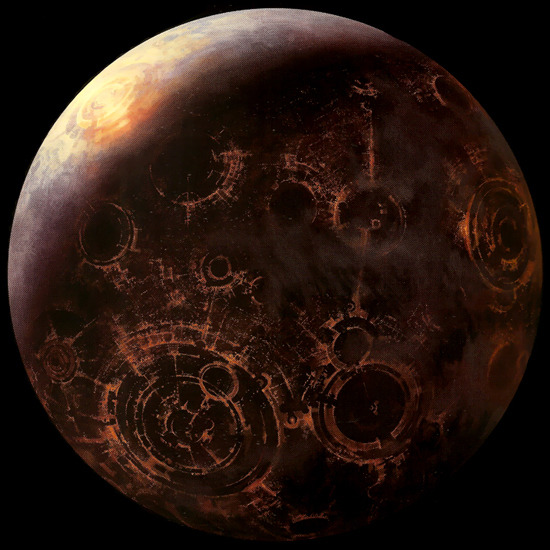
Arrakis! Vulcan! Tatooine! Alderaan! Barsoom! Akir! Zeist! Veridian III! Hoth! Mustafar! Coruscant! Trantor! Krypton!

All hail the Planet!

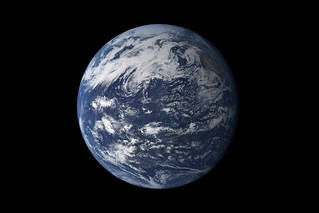
Planets are everything. Without planets, we’ve got nothing, in SF. Without planets, we’ve got no place for stories to happen. Planets are where it’s at. Without a nifty planet, your space story isn’t going anywhere.

Some planets are Earthlike in most ways. Others are inhospitable almost to the point where humans can’t live there…but only just. Some planets are gas giants, leaving us to hope for livable environments on the moons; other planets are tiny, cold, airless rocks.

Planets give rise to amazing life forms. There are enormous worms that slither through the sands of the worldwide desert, catching entire towns in their gaping maws. Or there are scavenging little dwarfs, who wander around picking up bits of technology to sell at the settlements. There are planets whose inhabitants are governed by their fiercest passions, and there are planets whose cultures are rigidly devoted to logic and reason. Planets, planets, planets. Planets everywhere.

I speak here more of fictional planets, but it’s always worth remembering that planets are very real in our universe, and not just in our Solar System: planets are places, and reasoning out their motions is one of the greatest achievements of all time. Here’s Carl Sagan on Johannes Kepler and Tycho Brahe:

It’s interesting to note that for a time, in Carl Sagan’s early years in the spotlight, planetary astronomy wasn’t much of a going concern.

(I keep forgetting to include the A-to-Z graphic on these posts. Apologies to the event organizers!)

Share This Post

A to Z: Old People of Wisdom

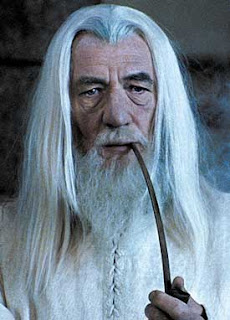
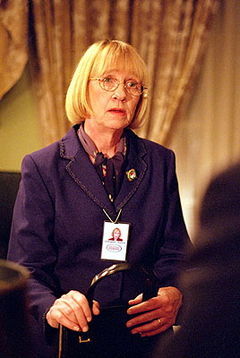
Gandalf. Loren Silvercloak. Mrs. Potts. Obi Wan Kenobi. Boothby the gardener. Sarek. T’Lar. Dumbledore and McGonagall. The Oracle. Jor-El. Maester Aemon. Mrs. Landingham. And, of course, Merlin.

What do all these folks have in common? They are Old People of Wisdom.

In the Campbellian Monomyth, the Old Person of Wisdom is the mentor-figure who provides the Hero with magical aid that he or she will need, going forward, to complete the adventure. It is also often the Old Person of Wisdom who provides the Hero with their initial ‘Call to Adventure’. So this figure is often the catalyst for the story.

“If you’re referring to the incident with the dragon, I was barely involved. All I did was give your Uncle a little nudge out the door.” –Gandalf the Grey, The Lord of the Rings: The Fellowship of the Ring (film)

Of course, those familiar with ‘the incident with the dragon’ know that Gandalf did a lot more than that. Yes, he showed up on Bilbo’s doorstep and introduced him to a bunch of dwarves who wanted to hire him to be their burglar, but how did it come to that? How did Gandalf settle on Bilbo, and not, say, some Bolger or Bracegirdle or Proudfoot? It’s often the role of the Old Person of Wisdom to see something in the hero that they don’t see in themselves. Gandalf sees in Bilbo a stalwart burglar. Obi Wan Kenobi sees in Luke Skywalker a future Jedi knight. (We’ll learn, of course, that he has a lot of reasons for seeing that.) Loren Silvercloak sees in five young University of Toronto students qualities that will prove essential in the final war with the darkness of Rakoth Maugrim.

One of the interesting things about the Harry Potter books is the way that multiple characters fulfill the function of the Old Person of Wisdom. Albus Dumbledore is the key of them all, but he doesn’t do it all. The Call to Adventure comes from Hagrid. Supernatural aid comes not just from Dumbledore but from McGonagall, Sirius Black, Remus Lupin…a whole host of people. Of course, JK Rowling didn’t blaze this trail on her own; in the James Bond movies, what are M and Q but Old People of Wisdom?

Why does this trope have so much power? It seems pretty obvious to me. Age implies experience and wisdom. We look to the mothers and fathers of our communities for wisdom. And we know that eventually they move on, into death, and that eventually the story will be ours and ours alone…until we have to serve as Old People of Wisdom ourselves.

I’m reminded of the wonderful closing speech that Sir Anthony Hopkins delivers in the movie Amistad:

The other night I was talking with my friend, Cinque. [The African man who was kidnapped into slavery and who is suing for his freedom in the film.] He was over at my place, and we were out in the greenhouse together. And he was explaining to me how when a member of the Mende — that’s his people — how when a member of the Mende encounters a situation where there appears no hope at all, he invokes his ancestors. It’s a tradition. See, the Mende believe that if one can summon the spirits of one’s ancestors, then they have never left, and the wisdom and strength they fathered and inspired will come to his aid.

James Madison, Alexander Hamilton, Benjamin Franklin, Thomas Jefferson, George Washington, John Adams: We’ve long resisted asking you for guidance. Perhaps we have feared in doing so we might acknowledge that our individuality which we so, so revere is not entirely our own. Perhaps we’ve feared an appeal to you might be taken for weakness. But, we’ve come to understand, finally, that this is not so. We understand now, we’ve been made to understand, and to embrace the understanding that who we are is who we were.

We desperately need your strength and wisdom to triumph over our fears, our prejudices, our-selves. Give us the courage to do what is right. And if it means civil war, then let it come. And when it does, may it be, finally, the last battle of the American Revolution.

What’s wonderful about this particular cinematic moment is that in the film, Hopkins’s John Quincy Adams is himself an Old Person of Wisdom…and yet here he is, citing the eternal need in our species for Old People of Wisdom. (You can watch the speech here.)

It’s almost impossible, I think, to avoid the trope of the Old Person of Wisdom. It’s not just ingrained in our storytelling. It’s ingrained in us.

Share This Post

A to Z: North!

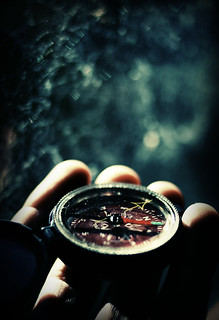
Direction is always important…and in a lot of fantasy, specific directions carry with them specific connotations. Such as North.

finding north

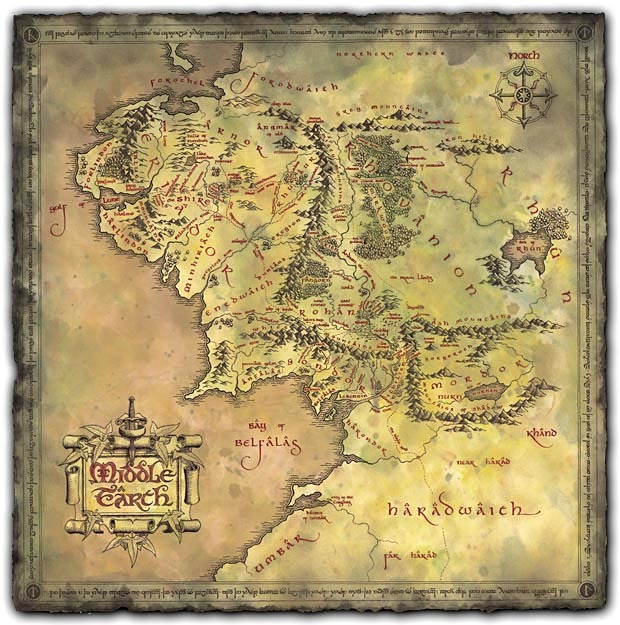
North is often portrayed as cold and desolate and lonely. Just about every fantasy that I know is set in the northern hemisphere of its particular planet, so north really does tend to be a land of cold and, sometimes, a land of unknown. In some cases, the North is where Evil lives: Guy Gavriel Kay’s The Fionavar Tapestry puts Rakoth Maugrim’s fortress up north, just below the “Ruk Barrens”, which are endless lands of ice. In Tigana, he flips things around – it’s the warm lands that are in the north, and to the south are the snowy mountains. But it’s easy to miss this geographic flipping.

George RR Martin uses the North as a source of cold grim things, as well; in fact, it could very well be that the main existential threat of his books is coming from the North, beyond the Wall that was built thousands of years ago to hold the North at bay.

I don’t recall what is in the far north in Stephen R. Donaldson’s “The Land”, the setting of his Thomas Covenant books, but he does invert things a bit by placing Revelstone, the chief fortress of his forces for Good, in the northern part of The Land, while Foul’s Creche – the stronghold of villain Lord Foul – is in the east.

For JRR Tolkien, the north seems to have been also a source of cold, of snows, and of dark things. In the north is the kingdom of Angmar, whose Witch King would later come to serve Sauron as Lord of the Nazgul. The North is never really visited in The Lord of the Rings; it is a location of legend more than action of the story. But it’s not only a source of grim things, for the Rangers of the North are also there, protecting the Shire and from their number comes Aragorn, heir to Isildur and rightful King of Gondor.

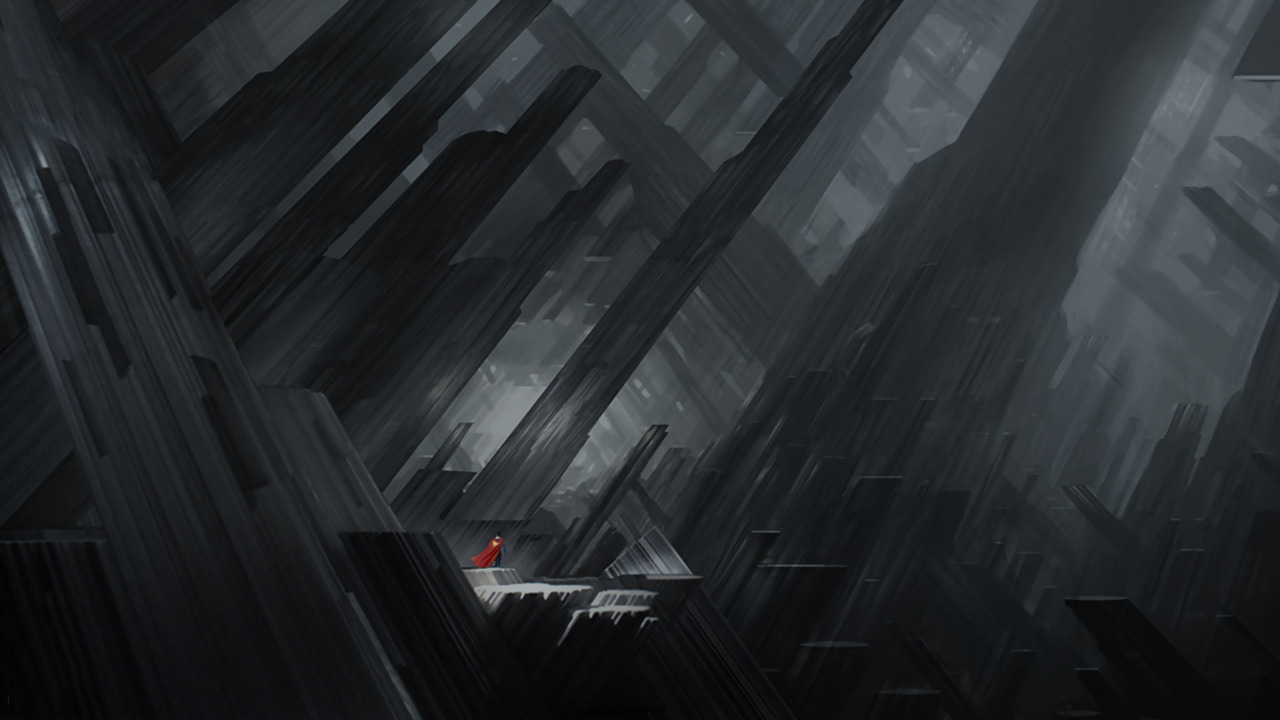
The North is not always a source of darkness, cold, villainy, or evil. For Superman, the North is a place of quiet and contemplation, where he goes to rest. It is in the North that he builds his Fortress of Solitude, his unearthly home on Earth.

How do you see the North? Cold and desolate and full of dark beings? Or stark and majestic and a place of enormous solace?

Share This Post

A to Z: M5

Ah, the supercomputer that is benignly invented as a means of making life easier, but which ends up wanting to kill us all! What a nice, fun, reliable SF trope. All hail our digital overlord, the M5 computer from Star Trek! (And other supercomputers.)

The M5 (from the episode “The Ultimate Computer”) is built by a supergenius named Richard Daystrom, and it is installed on the Enterprise for a series of wargame-style tests that will put the M5-controlled Enterprise against several other starships. Everything is going swimmingly, until the wargames get intense enough that the M5 assumes that it is actually under attack, at which point it opens a computer-driven can of whoop-ass. It turns out that Daystrom used engrams from his own mind to program the M5, so it thinks the way he does – which is unfortunate, as Daystrom turns out to have some psychological issues. The computer is going all-out, which forces Starfleet to also go all out, planning to destroy the Enterprise, unless Captain Kirk can save the day. Which he does, of course, using his tried-and-true method of talking the computer into a logical contradiction that forces it to shut itself down.

Kirk would do this a few other times in the course of the series, and it became enough of a cliché that in the DC Comics Trek series in the late 80s, there was an issue where the Enterprise crew comes up against a supercomputer and the first thing Kirk does is say something like, “Well, I suppose I could try talking it into a logical contradiction. That usually works.” Needless to say, it doesn’t.

But supercomputers with a malevolent bent are certainly not unique to Star Trek. There was the computer in Wargames, the one designed to manage the entire nuclear defense of the United States. There was the Master Control Program in TRON, and, of course, the granddaddy of all malevolent supercomputers, the HAL-9000 in 2001: A Space Odyssey, whose insanity would later be explained in 2010: Odyssey Two, which ends on some tension as the entire crew’s survival depends on HAL, whose sanity is open to question. (To the extent that one can even talk about sanity in a computer.)

And let’s not forget about Skynet. That one turned out poorly, didn’t it? Beware the supercomputers! They’ll kill us all!!!

Share This Post

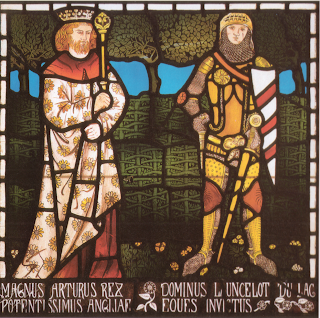
A to Z: Lancelot

One thing I noticed in all my years of reading Arthurian fiction was that Lancelot is an awfully hard character to pull off.

Lancelot, for those not ‘in the know’, is the magnificent knight from France who comes to Camelot to serve King Arthur and sit the Round Table. Lancelot is the greatest knight anywhere (well, until Galahad shows up); no one can best him in any test of skill, and what’s more, he’s morally pious to the point that being around him is a real downer. At least, he’s those things until he meets the Queen, Guinevere, and falls in love with her. This would be bad enough, but she falls in love with him, too. Lancelot and Guinevere carry on an affair that eventually becomes the moral crisis that causes the Knights of the Round Table to splinter, and in the end brings about the end of King Arthur’s reign.

Now, depending on which version of the tale you read or watch, it’s not all the fault of Lancelot and Guinevere. Many tellings of the story also include Arthur’s magical seduction by his witch sister, Morgause, who bears a son, a force for malevolence named Mordred. In these tellings, it’s Mordred who finds out about Lancelot and Guinevere and forces their affair into the open, in turn forcing King Arthur to choose between enforcing his morality or allowing his deepest friend and wife to go free.

The problem with Lancelot, then, is two-fold. First, you have to establish that he’s virtually perfect, which makes it nearly impossible to sympathize with him. Then you have to make him sleep with his best friend’s wife, which also makes it nearly impossible to sympathize with him. This is why, when I’ve read Arthurian fiction, it’s the Lancelot character who usually suffers the most, and in reality, this is why I can’t honestly even recall a book where Lancelot comes off very well at all. T.H. White’s The Once and Future King probably does it best of anybody, but even for him, Lancelot comes off feeling a bit unreal.

Lancelot’s origins are hazy, but that’s to be expected, as the origins of the entire Arthurian corpus are pretty hazy; the Arthurian legends – the “Matter of Britain” – were not so much created as they accrued over time, gathering bits and pieces from other, older legends and myths and folk tales. Back when I was studying Arthuriana a lot, I started to realize that I was finding that older material more and more compelling – tales such as the Welsh Mabinogion and other parallel stories.

Why has the definitive Lancelot not yet turned up? I think it’s probably part of the same reason that a definitive telling of the entire Arthur story hasn’t turned up. The story is not a story, but rather a collection of interrelated stories, a grab-bag of tales, told in many different styles over the centuries. As for poor Lancelot himself, he’s a tough nut to crack because he’s a jerk in two different ways and if there’s one thing we like, it’s to see a jerk get his comeuppance. But we also don’t like to see jerks take good people down at the same time, which is why the tale of King Arthur is such a tragedy.

As I note, Lancelot is a deeply troublesome character to pull off. Most authors, I have found, choose to make Lancelot less than perfect, and merely a likable guy and a very good knight. They also try to soften Guinevere’s appearance of fault by making her more sympathetic — possibly by making her marriage to Arthur an arranged marriage, so that while she honors him and may even love him after a fashion, he never has her heart. Making everyone sympathetic in a tragic story that involves moral failure is not an easy thing, and to my experience, no one has quite pulled it off.

Ultimately Lancelot seems to be a reminder that our greatest dreams for ourselves may well be unattainable, and that our hubris often contains the very seeds of its own downfall. King Arthur forms the Round Table out of a desire to have a peaceful realm where justice is served by all his knights, but along comes Lancelot, ostensibly the man most ideally suited to this lofty goal – and he’s the one who sets in motion the events that will eventually destroy the Round Table and cost Arthur himself his life (or, at the very least, see him carried off to Avalon).

Share This Post

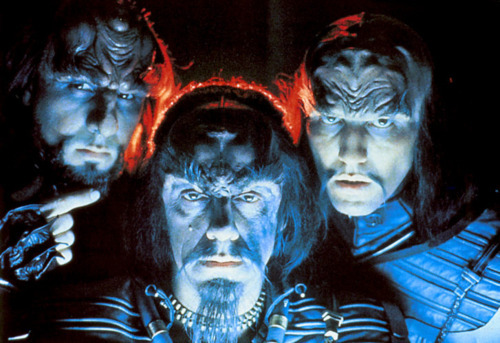
A to Z: Klingons

So, let’s talk for a few minutes about Klingons.

If one of the questions on Family Feud was ever “Name a fictional alien species”, I have to think that Klingons have a pretty solid shot to be the number one answer. (“Let me see…Gungans!” BZZZZZZZT “And the Laramie family with a chance to steal!”)

But why is this? Why are the Klingons so memorable?

The obvious first answer is in Star Trek‘s longevity. A thing doesn’t remain a pop-culture concern for as long as Trek has without having some of its terminology enter the pop-cultural lexicon, and the Klingons were the main bad guys of the Original Series, so there’s that. And more than that, a case could be made that the Klingons were the main alien species of the Original Series! More Klingons undoubtedly appeared on Star Trek TOS than Vulcans, and of the first ten Trek movies, there is exactly one in which no Klingons appear. (Wrath of Khan being the one – we see Klingon ships as part of the Kobayashi Maru test, but that’s it.)

I think it’s also easier to remember Klingons because they were often characterized as a group, more than as a race of specific individuals. Until Worf came along as a part of the Next Generation crew, we only saw a few Klingons at a time, and they never recurred (which was a shame – some of those early Klingons would have made great recurring characters, but recurring characters and stories just weren’t the style back then). Klingons were, basically, the ‘Indians’ in Gene Roddenberry’s space western that really wasn’t much of a space western at all. It amazes me to this day that one of Roddenberry’s concepts for pitching the show to the networks was “Wagon Train to the stars”, a concept that fits Battlestar Galactica better, orders of magnitude better, than Trek. But the Klingons were the disposable villains who would pop up, make life difficult for Kirk and company, and then disappear again.

This continued in the movies, too. The main villain of The Search for Spock was Klingon Commander Kruge, who was played very nicely by Christopher Lloyd, and who might have been a decently memorable villain if not for the fact that he was following up Ricardo Montalban as Khan. There’s another disposable Klingon bad guy in The Final Frontier — I don’t even remember his name, that’s how memorable he was – and then, in The Undiscovered Country, the TOS-era crew finally engages the Klingons as more than villains of the week, but as complex individuals. How did that happen?

Well, in between Treks V and VI came TNG, which decided to deepen the canvas a bit when it came to the Klingons. They weren’t boring villains of the week anymore; there was a weekly name attached to them. And with a spot in the regular cast, that meant installing a back story, which in turn meant finally delving into the nature of the Klingon society. TNG often did its best stuff in Klingon-culture related stories; instead of being the warlike goons of TOS, in TNG they were driven by honor more than drive for conquest. The Klingons of TNG came off as kind of a blend of Samurai and Vikings, if that makes sense. It was also interesting to me that as the Klingon Empire came to reach the limits it could reach without engaging in full-on war with other powers, their society turned its quest for honor in battle on itself, so for the rest of TNG and DS9, the Klingons were always engaged in a lot of violent interior politics and sometimes open warfare.

Of course, I can’t write about the Klingons without also mentioning the physical change they went through. In TOS, Klingons were just human-looking people with demonic-looking eyebrows and uniforms of gray and black. In the opening scene of Trek: The Motion Picture, though, the Klingons were well and truly alien, with enormous spiny ridges up their bald heads. This change was never explained, really; I assume that the original thought was to just go ahead and use the film’s large budget to re-do the Klingons in order to make them look a lot more alien, and that we were to just assume that the Klingons always did look like that and we were just supposed to accept the TOS Klingons as such.

But then, DS9 did its brilliant episode “Tribbles and Tribulations”, which had Worf – looking like very much the spiny-head Klingon – having to be in the same room with the ‘human’ looking Klingons. When someone asks him about it, he simply says, “We do not like to talk about it.” I’m sure this has been explained in some novel or some such, but I wouldn’t know. (Heck, they may have explained it in Enterprise, but again, I wouldn’t know.)

Anyway, long live the Klingons. Qapla’!

Share This Post

A to Z: James, Jerry, and John

The other day SamuraiFrog paid tribute to John Williams, which gave me the inspiration for this post. I grew up listening to film music, and at that time, my three favorite composers were John Williams, Jerry Goldsmith, and James Horner.

Williams was, of course, my favorite from the earliest, and he remains so to this day. His gift for melody, his orchestrations, his touch with a scene…he has an ability to get right to the heart of the emotions of a scene that has always been, for me, the key to film music.

Horner came along a few years later. I’m happy to say that I was on board with Horner very early on; his first major scoring assignment was the Corman B-movie space opera Battle Beyond the Stars, and Horner provided a nifty bit of space adventure scoring, even if I would realize in later years that it was pretty derivative of the work Jerry Goldsmith was doing at the time. Horner’s first major assignment was for Star Trek II: The Wrath of Khan, and what a score he turned in – exciting and adventurous, while at the same time elegiac and with a definite seafaring mood, as befitting the movie’s Moby Dick parallels. I’ve cooled on Horner in recent years, as I think that his compositional palette tends to be a bit limited. But I can’t deny his power in his best scores.

Goldsmith was the toughest nut for me to crack. I first experienced him via Star Trek: The Motion Picture, a score which I liked well enough but found harder to draw myself into, given long passages that were pretty free of bombast (remember, I was nine at the time, so bombast was my order of the day). I would come to love a great deal of Goldsmith’s music over the years, but my enthusiasm for him waned a bit during the last ten years or so of his career, when he seemed to eschew the wonderful complexity of his earlier work in favor of giving each film a single memorable melody or two and then leaning on those melodies, over and over and over again. But there’s no mistaking that Goldsmith composed a great deal of truly great film music.

Of course, I’d learn a great deal more over the years about other composers, some of whom could easily fit into this ‘J’ post (John Barry, Joe Hisaishi, Jan AP Kaczmarek….). But from my early days, those were the biggies for me.

Here are some musical selections. (I’ll provide links to YouTube rather than embed the videos, so as to keep this post uncluttered.)

John Williams:

1. Williams is often associated with bombast, but he can do churning suspense as well as anybody. Witness his main title to Dracula, with its haunting suggestions of lurking terror.

2. The Flying Sequence from Superman blends lyricism with magical wonder better than any music I can think of.

3. One of Williams’s most underrated scores is his music for Nixon, the Oliver Stone film about the 37th President. The 1960s: The Turbulent Years is a fascinating tone poem that suggests American idealism and paranoia in the same track, as well as Nixon’s often single-minded pursuit of his political goals. It’s Williams’s insight that allows him to musically portray these things in the same individual.

4. I don’t think I can write even a brief “What John Williams means to me” post and not include something from a Star Wars movie, so here is, for me, the musical emotional heart of the entire saga. This moment – when Luke attempts to raise his X-wing from the swamp and cannot – really drives home the mysticism of the story, and makes Luke’s failures more elemental in nature. The music is “Yoda and the Force”. (This cue, to me, also gives the lie to the notion that until a certain point, Williams was all about brassy bombast. His string writing in this cue is amazing.)

5. Well, one more from Star Wars, this time Return of the Jedi. Brother and Sister underscores the scene where Luke reveals to Leia who he is, who Vader is, and why he must confront his destiny. It’s gorgeous writing, and in three minutes, Williams employs three different themes to suggest what is going on.

Jerry Goldsmith:

1. I can’t talk in any emotionally true way about Goldsmith without talking about Star Trek, so here’s his amazing music for the Enterprise (in a live performance), from Star Trek: The Motion Picture. Lots of folks decry this long sequence of James T. Kirk undressing a starship with his eyes, but…I’m fine with it.

2. There’s another long sequence later in the same film, in which, just as we had earlier seen Kirk relating to the Enterprise, now we see the Enterprise relating to the massive ship called V’Ger. The first music was romantic and stirring; this is haunting and mysterious. It’s Vejur Flyover.

3. One of my very favorite Goldsmith scores is his stunning work for the Schwarzenegger skiffy action flick, Total Recall. Here’s the main theme. It’s just fantastic, the way Goldsmith keeps the musical momentum percussively driving forward, forward, forward, suggesting the story to come of a man on the run who can’t stop running, even though he has no real notion why he’s running.

4. Goldsmith did a lot of synthesizer work in the 1980s. Some of this stuff sounds awfully dated, but the scores still work, for the most part. He also scored one of the best sports movies ever, Hoosiers. Here’s the theme.

5. One of the greatest noir scores of all time is Goldsmith’s score to Chinatown, which he had to churn out in a very short time, which is part of what led him to compose a very minimalistic score for a very small ensemble. The main theme sets the stage for a weary, bleak story to come.

James Horner:

1. It’s been nearly thirty years since I saw the movie – and it wasn’t really all that memorable – but Horner’s score to Brainstorm is wonderful. I should probably watch it again, just to remind myself what’s going on during “Michael’s Gift to Karen.

2. Horner’s score to Titanic isn’t my favorite, but the gently simple solo piano arrangement of the love theme, heard when Jack is drawing the portrait of Rose, is a beautiful moment.

3. The finale to Legends of the Fall is a fitting conclusion to a big-skyed Western family epic melodrama. This is my favorite Horner score.

4. Re-entry and Splashdown from Apollo 13 is just a great bit of film scoring. Horner keeps the tension going, even during the parts of the scene where it seems that hope has been lost.

5. From Battle Beyond the Stars, here’s “Cowboy and the Jackers”. This bit of action music comes when our hero, a kid named Shad, encounters a guy named Cowboy whose ship is under attack. This is what Horner sounded like when he first came on the scene. He would mature a lot, and pretty quickly. (He’d also learn to orchestrate…at the end of the track, just listen to the long, slow execution of the trumpet section that Horner mounts. Ye Gods.)

Share This Post


A to Z: Incunabulum

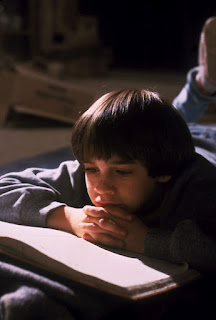
Books abound in fantasy and science fiction. The book is a central plot device or Maguffin or important element in so many stories that to catalog them all would be an exercise in utter futility. But let’s explore some anyway, in this entry. Behold the Incunablum!

Strictly speaking, an incunabulum (plural incunabula) is a book printed in Europe before 1501. According to Wikipedia, this is an arbitrary distinction, which is why I can get away with it here. But it’s a cool word, and it kind of connotatively suggests not just any old book, but rather the types you see a lot in fantasy: big, heavy tomes with lots of pages between leather covers. A locking clasp is also good; witness Indiana Jones’s Bible in Raiders of the Lost Ark.

Books are so often important objects within fantasy and SF stories that I can only offer a smattering here. The Neverending Story is a great example (even if I don’t like the movie all that much), in which the act of reading a story and the act of being in a story are melded into one. Books are a constant thing in the Gothic YA novels of John Bellairs; in one, the young hero’s adult friend is a literature professor, while in another, the adult companion is actually a librarian.

Books are the ultimate symbol, I suppose, of education and learnedness. Showing a person surrounded by stacks and stacks of books is almost a cliché for “This person is smart!” But it can also be shorthand for “This person is really eccentric!” — hence all the somewhat dotty wizards and witches in fantasy literature who are forever losing themselves in the pages of their tomes. And books can also establish one more facet of someone’s ass-kickingness:

Magic books? Those can be found, too. A magical book is at the center of Lloyd Alexander’s Prydain Chronicles, which begins with The Book of Three. Books are the magical gates between worlds in the computer game Myst. Books as central organizing principles of civilization? The original series Star Trek episode “A Piece of the Action” gives us a society that has organized itself around the rules of a civilization they read about in a book they recovered from a crashed starship. Unfortunately, the book was about mob men of Prohibition-era Chicago. This notion would later be repeated in the Next Generation episode “The Royale”, in which some well-meaning aliens construct a ‘world’ for the sole human survivor of a crashed spaceship on their world; they assume that the crappy novel he’s reading is an accurate depiction of human society, so they create that novel’s setting for him. (This is one of my favorite episodes of the series, although it doesn’t seem terribly popular.)

And books can be key moments of villainy, too. George RR Martin has well established King Joffrey’s colossal sociopathic status by the time we get to A Storm of Swords, but that doesn’t stop Martin from giving us a scene where Joffrey receives a very rare book as a wedding gift, and then uses another wedding gift – a sword of Valyrian steel – to chop the book in two. When someone points out that there were only four existing copies of that book in the world, Joffrey shrugs and says, “Now there are three.”

I could go on and on, but I’ll stop there. But remember: books rule!

Share This Post

A to Z: Horses

If there’s an animal more suited to heroism and derring-do than the horse, I don’t know what it is. Horses abound in fantasy and in science fiction. If you want a big heroic moment, you can do it without having a horse there…but a horse or two really helps.

Horses aren’t just well-suited to heroism. Horses lend themselves to tearjerking, too; if you want the audience to sympathize for the main character, well, just kill his poor horse, and that’ll do it. Dances With Wolves starts to become gut-wrenching when Cisco, John Dunbar/DWW’s horse, is killed out from under him.

Horses are, of course, a major factor in The Lord of the Rings. You have Gandalf, claiming for himself Shadowfax, the greatest of all horses, and one of the most heroic moments in the story – book and film – comes when the Riders of Rohan, a culture devoted to the horse, finally arrive on the scene at the Battle of the Pellenor Fields. Even the hobbits get into the horse act, with their use of ponies; Sam’s beloved pony Bill, who gets turned away at the Mines of Moria, is long-missed, and Sam’s relief many months later to discover that Bill has turned up back at Bree is a wonderful moment. And in truth, the fact that the Fellowship is mostly horseless seems to put them at a psychological disadvantage already, before they ever set out from Rivendell.

LOTR also gives us evil horses, in the black steeds that the Nazgul ride in the first half of The Fellowship of the Ring. In the film, Peter Jackson depicts this by use of close-ups of the horse, from strange angles, shots of the spittle dripping from the horse’s mouth, and so on. And when the power of the river is unleashed against the Black Riders, the foaming waters take the form of white horses.

On the flip side of that particular coin we have the sacred horses of Stephen R. Donaldson’s Chronicles of Thomas Covenant, the ‘Ranyhyn”. These horses are larger than their Earthly equivalent, and they are somehow in touch with “Earthpower” – the magic inherent to the world – and will not allow anyone to ride them that they themselves do not choose. One of the most potent moments depicting the power of Thomas Covenant comes when Covenant, as an act of atonement, commands the Ranyhyn to visit Lena, the girl he raped earlier.

Great horses are the key plot point of Guy Gavriel Kay’s brilliant novel Under Heaven, when a distant princess decides to gift a relatively minor man with two hundred fifty of her great horses, an act which sends shockwaves across the dynastic rule of Kitai (GGK’s medieval China). And let’s not forget the Firemares of Krull!

Horses in SF? Well, there are horses aplenty in Firefly, which is fitting as the show is essentially a space western. There are no horses, per se, in Star Wars, but the Tauntauns of The Empire Strikes Back are rather horselike. In Star Trek V, there are beasts on Nimbus III (the “Planet of Galactic Peace”) that aren’t horses, but might as well be. (I think they’re there because William Shatner, who directed that one, is a noted horse enthusiast.) Shatner’s equestrian enthusiasm would be indulged again in Star Trek Generations.

Not SF or fantasy, but here’s a scene from a good movie called Hidalgo, which has Viggo Mortensen playing a guy who, along with his horse Hidalgo, enters a race across the Sahara. I like this scene because it shows the beginning of the race…and what happens once the racers are out of sight of the people watching them start.

All hail the horse!

Share This Post

A to Z: Gagh!

There’s an episode of Star Trek: The Next Generation in which Commander Riker takes part in an officer exchange program and goes to serve on a Klingon vessel for a time. As part of his effort to familiarize himself with Klingon food, he goes to Ten Forward and orders himself up a smorgasbord of Klingon food, all of which looks very odd. The most notable dish here is Gagh, which he later learns is “best eaten live”. (When he looks askance at eating live Gagh, a Klingon japes, “Perhaps we can arrange for one of the females to breastfeed you!”)

So what is Gagh, anyway? Well, the experts, Gagh is:

A Klingon delicacy of serpent worms (pronounced “gawk”). Connoisseurs of Klingon cuisine claim that gagh is best served very fresh — i.e. live.  But it is sometimes served stewed. Gagh is one of the most popular foods served aboard Klingon warships.

Apparently the chief appeal of Gagh is its unique mouthfeel as the live worms pass through your mouth and into your digestive tract to die. Awesome! (It also turns out that in Klingon, Gagh is spelled qagh, so I could have done this one under Q. I haven’t yet pre-selected my Q entry for this series, so I’ve missed an opportunity!) But even vegans don’t have to feel left out, as they can simulate Gagh thusly.

Which brings up the more interesting topic of fantasy and sci-fi food. Food is one of the best ways to convey an alien quality of any situation, which is why we’re told that Klingons like to eat a dish of live worms because they like the feeling of slithery things going down their gullets. “Normal” food in science fiction? Never! There’s not a whole lot of food in Star Wars, but there is “blue milk” at Luke’s table on Tatooine. Jabba the Hutt likes to eat little beasties live, and so on. And Star Trek was forever giving us different alien foods, some of them live, like the eggs that the Cardassians like to eat, the ones that you crack open and see the embryo squirming about inside.

Of course, science fiction food used to be all about taking pills. You’d take a single pill and there’s all your nutrition! Food would be a thing of the past in our technological future. And then you have food, real food, used as a way to suggest certain luxuries. Witness Firefly, when Shepherd Book’s ability to cook with a few actual spices is welcomed warmly, and when he is able to partially guarantee passage on Serenity by giving Kaylee a single strawberry.

Fantasy food tends to be different. In fantasy, food is often where some of the magic happens. The Lord of the Rings gives us lembas, the Elven bread that can sustain a grown man for an entire day in a single bite. In the Chronicles of Thomas Covenant, one of the main foods is aliantha, the berries of The Land, which provide sustenance in much the same way as lembas does. Magical foods abound, and turn out to be an outstanding way to get magic into the story without resorting to wizards and spells; the magic in food is a part of the fantasy world itself, and not a creation of the people in it. There’s even food inside the computer, as TRON indicates, as the programs have to stop and drink some pure energy after escaping the Game Grid.

Guy Gavriel Kay’s use of food is tied to themes of nationality, a common theme in his books. For example, in A Song for Arbonne, much is made of Cauvas Gold, a wine that is especially beloved in the land of Arbonne. And then there is George RR Martin, who provides a lot of descriptives for the foods served in A Song of Ice and Fire. There, food creates mood: when writing about highborn characters in their castles, he lovingly describes a lot of gourmet-sounding foods; on the other hand, when characters are out in the wilderness or among the ‘smallfolk’, the food is characterized as ‘rustic’, at best. So descriptive can Martin be of his food that there’s a blog devoted to recreating it.

Why is food so central in storytelling? Because food is tied to so many prime emotions. Spirituality? Food is a central part of Christian ritual. Food’s a part of football – just try throwing a Super Bowl party with little or no food. Food as love? There’s your chocolate. Food as laughter? My beloved pie in the face. Food as horror? Well, what does Dracula need to live?

Food is also a gateway to character. Jean-Luc Picard has to have his tea (Earl Grey, hot). James Bond and his vodka martinis. When you think about it, food does an awful lot of heavy lifting in stories, doesn’t it!

So next time you’re watching a fantasy or SF show or reading a novel, pay attention to the food! And if you engage a story with little or no food in it, ask yourself if that world seems quite as real as others that tell us what their people are eating.

And you know…I’ll bet with plenty of hot sauce, gagh would be just fine.

Share This Post