A to Z: Zany!

Hey, I made it! It’s the end of the A-to-Z Challenge. Let’s look at some Zaniness, shall we?

According to this site, the word ‘zany’ was first used in English by none other than William Shakespeare, although its origins are apparently Italian:

Somebody zany is amusingly crazy or clownish. If you object to my definition, then you may be in the company of the compilers of several current dictionaries. It’s a hard word to pin down — we all think we know what we mean by it, but we may find describing it in plain English surprisingly hard.

That may have something to do with the way the word has evolved. It was first a noun, to describe a performer in the commedia dell’arte, an improvised Italian comic form of the sixteenth to eighteenth centuries. The zany was a foolish servant, a buffoon, who attempted to mimic the actions of his master, himself a clown. The servant was given the generic name Giovanni (the Italian equivalent of John), much as English servants of the same period were frequently called Andrew (indeed, one English equivalent to the zany was a merry-andrew), or as a Glaswegian might call someone Jimmy as an all-purpose name. In time Giovanni turned into zannie and we imported it in that form.

. We tend to think of zany as meaning a special kind of madcap comedy, one in which questions of sanity are best left at the door. Here’s Merriam Webster on the case:

1: being or having the characteristics of a zany

2: fantastically or absurdly ludicrous (a zany movie)

However, looking at definition number one under zany as adjective, I see that zany can also be a noun. This, I did not know! y interesting word, actually. Merriam-Webster defines it thusly (same link as above, toggle a link there to switch from noun to adjective):

1: a subordinate clown or acrobat in old comedies who mimics ludicrously the tricks of the principal

2: a slavish follower

3a : one who acts the buffoon to amuse others

The noun use of zany seems to have dropped out of usage, in favor of the adjective. I’ve never, to my knowledge, heard of someone refer to a ‘zany’, but I have heard, many times, someone or something described as ‘zany’. So how about some zaniness in fantasy and SF?

Well, there’s quite a lot of comedy to be found in both genres. Fantasy isn’t all long, wordy, and ponderous tales involving plucky rural heroes making their way across a vast continent to the very stronghold of evil; there’s plenty of funny stuff be found. But not everything that is funny is also zany. I’d definitely file the books of Christopher Moore in the ‘zany’ category, and they are cheerfully zany, full of wild leaps in logic and loaded with highly eccentric characters; his books are, in the words of Merriam-Webster, “fantastically or absurdly ludicrous”. That’s part of their charm. Moore writes the kinds of books where two women in a rubber raft at sea find themselves in between two whales who are about to engage in the physical act of whale-love, or where a six-year-old Jesus causes a stir in his hometown when he makes his own face appear in the Passover bread.
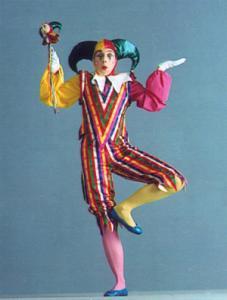
Interestingly, Moore has also written a book that fits the noun use of zany, the wonderful Foole, in which Moore tells the story of King Lear from the viewpoint of the Fool…the zany, you might call it.

Lois McMaster Bujold’s “Miles Vorkosigan” books aren’t really zany, per se, but they do have moments when the humor rises to a certain level that’s almost zany. Ditto Scott Lynch’s Gentleman Bastard Sequence (comprising The Lies of Locke Lamora and Red Seas Under Red Skies. I suspect that the Hitchhiker’s Guide to the Galaxy series is pretty zany…but I wouldn’t know. I haven’t read them. (I’ll hang my head in shame.)
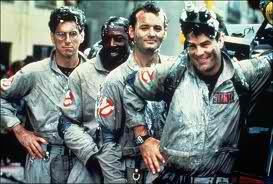
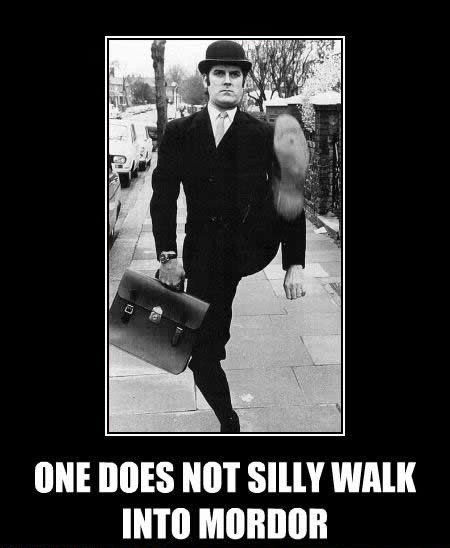
Fantasy and SF in the movies? There, it’s easier to find zaniness on display. Ghostbusters is pure zaniness, through and through. So is Back to the Future, Galaxy Quest, and most of Star Trek IV. Men in Black is zany, and amongst animated films, The Emperor’s New Groove is as zany a film as I can remember. And you have to include the films of Monty Python, which are as zany as it gets and which are often filled with fantastical content.
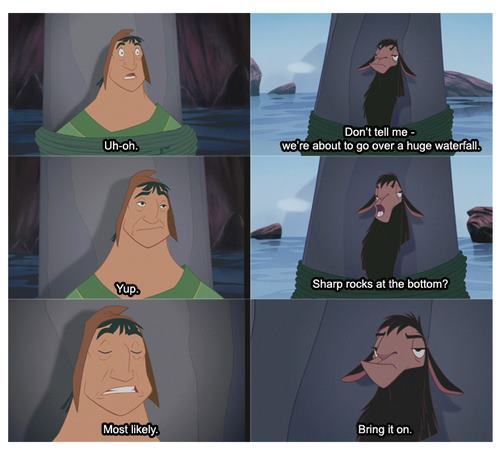
I’m sure it comes as no surprise that I’m a fan of zaniness, both in life and in fiction. Serious things are good, but zaniness is a part of life, is it not? Life should be a little bit zany…or a lot zany, if you can manage it. The trick is to find your preferred versions of it and incorporate them into your life. Don’t be afraid to, as Merriam-Webster defines it, “act the buffoon to amuse others”…even if it means the occasional pie in the face.

And with that, I come to a successful close of the A to Z Challenge for 2012, Huzzah! Maybe I’ll do this again next year….

Share This Post

A to Z: YAHHHHH!

YAHHHH? What on Earth is that?

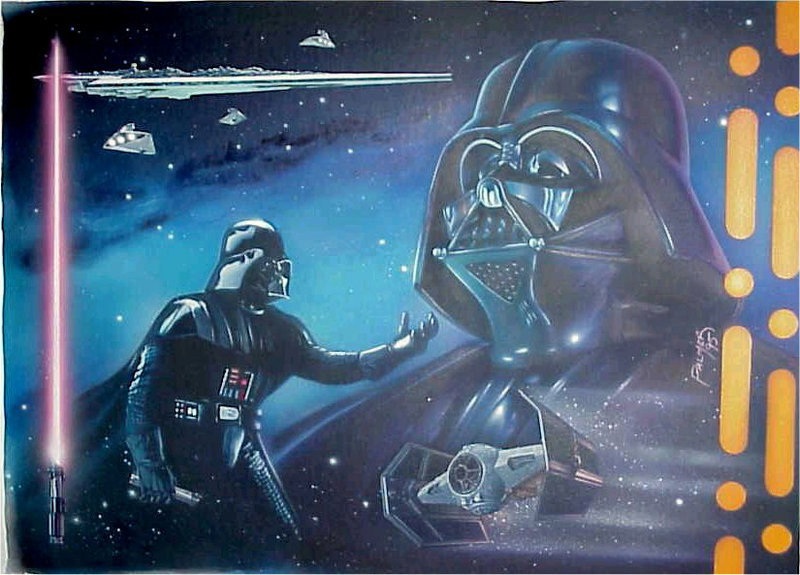
Well, it’s a rough transliteration of the final death shriek of Red Leader at the Battle of Yavin in Star Wars Episode IV: A New Hope. He’s just led an unsuccessful attack run on the two-meter-wide thermal exhaust port, failing to get his proton torpedoes to go down the shaft to the reactor (“Negative! It didn’t go it. Just impacted on the surface.”). He orders Red Five (Luke) to gather the remaining pilots (Wedge and Biggs) for one last shot at the exhaust port, before his ship is struck by blaster fire from Darth Vader’s TIE Fighter. Red Leader’s ship sinks toward the surface of the Death Star, and just before he goes up in a ball of flames, he screams, “YAAAHHHHH!”.

So what are we on about here? Acts of self-sacrifice or going-bravely-into-the-night in fantasy and science fiction.

Few things in fiction are more inspiring, frankly, than some person choosing, with their full faculties about them, to undertake an action or series of actions that will result in their deaths but will also result in someone else’s survival. In fact, it’s not even in fiction that this is inspiring, because such actions are typically seen as among the very highest things one can do, and it’s the act of self-sacrifice that makes the Jesus story what it is. Noble acts of self-sacrifice, and their cousins – bravery in the face of certain death – stir our emotions like nothing else. It’s the soldier who throws himself onto the grenade that’s about to explode; it’s the person who gives up their seat in the lifeboat for someone else as the ship sinks.

It’s the man who, bearing an extremely close resemblance to a man who has been falsely imprisoned and sentenced to death, conspires to take his place in prison so that the convicted might rightly go free.

It’s the woman who offers her seat on the last helicopter to the deep underground shelter, as the asteroid nears its humanity-killing collision with Earth, to a desperate woman and her child who weren’t originally offered spots in the survival lottery.

It’s the First Officer who knows that his starship will be destroyed if he doesn’t brave the lethal radiation of the engine chamber and personally mix the matter and antimatter by hand to make the final warp jump to safety possible.

It’s the woman superhero who has realized that her powers are out of control and that she will soon forever lose her command over them, to the ill of all, unless she gives up her own life.

It’s the musicians who, knowing that their escape from the sinking ship is impossible, decide to do what they do best as the waters near: keep playing.

It’s the patriot who, with his head in the noose, states quite clearly that he wishes he could live, just so that he might do it all again.

It’s the freedom fighter on his execution table, refusing to pledge fealty to the despotic King against whom he has struggled for years, just to get the execution over with.

Self-sacrifice and courage in the face of certain death are impulses cut from the same cloth, and when such a moment is captured well in a story, it’s always a moment of power and high emotion. It need not even involve death, really; the final scene of Casablanca is pure self-sacrifice, all the way; Rick is choosing to go to a concentration camp so that Ilsa and Victor can go free. (He can’t foresee that it doesn’t quite work out that way, thanks to the ever-unknowable convictions of Captain Louis Renault.)

Having a character make a choice that brings about doom for themselves, no matter what form that doom might take, so that someone else might prosper, is about the most fool-proof way I can think of to make a character into a hero. You can have a flawed hero, as much as you want, but a true hero, deeply flawed or not, will make that choice each time.

Above I allude to Spock’s self-sacrifice in Star Trek II: The Wrath of Khan. The rest of the crew reciprocates with acts of self-sacrifice in the next film, Star Trek III: The Search for Spock, so that Spock might live. Their sacrifices are real and painful. Near the end of the film, when Kirk and crew have brought Spock back to Vulcan so that his katra (his living essence, just go with it) can be reintroduced to his regenerated body (again, just go with it), they are waiting to see how it went. Sarek (Spock’s father) comes to Kirk, and this exchange takes place:

SAREK: Kirk, I thank you. What you have done–

KIRK: What I have done…I had to do.

SAREK: But at what cost? Your ship. Your son.

[Kirk’s son, David Marcus, had been killed in the course of the film, and Kirk had to put the beloved Enterprise on self-destruct to defeat some Klingons.]

KIRK: If I hadn’t tried, the cost would have been my soul.

Trek III is often derided, and yes, it has its flaws, but it also has this amazingly succinct and wonderful statement of what heroism is all about. And for a virtual meditation on the entire theme of self-sacrifice, Guy Gavriel Kay’s Fionavar Tapestry fills the bill, with so many such acts — including a good number in the last hundred pages — that the trilogy can, for some (myself included), be emotionally overwhelming in spots.

In the end, these kinds of scenes and characters make us ask, does it matter how one falls down? And the answer, as given in The Lion in Winter, is simply this:

Wow, one letter left!

Share This Post

A to Z: XYZZY

Wow, we’re almost done with this whole thing. Pretty cool! It’s been fun thus far, and I look forward to next year’s edition. I’ve only missed one prescribed day thus far, which was yesterday, but as the Challenge does not include Saturdays, I can catch up right here and then finish up with Y and Z tomorrow and Monday. As for X, let’s talk about magic words, of which XYZZY is one!

XYZZY? What’s that, you may ask? Well, many moons ago, fantasy adventure games on computers had no graphics, so everything was done via text. (Insert voice of Peter Falk as the Grandpa in The Princess Bride here: “When I was your age, TV was called ‘books’.”) The computer would give you a textural description of where you were, what you could see, hear, and smell, what you could pick up, what directions you could go, and so on. And then you would tell the computer what you wanted to do. These were called “text adventures” back then, although as time went on they would come to be known as “interactive fiction”. There were quite a few of these games around in the 1980s, and to this day, there’s a small but active subculture still producing these with vigor. I haven’t played one in years, but I lost a lot of time as a kid doing so.

The great classic of the genre is probably Zork!, but the original, the one that started it all, was a game called Colossal Cave (or just plain Adventure on some systems). This game started you outside a little house in a forest. As you explored, you’d find an empty stream bed. You’d follow the empty stream bed, to a steel grate that was locked. After figuring out how to open the steel grate, you would enter the Cave via the grate. And thus the tale begins, in which you explore Colossal Cave to find things like canaries in cages; a magical rod; treasures like rubies and golden eggs, the goose that laid the golden eggs; a snake barring your way; a dragon barring your way someplace else; a bridge blocked by a troll who demanded payment for passage; and if you weren’t careful, a maze of twisty little passages, all alike. The object of the game was to recover treasures from the Cave and bring them back to the little house. However, there were puzzles galore here: Some treasures couldn’t be easily transported. Others had puzzles of their own, like how to get to them. And that troll…you had to pay him a treasure in order to pass the bridge, but if you do that, he keeps the treasure…and you can’t win the game unless you return all the treasures to the little house. What do you do? Hmmmm!!! (To this day, I remember the feeling of triumph that came over me when I solved that particular puzzle. That, and the one about getting past the Dragon.)

But anyway, getting back to the original topic here, there are special locations within the cave, from which you can teleport yourself back to the little house, through use of a magic word, and one of these magic words was XYZZY. This served as a way to escape danger quickly (the few villains wandering the cave can’t follow you to the little house), and as a shortcut so you didn’t always have to type out all the directions back to the little house from the cave entrance; just get back to one of the magic-word enabled locations, say the word for that location, and poof!, you’re there. Drop the treasure in the house and then go back and keep exploring.

Colossal Cave was, to a certain degree, a grab-bag of tropes from classic fantasies, adventure stories, and fairy tales. There were allusions to The Lord of the Rings, as well as things like Jack and the Beanstalk. Magic words fit right into this, as magic words abound in fantasy. They are a very old staple of the genre, all the way back to the Arabian Nights (which I really need to blog about, having read a selection of its stories recently), and the “Open Sesame!” of “Ali Baba and the Forty Thieves”. The idea of magic words is very, very old, and in fact, it has in some ways become so much a part of the greater notion of magic that a lot of times, magic words aren’t described as such at all. They become, in the parlance of Advanced Dungeons and Dragons, the ‘verbal component’ of a spell: the mystical-sounding mumbo-jumbo that a wizard must utter in order to get off a fireball or magic missile.

These kinds of magic words are an extremely important component of the magic system of the Harry Potter books. Over the course of the stories we come to know a good deal of the spells that the wizards in that world use, mainly by way of the words used to cast them. We learn that proper pronunciation is very important (“It’s Levi-O-sa, not Lev-i-o-SA!”), and through these words, we’re able to tell what the various wizards are up to, merely by the words they use. One of the key flaws, I think, in the last of the Potter films is that the final confrontation between Harry and Voldemort is dialogue free, including their final spells against one another; in the books, Harry explains to Voldemort precisely why he’s about to lose the battle, and Voldemort tries anyway, while in the movie, Harry doesn’t explain what’s happened until afterwards. And there’s a real sense of fittingness in the book, when Harry is able to ultimately defeat Voldemort with Expeliarmus, which he learned way back in the second book.

The Lord of the Rings has its share of magic words and incantations. The most notable is probably when the Fellowship is trying to enter Moria via the secret door, and Gandalf tries every magic word he can think of to get the doors open. But it turns out that the Dwarves enchanted the door to open with only one word, and they inscribed the word itself right on the door, but in such a way as to make you not realize that was the word at all. The magic-words thing is more inconsistently handled in the movies; Gandalf and Saruman’s battle in Orthanc is incantation-free, but they both shout incantations into the sky while the Fellowship is trying to climb over Caradhras. And when Arwen crosses the river with Frodo and the Nazgul are threatening to follow, Arwen begins uttering words in Elvish, and you know that, well, “shit’s about to go down”. But when Gandalf returns as Gandalf the White, he uses magic without any incantation whatsoever. I don’t know that JRRT ever had in mind any kind of rigid ‘magic system’, complete with rules for magic use, that all the “How to Write Fantasy Books” articles and books say that you need to have.

In Star Wars, however, there is no hint of magic words, no incantations needed to invoke the Force, at all. For a story that is as steeped in the tropes and traditions of mythology as Star Wars is, this fascinates me. The Force has no ‘verbal component’ at all, so far as I can see.

So, what magic words have I forgotten or omitted for reasons of space, and what favorite magic words of yours are there?

Share This Post

A to Z: Women

I’ve been thinking a lot lately about Women. No, not like that. Well, OK, maybe a little like that. Sometimes. But not always. And only about the one I married–look, can we get on the topic at hand here? OK? OK.

But seriously…I’ve been thinking about women as characters in fiction. This has been brought on by a number of things, such as some online discussions I’ve read, but a bigger factor has been reading George RR Martin’s A Song of Ice and Fire, and by far the biggest factor was writing Princesses In SPACE!!! (not the actual title), in which each of my three main characters is a female of differing age: one is a full-grown woman, one is a teenager, and one is an eight-year-old girl.

Why did I choose three females? In the case of the two young ladies, I wanted a pair of leads, but I didn’t want to do the brother-sister thing, because that’s been done a lot. The older woman came along later; she was actually a character who was intended to play a small role, near the beginning of the book, mainly to facilitate some exposition, but as often seems to happen with characters of mine, this one decided to stick around. For, like, the whole book. But hey, that’s OK. She’s pretty cool.

I liked the dynamic of these three characters, but it was at times a struggle for me to write them in a way that I felt somewhat convincing as women, and I think that’s because I’m a man. I didn’t want to write three men in the bodies of women. Did I succeed? Well, I don’t know yet. I hope so, though.

(And no, I didn’t take Melvin Udall’s advice on writing women.)

What I really, really, really wanted to avoid was writing women as passive creatures, people to whom things happen, and people on whose behalf others act. I didn’t want a bunch of rescue sequences, featuring strong male characters coming to the rescue of a damsel or two in distress. Nor did I want super-powered heroines who were super-active. I just wanted real people. (Who are Princesses. In space. Reality’s a tough nut to crack, sometimes.)

I’ve mentioned, in my posts on George RR Martin’s books, that I’m troubled by the depiction of the female characters in his universe. Some are active, some are passive…but all struggle mightily against a world dominated by men, a world in which men will tell spirited women, “What you need is a good raping.” I recently read this article that takes Martin strongly to task for his depiction of women:

WHERE WILL YOU END UP IN MYSTICAL DRAGON LAND? If you are an unmarried woman, it is 100% certain that you will be raped or experience attempted rape (4/6: Arya, Sansa, Daenerys, Brienne). If you are married or engaged, there is a 75% chance that your husband or fiancee will beat or sexually assault you (3/4: Sansa, Cersei, Daenerys). If you are an adult woman who exercises authority, you will be killed (Catelyn) or imprisoned (Cersei), because your attempts to exercise said power will backfire (Catelyn, Cersei). If you are a child who exercises authority, you will not be killed or imprisoned, and will be seen as competent (Daenerys). It helps if your subjects are cultural Others, in which case your superiority is assumed (Daenerys). As with all female children, however, you will be sexually assaulted (Arya, Sansa, Daenerys). If you have a traditionally male role, with traditionally male skills, you will merely be threatened with rape (Brienne, Arya); if you are traditionally feminine, or occupy a traditionally feminine role, attempts to sexually assault or beat you will be successful (Sansa, Cersei, Daenerys). If you are the rare character who is an adult, occupies a position of authority, exercises power, and has not been sexually assaulted or beaten by her partner (Catelyn), don’t worry: You’re not getting out of this story alive.

VERDICT: George R.R. Martin is creepy.

Ouch. And while I’m enjoying the series, I honestly can’t argue with a whole lot of this. Now, my problem continues to be the fuzzy line between depiction and approval; I’m not comfortable drawing conclusions as to George RR Martin’s level of sexism based on these books. But I do find a great deal of the treatment of women uncomfortable or downright distasteful. It could well be that he intends this because he’s depicting a world that’s hell for women, but is he planning to develop this world into one that is better for women by the end? Or is this just the way it’s going to be? Time will tell.

In my own writing, I’m unlikely to go the Martin route because I’m just not terribly interested in sex as a matter of literary exploration. In this my work is more likely to be like JK Rowling’s than GRRM’s. I hope to write a number of books featuring the adventures of these characters, so I imagine that sex will have to come along at some point. But I’ll probably handle it subtly and offscreen, or so I hope.

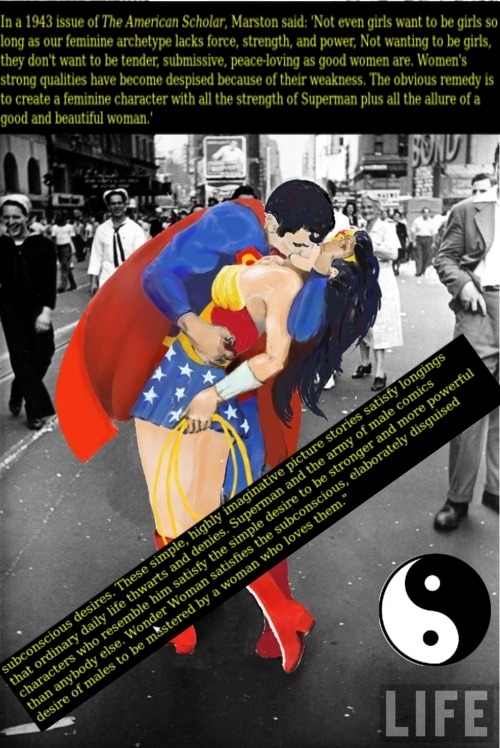
A week or two ago I saw this photo on Tumblr:

A pretty large debate fired up over it. I personally found the picture deeply distasteful, and not just because it plays cut-and-paste with one of the most iconic photographs in history. I disliked it because I don’t like what this suggests about Superman, and I don’t like what it suggests about Wonder Woman. It suggests to me that Wonder Woman is just waiting for a man to come along and sweep her away, and it further seems to imply that the only man suitable for Wonder Woman is Superman, which seems odd because everyone knows that Superman’s ideal woman is Lois Lane, a normal human. I find this picture incredibly creepy because it displays Wonder Woman as submissive.

I’m not terribly interested in submissive women, or passive women, as fictional characters. (And probably not as people, either.) I want to write women who are agents of their own action, women who may need others sometimes but who can gets things done on their own. An occasional rescue is OK, but so is an occasional rescuing of someone else. And I want my female characters to think. None of this should sound odd, because that’s what I want of pretty much any character, male or female.

I really hope this post made sense.

Share This Post

A to Z: Villains

A good adventure tale needs a lot of things: a hero or two or three or four, a problem for them to solve, long odds, improbably escapes from certain doom, high stakes if they fail…and a Villain. It’s often said that a tale of adventure succeeds as much on the strength of its villains as it does on the strength of its heroes. A great villain is fun to watch, and on some small level, we might even find ourselves rooting for him or her…maybe not for ultimate victory, but at least for keeping things tough and interesting for our hero.

The best villains are, obviously, people. Except for the ones that aren’t. How’s that for hedging your bets! But it’s really true. When I think of adventure movies or books that I love the most, those are the ones that often boast the best villains. And in adventure tales that fall short for me, it’s equally often because the villains just aren’t interesting, or fun, or they are so evil and despicable that it becomes depressing just to watch them in action.

A good example of the last kind are the Gary Oldman character in the Harrison Ford-as-President flick Air Force One. At first he’s OK, but as the film goes on, Oldman doesn’t play him as a person who is having the least amount of fun – a villain should seem to enjoy him or herself a little – and then there’s an awful scene where he threatens to kill a defenseless woman if the President doesn’t surrender. The President doesn’t surrender, so he kills the woman after counting down from ten with his gun pressed to her temple. The scene cast a huge pall over the rest of the movie. There was no particular thrill when President Indiana Jones defeated Oldman in the end; it was just, “OK, that monster’s gone now.”

Another such example is the Jeremy Brett character in The Patriot, the Mel Gibson Revolutionary War epic. Brett plays this guy as a lunatic who is perfectly happy to kill anyone he wants, and this culminates in a staggering scene of awfulness when he has his men round up an entire town’s people into a church…and then bars the doors and sets the church on fire. Ye Gods. (It doesn’t help that the Nazis would do just that, 180 years later.) Again, it’s so over-the-top and awful that for me, Brett’s final defeat in the movie had little feel of actual triumph.

So, who are the good villains, then? Well, they’re all going to kill…but they make choices about when to do it, and they only do it when they must. Kind of like heroes, right? Which is why it’s best if the hero and the villain can be shown to have some of the same kind of personality. I think of that wonderful scene in Raiders of the Lost Ark, when Belloq points out to Indy that they really aren’t terribly different. “It wouldn’t take much to make you like me,” Belloq says. “To push you out of the light.” And he’s right. Belloq is a big reason why Raiders is the best Indiana Jones film.

Villains have to be motivated, and they have to act in ways that are consistent with their motivation. But villains also should, if they are to be compelling and believable, clearly see themselves as the heroes and the hero as their personal villain. The best example of this I can think of is Hans Gruber from Die Hard; he gets nearly as much screen time as John McClane, and it’s not all just Hans killing hostages and saying evil-sounding things in his lair. Gruber’s got a plan and he’s got motivations, and the film lets us see his annoyance and irritation – as well as his intelligence – when things happen that derail the perfect execution of his plan. Alan Rickman lets us see Hans’s wheels turning. Hans Gruber is one of the best villains of all time.

Of course, there are outliers to the above. HAL-9000 of 2001: A Space Odyssey is a fascinating villain and deeply memorable, even though his motivations are inexplicable. We’re never told (in 2001, anyway) why the ship’s computer would become psychotic; it’s effective because of how odd a thing it is. And then there’s The Lord of the Rings, whose main villain is never directly interacted with, and whose physical embodiment is a giant flaming eyeball. Tolkien’s skill is such that he still manages to create with Sauron a palpable feeling of menace, and a sense that Sauron’s actions are driving everything that happens in our story.

And then there are the villains in comics. Each major superhero seems to have one or two iconic villains that they tend to be the ones to square off against: Spiderman has the Green Goblin and Dr. Octopus; Superman has Lex Luthor; Batman has the Riddler, and so forth. You don’t see very often things like the X-Men squaring off against the Lizard, or Batman having to deal with Brainiac (but you do see it from time to time). That’s always interested me…it always felt a little bit wrong when there would be ‘crossovers of villainy’. And sometimes it gets a bit hard to swallow, such as the issue of Spiderman that acknowledged that 9-11 had happened; in that issue we saw Doctor Doom shedding tears. That was just tough to believe.

Books, of course, can get even deeper with the villains. In Guy Gavriel Kay’s Tigana, Brandin is portrayed at first as an evil enough man to have erased an entire nation from memory, but it quickly becomes more complicated than that, and GGK allows us to see him as a man who deeply loves his wife. I have a friend who is watching the Games of Thrones teevee series, but he hasn’t read the books, so when he said, “Wow, I hope they kill Jaime this season. That guy’s a scum!” I had to laugh. Is Jaime a villain? He is in the first two books. In the next two…it gets complicated.

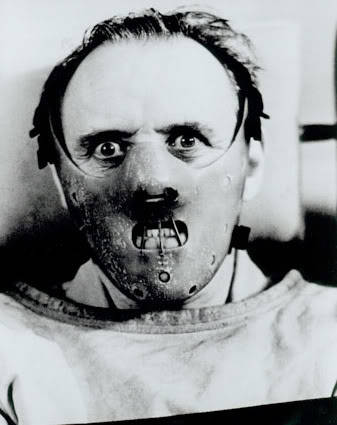
So: villains have to be motivated, and they have to seem that they are the protagonists in their story. And they should be the tiniest little bit sympathetic. You know, kind of like this guy:

Share This Post

A to Z: Universes

Way back when, movies and teevee shows and books and whatnot used to be pretty much self-contained items. But nowadays, in a lot of cases, as specific movies and teevee shows and books and comics branch out into multiple sequels and spinoff series and all of their sequels, what becomes important isn’t so much the original story. Instead, the entire setting of the story takes primacy. Thus, a Universe is born.

At what point does a fictional setting become a universe? Star Wars takes place a long time ago ‘in a galaxy far, far away’, but at what point did it become possible to talk about the Star Wars Universe? My guess is that it was when other stories started to be told there, other than the original three movies. The emergence of the Star Wars universe seems to me to have arisen in the mid-1990s, when, on the heels of Timothy Zahn’s Thrawn Trilogy, a whole bunch of new books started coming out…and then comics…and then games…and all this before the Prequels started even shooting. Star Wars had become a Universe.

The same thing happened to Star Trek, when it went from being the adventures of a specific crew of a specific ship to also including the adventures of another crew, 80 years later, and then the adventures of the crew of a space station, and then the adventures of…you get the point.

And then there are the big comics publishers, Marvel and DC, both of whom have their own universes. All their respective superhero books take place in the same world, so that there can be crossover appearances that take characters from one book into another. It’s not enough to have Spiderman having his own adventures; no, every so often he has to have a run-in with, say, Daredevil or the Hulk or whomever. Most times this is just fun name-dropping, but it’s also a subtle way for the comics companies to cross-market their other books, the ones you might not be reading.

Famously, the DC Universe became extremely cluttered and complicated over the decades, until the point where the Powers-That-Were decided to do a big storyline in which the entire universe would basically be re-booted. Apparently this didn’t take, as there have been several reboots since the original Crisis on Infinite Earths. Meanwhile, Marvel’s Universe, while not so complex, was still plenty crowded — which allowed Marvel to make money a few times by putting out a Complete Guide to the Marvel Universe, or something like that, which was basically an encyclopedia of just about everybody. And Marvel, too, had its Giant Enormous Crossovers, which they called Secret Wars.

In Firefly, the characters actually refer to their Universe, by calling it “the ‘Verse”. Oddly, nearing ten years after the show’s brief run, the Firefly universe is among the most beloved and yet least explored; all we have are fourteen teevee episodes, a movie, and three graphic novels. That’s it.

So, what’s the difference between a Universe and a ‘World’? For instance, nobody talks about the Lord of the Rings Universe. They refer to its world, or even to the world by its name, Middle-Earth. A Universe seems to me a primarily science-fictional concept, and needs more than one planet to be properly a Universe. But why a Universe, and not a Galaxy? Well…who knows? I personally like the word “Galaxy” better, but what if you start mucking around with black holes and stuff in other Galaxies? What if you start to dink around with multiverses? Aieee! It makes the head explode!

Share This Post

A to Z: Trains

There’s some part of me that thinks that no matter how far in the future we get, no matter how awesome the spaceships or starships we build, there’s a degree to which human transportation will never exceed railroads for romance, intrigue, and a just plain civilized feel. Trains rule…and judging by fiction out there, a lot of writers and creators agree.

What is it about trains? Well, you have a confined setting, but it’s a setting on wheels, and therefore, the setting moves. So you get the best of both worlds: you can lock your characters in one place and watch them interact, or you can have the train stop and have some other stuff happen. Trains increase the intrigue by virtue of the fact that once on, you can’t get off until it stops. Trains lend themselves to tension in so many ways.

Trains are also a concept which can be modified to fit nearly any time frame. Trains figure in a lot of far-future stories, as far from their ‘wild west’ forebears as you can get…and yet, there they are, strings of metal cars, riding atop rails or suspended from cables or embedded in tubes. Arnold Schwarzenegger’s Quade boards a train once he gets to Mars in Total Recall. In the Commonwealth of Peter Hamilton’s space opera novels, one travels from one world to the next not via starship but via train, as it’s the trains that pass through the wormholes to other worlds.

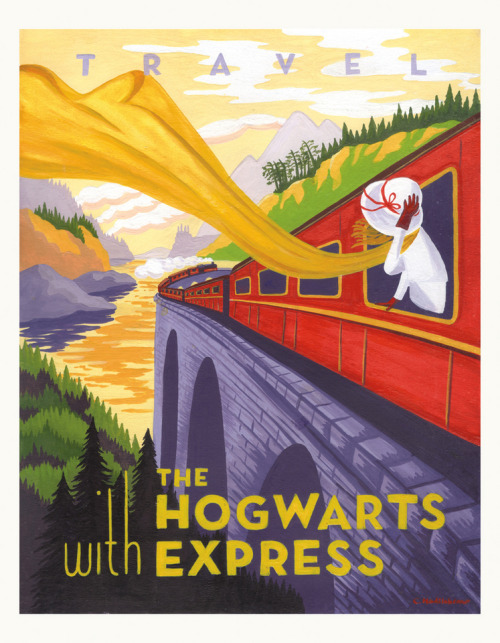
Trains can be futuristic, but they don’t have to be. The most famous fictional train right now may well be the Hogwarts Express, which departs from Platform Nine and Three Quarters in London for the great school of wizardry. The Express isn’t one of the major locations in the Potterverse, but it appears in each tale, its importance quietly understated.

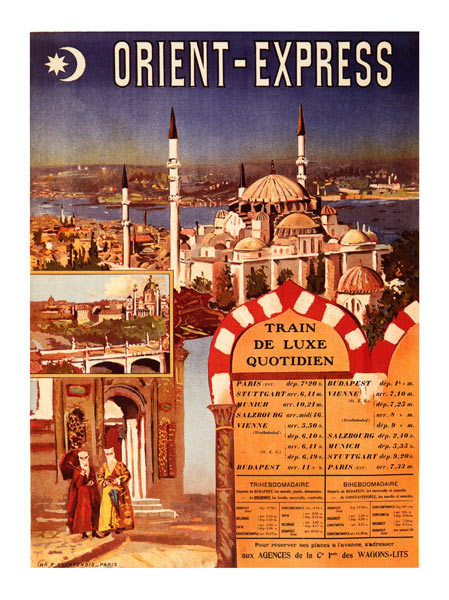
Of course, trains figure all the time in “real world” fiction. There’s the Agatha Christie novel Murder on the Orient Express (whose solution is one of the more elegant to be found in Christie), and the same train figures prominently in the James Bond book and film From Russia With Love. You can’t have Westerns without trains, and one of the most riveting action films of recent years, , dealt with a runaway train.

I wouldn’t want to live in a world without trains, and I deeply wish I lived in a country that took them more seriously than others.

Share This Post

A to Z: Spaceman Spiff

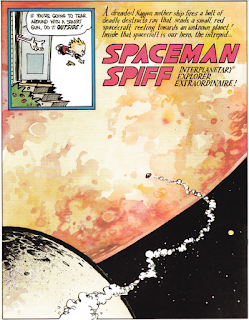
Once upon a time, the occasional adventures of one of the greatest of all Interplantery Adventurers Extraordinaire appeared in daily newspapers across the world. You couldn’t be certain of when he would appear, but sooner or later, there he’d be, and we’d thrill to his exploits, as envisioned by a young schoolboy with, shall we say, a fascinating combination of powerful imagination and a very short attention span. Yes, it’s our hero, Spaceman Spiff!

Spaceman Spiff is, as most cultured persons know, one of the imaginary alter-egos of young Calvin of Calvin and Hobbes. Spiff tended to turn up in moments when Calvin’s attention span was wandering wildly from something he probably should have been attending to more (such as school lessons), but not always.

Bill Watterson (creator of C&H) always seemed to me to have a really good grip on the fact that for children, the boundary between reality and imagination is nowhere near as strong as adults tend to prefer. Kids seem to have this ability to switch back and forth between their imaginations and their realities almost seamlessly, which can be confounding for adults who have lost this ability (or worse, the ability and the memory of how wonderful that ability made the world). This very ability seems to me a key component in the lives of creative individuals, and amongst the oft-cited characteristics of young Calvin, it’s his astonishing creativity that seems to go unnoticed much of the time.

I always thought that Watterson in C&H was able to stay right at the line of pointing out that imagination is a good thing, while also pointing out that yes, our hero Calvin can take things too far. But it’s fascinating to me that, in the last of the “Rosalyn the Evil Babysitter” storylines, Rosalyn was finally able to get some control over Calvin not by battling against him, but by giving in and making Calvin’s signature sport, “Calvinball”, work for her. She had to endorse imagination in order to corral this kid who was running out of control.

The Spiff stories were also notable in that tales like this — and when Calvin imagined himself to be other things, such as a dinosaur, or superhero Stupendous Man, or hard-boiled private investigator Tracer Bullet — allowed Watterson to really go all-out with his art in a way that you really can’t do when your comic strip is set in the real world. Watterson was thus able to cook up nasty-looking aliens, landscapes of other worlds, and various bits of explodey-spaceshippy-goodness. In creating a kid with an extremely potent imagination, Watterson created for himself the ideal playground for a cartoonist with an extremely potent imagination. (He would also cite that he would use such opportunities to pay tribute to the comics masters of the past, like George Herriman of Krazy Kat.)

So, let’s all raise a glass to the ongoing and incomplete and always-interrupted adventures of Spaceman Spiff, and to the imagination, both real and fictional, that created him!

Here’s my favorite of all the Spiff strips:

Share This Post

A to Z: Royalty

Kings and Queens, Dukes and Duchesses, Princes and Princesses, Lords and Ladies, Czars and Czarinas, and to an extent, Presidents and First Ladies. If there’s one thing about humans, it’s that we sure do love our Royalty.

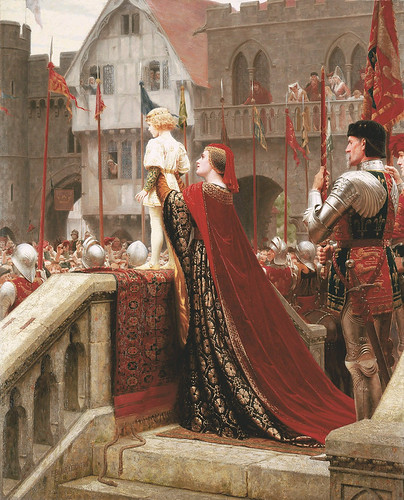
Edmund Blair Leighton (1853-1922), "A little prince likely in time to bless a royal throne"

The concept of royalty is almost impossible to escape, even in our democratic, pseudo-egalitarian society. Royalty commands an enormous level of fascination for us all, to the point where we are endlessly fascinated by real-life royalty in countries that have it; we have royalty figures in our public life and entertainment worlds; and royalty is an extremely common theme or facet in just about all of our storytelling. Why is this?

Well, I’m sure that rivers of ink could, and probably have, been used in the explorations of the anthropology of our continual fascination with the concept of royalty and in the specifics of its practice. I’d assume part of it is some fascination with authority figures — for the same reason that lots of stories set on ships, either sea or space, focus on the Captains — and our hopes that those who are high above in terms of societal importance are living lives that are filled with their own problems and difficulties. I also suspect that’s why writers gravitate to those types of characters, too: because you can really work in some conflict when normal human concerns have consequences that affect nations, or star systems, or even worse. (And I’m no different — I’ve just finished the draft of a novel about space princesses!)

But we also like glamour and pomp and ritual and that sort of thing as well, which following royalty provides in abundance. I think that’s a big part of why there was such a large American audience for last year’s wedding of Prince William to Kate Middleton; I think that ritual of that sort is pretty appealing on a very basic level. Even in this American democracy, we have pomp and ritual surrounding the Presidency. There’s a march that’s played for the entry of the President, and there’s ritual involved in installing a President every four years, including a sacred oath.

Will we ever be without royalty, or some form of royal impulse? I suspect that our tendency toward royalty is something that makes us very human. I can’t see a humanity that has totally divorced itself from fascination with those who drive our society, and if we do attain that, I’m not sure we won’t still be human but rather something else.

In fantasy, a common meme is that of a ‘rightful King’. The realm was once in a Golden Age, but something happened to the King or Queen at that point — a tragedy, perhaps, or maybe some kind of error of personal morality — and the Golden Age ends. The Kingdom suffers because the King has not returned to take his throne, or because the King has not atoned for his sins, and so on. In The Lord of the Rings, Gondor has remained Kingless since Isildur fell, and as a result, the realm has become weaker and weaker, until Aragorn can, as rightful King, set things right. In The Lion King, all is well in the Pridelands until Scar kills his brother the King and usurps his throne; only Simba’s return can again put things right. And when King Arthur commits the act (under sorcerous duress, but he does it all the same) of bedding his half-sister and then killing the children to prevent the fruit of that union from coming back to haunt him, the realm suffers to such a degree that Arthur decides that only the Holy Grail can put things aright, so he sends the Knights of the Round Table to find it.

Thus it often is that the land itself is seen as tied to its Royalty. This conceit is a very, very old trope in storytelling, and it shows the ongoing potency of the very concept of Royalty.

Share This Post

A to Z: Q

The obvious choice here is to talk about Q, but I couldn’t decide which one. This Q?

Or this one?

Luckily, this is my personal blog, where the only rules that apply are the ones that I choose for myself, and which I can summarily set aside any time I want, so…let’s talk about both Q’s!

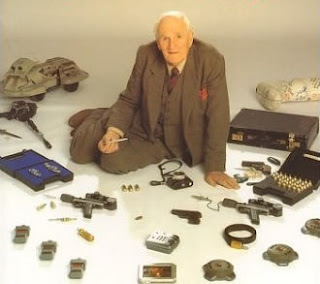
Our first Q is less well-known as Major Geoffrey Boothroyd. (The only time we ever hear his name in the James Bond movies is in The Spy Who Loved Me, when he holds a door open for Agent Anya Amasova, and she thanks him by name.) Q’s first appearance was in From Russia With Love, when M informs Bond during his briefing that “Q branch has been working on something special for you.” In walks our man, looking pretty young and spry back then, played by actor Desmond Llewellyn. He’s got with him a briefcase that has trick catches that, if not opened properly, causes an explosive to go off; contains a rifle that’s nicely broken down into a bunch of small pieces (this was 1962, well before X-ray machines at airports!); and fifty gold sovereigns. There had been a character in Dr. No simply referred to as “the armorer”, who relieved Bond of his Baretta pistol (derisively calling it a fine gun “for a lady’s handbag”) and giving him his trademark Walther PPK, but the guy we would know as Q didn’t come until the second movie.

But it was in the third Bond film, Goldfinger, that Q would become iconic. That’s when he unveils his tricked-out Austin Martin DB-V, with machine guns in the headlights, spinning license plates, homing device trackers, and the ejector seat. It’s too bad that the car doesn’t end up amounting to much…but Q’s attitude toward James Bond becomes clear when Bond says “You’re joking!” in reference to the ejector seat, and Q replies, “I never joke about my work, 007.”

Q was a fixture for most of the remaining Bond films. He wouldn’t appear in Live and Let Die, but he’d be present for all the remaining films until Die Another Day; Q was revealed to be retiring in The World is Not Enough; he even introduced his successor, who was played by John Cleese, in an inspired bit of casting. There was a giant pall cast over the whole thing, though, when Desmond Llewellyn died in a car crash not long after TWINE came out.

The Daniel Craig films have not availed themselves of a Q character yet, which I hope is forthcoming, even if I also hope that the gadgets don’t get too outlandish (the invisible car in Die Another Day was too hard to believe). Maybe in Skyfall; I don’t know yet.

My favorite Q gadgets? I loved the exploding key ring in The Living Daylights, the wrist-activated blowgun of Moonraker, and the fountain pen filled with acid in Octopussy. And my favorite Q moment came in Licence to Kill. In that film, Q actually goes out into the field to assist 007, who has gone rogue. Now, all through Bond’s career, Q has constantly complained that Bond never returns his gadgets in their original working condition. Late in the movie, though, Q is posing as a peasant sweeping a sidewalk when the bad guy drives by. Q alerts Bond via the little radio he has attached to the broomstick…and then, with his job done, he casually tosses the broom aside.

But…what about the other Q?

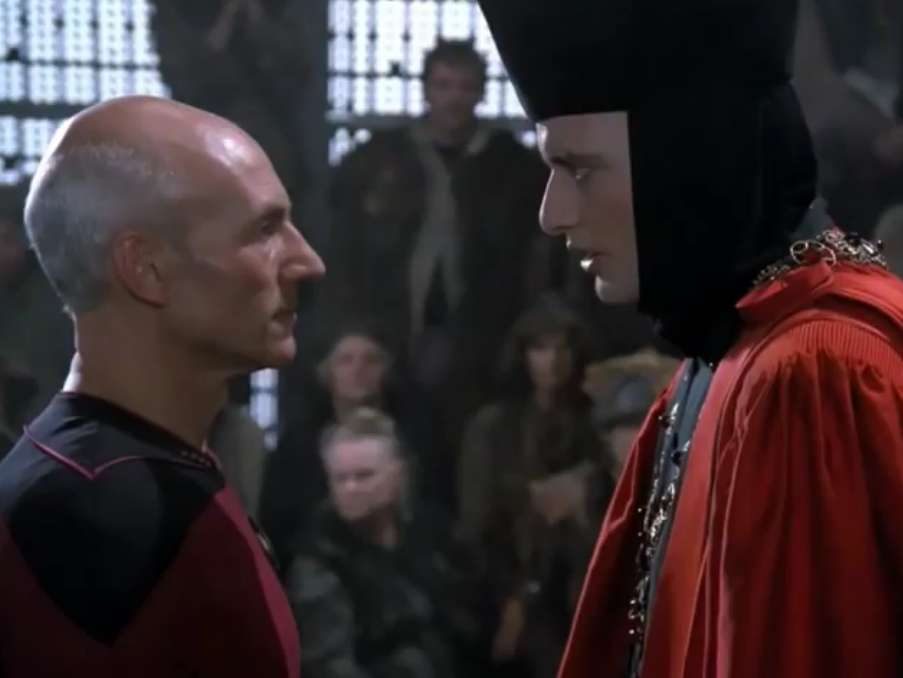
This Q showed up immediately on Star Trek: The Next Generation, right in the very first scene of the pilot, and he was originally depicted as a representative of a nearly omnipotent species that is deeply ambivalent toward humanity. Played with zeal every time he showed up with John de Lancie, Q put all of humanity on trial through the persons of Picard and the rest of the bridge crew. I think the character of Q went through evolution, though, as all characters do. Originally, Q was seen more as a trickster character, but then he became more of a gadfly through whom the Enterprise crew learned their deeper lessons about the universe and about life. Most of Q’s episodes were highly memorable: it was Q who made the Borg aware of the Federation; it was Q who greeted Picard in the afterlife and somehow arranged for him to experience an astonishing life lesson.

I never liked Q as much when he started turning up on DS9 or Voyager, when the producers started to explore the entire ‘Q Continuum’ and the politics thereof, which had the unfortunate effect of turning Q into, well, another in a long series of alien races with their own concerns and whatnot. When he was by himself (for the most part), Q something unique unto himself.

Share This Post