A to Z: Florin

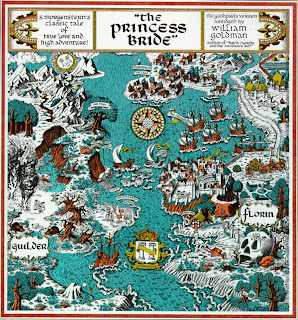
Stories have to take place somewhere, don’t they? In the best of tales, the someplace is almost as important as what goes on there. Heck, there are times like The Lord of the Rings when the setting is, or seems, more important than the tale. The rule of thumb holds: if the setting isn’t memorable, then the tale of the fantastic isn’t going to be, either. Conversely, if you have a really good tale, your setting’s going to be good. So, it stands to reason that one of the greatest of all tales – a tale featuring fencing, fighting, torture, revenge, giants, monsters, chases, escapes, true love, and miracles will take place in a very special realm indeed. Hence Florin, the land of The Princess Bride.

We don’t learn a whole lot about Florin as a country, really. What we know is that it is a monarchy, ruled currently by a very old King and Queen, with a nasty Prince waiting in the wings. Florin is the sworn enemy of Guilder, a nation that lies across the sea. Florin is largely agrarian, and yet it has a number of notable geographic features, such as the enormous Cliffs of Insanity and a horrible place called the Fireswamp. Florin is also the location of vicious sea creatures like the Screaming Eels, and the rumored ROUS’s that dwell in the Fireswamp.

The people of Florin don’t appear to be terribly wealthy, and the castle itself looks fairly spartan in its appointments, so it’s to be assumed that Florin doesn’t have much of a standing army. This likely explains why the elite of Florin seem to prefer schemes against Guilder to open wars of conquest. The latest such scheme, hatched by Prince Humperdinck, involved his murder of his own wife and framing Guilder for it. This plan turned out to be overly complicated, to the point where Humperdinck had to claim that it was a major reason for his being ‘swamped’, and in any case, Humperdinck failed to take into account the power of Twoo Wuv…er, True Love.

Florin’s greatest achievements as a nation may well end up being the fact that the Greatest Kiss of Them All took place there, and its placement of the phrase “As you wish” among the most powerfully romantic things one can say to one’s lover.

Huzzah for Florin!

(image credit)

Share This Post

A to Z: Elphaba

There’s a certain subgenre in which existing, famous stories are retold from the inside-out. I’m not sure what this genre might be called, but when it’s done well, it can be a lot of fun. There’s a great example in Star Trek: Deep Space Nine‘s “Tribbles and Tribulations”, which has the DS9 crew time-travel back so they are actually inside the events of the TOS episode “The Trouble with Tribbles”. The second Back to the Future movie does this as well. And then there’s the Tom Stoppard play Rosencrantz and Guildenstern Are Dead.

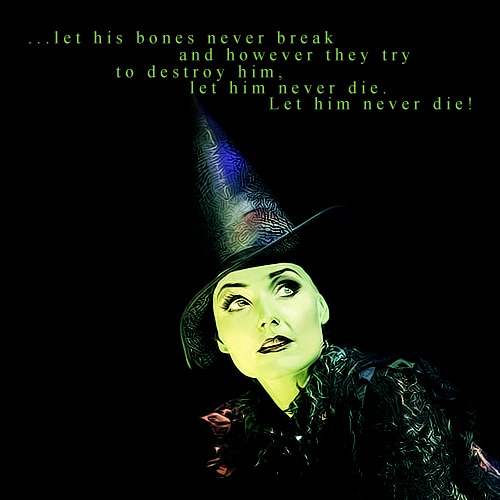
For these kinds of stories to work, the original story has to be fairly well-known, so the audience can notice when the events of the original are shown, but with the shift in point-of-view. One of the most famous recent examples of this kind of meta-story is the book Wicked (and its sequels), and its subsequent Broadway adaptation. It gives us The Wizard of Oz, from one possible viewpoint of the Wicked Witch of the West, whose name is revealed to be Elphaba. So there’s our ‘E’!

I haven’t read the books, so my only acquaintance with this character comes via the show, which I saw last year and blogged about here. Wicked, the show, takes sufficient liberties with the characters and the original story that I can’t honestly say that I’ll be thinking of that tale lurking in the corners next time I watch The Wizard of Oz. But as a meta-story, it’s a lot of fun, and in providing a sympathetic Elphaba, we get a good illustration that we’re all the heroes of our own stories. The really memorable villains aren’t always the ones who act the most evil, but rather the ones who are genuinely committed to their own causes and who really believe themselves to be on the side of the righteous.

Here’s Elphaba and Glinda in the big Act One showstopper, “Defying Gravity” (embedding disabled). Elphaba is played by Idina Menzel, and Glinda by Kristen Chenoweth. (Menzel had apparently suffered an asthma attack minutes before going onstage to do this, which is why her breathing in this performance is so pronounced.)

Trivia: Elphaba’s name came about by sounding out L. Frank Baum’s initials.

Share This Post

A to Z: Diana

So, now we have Diana. But not this one:

Phil Jimenez art in Wonder Woman #600

No, that would be too easy. We’re going with this one!

best villain of all times

Yes, it’s Diana from V, V: The Final Battle, and the series V that lasted only a single season on NBC back in the 1980s. Diana was the show’s main villain, and she was truly rotten to the core. Played with relish by Jane Badler, Diana never had, to my recollection, so much as a second of repentance or any kind of flash of good behavior. No Darth Vader-esque deathbed conversion for her; Diana was the show’s Hitler. (Although that’s probably not the best analogy, since she was a military leader and not a head of state.)

Here’s Diana being all evil and stuff:

In retrospect, I’m not sure how well V holds up. The central SF-nal premise is deeply silly; these aliens have come from across the Galaxy to steal all of Earth’s water, under the notion that water is a very rare commodity. Even given that it was the early 1980s, I think we knew at that point that water was more common than that; just a couple of years later, Arthur C. Clarke’s 2010: Odyssey Two made a key plot point out of the enormous amounts of water ice on Europa. It’s just awfully hard to believe that these aliens can build interstellar FTL starships that are three miles in diameter, but can’t figure out how to feed their people or come up with water.

And the characters are pretty much all stock characters, every one of them, right down to Diana, who could be a fascinating character to explore – what would the aliens’ ethics be, that they’re perfectly willing to slaughter a sentient species for food? Alas, this is never explored, in favor of action and derring-do. Which is all pretty fun to watch, it must be admitted. Diana herself is as one-dimensional as villains get. She doesn’t even get to seem terribly intelligent; her main defining traits seem to be visceral loathing for humans and utter ruthlessness in getting what she wants.

But she’s still really memorable, at least for me, because Jane Badler played her wonderfully.

Share This Post

A to Z: Clint Howard

OK, we’re going with an actor here rather than a character or thing, but let’s be real here: Ron Howard’s younger brother Clint is, in addition to being one of the hardest working character actors anywhere, an absolute fixture in F&SF movies and, more generally, in geek culture. I mean, the guy has been in, as near as I can tell, just about everything. I mean, just go look at his filmography. It’s astonishing how much stuff he’s been in, and he’s always so professional about it.

You want to know how cool Clint Howard is? In 1998 he was given MTV’s Lifetime Achievement Award at the MTV Movie Awards. Now, this award was considered something of a spoof award, but when they gave it to Howard, it was an actual honor – so much so that they retired the award after he got it. Isn’t that a hell of a thing!

So here’s to you, Clint Howard. Geek culture and F&SF fandom would be poorer for your absence!

(That’s Clint Howard, as a kid, voicing the child elephant.)

Finally, I can’t embed this one, but it’s a pretty funny send-up of movies like Armageddon, where early on the experts have to brief the President and use some handy metaphors to convey the direness of the situation.

Bravo, Clint Howard!

Share This Post

A to Z in April: Bib Fortuna

Continuing our alphabetical trek through the highways and byways and Fantasy and Science Fiction, here’s a very minor character from Star Wars Episode VI: Return of the Jedi. Bib Fortuna is the chief servant of Jabba the Hutt, to whom falls the duty of being Jabba’s main assistant and, I suppose, major domo.

Now, Return of the Jedi strongly implies that Jabba is an angry sort who tends to go through menial servants at a high rate. The only reason C-3PO is able to fill a job opportunity for Personal Interpreter to Jabba the Hutt is that Jabba reacted angrily to something his last interpreter had told him, and killed him. Bummer. Jabba is also given to torturing his droids in medieval ways, which seems kind of extreme, but what are you gonna do, right? Good help is hard to find.

However, in the Pod Race sequence in The Phantom Menace, we clearly see Bib Fortuna at Jabba’s side, which means that by the time of ROTJ, Fortuna has been serving Jabba for at least 23 years or so. This implies several possibilities:

One: Bib Fortuna is really good at his job.

Two: Bib Fortuna is OK at his job, but really good at not pissing off Jabba.

Three: Jabba isn’t as quick to murderous rage as he’s made out to be.

Now, the third seems the least likely. Not only are we told that he’s disintegrating his interpreter because he doesn’t like what he was told, he also tosses poor Oola into the Rancor pit when she resists his ‘charms’. And he does seem to keep a rather extensive catalog of Ways To Kill Individuals Horribly around, doesn’t he? He’s got a medieval torture chamber for droids, a Rancor, and for a really special execution, he’s willing to whisk his entire court off to the Dune Sea for a game of Feed-the-Sarlacc.

We can probably also rule out Number Two, because of the sheer length of time involved. Jabba really does seem to have a fairly short fuse, and he seems to view death as the proper punishment for all transgressions (unless carbon freezing happens to be involved, but remember, that wasn’t his idea). So I have to conclude that Number One is the case, and that Bib Fortuna may be the greatest single major domo in the history of science fiction. Too bad, then, that he died on Jabba’s Sail Barge…

…or did he? Hmmmmm!

(Actually, according to Bib Fortuna’s entry in Wookieepedia, it’s a combination of One and Two, and he did get off the Sail Barge and go on to live a long life of crime! Check it out, it’s interesting reading, if you’re in any way interested in ‘Expanded Universe’ stuff.)

Share This Post

A to Z in April: Adama!

So I’m launching yet another series, this one called the “A to Z Challenge”. The idea is pretty clear: write posts every day in a Month (excluding Sundays, excepting from that instances like today, when the first of the month falls on Sunday). I, of course, do post on Sundays, so this challenge may well guarantee that something fresh will appear on this blog every day this month. And who doesn’t want that!

So I’m doing this A-to-Z thing, and I’ve decided to give it a Fantasy and Science Fiction turn, as is my wont. So each entry in this series will take its inspiration from something or someone from F&SF, that starts with the respective letter of the day.

Thus we start with Adama, the Commander of the Battlestar Galactica.

Of course, we’ve had not one but two Adamas. The first one was played by Lorne Greene:

And then, in the remake of Battlestar Galactica from the 2000s, Commander Adama was played by Edward James Olmos:

Now, I’m at a small disadvantage because I haven’t yet watched very much of BSG 2003. In fact, I’ve watched barely any of it – all I’ve seen is the three-hour pilot movie, which I am actually currently re-watching as a prelude to watching the entire series. But I think I’ve seen enough of the Olmos Adama to make a small bit of comparison.

Both men are older, somewhat weary starship commanders who might well be at the twilight of their careers when the Cylons, humanity’s ancient enemy race of androids, launches a devastating attack that destroys the human homeworld and most of its remaining star fleet. Humanity is quickly rendered unable to stand and fight, and must instead flee in a desperate journey across the galaxy for a destination that may or may not be there. That destination? The fabled ‘Thirteenth Colony’, called ‘Earth’. So, Commander Adama not only has to rise to the occasion as a military leader; he must also be a political one, as he, his ship, and his crew are pretty much the only thing standing between the rest of humanity and the Cylon forces striving to kill them all off.

I’ve always dug this story set-up. It’s a nifty premise that can go a lot of ways, and I’m looking forward to seeing how it shapes up in the remake series. The earlier version, made with great fanfare in 1978 but canceled after one season because the ratings, while decent, weren’t sufficient to make the show cost-effective, was heavily steeped in Mormon lore and mythology; I expect that the mystical angle is downplayed in the remake series for a more character-driven SF drama. So it is that the later Adama seems to be a more three-dimensional individual than the earlier, Lorne Greene Adama.

Greene played Adama as a noble father figure who was often a source of wisdom to his crew. Olmos captures some of that, but his Adama is more flawed. He is tired and weary and, as the show begins, on the verge of retirement when the Cylons strike. Lorne Greene’s Adama is rarely seen anywhere but the bridge or his quarters, and I don’t recall ever seeing him out of uniform. This contrasts with Olmos’s Adama, who is in his dark, cramped quarters wearing only a t-shirt when his phone rings with the news that the Cylons have attacked. Adama sighs and says, “I’ll be right there.” But when the grim situation becomes clear, he is able to shake off his haze and take command in a forceful way.

There are also hints of future conflicts to come, which were not always in evidence in Galactica 1978. Greene’s Adama must also serve as de facto Head of State, but Adama is confronted by an actual Head of State: the Secretary of Education, who, as the only surviving member of the Cabinet, has just ascended to the Presidency of the Twelve Colonies. There is also conflict between the Olmos Adama and his son, Captain Apollo, whereas there wasn’t much conflict at all between the Greene Adama and his son Apollo. As the remake series dawns, the Adamas have not spoken much since the death of other son Zack. In BSG 1978, we see Zack die and we see the two Adamas commiserate over it.

Lorne Greene brought to the original BSG the gravitas that the show needed. So far, Olmos seems to be doing the same. So which Adama is my favorite? I don’t know yet. But we’ll see!

(By the way, the original Battlestar Galactica series is often derided as being a post-Star Wars bit of genre bandwagoning, and to be sure, the show probably never would have been picked up by ABC if not for Star Wars. But creator Glen Larson was kicking the idea around the networks much earlier in the 1970s, and really, the show holds up a lot better than many seem to think. It’s got its cheesy 1970s elements, yes, but it is not crappy teevee by any means. If you haven’t watched it, check it out. You may be pleasantly surprised!)

Share This Post