

Ad Astra

Time, I guess, for a little SF book blogging!

:: Here’s one of the great all-time opening paragraphs:

This was a Golden Age, a time of high adventure, rich living, and hard dying…but nobody thought so. This was a future of fortune and theft, pillage and rapine, culture and vice…but nobody admitted it. This was an age of extre,es, a fascinating century of freaks…but nobody loved it.

When I note that SF has had to scrape and fight for every tiny morsel of respect it’s ever been grudgingly offered by the Keepers of the Literary Canon, and I contrast that anti-SF attitude with writing like that paragraph, I invariably end up wondering if the Keepers of the Canon actually ever bothered reading any SF. Seriously, folks, Alfred Bester could write.

We’re talking Bester’s novel The Stars My Destination here, one of the great masterworks of all science fiction. Crammed into this fairly short book — my hardcover copy, a recent reissue of the book by the SFBC, ticks in at 212 pages, and toward the end of the book when Bester hits his stride with some of the more mind-bending stuff, he engages in some typographic pyrotechnics that take up entire pages — is a revenge tale, a love story, a mystery, another mystery, some space opera goodness, more mystery, a depiction of a massively corporate society, yet more mystery, daring escapes, and an iconic anti-hero twenty years before Stephen R. Donaldson introduced us to Thomas Covenant.

After a brief and fascinating introduction to the world of the novel (if you’re going to start your novel with an infodump, you’d better be as good a writer as Alfred Bester), we make the acquaintance of Gulliver Foyle (“Gully” for short), a mechanic’s mate on a space ship who also happens to be the sole survivor of the ship’s destruction. He’s floating along in space, eeking out a survival of sorts for months within the flotsam of the ship’s wreckage, when another ship comes by and…flies away again, leaving Foyle to die. Foyle becomes driven by the need to exact revenge upon this ship, the Vorga, and its crew who abandoned him without a single attempt at a rescue. From there the story barely pauses as the single-minded revenge story gradually increases in scope until Gully Foyle himself turns out to be…nah, I’m not going to spoil it here. Read the book.

I knew coming into this book that Bester was a great writer, having enormously admired a number of his short stories (“Fondly Fahrenheit” is of particular note). Even so, I wasn’t prepared for how good The Stars My Destination is.

:: From there I turned to Leigh Brackett and her book The Coming of the Terrans, which is a collection of five novellas set on Mars. But not the Mars we’d recognize today; this is the Mars as imagined by writers who toiled twenty years before the Viking landers unmasked the Martian landscape. (In fact, in a brief foreword passage inside the book’s front cover, Brackett notes that the astronomers of her day were quickly “reducing these dreams to cold, hard, ruinous fact”. This collection was published in 1967, a full ten years or so before the Viking landers touched down.) Brackett’s Mars is still a world of canals, ancient civilizations, deserted alien cities set at the side of long-dry oceans, and newer cities where the upstart humans from nearby young world Earth mingle with the Martians whose dying world boasts a history measured in millennia.

Strictly speaking, Brackett’s work here isn’t space opera, but its cousin, planetary romance. (I tend to think of planetary romance as space opera where nobody goes to space.) All of the tales in this book have an elegiac tone, and several have as main characters scientist-types who are searching for some kind of glory amongst the artefacts of long-dead Martian cities. For an idea of the kinds of stories that await within this book, one only need note the titles of the novellas within. They include “The Beast-Jewel of Mars”, “The Last Days of Shandakor”, and my favorite, “Purple Priestess of the Mad Moon”.

Well, maybe not: those titles sound pulpy in nature, but Brackett was no pulp hack as a prose stylist. Some might argue that a writer of her talent should have aspired to better than these kinds of pulp tales, but to my way of thinking, somebody‘s got to be writing the pulp tales, and a pulp tale by a good writer is always preferable to a literary tale by a hack.

I also find that with stories like this, it’s no real difficulty to summon up the suspension of disbelief necessary to buy into a Mars that has actually been inhabited for centuries by fabulous societies of aliens, any more than I find it hard to grant for the purposes of a story that many ages ago there was a land of heroism and darkness called Middle Earth whose only surviving records to our day were in the form of a Red Book found in Westmarch. Your mileage may vary. Suspension of disbelief is a tricky thing, after all.

:: I’ll be reviewing this book for GMR in a week or so, but I just wanted to note a wonderful observation within its pages, by Harlan Ellison:

An observation: it is my theory that the full and total explanation of the behavior of babies and kittens is that they spend all their time trying to make that which is moving, stop; and that which is stopped, move.

Now that is as true as anything I’ve ever read, anywhere.
Share This Post

River of the Monks

I recently read Bill Bryson‘s latest book, The Life and Times of the Thunderbolt Kid, in which Bryson recounts his experiences as a kid in 1950s America (Des Moines, IA, specifically). This was one of the more delightful reads I’ve enjoyed in a long time, full of the kind of loving naivete that marked, say, the funnier episodes of The Wonder Years or the less-serious parts of Stand By Me.

People [in the 50s] looked forward to the future, too, in ways they never would again. Soon, according to every magazine, we were going to have underwater cities off every coast, space colonies inside giant spheres of glass, atomic trains and airliners, personal jet packs, a gyrocopter in every driveway, cars that turned into boats or even submarines, moving sidewalks to whisk us effortlessly to schools and offices, dome-roofed automobiles that drove themselves along sleek superhighways allowing Mom, Dad, and the two boys (Chip and Bud or Skip and Scooter) to play a board game or wave to a neighbor in a passing gyrocopter or just sit back and enjoy some of those splendid words that existed in the fifties and are no longer heard: mimeograph, rotisserie, stenographer, icebox, dime store, rutabaga, Studebaker, panty raid, bobby socks, Sputnik, beatnik, canasta, Cinerama, Moose Lodge, pinochle, daddy-o.

(Well, a couple of those words are still around, aren’t they? Just last week at The Store I had to help move our rotisserie, and believe me, that damn thing is heavy, so much so that when we have to move it, we then refer to it by its official name, “the f***ing rotisserie“.)

This book was often laugh-out-loud funny, and it describes a world that is not only gone but that we also seem to admit is gone and thus try to preserve or recapture as best we can. Just last week in a Buffalo suburb, an injunction was sought by some preservationists in order to preserve a drive-in movie theater. The only mis-step in the book comes in a chapter toward the middle where Bryson delves into the dark underbelly of 1950s America (McCarthyism and the Red Scare, the dawn of the arms race, the seeds of Vietnam, race relations); it’s a well-written chapter, but it doesn’t really fit the rest of the book at all, and as such that chapter stands out like a sore thumb.

As usual with books like this, toward the end it takes on an elegiac tone about the passing of an age. Here’s the final passage:

That’s the way of the world, of course. Possessions get discarded. Life moves on. But I often think what a shame it is that we didn’t keep the things that made us different and special and attractive in the fifties. Imagine those palatial downtown movie theaters with their vast screens and Egyptian decor, but thrillingly livened with Dolby sound and slick computer graphics. Now that would be magic. Imagine having all of public life — offices, stores, restaurants, entertainments — conveniently clustered in the heart of the city and experiencing fresh air and daylight each time you moved from one to another. Imagine having a cafeteria with atomic toilets [you have to read the book to know what the hell Bryson’s talking about here], a celebrated tea room that gave away gifts to young customers, a clothing store with a grand staircase and a mezzanine, a Kiddie Corral where you could read comics to your heart’s content. Imagine having a city full of things that no other city had.

What a wonderful world that would be. What a wonderful world it was. We won’t see its like again, I’m afraid.

You see faint hints of that old world every now and then in American cities these days. Obviously things will never be like that again, but maybe as we move forward, we will draw inspiration from the best of that time? Who knows?

Anyway, this was a good book. I’m a big fan of Bill Bryson’s writing.

Share This Post

Vonnegut

Of all the authors out there whose work I have to admit to never having read at all, Kurt Vonnegut is probably the one of whom I’m most embarrassed to say that I’ve never read. And when I say I’ve never read him, I mean it — not a single word, to the best of my knowledge. This bothers me because plenty of people whose judgment I trust on such topics speak very highly of Vonnegut.

So I’ll read him, OK? Someday.

Share This Post

My wallet is shrinking! My wallet is shrinking!

Oy. The new Borders that’s about 1.5 miles from Minas Jaquandor has opened. It’s what they call a “soft open” — when they open the doors before their anticipated “Grand Opening” — but I don’t care. Open is open. If I can walk in and buy stuff, you’re not softly open, or kinda-sorta open, or in a state that resembles openness. You’re open.

Anyway, their parking lot is still unfinished — the islands have no grass in them, the surfacing of the lot is rough and uneven (they striped it anyway), and two other buildings on the same parcel (one a restaurant, the other something else that nobody knows yet) are still unfinished — but Borders is open. Aieee, and all that.

What of the new Borders, then? This was obviously a shakedown cruise, so there were tons of employees generically milling about, looking to show people where stuff was, sometimes with comical results (I heard at least two employees, when asked where certain topics were, respond with something along the lines of “Uhhh…I think I saw it over there.”). The music section is smaller than it used to be at the old Borders; but then, music sales are down these days and I suspect these sections will only get smaller with time. The manga section is surprisingly large, making me wonder if there are that many manga fans in Buffalo! The graphic novel section, like the older Borders, is great if you’re after standard superhero fare from DC and Marvel, but mildly disappointing if you’re after any of the non-superhero stuff. The Fantasy and SF departments are fine. Nice children’s section. Didn’t sample the coffee; the cafe was packed. I’ll save that for when they’ve been open for a while and I’m there on a weekday.

The woman who checked me out at the counter was very nice; and refreshingly enough, she wasn’t terribly apologetic about the fact that she was brand new on their register system. She just said “OK, bear with me, since this is still all new to me!” And that was fine with me, since I was armed with a Borders Rewards card, a gift card, and a coupon for twenty percent off one item. You shouldn’t be churlish with your checkout person when you’re the one gumming up the transaction with all manner of ancillary stuff.

Oh, what did I get? Well, The Daughter got to pick out five books for herself, because I’m a softie. (Hey, at least I made her whittle down her original picks from eight!) I bought Lost by Gregory Maguire for The Wife (I’ll probably read it too at some point), and for myself, I finally grabbed my own copy of David Dubal’s The Essential Canon of Classical Music (reviewed here), a novel by Steven Brust (never read any Brust before), and a study Bible with lots of maps and cross-references and notes and a giant concordance (this will supplement my KJV, which is my “main” copy of the Bible).

And now I’ll be eating Ramen noodles for the rest of the week. Wow, I’m glad I get paid weekly.

(Surprisingly, the shopping complex in question — Quaker Crossing, for you locals — has all manner of Big Box Retail going on. The oldest tenants are Target and a Regal Cinemas; there’s a Premier Liquor (where I’d shop more but there’s a liquor store that’s just as nice even closer to Minas Jaquandor — how great is that!), a Kohls, a furniture place, a Marshalls (whatever that is), and some other stuff that’s as yet unbuilt. But as of this writing, this particular retail complex violates what I’ve come to believe is the First Commandment of Retail Complexes:

Thou shalt include on thy property a dollar store.

I can only assume that the dollar store is to come at some point. I don’t know about any other major metro areas — feel free to weigh in on this point, readers — but in Buffalo at least, if you were to fly a Cessna at a low altitude in a straight line over our metro area from North Tonawanda to Hamburg and chuck one hundred rocks out the window of your airplane at an evenly-spaced rate, I suspect that at least eighty of your rocks would hit a dollar store.)

Share This Post

Ysabel

I finished Guy Gavriel Kay’s newest novel over a week ago; since then I’ve been trying to figure out what I thought of it.

Spoilers for Ysabel follow!

GGK’s career path led many to expect a far different novel this time out. He started out with his epic fantasy trilogy The Fionavar Tapestry, in which he delved deeply into that genre and pretty much wallowed in all its tropes before coming out clean on the other side; then he moved on to a subgenre he kinda-sorta invented, which I call “historical fantasy”. His main aim was to explore themes and events from history, by transposing them into fantasy realms of his own creation; thus we had Tigana, set in a faux-Italy, A Song for Arbonne, set in a faux-medieval Provence, the great Lions of Al-Rassan set in a fantastical Moorish Spain, the Sarantine Mosaic, a duology set in a faux-Byzantium, and most recently, The Last Light of the Sun, set in a faux-medieval Celtic Britain.

From all this, many wondered where he’d go next — historical Russia, perhaps? Or the Holy Roman Empire? I myself hoped he’d venture into the Orient. What I did not expect was for him to go in a Charles de Lint-type direction. Ysabel is set in modern-day Provence, and that’s where it stays. It’s pure real-world fantasy, all the way through.

Which isn’t to say that GGK avoids his traditional historical themes entirely, because he doesn’t. Instead, he seems more interested here in directly exploring how the tales from centuries ago still ripple through to our time and shape us and who we are today.

Ned Marriner is a fifteen-year-old kid, traveling with his photographer father who is on assignment in Provence. While his father is off taking photos, Ned goes wandering through a centuries-old cathedral, where he meets a girl his age named Kate. They then meet someone else, someone quite mysterious. And they find things in the tunnels beneath the cathedral that are equally mysterious. Ned goes with his father’s crew to scout out a location for a shoot, and suffers from migraines and visions of blood when he reaches the place of an old battlefield. He and Kate meet more mysterious people — and then they find themselves smack in the middle of a drama that apparently plays out repeatedly, over and over and over through history. It is a love triangle between a woman and two men. In this iteration, the woman takes the name “Ysabel” — and takes the body of Ned’s father’s aide, Melanie.

This was all very interesting, and Ysabel has a type of momentum that isn’t usually the kind of thing one experiences in a GGK book. I’m long accustomed to reading GGK’s historical novels (set in lands that never were, of course), and it was an odd sensation to read him in a more contemporary, “supernatural suspense story” mode. The book’s focus is also more intimate than GGK has written before; the cast of characters is small and the stakes do not revolve around entire realms but on a small set of individual lives.

Something strange happens a ways into the book, though, that took me a little off-guard. The two characters from The Fionavar Tapestry who returned to Earth at that tale’s conclusion show up. Kim Ford and Dave Martyniuk are Ned’s aunt and uncle, and they are summoned to give Ned aid in saving Melanie from the fate of being displaced from her own body.

The central conceit of Fionavar is that all worlds, including our own, are mere reflections of Fionavar, the “first of all worlds”. Thus, by directly bringing Kim and Dave into play here, GGK seems to indicate that the love triangle herein is also reflective of something deep that happened in Fionavar, and sure enough, that series had a couple of ill-fated love triangles at its heart (Arthur-Guinevere-Lancelot, Amairgen-Lisen-Galadan). The problem, though, lies in the execution: I’m not sure that a reader coming to Ysabel without having read Fionavar is going to understand it all. The events of that series are referenced a number of times, but always obliquely.

I found Ysabel to be an engaging read, and yet, somehow I felt disconnected with it at the same time. A big part of that is the presence of Kim and Dave: frankly, I’m not certain that I ever wanted to know what happened to them after The Darkest Road ended. That series, whenever I read it, always feels so complete, that the re-emergence of those characters felt strange to me, almost overpoweringly so. I think of GGK’s oft-stated insistence that he’ll never reveal just what befell the three women who saw a riselka at the end of Tigana; I feel as though now he’s done just that. (I did, however, get a fanboy thrill when I learned what false surname Dave’s been using in Africa.)

Of course, first impressions of a GGK novel are often unreliable. I can think of few authors whose books more lend themselves to re-reading than GGK, and this may well be another in a long line of such examples. Now, to schedule a re-read sometime in the future….

Share This Post

Sequential Art

I’ve been reading some comics and graphic novels lately, and I have more to go over the next few weeks. Here’s what I’ve read:

:: Marvels, by Kurt Busiek and Alex Ross.

I liked this quite a bit, but I wanted to like it more. The conceit here is an encapsulation of the first few decades of the Marvel Comics universe, starting with the debut of the Human Torch and ending shortly after the death of Gwen Stacy. The tale is told, however, from the viewpoint of a normal person witnessing all this: news photographer Phil Sheldon, who documents the adventures and battles of all the superheroes who would fill out the Marvel universe.

The best thing about this work is the art. Alex Ross’s paintings are often stunning, and it turns out (via a series of appendices) that he includes a lot of visual in-jokes along the way. The images are cinematic in the things they focus upon, how the characters move, and in how the action plays out.

Of course, this wouldn’t be a Marvel series without a nice-sized helping of angst, and we get that a lot here. Sheldon’s feelings about the sudden oncoming of superpowered beings tracks the general feeling that the Marvel Universe always posited, right down to the hatred and mistrust of mutants, and — well, frankly, a little of that goes a long way. Our narrator, Phil Sheldon, stews constantly over the public treatment the heroes receive from the public, so much so that about halfway through the four-episode set I was thinking, “OK, we get it. People suck even in the presence of superheroes.”

But the panoramic view of a large segment of the Marvel history is often amazing in a way that I, as a comics fan, often failed to notice when buying my titles each month. I enjoy the attempt to portray just what the effect on the populace would be — not just that heroes exist, but also because superheroes have enemies who like to destroy large whacks of large cities at a time.

As noted, I loved the artwork. (Gwen Stacy, as pictured here, is utterly beautiful.) I just wish the story had invested itself more in the sense of wonder than in the constant Marvel angst.

:: The Death of Superman.

Somehow, when this massive stunt by DC in 1991 (or thereabouts) took place, I never read it. Now I have.

And it sucked.

There’s a way to kill a major comic book character, and there’s a way not to do it. The right way is to make their death dramatically important. Superman’s…wasn’t.

The story? While Superman is going about his daily business, a horrible being named Doomsday bursts free from…somewhere, and makes his way to Metropolis, destroying everything he touches on his way. The tale ends with a fistfight between Superman and Doomsday, at the end of which both characters are dead.

Then there’s a follow-up storyline called World Without a Superman which fares a bit better; there’s some sense of real emotion there that was absent in the whole Death storyline. All the Metropolis stuff is still fairly dull, though; the only really interesting stuff is to be found in the reactions of Jonathan and Martha Kent to the passing of their adoptive son.

I started reading The Return of Superman, but I haven’t made a lot of progress and I’m not sure I care enough to finish it.

As much as I love comics, I have to admit that I may be losing my taste for superhero tales.

:: The Yellow Jar and Silk Tapestry (volumes one and two of Songs of our Ancestors), by Patrick Atangan.

Now here is some beautiful work. These two very small books — I read them both, taking my time on the words and savoring the art in their 96 total pages, in about ninety minutes — each tell a couple of short folk tales. The Yellow Jar is from the Japanese tradition, while Silk Tapestry‘s stories come from China. (There’s a third book, Tree of Love, which tells tales from India that I haven’t read yet.)

I don’t really want to say anything about these more than that. It’s just that after all the heavy superhero stuff where the Fate of the Earth/Universe/Multiverse hangs in the balance, turning back to lovingly illustrated folk tales is a pleasure not unlike a bit of lemon sorbet after a heavy meal.

Share This Post

Yeah, I’ll have a Screaming Viking!

Back when I was soliciting space opera reading suggestions*, a reader e-mailed me (or maybe he commented, I can’t recall) about a book called Space Viking by H. Beam Piper. I saw a few copies on eBay, but never acquired one.

Now, I see that I won’t have to. Viva Project Gutenberg!

OK, all you geniuses, what’s a good gizmo on which to read e-books?

(via)

* Not that I’ve stopped soliciting space opera reading suggestions, folks. Feel free to keep those coming!

Share This Post

O for a bunch of shelves!

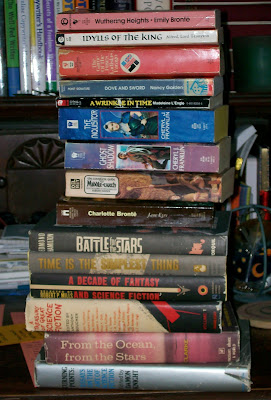
Today was the quarterly Used Book Sale at the local library. I always find some treasures there — and even treasures within the treasures themselves — but today was an even better haul than usual, with far better pickings in the SF department than usual. Behold:

And those are just the books I bought for myself. I also picked up five books each for The Wife and The Daughter. And the grand total spent?

Nine dollars.

Folks, if you like to read and if you like to own books, then you really have no reason to not be frequenting your local library’s used book sales. It’s just that simple.

Share This Post