But what’s the deal with THE DURSLEYS???

Cracked.com’s “Six Questions the Final Harry Potter Book Had Better F***ing Answer:

It’s expected that the main narrative of The Deathly Hallows will be about Harry’s hunt for the remaining Horcruxes before his final confrontation with Voldemort. If this is true, it means that the final Harry Potter Book will have the same plot as basically every RPG ever made, what with Harry having to “collect the Seven Important Things” to defeat the “loosely explained magic barrier” which will allow him to access the “final dungeon,” and in the end he’ll still be a “massive nerd.”

Geez. I hope we didn’t come this far to have JK Rowling end up channeling Terry Brooks. Wouldn’t that be a let-down.

Personally, I think it would be funny if the book ended with Harry and friends sitting around a table at the Hogwarts dining room, munching Bertie Botts Every Flavor Beans, wondering if at any moment one of Voldemort’s agents would burst in and kill them all — and then the last page ended in mid-sentence, with seven or eight blank pages following thereafter, making people wonder if their book was somehow affected by a screwup by the publishing company….

Share This Post

Books: I read ’em

Some recent reading:

:: I was a bit disappointed in Love is a Mix Tape: Life and Loss, One Song at a Time, by rock critic and Rolling Stone contributing editor Rob Sheffield. It’s a good book, to be sure, but it just felt a bit off to me. In the book, Sheffield uses mix tapes as a staging device for describing his life during the 1990s; each chapter opens with a facsimile of those fill-in labels that come with the box for blank tape cassettes, with the titles all filled in with the songs on that particular tape.

What disappointed me about this one? In truth, I’m not entirely sure. It could be that I found the book slightly unfocused; it’s not totally about the music, and it’s not totally about the relationship, either. Both aspects of the book seemed to get shorted, for me. But more troublesome was the general pall that hangs over the entire book, since Sheffield tells us right up front that his wife Renee died of a pulmonary embolism, one of those meaningless deaths where you’re going about your daily grind when suddenly it all ends and you’re gone before you can hit the floor like a burlap bag filled with gravel.

I’m not trying to make light of Sheffield’s horrific experience or the difficulty of his grieving, and I genuinely suspect that my feelings about Love is a Mix Tape stem from the fact that it didn’t turn out to be the kind of book I was expecting, and given personal factors, it didn’t turn out to be the kind of book I needed when I picked it up. So don’t take this as a non-recommendation, because it isn’t.

:: I mentioned him a couple of weeks back, but I’ll say more about him now: Nick Bantock. A month or so ago, a dear friend of mine gave me a hand-made gift that instantly put me in mind of Bantock’s Griffin and Sabine trilogy, and it not only occurred to me that I hadn’t read Griffin and Sabine in a number of years, but that I hadn’t read the follow-up Morningstar trilogy at all.

And then, a day or two after that thought occurred to me, I was in Borders and found four of the six books between the two trilogies on the “Bargain Book” stacks, each for $2.99. So I picked them up and bought the rest on eBay, over a week or two gathering a total of two copies of each trilogy: one for myself, and one for my friend whose birthday is next month. (Don’t tell her.)

I love this series, I really do, and I think it’s now to join Lord of the Rings and the books of Guy Gavriel Kay on my “To re-read in its entirety every few years” list. (I wait several years between re-reads to keep things fresh: there are still details in LOTR that catch me by surprise each time out.)

Griffin and Sabine and Morningstar are epistolary works, with their stories told entirely in the texts of letters and postcards mailed back and forth between the main characters. In the first book, Griffin and Sabine, English artist Griffin Moss receives an enigmatic postcard from Sabine Strohem, who is herself an artist who designs postage stamps for the tiny Pacific island nation of the Sicmons. Strangely, Sabine starts right off by referring to changes Griffin has made to a work of his that he hasn’t shown to anyone. Right off the bat, this story is by turns mystical and sensuous.

I’ve never read anything quite like it — especially seeing as how Bantock is himself a maker of art books. Instead of just printing the text of the postcards and letters, Bantock lets us handle the physical artefacts themselves. To read the letters, you actually have to remove them from their envelopes, which are glued to the pages. It sounds like a gimmicky device, but I loved the tactile sense not unlike reading a collection of love letters found in a dusty attic. Bantock is wise enough to give almost no narrative comment other than what’s in the letters and postcards themselves. At times this makes the story a bit hard to follow, but really, this is at it should be. The reader has to fill in the blanks by imagination, which is the way it would be when one reads a collection of old letters, anyhow.

I’ve checked out a bunch of other Bantock titles from the library, and will report on them in due course. (When I read them, of course.)

:: Finally, I’d been meaning to read Bill Mauldin‘s Up Front for some years, which I own as part of the Library of America’s amazing Reporting World War II collection, and I finally did so. What an amazing, stunning book. Seriously, I can’t recommend this highly enough, for anyone who wants to know what life was like for the infantrymen of World War II, or for anyone who admires good war writing, for that matter. I’d be very interested to hear just how life for the infantrymen in Iraq today compares with that Mauldin describes for those of World War II, over sixty years ago. There’s not much more to say than that, other than that I’m glad to have finally gotten to this one.

Share This Post

Will he finally become Totally Headless Nick?

Well, we’re about two weeks out from the massive THUD of Harry Potter and the Deathly Hallows, which I will of course buy on day one and read as quickly as I can. I actually haven’t re-read any of the previous volumes yet, but I suppose I will sometime once the series is complete. So, since I’m not totally “up” on my Potter-verse mythology, I’m not equipped to speculate a lot on what’s going to happen.

However, I will note that I’m keenly interested in seeing how two specific characters — well, groupings of characters, anyway — ultimately fit into the story. Sure, I want to know if Harry dies and what happens to Ron and Hermione and Hagrid and so on, but the two supporting-cast character arcs that most interest me are Neville Longbottom’s and the Dursley family’s. Neville’s got to have some important task to accomplish — maybe he’s the next Dumbledore! — and I can’t fathom that JK Rowling has kept the Durleys around just to have them be irrelevant in the end.

Oh yeah, and Peter Pettigrew’s life-debt to Harry Potter needs to come into play at some point, I suppose.

And here’s a question: I wonder if Rowling will ever write another word after this.

Share This Post

More Book Notes

Another quiz thing, this one about books, filched from Paul:

Recommend 3 books you believe everyone needs to read and say why people should read them.

The Lions of Al-Rassan, by Guy Gavriel Kay. Simply put, his finest novel yet, and a stunning and heartbreaking romance. (But as I’ve noted before, you have to read it twice. The second time out, when you know what’s coming, what was interesting before becomes shattering.)

A Gentle Madness, by Nicholas Basbanes, if only to give yourself an excuse to keep acquiring books (because there’s no way you’re as bad as the truly odd book collectors he writes about).

The Lord of the Rings, by JRRT. Just because. And don’t give me that “All they do is walk places” hooey. If you can read Robert Jordan or George RR Martin, you can certainly get through LOTR.

Bonus pick: The Grapes of Wrath, by Steinbeck.

Name three books you’ve never been able to finish and explain why.

OK, time for my annual admission of failure to get through The Brothers Karamazov. But I swear, by all the Gods above and some of the ones below, that I will not depart this earth until I’ve read this thing. Dostoyevsky will not be my undoing.

Neuromancer by William Gibson. I tried to read this at least four times in the 1990s, so badly did I want to get into cyberpunk. Life got better when I finally realized that I just didn’t like cyberpunk all that much. (I also bounced off a number of other cyberpunk novels, some by Rudy Rucker and Bruce Sterling. Neal Stephenson, I can deal with, just because he’s more funny than dystopic. To this day I’ve only finished one Gibson novel, Virtual Light. And I hated the Gibson/Sterling collaboration The Difference Engine.)

Let’s see, what else? There really aren’t too many books that I’ve “never” been able to finish. I’ve “bounced off” tons of books, which I always see more as a sign that I’m just not in the mood for that particular book at that particular time than a sign that I’m simply not meant to really read it. Some I come back to later on and get through, while some I simply never pick up again. Maybe The Silmarillion, but then, I don’t think I’ve made an attempt to really read that one since I was in high school, and that just doesn’t count.

My glacial reading of the Bible proceeds apace, I should report. I read a tiny portion of it when the mood strikes me. I’m still in the midst of Genesis. I find myself alternating between awe at the beautiful majesty of the Bible’s poetic constructions, and stunned disbelief that some of it gets taken seriously at all. The story of Sodom and Gomorrah just struck me as absurd: that these guys all come to Lot’s house and demand that he hand over the angel he’s just taken in so they can have carnal relations with him, and Lot’s response is that apparently the idea of homosexual action is so repugnant that handing over his daughters for carnal action is preferable. I read that whole passage, and I kept thinking, “Ummm…sure. Right.”

Name three books you want to read, but haven’t yet.

Just three? Ha! How about three entire authors? Robert E. Howard, Edgar Rice Burroughs, Jane Austen.

But OK, the question asks for titles. I’d like to read Gravity’s Rainbow (Pynchon), Infinite Jest (Wallace), and The Tale of Genji (Murasaki Shikibu).

Are there any books that you’ve loved, but been disappointed by the film/TV adaptation?

Actually, not really. Movies, after all, aren’t books, and movies have storytelling strengths that books don’t, and vice versa. I don’t normally read a book and then say, “Wow, can’t wait to see that on the big screen!” Lots of bad movies result from good books, lots of good movies come from good books, and so on. Heck, sometimes you’ll even find good movies from bad books (The Bridges of Madison County).

Which books (apart from the Potter books) do you re-read the most?

Not sure why the quiz specifies the Potter books, but I don’t tend to do a whole lot of cover-to-cover re-reading. I do, however, engage in lots of “dipping” into favorites, revisiting old passages and episodes I liked a lot. For actual re-reading, the usual suspects apply: Lord of the Rings, the books of Guy Gavriel Kay (I’m actually due to re-read a number of these; it’s over five years since I’ve been through Tigana, A Song for Arbonne, The Sarantine Mosaic, and four years since The Last Light of the Sun), and the books of Lloyd Alexander.

Which books do you remember most from your childhood?

Pretty sure I’ve answered this question many a time, but Lloyd Alexander’s Prydain and Westmark series; the gothic horror stories of John Bellairs; the real-world tales of Betsy Byars. Robert Cormier was also a good one — his were the first books I read that contained large doses of moral ambiguity, and his Fade is a genuinely unnerving supernatural story.

Are there any books that you are proud to say you have read?

“Proud”? I’m not sure that’s quite the word. I’m tickled to have read The Three Musketeers, and I feel like I’m aging into some of the great books of our collective past, but I don’t feel proud of that. I’m proud of what I’ve written, but I’m fortunate to have read what I’ve read. For the most part, anyway.

Are there any books that you are ashamed to admit reading?

Similarly, I’m never ashamed of my reading. There are books that I wish I’d not read in favor of something else — I believe I’ve mentioned my tenth grade English teacher before, the one who made us read Ordinary People while the other classes were reading Mark Twain. (I’ve never forgiven that teacher for this.) Hell, I don’t even wish I hadn’t read Ayn Rand — in fact, I’m glad that I made it through her ghastly prose and appalling pseudo-philosophy with my personality intact.

Of course, if this question’s merely asking about “guilty pleasures”, I suppose I can impugn my own literary credibility forever by simply making this admission: I still like Jonathan Livingston Seagull.

Are there any books that have had a big emotional impact on you? List 2.

Well, in 1994 I figured I was a sophisticated enough reader that I would likely never be moved to tears by a book again. And then I picked up GGK’s Fionavar Tapestry. Every time I read that thing, I sob like a little girl. In fact, when I re-read it now, since I know the story so well, I tend to set it aside when I’m coming up on a passage that I know has that effect on me until I’m alone, so I can wallow in my teary blubbering.

On the flip side of the coin, laughter’s also an emotion, and there’s nothing like a good Christopher Moore book for that. Fluke and Island of the Sequined Love Nun are my favorites here. (Note to self: your copy of You Suck: A Love Story is still unread.)

I know it said to list two, but I’ve gone this whole post without mentioning Carl Sagan’s Cosmos, so here it is. No book has ever given me the sense of wonder that this book does.

This is a non-tagging quiz, by the way, so grab it if you want it.

Share This Post
Book Notes

Some book-ish stuff:

:: I keep forgetting to link these reviews I wrote for GMR: The Boy Who Cried Freebird: Rock and Roll Fables and Sonic Storytelling by Mitch Myers, WorldCon Guest of Honor Speeches edited by Mike Resnick and Joe Siclari, and (a recording, not a book) a double album by John Wesley Harding.

:: Good book on baseball, if you like baseball (or good books about subjects you don’t particularly care about): Is This a Great Game or What?, by ESPN’s Tim Kurkjian. If George Will’s Men at Work made you want to open a window and turn on a fan (I did, and I liked that book), then this is the book for you. It’s nothing more, and nothing less, than a 250-page love letter to baseball. What’s different is the tone: it’s genuine enthusiasm for the game and all its foibles, with little of the philosophical “baseball as metaphor for life” stuff that one often finds in book-length love-letters to the game. No sepia-toned descriptions of every deal Branch Rickey swung here; just one writer’s reasons for loving baseball more than any other sport.

The best part is the funny anecdotes:

The funniest promotions come from baseball. The minor-league St. Paul Saints had Two Dead Fat Guys Night, which commemorated the lives of Elvis Presley and Babe Ruth, who died on the same day, August 16…But the Orioles blew a great opportunity after acquiring pitcher Daniel Boone, a direct descendant of the Daniel Boone. “I suggested instead of Cap Night, we have Coonskin Cap Night,” said Doug Melvin, then the Orioles’ assistant general manager. “I was told to stay out of marketing.

As pitcher Dennis Lamp watched teammate outfielder Luis Polonia butcher another fly ball, he decided, “If you hit Polonia a hundred fly balls, you could make a movie out of it, Catch-22.”

Larry Andersen played all over the major and minlor leagues, including one season in reno. “Our clubhouse guy quit midway through the season, so, for an extra $10 a week, I was the clubhouse guy,” he said. “I was a starting pitcher, I had time on my hands. But I’d be on the mound in the fourth inning wondering, ‘Did I take the jocks out of the dryer?'”

When Rangers pitchers started throwing footballs before each game to strengthen their arms, I asked [Charlie] Hough if it was doing any good. “I don’t know,” he said, ‘but we lead the league in third-down conversions.”

I promised never to reveal the name of the player who was told in the early 1990s that Major League Baseball might be moving a team to Washington, DC. And the player said, “The league can’t give Washington a team. It already has two teams, Baltimore and Seattle.”

:: I’ll flesh this out later on, but for right now, I’m becoming a huge fan of the work of Nick Bantock.

Share This Post

Books, books, books!

Recently read items here at Casa Jaquandor:

:: How could I not read The Making of Star Wars? Written in honor of the original film’s thirtieth anniversary, J.W. Rinzler’s book more than lives up to its subtitle: The Definitive Story Behind the Original Film. The book pretty much starts at about the earliest possible point, when young filmmaker George Lucas starts kicking around the notion of making a science fiction movie. There’s just an astonishing amount of information here, and the book is actually a fairly dense read — so much so, in fact, that I suspect that had the book not also been lavishly illustrated with photos and art from the production, it would have been a lot less enjoyable.

A lot of what’s in the book is already known — the nearly fruitless search for a studio to bankroll the film, the struggles Lucas had with writing his original script, the struggles Lucas had with his British crew who didn’t take the film all that seriously, the way the film probably would never have happened had Lucas not used the conceptual art of Ralph McQuarrie in his studio pitches. The book fleshes out a lot of the narrative, though, and I found it fascinating to see just how many ideas that eventually showed up more than twenty years later in the prequel trilogy had their genesis way back in 1974 when Lucas was writing his original story treatments.

:: The Making of Comics by Scott McCloud is the third volume in what I think of as his “meta-comics trilogy”, which began with Understanding Comics and continued with Re-inventing Comics. Understanding Comics is an essential read for anyone interested in the medium’s history and background; Reinventing may not be quite essential reading, but it’s a valuable follow-up. Making is a different animal: this is basically the comics equivalent of, say, Stephen King’s On Writing. Here are the thoughts on a specific kind of creative process by a person who has spent significant amounts of time over his career thinking about that creative process and the work that goes on behind it, so there’s value to reading this book even if you, as do I, have little interest in making comics.

(Actually, let me qualify that. I wouldn’t mind writing comics, but my drawing skills are about as bad as a person’s drawing skills can be without that person actually being dead.)

This is a “Thoughts of a master craftsman” kind of book, and I found great value in it on that basis. He won’t teach you how to tell stories, but rather, how to use comics as a medium in storytelling. Great stuff.

:: I watched The English Patient years ago on TBS, and I found it generally dull, drawn-out, and for the most part, really pretty boring. But having just finished Michael Ondaatje’s original novel, I’m wondering if maybe I failed to appreciate the film fairly, or if my tastes have simply changed since 1999 or whenever it was that I watched it. Hey, it happens.

The novel captivated me in a way the film didn’t, with its depiction in close proximity of four people, all damaged in various ways (all emotionally, and some physically as well), whose lives intersect in a fairly mysterious way. The mystery of the story — the identity of the unidentifiable English patient, burned almost to unrecognizability in a plane crash — unfolds in unpredictable ways, and I greatly appreciated the way his story isn’t allowed to totally dominate the entire novel. In fact, only the English patient’s status as the book’s title character really indicates at all that he’s the most important character in the book at all. Ondaatje writes from constantly shifting viewpoints, and he switches seemlessly from present tense to past and back again, making for what I found to be a fairly hypnotic read.

I’m thinking I should watch the movie again.

:: Speaking of movies from books: I’ve long loved the Richard Lester-directed version of The Three Musketeers, and I’ve recently read the original Alexandre Dumas novel. I know this will come as absolutely no surprise, but this book is just one big swashbuckling delight from start to finish. Dumas’s blend of court politics with sword-crossed derring-do is…well, the book’s just a blast. After finishing it, I felt the way one should feel when finishing a classic work: I felt better for having read it. (I read Lowell Bair’s translation for Bantam Books, if anyone’s wondering.)

Surprisingly, the phrase that should leap to anyone’s mind when hearing the words “Three Musketeers” — “All for one and one for all” — are, if memory serves, only uttered once in the book!

(BTW, if you need to watch a filmed version of the book, go with the afore-mentioned Richard Lester version. The one from 1994 or thereabouts, starring Keifer Sutherland and others, was a mildly entertaining flick but turns out to bear almost no relation to the book. It’s got a cracking good score by Michael Kamen, though.)

Share This Post

Monty Haul

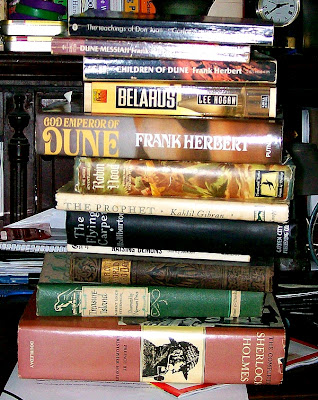
Yesterday was my local library’s quarterly used book sale, an event that always fills my heart with joy and my arms with pain (from lugging out a huge number of books). The pickings this time weren’t as good from the SF standpoint as the sale in March, but that sale was an outlier of sorts as far as SF goes; I’ve been going to this library’s sales for more than three years now and have never seen as much old SF as I did on that day. But I was still able to get the second, third, and fourth books in Frank Herbert’s Dune series (I already own Dune), and some other nifty stuff on the non-SF front. Behold:

And that’s not all I bought: I picked up five and four books respectively for The Daughter and for The Wife, in addition to all that above, and all for $8.75. Amazing.

The best part is that I’ll likely end up profiting on this book sale, because I also snagged a pristine Library of America edition of the essays and lectures of Ralph Waldo Emerson, and when I’ve sold LoA volumes on eBay in the past, they’ve always gone for somewhere around fifteen bucks each. I may also auction that Complete Sherlock Holmes, and since that copy of Halliburton’s The Flying Carpet is nicer than my other two copies of the same book, I’ll keep that one and auction one of the others.

It’s hard to see, but that third book from the bottom is an old translation of Around the World in Eighty Days by Jules Verne — it’s so old that the title is given there as Tour of the World in Eighty Days. There’s no date in the book that I can find, unfortunately, but the thing is clearly quite old, judging by the browning of the paper, the typeface, and the old stylistic thing where book titles were always followed by a period in that era. I’ll have to investigate this further, but I strongly suspect that this book will be of more use to collectors than to anyone as a reading copy of Verne’s novel.

Oh, and that paperback of the Carlos Castaneda book at the top? I found in its pages the original owner’s receipt of purchase. They bought it at the Canisius College bookstore on April 2, 1971. I love finding stuff in old books.

So where am I going to put all this stuff? No idea at all. Duh!

Share This Post

Books: I read ’em

Some notes on recent bookish activity at Casa Jaquandor, since I’ve had lots of reading time lately (about the only good thing about lengthy hospital stays):

:: Every week at the library I carefully inspect the “New Nonfiction” shelf, and often times I’ll check out a selection or two from there pretty much on a whim. One such case was Automat: The History, Recipes, and Allure of Horn & Hardart’s Masterpiece, by Lorraine Diehl and Marianne Hardart. I saw the word “recipes” and that’s all it took, since I’m always a sucker for new cookbooks, and after about five seconds of thumbing through the book, I surmised that it was apparently a celebration of a long-vanished New York City restaurant. I almost always enjoy food writing, so home it came.

What I discovered is that it wasn’t a book about one restaurant, but about a whole chain of them, a chain that launched in the 1880s and only finally closed for good in early 1991. The short version of the tale is that two guys, one named Horn and the other named Hardart, got together to open first a lunch counter and then a series of them, eventually spawning a chain of Automat restaurants in New York City and in Philadelphia. The automat concept was that food would be distributed not by servers, but through a wall of coin-operated compartments: insert coins, and then open the little window to take the food out. And then someone in the kitchen, behind the wall of food compartments, would come along and “reload” the thing.

Apparently these places were extremely popular in their day, in pre-WWII New York and Philly; their decline began with the post-war exodus of the middle class to suburbia. The Automat concept sounds a little weird at first glance, but looking at the photos in this book makes me wish there was one still around somewhere, with the art-deco styling and the stained glass windows along the front. This is a slice of bygone-Americana that I never knew existed.

(After a little Googling, here’s a new Automat-concept place in NYC. It doesn’t look at all like the Horn & Hardart Automats; rather, this looks like something you’d see on a streetcorner in Tokyo or Hong Kong. I wonder if they have Automats in those cities?)

:: Words Words Words by David Crystal is just that: a book about words. Crystal is a Professor of Linguistics at the University of Wales, and he turns out to be extremely prolific on the subject. Even though Crystal is a professional academic linguist, this book isn’t an academic tome. It’s more of an introduction to the kinds of things linguists study, as well as a general rumination on the kinds of linguistic matters that are likely to perplex people who think about language on the level of the intrigued amateur. Crystal ruminates briefly on issues such as: Is the English language deteriorating? What makes a word beautiful or ugly? How is it that words change meaning over time? Why can’t language stay the way it is, forever? And why does everybody but me speak with such outlandish accents?

:: A Short History of Nearly Everything by Bill Bryson is one of those single-volume discussions of just about everything in the world of science as it is today, similar in focus to Carl Sagan’s Cosmos and Pale Blue Dot and Timothy Ferris’s Coming of Age in the Milky Way. I love a well-written popularization of science, and this is a good one. It’s particularly notable for two features. First is Bryson’s focus on a lot of the personalities of science responsible for the things we now know (or don’t know) about our world. Science doesn’t progress in the straight line everyone likes to think it does, and often scientific progress is held up decades or longer by oddities of personality. The other notable feature of the book is its fairly bleak outlook: if Carl Sagan’s theme in Cosmos is what a wonderful and amazing thing the Universe is, Bryson’s theme is that the Universe doesn’t care one whit about us and is set up such that any number of things can happen at any moment to wipe us out forever: a giant pulse of gamma rays from a supernova we don’t know happened yet, an eruption of the giant volcano underneath Yellowstone National Park, Earth being struck by any of the likely thousands of meteors and asteroids we don’t know are aimed at our planet because we’re too dumb to spend the money to look for them, and so on.

So there’s my recent reading (along with several others that I’ll blog about later on or review for GMR)!

Share This Post

Clubbing

There’s been some turmoil over the last few days involving the Science Fiction Book Club, of which I’ve been a member for over a year now (and of which I’d been a member sporadically three or four previous times during the 1990s). Basically, the SFBC’s parent company, BookSpan, has been purchased by the corporate behemoth Bertelsmann, which owns BMG/Columbia House. Bertelsmann is therefore set to combine the book clubs it’s just bought with its other direct marketing entities, while also closing some of the smaller book clubs. Most notable here is their book club for conservatives, I suppose; I’d never even realized the other clubs slated for closure, such as one devoted to equestrian-related books, even existed.

The general thought now is that SFBC isn’t going to close, but that it will be altered substantially from the way it currently operates. Part of that was the early retirement of longtime (over thirty years) SFBC editor Ellen Asher and assistant editor Andrew Wheeler. Obviously any time a business changes hands from one owning corporate entity to another, there will be job losses as redundancies are eliminated and as infrastructures from the smaller company are brought in line with those of the larger; however, the elimination of the two people who have probably done the most to give the SFBC its unique approach to SF publishing is troubling, especially since it’s highly unlikely that Bertelsman has a well-qualified SF book editor already on staff.

Over at his blog, writer/editor Jonathan Strahan has been posting quite a bit about all this, and in this post he solicited comments from readers about their experiences with the SFBC. Here is the comment I left:

I’ve been a member at three or four different times since the early 1990s, and I am a current member now. In fact, my current membership represents the longest instance of membership for me. For the last year or so, it’s seemed as if every time I even consider the tiny possibility of canceling, the very next flier to come in the mail had three or four things in it that I wanted.

As I’ve seen mentioned in just about every blog comments thread on the SFBC topic since the turmoil became evident, the main value is in wonderful omnibus editions, and that’s where I’ve taken great advantage of the SFBC. It’s been invaluable over the last two years for my filling in of certain gaps in my collection, and at considerably less expense than if I were to track down the titles on their own, especially of things that just aren’t in print anymore or, if they are, are in expensive trade PB editions. Through SFBC I’ve been able to get nice editions of the Lensmen series by Doc Smith, the Barsoom novels of Edgar Rice Burroughs, Jack Vance’s Demon Princes series, and so on.

Sure, these are “book club” editions of the books, so the paper isn’t quite as good quality and the bindings aren’t as good either, but that doesn’t bother me, as I’m a reader first and a collector second, and I treat my books well anyway, so even the book club editions tend to do just fine on my shelves.

I’ve used SFBC more as a route to hard-to-find fiction than to get the new stuff (although I’ve bought some new stuff from them as well — books by John Scalzi, Charles Stross, and others). While I plan to stay a member for the time being, I am less than optimistic that SFBC will remain a good resource for the type of book-buying I’ve done from them. The fact that all the current turmoil springs from the eternal bugaboo of making the damned stockholders happy does not, it seems to me, bode well for a person like me who is happily digging into the earlier and, in some cases, largely forgotten byways of the genre.

I’m sure we’ll reach a point someday in the future when the concerns of stockholders aren’t given paramount attention on an a priori basis. I just hope I’m still around when we get there.

As I say, I do not currently plan to abandon my membership, mainly out of curiosity for what the new (but not likely improved) SFBC will be. I’m not optimistic about the direction they will take, though; I’ve never once encountered an instance where something got better after the people who were doing out of love were pushed out in favor of people who do it because it’s just a whole new pile of beans to count.

Here’s another SFBC member’s take on the whole thing.

Share This Post

Recent Readings

Brief notes on several books I’ve read of late, two graphic novels and two memoirs:

:: Love in a Torn Land (which sports a fairly ungainly subtitle, Joanna of Kuridstan: The True Story of a Freedom Fighter’s Escape from Iraqi Vengeance) is a highly effective memoir of a woman who had the misfortune of growing up Kurdish in Iraq during the end of the 20th century, coming of age during Saddam Hussein’s dictatorial rule of that country. In the book, author Jean Sasson writes the tale of Joanna al-Askari’s life as she related it in telephone interviews and a few personal meetings. Joanna’s life is one of unexpected sadnesses and triumphs, of mundane events like schooling and dating and, ultimately, falling in love and getting married juxtaposed with horrors like her brother being taken by the Iraqi police to Abu Ghraib and the poison gas attacks on her people.

Love in a Torn Land is on one level a gripping story of love in a time of war and upheaval, but it’s all the more relevant as a personal narrative set within the events that continue to shape the larger history of our world right now. Highly recommended.

:: I Don’t Want to be Crazy by Samantha Schutz is a memoir of a young woman who suffered debilitating anxiety disorders through her college years. Not usually the type of thing I read, but what caught my eye was the fact that this book is written in blank verse, which allows Schutz to create some literary echo of the anxiety that nearly ruined her life.

Graphic novels:

:: Age of Bronze, Volume One: A Thousand Ships by Eric Shanower. A few years ago I read The Iliad, and I was shocked to realize that in that work, one of the longest enduring tales of war and adventure in all literature, only a tiny portion of the story of the Trojan War is told. No “face that launched a thousand ships”. No Trojan Horse. None of that — just singing the “rage of Achilles”.

Now Eric Shanower is endeavoring to tell the entire story of the Trojan War in comics form. He’s done tremendous research into the war (he describes his work in a fascinating afterword), and the “labor of love” aspect of Shanower’s work shines through in the resulting product. The art is cinematic, the characterizations sharply drawn, the pacing excellent as the book draws us in.

This is a wonderful example of what comics can be. The only thing it’s missing is a music score.

:: This one needs no musical score, since it already has one, and it’s one of the greatest musical works ever composed: P. Craig Russell’s adaptation of Richard Wagner’s Der Ring des Nibelungen. The tale of heroes and gods and the jealousies and conflicts between them is one of the timeless stories of humanity, and Russell wisely tells the tale pretty much at face value. I’ve always wondered if the ideal way of doing Wagner’s Ring wouldn’t be on stage but rather on film, perhaps even with animation. Russell’s graphic novel is a step in that direction. Now to track down the second volume, wherein Siegfried and Gotterdammerung are told.

Share This Post