Carmine Infantino

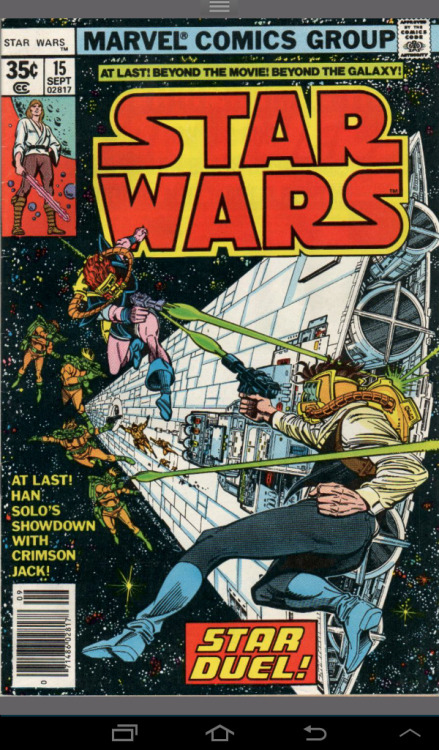
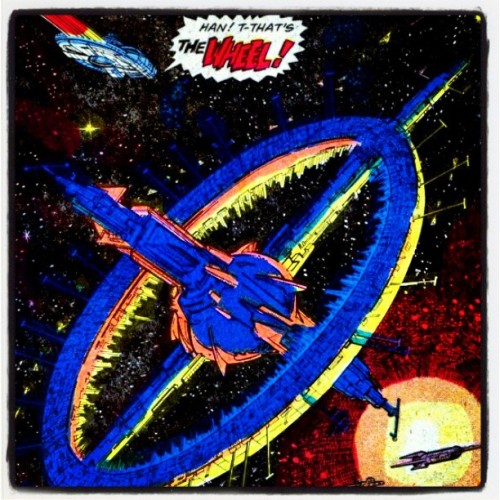
Comics artist Carmine Infantino died the other day. I primarily remember his work on the Marvel Star Wars series, which he drew during a hefty chunk of the period between A New Hope and The Empire Strikes Back, which was actually a really wild-and-wooly time for the Star Wars comics. At that point, nobody had any idea what was to come in terms of the Star Wars mythology and backstory and so on, so Marvel was flying about as blind as could be. The result was a sequence of issues that told some really fun and entertaining space opera adventure stories, and Infantino’s art was a big part of that.

A fine, fine artist.

Share This Post

Avengers assemble!!! (no spoilers)

Heavens, what a movie.

I mean, really. Heavens, what a movie.

The Avengers doesn’t quite take the top prize as my favorite superhero movie of all time, but at this point, I just don’t think that Superman is likely to be dislodged from that spot in my heart, ever. But the spot for number two? I think that Spiderman 2 is in that spot…but I’m not sure if The Avengers didn’t just take it over. Or at least tied it.

I loved this movie. It’s thrilling and exciting. Its story is epic in scale, but fairly simple in its particulars. Its characters are all well-drawn and sharply written. Its dialogue crackles. Its action sequences are full of effects that look amazing even in this day and age, and the sequences are not impossible to follow. The Avengers is pretty much a joy from start to finish.

I’m a fan of Joss Whedon’s, although I’m not an obsessive one (I have yet to watch much of Buffy the Vampire Slayer at all), nor one who believes he is infallible (I watched four or five episodes of Dollhouse before I gave up). I do rank Whedon above the other great God Emperor of Geekstuff, JJ Abrams, though; Abrams is a fine director, but his writing just leaves me wanting. I was never a big fan of the Avengers during my own comics reading days, but when I learned that Whedon was writing and directing the film toward which all the Marvel superhero movies of recent years had been building toward, I was terribly excited. And I’m glad to report that this excitement has paid off.

The films leading up to this have, admittedly, been a mixed bag…but a generally likable mixed bag. Iron Man  was a lot of fun; Iron Man 2 a bit less fun, but enjoyable. Thor was a blast, although its blend of New Mexico desert and an Asgard that looked made of freshly-painted plastic felt odd. Captain America was probably the best of all these; I enjoyed the hell out of that one. (Did I ever blog about it? Oh noes, I didn’t! Especially since I didn’t see it until just a month or so ago.)

So, along comes The Avengers. This movie has to reintroduce all these heroes, and do it in such a way that it reminds those of us who saw their individual movies what went on, but doesn’t bog down in reminders for people who didn’t see them. It also has to set up the villain (Loki) and explain what he’s up to. Whedon gets all these various pots boiling, and he does it with flair and confidence. Where lots of superhero movies falter is in their various first acts, but Whedon is able to keep all this pretty interesting. He doesn’t spend too much time in explanations, and gives pretty much exactly as much information as you need to make sense of what’s going on. (And, frankly, he honors the longstanding tradition of superhero comics that everything makes sense as long as you don’t really think about it too closely.)

This isn’t a perfect movie. The pacing is pretty relaxed in the first act, but each act picks up steam, until by the end of the movie, I was left pretty breathless. Whedon is able to make the film large in scale; this feels like a genuine epic, and it doesn’t feel artificially inflated. Here are some great things that Whedon does along the way:

  • He raises the stakes a little at a time. Early on, in the first skirmishes, a given fight might need one hero, maybe two. This changes as the nature of the threats becomes greater and greater.
  • He establishes that in any battle worth fighting, a price will be paid. Anyone familiar with Whedon’s work over the years will know that he definitely likes to do this, and there are moments in this film where I found myself wondering if the price had just been paid, because I know Whedon and his lack of fear when it comes to putting his characters through hell.
  • The battles take their toll on our heroes. Whedon makes them work for it. This is a hallmark of all the great Marvel Comics team battles over the years. Sometimes the team — any team, whether it’s the Avengers, the X-Men, whomever — even loses. And the battles themselves have acts! It’s just classic Marvel Comics storytelling that our heroes have to work to exhaustion just to beat the first wave of attackers, and just as you’re wondering how they can ever defeat what’s next…what’s next comes upon the scene.
  • Whedon gets that superhero teams are not inherently given to teamwork. He knows that there are egos at work, and he shows this. Best of all, he’s able to show all these clashing egos without making us think that any one of them is a complete jerk. I loved that.
I love the acting in the film, as well. All the leads are superb, just as they were in their respective films before. Chris Evans is still able to portray Captain America’s earnest goodness without making him an insufferable boor to be around; Robert Downey Jr. as Iron Man gets all manner of great lines. The best part of the cast may be Mark Ruffalo as Dr. Bruce Banner, who also has to turn into the Hulk on occasion. He’s able to portray Banner as brilliant and cursed, a man who is wounded by his inabilities to always control who he is.
As I mention above, the action sequences are filmed perfectly. Despite the fact that New York City is exploding left and right, Whedon establishes what’s going on and shows it without filling his frame with so much mayhem as to make the shots impossible to follow. And I liked that he engages in minimal cross-cutting, so that when he takes us to see what, say, Black Widow is up to, he stays with her long enough that we know what’s happening.
No, The Avengers is not perfect. It does have moments of slowness, and the motivations of the villains aren’t always obvious. And as much as I’ve enjoyed Alan Silvestri’s music in the past, I don’t think he turned in the best score here; I’d hoped for one big, memorable theme for this film, but it just wasn’t there. In a very real way, if forced to choose one factor that keeps this film (and Spiderman 2) behind Superman in my heart is that Superman boasts a score by John Williams at the height of his powers. But to my mind, there is no flaw in The Avengers that keeps it from being what it is: one of the most entertaining films I’ve seen in years.
A couple of random notes:
::  Yes, Stan Lee has a cameo. But my favorite cameo was from character actor Kenneth Tigar as the “German Old Man”, who talks back to Loki. I’ve always liked Tigar (he was the bomb squad guy in the Lethal Weapon movies, and he was one of the more notable killers against whom Thomas Magnum matched wits on Magnum PI) , and I’m glad to see that he’s still active and acting!
::  Reportedly, Joss Whedon wanted Cobie Smulders as Wonder Woman, back when he was attached to whatever Wonder Woman movie was in development. I’m glad that he managed to get her into the superhero movie world here, as a SHIELD agent.
::  A lot of reviews I’ve seen accuse Samuel L. Jackson of just doing his standard glower through the movie. It’s not like his role didn’t really call for him to do much else, but he did allow his Nick Fury to show what little vulnerability he would.
::  There’s an airplane in this movie that bears a small design similarity to the Serenity. It’s a blink-and-you-miss-it kind of thing, but I sure saw it.
::  If you see it, stay for the very, very end. All the way to the end of the credits. Trust me.
::  Bring on The Avengers II! (And while we’re at it, let’s get the Serenity out of mothballs, shall we?)

Share This Post

Sunday Burst of Weird and Awesome!!!

Oddities and Awesome abound!

:: Dungeons and Dragons was created almost 40 years ago by Gary Gygax and David Arneson. Both men have passed on, but Arneson’s personal collection of materials comprising his creative work on the game was recently found in, of all places, an abandoned storage locker. Now it’s all going to be auctioned. Wow! I’m glad that the new owner of the locker wasn’t a putz like that guy on Storage Wars who is always searching for ‘collectibles’, and just tosses stuff aside if he has no idea what it is.

:: How in God’s name have I gone this long without learning about Blue Milk Special? This is a webcomic that is retelling the Original Trilogy of Star Wars, as a parody. And it is awesome. I spent some time this morning reading it, getting up to the Millennium Falcon blasting its way out of Mos Eisley. I think that this one is my favorite thus far…but it’s got some competition.

:: Some recent stuff pertaining to that goofball fascination of mine, the pie in the face:

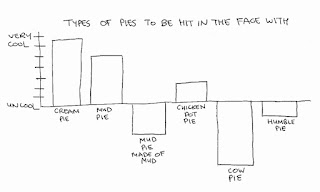
I saw this on Tumblr. I guess I’d agree on the first two, but I’m befuddled that a chicken pot pie has a ‘positive’ rating as a potential pie for someone’s face. I don’t think I’d like that at all. Especially if it’s still fairly fresh from the oven.

A reader e-mailed me this helpful bit of advice:

See? Pot pie is not recommended. (I wouldn’t recommend shaving cream either, because it tastes like, well, shaving cream. And meringue doesn’t stick, at all.) As for the delivery techniques, I have zero experience in this regard myself, but I recall from gym classes in school that throwing things isn’t my wheelhouse, as it were. Best stick with the push, I suppose.

Comics readers from the 1970s (on which I was a young one) may recall a DC Comics superheroine named The Mighty Isis, whose powers and mythology was derived from Ancient Egyptian mythology. (Hmmm…I wonder if her creation was inspired by things like the tour of King Tut’s treasures around the US….) She had a teevee show that was paired with the Shazam! show, along with her short-lived comic. In one of the issues of the comic, one of Isis’s fellow Egyptian gods, Set, shows up to try to force humans to worship him, and he works all manner of mischief, which Isis can’t stop because she’s not as powerful as he is. So she hatches a plan to show Set that he doesn’t really want to rule humans anyway, because they’re not sufficiently reverent of the gods. How does Isis demonstrate this? By letting some kid (from her schoolteacher alter-ego’s class) throw a pie in her face.

Spl-lat

It’s a weird story (I posted the whole thing on my Tumblr), but kind of funny and even ‘wholesome’ in that “Hey, I can triumph over my foes without resorting to violence!’ way. And as comic-book pies in the face go, this one’s fairly nicely drawn. (Not that I have a huge sample size of such things to meditate upon…I remembered this one from when I was a kid, and I spotted the issue in an ‘Old Comics for Ten Cents Each’ box at a local comics store, and the cover jogged my memory.)

::  Finally, I note the passing last week of Adam Yauch, one of the founding members of the Beastie Boys. In truth, I wasn’t a fan, but that’s more because I just don’t grok rap in general. Not my cup of tea, although I do grant the artistry involved. The Beastie Boys’ popularity and influence can’t be ignored, but for me, their best thing was their famous video that included a pretty spiffy pie fight.

OK, that’s it. More Weirdness and Awesome next week!

Share This Post

Some recent comics reading

Catching up on some notes about some stuff I’ve read over the last few months, in this case, comics….

:: I recently read in its entirety the comic book series Air, by G. Willow Wilson and M.K. Perker. It’s a very strange story, much in the vein of things like LOST, with weird mysteries compounding more mysteries and lots of strange goings-on, surprising revelations, plots that start small but end up huge, characters whose loyalties and status as heroes or villains isn’t immediately obvious. For the most part, Air is well done and intriguing, although it does suffer from the fact that it quite obviously ends too soon. The story slowly unfolds, and then it suddenly becomes clear that the book had been canceled by Vertigo Comics, so instead of building over time, the book quickly starts to wrap up and then it ends.

Our heroine is a flight attendant named Blythe, who has taken this particular job despite severe phobia of heights (to the point where she has to pop pills to deal with it all). She finds herself in the midst of a highjacking in which her plane is directed toward a country that doesn’t exist, and then she is living out her worst fear: tumbling through the sky without a parachute. Except she is rescued by a tall, handsome stranger named Zeyn. We learn of a shadowy government (or not) group that has goals all its own, and then, before long, the story plunges us into lost countries that appear on no maps, ancient Aztec artifacts, a new kind of engine that will revolutionize aviation, visions of a bird-snake named Quetzalcoatl, and a lot of ruminations on the nature of terrorism.

Air is an intriguing read that held my interest most of the way, even though, as I noted before, I could sense that the air (no pun intended) was let out of it toward the end. The comic’s art is good when dealing with people, but in the flight scenes the series could have used an artist more able to suggest a feeling of ‘soaring’ and the wonder that exists in the sky. Still, Air was, for the most part, an enjoyable read – and a reasonably generous one, at 28 issues collected into four trade paperbacks.

:: The movie The Rocketeer is an entertaining little adventure flick that I enjoyed back when it came out in the early 1990s. However, I did not realize that it was based on a comic book, by a man named Dave Stevens. An omnibus edition collects the complete adventures of the Rocketeer, which were apparently serialized in several publications before at last appearing in a one-shot issue that resolved a cliffhanger. Unfortunately, that’s all that exists of The Rocketeer; Stevens died of leukemia not long after finishing The Rocketeer. I was pleased to note the degree to which the film honored the retro homage tone of the comic. There’s a lot to be fond of here.

:: I have mixed feeling about Craig Thompson’s latest work, Habibi. I honestly don’t know what to make of it. This long, sprawling tale follows two youths in a fictional Arabic land, a young woman and a boy, whose grim turns in life bring them together. They run away into the desert and make a home, of sorts, in an abandoned boat, where the woman cares for the boy, who slowly grows up and starts to notice things about the woman he lives with.

I really don’t want to say more than that about the story, which is very long and meandering and full of developments that put the characters into positions of nearly abject horror. I found large parts of the book distasteful, with a relentless focus on sexual behavior that borders on depravity and the limits to which our two heroes must endure horrible things in order to survive and find their way back to one another. It’s to Thompson’s credit that when they finally do find each other again, there are no easy, happy endings; instead, the events leading to that point continue to haunt them in ways that they will probably never completely surmount.

Still, there’s just no getting around the fact that I found long stretches of Habibi downright unpleasant, and there are parts that are nearly impossible to fathom, such as the mad man who clings to a sunny disposition on life, which would be fine were he not convinced that the objects he pulls out of a sewage-choked river are treasures.

Habibi also confounds expectations in other ways. There are times when the nature of what’s going on in the story seem to convincingly place the story in some passed time, decades or centuries ago, but then we discover that the Arabic palace that is full of concubine-slaves and the beggar-society of eunuchs are both located in a city that is also the home of modern skyscrapers. I’m not sure what statement Thompson is trying to make about the Arab world here, but the juxtaposition of a society stuck in medieval times in its sexual mores while building for the current century is unsettling.

Thompson’s art is, as ever, absolutely stunning. There are pages upon pages in Habibi that beg to be reproduced and framed. Thompson’s major recurring theme is the nature of the Arabic written language, and many of the book’s finest pages clearly draw artistic inspiration from the traditional illumination of Arabic manuscripts.

I’m just not sure what I think of Habibi as a whole. I can’t say that I liked it, but it’s certain to stick in my mind for a good while.

Share This Post

A to Z: Spaceman Spiff

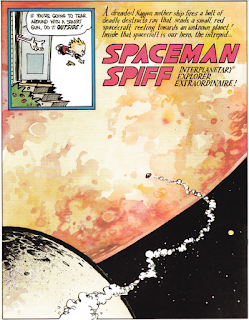
Once upon a time, the occasional adventures of one of the greatest of all Interplantery Adventurers Extraordinaire appeared in daily newspapers across the world. You couldn’t be certain of when he would appear, but sooner or later, there he’d be, and we’d thrill to his exploits, as envisioned by a young schoolboy with, shall we say, a fascinating combination of powerful imagination and a very short attention span. Yes, it’s our hero, Spaceman Spiff!

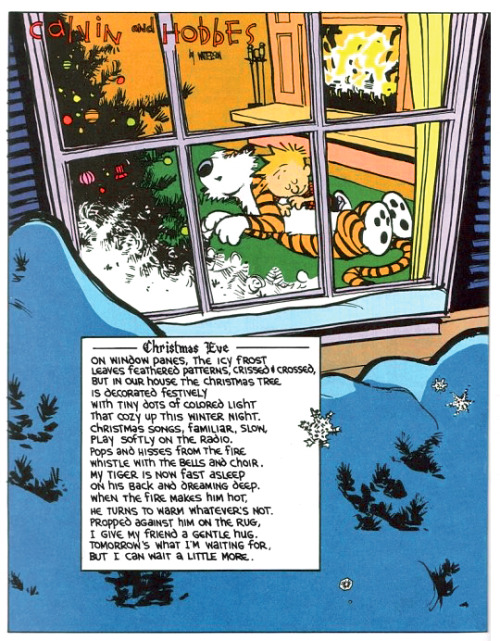
Spaceman Spiff is, as most cultured persons know, one of the imaginary alter-egos of young Calvin of Calvin and Hobbes. Spiff tended to turn up in moments when Calvin’s attention span was wandering wildly from something he probably should have been attending to more (such as school lessons), but not always.

Bill Watterson (creator of C&H) always seemed to me to have a really good grip on the fact that for children, the boundary between reality and imagination is nowhere near as strong as adults tend to prefer. Kids seem to have this ability to switch back and forth between their imaginations and their realities almost seamlessly, which can be confounding for adults who have lost this ability (or worse, the ability and the memory of how wonderful that ability made the world). This very ability seems to me a key component in the lives of creative individuals, and amongst the oft-cited characteristics of young Calvin, it’s his astonishing creativity that seems to go unnoticed much of the time.

I always thought that Watterson in C&H was able to stay right at the line of pointing out that imagination is a good thing, while also pointing out that yes, our hero Calvin can take things too far. But it’s fascinating to me that, in the last of the “Rosalyn the Evil Babysitter” storylines, Rosalyn was finally able to get some control over Calvin not by battling against him, but by giving in and making Calvin’s signature sport, “Calvinball”, work for her. She had to endorse imagination in order to corral this kid who was running out of control.

The Spiff stories were also notable in that tales like this — and when Calvin imagined himself to be other things, such as a dinosaur, or superhero Stupendous Man, or hard-boiled private investigator Tracer Bullet — allowed Watterson to really go all-out with his art in a way that you really can’t do when your comic strip is set in the real world. Watterson was thus able to cook up nasty-looking aliens, landscapes of other worlds, and various bits of explodey-spaceshippy-goodness. In creating a kid with an extremely potent imagination, Watterson created for himself the ideal playground for a cartoonist with an extremely potent imagination. (He would also cite that he would use such opportunities to pay tribute to the comics masters of the past, like George Herriman of Krazy Kat.)

So, let’s all raise a glass to the ongoing and incomplete and always-interrupted adventures of Spaceman Spiff, and to the imagination, both real and fictional, that created him!

Here’s my favorite of all the Spiff strips:

Share This Post

A Deepness in the Sea

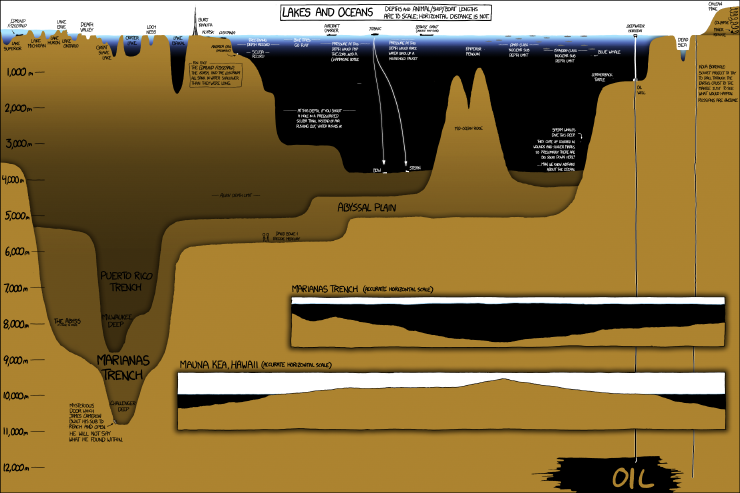
By rights I should save this for next week’s Sunday Burst, but it’s too good for that. xkcd brings the infographic goodness to the depths of the large lakes and oceans.

Note the depth of Lake Erie, relative to the other Great Lakes — that’s why Lake Erie usually freezes over during winter (although not so much the last couple of years, and in the future, who knows — thanks, Global Warming!).

On a related note, I think that we may be living in the Golden Age of Infographics. I love losing myself in these things!

Share This Post
I lived on a cul-de-sac once….

There was a brief running story in the comic strip Pearls Before Swine a couple weeks back that had the strip’s animal characters commiserating with their creator, Stephan Pastis, on his failure to win the highest award for cartoonists. (Pastis routinely draws himself into the strip; it’s one of many reasons I love Pearls.)

This led to this installment:

And of course, reading that, I had to look up this other strip, Cul de Sac. I’d never heard of the strip before (the Buffalo News doesn’t run it — but we get our crappy reruns of For Better or For Worse, so heckuva job, BuffNews!), but having read through a chunk of archives online, I have a new daily must-read. So thanks, Stephan Pastis! You’ve given Richard Thompson at least one new confirmed reader.

Share This Post
Page One: The Dark Phoenix Saga (Uncanny X-Men)

My main era of comics reading was in the mid to late 1980s, spanning roughly the latter half of seventh grade until the end of my senior year, when I decided to pretty much stop reading comics on the basis that there was no way I was going to be able to afford all my monthly titles whilst in school.

For the most part I was a Marvel fan. There were titles that I didn’t much care for, but I really grooved on The Uncanny X-Men from the first time I read it (issue #183 or thereabouts, my first issue being one in which Peter Rasputin has to tell Kitty Pryde about a girl he’d met on an alien planet). My entrance into the Marvel Universe was pretty much of the “jump in, buy comics, read ’em and put it all together in my head” variety, but back then, you could do that. Sure, the Marvel Universe had tons of continuity going on, but it was still fairly manageable without resorting to lots of reference stuff.

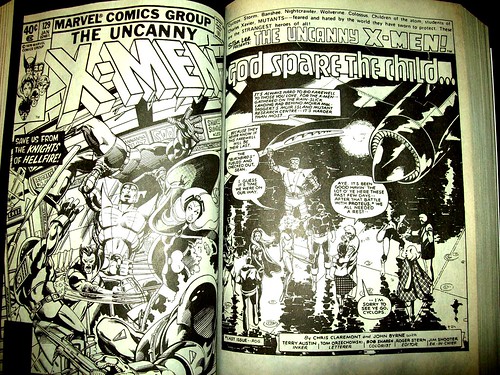
So, a couple of years after I started reading comics a lot, Marvel produced a trade paperback of something called “The Dark Phoenix Saga” from The Uncanny X-Men‘s issues 129 to 137. I knew enough about this storyline to know that it was already considered something of a classic of the genre, and I knew that Jean Grey’s death was an event that was still showing repercussions throughout the Marvel Universe. Now I was going to find out how that death had come to pass.

That original trade paperback of mine is long gone, but I have since reacquired the “Dark Phoenix Saga” as part of one of Marvel’s “Essential” compilations, which nicely and cheaply reprints lots of issues into a nice thick volume (albeit keeping the cost down by printing in black-and-white). I plowed through this entire volume a while back, and a lot of it comprised stories I didn’t know, particularly the ten or fifteen issues leading up to the start of the “Dark Phoenix Saga”, and a couple of issues that showed the aftermath.

The faults in Chris Claremont’s stories tend to stand out quite a bit more in omnibus editions. Now, to be fair, I’m not sure if some of the most annoying style tics of his were actually tics of his or if he was directed by editors to do some of these things, but we’re talking about Wolverine constantly pointing out his unbreakable claws, Cyclops constantly referring to his ruby-quartz visor, and so on and so forth. Or how it sometimes seems as though two or three pages of every twenty-two page issue is given to summing up stuff that happened before. And over time, Claremont’s focuses on character interactions and complex webs of interrelationships tends to start to feel like soap opera; I remember one commentator describing his run on Uncanny X-Men as “Dallas with capes”.

And yeah, that’s all true. But it worked a lot better when you were reading these issues one at a time, once a month. And now, reading the omnibuses, those flaws aren’t really all that distracting, when Claremont is firing on all cylinders…as he is in the “Dark Phoenix Saga”.

This story starts out small. The X-Men are recovering a bit from a pretty tough battle, and there are apparently some conflicts of personality within the team (this is how things seem if you start here and not before). Professor X returns from somewhere (I don’t recall where he was), and almost immediately, they detect two new mutants, one in Chicago and one in New York City. (The X-Men are always scanning for new mutants, so they might intercede and help them learn to deal with their mutancy in a world that is hostile to mutants.)

From such humble beginnings — tired team, investigating two new mutants — this story takes us on an ever-widening story whose scope gets bigger and bigger and bigger until, by the time we get to the final three issues or so of the “Dark Phoenix Saga”, we’ve got full-blown space opera going on, leading to a showdown amongst ruins on the dark side of the Moon. And along the way there is a love story, seeds planted for future tales (this is where we meet Kitty Pryde, after all), and the slow but inexorable rise of Jean Grey’s power until she can no longer control it.

Claremont — along with artist Byrne — presents one of the most cinematic stories I’ve ever read in a comic. In a real way, most of the comics stories of today — and the comics movies — can trace some piece of lineage, in terms of storytelling style, back to the “Dark Phoenix Saga”. This is one of the stories that I would likely cite if someone ever asked me what stories they should read if they want to see superhero comics at their very best.

And now I want to read the bloody thing again!

Share This Post