

To the books!

So, what have I been reading lately? Let’s look:

:: It’s actually been a long time since I bounced off a book, but damned if I didn’t bounce clean off a Stephen King novel. I haven’t read a whole lot of King, but what I have read, I’ve at least liked, and some of it I’ve found utterly brilliant (The Stand is just a magnificent work). So I didn’t expect to find Dreamcatcher a tough nut, but tough indeed I found it. Like many King books, the early going started flying by, and I actually got about a third of the way into the book before a major shift in tone and focus stopped me cold. The early stuff, detailing the lives of our hunter friend heroes, is all winning stuff, vintage King. But something really bothered me in the book’s tone once the military guys show up, and then the book veered into a long surreal section with Jonesy, if I was reading things right. Anyhow, my interest in the book dropped like a rock at that point, and I eventually set the thing aside. I’m quite surprised that’s how it worked out, and maybe I’ll give the book another go someday.

:: I did not bounce off In the Heart of the Sea: The Tragedy of the Whaleship Essex. This is one of those books I’d seen any number of times, either in bookstores or at the library, and each time there was something about it that said, “You know you’re going to read me sooner or later.” So the last time I saw it in the library, I picked it up and read the blurb on the dust jacket, describing the fate of the Essex as being a partial inspiration to Herman Melville in Moby Dick, and claiming that the Essex disaster was as famous in the nineteenth century as the Titanic wreck was in the twentieth. Clinching it is the fact that the book is cited on this list of sea books. I love a good book about the sea, and this certainly is that.

The Essex was a whaling vessel that set out from Nantucket on a whaling expedition and encountered many problems along the way, such as storms and short provisions as it sailed into the Atlantic, down the east coast of South America, around Cape Horn, and into the Pacific to attempt to harvest the whales in recently-discovered feeding grounds there. At that point, the voyage, already difficult, became calamitous when a sperm whale rammed the Essex repeatedly, eventually dealing the ship a mortal blow. The crew then set out in lifeboats to try to return to South America. A handful of crew eventually made it, after many days at sea in which they became starved and dehydrated and eventually resorted to cannibalism.

Tales of disaster like this, in which arrogant man is pitted against heartless nature, always seem to include numerous instances in which everything could turn out differently, and better, if only better decisions were made. Those bad decisions, constantly exacerbated by bad luck, make for a riveting and haunting read.

:: One doesn’t explore the world of comics beyond the well-known superhero stories very far before one encounters the name of Will Eisner, who by all accounts is one of the twentieth century’s leading lights of comics-as-literature, as opposed to comics-as-diversion-for-adolescents. Such creators as Scott McCloud, Art Spiegelman, and Craig Thompson all spring from the ground seeded by Will Eisner. And yet, until a few weeks ago, I’d never read any Eisner at all. Well, that is no longer the case.

Life, in Pictures is a collection of autobiographical stories, drawing from various aspects of Eisner’s life. The term “autobiographical” is meant to be taken somewhat loosely, as apparently the first tale in the book, “A Sunset in Sunshine City”, is not autobiographical at all but rather a fictional meditation on the kinds of feeling Eisner experienced when he, like the main character in the tale, moved from his lifelong home in New York City to a retirement home in Florida. Also partially autobiographical is “The Dreamer”, which follows the early career of a young cartoonist (a stand-in for Eisner) in the youthful days of the comic book industry (before World War II, and definitely before the disastrous creation of the Comics Code). Here Eisner depicts his young stand-in running across numerous real figures from comics history, albeit disguised with fictional names. (Luckily, this story includes a set of annotations, clearing up the identities of those depicted.)

The largest portion of the book is devoted to “To the Heart of the Storm”, in which Eisner, having been drafted into military service and on board the troop train riding to his bootcamp, reflects on his personal history and that of his parents, with particular emphasis on the fact that they are seemingly always on the run from anti-Semitism. “The Name of the Game” traces Eisner’s family history through his mother’s side, and the book concludes with a very short tale – a vignette, actually – called “The Day I Became a Professional”, which is exactly that.

I suppose this is no revelation whatsoever, but Eisner turns out to be that rare item in comics: the complete package, the brilliant writer as well as the terrific artist. His texts and his visuals blend so seamlessly that there were times in reading Life, in Pictures that I found myself literally losing my sense of time in the face of my awe at my first encounter with an obvious master of his form. So yeah, Will Eisner turns out to be pretty good. Film at eleven!

:: Sticking with comics, I thought that American Born Chinese by Gene Luen Yang would be an manga, but it’s not, really. It’s just a graphic novel by a comics artist of Asian descent on the subject of a young man who finds himself isolated as the only Chinese-American in his new school. It’s also the story of the Monkey King, a monkey who isn’t satisfied to be a King but who also wants to be a God. And it’s the story of a popular kid named Danny who sadly has a cousin named Chin-Kee, who happens to be the personal embodiment of every obnoxious stereotype of Chinese people that exists. American Born Chinese tells all these stories, and in reading the book, I figured that each tale existed in its own particular space in the book. That assumption turns out to also be wrong, when the three stories become one late in the book in one of the more delightful surprises I’ve encountered lately in a book.

I suppose there’s something about my initial assumption that the book was a manga (“Hmmm, Asian subject matter, Asian artist…clearly a manga!”) that illustrates part of the point the book makes about racial stereotypes toward Asians in the first place. We’re talking about a Chinese-American comics artist here, after all, and manga is a Japanese medium. But the book is brilliant, and along with the Eisner volume above truly indicative of how powerful a medium comics can be.

:: It’s generally taken as a given that political figures tend to exhibit qualities in their public speaking that are often labeled in the colorful way as “being full of shit”. However, it can always seem a bit daunting to identify exactly how our politicians are befuddling us with bullshit, since they’re obviously not baffling us with their brilliance. Hence a book like Aristotle and an Aardvark Go to Washington: Understanding Political Doublespeak Through Philosophy and Jokes, by Thomas Cathcart and Daniel Klein. It’s a brief, breezy, and mostly entertaining look at the various tricks-of-the-trade of political rhetoric. Granted, most of the examples the authors select involve lapses in logic by right-of-center politicians, but there are the occasional quotes by such Democratic masters of BS as Bill Clinton. The book also features lots of regular old jokes along the way, used to depict logical fallacies. It’s a fun and breezy read, especially as a kind of refresher course in logical argumentation.

:: I read Sheila’s appreciation of a production of Macbeth with Patrick Stewart as the lead with interest, as I had just weeks before finished reading Macbeth for the first time since high school. I remember this being the first of Shakespeare’s plays that I really liked, probably owing to its blood-soaked tale of regicide and eerie supernatural content; I remember being especially pleased in discovering the way Shakespeare had made the witches’ prophecies come true.

We read Macbeth in eleventh grade English; at the time, the norm was, if memory serves, one Shakespeare play a year. We started in ninth grade with Romeo and Juliet, which, well, I just wasn’t capable of appreciating in any way that early on. (I’ve always had this pet notion that literature should be taught in reverse chronology; dumping a bunch of ninth graders into iambic pentameter can’t be the best way to introduce kids to The Bard, I think.) In tenth grade it was Julius Caesar, which I found more interesting, although I still found Shakespeare mostly impenetrable. “Why do they keep talking for so long? A bunch of guys stab Caesar and yet he still manages to get out ‘Et tu Brute’?” It wasn’t until Macbeth that I started to actually see what Shakespeare was doing, that I started to understand that his language had rhythm and music inherent within it. (I may have been influenced by my discovery the year before of Berlioz, and my further discovery that Shakespeare had been one of Berlioz’s greatest artistic influences. I guess that was my first personal experience with being swayed by a celebrity endorsement.)

Anyhow, Macbeth. I don’t have anything particularly insightful to say about this work; I only note how wonderfully brooding a play it is, how gloomy. Macbeth himself always seems as though he believes himself to be in control of his own actions, but all along, we know that he is in no control at all. Watching his entire world collapse around him, and seeing him reduced to, in his words, “a poor player” strutting and fretting his hour upon the stage, forms the heart of the tragedy. I love this play, and I should really try to see some Shakespeare on stage someday.

:: Finally, I’m trying an experiment: reading Moby Dick at the rate of one chapter a day. If I can stick to that pace, I will get all the way through the book in 135 days. (Yeah, that’s a big ‘if’.) I’ve been planning to read Moby Dick for a while now, but my enjoyment of In the Heart of the Sea influenced my decision to get going now, and it will help that the chapters are all very brief. Occasionally I will post a brief thought about the book as I make my way through it, starting with this: the first sentence of Chapter Two.

I stuffed a shirt or two into my old carbet-bag, tucked it under my arm, and started for Cape Horn and the Pacific.

That is just a terrific sentence, isn’t it? Our boy Ishmael dreams big. He’s not setting out to find a berth on a ship, he’s not setting out for Nantucket, he’s setting out for Cape Horn and the Pacific. That would be like if Neil Armstrong had risen on that morning in July 1969, kissed his wife, and said, “Bye dear, I’m off for the Sea of Tranquility.” Ishmael’s a guy who knows where he’s going.

So that’s the literary activity lately at Casa Jaquandor.
Share This Post

Stuff!

Some lazy linkage for a snowy Thursday evening:

:: Lynn Sislo hasn’t posted in several days. As she lives in Oklahoma, I assume that this is due to the ice storm they had in those parts. I hope she’s back online soon.

:: Do check out this wonderful article about visual injokes in Pixar’s movies. I love stuff like this.

:: I suppose I should start reading Terry Pratchett sometime soon. He has been diagnosed with Alzheimer’s.

:: When I become Supreme Ruler of Teh Universe, my first decree will be that all gas stations shall be one-way only, and that it will be illegal to swing your car into the opposite direction just because the one open pump is on the opposite side of your car as the gas cap. I am really tired of trying to figure out how to line up for a pump, when more often than not, the cars at the pumps will be facing me no matter which way I queue up.

:: Via Michael May I see that Joss Whedon’s not done with the Firefly universe, and will tell more stories there in the best medium for the job: comics. In fact, he’s apparently already done a comic of Firefly; I’ll have to track that down. It’s called Those Left Behind; the new one will be called Better Days. Cool. (Note to self: finish watching Firefly and then watch Serenity one of these days.)

Share This Post

Funny pages? Aieee!!!

I really have to wonder if it’s coincidence that Funky Winkerbean and For Better or For Worse are each apparently about to shuffle their respective near-death characters off this mortal coil? Read both of today’s installments, with pithy gallows-humor comment, here.

UPDATE: I should note that I’ve found the Winkerbean storyline very deftly handled and very touching. I don’t really have much more to say about it than that.

Share This Post

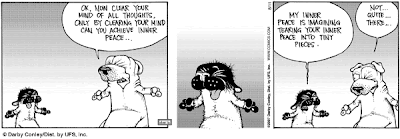
Inner Piece

I feel the need to enshrine today’s installment of Get Fuzzy. Our story so far is that Satchel has taken up Tantric meditation (which he’d misread as “Tantrum meditation”), and is now apparently teaching Bucky how to do it:

Bucky’s line there belongs on a t-shirt or something.

UPDATE: It occurs to me that I haven’t complained about For Better or For Worse in a while, so the current storyline — yet more in the inevitable pairing of Liz and Anthony — makes me want to vomit. And remember, I love a good sappy love story. This one, though? Blecchhh. What is with Lynn Johnston’s rather creepy apparent belief that true happiness involves marrying one’s grade school sweetheart and never moving more than a mile or two from home?

Share This Post

Make ready my ship, general!

I keep meaning to post about various books I’ve read lately, and I keep putting off the post. So now I’ve got several such posts to write! First, three recent reads on the Space Opera front:

:: Dread Empire’s Fall: The Praxis, by Walter Jon Williams. The basic idea behind the Dread Empire’s Fall trilogy is that much of the galaxy has been conquered and brought into the Empire of the Shaa, a fairly mysterious alien race, under a guiding philosophy called “the Praxis”. But as The Praxis opens, the last of the Shaa rulers is about to die, which means that their Empire is about to undergo some serious change — change that one of the Empire’s dominant races, the insectoid Naxid, are plotting to exacerbate by basically rising up and taking over. In this book, Williams engages in the good old standard plot where one minor military officer recognizes the signs of enemy conspiracy but can’t convince his higher-ups that there’s anything going on…so he has to take matters into his own hands. (None of this is spoiler, really, since it’s all spelled out on the back cover blurb.)

What’s good about the book is? Well, Williams’s universe has more of a sense of hard-SF plausibility about it than most “space opera war-in-a-Galactic-empire” tales. The movements of starship fleets take weeks and sometimes months to execute, and the battles aren’t matters of giant ships getting really close to one another and then firing lasers back and forth, but rather ships from great distances firing missiles and then waiting hours to see if they hit anything. The combat sequences are really well done here, and they’re a nice change from things like the Battle of Endor in Return of the Jedi. Particularly welcome is the way Williams can set up these kinds of space battles without devolving into the kind of terminal infodumps that cause the books of, say, David Weber to grind to a halt when they should instead be ramping up to real excitement.

Williams’s characterizations tend to be limited, I found. The two “lead” characters — Lt. Gareth Martinez and pinnace pilot Caroline Sula — are sharply drawn, with lots of motivation behind them. Few of the other characters are so three-dimensional, I found.

The biggest problems I had with this book were in the world-building and in the pacing. This first book of the trilogy is called The Praxis, and yet we learn very little about this guiding religion of the Shaa empire. I suppose it’s at the heart of the way the society Williams creates is almost entirely stratified according to class, but “the Praxis” itself doesn’t seem to factor much into the story. Additionally, little is learned of the Shaa themselves. Williams does an excellent job of showing us his world, but I found too little sense of just why this world is the way it is.

The pacing was the biggest problem. Too much of this first volume feels like wandering through backstory — and, in the case of pilot Caroline Sula, it actually is wandering through backstory, as her past is shown through long flashbacks into her earlier life. There’s literally more than two hundred pages of set-up and character stuff before we ever actually get to the meat of the story, and I have to admit that I came close to setting the book aside several times before the tale finally kicked in.

Nevertheless, I enjoyed the second half of The Praxis sufficiently that I plan to read the second installment (and, unless that one completely blows, eventually finish the trilogy). If you decide to pick this one up, just keep plowing through those first 230 pages or so. It gets a lot more interesting later on.

:: Sigil is a comics series that I’ve picked up in TPB format, starting Mark of Power. Thus far, what happens is that a group of four wildly-different individuals are brought together by circumstance in the midst of a war between humanity and a reptilian race called the Saurians. Our hero, Samandahl Rey, is for some reason branded on his chest with the mark of the Sigil, some kind of mark of great power, which he uses in a moment of rage to annihilate a large part of a city. Rey and his three new cohorts have to flee, all the while seeking revenge on an old Saurian enemy of Rey’s, whilst also fleeing government agents who want to acquire this new weapon that can destroy entire cities.

At least as far as the first volume goes (containing eight or so issues of the original comic), this thing is just about all-action, all the time. So far I’ve found it a fun read, and I’ve already picked up the next two volumes in the series. The art thus far is pretty good, although I found the action sequences a bit hard to follow, artistically.

:: I really got a kick out of The Metabarons, though. This series relates the sprawling saga of a race of genetically-perfect warriors called the Metabarons. Imagine if the Jedi had been warriors along the lines of Conan the Barbarian, and you’ll have it.

These stories are full of lust, blood, war, sacrifice, and exactly the kind of Big! Bold! Gestures! that I tend to crave in story. If melodrama isn’t your thing, then avoid The Metabarons like the plague. But there’s just something hugely operatic about this series, in a Wagnerian way. The art is stunning — panoramic and beautiful. It took me twice as long to read Book One of Metabarons as it did to read Book One of Sigil, because the art is so intricate. (It must also be admitted that the dialogue of Metabarons tends to the dense, and almost stilted, language of The Big Epic. Partly this may be due to the fact that the story was originally written in French and then translated, but while I had no problem with it, other readers may find the dialogue not to their liking either.)

I’m a bit confused about the publishing history of the Metabarons series in TPB format. There seems to have been two separate publications of these tales, under two different titles, so one has to pay careful attention when buying these to make sure that one’s actually buying the right volumes and not simply buying the same volumes with different names. Book One, for example, seems to exist as both The Path of the Warrior and Othon and Honorata, published by two different companies (Humanoids Publishing versus DC Comics). I’m also not sure if each book contains the same groupings of issues, so if one mixes and matches from both — which I’m doing — there’s a possibility of either duplicating material, or missing material entirely.

Share This Post

The Unnamed Hero Cometh!

OK, folks, I just saw this “Make Your Own Superhero” gizmo over at Aurora Walking Vacation, and I just had to give it a try, using his suggestion of creating a superhero based on myself. Here it is!

How about that! Lightning from my right hand, and a blaster in my left; long hair blowing in the wind; some kind of green energy crackling ’round my Eyes Of Hot Instant Death; nifty wristguards that may or may not have extra powers within them; and on my feet, Rollerblades of LightSpeed! Note the battle scars on my powerfully-muscled arms, and the necklace made from the teeth of my vanquished Rigelian foes! Note my faithful companion through many dangers, Ozzy the Avenging Ocelot! Zap! Pow!

(Yeah, my alter-ego is a smoker, I’m sorry to say. Maybe the cigarettes deliver some kind of super-duper battle drugs into my bloodstream or something. And yeah, I was surprised that overalls were a clothing option there, too.)

I did have a problem, though. See that empty text box at the bottom? That’s where the name of your Superhero goes. Problem is, I couldn’t think of a name for this guy. That’s where you all come in. Put your suggestion in the comments!

Share This Post

Graphically speaking

I’ve been reading quite a few graphic novels of late, and I have some more in the “to read” stack, seeing as how the Buffalo and Erie County Public Library actually stocks them to a nice degree.

(If you live in or near a locality with a large public library system and you’re interested in graphic novels, give this route a try. I firmly believe that one big reason that graphic novels are seemingly forever stuck in that “on the brink” phase, where people are constantly saying things like “Hey, these aren’t the funny books you grew up with!”, is that graphic novels tend to be priced in so high a fashion as to seriously discourage random exploration of the medium. Do I strongly recommend Craig Thompson’s Blankets? Absolutely. But if someone came to me and said, “I have forty bucks. Recommend some reading material I might like”, I’d probably feel a little guilty if I advised them to blow their money on Blankets only to have it not be their cup of tea.)

I don’t know if we’re in some kind of “Golden Age” of graphic fiction, but there’s just some amazing work being done outside of the standard superhero stories. (Not that there is anything inherently wrong with superhero stories in the first place.) To anyone who would dismiss the graphic novel along the lines of “I don’t need pictures to go with my storytelling”, I’d simply ask if you keep your eyes shut when you go to the movies!

Here are some thoughts on some recent reads of mine.

:: I never saw the David Cronenberg film of A History of Violence, so I have no idea how accurate the film is to the original graphic novel. I heard that the film was very good, so I checked out the novel on that basis alone, much as I did with The Road to Perdition a few years back. In that case, I found the ways in which the film diverged from the novel interesting, and I couldn’t decide which version of the tale I preferred. (In fact, the versions are sufficiently different that I find it easy to like both equally.)

A History of Violence has much the same kind of feel as Perdition; both involve (at least in part) the way big-city violence comes to small-town America. Even though both books are by different authors and have different artists, the same kind of emotional pall hangs over the story in each, a sense of impending doom where happiness will be destroyed forever, and quite violently, at that. Part of this comes from the art of History, which has the same stylistic feel as Perdition, with heavily-lined black-and-white images that make the larger panels almost impressionistic in nature.

I found the tale of History a bit less gripping than Perdition‘s. In History, a pair of violent killers come into a small town where they are done in when they run afoul of the wrong guy to pick on. The rest of the story comes out of the reasons why Tom McKenna is the wrong guy to pick on, and just what the secret history he’s concealing happens to be. I did find it a bit disappointing when it turned out that McKenna is your basic “running from the mob” kind of protagonist, but even so, the story does take some surprising twists as it heads toward its conclusion.

:: Of a completely different nature is Persepolis and Persepolis 2 by Marjane Satrapi. I read Persepolis more than a year ago (and seem to have inexplicably not posted about it here), but I finally read the second volume just a few weeks ago.

Here is an amazing memoir of an Iranian expat, now living in Paris, who grew up witnessing firsthand her country’s embrace of — or descent into — fundamentalism and oppression. The first volume deals mainly with Satrapi’s childhood and early adolescence, while in the second Satrapi goes to live abroad to finish her studies. Thus the books tell two stories: the first, an internal tale of a society’s willful decision to become fundamentalist, and in the second, a story about a person living abroad who happens to come from one of the more disliked nations on Earth.

As autobiography, Satrapi’s work is riveting. She has a keen perceptive gift that is the key to all good autobiography; in our lives, we all tend to be our own heroes and villains from time to time, and Satrapi never shies from depicting her own faults as well as her own strengths, her own mistakes as well as her own triumphs. And her ability to put into very few words and images the strife that surrounded her country in that tumultuous period is particularly noteworthy. At one point, while discussing the fundamentalist government’s focus on acceptable public clothing for women, Satrapi writes:

The regime had understood that one person leaving her house while asking herself:

“Are my trousers long enough? Is my veil in place? Can my makeup be seen? Are they going to whip me?”

…no longer asks herself:

“Where is my freedom of thought? Where is my freedom of speech? My life, is ti livable? What’s going on in the political prisons?”

I wonder if there will be a Persepolis 3. I hope so. Satrapi’s art is simple and evocative, and her writing is exemplary.

:: Moving into equally serious territory, last night I read The Tale of One Bad Rat by Bryan Talbot. In this book, a teenaged runaway girl named Helen is living on the streets of London for a time with her pet rat; she has run away from home because of her father’s molestation of her. Over the course of the book, Helen draws much inspiration from the life of Beatrix Potter, to the point where she unconsciously (or perhaps partly consciously) begins to model her own life on that of Potter, with whom she apparently shares some parallels.

This is a difficult work to characterize. Parts of it seem almost fantastical, but those kinds of elements are always portrayed as being in the mind of Helen; and what I admired most was the book’s insistence on the role that story and fantasy can play in helping us heal from unspeakable hurts. Too often we view fiction as “escapism”, but in this story, Talbot gives us a character for whom fiction is an essential way of dealing with her particular part of the world.

:: And now into pure fantasy: The Life Eaters, written by David Brin and painted by Scott Hampton. This book depicts a World War II gone horribly awry when the concentration camps turn out to be massive “factories” for necromancy, thus bringing the gods of Norse mythology to horrible life.

Apparently this is based on a short story of Brin’s (and it reminded me in part of a story of mine; I’ll have to post that here at some point). It’s a fascinating blend of fantasy and SF tropes, as well as an enjoyably dark tale about the borders between science and mysticism. My only complaint here was that to me the ending felt a bit rushed.

:: Moving into the folkloric type of talespinning, there was the utterly gorgeous Book of Ballads with art by Charles Vess and written by many contributors, among them Emma Bull, Charles de Lint, Neil Gaiman, and Jane Yolen. Seriously, this book contains in a fairly compact package the work of some of the top names in fantastic literature today.

According to Terri Windling’s introduction, in the 1990s Charles Vess illustrated a series of comics which simply told the stories of old ballads from the English, Irish, and other traditions. For anyone who is used to more “sanitized” folklore, the original tales and ballads often turn out to be quite dark, and a number of the tales contained in The Book of Ballads are downright grim. But each is done with charm, and Vess’s artwork — black and white, with so many tiny and precise marks that one wonders how much time Vess spends on a single panel — is always stunning.

I recommend this book highly; it’s made its way onto a short list of graphic novels of which I’d like to own my own copy.

:: OK, a brief digression here. I often have difficulty reading manga, and oddly enough, it’s nothing to do with the right-to-left thing. (For those who have never tried to read an authentic manga, they are printed in reverse of the way we print books in our culture, and you read right-to-left.) This is easy enough to get used to. My problem with a lot of manga is the artwork: I often find it terribly difficult to figure out just what it is that I’m looking at, and in a graphic novel, that’s not the effect one wants. The latest victim here was a book called Trigun, which I went into with high hopes, mainly because of its subtitle: who wouldn’t want to read a tale subtitled “Deep space planet future gun action!”?

I’ll try it again sometime. But for now, I found the art nearly incomprehensible a lot of the time.

:: OK, last one. This is the wonderful Castle Waiting by Linda Medley. This is another collection of installments of a comic, so the book ends without much sense of closure — so I fervently hope this isn’t the end! (And according to Medley’s official site, this is only Volume One. Huzzah!) But the book is incredibly generous in its contents: there are almost 450 pages here. Lots to get through.

Castle Waiting is the story of the denizens of, wait for it, Castle Waiting. This castle is the formerly abandoned home of Sleeping Beauty (the first chapter tells that story from a different perspective), but is now home to a motley collection of odd characters (a steward who has the head of a stork, for instance) whose lives have all come together at this castle. Into their midst comes a pregnant woman named Jain, whose past is rather mysterious (and which is never really explained in the extant volume!). Medley delves into the backstories of these strange people who have made their home in this abandoned castle, with its water sprites and mischievous bodyless demons (he’s a head with feet) and a nun from a cloister for bearded women and so on.

If I had to make an analogy, Castle Waiting feels cut from similar cloth as The Princess Bride; it’s not parody per se, but rather gentle pastiche, loaded with in-jokes and inside stories that descend into other stories of their own. The book meanders all over the place, and never once did I mind.

Bring on Volume Two.

Share This Post