
Graphically Reading

Time to catch up on a few graphic novel titles I’ve read recently:

:: Water Baby by Ross Campbell is a different kind of story, certainly. I didn’t much enjoy it, but it’s OK. A female surfer named Brody loses half of her leg to a shark attack while surfing, which leads to some kind of existential crisis involving her ex-boyfriend who shows up after an absence, her best friend who seems to have some homosexual tendencies. The three fall in together, alternating between getting along and not getting along, and then they embark on a road trip. The book ends when the road trip ends. I’d say more, but there’s really not much more to say about the story than that. This is the kind of character study piece where the point is to spend some time with some characters, rather than paying a great deal of attention to what happens to them. (Aside from the shark attack, of course.) The book is aimed at teen readers. I found it mildly interesting, if rather short and slight. The book suggests some interesting things regarding Brody’s psychology after she loses the ability to surf, but nothing much is made of it.

:: House, by Josh Simmons, tells the tale of a young man who is backpacking through the countryside when he comes across an enormous dilapidated mansion and two women sitting outside, who are also backpacking. They go inside, and haunted-house type stuff ensues. This book’s art is very compelling – the atmosphere reminds me a bit of Edward Gorey’s work, although it is at times hard to figure out exactly what’s going on, and this is important because the book is all art and no dialogue. Not a single speech-bubble to be found here – the entire story is conveyed through pictures alone. That said, I read this in about twenty minutes.

:: Madame Xanadu tells the backstory of a character who has apparently been in the backgrounds of the DC Comics universe for years now. I’d never heard of Madame Xanadu before I saw this book on the shelf at the library, but you’ve always got to start somewhere. Madame Xanadu turns out to be a magician who has lived for many centuries, and whose adventures have taken her from the tutelage of Merlin to the palace of Kublai Khan to the court of Marie Antoinette and to other places. All throughout these journeys, she finds herself struggling against the forces of history, which are personified in a man she knows only as “The Stranger”, who is everywhere she goes and whose presence she finds both maddening and intoxicating. The present graphic novel collects the first issues of a “Madame Xanadu” series, so I’m not even sure if the book is complete, even though it does end on a “full stop” of sorts. I did appreciate that the book doesn’t assume any particular degree of knowledge of the DC Universe, and I really appreciated the art, by Amy Reeder Hadley. Matt Wagner’s writing is also very good. I enjoyed this book a lot.

:: And then there’s Cairo, which I loved. I outright loved it. Written by G. Willow Wilson and drawn by M.K. Perker, Cairo is a thriller in which five strangers – a drug runner, an alternative journalist, an American expatriate, a college student, and an Israeli soldier – find themselves involved in the search for a stolen hookah pipe that happens to house a genie. The search is joined by a gangster-magician, and the story set in present-day Cairo, with all its East-meets-West tensions, turns into a highly entertaining, and moving, potboiler. If anything, I felt that this book ended too quickly.

:: Finally, I read the autobiographical The Quitter by Harvey Pekar. Pekar is the writer of the highly-regarded American Splendor, but he has not been a career writer. Rather, after knocking around from one job to another in his youth, he got an office job with a government agency and stayed there until retirement. Nevertheless, he was apparently a fine jazz critic, and he really does turn out to be a very gifted writer after all, when one considers how fascinating The Quitter is despite the fact that there is, at first glance, almost nothing about Pekar’s life that people would consider fascinating at all. But then, that’s the whole point, isn’t it – that the normal and the boring in everyday life can actually turn out to be the most fascinating. I’m reminded of Gene Siskel’s old test for how he was liking a movie: “Would I rather watch a movie of these people just having lunch?”

A pretty good run of titles, I think…Water Baby was the least of them, and even that one wasn’t a complete waste of time.
Share This Post

Bone

UPDATE: Welcome, readers of Boneville, and thanks to Jeff Smith for the link.

I’ve read a few graphic novels lately that I’ve procrastinated posting about, so here goes.

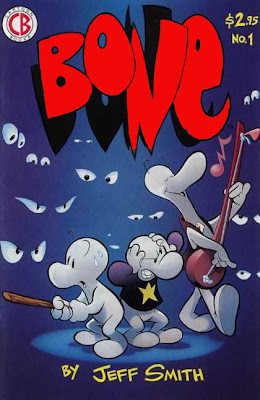
I’ve seen Jeff Smith‘s name mentioned a lot in comics circles as being a highly-admired artist and writer, but I hadn’t read him much at all except for his recent Shazam! miniseries (which I reviewed for GMR back when). Smith’s most famous work to date is his gigantic opus Bone, which I’d held off reading for a while. The first time I heard of Bone was in the comics essay in one of the Year’s Best Fantasy and Horror volumes about ten years ago now; the writer made the first of many comparisons I’ve seen over the years of Smith’s work to Tolkien’s. Well, that is certainly high praise.

But when I looked into a volume of Bone back in 2003 in the library, I remember being confused. I open to the first page and see, instead of epic fantasy goings-on, a trio of characters wandering through a wasteland. The characters are…well, they’re hard to describe. Pasty-white, doughy folk. Short. It looked like, well, the Pilsbury Dough Boy and two of his friends wandered off for an adventure. Tolkien? Bone? Not so much. Maybe it was a great book, but…I wasn’t going to find out right then.

Well, years go by, and I see more and more reference to Bone in reverent tones, with more comparisons of the book to Tolkien. Now I was finally intrigued, although I still didn’t read the book; but when I read Smith’s afore-mentioned Shazam!, I was highly impressed with Smith and decided that it was finally time to look into Bone. A little while after that I’m in a local bookstore and spot individual volumes of Bone priced cheaply ($9.99, I think), and picked one up. Then I forgot I owned it, as I do with many books I buy. I only read that first volume of Bone, Out From Boneville, a few months back, and I enjoyed it so much – it won me over in the first ten pages – that I soon tracked down the rest of the series in the enormous, single-volume edition.

When I say “enormous”, I mean just that. Bone runs for more than 1300 pages. (That single volume edition retails at around forty bucks, but that’s when I tend to use those 40%-off-any-item coupons that Borders sends me once in a while. It’s the best way I know to make comics affordable. As I’ve noted before, I tend to think that price point of individual volumes is one of the major factors that keeps comics readership lower than we all know it should be.) And yes, it turns out that this is a comic of truly epic scope, even if it doesn’t feel epic in its first few chapters. Bone‘s epic quality sneaks up on you, and there’s the big way in which Smith’s opus mirrors Tolkien’s: the story starts out quite small indeed, and gradually becomes bigger and bigger and bigger over time until we realize that our heroes have stumbled into the middle of an ancient struggle that is about to climax.

The story opens with three “Bones” wandering in the desert: Phoncible P. Bone (otherwise known as “Phoney Bone”), Smiley Bone, and the one who will turn out to be our main hero, Fone Bone. They’re known as “Bones” because they hail from “Boneville”, a locale we never see. They have been kicked out of Boneville because one of Phoney Bone’s get-rich-quick schemes has gone awry. Never fear, though: Phoney Bone is always ready with a new get-rich-quick scheme, much to the chagrin of the sweet-natured Fone Bone and much to the amusement of Smiley Bone, who finds mirth in nearly everything. Soon the Bones are separated, however, and Fone Bone finds himself stranded and alone in a dark and mysterious forest populated by talking insects, giant furry beasts called “Rat Creatures” who are menacing but not-terribly-bright, a dragon whom apparently only Fone Bone can see, and a girl named Thorn and her protective grandmother. Fone Bone follows Thorn to the little farmstead where she lives, and little by little finds himself drawn into various intrigues in this forest, where all is watched by a menacing figure who seems to be directing the Rat Creatures for some nefarious purpose.

Along the way, Fone Bone develops a crush on Thorn and bores everyone around him by obsessively discussing his favorite book (Moby Dick); he runs afoul of too many of Phoney Bone’s schemes to remember; he runs afoul of a giant cat whose allegiances are unknown; he runs afoul of hidden perils called “Ghost Circles”; he travels into ancient shrines and ancient cities and finds himself in the middle of ancient wars.

Bone is really something special. It is long and epic, but also poignant and intimate and familiar. The characters’ motivations are never unexplained or inexplicable, and much of the conflict is character-driven. There are sad moments and laugh-out-loud funny moments, and Jeff Smith ties it all together with wonderful art. Originally the series was done in black-and-white only (and that’s how my single-volume edition is), but the smaller re-issues have been colored beautifully under Smith’s direction. I prefer the B&W because it is (a) original and (b) cheaper. Bone is seriously wonderful stuff.

Smith’s most recent comics work is an ongoing series called RASL. This is an ongoing series which Smith is apparently self-publishing. It’s a science-fiction story that is aimed at mature audiences (which is a strong consideration after Smith’s earlier appropriate-for-all-ages Bone and Shazam! work). I’ve only read the first volume of the graphic novels that are collecting it, so I don’t have a strong impression of RASL yet. But it’s a surprisingly dark and violent tale featuring an art thief who travels between dimensions using this gigantic gizmo he wears on his back. The book is hard to describe, and while I found it intriguing, I also found it hard to evaluate based on the little that is printed in the graphic novel edition. I’ll probably wait however long it takes Smith to do RASL in its entirety before I really dig into it.

Share This Post

Moving forward – the same direction as always.

I wrote once before on the initial graphic novel set in the Firefly universe, Those Left Behind. Now there are two such graphic novels; Those Left Behind has been joined by Better Days. While I’ll pretty much jump at nearly any chance to revisit this universe, neither of these two graphic novels is completely satisfying, which is oddly disappointing considering my belief that comics is the ideal medium for the Firefly universe to live on, if live on it does.

The problem with each one boils down simply to the fact that they are too short. It took me about twenty minutes to read each one; they’re just too slight. It’s really pretty frustrating; you would think that comics would give Joss Whedon room to breathe with his Firefly tales, but apparently these books are collections of miniseries that were mandated at just three issues apiece. The result are fun stories full of that Firefly flair that nevertheless flash by, without a real sense of the stories being fleshed out or with the subplots resolved too quickly or not given enough room to breathe.

Those Left Behind is apparently intended to lead right into the movie Serenity, and thus sets up things like Shepherd Book having left the ship when the movie starts and the two “Hands of Blue” pursuers of River Tam having been replaced by The Operative. Thus, parts of Those Left Behind probably won’t make sense to anyone who hasn’t seen the movie, or if they do make sense, they won’t realize how things are resolved at the end of the story.

Better Days tells a “standard” Firefly story; this could have been an episode of the show, really. The crew performs one of its less-than-legal jobs, but unlike most jobs Captain Reynolds and crew take on, this one results in a huge payday, resulting in the crew getting to indulge some fantasies as to what they would do if they had lots and lots and lots of money. (Jayne’s fantasy is a hoot, and River Tam’s is…well, you’ll have to read it yourself.) It’s a good story, but again, it contains one too many subplots for a story that is only being told in three issues. Also, since the page count is at a premium, the action sequences in these comics tend to be hard to follow. They almost seem like individual frames taken from filmed action sequences, and as such it’s often hard to understand who is doing what.

This is all a shame. I don’t know if Firefly has a future in comics or not; while I enjoyed these two books, I can’t think they really helped the cause at all. Three issues here, three issues there – that’s no way to sustain interest in the ‘Verse. Bummer.

(Apparently a third Firefly comic, one which fleshes out the background of Shepherd Book, is on the way at some point.)

Share This Post

Graphically Reading

Want a foolproof way to get some good graphic novels to read? Grab any edition of The Year’s Best Fantasy and Horror – the ones edited by Terri Windling and Ellen Datlow (at least until a couple of years ago, when Windling stepped down and was succeeded by Kelly Link and Gavin J. Grant), look in the introductory essays for the one on the year’s best graphic novels, and make a reading list from that essay’s recommendations. You won’t go wrong, and you’ll find a lot of amazing stuff across all genres. (And now you’ll have plenty of time to catch up, as the YBFH series has apparently been discontinued, damn it all.)

A case in point is Bookhunter, by Jason Shiga. A rare book is stolen from the Oakland Public Library, and the Library Police are dispatched to investigate the theft. Who are the Library Police? They’re a crack squad of law enforcement professionals who are charged with protecting American access to information via the libraries, and they investigate the theft of the rare book with meticulous attention to detail and good old fashioned gumshoeing.

The story is set in the 1970s, so the overall tone is kind of like CSI meets Kojak. The book is full of fun information about books, and about libraries and library procedures; and of course, the entire conceit is hilarious, right down to the last fight where the villain is able to jump-start his final getaway attempt by using the drawers of the card catalog to his advantage. This is a wildly fun and entertaining book.

Not wildly fun is Shaun Tan’s The Arrival; this book is stunningly beautiful instead, a true work of art that puts the very best of comics on display for anyone who may still be skeptical as to whether comics are a viable medium for deep storytelling. This tale of immigration is told through illustrations only; there isn’t a single word anywhere in the book. But what illustrations they are: evocative, haunting, and all of them beautiful. This book reminds me of the work of David Wiesner in its sophisticated use of nothing but image to tell an involving story. A man comes to a new country, where he’s immediately baffled by the customs he finds and the sprawling cityscape in which he must live. But he manages, through the help of new friends, some of whom aren’t human or any recognizable species at all. The way this book uses the fantastic to make statements about the universal experience of people who voyage to a new homeland is nothing short of amazing. This is a gorgeously wonderful book.

I also note the anthology series Flight, whose fifth installment came out last year. For some reason I’d had the impression that the Flight books present excerpts from long-form works, but that’s incorrect; the pieces in each volume of Flight are complete, and the books are basically collections of short fiction, just in the comics medium. I’m not going to cite specific examples of effective stories here, but each volume thus far contains some absolute gems. Give Flight a look.

Share This Post

Stupid Thoughts that Randomly Popped Into My Head

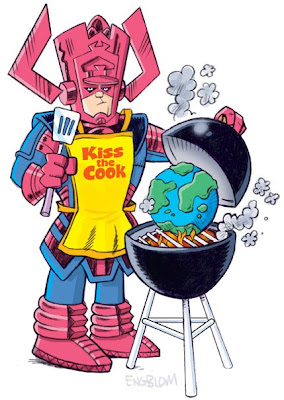
OK, so for some reason, I was thinking about Galactus. He’s the Marvel Comics supervillain who basically flies around the Universe eating planets, because that’s what he eats: planets. So I was thinking, does he get in the mood for certain kinds of planets? I mean, is Galactus ever kicking back and thinking, “Hmmm, I could go for a nice frozen rock of a planet right now, kind of like that one they call ‘Pluto’ in that one system I’m not supposed to eat?”

Are there any planets that are a guilty pleasure for Galactus, in the way that, say, a bucket of fried chicken might be a guilty pleasure for humans right now? As in, “Boy, I don’t eat gas giants all that often because they’re really not terribly good for me, but sometimes I gotta indulge!”

Are there any planets that Galactus avoids unless he’s utterly ravenous, because he either hates the taste or because they disagree with him? Does Galactus fly through our system, look at Mars, and think, “Tastes good, but I’d better not. Last time I ate a planet with that much red dust, I had heartburn for a thousand years.”

Does Galactus ever throw up? What does that look like? Could our Solar System’s asteroid field have resulted from Galactus doing his Galactic equivalent of praising the porcelain god?

Would Galactus’s Thanksgiving dinner consist of eating Jupiter, Saturn, Uranus and Neptune in one shot? Would he take a nap afterward?

Would a planet like Venus, by virtue of all that CO2 in the atmosphere and all the sulfuric acid and other nasty chemicals all over that world, leave Galactus with a really nasty aftertaste in his mouth? Would it give him a bad case of space flatulence?

When Galactus is just kicking back and wants to nosh on some snack food, does he snack on moons and comets and stuff like that? Is an Oort Cloud his version of a big bag of Cheetos?

And does Galactus ever get to wash it all down with anything at all? Or could his constant angry look just be the fact that he has eternal cottonmouth because he can’t ever get a nice drink to clean out his palate?

If Galactus eats a planet that hasn’t completely solidified yet because its accretion disc isn’t quite done accreting yet, is that his equivalent of eating something that’s only half-baked? Does he spit it out when he realizes it isn’t done yet? Does he shove it closer to its sun to help it cook a bit more, like throwing a steak back on the grill?

Yeah. I desperately need to get out more.

(Above image stolen from here.)

Share This Post

Great Moments in Sequential Art

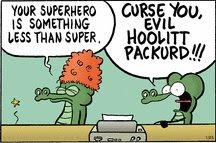
This panel from a recent installment of Pearls Before Swine made me laugh uproariously:

The storyline here was amusing — the trio of stupid crocodiles adopting superpowers, each relating to obscure office skills like doorstopping, stapling, and removing paper jams from printers — but what got me was “Curse you Hoolit Packurd!”

Share This Post

FOOB-ar

It’s been a while since I bitched about For Better or For Worse, and since the strip is apparently “ending” sometime soon (next month, I believe), I won’t have too many more opportunities.

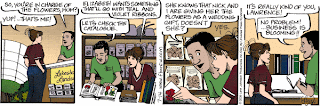
So! One of the annoying tics of this strip (one of oh so many) is the way Lynn Johnston so often seems to find it funny to close out a strip with a really lame pun, like so:

And when these lame puns take place, everyone involved in that strip ends up standing there, grinning like idiots at the lame wordplay. It took me a while to figure out what this reminded me of, but it finally hit me a few hours ago: these are the comic strip version of the final scene of an episode of CHiPS! Skip to the three-minute mark and you’ll see what I mean.

Of course, this kind of thing was done definitively on Police Squad!:

I should figure out a way to end my posts with lame freeze-frames!

Share This Post

“I’ve recently spent a spell of time being dead.”

I don’t remember where I first saw The Rule of Death linked, so thanks to whomever, but I’m hooked. It’s a web-comic that’s a Western about a man named Pete who, having died, decides that he’d just as soon not be dead after all. It’s got a wonderfully creepy tone to it, along with acerbic dialogue that reminds me of the kind of thing Joss Whedon writes (such as when the town Doc, meeting Pete after Pete’s returned from the dead, says, “You may not realize this, Pete, but yes, accurate identification of life or death is still considered a pretty fundamental ability in my profession.”). There aren’t too many installments yet, but the comic is apparently updated every Friday.

Read the first installment here.

Share This Post

The Big Red Cheese (and that other guy)

I have a couple of new reviews up at Green Man Review. First I look at Jeff Smith’s recent graphic novel treatment of Captain Marvel, SHAZAM! The Monster Society of Evil, which I liked a lot, and Kevin J. Anderson’s recent prose-novel treatment of the last days of Superman’s home planet of Krypton, titled appropriately enough, The Last Days of Krypton. This one I didn’t like as much, although I’m not sure it’s totally Anderson’s fault as he probably did the best he could with the task at hand. Anyway, check out the reviews. Or don’t. Hey, it’s your mouse. I can’t make you click the links!

Share This Post

Wake me when the serial killer gets here

I used to actually enjoy For Better or For Worse, but like everybody else, I read it daily now out of the same compulsion that impels me to crane my neck for a better glimpse when I drive by a particularly nasty car wreck. It started going south in a big way when Lynn Johnston decided that Elizabeth needed to ditch her teaching job in that Inuit town in the wild northern Canadian country and return home so she could re-shack up with Anthony, a character so bland that if you distilled his essence to that of a food item, he’d be a rice cake that’s been left under your couch for a year.

FOOB used to be an endearing strip about a family of individuals who lived their own lives, but over the last year or two, in the wake of Johnston’s announcement that she’ll be retiring the strip, she’s been steadily pushing her characters toward a rather creepy denouement in which all of the Patterson children will marry their childhood sweethearts and live within a mile or two of the ancestral Patterson home. The characters have stopped being characters, and are now nothing more than plot-devices. It’s like we’re watching the final season of Happy Days again, still knowing that yeah, Joanie’s gonna marry Chachi and at the end, Howard Cunningham will make a tearful speech about his two wonderful children, forgetting his oldest son, Chuck.

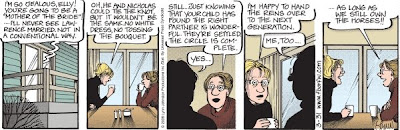
But as creepy as FOOB has been, today’s installment is the creepiest yet:

First, there’s the whole nauseating “My son could get married but it won’t be the same” crap. Uh…yeah, it would, because it would be a wedding. That entire exchange is disgusting. It’s like Lynn Johnston is saying “Yeah, you gays out there can say you’re ‘married’, but it’s all about the ceremony and it’s not the real thing without that.”

But even more disturbing is Ellie’s describing her child’s impending marriage in the words “The circle is complete”. Is Ellie really trying to channel Darth Vader here? Is Lynn Johnston really maintaining that parenthood is about relentlessly steering your children toward a predetermined destination, and only by successfully reaching that goal can one really look back on one’s years of parenting with satisfaction? And that isn’t even bringing up Ellie’s admission in the last panel that she has no intention whatsoever to stop controlling and pushing.

Just a few weeks ago, Ellie’s oldest child, Michael, discovered his grandmother’s wedding dress packed in a crawlspace in the Patterson ancestral home. Wow, wasn’t that a bit of convenient timing! Guess who now gets to wear the dress to her marriage ceremony when she, too, weds her childhood sweetheart! But don’t stop reading, because what if Grandpa doesn’t live that long!

FOOB has become a soap opera, and not even that good a soap opera, either. Oh well, but there’s still time for Lynn Johnston to rectify matters. For instance, she can take her cue from that wonderful 1980s prime-time soap Dynasty, and have the Elizabeth-and-Anthony wedding end the way this Dynasty wedding did:

Yup, that’s the only thing that can save FOOB now: armed commandoes seizing the throne of Moldavia!

Share This Post