Forty years ago tomorrow, I got up to get ready for school. My mother had Good Morning America or Today or one of those on in the living room, which is when I learned of what happened forty years ago today. John Lennon, shot dead in New York City.
It would be many years before I would finally warm up to the Beatles’ music and the enormity of the act of cultural assault that Mark David Chapman committed that day.
One area of classical music I always tell myself I would like to explore, and yet never quite do, is the operas of Nikolai Rimsky Korsakov. NRK was a brilliant orchestrator, a musical colorist who also had a fine gift of melody. His music teems with the sense of exotic color and adventure and emotion; his Scheherazade is one of the enduring works of orchestral magic.
I have read that NRK’s operas constitute a treasure trove of storytelling and music, all based on the legends and fairy tales of Russia. The operas are not often staged, however, mainly because Russian is not one of the more popular languages for singers to learn, which is likely a pity. But we do have orchestral suites derived from NRK’s operas, like this one, from an opera called…Christmas Eve. A light romp, this is not; the story involves a plot by the Devil to steal the moon, and it proceeds from there in what I am sure is delightfully operatic fashion.
This is an orchestral suite derived from the score to Christmas Eve, and if it doesn’t make use of any traditional musical trappings of this season — no jingle bells here! — it nevertheless creates that wonderful sense of NRK’s grand orchestrations and music that is full of rhythmic excitement and emotion.
You know how sometimes a song will have a great tune and a great beat, but when you listen to the lyrics you’re kind of repulsed? For me one great example of this is the first of the 1980s pop music charity hits, “Do They Know It’s Christmastime”, by “Band-Aid”, a super-group made up of a whole lot of big names at the time. The song is basically asking if the starving Africans have any idea that it’s even Christmastime, so awful has their lot become. I’m always thinking, “Why wouldn’t they? They have calendars. Just because they’re dealing with a lot of shit doesn’t mean they don’t know what the date is.” And besides, there are a lot of Christians in Africa too. The whole song always bugs me (and not just for Bono’s lyric, “Well tonight thank God it’s them, instead of you!” Yikes.)
Anyway, yes, they know it’s Christmastime in Africa. Here’s some musical evidence.
So far this year we’ve had about an inch of snow altogether at Casa Jaquandor, and at the moment the grass is green and the woods are brown and everything is wet and muddy. Meteorologically, we just aren’t in the Christmas mood yet.
But anyway, here’s “Sleigh Ride”, in the original orchestral version and the Johnny Mathis version with words, because hey, it’s Buffalo! It’s gotta snow sometime, right? Six years ago we were still digging out from seven feet of the shit!
Anyway, here’s the music.
I wonder if Currier and Ives knew that this song was what would carry their names into the ages….
Oh heck, here’s another version, the short Roy Rogers and Dale Evans version that blends Sleigh Ride with Jingle Bells and if you listen to it you’ll walk around all day humming “Harses harses harses” to yourself. You may remember this version from Sleepless in Seattle, when Meg Ryan sings along with it while driving….
Songwriter Adam Schlesinger died earlier this year. He was one of the first high-profile deaths from the COVID-19 epidemic. He was also one of the brilliant creative geniuses behind the amazing show Crazy Ex Girlfriend, and many of that show’s best songs reflect his creative stamp…including this one.
Here’s “California Christmastime” from Season One of Crazy Ex Girlfriend, one of my favorite shows ever.
British composer Gerald Finzi was not prolific, which can be seen one of two ways: either the world was denied further work of fine quality by his slow process, or his slow process was essential to his work as a composer. Either way, Finzi wrote in a Romantic, English-pastoral vein that reflects influences of Ralph Vaughan Williams. Much of his work is meditative and full of lush harmonies, and his choral writing is outstanding. All of that is on display in In terra pax, one of his last works. Here Finzi combines the text of a poem by Robert Bridges, “Noel: Christmas Eve 1913” with the famous telling of the birth of Jesus from the Gospel of Luke. He gives the words of the poet to a baritone soloist, and the words of the Angel from Luke to a soprano, with the chorus handling the rest. Even though the work starts off hauntingly and quietly, there is drama later on as the dynamic become quite expansive when Luke tells us that the shepherds were “sore afraid”.
Here is the text of the start of Bridges’s poem:
Pax hominibus bonae voluntatis
A frosty Christmas Eve
when the stars were shining
Fared I forth alone
where westward falls the hill,
And from many a village
in the water’d valley
Distant music reach’d me
peals of bells aringing:
The constellated sounds
ran sprinkling on earth’s floor
As the dark vault above
with stars was spangled o’er.
In terra pax is a wonderful choral miniature piece, a masterwork by a composer who isn’t heard enough.
So far, this Christmas season doesn’t seem to be off to the most joyful start, does it? I remember hearing this song quite frequently during the Christmas season, but it doesn’t seem to show up all that often anymore. And in truth, it’s not really strictly a Christmas song at all, is it? It’s set at Christmas, but that’s not the same thing. However, I could say the exact same thing about “Same Old Lang Syne” by Dan Fogelberg, which I feature in this space every single year, and almost certainly will later this year.
So here’s a sad song about a breakup that happens at Christmastime, which is surely among the worst times such a thing can happen…but really, is there a good time? Here’s “River” by Joni Mitchell, performed by the amazing Sarah McLachlan.
And I promise I’ll start posting some actually happy music one of these days.
Well, it’s December 1, do let’s get started with this year’s musical run-up to Christmas, shall we? I know, I know–this ghastly year is more limping toward Christmas than anything else, but there’s nothing we can do about the calendar, and all we really can so is try to find what light we can.
Longtime followers will not be surprised that I’m featuring this particular song, because I do every year…but never on the very first day of December. I usually wait on this one, because it’s not obviously cheery. Lontime followers of mine will also know that I always accompany this song with my objection to the changing of the lyrics, at the behest of Frank Sinatra, that has become pretty well standardized ever since he figured that part of the original lyric wasn’t sufficiently brimming with Holiday cheer. And this year is no different…in fact, if ever a year made the case for keeping the original lyrics, this is the one.
Someday soon we all will be together, if the fates allow; Until then we’ll have to muddle through somehow, So have yourself a merry little Christmas now.
What lyrics could we possibly have this year, when so many of us are unable to be together at Christmastime (or any other time)? “If the fates allow,” indeed…and indeed, all we can do is “muddle through somehow”. That’s all we can ever do, really…but 2020 has made it manifest.
So let’s enter December, trying to find what hope we may…even as we muddle through somehow.
And if you didn’t get to hear your personal favorite Christmas carol in this feature this season, I apologize…but here’s an entire album that covers almost the entire gamut. This is one of the great Christmas music recordings of all time: The Many Moods of Christmas, featuring the Atlanta Symphony Orchestra and the Robert Shaw Chorale, conducted by Robert Shaw. Interestingly, the digital Atlanta Symphony recording was a follow-up to a 1963 recording of mostly the same music, also featuring Robert Shaw and his Chorale (but back then with the RCA Victor Symphony Orchestra). Enjoy, and may each and every one of you enjoy the very happiest of holidays!!!
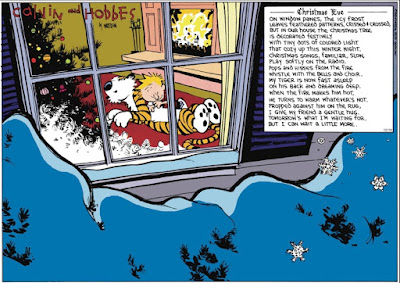
As Christmas nears each year, eventually the boisterous jollity of the season fades and the need for silence rises, and as we all adjourn from our daily lives to the sequestered comfort of our home (or, at least, so we hope), we look inward. I know that I do as the outside world fades away. I think this sentiment was captured wonderfully by Bill Watterson in this one-panel installment of Calvin and Hobbes:
Musically, this brings me to Silent Night, one of the most magical of all Christmas carols. It was written in 1818 by Franz Xaver Gruber, who was given the words by a local priest who needed a Christmas carol that could be accompanied by guitar as the organ in his church had been damaged by flooding. What resulted is one of the most enduring of all Western songs.
What makes Silent Night so effective? Well, the lyrics are quite wonderful and evocative, painting word-pictures of the miracle taking place in Bethlehem and exhorting us to sleep in peace before we wake to the new dawn, heralded by the birth of God’s son. But it’s not just the words. Those lyrics are wedded to a melody that almost perfectly captures the song’s dual themes of restful peace in the face of a transcendent miracle. Silent Night combines falling intervals, especially the minor third which seems to eternally connote motherhood and the protection of rest at home, with upward leaps and climbs that musically challenge us to see the light dawning in that manger. That’s how I see it, anyway. Just the way the tune of Silent Night unfolds speaks to something primal, something hard-wired in us.