Visual Surveillance of Extremities

That phrase will be familiar to anyone who has read Stephen R. Donaldson’s Chronicles of Thomas Covenant the Unbeliever, a series which was an absolute favorite of mine when I was younger but which I haven’t read in years. (I stared a re-read sometime in the early years of this blog, but never finished got beyond the first book, for no reason that I recall — I still liked the first book.) Donaldson is presently writing the third Covenant series, this one a tetralogy, which I intend to read at some point. SF Signal has an interesting interview with Donaldson, which includes this bit about process:

First, I’m a person who has to concentrate-and concentrate exclusively-in order to accomplish anything. And second, I’m not a “facile” writer: I write slowly, with much sturm-und-drang. So I knew from the start that I can’t afford to just grab time when I can, or to wait for inspiration to strike. I have to make steady progress every day, or I’m doomed. (A music critic named Newman said of Beethoven, “Great composers do not compose because they are inspired. They become inspired because they are composing.” I don’t claim to be a great writer-how would I know?-but that’s one of my mottos.) And soon after I got going on Lord Foul’s Bane, I learned another crucial lesson: I have to pace myself. If I write as much as humanly possible one day, I’ll probably find myself too stunned to write anything the next. So I developed an approach which has served me well ever since: I’m in my office 8 to noon and 1 to 5 five days a week; I always quit at quitting time, no matter how I’m writing; and I never (well, almost never) work in the evenings, or on the weekends, or on holidays, or on vacation. This enables me to keep going day in and day out, week after week, month after month, until the first draft is complete. (Revision presents a different set of challenges, but I approach it in the same way.)

For some reason I’m always interested to read about writers’ processes.

Share This Post

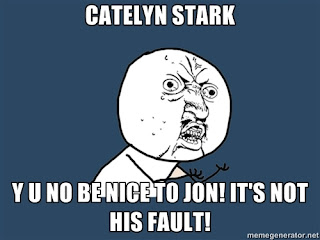
“You know nothing, Jon Snow.”

I have now completed A Storm of Swords, being the third book in George RR Martin’s A Song of Ice and Fire. Perhaps undertaking this re-read in so short a time frame was not wise, because as I feared (and as I remember from when I read this book the first time), the feeling of the book stops being immersion in a big and fascinating world, and starts being a feeling of being worn down under a tremendous weight. And if that’s what it’s like to read it, I can only imagine what it’s like for GRRM to write it. No wonder he’s been having trouble.

My reaction to Storm is almost schizophrenic, so much so that I can barely determine where to begin. There is an awful lot of good stuff in this book, and there’s some stuff that is indisputably great. There’s also some stuff that’s meh, and a bit of stuff that downright irritated me. But the overall impression is just unrelenting hugeness. Once again I am drawn to my soap opera metaphor for these books. Aside from a very few moments, I get almost no sense that there’s a story that’s being set up here. I get very little sense of forward momentum from the events of this book. What I get is just a series of events that affect all others, because everyone knows everyone else and lives have that pesky way of crossing. A good read? Absolutely. A fascinating world? Certainly. Interesting characters, both sympathetic and not? Indubitably. A story, though? Well…I’m just not sure.

Part of my problem with Storm is that it’s simply too long. I’m sorry, but it just is. I’m not sure what the remedy for that might be, since a strategy of cutting the book in two didn’t seem to work out as well as GRRM thought it might for the book immediately following. I’m not sure where the thing should have been cut, but there’s just so much that goes on. That sounds whiny, probably, but I can’t deny it. Over the course of nearly a thousand pages, most of the characters only manage to move no more than, say, fifty miles. Some go in circles. Some are captured, escape, and are recaptured again. Some make fairly improbable acquaintances along the way. Some characters from the last two books simply drop off the radar screen entirely. And yes, some die.

I am starting to conclude that GRRM is creating a story that is simply too big, if he’s even creating a story at all. At this point, it wouldn’t surprise me much to eventually learn that there is no ending to the series, no climax we’re building to, and that what GRRM simply intends is to just create a series of massive books set in a fantasy realm that just details some marches of some people’s lives. Maybe I’m wrong…and on balance, I suspect I am, because there are a few precious hints of a larger story to emerge in Storm…but it wouldn’t totally surprise me. If I’m correct, the actual main story is the threat that’s taking shape in the North while everyone else is fighting for thrones. But then, what part in that story for each and every one of these characters? I just don’t know.

I liked the book. Loved it, even. But I can’t deny that there were times when reading it felt like a slog, and not because of any deficiency with the prose – never that, because GRRM can damn well put the words together – but because it’s just so big. I’m trying to come up with a metaphor here…maybe trying to have a perfect vacation to Disney World when you know you’re only going to be there one day? Nah, that doesn’t work…I’m not sure, I guess. But I can’t get over the feeling with this series that it’s not unlike that third slice of cake, the one that’s just as good as the first two, technically speaking, but just isn’t satisfying because by now it’s just too much.

More random spoiler-iffic thoughts after the break….

:: After two books, I was of the opinion that GRRM’s best characters were Tyrion, Jon Snow, Arya Stark, and Daenerys Targeryen. I have not changed that opinion, but I do add to the list: what he did with Jaime Lannister in this book is amazing. I remember that before I read this book the first time, years ago, someone on a newsgroup said that Jaime is portrayed sympathetically here, and I scoffed at that, thinking that he was a loathsome character. What strikes me now is that Jaime actually isn’t in A Game of Thrones or A Clash of Kings much at all, so Storm is the first time we really get to know him. He’s arrogant, regal, incestuous, and he attempted to kill a child. He’s also torn in a number of directions, he is driven by a love of his sister that’s creepy but for which he refuses to apologize, and he knows that forever he will be tarnished by the fact that he killed the last Targaryen King. Jaime Lannister is a fascinating, fascinating character – and he was shaping up to be so even before he got his sword hand chopped off.

:: This was apparently the book where GRRM decided that it was time to drag Tyrion through the mud. Nothing good happens to him at all in this book, until the very end, when Varys shows him the way out of the Red Keep. Tyrion goes from acting Hand of the King in the previous book to an afterthought for everyone in this one; he doesn’t even get any credit at all for his efforts in the Battle of the Blackwater, in which his side defeated Stannis Baratheon. All the credit, it seems, goes to Lord Tywin Lannister, who arrived just in the nick of time. Eventually Tyrion is forced to marry Sansa Stark, who refuses his touch; it’s to his credit that he likewise refuses to force his touch upon her. The poor dwarf is even blamed for the death of King Joffrey, after he figures out that it was Joffrey who sent the brigand to try to finish the job of killing Bran Stark back in the first book.

Tyrion does get his moment in the sun, though – oh, does he ever. In his final confrontation with his father, Tyrion extracts the information he wants, and then he kills Lord Tywin Lannister by shooting him in the crotch with a crossbow while the Lord is having his morning constitutional. It’s one of the most memorable scenes in the book, and Tyrion’s last exchange with his father is terrific:

…”You shot me,” he [Tywin Lannister] said incredulously, his eyes glassy with shock.

“You always were quick to grasp a situation, my lord,” Tyrion said. “That must be why you’re the Hand of the King.”

“You…you are no…no son of mine.”

“Now that’s where you’re wrong, Father. Why, I believe I’m you writ small. Do me a kindness now, and die quickly. I have a ship to catch.”

That’s great stuff.

::  This book nails down some of the outstanding mysteries from the first couple of books. In addition to revealing that Joffrey is behind the brigand’s attack on Bran, we also finally learn who really killed Jon Arryn,  where Robert was getting his information on Daenerys, and Tyrion learns some things about the woman he first loved.

:: GRRM sometimes writes dialogue that is so good it makes me want to cleave my laptop in two with a sword of Valyrian steel. Tyrion gets off the best insult, when he refers to Joffrey as “His Grace, the Royal pustule”.

:: I can’t figure out Sandor Clegane for the life of me. Am I supposed to hate him? Because I don’t. Am I supposed to like him? Because I don’t. And given the rest of the people in these books, that might well be what GRRM intended after all. It interests me that Arya Stark owes him her life. Will she realize it, one day?

:: Sansa Stark continues to impress me on this re-read. She’s still much more reactive than active, but there’s got to be a big moment coming for her, at some point. People around her come and go, people around her come to battle and live and die, and yet…Sansa just keeps on enduring.

:: Daenerys Targaryen’s story continues to be one of the best things about this series. In Storm she becomes a full-blown conqueror, securing an army of creepy eunuch warriors called the Unsullied, in a pretty amazing moment when she agrees to terms whereby she gets the warriors in exchange for one of her three dragons. She quickly turns the tables, though, and winds up keeping her dragon and the warriors. I like how she conquers city after city, but has increasing doubts about this activity, until she decides that she will be Queen to the city she’s just sacked, proving herself as a ruler instead of just leaving a series of wrecked cities behind her.

Her rejection of Ser Jorah Mormont at the end of the book is interesting, and there’s no way this doesn’t come back to haunt her in some way. Will Mormont try to prove himself to her? Or will he act in a way that’s more consistent with what he’s been before, and try to get revenge upon her? He’s a mildly interesting character, harboring doomed love for Daenerys, but also having sold information about her to the powers of Westeros for a time after escaping, way back in the first book.

:: Jon Snow’s tale was mostly intriguing, although it gets a little much, having this many characters in the book who have lost their first loves. As the book ends, though, he’s been voted Lord Commander of the Night’s Watch – just after Stannis Baratheon has offered him Winterfell. Hmmmm. Stannis isn’t a guy who likes to hear the word no. I really liked his relationship with Ygritte, and the way she kept saying “You know nothing, Jon Snow.” I suspect Jon will have a heavy emotional burden to bear in the future; I’m not sure he’s really realized what his feelings for her even were.

:: Bran is still wandering around the wilderness with his two saviors and he is still a shapechanger or something. Bran’s story is Exhibit A for this book not really going anywhere. As the book ends, he and his friends are now going north of the Wall.

:: Samwell Tarly’s continued insistence that he’s craven is starting to get a little old. He’s a bit like Sansa Stark, but with the lack of self-confidence dialed up to 11. The guy killed a zombie with an obsidian dagger, for God’s sake…and he still thinks he’s a coward!

:: By the way, who is ‘Coldhands’, the mysterious elk-riding figure who saves Sam and Gilly, and who takes Bran and friends north? I’m guessing that he’s what’s left of the long-missing Benjen Stark, but I suppose we’ll find out. Maybe. This is GRRM we’re talking about.

:: After lots of Theon Greyjoy in Clash, he doesn’t appear at all in Storm. Good. He’s a crappy character.

:: Lord Tywin Lannister is kind of an odd case. He’s a really good villain, and he’s fairly complex – the Lannister version of Stannis Baratheon, every bit as unbending – but GRRM tosses him aside when Tyrion kills him. And no, I wouldn’t trade that moment…but to paraphrase Captain Renault in Casablanca, “How extravagant you are, throwing villains away like that. Someday they may become scarce.” I like how Tywin dies thinking that his sons have both utterly failed him. That’s probably the ultimate punishment for a man like him.

:: It’s hard to read the Catelyn chapters with any degree of interest when one knows that the Red Wedding is to come. Still, I didn’t recall the hints about resurrection from the dead from my earlier re-read, although I certainly remembered Lady Catelyn being, well, only ‘mostly dead’, I suppose, at the end of the book. I confess that I didn’t pay a great deal of attention to those chapters, except to get the main gist of them. I still don’t understand why Robb Stark has bothered trying to be King in the North in the first place. Seems to me that he’d have been better served to throw his lot in with Stannis Baratheon in the first place; I suspect that’s what Ned Stark might have done, anyway, especially once the rumor got out that Joffrey isn’t Robert’s son in the first place. And marrying some other girl after he’s already pledged to marry the daughter of the notably temperamental Lord Frey? That’s just about as stupid a thing to do as Ned’s “Now Cersei, I think you should pack up and leave now” bit from Game. I suppose doing dumb stuff runs in the Stark blood?

:: Speaking of Starks, I wonder whatever became of Rickon? It would be funny if he doesn’t show up until the very last page of the very last book, wondering what he missed.

:: Of course, I remembered the Red Wedding; it’s one of the book’s major events. I also remembered the death of Balon Greyjoy and the sad passing of Joffrey. What I did not remember was that their deaths seem to have been magically caused by Stannis and his spiritual counselor, Melisandre. When I read that scene, my jaw dropped. Really. I read that in the middle of my break at work one day, and I said right out loud, “Oh my God!”

:: Brienne of Tarth is certainly interesting, but I just don’t have a whole lot to say about her yet. She hasn’t developed much, and I can’t tell if GRRM is trying to develop some kind of love-thing between her and Jaime.

:: I continue to hate the sex stuff in these books. Do we really need Jaime and Cersei making love on the altar of the church? Do we really need Daenerys figuring out how to masturbate? Do we really need continued scenes in which GRRM’s men probe the ‘secret sweetnesses’ of the women? I hate this stuff. Ugh.

:: Last thing: there’s really not a lot of comic relief in these books. Tyrion occasionally says something really funny, but other than that, the only real consistently funny individual in these books is Dolorous Edd of the Night’s Watch. Whenever he shows up, read closely, because he’ll say something fatalistic and very funny. Yup, I love me some Dolorous Edd! I hope he survives the series.

OK, that’s it for this one…but see what I mean? All that stuff I comment on…and I don’t even comment on a lot of stuff in the book. Anyway, only two books remain…next up, Michael Chabon’s Summerland, and then back to Ice and Fire with A Feast for Crows.

Share This Post

Return to Kitai

Those who have have followed the career of Guy Gavriel Kay long enough know that, since his last book came out just about two years ago, this is roughly when drips and drabs of information about his next book should start showing up. And, right on cue, we get some details. GGK is returning to Kitai, the fantastical medieval China which was the setting of the brilliant Under Heaven!

Guy Gavriel Kay’s new novel is once more inspired by Chinese history, this time during the Song Dynasty, almost four centuries after the story told in his bestselling Under Heaven. The dazzling elements of the Song – cultural brilliance, vicious political rivalries, warfare against nomadic peoples, court mandarins versus the military – are rich ground for Kay’s unique blending of fantasy and themes of history. Vivid among a large cast, a young man with a dream of regaining the empire’s lost ‘rivers and mountains’ and a brilliant woman trying to shape a space for herself outside the ‘inner quarters’, where women are expected to live out their lives, confront the challenges and dangers of a world in turmoil. The Song Dynasty’s legacy is prominent in the way Westerners imagine Chinese history to this day and Kay weaves a story that captivates on both an epic scale and within the intimate lives of his characters.

Apparently this book is due in 2013. It’ll be a long year! (But that will give me time to re-read the GGK books I have, as yet, not re-read: Last Light of the Sun, Ysabel, and Under Heaven.)

Share This Post

"Valar morghulis."


Tyrion, yay!, originally uploaded by Jaquandor.

So, I have now knocked off two books in George RR Martin’s A Song of Ice and Fire series. I remember A Clash of Kings as being nearly the equal of A Game of Thrones; this time out, the book impressed me ever more than I remember it doing the first time out. This could be because I know what’s coming; middle acts tend to look better once the acts that follow are in place, so that more of the structure can be seen. I don’t think that The Empire Strikes Back‘s lofty reputation began to set until after Return of the Jedi arrived, and not because the former is clearly superior to the latter, but because once the third act is out, one can see just where the second act was going. So it might well be with Clash.

In this book, the smoldering tinderbox that was Westeros in the first book explodes outright into two separate wars. Or three. Or four, come to that, depending on how one counts them. Now, instead of great Houses jockeying for position under a single King, we have four different Kings, each looking to lay claim to the realm (or a big chunk of it). In addition to them, there’s a fifth King on a crappy, rocky island looking to strike while everyone else is looking the other way, and there’s the Queen Across the Sea, Daenerys Targaryen, who is still looking to put together an army that she can bring back across the sea and claim the Iron Throne herself. It’s a heady mix.

Clash pretty much picks up right where Game left off, so we are brought up to speed on what happens to our favorite and not-so-favorite characters along the way. Arya Stark has fallen in with an officer of the Night’s Watch who has come to King’s Landing on a recruiting mission. (‘Recruiting’ for the Night’s Watch is a pretty generous word, given the dregs of society that tends to go up there.) Sansa Stark is still a virtual prisoner of the Lannisters and is still betrothed to King Joffrey, who is still Exhibit A in Why We Don’t Let Teenagers Be Heads Of State Anymore. Robb Stark is still trying to act the King in the North, with his mother’s help. Jon Snow is still on the Wall, getting ready to journey with his fellow Brothers in Black on a mission to see just what strange doings are afoot in the far frozen north. And of course, there’s Tyrion Lannister, who is sent by Lord Tywin Lannister to serve as Acting Hand of the King, which means that most of the statecraft and strategic planning in the book falls to him.

The ongoing theme continues to be the way that the people best suited for various jobs are not allowed to hold those jobs, simply because of bloodlines or sex. Tyrion has a clear gift for governing a Kingdom, but he can only do so as the Acting Hand of the King, because no one trusts a dwarf to run much of anything at all.

The ‘soap opera’ structure of the books continues to be in full effect, right down to either being excited or disappointed by the name at the head of each chapter, indicating who our viewpoint is to be for a while. This structure also helps keep the pages turning, as it’s not hard to finish one Arya chapter and then say, “Well, I’ll just keep going until the next Arya chapter.” This also means suffering through some chapters that aren’t terribly compelling, because I don’t like the characters on whom they focus. Through the next two books, I have zero recollection of what, if anything, happens to Theon Greyjoy…but damn, I hope he dies. Hate that guy.

Some random thoughts:

:: Martin is not tipping his hand at all as to whether Benjen Stark is still alive or not. And very little mention of the Others, although we saw them in the very first pages of the first book. This is taking a lllooonnnggg time to develop.

:: Martin’s writing of sex scenes is a bit too graphic for my tastes. I honestly did not need to read about Tyrion’s probing of Shae’s “secret sweetness” to the point where his beard was drenched.

:: Tyrion seems awfully prescient about how the river battle is going to go, as he starts getting things ready for it hundreds of pages before it happens. This is incredibly effective, though, as the actual battle unfolds; we follow Davos Seaworth into battle and we know that he is troubled by a gnawing certainty that he is sailing into a whole lot of shit, but he can’t put a finger on it.

:: I tended, while reading, to wonder just what it was about the Baratheons that inspires such loyalty, because frankly, they’re all jerk-offs. Robert was a drunken sot who ripped a kingdom apart because of a girl; Stannis is so busy being offended by the speck in his brother’s eye that he never notices the plank up his own ass; and Renly is just a lightweight who has no real justification for his claim to the throne outside of “Because I wanna!”. Why do so many people follow these guys? I wouldn’t follow them into 7-11 if I really had to use the bathroom.

:: Bran Stark seems to have some kind of lycanthropy thing going on, and Arya is entranced by one guy’s ability to change his face. I assume these threads will come to interesting ends at some point.

:: I’d forgotten about Brienne of Tarth, and what a tragic figure she is. It’s clear that Martin has gone out of his way with her to create a character who has zero place, anywhere, in his universe.

Next up is A Storm of Swords, which I recall as being where, for me, some of the luster on this series started to diminish. We’ll see.

Share This Post

“Dark wings, dark words.”

One down, four to go: I finished re-reading A Game of Thrones the other night. As noted the other day, I’m going to read something else before returning to Westeros (and the lands beyond the Narrow Sea) for A Clash of Kings. (What book will that be? I wonder!)

So…what do I make of A Game of Thrones?

As I’ve noted a number of times, my overall impression of the series is that it starts off very strong and gets less good with each book. I’ll need to read the others before I can verify whether this is the case or not, but for now, my original view is somewhat confirmed: A Game of Thrones is a very strong book, indeed. But it’s also a changed one when one knows what’s coming. The moments that were clearly designed to shock no longer do so, and instead, I find myself being more attentive to George RR Martin’s story architecture than simply being swept along in the momentum of his narrative. The question I kept asking myself during this re-read is simply this: What is this story about?

I don’t mean this as a criticism, but I once compared A Song of Ice and Fire to a soap opera, and I have to admit that I’m standing by that comparison. All the trappings of soap operas are here: families with long-standing enmities between them, members within the families who are both honorable and complete louses, threats from within and from without, et cetera and so forth. I don’t mean it a criticism when I say that often A Song of Ice and Fire feels to me like General Hospital with swords and dragons.

I’m also intrigued that the series, by its very nature and structure, seems to have absolutely no protagonist. Instead, we have the very soap opera-ish conceit that every person is the protagonist in their own story. And besides, protagonists are overrated, anyway.

So, to return to the question: what is A Song of Ice and Fire about? Well, given that we’ve got a story that currently stands at somewhere around 5000 pages in length, it’s not going to be about a single thing, is it? It’s about a lot of things. Here are some of them:

:: A Song of Ice and Fire is about the passing of conflict from one generation to the next. Every family depicted here has a history of not much liking the other families, and every family is depicted in multiple generations. Every conflict, it seems, is handed down to the kids to deal with. Especially the Starks versus the Lannisters.

:: A Song of Ice and Fire is even more about the demands and expectations placed upon children by their parents. If there’s one dominant recurring motif in A Game of Thrones, this is it. How is it that the child of Eddard Stark who so seemingly manifests his father’s honorable qualities is Jon, the bastard he sired outside of his marriage (and whose mother he refuses to discuss…now there‘s a plotline that’s certainly not a dangling thread!)? Arya, too, seems to be cut from the block of Ned…but she’s a girl, so it matters little, and by book’s end, Arya’s been used as a marriage pawn to buy an alliance, even though she’s not even present to know about it. Then there is Tyrion Lannister, the misshapen dwarf who is loathed by his father and only allowed to be useful when preferred older brother Jaime is out of the picture. And let’s not forget Samwell Tarly, who was so hated by his father that he was given the choice of either joining the Night’s Watch or find himself the victim of an unfortunate ‘accident’. Yeesh, indeed.

And then there’s young Robert Arryn, who is still breastfeeding at six years of age. He actually isn’t falling short of his parents’ expectations, as father Jon is dead and mother Lysa is something of a protective lunatic.

It interests me that of all the characters in the book, the ones I like the most are the ones who are children whose success in things will depend greatly on their abilities to outstrip the expectations placed upon them by their fathers and by their world. Here I’m talking about Jon, Arya, Tyrion, Daenerys, and good old Samwell Tarly.

:: A Song of Ice and Fire is about great, vast, huge, oceanic amounts of suffering caused by people in power who care about two things, and two things only: Keeping their power, and avenging personal slights. That’s it. What motivates Robert Baratheon to muster an army and ride to war against the reigning Targaryen dynasty? A personal slight. What motivates all of Cersei Lannister’s scheming against King Robert? A personal slight. What motivates Viserys and Daenerys? Nothing more than the desire to get back the throne that was stolen from their family.

The only characters not motivated by some kind of personal slight or out of a desire for personal power seem to be the Starks themselves — all they want is to get everything nice and peaceable again so they can all go back to living in Winterfell, far away from all the various intrigues and dark things going on – and the men of the Night’s Watch up on the Wall, who are on guard against whatever very dark things there are that live in the icy, frozen North. There’s a real sense in which only the men of the Night’s Watch are concerned with the survival and protection of the entire realm of the Seven Kingdoms.

So, A Song of Ice and Fire is about suffering, and hereditary conflict, and grown-ups who drag their children into their conflicts and saddle them with all the issues that come from expectations, both unfulfilled and those that are impossible to fulfill. What a good thing that Martin is a fine writer with a gift for often sparkling dialogue, because otherwise, this would be an insanely depressing series to try to get through. Even as it is, an awful lot of depressing stuff happens. We’re talking about a book that in the first hundred-fifty pages has one kid getting pushed out a tower window when he saw something he shouldn’t have, another kid basically getting forced to go join the Night’s Watch (a lifetime commitment of hardship) because he’s not wanted around by his step-mother, and another innocent kid getting sucked into her sister’s mischief and having her pet wolf killed because of it. Heavens.

I mention above that I noticed more of Martin’s story architecture on this re-read, and it surprises me to see that some of the plot developments that shocked me the first time seem almost contrived the second time. Cersei’s manipulation of Robert into ordering the murder of Sansa’s pet direwolf is a good example. The first time I read this, I remember being viscerally surprised by this, and it certainly went a long way to cementing a hatred of Cersei as a character. But this time, I don’t know…it just felt forced to me, as if Martin felt a need to really get the audience firmly on the anti-Cersei side of the fence.

Ditto a bit later on, when Ned Stark decides that he’s had enough of being King Robert’s Hand, resigns the position, and makes arrangements to leave King’s Landing. Problem is he’s attacked that night by Jaime Lannister and his men – for something his wife has done – and he’s injured, this forcing him to stick around, so that the rest of the plot can unfold. There are more such false-feeling moments in the book, where it seems as though Martin is simply providing plot-related reasons as to why characters can’t do the very obvious thing.

A special note about Ned Stark: he’s a deeply likeable, deeply honorable man. And yet, he’s a complete idiot whose time in King’s Landing is marked by one mistake after another. This is a guy who places his trust in another guy who is well-known for being somewhat slithery as an individual, was once notably in love with Ned’s wife, and who specifically tells Ned, “You don’t want to trust me.” Ned carries on an open investigation as to why Jon Arryn was killed, not bothering in the least to cover his tracks or look like he’s not investigating; and when he discovers the reason, he tells the guilty party about it and leaves it up to them as to what to do! This, obviously, goes exceedingly poorly; so poorly does it go, in fact, that it quite frankly makes Ned Stark the dumbest blockhead in the entire book. Who else can compete? Well, there’s Robert Baratheon, who is an awful King; seriously, folks, when a King cuts off virtually every discussion of some matter of statecraft with something like “Enough of this, let’s go hunting/whoring/have a tournament!”, you’re not dealing with a good King.

Joffrey? He’s a brutal bully, and that’s all. He’s stupid as a post and acts with no agency of his own…but then, he’s not really supposed to. Cersei? She’s a very lethal blend of stupid and shrewd, able to play Ned and Sansa like cheap violins but also sanctioning governing decisions after Robert’s death that even her own family members judge to be awful notions. Sansa?

Ah, now Sansa is a special case. I remember hating her when I first read the book, but this time through, I didn’t dislike her nearly as much. Again, part of this is probably sympathy from knowing just how disastrous her dream-life is about to become, but also, it’s partly because I can understand her blissful naivete. The only thing I’m not sure of is how her blissful naivete even exists in the first place; Winterfell does not strike me as a place conducive to the raising of children who harbor deep illusions about the coldness of the world. No, I don’t dislike Sansa now nearly as much as I did.

But Catelyn? Not nearly as fond of her now as I remember being. I find her attitude toward Jon to be deeply ugly, and her indulgence of her instincts as soon as Tyrion practically drops into her lap is the event that pretty much causes the entire state of the world to ride off the rails. True, she does come to her senses later on, but after the damage is done. I remember Catelyn as being more likeable than she came off on this re-read. Maybe I’m misremembering, though. Catelyn is one of the book’s most three-dimensional characters, though.

I’ve heard praise of the worldbuilding of A Song of Ice and Fire for years, but to be honest, I just don’t see it. Westeros is your basic northern European-style realm, with frozen wastes to the north, warmer climes to the south, important strongholds in various places, lands that are often trampled by war, et cetera and so forth. No mechanism at all is posited to explain seasons of varying length, magic and religion exist but aren’t explained much at all, and so on. No, the strength of A Song of Ice and Fire is not in the worldbuilding; it’s in the people that inhabit it. And I’m fine with that. I’m also fine with all the foreshadowing that goes on, and the fact that knowing a lot of what comes, I can see now how Martin sets a lot of it up. Now, I rather doubt that Martin really plans for what seems like a throwaway detail in Game of Thrones to come back as a fairly major point in, say, A Storm of Swords; but it’s to his credit that he clearly knows his world and the history he’s creating enough to be able to use stuff he’s done earlier to good effect later. Even with things like the afore-mentioned plot contrivances, I never get a feeling of Martin not being in control. (This, I fear, is yet to come.)

Next up, obviously, will be A Clash of Kings. After I read Nine Princes in Amber by Roger Zelazny (and a few graphic novels, to be determined).

Share This Post

A Pile of Doorstops?

A Pile of Doorstops

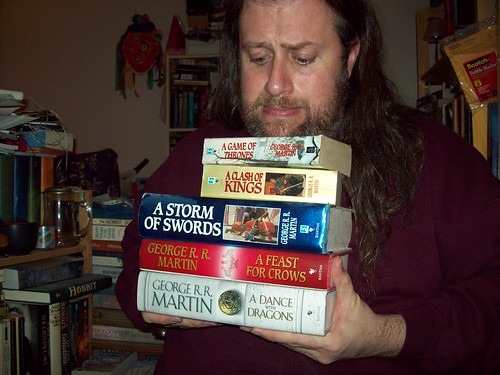
So this year I’m re-reading all of George RR Martin’s A Song of Ice and Fire (which, when I piled all the books in my arms, I realized should be retitled A Dirge of Back Pain and Eye Strain). I’ve been meaning to do this for a while, and I figure with A Dance with Dragons sitting on my shelf still un-read, it’s time to take the whole series on again. A big reason for this is the long time it took Martin to get this last book out; it’s been so long that I simply don’t remember a lot of the finer details of the series, so I think I might miss out on something if I don’t do the refresher work. I remember reading A Game of Thrones for the first time way back when we’d first moved into our very first apartment in Buffalo, which would have been late 2000, so it’s nearly twelve years since I read that one; a similar period. Wow, this series has been going on for a long time!

I’m reading Game of Thrones right now, actually, and just last night passed the halfway mark. As readable as these books are — the first two, at least — they’re so long that reaching halfway feels like an accomplishment. These are the kinds of books where you sit down, read fifty or sixty pages, and not really feel all that much closer to the end. It takes a lot of reading before the part of the book in my right hand starts to feel noticeably smaller, you know?

I will, of course, post thoughts on each book as I finish them. It’s interesting to me right now, though, that my favorite characters are still my favorite characters, and also that a few characters I didn’t like so much the first time through are more palatable now, which I suppose is partly because I have some idea of where their respective stories are going. I’m also keenly interested to see how my impressions of the books stand up: my recollection is that there is a distinct diminishing of returns with each successive novel; Game is great, Clash is really good, Storm starts to verge on the reading equivalent of sensory overload, and Feast is pretty much of a slog. Is this the way of it? We’ll find out!

Oh, and I’m not re-reading all this straight through. No, I’ll be alternating these books with something else each time. I really don’t want to spend that long of an uninterrupted time in Westeros. That way, madness lies! But anyway, that’s what’s happening. Winter is coming; dark wings, dark words; A Lannister always pays his debts; yada yada yada!

Share This Post

Avada….

And, just like that, Harry Potter is over.

I’d like to think that we’re not done with him, actually. JK Rowling is still on the young side, and she should have many years ahead of her. I wouldn’t mind at all if, maybe ten years from now, she decides to take up the pen again and let us in on what happens now. Maybe Hogwarts: The Next Generation. I posed this question on Facebook a bit ago, and one person said, “What’s wrong with having a story finished?” And I’m thinking, Was this Harry’s only story? The kid’s only in his 40s when the first story ends!

But anyway, about the movie of Deathly Hallows, or more specifically, part II of the movie of Deathly Hallows. I don’t think that a single bad film was made out of the entire lot of the Potter films — Chamber of Secrets comes closest, and even it is quite entertaining and watchable, even if it doesn’t really do a single thing to expand on the cinematic Potterverse from Sorceror’s Stone — and this one is, like all the others, quite fine indeed. No, it’s not perfect; none of them are. But they get a lot right in this one – just about everything they need to get right, actually.

It’s an odd thing, how the Harry Potter franchise has ended twice. First the books were all out, but the arrival of that final book – even though it finished the story and told us all that happened – didn’t really have that feeling of ending, precisely because we knew, at the time, that there were still three movies (which turned out to be four, what with the split of Deathly Hallows in two) to come. And sure enough, the real feeling of an ending, of an era closing, of Harry Potter now joining the ranks of things that are complete is here now, with this final movie.

When I discovered Harry Potter, there were just two books, but Prisoner of Azkaban came out shortly thereafter. This was in 1998 or 1999 or so. The movies didn’t start coming out until 2001. At the time I was skeptical that the filmmakers would be able to make all the books with primarily the same cast; I figured at least one of the major characters would have to be recast at some point in the line, but as it happened, the only one that had to be recast was Dumbledore, and that was because Richard Harris passed away after Chamber of Secrets.

I actually don’t have a great deal to say about Deathly Hallows part two — just some random notes, really. I thought it a wonderful close to the series in general.

:: I’m hard-pressed to think of a single weak link in the entire cast of this entire series of movies. I particularly admire Michael Gambon’s work as Albus Dumbledore, though. I’ve read some critiques of his interpretation of Dumbledore, but what he’s always managed to capture for me is the sense of distance that surrounds the character. In the books, even though Dumbledore often comes off as a kindly old man, there is always the hint of many things going on underneath his surface and that he has thoughts which are forever off-limits to Harry and friends. There’s an air of mystery that always surrounds Dumbledore that Gambon very ably captures. It would have been too easy for Gambon to play Dumbledore as “Gandalf the Second”, but to his credit, he never did.

:: Maggie Smith has been in great need of a real moment in these films, ever since the first one. And boy howdy, did she get one.

:: If ever they needed a partial reason to muddle with the script a bit and deviate from the books, the first ten minutes or so was probably it. Part One of Deathly Hallows ended on a perfect break point, but it left a less-than-enthralling starting point for Part Two. The plot gets boiling quickly enough, but there’s a bit of talking at the beginning that keeps the pacing down a bit.

:: Our Big Three – Daniel Radcliffe, Rupert Grint, and Emma Watson – have really grown well over the course of these films. They’ve developed finely as actors, and the series frankly would not work at all if they hadn’t. Grint and Watson shine as they come together finally as a couple, and Radcliffe? He just takes over. He really does. His Harry Potter in this movie (and in the previous half) is finally coming of age as a Wizard, and Radcliffe nails that portrayal, right down to his sad but serene acceptance that he must go to what he thinks is his own death.

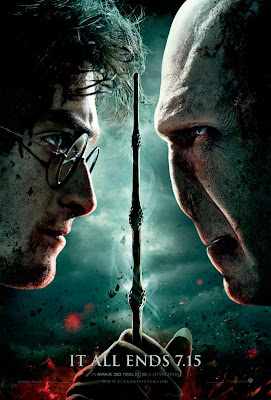
:: I love Ralph Fiennes as Voldemort. I really do. Until now he has played Voldemort in a quietly menacing way, but then, when his victory seems utterly at hand, he begins to mug and preen and gloat and allow his overconfidence to show. It’s really quite superb, and I think Voldemort will be remembered well in the annals of movie villains.

:: And then there’s Alan Rickman, who finally gets his payoff as Severus Snape. He’s just a great, great actor. He truly is. His resignation when he knows that death is less than a minute away, and his willingness to at last show emotions to Harry Potter that he has kept tightly in control for all these years, is terribly heartbreaking. “Take them,” he says, referring to his own tears; and, of course, his last reminder to Harry that he has his mother’s eyes. The only thing missing – and it’s more JK Rowling’s problem than anyone’s with the film – is insight into just how Snape was able to keep hold of himself during all the years he had to do awful things on little more assurance than Dumbledore’s faith in him.

:: OK, the very last battle between Harry and Voldemort? I can’t quite make up my mind about it. It’s filmed wonderfully, but it’s done very differently in the book, where Harry and Voldemort circle each other, talking, before the final bit of magic comes. Harry’s explanation as to why the Elder Wand won’t kill him no matter who commands it to? In the book, Harry says that to Voldemort before the end, and it creates terrific suspense: Is Harry right, or is he wrong? In the movie, though, we don’t learn this until afterwards, and to me it felt like the wrong time to do it. Even if David Yates was going to save the explanation for afterwards, there still should have been a line for Harry, something like “The Elder Wand will never kill me, Tom Riddle. And you’re too blind and twisted to figure out why.”

I also loved how, in the book, that final confrontation comes as everyone – the entire cast that isn’t dead by that point – is gathered round to watch. Everyone sees what happens, everyone hears it. In the movie, Harry and Voldemort have their final moment alone, unwitnessed by everyone (except Ron and Hermione). But then, I loved Harry’s “Let’s finish this as we started – together!” before he grabs Voldemort and jumps off the tower. And I loved how Voldemort’s demise was depicted – no sudden flash of death, but his screaming as his body suddenly and slowly fragmented into ash that fluttered away in the breeze. It was a very striking moment. The problem was that there wasn’t enough build-up to it, so when Voldemort started to disintegrate, I was thinking, “Wait, that’s it? Harry beat him already?” At the very least, those last two dueling spells should have been shouted out, as they were in the book, with Voldemort’s Avada kedavra meeting Harry’s Expelliarmus head-on.

So on one hand, it bugged me that Harry never explained to Voldemort just why the Elder Wand wouldn’t work for him. But on the other, how great is it that Hermione asked Harry why the Elder Wand didnt’ work for Voldemort? The most important bit of magical knowledge in the entire series comes down to something Harry knew and figured out, something that no one else did. He’s come along way from having to ask Hermione to explain things. Harry won’t be looking to Hermione to explain the pronunciation of “Leviosa” anymore, that’s for sure.

:: But then, I am glad that Yates and company didn’t include the Hogwarts ghost who flew around right after the battle in the book, chanting “Voldy’s gone moldy, so let’s have some fun!” That may have worked in the book, but it would have been an awful thing in the movie.

:: The film’s overall look is fantastic, and I love how in the epilogue, the washed-out colors are gone and we’re back to the bright palette of the first film. It’s a key visual way in which the film shows us that the rightful order has been restored. I still think that a nice touch would have been to have Dudley Dursley show up on Platform 9.75, with his own muggle-born wizard kid in tow, but that’s Rowling’s fault, not the filmmakers. Oh well.

So…that’s it for Harry Potter, I suppose. I do find it kind of saddening, but that’s the great thing about stories, isn’t it? They’re always writing more. And hey! So am I.

(But really, Ms. Rowling? You need to start writing something, if you hadn’t already.)

Share This Post