I saw someone do this on Tumblr a couple weeks ago, and I fell in love with the idea, so I’m starting a whole new series of blog posts, which I will intend to do weekly but which, as with all such things, I will actually do whenever I think to do one. The idea is a simple one: the first page of books that mean a great deal to me.
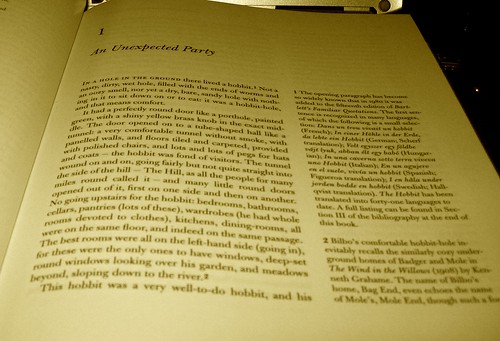
For my purposes, I will generally define “page one” as the first page of the actual story, whether that be a prologue or the first chapter. Anyway, here is Page One of The Annotated Hobbit, featuring the complete text by JRRT with annotations by Douglas A. Anderson. This book is full of fascinating details about the writing and publication history of The Hobbit, and of course, the ever-wonderful story of The Hobbit, which I continue to believe is absolutely essential to any proper reading of The Lord of the Rings.
That’s a memorable line of dialog — perhaps the most memorable — from any of George RR Martin’s A Song of Ice and Fire books, and fortunately, it’s spoken in the television adaptation of A Game of Thrones, in exactly the right way. That moment, early in the book, jolted me a bit as a reader as a genuine surprise. Martin would, in my opinion, go to this type of well a few too many times over the rest of that first book and in the three that came after, so much so that I remember reading A Feast for Crows with a constant sense of impending doom for every character. After a while, I have to admit that it got to be a little much, and sometimes I think of A Song of Ice and Fire as the fat-fantasy equivalent of Funky Winkerbean.
Maybe that’s not fair; heck, it probably isn’t. But while I’ve enjoyed Martin’s books, I’ve never been as big a fan of them as many. I started to tease out the reason why when I read A Feast for Crows, and now that I’ve seen the first episode of the teevee adaptation, I’m seeing ASoIaF for what it is: it’s a fantasy soap opera.
When I was a kid, I actually became for a time a huge fan of General Hospital. This was back when each summer would have a long and sometimes “action-packed” tale involving spies and espionage and intrigue of such nature, usually featuring characters like Robert Scorpio and his former wife Anna, who were both also former agents of the WSB (World Security Bureau), when they’d square off against the nefarious agents of the enemy DVX. As these storylines wended their way through the summer months, lots of other characters would see their own lives intersect with the “main summer storyline”. This was all usually quite a bit of fun, but there were characters I didn’t really care about, and thus their bits in the storyline tended to slide beneath my radar. And not all of the show’s characters would be involved in the “main summer storyline”, so once a week — usually on a Tuesday or Wednesday — there’d be an episode of GH that served only to catch us up on the characters who had nothing to do with the fun stuff. These episodes were largely boring as hell; I was watching the show for Robert Scorpio’s heroics and whatnot, and I didn’t really care one whit about Steve Hardy’s son’s relationship problems or the various infighting of the Quartermaine clan or the trials-and-tribulations of hooker-turned-straight Bobbi Whatshername. But that was the price to pay for the good stuff.
So GRRM’s massive fantasy series is getting kind of like that. Each chapter is told from the viewpoint of a different character, with that character being named in BIG LETTERS at the top of each chapter, so as soon as one chapter ends, you know just by looking at the next page where you’re going next in the story. This is classic soap opera structure, and in the first two books it was extremely effective, but I’m finding that now as we’re into our fourth book here, it’s all starting to feel the same way it felt when I’d watch GH all those years ago. “Oh, cool! An Arya chapter! Her story’s interesting!…Oh, bugger, another chapter about Sansa. Snore.” If ASoIaF were to be filmed, I think it should be as a soap opera, titled Westeros!. And if they change actors, a voiceover guy could intone, “The part of Jaime Lannister will be played on this episode by….”
It’s not that I didn’t enjoy the book, because I did, mostly. But the feel of reading this series has become eerily similar in my mind to that of watching a soap opera. I’m not sure if that’s what GRRM has in mind, but there it is.
I’m not trying to belittle things here, because it’s fun to delve deeply into stories like this. But even so, reading that last book, I remember a certain creeping frustration that things weren’t unfolding so much as grinding along.
Martin’s series gets compared to The Lord of the Rings a lot, which interests me. I just re-read LOTR a month or so ago, so it’s fresh on my mind, and what struck me this time is how surprisingly focused Tolkien keeps things: he’s got the story he wants to tell, and he pretty much sticks with it. Martin, however, focuses everywhere. If Martin had written LOTR, we’d have long chapters describing the trials and tribulations of the folk at Bree. We’d have chapters showing the befouling of the Shire while Frodo and the others are away. We’d have the meetings of the Council of Wizards. We’d have chapters set in the North and around the Lonely Mountain, showing what the dwarves up there are up to. And Gondor? We’d see all of the intrigue there.
At this point, I’m not sure that there even is a story that Martin is trying to tell. I think he’s immersing us for a very long time in a heavily populated world, a world where there are good people and bad people and people who are just kind of all right, and where sometimes these people do horrible things to one another and where love is not necessarily a happy thing and where sins of fathers ripple out through the generations and where there is murder and incest and people thought dead who turn out to not be dead and…so on. Basically, all the things you’d find in a soap opera.
I swear that I don’t mean any of this disparagingly — but I’m just not all that convinced by repeated claims that George RR Martin has done something staggeringly new and stunning and original with this series. It’s a fantasy soap opera. General Hospital meets the Wars of the Roses. The Sopranos with swords. Dallas with dragons. The X-Men when Chris Claremont was in charge.
As for the show itself? Very well done, for the most part. A few more characters might have been named. I didn’t care for the look of Winterfell, with all those round towers — it seemed a bit too elegant in a long shots. But still, very effective. I took one look at Joffrey and immediately thought, “Oh, you little f***er. And the acting was uniformly excellent — I liked the way everybody looked. I’m fine with Tyrion not being as ugly as described in the books. Part of my problem right now is that I’m spoiled by my knowledge of what is to come; like it or not, I can’t set aside the more favorable opinion of Jaime Lannister that the third and fourth books created to hiss the pure shit that he is in the first two.
And as for the books, I remain deeply skeptical that Martin will ever finish them, and I remain deeply hopeful that if he does finish them, the very last line of the last book is “Hodor.”
(Can’t wait to see Hodor, actually. Talk about an actor lucking out — he can memorize all of his lines in less than two seconds!)
A few years ago, I started seeing mention of a new fantasy author in some of the blogs I read, a guy by the name of Patrick Rothfuss. His debut novel had just come out, called The Name of the Wind, and by the time I heard of this, Rothfuss was apparently starting to have some trouble with the sequel to his first book. I remember reading this in the context of the fan ire that bubbled over towards George R.R. Martin, whose ongoing struggles with the fifth book in A Song of Ice and Fire is a constant topic of vexation among fantasy fans. I didn’t actually read The Name of the Wind until just a few months ago, however, when I finally decided to see what the fuss was.
So, what was the fuss? A novel that, it turned out, I had several different reactions to. I loved it and found it to be a compulsive page-turner, so much so that I really didn’t find the book’s length cumbersome at all. Yes, I loved The Name of the Wind — and yet I wanted to like it more than I actually did.
The Name of the Wind falls, categorically speaking, in line with other recent fantasy novels that use a more modern approach to language to telling a story that is an epic fantasy. (Another example of this type of book is Scott Lynch’s The Lies of Locke Lamora.) And yet, the language is a major element to the novel, and language is also a major theme of the novel.
There are two stories at work in The Name of the Wind. We begin in that old stalwart setting of fantasy novels, the inn in a small, unremarkable village. The inn is run by a man who goes by the name Kote, and he is doted upon by an assistant named Bast who is not what he first seems to be. There are hints that there are troubles in the world at large, with demonic creatures on the loose, harvests failing, and business at the inn down. A scribe arrives who only goes by the name Chronicler, who recognizes Kote as a long-disappeared hero named Kvothe, and Chronicler convinces Kvothe to tell him his story.
At this point, most of the book takes place as flashback as Kvothe tells his life story. His life is deeply complex, and most of the pleasure of the book for me came from following Kvothe’s life as he struggles to overcome the horrible things that happen to him. He first grows up as a member of a traveling troupe of musicians and actors, but then his entire family is murdered by beings called the “Chandrian”, because his parents “have been singing entirely the wrong sort of songs”. Kvothe escapes, and ends up living on the streets in a brutal and filthy town. Using his innate intelligence and competence, he makes his way to the University, where he starts to learn about magic. This may sound like a Harry Potter tale, but Kvothe’s story has a very different feel, and despite the fact that Kvothe is intelligent, witty, and good at most things he tries, his life has the feel of constant disaster as he fails to recognize enemies even as he makes them, annoys teachers, commits errors of judgment, and falls in love with a woman named Denna who comes and goes with little or no warning.
This book is long and rich, and it’s so packed with stuff going on that it’s clear that Rothfuss is liberally scattering story seeds everywhere; the book is full of characters and details that scream out as “important somewhere down the road”. Part of the pleasure will be seeing how it all fits together, in the end, and how the two stories – Kvothe’s earlier experiences, and his adulthood after he has set aside his life as a hero – come together. My main, and really only, reservation, lies in the way Rothfuss often uses more modern idioms and methods of speech than one might usually find in a fantasy novel. I found the way a lot of the characters talked jarring and out of place, and it wasn’t something that I was able to quickly get used to. Nevertheless, the pages keep turning, and the richness of the story sneaks up on me. This novel would be a good book to give someone who doesn’t love fantasy all that much. Or for those who do love fantasy all that much. Basically, it’s good for people who like good stories that don’t always go where you think they’re going and which have engaging characters.
(My review of the sequel, The Wise Man’s Fear, will be appearing on GMR, probably a little bit after I write it. A preview: It’s good. Really good. I am now a Patrick Rothfuss fanboy. That cover art up there, also, is the German cover. I don’t have that cover art, obviously, but I love the way it looks, a lot more than the American paperback art that I ended up with.)
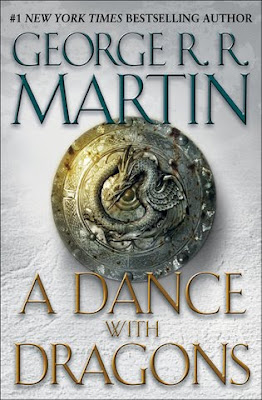
I’d love to be one of the fans of A Song of Ice and Fire screaming “HUZZAH!!” over this, but…well, I’ll read it, sure. I won’t buy the hardcover right off the bat, but I’ll read the book. Sometime. But it’s been so long since the last one came out that I really don’t remember a lot of what was going on, so I feel the need to do a complete re-read before I get to Dance. And I can’t forget that I wasn’t terribly enthusiastic about A Feast for Crows — especially since Dance tells the rest of the story from Feast, but with other characters. The last one was, frankly, something of a structural mess.
And…well, the thing is, Martin still isn’t done with the book. It’s not “It’s finished, they’re editing and it will be out in July!” Instead, it’s “I’m really close, so we’re just throwing out a date!” This does not inspire confidence. They’ve announced release dates for Dance before, and yet, it’s been seven years since the last one.
Last I checked, the entire series was supposed to end after seven books. Unless Martin is able to significantly get a jump on the next one, I stand by what’s been my opinion for several years now: A Song of Ice and Fire will never be finished. At least, not by Martin.
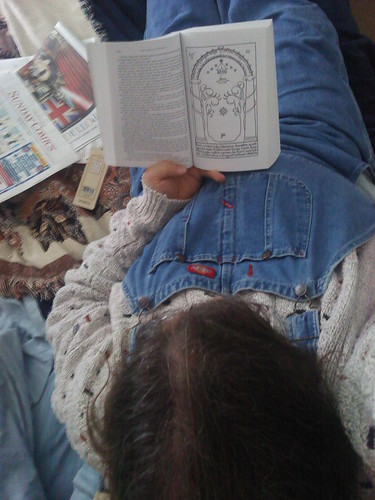
This is where I was when I sat down to read more Lord of the Rings yesterday. Those who have read the book will recognize the artwork there as the inscription upon the Doors of Durin, which lead into the Mines of Moria if one knows the password.
Some thoughts on some recently seen movies at Casa Jaquandor!
:: When we were moving from Hillsboro, OR to Allegany, NY in the summer of 1981, there was one day on the trip when my mother handed me a book and ordered me to read it. The book was The Lion, the Witch and the Wardrobe, and I read it in its entirety that day. We started out that day somewhere in Nebraska and ended up somewhere in Indiana. I was riding the Ryder truck with my father; my mother and sister were in the pickup truck which was towing the camper. When we finally stopped at a Holiday Inn in Indiana, my father complained to my mother that he hadn’t been able to talk to me all day, so absorbed was I in the book.
Unfortunately, I never found the subsequent books in the series remotely as captivating, and to this day, Lion, Witch and Wardrobe is the only one of the Narnia books that I’ve actually read. So except for the first movie (previously written about), I bring no assumptions or impressions with me into the films. I actually enjoyed Prince Caspian more than I did Lion, Witch, and Wardrobe; and I actually enjoyed The Voyage of the Dawn Treader more than Prince Caspian.
Mainly, I liked it because, aside from a few moments at the very end, Dawn Treader didn’t seem to take itself as seriously as the previous two films did. This one just felt like more of a fairy tale adventure than Big Important Fantasy Battle Between Good and Evil.
I don’t really have much more to say about it than that, maybe because I don’t count the Narnia books among my favorite things, so I’m not terribly beholden to its message or the faithfulness with which it delivers that message. I’m not invested in whether or not the movie gets its CS Lewis right, or if by extension it gets the Jesus right. I’m trying to think up more to say about the movie, but I just don’t have anything. Voyage of the Dawn Treader is a genial, nice-looking, mostly entertaining fantasy adventure movie. That’s fine with me.
(I could tell that the film was shot with 3D in mind, which made some of the cinematography a bit unpleasant at times. We saw it in 2D, because I think 3D is stupid.)
:: How to Train Your Dragon is a really, really fun movie. It’s just a lot of fun, and it’s got a lot of heart, and best of all, it does things, story-wise, that are actually surprising. I don’t want to say too much about this animated tale about a young boy in a Viking village who befriends an injured dragon, but it’s just a fine, fine movie. It’s a pleasant piece of mainstream computer animation, but it’s also a movie that doesn’t fill its cast with cardboard stereotypes, opting instead for conflicts that are actually fairly complex. The story is your basic “War based on a misunderstanding” tale, but it finds some new things to saw within that framework, and the dragons themselves are a lot of fun to watch. (The main one seems to be more cat than lizard, if that makes sense.)
:: I’ve never been one to believe in the concept of “guilty pleasures”, but damned if I don’t think I have an honest-to-goodness guilty pleasure: the movie Armageddon. It’s utterly ridiculous; it screens like a 150-minute rock video, with its endlessly moving camera; its story makes very little sense. All the movie really has going for it is some entertaining banter amongst the characters, and Bruce Willis in his full-on Bruce Willis mode. Oh God, Armageddon is a bad, bad, bad movie.
And yet…I watched the damn thing, yet again. Voluntarily. And I didn’t feel that guilty at all. Except, maybe, in that feeling I get after I have my second slice of cake on my birthday. Of the two “giant rock hitting Earth” movies that came out roughly the same time, Deep Impact is the better movie. But Armageddon is the one I prefer to watch. Even with its horrible script, its cardboard characters, its abysmal scientific accuracy, and its relentless score that pounds away at you with all the subtlety of a brick thrown through a plate-glass window.
:: Robert Zemeckis’s Beowulf is a movie I wanted to like a lot more than I did. The film actually has a very good script, by Neil Gaiman and Roger Avary, and it has an excellent cast. But the film is very nearly undone by its visuals.
The Beowulf story is a familiar one, and the film depicts its world with all of the bawdiness, raunchy behavior, and brutality that one might expect from a PG-13 film. Hrothgar’s hall is being attacked by a horrible beast called Grendel whom no one can kill; enter the great warrior Beowulf, who kills Grendel but then discovers that Grendel isn’t actually the real beast. The story is pretty straightforward.
Zemeckis’s visuals, though, are too often distracting to the point that they ejected me right out of the story. The film is made in the “motion capture” animation style that The Polar Express had formerly exhibited. A lot of people hated the look of Polar Express, particularly the eyes of the characters; I wasn’t one of them, but the visuals of Beowulf really gave me a hard time. Part of it was that there really wasn’t that much of a reason for the stylized look of the film; Polar Express had a “Is it a dream?” quality to it, and the visuals there were influenced by the design of the famous childrens book that inspired it.
There really doesn’t seem to be any reason for Beowulf to be shot in this way, however, and the visual design of the film does a disservice to the earthy tone of the script. Hrothgar’s hall should be a dirty, filthy place, and yet, the film makes it look almost shiny and spotless. Bright fires fill the movie with brilliant yellow light that seems out of place most of the time.
And that’s just the general appearance of the film; Zemeckis also goes for specific shots or effects that draw so much attention to themselves that it detracts from the story. Here’s a perfect example:
Of what use was the spear, sticking that far forward? Or the camera pivot to show that the spear tip is an inch from Beowulf’s eye? The shot is just goofy. And then there’s the supremely silly bit where we see, in flashback, Beowulf’s swimming contest against another warrior. Now, this bit is unbelievably over the top, which may be because the film implies that Beowulf is embellishing this story (he’s telling the tale to someone else as we watch the flashback). He’s swimming at sea, neck-and-neck with the other guy, when he is attacked by a series of sea monsters, each one of whom he vanquishes by stabbing in the eye. Except for the last one, which rears its head from the sea, shudders a bit, and then dies as Beowulf literally explodes from inside the creature’s eye. The whole sequence is just so gonzo, so fake, that even the story’s implication that Beowulf is spinning a web of bullshit doesn’t help. At this point I was actually laughing at the movie.
And there are many other scenes in the film that just look wrong, or that look as though Robert Zemeckis fell in love with things he could do with his camera without ever stopping to consider if those things were a good idea in the first place. It’s a shame, really. Beowulf has a good script. If only Zemeckis had directed it.
Of course there’s the Lord of the Rings, which is very different when you come to it at different times of life. I go back to it every six or eight years, give or take, and part of the experience is spending time with the version of myself that read it last.
If I recall correctly, the last time I re-read The Lord of the Rings was in 2004; I was reading it when Little Quinn was born and during his initial hospital stay. I’ve generally re-read it every four or five years, so I’m actually overdue. It’s time to return to Middle Earth!
Although, actually, I’ve already been there for a week; it’s always been my practice to re-read The Hobbit first before any re-read of LOTR. A couple of years ago, when we were in Ithaca for the Apple Harvest Festival, one of my purchases at the amazing Autumn Leaves Bookstore was a pristine copy of The Annotated Hobbit, which turned out to be a fascinating read for the annotations as well as the wonderful story. It was like having a running commentary for the book, with notes on Tolkien’s thought processes, various background materials from which Tolkien drew his material, and illustrations from many foreign editions of the book.
And now, it’s on to LOTR, which makes me very happy indeed. I even bought a new copy of the book for this re-read. This is now my third copy of LOTR. Will I buy another for my tentatively-scheduled re-read in 2015? We’ll see!
:: Some years ago — I don’t recall how long — I read the first few volumes in Lois McMaster Bujold’s series of books on the adventures of a man named Miles Vorkosigan. I’m not sure that the series has an “official” name, so for my purposes, I’ll call it the Vorkosigan Chronicles. I’d been hearing about these books for years; it consists of a long series of self-contained novels about Miles Vorkosigan and the people around him, and every time a new book in the sequence would come out, I’d see a flurry of discussion in various forums online as fans of Bujold’s books devoured her latest offering.
This is one of those series where there tends to be a bit of diverging opinion as to the “best” order in which to read the books. One can read them in “story order”, meaning, reading the books in the order that the events within take place; or, one can read them in the order in which the books were published. In truth…I’m not sure which order I went with. Baen Books has reprinted the novels over the last few years in omnibus editions that gather two or three at a time, making it easy to read the books more-or-less in story order, or so I think. Anyway, I started with Cordelia’s Honor, which gathers two novels, Shards of Honor and Barrayar, which tell the story of how Miles’s parents come together and have their famous son. So I read a book consisting of two books, out of publication order.
You can see how this gets a bit confusing.
Anyway, this was the second time I had read Cordelia’s Honor. The first time, I liked the book just fine…but I wasn’t sure I understood the wild love that fans have for the series. I found it genial enough, but I wasn’t overwhelmed. I later read The Warrior’s Apprentice, the first actual book about Miles himself, as part of the omnibus Young Miles. That one, too, I enjoyed…but wasn’t overwhelmed.
So why did I decide to return to the Vorkosigan Chronicles? Well, even though I wasn’t wowed by it, I did like it, and always meant to get back to it. But I’d waited long enough that I figured I pretty much didn’t remember enough of it to keep going, so I figured I’d best start over at the beginning. Which meant going back to Cordelia’s Honor. And this time, I was wowed by the book.
I’m finding that this happens a lot for me when I return to books some years later, especially SF books that I either didn’t dislike but also didn’t find fantastic the first time around. I chalk this up to the fact that I’m a more experienced SF reader now than I was even five, six, seven years ago. I find it easier to pick up on certain SF tropes now than I used to, which makes it a lot easier to read some of these books.
But maybe this shouldn’t have mattered so much in the case of Cordelia’s Honor, as the book is very character-driven. At no point did I get a feeling that I was reading the unfolding of a plot, but rather following the actions of a group of characters, some of whom are deeply sympathetic and some of whom are…deeply not. As the book opens, Captain Cordelia Naismith is commanding a scientific expedition on some planet when her group is attacked by soldiers from the militaristic world of Barrayar. Left behind by her fleeing co-workers, she finds herself depending on the similarly-stranded Barrayaran officer Aral Vorkosigan for her survival. Cordelia is from Beta Colony, a rival world of Barrayar, and as the two work together to survive, they discover plots afoot…and increasingly complex feelings for one another.
I don’t want to give away much, since the story twists and turns in a lot of fascinating ways, but it’s no spoiler to note that eventually Cordelia gives birth to young Miles Vorkosigan, who will be the hero of all the books and stories in the series to come. Miles, though, is not without his own set of challenges; for reasons outlined in Barrayar, Miles is born with his growth stunted and with extremely brittle bones that are constantly breaking. In short, Miles is the last kind of son a man would wish to have in a heavily militaristic society. I look forward to reading how Miles overcomes these challenges in the books ahead; just from the two volumes presented in Cordelia’s Honor, I can tell that Bujold’s approach is to create engaging, sympathetic characters and then put them through hell.
:: Another book that I probably should have read long before this is Madeleine L’Engle’s A Wrinkle in Time, which was published in 1962 and won the Newbery Award. [CORRECTION: Until just today, I always thought that the famed award for Childrens’ Literature was spelled “Nerberry”. It’s actually “Newbery”. Thanks to the reader who pointed this out — that reader being none other than my retired librarian mother. Thanks, Mom!] I had no idea at all what to expect from this book, but even so, it defied the few expectations I had. I expected fantasy, but the book is much more strongly science fictional than fantastic in nature (even taking into account the forever-shifting dividing line between SF and fantasy). As with many books involving children as protagonists, the heroes are misfits — generally unpopular at school and not understood by anyone except for a couple of their peers. They are whisked away on an improbably adventure, this one to rescue their father, who has been missing for years and whom most believe to have basically run off, either with a mistress or for some other reason.
What makes A Wrinkle in Time compelling, in addition to well-done characters, is the ominous tone struck throughout the book, and the fact that it’s so overtly SF. Among books published today, I don’t see a whole lot of SF for kids, but there’s so much in Wrinkle that is SFnal that I end up wondering anew when it was that kids turned away from SF, or had SF turn away from them. Nowadays, it seems that the only real SF-type stuff kids ever see aimed at kids are a lot of Star Wars materials and superhero stories.
Anyway, I’m not sure how A Wrinkle in Time managed to elude me all these years, but I’m glad to have it off my “I should read that sometime” list. Now to track down the others in the sequence.
:: Way back when we were in college, The Girlfriend (now The Wife) bought a goofy book called 14000 Things to be Happy About. And that’s exactly what it is: a giant list of 14000 things you should be happy about.
Obviously you don’t just read this thing cover to cover. That way, madness lies. Instead, you dip, here and there, finding things you’re already happy about, or that you should be happy about, or things that you’d be happy about if you were certifiably insane.
Of course, I’d be silly to read anything into this, but it tickles me nonetheless to see two of my favorite things on the same page, out of 14000:
Of course, I’m ambivalent about unbuttered green beans, and I’m not sure why I should find appeal in the rattling of garbage cans, but bib overalls and pie throwing? I’m there!
More book notes, as always, as I read more books….