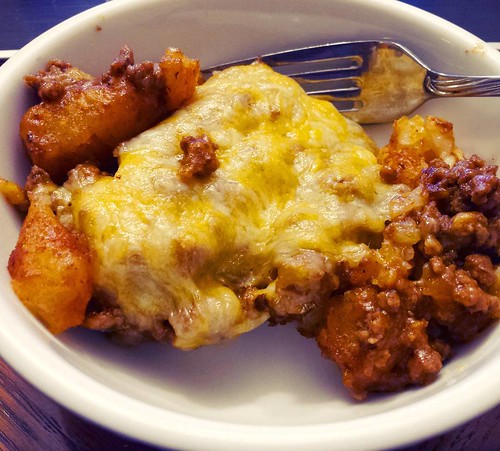
Behold…NACHO-TOTS!!!

When it comes to culinary invention, I’m a fan of the “Let’s throw some stuff together, bake it, and see what happens!” approach. So here’s something I whipped up yesterday, and I rather like the results. Behold the NACHO-TOTS!

LET THE WORD RING FORTH THAT THIS DAY I HAVE CREATED NACHO-TOTS

You’re probably thinking, “What is that, some blend of nachos and tater-tots?” And yes, you’re exactly right. I’ll almost certainly make this again, and I’ll tweak it some, but to start with, I baked enough tater-tots to line the bottom of a casserole dish (I got ’em fairly crispy, so they’d stand up), and then I topped them with prepared taco meat (in this case, ground beef with taco seasoning) and a “Mexican” cheese blend. I baked this in turn for fifteen minutes or so, just long enough to melt the cheese and make things pleasantly gooey, and then I served! Divvy the tots up in bowls, and provide salsa and sour cream and whatever other nacho toppers you might like.

Next time I think I might add a can of refried beans to the baked mixture…this is really one of those meals you can take in many directions.

And really, it’s just fun saying NACHO-TOTS!

Share This Post

On Waffles

Have I ever mentioned my deep and abiding love of waffles? Maybe I have, but here I go again:

I really really really love waffles.

Dinner #Yum #waffles

Fluffy, crunchy waffles dripping with real maple syrup. Belgian waffles with a scoop of vanilla ice cream and hot fudge. Traditional square waffles with a couple of pieces of fried chicken and some maple hot sauce to go with the maple syrup. And that’s not all! How about waffle sandwiches? Ham and swiss on two toasted pieces of waffle, dipped into syrup or jam? That’s like a Monte Cristo sandwich but with waffles instead of French toast! Oh, and blueberry waffles. Boy howdy!

Yup, waffles are awesome.

Now, growing up, waffles were a rarity. We never owned a waffle iron, probably because of space reasons and because I was really the only one in the family who really dug them. But since The Wife and I have been, well, The Wife and I, we’ve always had a waffle iron. In fact, we’ve always had more than one waffle iron.

Our first waffle iron was probably a wedding gift — I honestly don’t remember — and it was a decent enough machine. It likely still works, actually. It’s sitting in the garage right now, and I should probably clean it up and send it on its way to another waffle-loving but waffle-deprived household. This iron became superfluous when my mother-in-law gave us her old iron, presumably because she wasn’t using it much anymore.

Now, I’m generally of the view that with some things, older really is better. Waffle irons are a good example. Over time the metal grates should take on a rich patina of seasoning, giving you that wonderful crunch that you can really only get with an old waffle iron. This one definitely has the feel of an old appliance. Its cord is ungrounded, the knob that adjusts the temperature has a certain looseness to it — the looseness of old knobs, the “loose but not likely to fall off” kind of looseness — and the silver exterior is worn and scratched and looks like it’s been in various homes for years. Which, indeed, it has.

And it turns out amazing waffles.

My mother-in-law's old waffle iron. There's something to be said for old-school things. #waffles #vintage #Yum

I know, Alton Brown’s waffles episode of Good Eats weighs in pretty definitively in favor of circular waffle irons instead of square ones (it has to do with the circle being a better shape for efficient heat transfer to the batter), but I love this old beast, I love the product it turns out, and I love that it’s a connection to my mother-in-law.

One problem, though: we can’t use it anymore. At least, not for Family Waffle Night. I can use the old one for when The Daughter and I want waffles, but if we’re including The Wife, this one is off the table, because she is on a gluten-free diet. That being the case, she is too wary of not being able to clean the grates of the old iron sufficiently well to convert it to gluten-free batter. For this reason our waffle nights have decreased dramatically over the last couple of years. The few times we’ve had waffles, she’s made waffles for us and pancakes for herself, and that’s a fairly annoying amount of work.

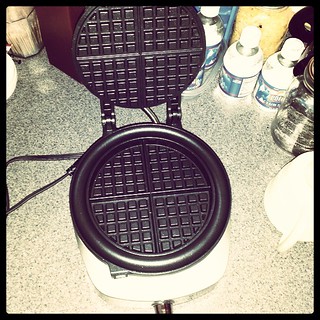
Thus it came to pass that leading up to this past Mothers Day, I got in the market for a new waffle iron which she’d be able to employ in the baking of gluten-free waffles. After some shopping and comparing, I ended up at Williams-Sonoma and dropped over a hundred bucks on this bad boy:

FINALLY! #NewWaffleIron #waffles #Yum

I have no regrets, regarding the sticker price. None at all. For something like this, a device to make a food we love and like to have often (especially in the colder months), I’d rather spend a lot and get a good iron than some cheap $30 thing from Target where the construction is part-plastic and the lid doesn’t seem to settle down snugly over the bottom and so on.

How were the waffles from this iron? Quite good, actually! It’ll take years for the iron to develop that nice old patina, but it’ll get there. Meantime, we can all have waffles now.

Let us praise the Waffle Gods! #waffles #Yum

Now I need to figure out how to make gluten-free fried chicken….

Waffles and fried chicken! #Yum

Share This Post

It’s crunch time for Mercado!

I wrote a couple of weeks ago about a new project coming to Buffalo, Mercado Revolution, which is to be a marketplace and dining establishment featuring all things local and artisanal in Buffalo, as well as also featuring young and rising chefs who will be working to bring to Buffalo some of the new techniques and thought processes regarding food that have been thrilling the culinary world but have been oddly slow in coming here. The Mercado project is being funded by Kickstarter, and the funding window has just over two days left as of this writing, so if by chance you’re a local who hasn’t already heard of this project, please consider backing it!

In my earlier post I mentioned some questions I had about the project, questions which have now at least partially been answered. The Mercado folks have really done a masterful job at being able to make sure they have something new to get out, information-wise, nearly every day, mainly in terms of people and vendors who will be involved. There is a lot of exciting stuff slated for Mercado: a test kitchen for Lloyd’s Taco trucks (a food-truck business whose quality is so high that in just a handful of years it’s become an almost beloved feature in Buffalo and WNY food circles), a Lake Effect Ice Cream shop (this excites me, as their main location is in Lockport, which is just too far for normal trekking for us — it’s about 35 miles one way), and the Bavarian Nut Company (how nice to not have to wait until the County Fair to buy their products!). And many others.

The Mercado drivers have also been very much engaged in the social media scene, engaging people and answering questions almost immediately on Twitter or Facebook. Last Saturday afternoon I asked two questions and both were answered within minutes. (The first had to do with food allergies, as gluten is an issue at Casa Jaquandor — Mercado will be cognizant of food allergies and accommodating, although obviously they can’t make every single item comply — and the second was whether Mercado would be more geared to dining-in or carrying ingredients for home cooking. The focus will generally be on eating there, which makes sense.) There’s just so much about the way they’ve been going about this thing that feels right.

Another person asked why they are using Kickstarter, and it seems to me that doing it this way creates a sense of community ownership before the place ever chooses a location, breaks ground, or even opens. You can virtually guarantee that a person who has donated is going to visit, just to see what they were supporting; given that it’s a food place, they’re likely not coming alone; and then after that, the word-of-mouth will spread. It’s a unique approach that demonstrates that there’s hopefully a critical mass already in place in this region, waiting to support something like this. I’m no expert, but I imagine that would be a big factor in helping the Mercado founders to secure funding later on through more traditional means.

Anyway, I personally find this project deeply exciting. It’s interesting that it happens when my own family is on the cusp of moving into a home with a kitchen that is actually conducive to a lot more cooking than we’ve ever had before. I’m looking forward to being able to do more with food, and do it with higher-quality products and techniques that I haven’t been able to do for lack of decent space.

It’s time for Mercado. Please consider supporting!

UPDATE: Forgot this: local teevee station WGRZ did a feature on Mercado the other day; you can watch it here. Just ignore the fact that the anchor mispronounces “Mercado” at the beginning, and all the stock footage taken from the Taste of Buffalo festival, which I don’t entirely think is what Mercado is aiming for!

Share This Post

The revolution will be incentivized.

(I’ve changed the wording below a little since my first posting.)


I actually donated to a Kickstarter project recently: Mercado Revolution, a new venture in Buffalo that will…well, here’s how Mercado’s visionaries describe it:

Mercado will kickstart the Buffalo/Niagara region by assembling 15 different, excellent restaurants under one “market” roof – a centralized hub where anyone can sample products from Western New York’s top food artisans, watching from counter seating as dishes are made. The market will also serve as an incubator and lab for the next generation of Buffalo culinary success stories. Thanks to culinary director Scott Kollig, Mercado will bring the latest techniques and world-class ingredients to WNY from Washington, D.C., where Scott has worked for celebrity chefs as a chef de partie and sommelier. Working together, we will create an incredible culinary bazaar – a one-stop shop to experience the future of food and drinking.

When it comes to food, I’ve always felt of two minds in this region. I’ve never been down on the food that’s here, but at the same time, it’s impossible to not realize that there’s a great deal of exciting things happening in the food world that just don’t make their way here for years and years and years. The Buffalo Niagara region tends to be oddly resistant to new things, but the time just may be right for something like this, as a lot of small and independently-driven projects are underway in this region that seem to signify a terminal frustration with business-as-usual. I suspect a lot of it is the younger generation, which has had the chance to go elsewhere and see different things and come back with new ideas.

So what is Mercado? I was a bit fuzzy at first as to how this project will be different from, say, the wonderful St. Lawrence Market in Toronto (one of my favorite places on Earth). The Mercado people have been releasing little bits of information here and small tidbits of their vision there since they announced their project, and it seems that Mercado will be something halfway between a market and a restaurant, with the best features of both. Their focus will be on locally-sourced (as much as possible) and locally-prepared foods, as well as (I believe) foods that have never been seen here before. They are also pledging to be as affordable as possible (a major consideration for my family and I, as we aren’t generally in a position to spend more than $100 on meal very often). My general sense is of a hybrid between a restaurant and a fine public market. Either way, it’s exciting stuff, and I look forward to visiting once they’re up and running. There will be many options under one roof, with — it is to be hoped — the kind of vitality that the best such places in the world offer.

I don’t consider myself a “foodie”, but I am curious about food and while I enjoy a cheap meal from Mighty Taco or a pizza from Imperial as much as anyone, I do also want more variety and international flavor to choose from in this region. There’s room here for a lot of different approaches to food, after all, and a locally funded business like this seems to me an idea so obviously good that I’m not sure why more people aren’t rushing to fund it.

Heck, I’m looking forward to the coffee.

Follow Mercado on Twitter, if you’re so inclined. They’re not backing off their ideas of community engagement.

Share This Post

That’s funny…he NEVER asks for a second cup at home….

I was in a brief conversation yesterday pertaining to coffee-brewing methods. It started when one friend indicated that he’d just witnessed a guy spend fifteen minutes making “pourover” coffee, which struck him as excessive. Well, I make pourover coffee here at home, and I can say…yes, fifteen minutes is excessive.

I’ve pretty much stopped using my drip maker for my own coffee, because after doing a lot of reading about coffee, I’ve learned that drip machines, with very few exceptions, simply don’t get the water quite hot enough to really extract the coffee. You need water that’s just off the boil, about 200 degrees, so I’ve adopted two main methods of brewing: the French press and the pourover.

The pourover method is actually the same thing your drip machine does, only it’s all done manually. You put a filter into a holder, measure your ground coffee (freshly-ground, mind you!) into the filter, and then pour the water through it. The water drips through into the receptacle below. When I make pourover coffee, here are the steps I use:

1. Fill kettle and put on stove to boil. (I’m told that if you use an electric kettle instead of the stove, the water boils a lot more quickly.)
2. While water heats, measure out and grind beans.
3. Transfer beans to filter in pourover brew basket.
4. When water boils, lift kettle from stove, hold aside for ten to fifteen seconds, and then slowly pour the water over the grounds, filling the brew basket.
5. When all the water has dripped through, repeat if necessary.

That’s it. The whole process, if I’m taking my time and not acting with any urgency, might take ten minutes. It certainly doesn’t take any longer to do the ritual needed to get the drip machine going, and I get better coffee for the bargain.

Here’s what the process looks like:


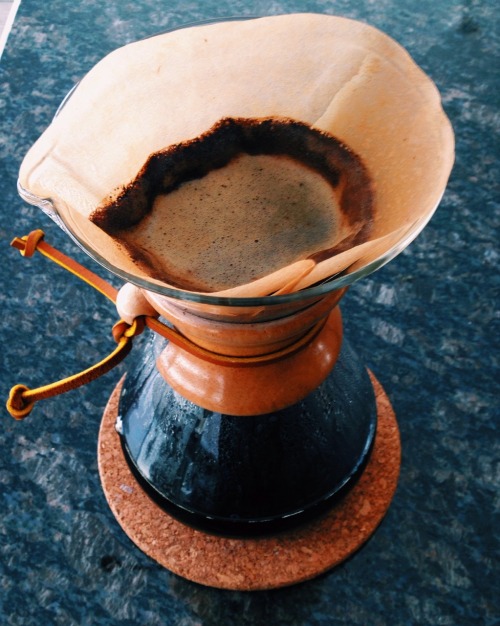
Now, that basket is a Melitta doohickey that I got for less than ten bucks, and the filters are standard #2 cone filters. It’s utilitarian and it works just fine. However, my friend on Twitter mentioned that the guy he watched used a Chemex pourover system, which is the Cadillac of pourover coffee. It looks like this:

Yes, that looks nifty. And if I had more money than I do, maybe I’d have one on the basis that they look pretty cool. But – and I say this never having actually tasted coffee brewed in the Chemex pot – I am perfectly satisfied with the flavor of the coffee that results from my cheap gizmo. I have a suspicion that my friend’s coworker isn’t just about having quality coffee, but about being seen executing the process using Chemex smallware.

The other brewing method I use a lot is my French press. This is more familiar-looking, even if most folks likely don’t use one of these, either. You put your measured grounds at the bottom of the carafe, pour in the proper amount of water, stir, and then wait a few minutes. After the few minutes (about four) you slowly push down the plunger, clearing the grounds out of the way and then you pour off the coffee. When I use the French press, I pour my resulting coffee into a thermal carafe for hotkeeping.


What’s the difference, taste-wise? Well, the French press method leaves a lot more of the oils and particulates in the coffee than does the pourover method, so for me, the result isn’t very different in taste but fairly different in terms of mouth feel. French press coffee has a thicker feel, more “body” to it. I was a bit gun-shy about the French press at first, because I wondered if the coffee would lose a lot of heat just sitting there in a glass carafe for four minutes as it steeped, but it turns out that it really stays hot for that period of time. I suppose four minutes isn’t long enough for four cups of water to lost that much heat once they’ve been brought up to a boil and I further suppose that the inch-thick layer of coffee grounds that forms up top provides some insulation against heat loss out the top of the pot.

(By the way, if you try a French press for the first time, when you press the plunger down — press slowly. Some interesting things happen with water pressure as you push that thing down, and it can get a bit explosive if you push too quickly!)

Now, I will admit that there is one area of the whole procedure where I obstinately refuse to do things in any more of a complicated way. That’s in the grinding of the beans. I still use a cheap, $20 blade-style grinder. I’ve been told my numerous folks whose food tastes I trust that blade grinders are awful and that you really really really have to use a burr-style grinder so as to get the uniform size of grounds that result in optimal coffee. And maybe that’s even so, but I just have no desire to spend over $100 on a single-task machine for grinding coffee beans. On this point my sense of economy will go no farther! (Plus, our tiny-arsed kitchen simply does not have counter space for such an item.)

I’ve also heard that tossing a pinch of kosher salt into the grounds before brewing removes some of the bitterness, but…I dunno. I’ve tried it, but I really couldn’t detect a significant enough difference to do that on a regular basis.

And there you have it: more than you wanted to know about how I make coffee!

Share This Post

In praise of Bugles

I have long maintained that I don’t believe in “guilty pleasures”: things that I like and yet I know they’re bad. But there are things that come really close to “guilty pleasure” status for me, and Bugles are one of them. They’re…well, they’re not “good”. For corn-flavored snacks, tortilla chips are so much better. More versatile. More authentic. And even Fritos are better.

But there’s something nifty about Bugles that defies description. Obviously it ain’t flavor, because they really don’t have much. They counteract the lack of flavor by amping up the salt. And they’re not uniquely crunchy, either. What I think they do, though, is have a specific way of crunching that’s all their own. That shape makes them crunch very easily, almost softly, at the wide end, the “bell”, as it were. But the inner end, the closed end? Ahhhh, there’s a totally different crunch there. Harder. More percussive as your teeth break through it and crush it.

So there it is: Bugles combine different textures into a single snack just by being shaped the way they are. And that’s why, once or twice a year, I’ll consume an entire bag. By myself. And not feel the slightest bit of guilt in doing so.

Share This Post

Further evidence that I need to get out more

I made Chicago deep dish pizza last night. Making this meme-photo is how I occupied my time as it baked. Not reading, not writing…this.

I hang my head in shame.

(Pizza was damned tasty, though! Next, I’ll experiment with gluten-free flour. That oughta be a trip.)

Share This Post