
Strange brew! (And cold.)

So I’ve been intrigued for a while about the idea of cold-brewing coffee. This is a method whereby one extracts the flavors and oils from coffee not with hot water, but with cold. (Duh!) Basically, you mix ground coffee and cold water and let it sit out, at room temperature, for a long time: 12 to 24 hours. Then you strain out the coffee, resulting in a concentrated coffee extract that, because it was done at a low temperature, cuts down on the coffee’s acidity.

So I acquired a really nice glass bottle, hunted around for recipes (eventually settling on this one), and away I went! Here’s the pictorial tale.

First, I measure out coffee: 4.5 oz of it. Which turns out to be quite a bit of coffee.
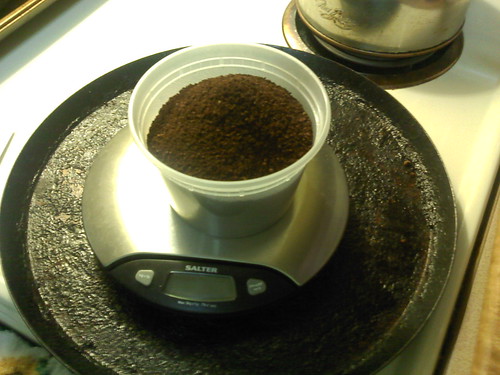
Cold Brew Coffee I

Into the bottle goes the coffee. Most recipes I’ve looked at say to use a fairly coarse grind, since the long steeping time will be used and since it’ll be easier to strain it out later on.

Cold Brew Coffee II

Then, into the bottle goes the water: 3.5 cups of it.

Cold Brew Coffee IV

This results in a pretty gross-looking sludge. Don’t worry! This is normal.

Cold-brewing coffee. Never tried this before, so we'll see! #Yum #coffee

Now came the waiting game. I did the prep part of the job at 4:30 in the afternoon, and I did the straining around 8:00 the next morning.

Straining turned out to be…problematic. The recipe I used said to simply put a standard paper coffee filter into a fine-mesh strainer and pour the sludge through there, slowly, and let it drain into a bowl. The problem is that when I did this, the paper filter clogged up almost immediately; the initial slow pour of coffee slowed in minutes to a slow drip, and then stopped altogether. I tried another filter, and the same thing happened. This was a problem, obviously. So I dispensed with the paper filters: I poured the coffee mixture through the fine-mesh strainer into the bowl, and then, after cleaning the glass bottle, I strained the coffee again, through the same strainer, back into the glass bottle.

The result? Here’s my coffee concentrate, after double-straining and several hours of refrigeration.

Cold Brew Coffee VI

Yes, it’s only half the bottle. But it is, after all, a concentrate, so you’re not going to use that stuff straight. (Well, I suppose you could, if you wanted to. It’s your nervous system, folks. I’m not the bossa you!) The idea is to dilute the coffee concentrate, with whatever it is that you typically like. You could use water, I suppose, but that seems goofy. I used milk, in equal portions. Here’s what I ended up with:

Cold Brew Coffee VII

And then:

Cold Brew Coffee VIII

I have to tell you: this is really pretty tasty. In the future I think I’ll use the half-size tumbler for this, though; a glass that size is a lot of this stuff to drink at once. And I’m kind of wondering if I don’t need to use one percent milk or maybe even two percent, because we only keep skim milk around, and for this kind of drink, I kind of miss the mouth-feel I get from a little bit of fat content.

And of course, there’s a virtual galaxy of flavorings I could add to the mix. On a future iteration, I may well try adding a teaspoon of cinnamon to the coffee during the steeping. And if I get into this in a big way, I might start keeping the finished concentrate in smaller glass bottles (of which I have a few floating around, from commercially-prepared iced tea) so I can start the process over again with my main bottle.

Ah, coffee. You make things possible!
Share This Post

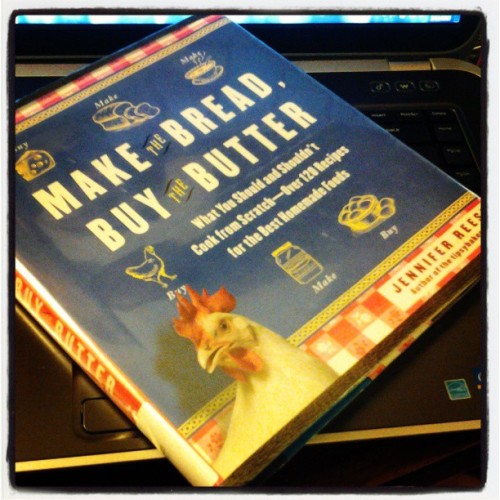
From the Books: Make the Bread, Buy the Butter

I don’t own this book yet. But I’ve had it checked out of the library a majority of the weeks it’s been in the collection, which means that it’s well past time for me to get off my ass and buy a copy, innit? Anyway, Jennifer Reese‘s Make the Bread, Buy the Butter (subtitled What You Should and Shouldn’t Cook From Scratch) is a terrific cookbook. Not just a collection of recipes, it’s a chronicle of one woman’s quest to take more of a do-it-yourself (DIY) approach to her family’s food preparation, and the discoveries she made along the way that there are some things that you certainly should make for yourself (either because it’s easier, or cheaper, or just plain better, or all three), and that there are other things that you’re just fine buying for yourself at the store.

I haven’t done a whole lot of cooking out of the book yet (one new wrinkle is The Wife’s adoption of a gluten-free diet, which has us going in other food directions currently), but there are a lot of good insights here on food and making it yourself and the fact that sometimes it’s just fine to not do things from scratch. The book is full of frank observations, like this:

If bay leaf didn’t exist, would anyone miss it? I’ve never tasted anything and thought, This stew is just crying out for bay leaf. But I keep buying and using it nonetheless.

And Reese’s explorations are hard-core. This isn’t just about making your own breads or spice mixes or your own peanut butter. She writes about keeping — and killing — her own chickens, and keeping goats. She writes about making her own hot dogs (her conclusion? Just buy ’em.). And she writes thusly about a dish that’s wonderful when made at home, but may or may not be worth all the effort: fried chicken.

One rainy Sunday a few years ago, Isabel, Owen, and I decided to pass the afternoon by watching a DVD of The Fellowship of the Ring, that movie about hobbits and elves and Orcs that we’d been hearing about. One hundred and seventy-eight minutes later, during which we neither moved nor spoke, we looked at each other, eyes glazed. We walked straight to the car, drove to the video store, and rented The Two Towers and The Return of the King. It was getting on dusk when I pulled into the Kentucky Fried Chicken down the hill and bought dinner.

My kids were shocked. Happy, but shocked. What was going on with Mom? KFC? I wondered that myself. But we were hungry and the chicken was hot and we had five more hours of Viggo Mortensen to watch. Fifteen minutes after I pulled into the KFC, we were back on the sofa with the bucket on the coffee table, eating mediocre chicken and mashed potatoes and biscuits and watching The Two Towers. It was one of the happiest nights of my adult life and my children still get dreamy and nostalgic talking about it.

Not long ago, I cooked a grand fried chicken dinner out of Ad Hoc At Home by Thomas Keller. I bought the book based on rave reviews of Keller’s chicken, which is brined and air-dried before it is dipped in multiple coatings and fried. The effort paid off; the recipe did not disappoint. TO go with that incredible chicken — because you can’t serve fried chicken without fixins — I mashed potatoes and baked biscuits. There was a salad in there somewhere, too. Frying chicken is messy and nerve-racking because oil spatters and spits and stings your forearms and you have to do it at the last minute, which is also when you’re mashing potatoes and pulling biscuits out of the oven and pouring glasses of water and calling to everyone that dinner is ready. Leave it in the pan too long, and the chicken is ruined; take it out too soon and it’s a health hazard. You really have to be up for the logistical challenge.

And fried chicken comes with baggage: You expect fried chicken to be so good that people lick their fingers. Literally. You expect people to linger at the table and loosen their belts, lean back in their chairs, tell stories, pull out a bottle of corn likker. You expect people to somehow recognize that this isn’t a meal like all other meals.

Sometimes all of that will happen.

Sometimes it will not.

By the time we sat down, I was bleak with exhaustion, everyone was ravenous, and we put away that chicken in about ten minutes flat. The coating formed a crispy sheath around meat that, thanks to brining, was juicy and flavorful through to the bone. The potatoes were a celestial cloud of starch and butter; the biscuits, perfection. But I don’t remember a thing anyone said; I don’t remember anyone lingering at the table or thanking me or recognizing that the meal was special or iconic or hanging around afterward to drink corn likker. One of these days I will forget the evening ever happened. I suspect Mark and the children already have. But that night we ate KFC on the sofa and watched The Two Towers? That, we will never forget.

Sometimes I have to remind myself that the symbols of wholesome domestic happiness — hot biscuits, a platter of home-fried free-range chicken, a family sitting around a table — are not domestic happiness. The family sitting in front of the TV with the bucket may be experiencing more joy and grace and love. Or, of course, they may not be.

Should you make your own fried chicken or buy KFC? Reese says there’s no easy answer to that, and I tend to agree. I’ve made my own fried chicken, and had a good time doing it. And you can probably tell by my self-photos that I’ve had my share of KFC.

I need to buy this book…and even after I do, I’ll probably keep checking it out periodically, just to keep its circulation numbers up.

Share This Post

Lake Effect!

No, not the snow. Ice cream.

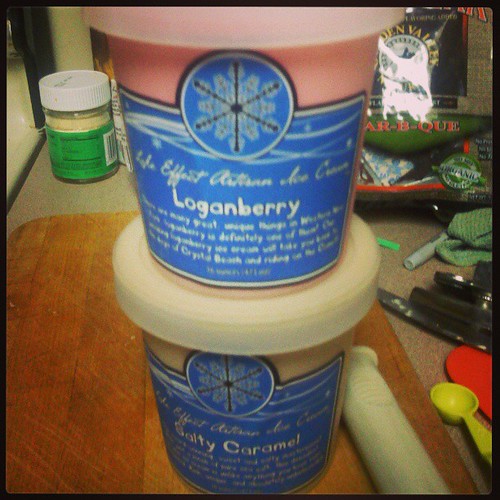
Trying this stuff at long, long last!

For the past couple of years I’ve been hearing about a local outfit that makes artisanal ice cream, called Lake Effect Ice Cream, after our region’s most notable climate feature. Problem is, by ‘local’, I mean within thirty miles of Buffalo, and in the opposite direction from Casa Jaquandor. Lake Effect Ice Cream is located in Lockport, NY, which is quite a road trip from lovely Orchard Park. In other words, we weren’t road-tripping just for ice cream. (What else is there in Lockport, anyway? I’m genuinely curious. If there’s a good reason to road-trip, I’m game.)

But now, the Lake Effect folks have grown big enough to be able to start putting their wares in local stores, one of which actually is about fifteen minutes away from Casa Jaquandor. So off we went today to pick some up.

And…wow.

I had the Salty Caramel; The Wife had the Loganberry. I suppose Salty Caramel is self-explanatory, but for anyone not from Western New York, “Loganberry” probably needs some explanation. Loganberries are a kind of hybrid berry, between blackberries and red raspberries. They are also a very popular flavor of fruit beverage in these parts, not unlike fruit punch. There are few things more satisfying on a hot summer evening than a glass of loganberry drink accompanying a hot dog and fries. Some places have loganberry milkshakes, and now, Lake Effect makes a Loganberry ice cream.

The Salty Caramel is very, very good. The Loganberry is amazing.

We’ll be trying more flavors, obviously. I saw one called “The Aud”, which claims to use as a base “Labatt Blue ice cream”. Ice cream, flavored like the area’s favorite lager beer? Really? Can that be possible?

I will find out, and report!

Share This Post

Makin’ Meatballs

Food has become a bit of a challenge here at Casa Jaquandor of late, as The Wife has found it necessary to adopt a gluten-free diet. For the most part, we find that eating gluten-free is not that hard, as long as you are (a) diligent in checking the ingredients of what you eat, and (b) curious and willing to explore foods you’re unfamiliar with. The Wife is very wide in her tastes and willing to try new foods, so while some favorites have slipped beyond our grasp, we’ve found other things to eat and we continue to look for ways to get back some stuff that’s been ruled out. (I, personally, am not on a gluten-free diet, but it’s often easier to just go that way, simply because it seems silly to make two meals every night.)

Anyway, one thing we’ve been stymied on is meatballs. We’ve always loved spaghetti and meatballs. We have found gluten-free spaghetti, but gluten-free meatballs have been a bit more difficult. So I figured it was time to take matters into my own hands.

Now, meatballs are one of those things I’ve always thought I should be making myself anyway, but never did because I was just lazy about it. This was the time, though, so I bought a package of hot italian sausage links and removed the meat from the casings. Then I mixed the meat by hand with a cup of gluten-free panko crumbs, about half a cup of grated Parmesan, two eggs, and about a half cup of milk. After that, it was a simple matter of shaping the meatballs and baking them at 400 degrees for about twenty-five minutes. The result? Wonderful meatballs that The Wife can eat! We had a few of them for dinner, and now the rest are in the freezer. (My total yield was about 36 meatballs.)

Share This Post

Chickie du Chef

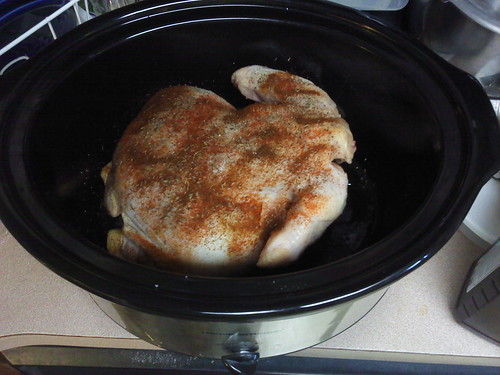
So, in my ongoing efforts to become more culinarily self-reliant, I’ve taken to cooking whole chickens in the crockpot. This, it turns out, is cheaper than buying chicken parts when I need just regular chicken meat for a soup or salad or something. And it’s incredibly easy. I just rinse the chicken, pat it dry, and toss him in the pot. Then I cover him with salt, pepper, and whatever spices I feel like grabbing.

Crockpot Chicken

Crockpot Chicken, done!


The best thing about this procedure, though, isn’t the large amount of cooked chicken I end up with. It’s the next part of the process, because now I’ve begun making my own chicken stock, too.

After we eat whatever of the freshly-cooked chicken we plan on, I bone the rest of the bird and then throw all the remaining parts of the carcass back into the pot (retaining all those wonderful juices that the bird itself exuded whilst crocking away for eight to ten hours). I’m talking skin, bone, fat, gristle, all of it. I cut up a couple of carrots, some celery, an onion, and a head of garlic; into the pot they go. Same with a quartered lemon. Then I cover the entire works with water, put the lid on, and crock the works on low for another twelve hours. The result?

Chicken Stock I

In the words of Emeril Lagasse, ‘Oh yeah, babe.’

I use my Chinese strainer to remove all the big chunks of veggies, bone, fat, and assorted whatnot (if we lived someplace with a yard, I suppose this stuff could go in a compost pile, but we don’t, so into the trash with it).

Chicken Stock II

Then I ladle the broth through a fine sieve to remove the tiny particles of stuff…

Chicken Stock III

…and after that, I have a whole bunch of tasty, unsalted chicken stock. We’ve been portioning it into 8oz servings and freezing it. Having homemade stock on hand is a great feeling, and I’m already thinking of getting beef bones so I can make my own beef stock, too. I can certainly say that my days of using store-bought stocks or bouillon powder are over. Had I known it was this easy–!

Share This Post

Lemons: I like them.

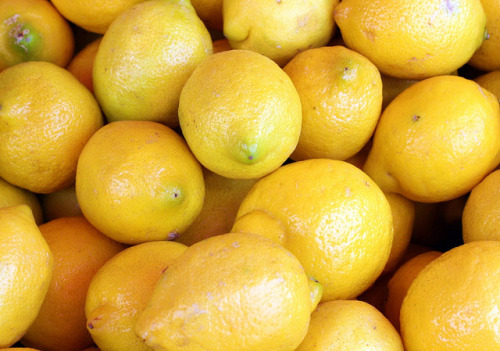
So a few weeks ago I saw an article, linked on Facebook by one of my friends, about the wonderful health benefits of lemon water. The idea is that you start your morning with a cup of warm water, into which you squeeze some fresh lemon. Why? Well, there are apparently a lot of health benefits. I think. In all honesty, I tend to be a bit skeptical of every single “OMG, this is healthy in 47 different ways!” thing that comes down the pike, but I decided to try the fresh lemon thing anyway, because I like lemon and it’s a good way to add some fruit to my daily food intake, which is always a good thing.

I’m not doing the warm water thing, though. I take my water bottle, the one that I use at work (it’s around 26oz, I think), and squeeze an entire lemon into it. Yup, the whole thing. Why screw around with half? One entire lemon, and then I fill the rest of the bottle with water. The benefit here is that, well, lemon just makes the water taste awesome, which gives me a way to drink lots of water without really getting sick of water’s not-terribly-exciting flavor. (Not that I dislike water — I’ve always been a water drinker. But if I can drink water and get a bit of extra fruity vitaminny goodness in there, hey, what’s not to like?)

This new fascination with the wonderful lemon (my next project will be to make Moroccan preserved lemons, once I find a jar big enough someplace) has also led me to investigate lemon concentrates and substitutes, simply because I don’t have time at work to be squeezing entire lemons every time I refill the water bottle. The RealLemon juice stuff is OK, but it’s never been my favorite stuff, as it tends to have a metallic hint to it. But I have found this stuff called True Lemon, which is a powder that comes in little packets. One packet is apparently equivalent of one wedge of a cut-up lemon (cut into 6ths or 8ths, I’m not sure). That stuff makes my water taste as freshly lemony as is probably possible, short of using the actual lemon.

My point here is this: Lemons rule.

Share This Post

Lemon paczki!

I usually indulge myself once a week by allowing the consumption of donuts (never more than two). This week, in honor of Mardi Gras, the donut of choice was the Polish delicacy paczki. I rarely like filled donuts, but I make an exception for these. Lemon filling, yum!!!

The rest of the day I gnawed on a head of lettuce. (No, not really. Too many carbs today, to be quite honest….)

Share This Post

Curse you, Alton Brown!

I recently watched the episode of Good Eats on YouTube in which Alton Brown describes the selection and brewing of tea. As ever, a fascinating episode, even if I don’t intend to follow all of his instructions (in this case, I rather like the little brew baskets that come with teapots). But what really vexed me about this episode was…the kettle he was using to boil the water. This is it:

See that brass ring near the top? The one with the little retro rocketships on it? When the water boils, the steam doesn’t whistle through the spout. No, the steam vents through the exhausts of those rocketships, making them spin around! How awesome is that! I really want one. This kettle is the very definition of ‘shiny’.

And it’s also the very definition of ‘not made anymore so you can’t have one unless you can track one down on eBay and spend a LOT on it’. So yeah: curse you, Alton Brown. Curse you indeed.

Share This Post

The receiving end

I’m in the midst of a vacation from work which started last Thursday and ends this Thursday morning. We took our annual trip to Ithaca for the Apple Harvest Festival, I’ve spent a lot of quality time with The Book, and in general, I’ve relaxed. Huzzah for relaxing! (Although, the joke’s on me as far as sleeping a little later than 5:50 am goes…The Daughter has to get up for school at 6:00 anyway. So I’m pretty much up at the same time that I’m up anyway.)

Yup, it’s been a nice vacation…and today we took care of another item on the list: my quasi-annual pies in the face.

As usual, I made a video of the event, and here it is. It’s quite a bit longer than usual, mainly because I didn’t have the heart to edit Mozart, so I padded it out to the full length of the piano concerto movement.


A pie in the face is a wonderful thing!

My oh my, the tie-dyed guy is pied!

Share This Post

It came from the freezer section!

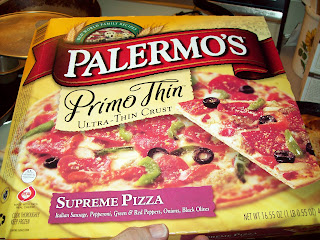
OK, another frozen pizza. Sticking with the Palermo brand and their ultra-thin crust, this time I went the complete opposite way from the cheese pizza I had the first time. This time, I had a Supreme pizza.

In general, over the years, my pizza tastes have shifted from liking tons of toppings to liking only a few toppings. ‘Supreme’ type pizzas too often seem like overkill to me nowadays, what with lots of pizza makers seemingly approaching these pizzas as a way of cramming toppings into every possible bite. The problem then is that all the flavors just end up clashing together, and all those toppings can make the crust hard to get nicely cooked, too.

(Now, there are exceptions here – our favorite local pizza joint, Imperial Pizza, absolutely loads its pizzas with toppings, and they’re frakking heavenly. I am large, I contain multitudes!)

So anyway, here’s the Palermo Ultra-thin Supreme Pizza box:

And here’s the pie just out of the box, before going in the oven.

In truth, I like the way that looks. There is a variety of toppings (pepperoni, Italian sausage, onions, peppers, and black olives), but they’re not so heavily piled on there that the cheese itself disappears. On that basis, this pizza looks promising. Into the oven it goes…

…and about twelve minutes later (the box recommends 10 to 15 minutes of baking), out it comes.

That looks…really nice. Really, really nice. The only downside here is that because toppings are taken right to the edge, a couple of those items actually fell off in the course of baking and wound up on the floor of the oven. There’s a little char around the edges (could’ve been a little more with a few more minutes in the oven), but no real burning. The bottom of the crust, like the cheese pizza, looks great:

But of course, the final test is in the eating. The crust and sauce are pretty much identical to the Cheese-lovers, so I ditto those comments here. The main difference here is the toppings, so what of them? They’re pretty good. Now, let’s be clear here: we’re talking frozen pizza, so we’re not going to be getting the highest quality toppings here. But the pepperoni is pretty good, as is the sausage. The meats are a bit on the dry side, which is fairly typical for frozen pizza; the veggies are decent and taste of what they are. Not great toppings, really, but as frozen pizza goes, they’re pretty good.

I liked this one.

(Why no, this series of posts isn’t just an excuse I’ve given myself to eat frozen pizza. Why do you ask?)

Share This Post