UPDATED below.
Seldom have I been more conflicted over a movie than I am over Star Trek. I mean, wow, am I of two minds on this movie. It’s as if the film has managed to split me right down the middle, which calls for something I haven’t done in a while on this blog: a full-on geek-out of epic proportions. Beware SPOILERS! I hold nothing back.
I loved watching it. Absolutely loved watching it. I don’t remember a more enjoyable piece of pure entertainment than Star Trek. Maybe the first Pirates of the Caribbean movie. As a piece of pure moviemaking, Star Trek is just about as good as it gets. Seriously. The cast is all wonderful, the direction outstanding, the editing is spot-on – there are maybe two or three minutes in the whole movie where the pacing flags a little, and those moments are over just as you notice that the moment in question is running a bit on the long side.
How about that casting? Chris Pine and Zachary Quinto are the most important players here, obviously, as James T. Kirk and Spock. Both are superb. What’s so impressive is that neither man tries to ape their forebears, William Shatner and Leonard Nimoy, instead choosing to create the characters as written for them, and yet also capturing the essence of the characters we all know so well. Karl Urban’s Leonard McCoy is just terrific; most commenters seem to think he’s just giving an eerily accurate impersonation of DeForrest Kelley, but I don’t think that’s quite fair. His McCoy is acid-tongued and emotional, and he gets to zip off the iconic “I’m a doctor, not a ____” line as well as make an angry reference to Spock as a “green blooded ____”, but surely that’s the essence of McCoy, not just of DeForrest Kelley. The remaining bridge crew is all superbly cast, even if there are a few too many riffs on Chekov’s thick Russian accent. (And of course, we all know that Chekov wasn’t on the Enterprise from the launch of Kirk’s captaincy, either. But more on continuity and canon later.)
Eric Bana as Nero, the Romulan villain, is OK, I guess. He doesn’t get much to do except look really angry and revenge-driven. He’s not an interesting villain, actually. Better is Bruce Greenwood as Captain Christopher Pike, who is presented as a father-figure to Captain Kirk. He has a ton of screen presence and charisma, which is exactly what that part needs; if Kirk’s going to grow into that, we need to see an example first.
Yup, this is how to make a movie, all right. Problem is, I’m not sure it’s how to write one. As great a time as I had watching it, I fear that Star Trek is kind of like the M. Night Shyamalan film Signs: the more you think about it afterwards, the less good it looks. (And nobody gets to say “But it’s a movie, you’re not supposed to think about it!” Nonsense.)
Plotwise, storywise, and to some extent characterwise, Star Trek is kind of disappointing in some regards, disappointing in others, and downright annoying in still others. The problem is that relatively few of the developments in Star Trek‘s story make sense. Some are contrived, others are just full of that good old fantasy element of SF, “handwavium”. Now, it’s true that virtually all SF relies to a certain extent on handwavium, but Star Trek positively drips with it.
While I noted above that there are virtually no boring moments in Star Trek, there are plenty of moments that made me think, “Hey, wait a minute.” Taking just one, Spock’s marooning of Kirk on the ice planet: first, doesn’t that seem a bit Draconian? Doesn’t the Enterprise have a brig he can lock Kirk up in? Second, how lucky is it that Kirk is marooned a mile or two from a crappy ice cave where Spock Prime (as he’s called in the movie’s credits) is hanging out, conveniently located to explain the whole plot? And then, how lucky is it that both of these fellows are marooned a mile or two farther away from the crappy outpost where Montgomery Scott is cooling his heels? This whole sequenced bugged the living hell out of me. In fact, Spock Prime’s presence irritated me. But more on that later on, as well.
I recall reading some positive reviews that cited the movie’s ability to avoid Next Generation-like reliance on technobabble to make its impossible stuff happen, but does it, really? A beach-ball sized glob of “red matter” is used, one drop at a time, to create black holes in the center of planets, thus destroying them? A drill that cuts holes to planetary cores? Temporal rifts? All of this is technobabbly, handwavium BS. Again, nothing against handwavium, but Trek has always made some attempt to make its nonsensical stuff seem believable. Sometimes that’s a case of “show, don’t tell” – note that in Wrath of Khan, no discussion at all is given to how the Genesis Device actually works; it just does. And I’d accept the handwavium here, if there wasn’t a lot of other complete nonsense going on that was avoidable. Spock refers to a single supernova that threatens to “destroy the entire Galaxy”. How the hell is one supernova going to do that? The blast wave of the nova, even if powerful enough to destroy a galaxy, would take centuries upon centuries, literally thousands of years, to traverse the entire Milky Way. This was complete nonsense that jolted me out of the movie. Ditto the way Spock is able to stand there on Hoth Delta Vega and watch as Vulcan is destroyed. There’s no way those two planets are that close. They would have to be orders of magnitude closer together than Earth and Mars. This, too, was complete nonsense that jolted me out of the movie. In fact, in terms of plausibility, this is the second-worst thing I’ve ever seen in a Star Trek movie. (The worst is Soren’s missile in Generations, the one that flies from the planet surface to the star in about eight seconds, leaving a contrail as it goes.) And then there’s the whole “going through a black hole takes you back in time” nonsense. This isn’t even close.
Other things bothered me about the movie, as well. For all the stuff early in the movie about James T. Kirk being a screwup and a delinquent, he undergoes a massive shift when he gets on board the Enterprise: suddenly he’s uber-competent and right about everything. There’s no real sense of growth to Kirk in this movie; one minute he’s the screwup with potential and the next he’s displaying “command fitness” out the wazoo. What lessons, really, does Kirk learn in this movie? He really doesn’t learn any, which is unfortunate. Everybody else learns from him, but he’s presented at the beginning of the movie as needing to learn the most.
I also didn’t like the Kobayashi Maru test. I’d like Kirk to have acted the part more, instead of just lazily goofing his way through a test that he knew he’d win. I’d have liked it if it had been the way he originally described it in TWoK: “I reprogrammed the simulation so it was possible to rescue the ship.” (My emphasis.) Instead, he simply reprograms it so he will rescue the ship. That was disappointing.
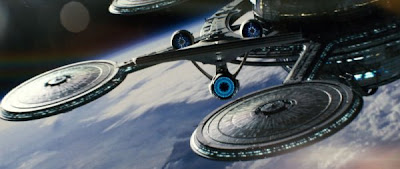
In terms of the film’s general look and appearance: I didn’t dislike the new Enterprise as much as I thought I would, honestly. I’m not big on how the rear ends of the warp nacelles light up when the ship is going to warp; the nacelles aren’t thrusters, after all. (I know they’re dumping all of the previously established canon as far as events in the series, but surely they’re not summarily dumping everything, right? The fictional idea behind warp drive still has to be the same, or else the creators here are just being dishonest.) The bridge is still too bright, too Apple Computer like, and the front viewscreen is no longer a viewscreen, but an actual window, apparently. (And there’s one shot in the movie that seemed to me to indicate that the bridge is now at the bottom of the saucer section! I could be wrong here – the shot was over in seconds – but if I’m right, that’s a huge change, and not one I much like. Why would a new timeline lead to a completely new design of starships? Did anyone else see this shot?)
And that brings me to the time travel stuff. I’ve had mixed feelings about this, ever since the film’s writers started giving interviews in which they indicated that they’re not resetting the Trek continuity to zero but rather kicking off a new timeline in which nothing has changed. The implication is that all the “standard”, or “canonical”, adventures of Kirk and company are still happening, to the Kirk and company in that timeline, where now we’re going to be following the adventures of Kirk and company in this timeline. This is, of course, pure handwavium, of the “have our cake and eat it too” variety. That’s all well and good for the writers, but is that really what happens in Star Trek?
Consider the chain of events. Apparently, in “Trek Prime”, Nero gets all pissed off and takes a mining ship after Spock’s attempt to save the galaxy from the exploding supernova destroys Romulus. But they end up going through the black hole and back in time (ouch). Pretty soon, Nero commits an act that changes history: he attacks the Kelvin, causing George Kirk to die heroically instead of living to raise his son. Now, everything is different. History has been changed.
Freezing the action right there: a few of the very best episodes of Trek ever made involve the changing of history. Most famous is “The City on the Edge of Forever”, in which Dr. McCoy, driven mad by an accidental overdose of some drug, jumps through the Guardian of Forever and winds up in 1930s New York, where he somehow prevents Edith Keeler from dying. Keeler goes on to found a peace movement that keeps the US out of WWII, allowing Germany to take over the world because they develop the atom bomb first. Also, just about every list of the best episodes of The Next Generation I’ve ever seen cites “Yesterday’s Enterprise”, in which the Enterprise-C gets thrown forward in time before it can accomplish what it needs to accomplish, again changing history (this time resulting in a Federation at war with the Klingon Empire). Both times, it’s taken for granted that history must be restored.
Other Trek time travel adventures include Assignment: Earth, in which the Enterprise travels back to 1968 and very nearly ends up a party to changing history again, and “Tomorrow is Yesterday”, when the Enterprise accidentally ends up in 1967 Earth and is seen by an Air Force pilot, whom they then beam aboard the ship and then realize have to beam back without his knowledge of having been there, lest history be changed. The best of the TNG movies, First Contact, has the Borg going back in time to take over Earth in the 21st century and preventing the Federation from ever existing; Captain Picard and the Enterprise-D have to fix history.
So, returning to the current Star Trek: Spock ends up with Nero back in time, and soon realizes that Nero has changed history. With all of that precedent in Trek lore for restoring the proper timeline, what does Spock do?
Nothing. And consider, he’s got his own ship, he knows how to travel in time (he calculated the equations for the time travel to get some humpback whales once), and failing time traveling in his own ship, Spock knows of an uncharted planet where resides a device called the Guardian of Forever. He could try to set things right…and doesn’t. He just accepts the “new timeline”, and at the end of the movie, is seen going off with the rest of the surviving 10,000 Vulcans who are left in the galaxy to re-establish their culture.
I’m sorry, but what the hell is that?!
Seriously, here, WTF? Why would Spock just blithely accept his fate in the “new timeline”? This makes no sense whatsoever. It would have been poetic, maybe, if Spock had tried, but failed, to set things right; maybe that could have ultimately been how Spock finally dies for keeps, and in all the “Hey, we gotta fix what we screwed up in time traveling!” stories ever made, I only remember one in which the time traveler doesn’t get it exactly right. And that’s a segment from one of the “Treehouse of Horror” episodes of The Simpsons. They could have had Spock being unsuccessful in restoring history, and realizing at the end that history is just going to go on now, in its rewritten state; that would have been poignant and gutsy.
Instead, we get this: Spock acting in very un-Spockish way, and some stuff about new timelines co-existing with old timelines from the creators. However, nobody in the movie indicates that the old timeline is still intact and just a dimension or two over to the left, so as far as they’re concerned, this is the way things are gonna be. All of that leaves me to believe that the writers’ babblings in the press about co-existing timelines was just as bunch of made-up nonsense to mollify the fans, who are annoyed at the prospect of a Jim Kirk who will never meet Edith Keeler.
Here’s my problem with that whole “co-existing timelines” thing: it renders the old stories irrelevant. Suddenly there turns out to be a lot less at stake than there might have been otherwise. Why should Kirk allow Edith to die, if he knows that there’s another timeline out there somewhere in which she does die, so why not just save her and have her love? Everything just becomes a bunch of dull counterfactuals. That’s what bothers me about the concept of a reboot – or rather, this particular concept of a reboot.
On reboots in general: they’re not all comparable. People like to justify this Trek reboot by citing Battlestar Galactica, the Batman movies, or the James Bond films. None of those comparisons hold, though. The original BSG lasted just nineteen episodes, so there’s really not much to cheapen by the existence of a reboot. Batman had four movies before the reboot with Batman Begins, and comics movies are a special case, anyway, since the movies exist outside the continuity of the comics in the first place. That leaves Bond – but the whole notion of James Bond being the same guy in Die Another Day and Dr. No is just silly on its face, so this isn’t the same kind of thing. It’s the reality of what exists right now, but the logic just doesn’t hold up.
Another note about canons and continuity: even if I grant that we’re in a new timeline now that starts with the destruction of the Kelvin, there’s still a remaining fact that the producers didn’t seem to realize: you still have to respect the established canon to that point. Which means that you have to deal with certain realities of Star Trek canon: Kirk has an older brother named Sam, who doesn’t appear to exist in the movie. You know who else has an older brother? Spock. So where is Sybok? And so on.
I also didn’t care for some of the depiction of the Vulcans in the movie. For a race devoted to logic and the suppression of emotion, they sure are a goofy bunch, as shown in Star Trek. A culture that advanced only manages to get 10,000 people off the planet? And the response of the “Elders”, whose job it is to keep the culture alive, to the imminent threat of planetary catastrophe is to go hide in a cave? And I’m sorry, but Sarek should never openly admit to loving Amanda. We know that he loves her, and that he shows it in the best Vulcan way, but to say “I married her because I loved her” just stood out as a staggeringly un-Vulcan thing to say. There’s no way Mark Lenard would have stood for that line! And McCoy refers to his divorce, but does his daughter Joanna exist in this timeline?
Other random observations and things:
:: We all know that James T. Kirk is a womanizer, but I didn’t much like how this movie depicts him as having an eye for anything that has the attributes of being a female and having a pulse. This can be chalked up to his being more of a delinquent slacker in this movie than Kirk Prime, but still, it got a bit annoying.
:: I like Michael Giacchino’s score a lot, although I would have liked to hear more of the classic Alexander Courage Trek Fanfare. At times the score called out for it, and it wasn’t there.
:: Why on Earth does Leonard Nimoy give the “Space, the final frontier” speech at the end? By the logic of the film, we should be hearing Chris Pine’s voice there. That made no sense.
:: I just loved the design of the end credits, with all of those nifty alien worlds and stuff. It looked like updated versions of the kinds of planets you used to see on the covers of cheap SF paperback novels.
:: So Nokia is going to survive the next 200+ years as a company? Really?
:: I had no problem with the relationship between Spock and Uhura. That’s fine with me.
:: It probably would have made the cast overstuffed a bit, but I would have liked to see Chris Chapel and Janice Rand in there somewhere.
:: Lots of people are wondering where Nero disappears to for twenty years. My assumption is that his nifty, bad-ass mining ship took some serious damage when it got rammed by the Kelvin, and making repairs to a ship from the future when the technology doesn’t exist probably takes a while. Twenty years? Well…the movie asks us to swallow the notion that a bit of “red matter” the size of a marble can destroy a planet, so why not?
:: But as for Nero’s ship — I didn’t get the design. What are all those appendages for? And why is the “flight deck” filled with ankle-deep water? A ship from the 2300’s doesn’t have floor-drains and plumbing?
:: I’m sorry, but I hated that they were building the Enterprise on Earth’s surface…and there goes another bit of continuity, too. Remember, in TOS, the Enterprise was not a new ship when Kirk took command; the events of “The Cage” are specifically indicated in “The Menagerie” to have taken place thirteen years earlier. That would mean that technically, the Enterprise should already be cruising around under Captain Pike’s command when young Kirk is joyriding in the hot-rod. I know, we’re in a new timeline, but there are limits to what I’m willing to accept as having been changed here. Enterprise should not be virtually out-of-the-box new when Kirk takes over the center seat.
:: The moment where Sulu screws up going to warp speed echoes a similar moment in an old Trek tie-in novel by Vonda McIntyre, called Enterprise: The First Adventure. That novel is a telling of the “Trek Prime” first voyage of the Enterprise under Jim Kirk’s command, and in fact, it’s actually a decent novel, well worth checking out. Kirk’s assignment to the Enterprise is what ultimately causes his break-up with Carol Marcus, and soon he’s getting to know a new crew. Anyway, there’s a moment at the beginning where the Enterprise is leaving spacedock, and Sulu messes up, causing the ship to lurch or something like that.
:: So, what’s next for Trek? The sequel has already been greenlit by Paramount, so I assume in two or three years we’ll be queuing up for Star Trek II…again. JJ Abrams has observed that the Enterprise crew could always meet Khan Noonian Singh again…for the first time, again. Or something like that. I personally don’t want that; nor do I want to see Borg again. Surely we can actually get a new adventure? Actually see some exploring of strange new worlds and new life and new civilizations? You know, going places boldly? In fact, it might be nice to have an exciting SF Star Trek adventure that never has the ship firing phasers or torpedoes. But if we have to bring back old Original Series characters for updating, how about some of the others? How about Klingon commanders Kang and Koloth? How about Harcourt Fenton Mudd? But really: how about a new adventure? Continually revisiting old characters is still fan-service for the Trekkers, and even they probably get tired of the same old thing every time out. (Of course, it’s to be noted that the least successful previous Trek flicks are the ones that tried to show something new instead of posing sequels or follow-ups to previous stories: TMP, The Final Frontier, and Insurrection. But then, I actually like those movies more than most, so….)
Well, anyway, Star Trek is a movie that bugged me, vexed me, annoyed me…and also entertained the crap out of me. Weird. JJ Abrams is a good director. I’m not much impressed by his writing, but his directing is spot on. (I know, he didn’t write Trek. I’m referring to past scripts of his.) I’ll be getting the DVD, you’d better believe it. All complaints aside, the movie did manage to hit my “explodey spaceshippy space opera goodness” sweet spot. Good on them for that much!
(Other blogger reviews I enjoyed were Jason Bennion, here and here; Snell; and Torie Atkinson.)
UPDATE: OK, I expected one, and I got it: a snooty comment from someone saying “You think too much. It’s just a movie.” Well, if I want to take that attitude into a movie, I’ll go see whatever Michael Bay’s got coming out. I expect more from Star Trek, and I didn’t get it here. Yes, it’s a wildly fun movie to watch. No, it doesn’t make any damn sense. The best Star Trek stories are the ones that are entertaining and manage to make sense; this movie got half the equation right. That’s my position, and I’ll think about it as much as I want.
Share This Post