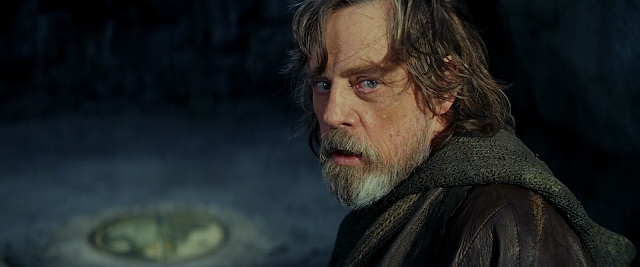
“It’s time for the Jedi to end.” (Thoughts on THE LAST JEDI, part 2)

Part 1

Ever since Luke disappeared, people have been looking for him…he was training a new generation of Jedi. One boy, an apprentice, turned against him. Destroyed it all. Luke felt responsible. He just walked away from everything…people that knew him best think he went looking for the first Jedi temple.

–Han Solo, The Force Awakens

The Force Awakens ended with Rey flying the Falcon, with Chewbacca and R2-D2, to a distant and lost planet where apparently the Jedi Order first began, on a rocky island in a wide ocean. Here she finds Luke Skywalker, who has disappeared. Rey approaches him and offers him a lightsaber–his lightsaber. His original lightsaber, the one that his father carried when he turned to the Dark Side, the one that Obi Wan Kenobi recovered after defeating Vader on Mustafar, the one with which Luke first fought Darth Vader before losing his hand and seeing that lightsaber plummeting down the central shaft of Cloud City.

In The Last Jedi, we continue this exact moment. Luke takes the lightsaber, looks at it, looks at Rey, looks at the lightsaber again. It’s his new “Hero’s Journey,” his new call-to-adventure–and he immediately rejects it. He tosses the lightsaber over his shoulder and walks away. Luke has no intention of returning to the fight. He tells Rey that he has come here to die. He really did give up on everything. He has come to Ahch-To, the first Jedi planet, to bring it all full circle. When he dies, the Jedi will have begun and ended in the same place. Luke didn’t come to the “first Jedi temple” to find some special wisdom or motivation. He really is giving up.

I am not really a big fan of this notion in itself. The Luke Skywalker who refused to give up on the idea of some small bit of goodness still flickering in the heart Darth Vader, his father and the most terrifying Sith Lord of all? That Luke Skywalker? And having the failed Jedi student be none other than Han and Leia’s son? No, I am not a big fan of that development. It doesn’t resonate with me. But Rian Johnson’s script for TLJ treats the idea with respect and logic, which I appreciate. It’s an old archetype in itself, the tired and weary onetime hero who has to drag himself out of his final, bitter retirement for one more attempt at glory. Decades after Ben Kenobi looked Luke in the eye and said “You must come with me to Alderaan,” along comes Rey to call Luke Skywalker to adventure again.

The problem I have–which Rian Johnson attempts to address, with varying results–is that we’ve seen Luke’s heroism before. We’ve seen him at his heights, and we’ve seen him when he’s already hit rock bottom and been in the pit of despair. We’ve seen him triumph, and yet here he is, utterly defeated. But we have seen nothing of his defeat. We haven’t seen him lose, we haven’t seen his failure. As deftly as Johnson handles Luke’s version of the Reluctant Hero and Mentor, he can’t do it total justice because the preceding film hasn’t done the heavy lifting that it needed to do to justify this story. Johnson tries his best with some flashbacks and a nod to Rashomon, but I am still left wondering the thing I wonder so many times in this sequel trilogy: “How can this be the way it all turned out?”

It’s hard to really get invested in a story when I don’t buy its premise in the first place.

So Luke has come to Ahch To to die. Fine…but is he sick? Has he become “old and weak,” like Yoda was? Or is he planning to live however many years it takes in seclusion on this island? And if he has come to die, then what of the “sacred Jedi texts”? Does he plan to burn them at some point and he just hasn’t got around to it? Or does he plan to die and just leave them there on the shelf? Eventually they’d get found again. Maybe he has those weird caretaker beings sworn to the task of destroying the texts if and when he dies.

As near as I can figure, Luke is trying to break the cycle. His father fell to the Dark Side, and his nephew has as well. He is weary of the whole Light Side/Dark Side dichotomy and the endless yin-and-yang of Jedi-and-Sith. He has come to resent the idea that the Jedi and the Sith hold the only claims to be able to speak for the Force, which penetrates all living beings in the universe. In an interesting moment, Luke openly acknowledges the events of the Prequel Trilogy (how that must have rankled some fans), noting that the Jedi at the height of their power still failed to notice the rise of Darth Sidious in time to keep him from utterly destroying them. He gets this wrong, of course (the Jedi of the Prequel era were not at the height of their powers; far from it, actually). But that doesn’t matter. What matters is that Luke is sick of the cycle of Light-to-Dark-to-Light again. He wants a new paradigm for relating to the Force, and in the absence of that, he’s content to let the old paradigm die.

The only way to win the game, for Luke, is not to play.

Luke’s story in TLJ isn’t just a second Hero’s Journey; it’s a redemption story. Luke blames himself for Ben Solo’s fall to the Dark Side (more on that whole story, which is one of my least favorite aspects of these new films, in a later post). It takes an appearance by Yoda to make Luke realize that he has a chance for his own redemption, and it is not by somehow redeeming Kylo Ren. Instead his task is to truly serve as a Master for Rey. She is already tremendously powerful, beyond even Luke’s abilities. Yoda takes Luke to task for not actually passing on what he has learned, and for being stuck himself in the very paradigm that he is trying to move beyond. Yoda acknowledges that the old ways of Jedi-dom should probably end, but he also points out that this doesn’t mean ending the entire thing, forever. He also makes one of the film’s wisest points in one of its finest moments when he says to Luke: “We are what they move beyond. That is the burden of all true masters.”

So, in light of all this, what should we make of Luke’s final actions? Are they pointless? All he really does is buy time for the handful of surviving Rebels to escape. But he has a much-needed confrontation with Kylo Ren, and thus he confronts his own past. There is a peaceful kind of determination about him in these moments, and even a bit of cockyness in the wonderful moment when he flicks an imaginary bit of dust from his shoulder. He is by design driving Kylo Ren to a distracted rage, and he leaves his former student with the bitter taste of a victory that was not a victory at all. The Jedi will endure after all, as will the Rebellion. And all this from Luke walking out with a laser sword to face down the entire First Order.

Luke Skywalker’s journey in TLJ is a very layered one. He has been a Campbellian hero before, and now he is the Campbellian mentor figure. But he is also still a hero, and he must walk his own path even as he helps Rey embark upon hers. He has to pass away in this film, because Rey’s final steps must be taken alone. Luke completes his job on Ahch To, sending a copy of himself to face Kylo Ren; then, the job done, he sees the binary sunset of his youth one last time as he goes into the Force and as the Force welcomes him home. He goes, as Rey tells us, with “peace and purpose.”

Luke’s path has always been unique. He was the Jedi who shouldn’t have been, the Jedi who arose outside all the old traditions and structures of the Jedi Order, the one who mostly had to figure it all out on his own. Even at the end, when he is planning to the the Jedi die with him, he does not bow to Jedi orthodoxy; it turns out that he has never read those “sacred Jedi texts,” and indeed he has cut himself off from the Force. But when he returns, when he lets the Force back in, he does so spectacularly, projecting a physical copy of himself across the stars. (And he is physically there, at least partly. He embraces Leia and puts the dice in her hand. Kylo Ren picks them up…before they, like Luke, disappear.) The film does suggest that maybe it’s the sheer effort of this that has led Luke to die, and maybe that’s a part of it. But it’s probably also partly that he knows that his work is done and that he can let go.

Perhaps it’s both.

So, with TLJ, the “Adventures of Luke Skywalker” come to their end. Only two Skywalkers remain, and one will sadly have to die off screen before the next episode begins. But meantime…what of Leia Organa, the last of the original trilogy heroes still alive when TLJ ends?

More on her in Part 3, “We fought to the end.”
Share This Post

"Amazing. Every word of what you just said was wrong." (Thoughts on THE LAST JEDI, part one)

So here we are, more than six months after the release of STAR WARS EPISODE VIII: THE LAST JEDI, and I’m only just now working out how I feel about it. I suppose this is is how it’s going to be with me and Star Wars as it moves forward in its post-Lucasian era. I expect that I will feel a bit conflicted about every successive movie that comes out. My feelings on THE FORCE AWAKENS took a long time to crystalize, until I generally settled on the view that it is two-thirds of a great movie followed by one-third of a terrible one. ROGUE ONE I liked considerably more, especially on the rewatch when its fine qualities stood out even more and its minor flaws receded somewhat (still, my only real objection that that film lies in its final two minutes).

Leading up to TLJ, I was in a strange place. I was looking forward to the film because I liked the new characters established in TFA, even if I didn’t care for a lot of the writing behind them thus far. I knew that we’d finally get to see Luke Skywalker again, and I expected some very emotional stuff involving Princess and General Leia Organa, made doubly poignant by the awful fact of Carrie Fisher’s passing after she completed filming. Other than that I genuinely had no expectations regarding the movie. As the TLJ release neared, a week or two out I suddenly realized that I knew less about this movie than I had about any Star Wars movie since The Empire Strikes Back. I went into TLJ knowing almost nothing about the story, which was a really interesting sensation. All I knew, literally all I knew, was what I saw in the teasers and trailers.

TLJ makes a lot of interesting choices. Some of its developments are clearly telegraphed, but in such a way as to conceal the telegraphing. Other times, Rian Johnson–our writer and director–seems to be telegraphing things, only to have them never come. Surely I can’t be the only one who, catching that throwaway glimpse of Luke’s X-wing submerged in the Ahch-To sea, expected a scene later when he would Force-raise it from the water, easily and effortlessly, just as Yoda once did for an unbelieving younger Luke. That didn’t happen. The film does contain call-backs to The Empire Strikes Back, but not that one. (In fact, TLJ calls back to nearly every episode thus far.)

For the first time we have a Star Wars film that literally picks up where the last one left off, an interesting nod to one of George Lucas’s most famous influences, the movie serials of his youth. We have a Star Wars film that points out gray areas in the established moral fabric of the Star Wars universe, and we have one of the most narrowly-focused Star Wars films yet. For a film with such an initially epic feel, what results is the most intimate Star Wars film ever made.

TLJ also takes what is perhaps the most elegiac tone yet in a Star Wars film. Revenge of the Sith was pure dark tragedy, and there was quite a bit of darkness in The Empire Strikes Back, but with TLJ we get our truest farewell to the Star Wars of old. We’ve already bid farewell to Han Solo, and now it is time to do the same for Luke Skywalker (at least in the physical sense). All that remains at film’s end of the Star Wars of old (aside from C-3PO and R2-D2) is Leia Organa, and given what’s gone before in this trilogy already it’s hard to imagine that Episode IX would not have depicted her death as well had Carrie Fisher not awfully and finally settled that issue by dying in real life. I imagine Episode IX may well open with Leia’s funeral. The feeling is of a conclusive passing-of-the-torch, an ending to the story that George Lucas began. Whatever stories come now are totally new and of a piece with Star Wars but not a part of it. In some ways I left the theater after TLJ with the same feeling that I left Star Trek VI: The Undiscovered Country way back in 1991, after seeing those actors’ signatures animated on the screen.

Back in the early 1970s, George Lucas appended a subtitle to one of the early drafts of a script he was working on for “a little science fiction project”: From the Adventures of Luke Skywalker. But those adventures are now ended, and this final trilogy in the Skywalker family saga feels perfunctory in many ways. Kylo Ren, Ben Solo, is now the only remaining Skywalker blood relative (barring some sort of JJ Abrams bombshell that keeps the Skywalkers going, and honestly, we can’t really rule that possibility out, now can we?).

If George Lucas’s original concept was an epic space opera combined with a closely-focused family saga, then this trilogy, despite being cast as Episodes VII, VIII, and IX of that story, feel less like that tale than an appended three-film epilogue designed more to set the stage for other stories than to the completion of this one. I suspect this is borne of a desire to have it both ways: to please the existing fans, but also to start moving Star Wars into the post-Lucas and post-Skywalker era. This approach is not always successful and may explain a lot of what I see as the questionable creative choices of these films. The best of these post-Lucas films thus far, for me, has been Rogue One, but even that film was severely hampered by a closing two minutes of awful fan service after two hours of very compelling storytelling in which the word “Skywalker” was never uttered.

TLJ ultimately suffers from the issues that afflicted TFA, chief among them the saddening notion that after all the crap that our heroes endured over the course of the Original Trilogy–what Yoda once called “all for which they have fought and suffered”–their hard-earned victory amounts to nothing. Their lives basically go to shit anyway: the Republic never takes hold, a new Empire stirs, Han and Leia have a kid who turns to the Dark Side, Han gives up on everything and goes off to being a space loser, Luke gives up on everything and goes to hide on some planet with some really pretty islands, Leia finds herself right back leading a war effort.

Better, perhaps, if this story had been set not thirty years later but a hundred years later, when Luke, Han, and Leia are but beloved memories instead of the weary, haunted star warriors for whom we are less rooting in their elder adventures than to whom we are saying our slow farewells.

I’ve seen a bit of criticism of Star Wars in general (the films thus far, at any rate) for being too Skywalker-centric. People would speculate on Rey’s parentage, wondering if she was a “lost Skywalker,” and the retorts would come: “Why does EVERYBODY have to be related in Star Wars!!!” Well, everybody isn’t related, but more to the point, George Lucas’s saga was always a family saga. It was one piece of galactic history, told through the lens of a couple generations of this one family. This is nothing new. Dallas wasn’t about the city of Dallas; it was about the Ewing family. Dynasty was about the Carringtons, not Denver. Bonanza was about the Cartwrights, not the entire West.

TLJ is, for all intents and purposes, the real farewell to the Skywalker family saga. Luke and Han are gone, Leia must be, and it seems beyond the realm of possibility for Kylo Ren to carry on the line. Whatever comes of Star Wars now, it will almost certainly not be the story of the Skywalkers. Maybe you think that’s good, maybe not. I’m of mixed mind. I don’t mind the Skywalker story ending…but really, they do seem to have all gone out with more whimper than bang. The Skywalker saga is petering out. It’s a little as if the last season of Dallas follows the last Ewing, a guy named Pete whose last name isn’t even Ewing because of marriages, who has left the oil business, works in a call center in Fresno, and is also an asshole.

I am not saying that Star Wars absolutely has to be about Skywalkers forevermore, until the end of time. One of my favorite Star Wars stories ever is Claudia Gray’s amazing novel Lost Stars which follows two young people into adulthood as their lives carry them through the events of the Star Wars saga, with only a few tangential encounters with anything named Skywalker. I am not opposed to opening the Star Wars universe to new possibilities, new stories…but this approach, right now, does feel like a simultaneous offering to fans and a reboot, not unlike the also-Abrams Star Trek reboot of 2009. He couldn’t just start over from scratch with the characters and say “We’re starting over.” He had to make connections to the “real” Trek to keep the fans happy (jury’s out as to whether it worked), and now we have some of the same thing going on.

None of that is TLJ‘s fault, though–this movie had to start with the ending point left for it by its maddening predecessor. So, how did I really feel about TLJ? Indeed, it’s complicated. I don’t like where the film had to start, and I don’t like the baggage it was forced by the previous film to carry…but given those constraints, I actually did like the film a great deal. I may have even loved it, as unenthusiastic as I am about the general direction Star Wars seems to be taking right now.

Part 2: “It’s time for the Jedi to end.”

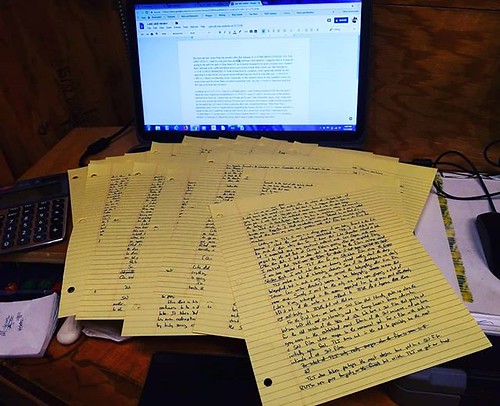
(BTW, one reason this review was so long in coming is that I wrote it out longhand first…and I kept writing…and writing…and writing. Seriously, look at this!


In the "yikes" department, those handwritten pages contain my review of THE LAST JEDI, which I am now starting to type up for the blog. #amwriting #writersofinstagram #essays #blogging #longhand


That’s just about the entire review, which I’m now posting here in installments. Yikes indeed!)

Share This Post

At least THAT happened in 2017!

Mark Hamill, Luke Skywalker himself, tweeted my name.

Here’s how it happened.

It began with, surprisingly enough, William Shatner:

Mark Hamill, cited by Mr. Shatner, replied:

Funny reply! Until, that is, a Star Trek geek from the Buffalo, NY area felt the need to point out that Mr. Shatner never faced the Borg on Star Trek. They came along for Patrick Stewart’s tenure as Enterprise captain.

Sayeth the Trek geek from Buffalo:

And then, replyeth Mr. Hamill:

Squeee! Proof for eternity that for a period of time–who cares if it was mere seconds long–Mark Hamill was aware of my existence!

I, of course, couldn’t allow Mr. Hamill the last word, so:

And as of this writing, there we stand.

Sometimes the future is kind of cool, in amidst the moments of existential dread and the ongoing awareness that everything is terrible.

Share This Post

The Fifteen Greatest Science Fiction Movies (according to me)

Not long ago the awesome folks at The Geekiverse posted their Top Fifteen Science Fiction Movies.

Their list is, for the most part, a pretty good list! And yet, I disagree with it! Naturally! So, let’s have at it: here is my personal list of the top fifteen sci-fi movies. I will go in reverse order, with comment.

15. Flash Gordon

Recently seen and written about! This is almost my platonic ideal of an afternoon fun movie, the kind of thing I watched on a Saturday afternoon as a kid with either a bowl of popcorn or a can of Planters Cheez-Ballz. I have never not loved this movie.

14. Galaxy Quest

Some people actually include this in their ranking of the Star Trek movies. I don’t, but if I did, it would outrank quite a few of the actual Trek flicks. Yes, it’s parody, but it’s parody with some real stuff to say, genuine heart, and an understanding of what really made the object of its humor so worthy of a devoted fan base.

13. Forbidden Planet

To modern eyes it’s a clunky and slow movie, full of cliché and occasionally almost laughable in its depiction of a future humanity where everyone dresses the same and follows the lantern-jawed blond leader around. This was a very effective game-changer back in the day, with its Shakespearean-inspired story and that electronic score.

12. The Iron Giant

Made when animation was just starting to shake off its cultural ghetto of only being suitable for telling Disney-style fairy tales, this movie is something of a Cold War analog to ET, with sadness at the end that is every bit as earned as in the other film. The Iron Giant tells an amazing story with economy and humor.

11. Terminator and Terminator 2: Judgment Day

OK, sure, I’m cheating naming two movies under one entry. It’s hard to separate these two, though, as they really combine to tell a single larger story very effectively. They are both amazing techno-thrillers with time-travel and a seemingly unstoppable enemy; they are also deeply human movies and the second one adds incredible visual effects to boot (the T1000 is every bit as convincing now as he was then).

10. TRON

I still remember my keen disappointment in 1982 when TRON came out. I loved it, saw it twice that summer, yada yada. I assumed that it would be the next Raiders or ET, the next thing that every kid saw. Instead, I got to school that fall, and nobody had bothered to see the movie about “the world inside the computer”. Alas. I still love it, for all its nifty world-building and videogame lingo.

I also enjoyed the sequel a great deal, which again does not seem to have been a universal opinion.

9. 20000 Leagues Under the Sea

I read some Jules Verne as a kid. I didn’t really understand him, but I could sense that there was some neat stuff going on there. This movie clears up a lot of it, making for a voyage into the unknown on our own planet that is fraught with wonder, danger, and a little madness. Like all sci-fi movies from the 50s and 60s it takes a bit of willingness on the part of the viewer to go where it’s taking us, but it’s a grand adventure of a movie.

8. The Adventures of Buckaroo Banzai Across the Eighth Dimension

For sheer gonzo weirdness, I don’t think this movie will ever be beat. It’s just fun, with characters that are a hoot to watch from start to finish. Jon Lithgow’s villain is over-the-top goofy hilarity, and Peter Weller balances everything with an understated performance as Buckaroo that somehow makes the entire thing believable. The movie also gave me one of my favorite obscure quotes (which nobody ever gets when I say it in real life): “Whoa, don’t tug on that! You never know what it might be attached to!”

7. The Day the Earth Stood Still

Sure, it’s heavy-handed messaging about nuclear war, and I’m not usually a fan of heavy-handed messages in stories (“If you want to send a message, use Western Union!” the saying goes). But this one is crouched in eerie mystery, and the iconic visual of robot Gort on his relentless march of destruction sticks with me even now.

6. 2001: A Space Odyssey

I saw this at a science fiction convention in Portland, OR when I was in fourth grade. I didn’t understand most of it…or rather, big chunks of it. I read the book a few years later, and then I watched it again on home video, and it never fails to engross me when I watch it. Huge and epic, and yet with only a handful of people in it; ambiguous and yet full of strange wonder. What does it mean? I dunno, really, although I do think it’s a story of unnamed aliens encountering humans at various stages in development over the millennia and performing uplift on occasion. I think.

5. Close Encounters of the Third Kind

Such a fantastic film this is! The tale of the aliens who implant strange visions into the minds of ordinary people for no other reason than to screen them for purposes of finding out who gets to make the first contact is still incredibly effective, drawing on the late 20th century UFO lore to tell a tale of optimistic meeting with aliens for the first time. I can’t wait to see this when its reissue comes out this fall. (Yes, the story has problematic elements regarding Roy Neary’s family life and the morality of Neary just leaving them to go fly with the aliens. Steven Spielberg has even admitted that he would end the film differently if he made it today. Still, those problematic aspects of the film raise important questions.)

Previously written about here.

4. The Abyss

What a ride this movie is! Again with the Cold War subtext, this time with aliens under the oceans. The version to watch here is the Director’s Cut, which restores a subplot that, yes, does hearken back to The Day the Earth Stood Still. But the way it all turns out is well-earned (even if James Cameron’s complete lack of subtlety does let him down a little bit). The film’s main mystery is fascinating to behold as it unfolds, and the film’s villains are also interesting people whose fears and aims aren’t entirely unjustified.

Previously written about here.

3. ET: The Extra-Terrestrial

This movie is near perfection, from its relationships to its pacing to the design of ET himself to the incandescent score by John Williams. Just listening to the music from the last scenes of this movie has been known to make me cry.

2. Castle in the Sky

This is almost my favorite Hayao Miyazaki film, but it’s here on this list because Princess Mononoke is a fantasy. Castle is an adventure-filled wonder-fest that involves a young girl with secret powers who may fulfill prophecies, the various groups looking for her, and…a castle in the sky, floating forever hidden beyond a bank of clouds. Hayao Miyazaki’s films have influenced my storytelling in ways that I haven’t even figured out yet. (BTW, this one is playing next month as part of the Fathom Events roster of great movies! If you’re interested, check out FathomEvents.com for info on screenings in your area.)

1. Star Wars

Oh, come on. Was there any doubt?

Now, this raises a question: can I name just one film? After all, I did cheat with the Terminator movies. But Star Wars now stands at eight movies, with the ninth on the way at the end of this year. Plus, they don’t all combine into one story as seamlessly as one might like. These tend to get made one-at-a-time and aren’t always conceived with the greater story in mind, which leads to tonal inconsistencies and a few lumbering plot points.

But I don’t care.

Star Wars (or, A New Hope) made me the storyteller I am today, which means that maybe it made me who I am today. More on this in this essay I wrote on the fortieth anniversary of the first film.

Honorable mentions:

Here’s a list of movies that I considered but which did not crack my top fifteen, for one reason or another. Titles marked with an asterisk came this close to the Top 15.

This Island Earth
Spaceballs
Battle Beyond the Stars
(written about here!)
Star Trek: TMP, II, III, VI, and FIRST CONTACT
Blade Runner
(I’ve tried, folks, really. I don’t think I’ll ever care about the characters in this story, though.)
Apollo 13 (Might not be science fiction…in fact, it probably isn’t)
The Black Hole (written about here!)
Brainstorm
Journey to the Center of the Earth
The Last Starfighter
Night of the Comet
Heavy Metal
Back to the Future
The Fly
Guardians of the Galaxy*
(again, not sure if it’s SF or Superhero)
Batteries Not Included
The Rocketeer
Jurassic Park*
Demolition Man*
Meteor
(Yes, it’s crappy 1970s disaster porn. I still like it.)
Space Battleship Yamato (written about here!)
The Postman (Not great, but not nearly as bad as its mega-flop reputation has us think)
Contact (written about here!)
Men in Black
Armageddon
(This movie is not good, and I can’t not watch it when it shows up.)
The Fifth Element (I need to see this again; it’s been fifteen years or so)
Atlantis: The Lost Empire
Eternal Sunshine of the Spotless Mind
Sunshine
Sky Captain and the World of Tomorrow
The Incredibles
Independence Day
Robocop
John Carter
(written about here!)

Here are some prominent SF films that I haven’t seen and yet need to:

Metropolis
Gattaca
War of the Worlds (Spielberg)
Planet of the Apes (the new ones)
Akira
AI
Treasure Planet
(Technically I’ve seen this and I disliked it, but enough people have told me otherwise that I’ve wondered if I owe it a rewatch)
Inception
Edge of Tomorrow
Minority Report
Jupiter Ascending
Tomorrowland

The Mad Max movies (Seen so long ago that at this point it’s easier to just say that I haven’t seen them at all.)

And finally, what of Alien and The Matrix? I dislike both, as movies and as franchises. And no, I don’t subscribe to the whole “Well, I don’t like it but I have to grant that it’s a classic” thing. Dislike is dislike for me, period.

Oh, and I cannot hate Starcrash, even though it is really, really, really really really bad.

What say you all, folks?

Share This Post

On Fantasy and Film

George RR Martin lists his Top Ten Fantasy movies. Of course I have thoughts!

First off, a stipulation: lists like this are mainly meant to inspire discussion and debate and, being that this is the Internet, rock-throwing and name-calling and aspersion-casting-upon-one’s-children-and-parentage. OK? OK!

Second: Well, Martin actually has a pretty good list here. You’ll have to click through to see his comments on each film (worth doing, also for the honorable mentions), but here’s the Top Ten by itself:

1. The Lord of the Rings (complete)
2. The Princess Bride
3. The Wizard of Oz
4. Ladyhawke
5. Dragonslayer
6. Monty Python and the Holy Grail
7. Dark City
8. Pan’s Labyrinth
9. Beauty and the Beast (1946, dir. Cocteau)
10. Raiders of the Lost Ark

Martin’s “honorable mentions” include some Disney movies (more on that below), Dracula, Frankenstein, Legend, Labyrinth, and Excalibur.

So. Discussion!

As noted, Martin generates a pretty decent list. I’ve seen seven of his ten (Dark City, Pan’s Labyrinth, and the 1946 Beauty and the Beast are the ones I’ve missed). I personally quibble a bit with Raiders: even though it has supernatural elements (as do all the Indiana Jones movies), I see them as primarily adventure films rather than fantasies. But that’s quibbling, and the fact remains that if you’ve never seen fantasy on film, watching all of the movies on Martin’s list is a great start. Also, I do not quibble at all with his Number One pick, which is as good as filmed fantasy gets.

Ladyhawke and Dragonslayer? Hmmmm. I like both, but I’m not sure I’d rank them this highly on my Filmed Fantasy Pantheon. In fairness, though, it’s probably twenty-five years since last time I saw Ladyhawke, and not too much shorter than that since my last viewing of Dragonslayer. I remember the latter being a well-made and exciting fantasy, if a bit dour in tone. I owe both a rewatch, though.

My biggest quibble with Martin’s list is that in his latter commentary he notes that for this list he adopted a “No animation” rule:

Going into this, I decided I had better exclude all animated films. Otherwise the list might well have been dominated by Disney’s classic retellings of time-honored fairy tales: Snow White, Sleeping Beauty, Pinocchio, and The Little Mermaid.

See, the problem here is that animated films are still films and animated fantasy films are still fantasy films. Likewise, there’s no reason to assume that the animated films will dominate the list, or that those animated films that will be doing the dominating are Disney films. A Top Ten list is often going to be exclusionary to the point of absurdity to begin with, but this is particularly bizarre, like making a Top Ten Restaurants of New York City list, but excluding those restaurants that focus on French or Italian cuisine. And in mentioning Disney, Martin makes a telling omission: he omits the masterpieces of Studio Ghibli. Looking at the list above, I would quite willingly trade Ladyhawke and Dragonslayer for Princess Mononoke and Spirited Away.

Then there’s Martin’s dismissal of Willow:

Then there’s Willow. Sorry, no. Yes, I liked Val Kilmer as Mad Martigan, but that’s about it. Willow set filmed fantasy back 20 years.

Look. Taste is taste and if you don’t like a movie, so be it. I don’t think Willow is a classic either, and I wouldn’t put it on my Top Ten Fantasy Movies list either. But yeesh, it ain’t that bad. I genuinely think that Willow has received a bum rap over the years. It’s an OK, fun, swashbuckling Sunday-afternoon-on-a-winters-day movie, and there’s a lot more in it that’s good than Val Kilmer.

And “Willow set back filmed fantasy by 20 years”? That’s a very silly statement to make, and Martin has to know better. Look at all the fantasy movies that came out in the 1990s, within just the first ten years after Willow (which came out in 1988). And just ten years after Willow, The Lord of the Rings was in pre-production. No, Willow did not hurt filmed fantasy. It’s a dumb thing for Martin to have said.

Let’s see, what else? Well, Martin doesn’t mention any of the Harry Potter movies, which seems odd, because they’re giants in the filmed-fantasy world, and they are a highly underrated achievement. They got the same cast together for eight movies over about ten years and told a big story. A little more respect for Potter, please!

And finally, Martin has this to say about Excalibur, which is probably the best version of the King Arthur story filmed yet:

I mentioned Excalibur earlier. There’s much to admire about John Boorman’s film. The visuals are a feast for the eyes, and the movie includes some wonderful performances. But Nigel Terry has to be the least charismatic King Arthur in film history, pouting his way from start to finish, and the film tries to cram in too many different aspects of Arthurian legend, and does justice to none of them. Some studio really needs to step up and film the definitive modern treatment of the Matter of Britain, T.H. White’s The Once and Future King. And not as a cartoon (Disney’s The Sword in the Stone) or a musical (Camelot) either. White’s trilogy deserves to be done as three films, the way Peter Jackson did Lord of the Rings.

OK. If you use the word “cartoon”, that tells me that you don’t really respect animation. Not really. Maybe the Disney film of Sword in the Stone wasn’t particularly good, but to dismiss the effort entirely makes me think there’s a little more to Martin’s stacking-of-the-deck against animation. As for a musical, well–no, Camelot isn’t great. That’s not why the “definitive” version of the Arthurian story hasn’t been filmed, though.

I think it’s because the Matter of Britain’s very nature is stacked against a film or even a tetralogy of films (The Once and Future King is a gathering of four previous books, not three, as Martin should know). The Arthur story isn’t one story but rather a whole bunch of them clustered together under one banner. I don’t know how one film or even several films could make that all work without significant re-casting of the story and removal of some of its key parts. Gillian Bradshaw’s trilogy of Arthurian novels, perhaps, or Mary Stewart’s wonderful trilogy of Merlin novels. Any telling of the Arthurian story is going to leave something behind, because it can’t possibly all be squeezed in there. I doubt very much if we’ll ever see a massive filmed trilogy of the King Arthur story, to be honest. That’s a bummer, but I think that’s the way it is.

So, what would be my Top Ten Fantasy Films list? Well….

1. The Lord of the Rings (complete)
2. Princess Mononoke
3. The Princess Bride
4. Conan the Barbarian
5. The Thief of Baghdad
6. Time Bandits
7. Who Framed Roger Rabbit
8. Harry Potter and the Prisoner of Azkaban
9. Excalibur
10. Monty Python and the Holy Grail

How about yours?

Share This Post

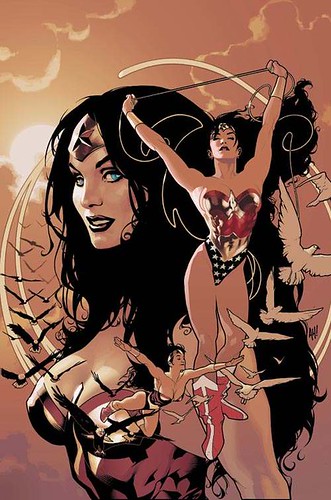
“I believe in Love” (Thoughts on WONDER WOMAN)

SPOILERS for WONDER WOMAN below. Seriously. I make ZERO effort to not spoil the movie.


Wonder Woman II


I have always counted Wonder Woman among my favorite superheroes, even though I never read her comics all that much. I wasn’t much of a comics reader until I was a teenager, and my main exposure to Wonder Woman as a kid came via the wonderfully fun–if highly campy–teevee show with Linda Carter. When I was seven or eight I bought, with my parents’ help, a copy of the Wonder Woman installment in a series of books called the Encyclopedia of Comic Book Heroes. Even though I knew next to nothing about Wonder Woman’s lengthy mythology at that point, I still enjoyed thumbing through that book and reading the entries on the various people and villains in Wonder Woman’s life and imagining the stories. There are times when reading about stories can be as thrilling to the imagination as reading the stories themselves.

Later, when I became a regular comics reader in the mid-1980s, I didn’t read Wonder Woman at all. At that time, DC Comics was in a creative rut and I gravitated toward the exciting and emotional (or downright angsty) Marvel books. Wonder Woman was actually put on a hiatus while DC pulled off a massive reboot of their entire comics universe in an event mega-miniseries (I know, that term makes no sense, deal with it), and after that, Wonder Woman herself received a reboot from Square One in a new series by Len Wein and George Perez. That’s when I jumped on board, because I absolutely loved that series. It was bright and cheerful and humorous and filled with adventure and mythology. That book came along, with its colorful tone, right around the time that Marvel was starting to get pretty dark in its own storytelling, what with gang wars and straight-up noir in the Spider Man books and the Mutant Massacre in the X-titles.

Eventually, of course, Wonder Woman had to get her own movie, right? Except even that took forever. There were abandoned scripts and false starts galore, most notably a script by Joss Whedon (which I have not read but which recently came to light and received some criticism from feminist voices I respect). As a Wonder Woman film came closer and closer to being a reality, though, I became nervous. DC’s track record in its superhero movies has not been especially inspiring. Yes, the Nolan Batman films are good (the first two, anyway, I haven’t seen the third), but the new take on Superman has proven to be a grim, washed-out exercise in violence and grimdark, and while I thought that there was a lot to like in the Green Lantern movie, there was simply too much in that movie, resulting in something of an overstuffed mess. I was skeptical, frankly, that the DC creative voices–with their Superman who kills, and their constantly-brooding Batman–could do justice to Wonder Woman.

Now the movie is here, and they have done justice to Wonder Woman.

They made a wonderful movie that does honor to the character, that isn’t depressingly dark, that leaps and soars with all the thrilling wonder that a superhero movie should (doubly so if that word is in the very title), and tells a story of good versus evil that is nevertheless nuanced and thoughtful. Wonder Woman may well join Superman (1978), Spider Man 2, and Guardians of the Galaxy as my favorite superhero films ever.

Every first film featuring a newly-adapted superhero has to be an origin story, which is probably why the most frequent complaint I’ve seen about Wonder Woman is that we don’t really see Princess Diana in full-Wonder Woman regalia until we’re halfway (or more) through the film’s generous run time. Frankly, I didn’t care. Everything that precedes her arrival is engaging and fun, and the film’s first act–depicting Diana’s youth and coming-of-age on Themyscira–is an engaging mini-film in its own right. We begin with a brief precis of the film’s basis in Greek mythology, done with a stylized animation sequence that calls Greek theater to mind and establishes Ares, the God of War, as the main villain behind everything that has happened. How the movie handles that main villain is one of its more interesting aspects, but more on that later, because the film takes us to Themyscira, the secret hidden island of the Amazon warriors whose task it will one day be to fight Ares once and for all. Here we finally meet Princess Diana, but as a young girl who has been forbidden by her mother to train as a warrior. So of course that becomes Diana’s greatest dream, and she watches all the training sessions in secret, mimicking her warrior sisters’ movements from afar. These moments establish Diana for us: her aspirations show that she is born for battle and will never shrink from it.

Of course, trouble soon intrudes upon the island of the Amazons, in the form of an airplane that somehow punches through the magical mist that conceals it from the rest of the world. The plane crashes in the sea, and Diana rescues its pilot. He is Steve Trevor of the United States, and he will become the great love of Diana’s life. But along with him comes war–World War I to be precise–and it is Trevor’s arrival that reveals to Diana that Ares has once more come forth. It is her time to leave and confront him.

The film’s approach to Ares is very interesting. After listening to Steve Trevor’s descriptions of what he is doing–his mission involves stopping a German military scientist who is developing some kind of super weapon–Diana becomes convinced that Trevor’s quarry is really Ares in human form. Who else could he be, after all? Who else would be behind the creation of a weapon that can kill thousands if not millions in one strike? More, though, Diana believes that by defeating Ares, she will defeat war itself, and that humanity will put aside its darkness and lay aside their weapons for good. Steve Trevor doesn’t know what to do with this. He does not share Diana’s belief. But he knows that something must be done, that Diana is a strong ally, and that he stands a far greater chance of success with her than without her.

(Some have complained about the film’s backdating Diana’s origin story to the WWI era as opposed to the traditional WWII as was the case in the comics, but this whole “Defeating war itself” subtext is served well by being set during what was thought to be “the war to end all wars”.)

So in a way the movie gives us two villains for the price of one, embodied in the same character. This dual way of looking at the villain, from the differing viewpoints of two protagonists, is one of the film’s master strokes. For Steve Trevor, the German scientist is a clear and present danger to untold thousands of innocent people. He is constantly talking of this villain in practical terms, reminding Diana of those very untold numbers who will die if the man’s plan succeeds. Diana, on the other hand, is battling the very idea of war itself and wishes to triumph by destroying the god who fuels it. It’s natural that Diana, with her belief system drawn from the ancient Greek pantheon, would see things this way. (And to the film’s credit, we get to see Steve Trevor grappling with this notion, while at the same time respecting the belief and the person who holds it.)

There is a problem here for the story, of course. If Diana stops Ares, there can be no more war, and we know that there will be, time and again. As Diana sees things, destroying Ares will unleash upon the world an epoch of peace unlike any other. We know that this does not come to pass…but by the same token, the film introduces Ares (or the concept of Ares) in the very opening minutes. To do all that and not have Ares himself show up would be an unbelievable cop-out. So Ares must show up, and show up he does (and his appearance may or may not surprise you–reaction I’ve seen seems to run about 50-50 on this), with the answer of how there will still be war in the absence of the very god who creates it. The answer, of course, is that humans themselves are the true engines of war and that all Ares need do is give a little nudge here, and little whispered inspiration in the ear of a superweapon-inventor there. To wage war, Ares tells us, is simply a part of human nature and it will go on with or without him. Thus he flips to dilemma back upon Diana: If humans are the true masters of war, why should she strive to save them at all?

Diana’s answer is a common one, but the reason it’s common is, I think, because it’s true. Even if war is a part of the human condition, so is love, and Diana has come to see this firsthand. Just before she ultimately delivers her final attack on Ares, she says the words that form the title of this post: “I believe in love.” It seems to me that Harry Potter came up with the same answer to a similar question, didn’t he?

For Diana, her discovery that humans are capable of staggering love in addition to staggering war isn’t just born of a romantic attraction to Steve Trevor. It’s something else. Not only has she fallen in love with Trevor–or so I believe she has, the movie does not outright state that she has, and I think it’s right to do so–but she has also seen that he has fallen in love with her but is also willing to put that love aside for a greater sense of love and duty. She has just witnessed Steve Trevor willingly sacrificing himself to destroy the superweapon before it can be deployed. Even though Trevor’s last words to Diana were “I love you,” his actions after demonstrate for her everything about humanity that is worth saving, even though Ares speaks truth when he tells her that war also lies at the very heart of humanity. Diana will oppose war with everything she has, but not at the expense of destroying love. In this moment she rejects Ares and his attempts to seduce her to his side.

Steve Trevor’s declaration of his love for Diana doesn’t come out of nowhere, but the film refreshingly doesn’t beat us over the head with their love affair either, such as it is. The film does show some of the romantic tension between the two, but it downplays it, keeping it mildly flirtatious and establishing that the chemistry between Diana and Trevor isn’t exclusively romantic. It’s a chemistry of two people, newly met, who find themselves fervent allies against a common thing. It is a chemistry of intelligent people who are both, for various reasons, unable to really belong in the world.

It’s too bad that Steve Trevor had to die in this film (mainly to accommodate the upcoming Justice League stuff, which I find a little disappointing because I honestly don’t care about any of that), because Gal Gadot and Chris Pine have terrific screen chemistry together. I’ve been liking Chris Pine for a while now. He’s good at portraying men of competence who aren’t utterly cocksure of themselves, men who make mistakes and learn from them. His Steve Trevor is clearly inferior to his Amazon captors and he is constantly unsure of what to make of all of Diana’s talk of Ares and defeating war and the rest of the mythological stuff. Pine does not portray Trevor as condescending or as blowing off Diana’s beliefs as naivete; rather, he shows Steve Trevor as believing Diana but not being sure of how any of it fits into his own world. At the end he figures it out in the heartbreaking moment that leads to his demise. Chris Pine has a fine line to walk here: He has to be able to convince Diana of humanity’s worth, and he has to be able to portray that he is actually awakening emotions in Diana that are surely alien to her.

And when Steve Trevor’s final moment comes, Chris Pine doesn’t give us a lantern-jawed hero who is unflinching in the face of his own death. He has to take a few deep breaths, close his eyes, make what little peace he can with what’s about to happen. He’s afraid, even in the moment of utter bravery. Chris Pine nails every moment of this, and it’s fantastic.

Even more fantastic, though, is Gal Gadot. She is the rock at the center of this movie, and the film belongs to her. Her Diana is otherworldly without being alien. She is strong and skilled, intelligent and persistent. She is heroic without that hint of a “dark side” that we seem to demand of our heroes today, where they are always trying to avenge some awful and unavengeable wrong in their past. Gadot vests her Diana with a strong sense of driving purpose, and also with an infecting curiosity and amazement about the world in which she finds herself. In her battle scenes she conveys Wonder Woman’s strength and skill without making it look effortless. Her skill is earned, not given. Gadot’s Diana is a warrior who has put in the long, long hours sparring with others and training and practicing. Gadot’s Diana works in every battle, observing and planning and reacting as she fights, and there are moments when she shows real fear. Gadot’s vulnerability in this movie is a practical and real vulnerability, and when the time comes to grapple with Ares’s awful dilemma, Diana’s resistance isn’t a perishing of heart but one of thought: Gadot shows us that Diana is still thinking, trying to reason through the dilemma, looking for a way out that doesn’t involve casting her lot with the God of War. For all the great work by the rest of the film’s cast, the whole thing would fall apart if not for Gal Gadot’s work.

(I overheard one moviegoer afterwards, griping about David Thewlis turning out to be Ares. She said something like “He has no business being the main villain.” Look, to each their own and all that, but…no. That’s just dumb.)

On a production note, I’ve read and heard some other complaints regarding the film’s appearance. At first glance, it does seem to spend most of its time in a similar kind of muted-color, washed-out appearance like the current incarnation of the Superman movies. This artistic choice made sense to me, though. First of all, the time period seems to almost require it, and the film’s look is better compared to the first Captain America film than the other grimdark DC stuff these days. Secondly, though, I like the color scheme as an artistic choice, because the Themyscira scenes are shot in vibrant color and the tone only goes more dark once Diana arrives in the world of humans during an enormous war. This is a reversal of the color scheme of The Wizard of Oz, and as such it makes great sense to me. (I also note that the film’s framing sequences, which very briefly establish Diana Prince working in the present day at the Louvre, are shot in vibrant color as well. In all honesty I didn’t think the film needed those sequences, which seem present more to establish Diana’s presence for future DC cinematic universe stuff than anything else, but I’m willing to overlook them.)

Penny Jenkins’s direction is as solid as it gets, too. The focus is always where it should be, and Jenkins gives all of her actors time and room to do their thing. Nothing drags, but nothing is rushed either, and in the battle sequences it is always clear what’s going on and why. Maybe the movie makes a little too much use of the “sudden slow-motion”, bullet-time kind of thing, but even if so, I’m mostly fine with it. It’s hard to show the kinds of superhuman things that superheroes do in any other way, and those sorts of shots seem to me more call-backs to the static-image comic-book origins of these stories.

In the end, I loved this movie. I loved its story and the way that it takes its time letting that story unfold. I love that it manages to make the stakes both hugely epic and deeply personal. I love that it earns every one of its emotional beats and that its characters are real, with real flaws and not a bunch of stereotypes. I am looking forward to a sequel and seeing more of Gadot and her incarnation of Wonder Woman, although I would almost rather see her continue to enjoy solo adventures as opposed to following the Marvel hero route of each film laying more groundwork for a larger story. (This is mostly because thus far the DC movies have not been inspiring confidence.)

Wonder Woman lives, and I could not be happier.

(But hey, can the next movie have the invisible airplane in it?)

Share This Post

“He’ll save every one of us!”

So a couple of weeks ago I attended a special screening of a very special movie:


YES


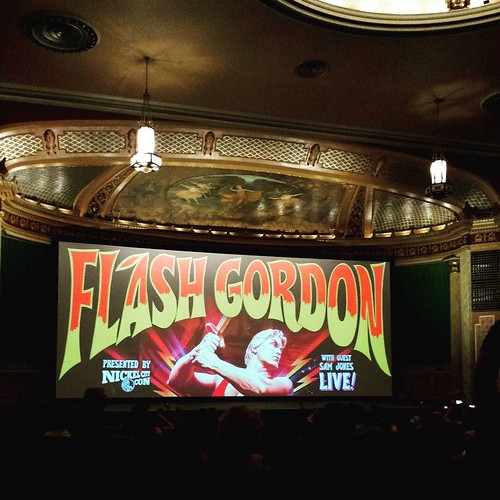
This was in conjunction with Buffalo’s new comic-con, Nickel City Con, and what a night it was!

In 1980, at the height of the post-Star Wars science fiction film boom, a screen adaptation of Flash Gordon came out. An amusing irony of this is that earlier in the 1970s, a filmmaker newly out of film school named George Lucas had wanted to make his own adaptation of Flash Gordon, but he couldn’t get the rights, so he set about creating his own original sci-fi space opera project. His work eventually did, in a way, pave the way for Flash Gordon’s return to the big screen.

The late 70s and early 80s were a heady time for sci-fi at the movies, provided you liked what I often call “explodey spaceshippy goodness”. After Star Wars, everybody wanted on board. There were low-budget flicks like Battle Beyond the Stars and Starcrash. Disney got on the bandwagon with The Black Hole, and there was even a sci-fi horror film, Alien (not a film I like, but I seem to be in a permanent minority on this) and sci-fi takes on the Western like Outland. On television there was Battlestar Galactica and Buck Rogers in the 25th Century. After Star Wars, Star Trek finally made its way to the big screen, and even James Bond got into the act in Moonraker.

Flash Gordon had been in development all along, stalled at various points as producer Dino De Laurentiis looked for screenwriters and then directors. He finally got the film made for a Christmas 1980 release, and I remember the keen anticipation for the movie, which in my fourth-grade class was at nearly pre-Empire Strikes Back levels. Every kid I knew was looking forward to the movie, both because of its sci-fi nature and because of its already famous soundtrack by rock band Queen. The movie arrived, everybody saw it, everybody loved it. I remember actually not being able to see it the first time we tried because the theater was so packed. Eventually I saw it either twice or three times, and then not again until college when we rented it and had a good time with it, and then not again until fifteen years or so later when I finally got a DVD of it. And now, on the big screen a couple weeks ago, at Buffalo’s North Park Theater.

The screening was followed by a Q-and-A session with Flash himself, actor Sam J. Jones, which was an added enticement to trek across town on a weeknight to see a 37-year-old sci-fi flick. The evening turned out to be quite wonderful, with the only downside being the North Park Theater’s air conditioning either being insufficient, or shut off, or simply nonexsitent (not sure which) on what was the first 80-degree day in Western New York. It was a really hot night in the theater, but for the most part I didn’t care. I was seeing Flash Gordon again. A few previews (for documentaries, not blockbusters — the North Park is an art-house theater most of the time), and then it was showtime.

How does Flash Gordon hold up?

Very well.

Now, I admit that “holding up” may not quite be the right way to look at things for a movie like this. Flash Gordon is most definitely of a specific time and place, and maybe you have to be pre-attuned to it to appreciate it. But I don’t think it’s particular dated in any way. It’s cheesy in the best way of being timelessly cheesy. The movie was never intended to be taken all that seriously. What it gets so right is that even as the movie isn’t taking itself too seriously, it doesn’t allow the characters to fall into the trap of winking at the audience. There are no knowing smirks here, no mugging for the camera. Well, yes, there is Brian Blessed, who has made a cottage industry for himself of grinning wildly as battle nears — witness his turn as Exeter in Henry V, and his glee during the St. Crispin’s Day speech. And in Flash Gordon he is playing a Hawkman lord, almost portraying him as a Viking chieftain in his great hall with a tankard of mead in his hand. And who can blame him? He has to deliver the signature line “DIVE!!!” three times, and he also says things like “Impetuous boy! Oh well, who wants to live forever?” Blessed gives the movie its single over-the-top performance, and a lot of the reason it works is that nobody else is going over-the-top.

Everyone else, though, plays things straight, which is really the only way to go. Flash Gordon has to say things like “A rational transaction — one life for billions!” Dale Arden has lines like “Keeping our word is one of the things that make us better than you” and “Just hold me two seconds, and then drop me so I can kiss the ground.” There’s nothing to do with dialogue like that but play it straight, and if Sam J. Jones and Melody Anderson aren’t considered great actors, so what? There’s something to be said for being able to convincingly create a character whom I can absolutely believe would say things like “Oh Flash, I love you, but we only have fourteen hours to save the Earth!”

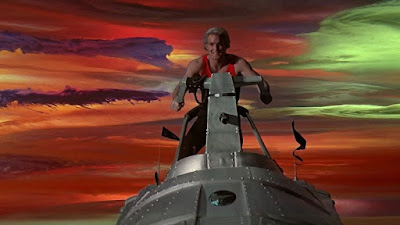
What I appreciated most about Flash Gordon, though, was its look and sound and feel. The movie is nicely paced, even at a less frenetic pace than we’re used to in films of this genre today. There are several interwoven storylines going on here, and nothing ever outstays its welcome (maybe the Zarkov “reprogramming” sequence). Best of all, though, is the way the movie looks. For another entry in the post-Star Wars sci-fi craze, Flash Gordon has a look all its own. Except for early on, there are no glittering starfields and its spaceships don’t look like real machines. The view of Earth in the opening scene itself is highly stylized, like a globe floating in space, bearing no resemblance to the famous blue-white marble of the Apollo photos. And once we get to Mongo, everything is vibrant, brilliant color, with swirling clouds and Art Deco war rockets and a towering glittering city that looks like the sinister version of Emerald City in Oz. The costumes are ridiculously ornate, as are the settings — even the muted appearance of Arboria, the moon of the tree-men, where everyone dresses like a late-70s disco version of Robin Hood. Flash Gordon wears its comic-book origins on its sleeve, going so far as to use actual comics imagery during its opening credits, sometimes in so close a resolution that you can actually see the dots of the color halftoning in the old printing process for comics.

And then there’s the soundtrack, which might be the film’s most famous element. This was when Queen was hitting it big in the US (I remember hearing them each week on the Top 40 show with Casey Kasem). It’s interesting to me that a movie which puts its origins in 1930s and 1940s comics and film serials so in the forefront — even more than Star Wars had done — choose an entirely different approach with its music than Star Wars, in which John Williams was at least partially channeling the spirits of Golden Age composers like Erich Wolfgang Korngold. Instead we get a rock-and-roll score by the greatest “showman” rock group of all time, with those pounding chords that introduce the main song, more lyrical passages along the way, and then a rock score for the big battle in the sky. Rock-and-roll action music, swirling passages of chords reflecting Mongo’s visuals, and there’s even a gonzo version of the Wedding March for Ming’s wedding to Dale. There is an orchestral score as well, by Howard Blake, that melds pretty seamlessly with the more bombastic material by Queen, the thundering rock drums and the blazing guitars. I wonder if Queen would have returned for the sequels that once seemed inevitable (and were never to be), or if the producers would have engaged a different rock band each time out: Flash Gordon II: Ming’s Return, featuring a score by Rush!

I love this movie. It’s a glorious, fun throwback movie of pure adventure and good humor. There are earnest heroes and skeptical allies and a scary villain (OK, his slightly Asiatic appearance as he is made up in the movie is admittedly problematic) and a mad scientist and a girl who is never entirely deprived of agency or reduced to mere damsel-in-distress status. Add to that all the neat visuals (really, no sci-fi movie has every looked like this again, even if the ships and the Hawkmen don’t move with the same convincing style as the ships in Star Wars, but really, that’s an awfully high bar to set, even today), an incredible rock-and-roll score, and a script that is cheesy as hell but is also occasionally downright witty (“I knew you were up to something, Aura, though I confess I hadn’t thought of necrophilia.”). Really, what more would I have wanted from a night in the theater with a big bucket of popcorn when I was nine?

And what more would I want from a similar night in the theater now?

Share This Post

The Force will be with you always: STAR WARS at 40


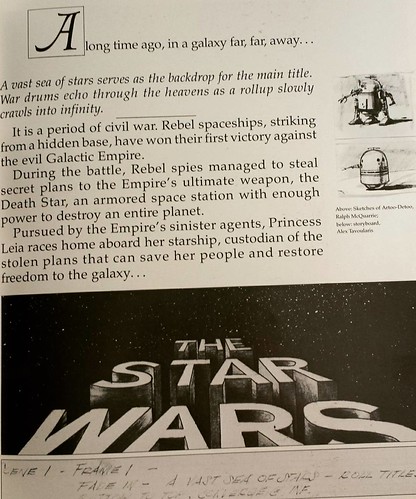
D19 of #IGWritersMay: Novel aesthetics. I make no secret that at its heart, THE SONG OF FORGOTTEN STARS is really my love letter to STAR WARS. (This is a page from the book THE ART OF STAR WARS.) #amwriting #starwars #sciencefiction #spaceopera #Forgotten


I didn’t see Star Wars on opening day. In truth I don’t even remember exactly when I saw it, but it was later in the summer of 1977. We had just moved from Wisconsin to Oregon, and in that time I was not even aware of this enormous movie phenomenon whose popularity was sweeping the nation.

I finally saw it, though, with my sister, who is six years older than me.

I didn’t like it.

It was very loud. It opened with big words flying through space and then there was loud spaceships and talking robots (one of whom only talked in beeps and whistles). There was a girl in white and a bad guy in black whose breath sounded weird. There was a desert planet with weird dwarf-creatures and a kid named Luke who lived with his aunt and uncle. (The uncle could be pretty gruff if Luke was goofing off, to which I could relate.) There were more loud spaceships and one really really big spaceship shaped like a giant ball. There was a guy dressed in black and white who helped the farm kid, and this guy had a giant ape-man friend. There were swords made of light and even more spaceships and a big battle in space.

All of that, and I didn’t understand a lick of it.

In my defense, I was all of five years old at the time.

Until Star Wars, my movie experience was pretty much limited to stuff like Bugs Bunny Superstar and Disney live-actions like The Shaggy DA (which contained a hoot of a pie fight). Then there was this movie with loud spaceships and robots and a farm kid and a bad guy in black and…well, I had no idea what to make of this movie.

Luckily for me I had my sister, who is six years older than me.

She went all-in for Star Wars. She ate it, drank it, breathed it. She talked about it a lot, and gradually her enthusiasm began to win me over. She explained the story to me because I hadn’t understood it all that well, and I decided that I wanted a part of her enthusiasm for my own. So I went with her to see the movie a second time.

I have never ever ever recovered.

I’ve been thinking a lot about Star Wars as it nears and achieves 40 years, and I find myself relating to it most as a storyteller myself. As a writer I tend most to look at Star Wars through the prism of story. Many stories have had a deep effect on me, on the stories I want to tell, and the way I go about telling them, but none moreso than Star Wars, even as the Star Wars story itself has changed over the course of its four decades. Most of the core ideas are still there, though, as Star Wars is now no longer in the hands of its creator, George Lucas. Star Wars is still a tale of heroic adventure unfolding in the sky. It is still a tale not just of the wars but more well-focused on the people fighting that war. It is a tale of improbably redeemable villains, of the way our paths mirror those of our parents, and of finding love in the face of desperation. It is a tale of family.

I can’t help thinking in most, if not all, of these terms every time I write a story, no matter which genre it’s in. Star Wars made me want to be a storyteller (what is playing with action figures, if not storytelling?). It also taught me that stories can focus at times on more mystical matters, and it taught me that story is an excellent way of addressing the challenges people face in their hearts. Most importantly, though, Star Wars taught me about heroes and quests and the wise elders who try to guide the heroes on their way.

Other stories have come since Star Wars arrived, and many have come to places almost as near to my heart. It’s not only stories, either; it’s all of creative art, really:

Lloyd Alexander’s Prydain Chronicles
The Lord of the Rings
Casablanca
On Her Majesty’s Secret Service
My Fair Lady
Cosmos
Much Ado About Nothing
The House with a Clock in its Walls
The Lions of Al-Rassan
Mary Stewart’s Arthurian trilogy (plus The Wicked Day)
Berlioz’s Symphonie fantastique
Rachmaninov’s Symphony No. 2 in E minor
Invisible Touch by Genesis
Once and Again
Princess Mononoke

These are all things — and there are more — that are at the center of my creative life, but none has ever quite dislodged Star Wars as my Prime Mover. Star Wars is, and continues to be, my Platonic Ideal of what story is.

Even so, I haven’t always kept as close an eye on Star Wars as a massive universe as many. I’ve read only a small handful of all the many novels and comics written over the years, and I haven’t played any of the video games. For me, my appreciation focuses pretty exclusively on the movies themselves, and not just the wonderful Original Trilogy but also the admittedly uneven — but still, in my eyes, uniquely compelling — Prequel Trilogy and even to a smaller extent the recent “Rebirth” movies, The Force Awakens and Rogue One. Those form the core.

Star Wars is as strong now as it ever was, and it is very likely even stronger. It has more fans than ever, and it is now in the hands of a corporate power whose pockets are deep enough to maintain it at a very high level for decades to come. More fans are created every day, it seems, and yet…I do have to admit to feeling a certain level of possibly grumpy oldsterism. Sure, you kids can love Star Wars and in fact I hope that you will, and that your love for Star Wars will lead you to other things. But I came in on the ground level. My memories may be hazy, but I do remember a time before Star Wars.

I believe that every story one writes — or rather, every story that I write — should be, in one way or another, a love letter, either to someone or something. The Song of Forgotten Stars has many influences, but it is ultimately my love letter to Star Wars. If not for Star Wars, there’s no way I would be writing this story. It’s not just about the internals of Star Wars, though: it’s about the way Star Wars impacted me and shaped my life and helped reflected certain relationships in my life. Put it this way: There’s a reason why the two main characters in my Forgotten Stars books are two Princesses, one of whom is six years older than the other. It’s a dynamic that makes sense to me on a lot of different levels.

I also know, from reading a lot about the making of Star Wars over the years and about the life of George Lucas in particular, that the way by which a creative work comes into existence is often a messy one. Lucas’s manner of creation is eerily similar to my own, or maybe vice versa. Lucas is someone who starts out by following ideas in any direction they might go, and only gradually whittles things down and discards this notion or that idea until a streamlined story starts to emerge. I work the same way, at least in part. My rough drafts are often very messy and they always contain entire ideas that I remove entirely, for one reason or another. Lucas has done so much mixing and matching of ideas over the decades (remember that for him, Star Wars is 47 or 48 years old, depending on where he dates The Beginning) that he at times seems to be misremembering his own history. I know how he feels. There are times when an idea seems so organic that it’s hard to claim it for my own. Even if it is.

So thank you for forty years, Star Wars! And may the Force be with you, forevermore.

Share This Post

“It’s time for the Jedi to end”

So last week the first trailer for Star Wars Episode VIII: The Last Jedi hit. Here it is!


I actually don’t have a whole lot to say about it. This isn’t out of any lack of excitement for the movie, although I was admittedly less thrilled than most with The Force Awakens. This trailer doesn’t really do much more than it absolutely has to. It’s a pretty middle-of-the-road, safe trailer, isn’t it? It pretty much hits all the points that this movie needs to hit. We hear Luke Skywalker’s voice, we see him doing a little bit of training Rey, and then we see some space battle stuff and some flying ships and the back of Leia’s head and a brief shot of Kylo Ren. Oh, and Poe and BB-8. And Finn! Only one shot of Finn and he looks like he’s still in the coma in which he ended The Force Awakens. Finn was huge in the previous film, so I wonder why there’s so little of him here.

Assuming that the trailer is representative of the film, this movie has potential to end up being the most beautiful Star Wars movie yet, in terms of the visuals. There are some gorgeous shots here, my favorite being the distant shot of Rey practicing with her lightsaber on the island.

Luke is also apparently not faking his whole “depressed Jedi teacher” thing, as hinted in The Force Awakens. From what little we see or hear, Luke Skywalker sounds old, tired, and weary of the whole thing. I still don’t know that I like this turn of events, and I remain convinced that surely the writers crafting this part of the story could have figured out a way to engage the emotions and have danger without undermining all the victories of the original trilogy. There’s a sense here of, oh, as if Victor and Ilsa’s plane at the end of Casablanca had to turn around and land again, due to engine trouble.

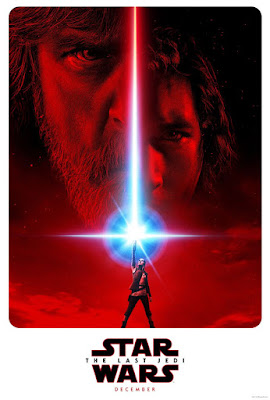
Also released was the first poster for The Last Jedi:

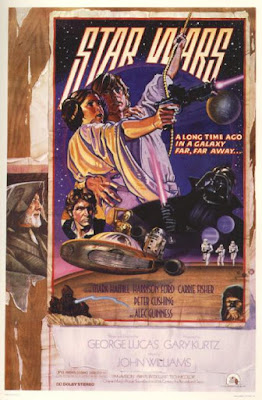
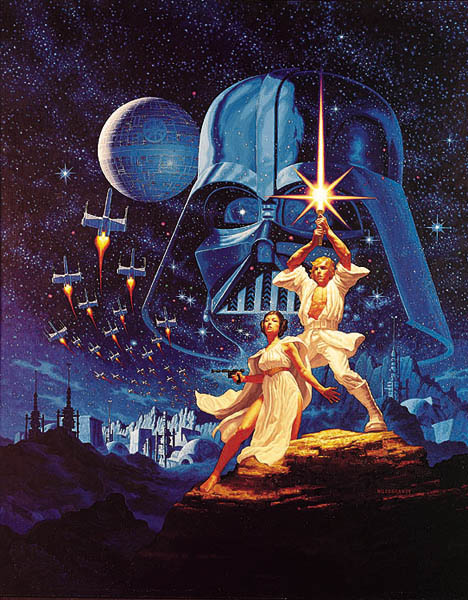
It’s OK as well. Nothing earth-shaking. The lightsaber blade, with the starburst right at the pommel, is a callback to the famous Brothers Hildebrandt poster for Star Wars, way back in the day. The faces of Luke and Kylo Ren, looming over Rey, seem to indicate that they will be battling for Rey herself; she appears to be caught in the middle of these two men. This is all a lot of tea-leaf reading, I admit, but I’m not really wild about the notion of these films making us wonder if Rey will tumble to the Dark Side or stay with the Light. Again, we’ve seen that story before. But I could be wrong, and I’m willing to see.

I also find it fitting that Kylo Ren’s face is notably smaller than Luke’s, because Luke is the ultimate hero of much of Star Wars, and frankly, as a villain Kylo Ren is simply not that interesting to me. Finally, as a visual note from the poster, that starburst at the lightsaber blade’s base is surrounded by a multi-ringed halo that seems suggestive to me of Captain America’s shield.

So, a nice trailer and a nice poster. Red seems to be a dominant color this time out, with the red lettering of the Star Wars logo and the red background in the poster and even the planet in the trailer whose soil seems to be a red dust. Red is typically the color of the Sith lightsabers, so…well, again, we’ll see.

Meantime, we’re two weeks out from Guardians of the Galaxy v. 2….

Share This Post