“Let me help” (Thoughts on “The City on the Edge of Forever”, on its 50th anniversary)

Edith Keeler: And you, um, don’t want to talk about it? Why? Oh. Did you… did you do something wrong? Are you afraid of something? Whatever it is, let me help.

Capt. Kirk: “Let me help.” A hundred years or so from now, I believe, a famous novelist will write a classic using that theme. He’ll recommend those three words even over “I love you.”

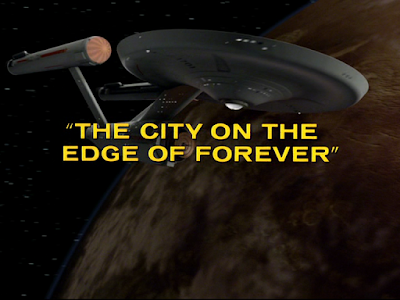
Fifty years ago today, “The City on the Edge of Forever” aired for the first time. This episode of Star Trek is, for me, not only the best episode of any Trek series ever filmed, but it’s also the best Trek story of all time. It’s one of the great science fiction stories, one of the great science fiction romances, one of the great time travel stories, and its ending packs one of the greatest gut-punches ever.

If you’ve never seen it…you should. Really. The story doesn’t really require a huge amount of knowledge of Trek. The Enterprise is investigating strange “ripples in time” that are emanating from a particular planet, and during one such jolt, Dr. McCoy accidentally injects himself with an enormous overdose of a drug that drives him temporarily insane. He flees to the planet surface, and Kirk follows, with Spock and some others. They find themselves in the ruins of an ancient city, with one functioning artifact remaining: a giant portal which is actually a portal through time itself. McCoy, still mad, jumps through and into history, and suddenly the members of the landing party realize that the Enterprise is gone. McCoy has changed history so that the Federation never happened.

With no choice but to try and put things right, Kirk and Spock follow, and find themselves in 1930s New York City. While trying to figure out what McCoy did and where he is, they enter the employ of a woman named Edith Keeler, a visionary who runs a soup kitchen. Kirk falls in love with her…only to have Spock discover that what McCoy did was prevent Edith Keeler from dying in a car accident. If she survives, she lives to found a peace movement that prevents America’s entry into World War II, allowing the Nazis to win and take over the world.

Spock: Jim, Edith Keeler must die.

The story unfolds so organically that the episode feels longer, heftier, than its 50-minute or so running time. The episode feels large, and yet all of its key moments play out on an intimate stage, such as when Jim Kirk and Edith are walking along the street at night and Kirk tells Edith some things about the future, things that don’t even strike her as strange to be hearing from this man she’s just met. And the way she sizes up Kirk and Spock’s relationship:

Edith Keeler: [to Kirk] I still have a few questions I’d to ask about you two. Oh, and don’t give me that “Questions about little old us?” look. You know as well as I do how out of place you two are around here.

Spock: Interesting. Where would you estimate we belong, Miss Keeler?

Edith Keeler: [to Spock] You? At his side, as if you’ve always been there and always will. [to Kirk] And you… you belong… in another place. I don’t know where or how… I’ll figure it out eventually.

Spock: [to Kirk] I’ll finish with the furnace.

Edith Keeler: [to Kirk] “Captain.” Even when he doesn’t say it, he does.

“The City on the Edge of Forever” involves relatively little action. It relies on its character work, showing us that Kirk is falling in love with Edith Keeler before Spock’s discovery that she is the key focal point around which history will pivot. William Shatner, Leonard Nimoy, and Joan Collins likewise turn in amazing work in this episode. Collins’s Edith Keeler is probably the woman in James T. Kirk’s history, the one he could not save even though he desperately wanted to. Her death is the memory that he will carry with him forever. Shatner sells every single minute of this, never once over-emoting, never once going too far. His Kirk doesn’t just fall for a pretty woman. Shatner portrays a Kirk who has just discovered, hundreds of years in his past, a kindred spirit. He has found someone whom he can understand and who can understand him. And when he realizes that he may well have to stand by as she dies…Shatner’s portrayal of a man torn on both sides of the awfullest of dilemmas is so stark, so aching, that it always moves me nearly to tears.

And then the moment arrives.

The script’s other masterstroke is that Spock can’t determine when the awful event will occur. There is no “She dies on November 12, 1937.” This isn’t like Stephen King’s (masterful) 11-22-1963, when we know exactly when the events are going to occur. Kirk has no idea it’s happening, even as we do. He sees her coming back across the street. He starts out to help her…and then he stops. He knows. The moment is upon him, and it unfolds as quickly as it has to. No slow-motion here, no long-held gazes. It comes so quickly that for us, the viewers, it’s almost like–what? Was that it? Oh my God, that was it. Over, that quickly.

But Kirk not only had to let Edith die, his choice — his only choice — was more awful than that. Because Dr. McCoy was there too, and he didn’t know. They had just found him, seconds before, and now McCoy too is watching Edith Keeler walk into the path of the truck. Kirk can’t just stand aside, or stand still, and watch Edith die, because if the script allowed him that much, he’d be able to say later, “I couldn’t have saved her. She was too far away.”

The script doesn’t pull its punches. It doesn’t give Jim Kirk that one possible out, that one possible way he can morally justify it all to himself.

Jim Kirk doesn’t just passively allow Edith Keeler to die. Jim Kirk grabs McCoy and holds him back. Jim Kirk stops McCoy from saving her.

Kirk’s choice is an active one.

McCoy doesn’t know this. He doesn’t know any of it. He only knows that he could have saved her. His voice fills with rage.

McCoy: You deliberately stopped me, Jim! I could have saved her. Do you know what you just did?

And then Spock, summing it up so logically, so heart-breakingly, in a line that no actor other than Leonard Nimoy could have delivered:

Spock: He knows, Doctor. He knows.

One thing about Star Trek II: The Wrath of Khan that has always bothered me was the idea of the Kobayashi Maru test, the idea that a false scenario could somehow test a cadet’s approach to a situation in which there is no possible “victory”. In that movie, Kirk openly says “I don’t believe in the no-win scenario,” and later on, after Spock’s death, he says that he has never really faced death. But in “The City on the Edge of Forever”, he faces both a no-win scenario, and he faces death. The idea that Kirk can later on claim otherwise has always seemed deeply false to me. Maybe he’s blocked the memory of Edith Keeler? Maybe it’s so painful that he doesn’t admit it in either case? Certainly Kirk never mentioned her again in any filmed episode or movie, which isn’t that surprising given the tendency of teevee shows back in that period to not mention previous events much. But the story here, this love between starship captain and soup-kitchen owner three hundred years before his time, is so iconic, and it carries so much weight, that it’s almost offensive to me to think that a James T. Kirk can exist who isn’t carrying her memory around. Maybe better, then, if in reply to his son David’s accusation that he never has faced death, Jim Kirk were to say, “There was one. She died saving us all, too.”

But then, you can’t have too many mentions, either. Trek would never again visit that City on the Edge of Forever, except in one episode of the animated series, and with good reason. No story involving the Guardian of Forever could possibly stand up to comparison with this one. Trek would not eschew time travel, by any means, but this particular means was left as a singular part of Trek mythology. I wonder if any Next Generation writers were tempted to visit it. I’m glad they didn’t. It is interesting, though, that Jean-Luc Picard would get his own kind of iconic time-travel story in “The Inner Light”, as would Benjamin Sisko in “The Visitor”.

James T. Kirk is an explorer at heart, and an adventurer. But his experiences in the past, via the Guardian of Forever, have a profound effect on him. At episode’s end, when he and Spock and McCoy return to the present with everything restored, the Guardian appeals to that part of his soul, offering to guide him and the others through history. What an offer to someone whose life is charged with boldly going! And yet, all Kirk can muster in that moment is a gruff, “Let’s get the hell out of here.”

“The City on the Edge of Forever” is the kind of story I dream of writing. For a single one-hour episode of a teevee show to hit so many emotional highs and lows? To linger in the memory as it does? I wonder if, as they were shooting it — maybe at the first table read — anyone either thought or muttered, “They’ll still be talking about this one in fifty years.”

Who knows? If my health permits, I’ll still be talking about this episode when it hits one hundred.

Share This Post

VHS Memories

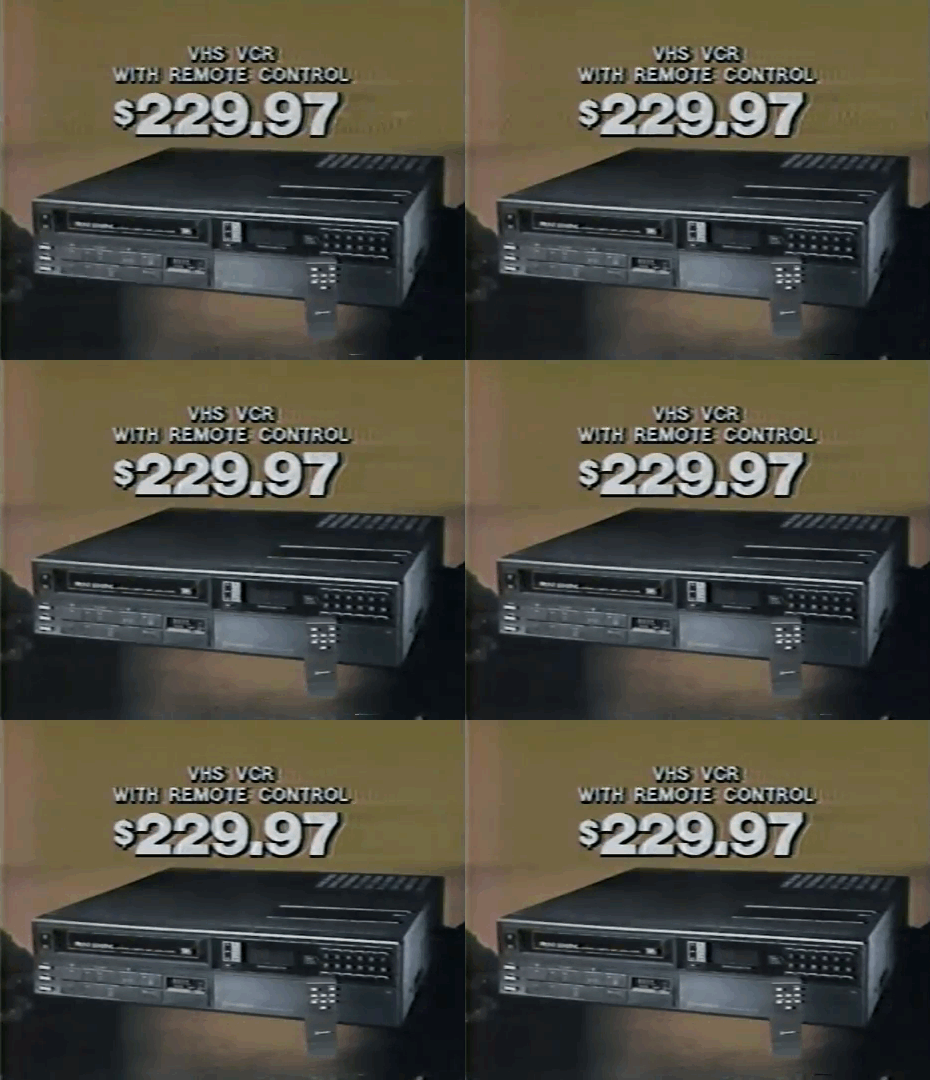
So the era of the VHS videotape player has finally come to an end. Last year, the last company that was still making the things rolled the last one ever off its lines, and that’s it.

I don’t have any particular attachment to the VHS technology in itself, but I did have a lot of fun times using it. How could I not? VHS was the home video thing for me for about 17 years (give or take). We got our first VCR in 1985 or so, and I didn’t get my first DVD player until 2002. Movie nights, recording shows for watching later…VHS was it.

I’m a member of the first generation to make the shift to “watching it later” or “watching a movie whenever I wanted”. Before the mid-80s, for most people, if you missed an episode of your favorite show, your options were to wait for that episode to run a second time in the summer, or just never see it at all (unless the show made it to syndication, in which case you could see the episode years later). I remember hearing about videotape recorders in the late 70s, but the technology didn’t become a serious thing for home use until the mid-80s, and that’s when we jumped on board. I don’t remember what brand our first VCR was, but I remember that unit pretty well: it had a silver casing, it was a front-loading machine (as opposed to top-loaders, in which the tape went into this carriage that rose up from the top of the machine and then snapped down into place). The ‘play’, ‘record’, and other buttons were on the left, and there was a long line of little buttons across the front for the channels. No “up” and “down” channel buttons – you programmed a button to a specific channel.

I’m sure it’s just an accident of the day of the week that we finally bought that first VCR, but the very first thing we ever recorded was an episode of a crappy detective show on NBC called Riptide. This show aired right after The A-Team for a couple years, and right before Remington Steele. I was so amazed at this technological quantum leap for our household that I watched that damned episode of Riptide five or six times. Hey, it’s what we had. (What, you don’t remember Riptide? Well…frankly, the only reason I remember it is because I watched that stupid episode five or six times. Here are the opening credits, and I don’t remember a thing other than three guys who were always around water and who were solving crimes. Huh…thinking back, weren’t just about all the shows in the 1980s about two or three guys who were always around water and solving crimes?)

The first movie we ever rented was Raiders of the Lost Ark, which blew my friggin’ mind, man. I just could not believe that I was sitting in my own living room watching Raiders of the Lost Ark. I watched that four or five times, too. We rented it from this place that was primarily a stereo and TV place, which had added movie rentals to its list of services, and in addition to the movie rental charge, I remember them charging a deposit of $50 for each rental! This was refunded upon return of the unbroken tape. That struck me as weird, but this was 1985 – no one knew how commonplace video rental was to become. I was just astonished to be watching one of my favorite movies of all time, in my own living room.

The first movie that I bought, with my own money, was Star Trek III: The Search for Spock. Maybe that’s why I still have a soft spot for that movie? I remember desperately wanting a copy of Star Wars and/or The Empire Strikes Back, but in that part of the home video era, no one was really sure that people were going to want to own movies, so a lot of titles were “priced for rental”, meaning that individual copies were $80, aimed at rental joints that were starting to become more common. I eventually got copies of the first two Star Wars flicks via illegal copies made by a friend’s family member (how that transpired, I’ve no idea), and I wouldn’t actually buy my own legit copies until college in 1992.

Oh, and we broke a videotape once by dropping it on the floor! The tapes you bought at the store to record you own stuff? Those came in boxes with the opening on the side, so you pulled the tape out like a book in a slipcase. Tapes of prerecorded movies, however, opened at the bottom, so one time one of us held up the box and the tape just slid right out and hit the floor. Yipes.

I would, however, record movies “to keep” off broadcast television. Right around the time we got our first VCR we also got cable for the first time, so I was able to tape movies in what I thought was great quality. Sure, they were edited for broadcast, but that was OK! I’d sit there, watching faithfully, and at each commercial break, I would jump up and press PAUSE, stopping the recording so I wouldn’t get a commercial in the middle. Sometimes I missed the target and got commercial bits; other times I missed the target and missed a little bit of movie on the back end. Video quality? Please! It was shitty as all hell, but I had no idea. I’d record on “Extended Play” mode, getting six hours on each VHS cassette. If I wanted to watch the third movie on a tape? I’d have to fast-forward through the tape and keep pressing ‘play’ until I found it!

Video rental stores were different in those days, too. There was a store in Olean, NY that not only didn’t categorize the tapes at all, but they didn’t alphabetize, either. It was all there on the shelves, and if you wanted a specific movie, you had to search for it, through the entire store. That place didn’t last terribly long.

By the time I got to college, VCRs were prevalent enough that every household owned one, but not every college student did. So if you happened to own one on campus, you became everybody’s best friend. We had many a Friday Movie Night in college, so many that I’m surprised we didn’t burn out the motors of my roommate’s VCR. A favorite was Pink Floyd’s The Wall, which one roommate owned on a dubbed tape that had started to wear out. If you remember VHS tapes, as they wore out the color on the programs started to do funky things, and this copy of The Wall was, as a result, even more psychedelic than usual.

Other movies that got frequent VHS play? The Star Wars and Indiana Jones movies, obviously. Close Encounters. The Star Treks, which at that point numbered only five. And one year in college I discovered that the little video joint up at the corner, a tiny place next door to the local student bar, actually had the complete run on VHS of Carl Sagan’s Cosmos! I rented the entire thing, one night after another. ‘Twas glorious, it was.

Fast forward to family life. We owned, at one point or another, just about every Disney movie that existed. These were invaluable during The Daughter’s early years. There was a show on the Disney channel called Bear in the Big Blue House that she adored when she was just a year old: when that show came on, she was transfixed and wouldn’t make a sound. So when we learned that the Disney Channel was going to run a marathon, we taped the whole thing. Six whole hours of that show, man. Yes, we used the teevee and VCR – once in a while – as a babysitter. I feel a little bad about this, but only a little.

At some point, The Daughter got jelly on the VCR’s innards, which infected our copy of The Rescuers. I don’t remember how this happened, but I remember that we had to buy a couple of head-cleaning tapes that we had to use every time she decided to watch The Rescuers. Which was often, as she really liked that movie. There are a lot of Disney films that I have never seen since we moved beyond VHS some years ago. It’s a shame that some films haven’t made the transition along with us. Remember how Disney films came in those oversized plastic clamshell boxes, unlike most other VHS movies, which came in cardboard boxes that opened at the bottom?

In the mid-to-late 90s, people started realizing that they were missing parts of the movies on VHS, quite literally: they began learning about aspect ratios, and realizing that teevee screens of the day were not the same shape as movie screens. VHS movie transfers covered this by use of what was called “pan-and-scan”: the image would shift back and forth as needed. The worst example of this I can recall came at the beginning of Return of the Jedi. First, the opening crawls weren’t legible until the crawl reached halfway up the screen, because that’s when the words were all visible, but then the camera panned down to the Death Star over Endor, at left, and a Star Destroyer enters the frame from above right, echoing the original film’s famous first shot. For the video transfer of Jedi, though, we had the pan down to the Death Star, and then a new pan right – not in the original film – to allow the Star Destroyer’s entrance. This was awful…and in the mid-90s, more and more movies started showing up in a “letterboxed” format, meaning that you got the see the entire cinematic composition, at the expense of black bars at the top and bottom of the screen. “Widescreen” or “Letterboxed” VHS copies of movies became a big enough deal that a lot of video stores and places like Media Play (God, that store was awesome in the mid-to-late 90s!) had entire sections devoted to them.

Through all this, digital video formats were always a thing. Laserdiscs were always popular with the high-quality set, but the dream always seemed to be a CD-sized format. This finally arrived in the late 1990s, with DVDs. We finally made that transition ourselves in 2002. The first DVD I ever watched was Spider Man, and I remember being shocked at the sharpness of the image and the fact that the colors didn’t bleed. We wouldn’t ditch VHS for good for another few years, but I knew that the writing was on the wall. At that point we only used VHS to tape shows to watch later, and eventually this function, too, fell by the wayside as on-demand and streaming services (along with, I cannot lie, torrents) came of age.

Of course, even DVD had its day, and now Blu-ray is the thing for those who insist upon physical formats. Most folks seem to think that online streaming will replace it all, of course, in our onward march to the Internet becoming the equivalent of Star Trek’s library computers, where the Enterprise’s computer had so much storage that Captain Picard could call up the text of a shitty novel that had been out of print for over three hundred years and had been forgotten upon publication.

I don’t miss VHS. Its technical limitations were too glaring in retrospect. But I do miss a certain feel about home video back then. Watching a movie with friends was an event, and for a really special night you’d cue up the entire Star Wars trilogy or some such thing. I discovered Casablanca on VHS, and I came to love it deeply by watching it every single Sunday afternoon, after football, for a solid month in my sophomore year of college. There was a feeling of uniqueness to VHS, even five or six years after the technology began taking hold. Nowadays, watching whatever we want whenever we want is a fact of life. Everybody owns at least a small selection of movies. The idea that missing a teevee episode once meant missing it forever is utterly alien to most now.

No, I don’t miss VHS. But I had a lot of good times around VHS, and those, I certainly do miss.

Share This Post

Why not “The Force Gets Coffee”?

Some geeky stuff!

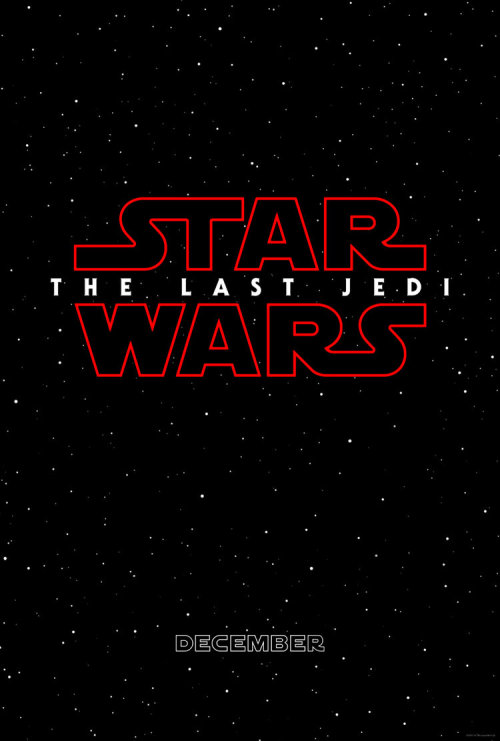
:: Star Wars Episode VIII has itself a title:

I honestly don’t have an opinion of this as a title. Star Wars titles tend to be greeted as events, and then…well, they’re titles. OK, The Last Jedi.

It does break a little with previous “middle installment” titles from previous Star Wars trilogies. The opening films generally have three-word titles that suggest a story beginning: A New Hope, The Phantom Menace, The Force Awakens. Then, previously, we’re had four-word titles that indicate a middle installment based on action: The Empire Strikes Back, Attack of the Clones. But this breaks that “tradition”. Is this a problem? Not really. If the movie’s terrific, they could call it Jedi Boogaloo for all I care.

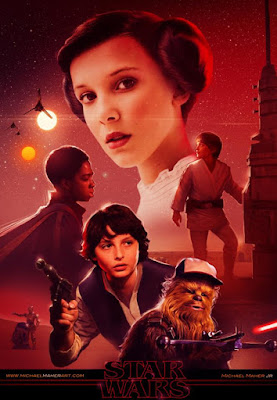
::  This has been making the rounds of Facebook the last few days: a poster for Star Wars in which the characters are re-cast as the kids from Stranger Things.

The artist, Michael Maher, has done quite a bit of cool Star Wars art, as well as other things. Check out his work!

::  I have no idea how I missed this show’s existence entirely, since I have to think this would have been right up my alley when I was seven or eight years old, but miss it I did. It was an NBC show called Supertrain.

The show is described thusly:

The series was one part sci-fi, one part The Love Boat. It revolved around a nuclear-powered bullet train that could travel from New York to Los Angeles in 36 hours and had amentities like swimming pools and shopping centers.

Just like The Love Boat, the plot focused on the passengers and their connecting storylines. Supertrain could have been a minor a hit, but there was one issue. It cost way too much money.

New York to LA in 36 hours? WOW!!! In an era when planes can do it in six! I assume the show had some explanation for why there were no planes.

Apparently to make the show look good, the producers had to make really large and expensive models. Look at this thing:

Unfortunately, the show’s big budget took an even bigger hit when — well, anybody who ever played with an electric train must know what happened.

My favorite part of that pic is the guy standing in the foreground, wreckage behind him, cigarette in hand as he undoubtedly wonders if he’s ever going to work in this business again.

Apparently the ratings were awful, leading to desperate casting stunts like Tony Danza and Zsa Zsa Gabor, making the show another in the 1970s-era super-genre of shows designed to have rotating All-Star Casts every week. Fantasy Island and The Love Boat meet…Silver Streak? I dunno, but this concept for a show seems gonzo enough to have really appealed to me as a post-Star Wars kid.

Share This Post

Conning!

This past weekend was Buffalo Comicon! And yes, we attended. Lots of fun was had by all, and some geeky stuff was acquired, as you might expect. My haul included the following items:

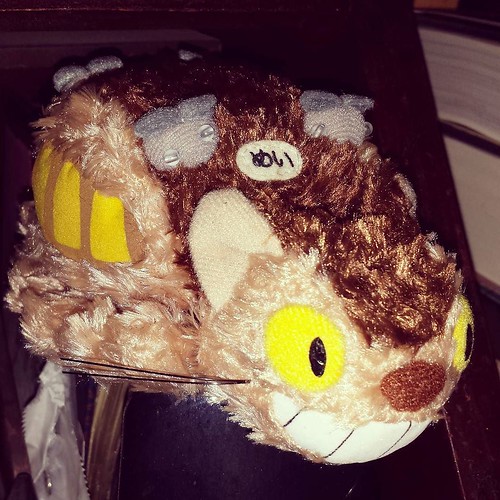
Comicon Find I: Catbus! #buffalocomicon #totoro #catbus

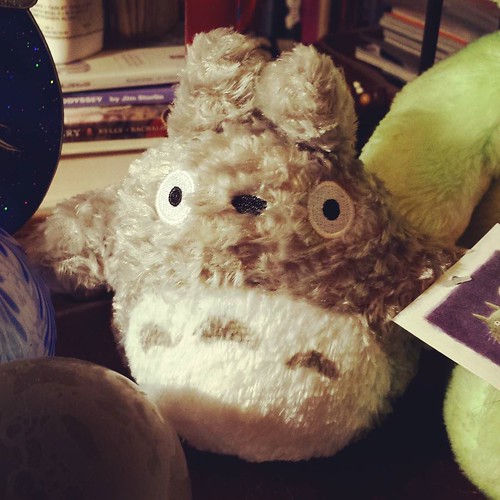
Comicon Find II: Tororo! #buffalocomicon #totoro

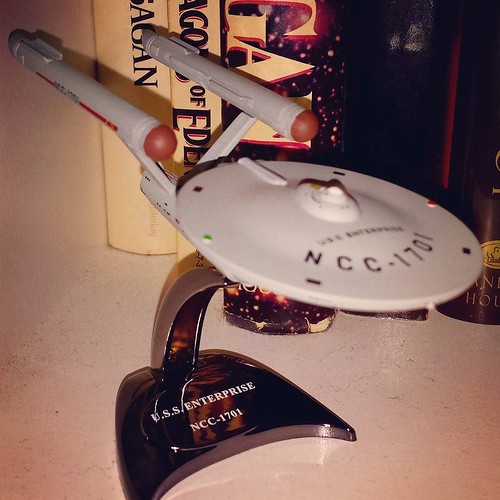
Comicon Find IV: The Enterprise. Ship Number Two of my Holy Spaceship Trinity (the other two being Serenity and the Millennium Falcon.) #buffalocomicon #StarTrek #SpaceshipsAreAwesome

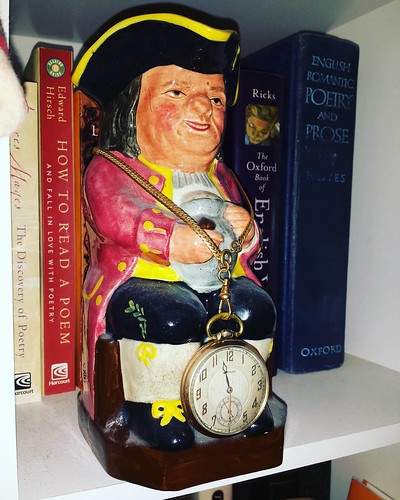
Comicon Find VI: Nifty pocketwatch! #buffalocomicon #pocketwatch

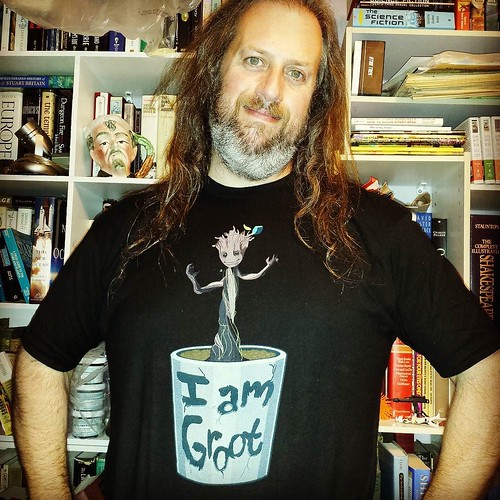
Comicon Find V: A Groot t-shirt! Yay Groot! #buffalocomicon #guardiansofthegalaxy #groot #iamgroot


Not bad, eh?

I’d like to have my own vendor table at a future con, once I have enough books available to make it work. I’m probably a year or two away, but I’ll get there! As for other Cons in Buffalo…well, I’m wondering if the local con market isn’t getting oversaturated. A new Comicon just launched to compete with Buffalo Comicon, and there are several other cons as well (Eeriecon, UB Con, et cetera). Of course, I’d love to see Buffalo gear up and host a Worldcon. They held Worldcon in Spokane two years ago, so Buffalo has got to be able to do it!

Share This Post

“You can type this shit, George, but you can’t say it.”

I recently read a fascinating book about the Star Wars phenomenon, titled How STAR WARS Conquered the Universe: The Past, Present, and Future of a Multibillion Dollar Franchise. Written by journalist Chris Taylor, the book traces the history of Star Wars, not as purely a “making of” story, but as a cultural phenomenon. It’s a terrific book that I reviewed on Goodreads, but I wanted to revise and extend those remarks a bit.

This book is one of the most even-handed accounts of Star Wars and the work of George Lucas that I have read. There isn’t much axe-grinding here, which I greatly appreciate. Taylor is interested in just how this thing called Star Wars came to be one of the dominant pop-culture forces today, tracing the influences that led a young George Lucas to think more and more obsessively about his “little space movie”, and then tracing its own influences on those who came after and showing some of the many and surprising ways that Star Wars has enhanced and influenced the lives of several generations of fans, geeks, and whatever else has come afterwards.

Star Wars started as one movie that wasn’t even supposed to be 20th Century Fox’s big picture for 1977, but it became an enormous force, as everyone knows. It is certainly, along with Star Trek, likely the single biggest influence on my creative life, and it’s inspired an astonishing amount of activity over the years, from comics to music to books to fan films to cosplayers, some of whom have organized into the largest amateur costuming group in the world after the Society for Creative Anachronism. All that, from the imagination of a filmmaker from Modesto, California who only became driven to succeed after he nearly died in a car crash in his youth.

From my perspective, the best parts of the book are those that home in on George Lucas’s creative process. A lot of ink and a lot of pixels have been deployed over the years in discussing Lucas, many times in derision. What emerges in this book – and in others I’ve read, such as Rinzler’s wonderful Making of… books for each of the original Star Wars films – is a man with a deeply non-linear creative process. Lucas’s approach seems to be to generate ideas by the dozen, and then mix-and-match them in various ways until something coherent begins to emerge. Sometimes his earliest ideas are set aside only to return many years later, and sometimes his early ideas stick around through most iterations of story.

The genesis of Star Wars, as it went from being an enormous and ungainly thing bogged down in dozens of names and jargon terms, was a very messy process, and it’s always amazing to me to see the long litany of notions that came and went. There are ideas that Lucas entertained in 1975 that would not show up on film until thirty years later (such as the planet Utapau, present in the earliest drafts of Star Wars, when it was called The Star Wars, and which would not actually show up on film until Revenge of the Sith). In this way, Lucas reminds me of some favorite artists of mine, like composer Hector Berlioz, who would think nothing of using a melody in an early work and then using it again many years later, if he felt that he still had use for it.

The messiness of Lucas’s storytelling process stands at odds with things he says later about his own process, which is something that a lot of people have used as a source of criticism. Lucas is often thought to have promised a nine-episode Star Wars saga back in the days of the Original Trilogy, but his actual statements were that he had written an enormous story and then cut it in half, resulting in the Original Trilogy being the second half; the seventh, eighth, and ninth episodes were only conceptual in nature. This seems to be partly true, but Lucas didn’t so much cut an original story in half as he kept reducing his focus. The “Star with Episode IV” approach seems to be more emergent than intentional, which is not a bad thing.

Here, from the book, is just such an example of one of Lucas’s old ideas resurfacing much later on:

The moment Lucas decided to add a kind of rational, scientific component to Jedi knowledge of the Force, in Episode I – the infamous “midi-chlorians,” microscopic organisms that are supposed to help the Force bind to living beings – long-time fans revolted. It didn’t matter that, as Lucasfilm protested, the midi-chlorians are not supposed to be what the Force is actually made of – just a biological indication of its presence. If you dig deep enough into the Lucasfilm archives, you’ll find Lucas talking about midi-chlorians as early as August 1977. “It is said that certain creatures are born with a higher awareness of the Force than others,” he said during a role-playing exercise designed to help him flesh out Star Wars concepts after the original movie. “Their brains are different; they have more midi-chlorians in their cells.” This didn’t matter either. What fans actually want, it seems, is as little detail as possible. They want twenty-eight words, and nothing more.”

The twenty-eight words Taylor refers to is the simple description of the Force given by Ben Kenobi in A New Hope, and nothing more. Without rehashing the whole midi-chlorian thing, it’s certainly interesting that Star Wars fans seem to want to leave things open and mystical and unexplained in a lot of cases. They certainly stand in contrast to, say, fans of JRR Tolkien, who want as much detail as humanly possible, to the point of learning to speak fictional languages and developing their grammars beyond what Tolkien created. (I still maintain that the midi-chlorians are not a category error but a storytelling one. Their existence adds exactly nothing, story-wise, to the Star Wars saga.)

This book also provides some evidence in favor of an oft-cited notion, that Lucas functions best when he has a strong voice to tell him “No.” By the time of the production of the Prequels, Taylor describes Lucas as so revered that literally no one goes against him in any way at all. I’ve never been totally convinced of this, and I’m still not. Producer Rick McCallum doesn’t come off terribly well, being shown as mainly a yes-man, but still: Lucas brought in script help for all three Prequels, in acknowledgment of his own weaknesses in the writing department. (Which are, in my view, a bit overblown.) Taylor’s own negative opinion of the Prequels stands, but to his credit, he does give voice to some pro-Prequel voices, and he acknowledges that they are not the irredeemable films that many have deemed them. (I’d rather he hadn’t even mentioned that awful Red Letter Media guy at all, though.)

Taylor seems fairly bemused, in the closing chapters, by the fact that Star Wars fandom has only strengthened over time, even in the face of three Prequel films that are, shall we say, less than beloved. As the book closes, Lucas has sold it all to Disney, but even then he was starting to knock around ideas for Episodes VII through IX, the ones he had previously said he’d never do. One ends up wishing that George Lucas would simply come out and admit that Star Wars has been his life. That wouldn’t be so bad a thing, would it?

Ultimately, Taylor’s book does a wonderful job of tracing the growth of Star Wars in our cultural life, and he also shows how it came to utterly dominate the life of its creator, a complex man whose own skills, great as they are, were not always a match for what was in his head. I’m grateful for the book’s portrayal of a George Lucas who is flawed genius, instead of a hack who just happened to get lucky a couple of times. I hope Taylor gets to revise the book in five or six years, once the Saga again stands complete. Unless, of course, Disney decides to fire up production on Episode X in due course….

Share This Post

Mugging!

One of my more esoteric fascinations is with Toby mugs and jugs. These are mugs or pitchers or other vessels worked into the detailed likeness of a person, usually just the head if it’s a mug, but featuring the entire body (usually seated and holding a pitcher or drinking vessel of their own) if it’s a jug. The Wife doesn’t get the appeal, but I think they’re great. This falls in, of course, with my long-noted love of drinking vessels of all types, from mugs to glassware to ceramic flagons to waterskins to, well, you name it.

I first discovered the existence of Toby mugs in, of all places, a cookbook by Jeff Smith (aka, The Frugal Gourmet), which focused on cooking at Christmastime. There’s a photo in that book of a table laden with Christmas fruitcakes and puddings, with a couple of Toby mugs off to one side. Presumably this is because Toby mugs originate in Victorian England, and according to Smith, heavy puddings and cakes such as are served at Christmastime (in properly Dickensian dinners, I suppose) are English in genesis. He notes in the caption that “Toby mugs traditionally held sauces for the table at Christmas.” I have no idea if that’s accurate or not; I just loved the visual of these head-shaped mugs on the table.

Longtime readers may remember that I bought this handsome guy some years ago, at a local antique place that has since gone out of business.

Toby mug V: I've had this guy for several years, but for completeness's sake, here he is! #antiquing

I love that guy! He makes a good place to display my pocket watch, too!

Flash-forward to the other day, when I traveled with my sister to an antique place near Rochester, NY, and there I found (among other cool things) these four mugs! In one trip, I quintupled my collection!

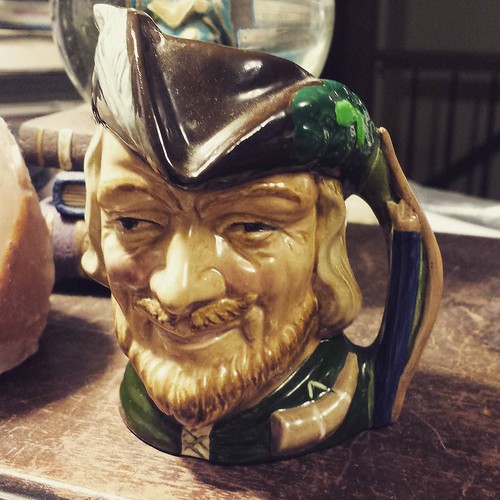
Robin Hood (note that the mug handle is his bow):

Toby mug II: Robin Hood. Note his drinking horn and that his bow is the mug handle! #antiquing

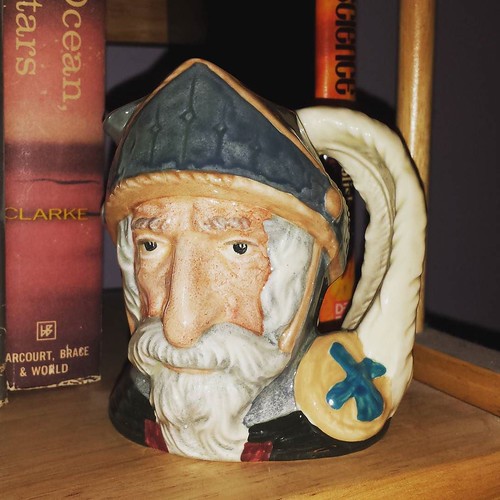
Don Quixote:

Toby mug I: Don Quixote. My wife makes fun of them, but I love these things. #antiquing

Then two which were not identified, both of which were marked “as is” and both of which sold for five bucks together. I don’t know why; the only blemish I can find is a very small crack in the sad-looking fellow, and since I don’t plan to use these as drinking or serving vessels, the crack doesn’t do anything against the display qualities.

Tobh mug III: I don't know what he's supposed to be, but his handle is a key. Maybe some secretive cleric, protecting a secret? #antiquing

Toby mug IV: No idea who he is, either, but he was marked 'as is' and sold for two bucks. He has a tiny crack in his crown, but as I'm not using these for liquid distribution, I thought I'd give him a bookshelf to hang out on for two bucks. Something abou


Wow, that lower fellow is sad-looking indeed! I wonder what his story is. Anyway, it was fun to scratch that itch for a while. Will I get more? Maybe! But not for now.

(Wondering about this odd bit of drinking-vessel ephemera? Well, as further evidence that for any given thing there is a museum devoted to it somewhere, it turns out that there’s an American Toby Jug Museum in Chicago! This just blows my mind.)

Share This Post

My Favorite Fictional Presidents

Let’s rank some Presidents Who Never Were!

5. Thomas Beck

President Beck’s record might seem spotty, given the amount of destruction due to natural disaster during his term, but his stoic leadership helped keep a seemingly doomed nation calm in the face of extinction-level calamity. And he pledged to rebuild, which was nice.

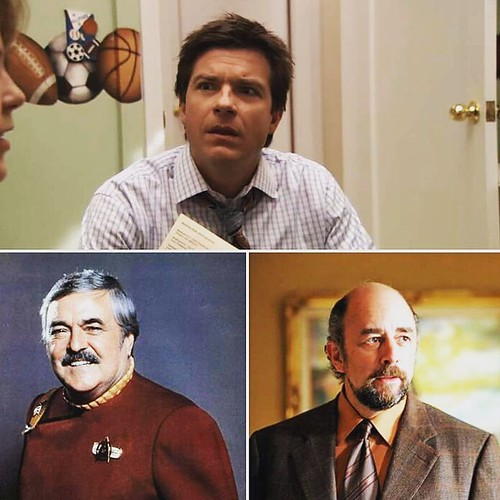
4. President Widmark

His first name is unknown, and he appears to have spent a good deal of his Presidency in traction due to back trouble. He is also known for being lazy, given his use of the “Declaration of War (the short form)”. Still, his term saw some gonzo stuff happen, most notably the attempted exodus of Red Lectroids to Planet Ten.

3. President Bill Mitchell

This President was a deeply odd man. He was cold and calculating, and was eventually proven to have been a crook as well…but then he had a very odd turn of heart and become something like a handsome FDR. In a creepy turn, after his death from some kind of cerebral hemorrhage or something, his wife ended up dating a guy who looked just like him. Very strange.

2. President Josiah Bartlet

One little-known aspect of President Bartlet’s term is the number of steps his staffers walked on a daily basis. One prominent observer once said, “Why do these folks have desks? They do all their major policy-making while walking in circles around the White House.” Bartlet is also noted for having lied about MS and having embroiled the United States in foreign policy crises (and gotten his own daughter kidnapped) when he decided to assassinate a leader of a fictional nation. Also oddly, he only served seven years and cited Rizzo from Grease as his favorite fictional character of all time.

1. President Thomas Whitmore

Apparently a crappy political leader, President Whitmore earns top marks for strapping into a fighter jet and helping blow up an alien spaceship. If Herbert Hoover had done that, he’d be on Mount F***ing Rushmore. Oh, and Whitmore gets special marks for becoming President and doing all that after being embarrassingly dumped by Meg Ryan in favor of complete stranger Tom Hanks.

Honorable Mentions: The President, unnamed, who pinned his hopes to Superman when three other people from Krypton showed up who were a lot less nice than Kal-El; President Allison Taylor, who resigned in disgrace after tearfully wishing that she could help disgraced agent Jack Bauer (apparently forgetting that she could just pardon him); President Andrew Shepherd, who fell in love with a lobbyist and had very nervous sex with her in the White House before giving a speech in which he literally promised to go door-to-door if he had to in order to confiscate Americans’ guns; President Richard Nixon, and not that one but the one who looked a little like that Hannibal Lecter fellow.

Oh, and The President of the United Federation of Planets who helped negotiate peace with the Klingons at Camp Khitomer, without calling anyone a “dumbass”.

Finally, make sure to check out this summary of the most dangerous period in Presidential history.

Share This Post