Curse you, Productivity Gods!

COWORKER: So, what’re you gonna do tonight?

ME: I think I’m gonna go home, do the normal stuff — relax, quick nap, shower, dinner — and then get some writing done.

COWORKER: Cool!

[CUT TO LATER — MY APARTMENT]

ME: Ahhhh, good to be home! Change clothes…put new ice cream in freezer…open up computer, check e-mail…huh, seems I got a package in the mail, wonder what it is….

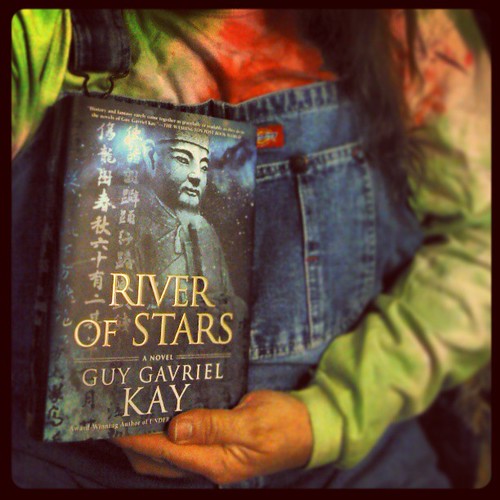
Oh, productivity...how I miss you...but not right now, 'K? #GuyGavrielKay #RiverOfStars #swoon

ME: Well played, Productivity Gods. Well played, indeed.

[I look at the book I’m already reading and enjoying, but for which I suddenly feel significantly less enthusiasm….]

Share This Post

River of Stars

That’s the title of Guy Gavriel Kay’s next novel: River of Stars. As I noted before, it is set in the same fictional China as his last book, the amazing Under Heaven, albeit several hundred years later, so it’s not really a sequel at all.

And now we have the cover art:

I never finished re-reading my way through GGK’s output prior to Under Heaven‘s release, so this winter should be my chance….

Share This Post

Return to Kitai

Those who have have followed the career of Guy Gavriel Kay long enough know that, since his last book came out just about two years ago, this is roughly when drips and drabs of information about his next book should start showing up. And, right on cue, we get some details. GGK is returning to Kitai, the fantastical medieval China which was the setting of the brilliant Under Heaven!

Guy Gavriel Kay’s new novel is once more inspired by Chinese history, this time during the Song Dynasty, almost four centuries after the story told in his bestselling Under Heaven. The dazzling elements of the Song – cultural brilliance, vicious political rivalries, warfare against nomadic peoples, court mandarins versus the military – are rich ground for Kay’s unique blending of fantasy and themes of history. Vivid among a large cast, a young man with a dream of regaining the empire’s lost ‘rivers and mountains’ and a brilliant woman trying to shape a space for herself outside the ‘inner quarters’, where women are expected to live out their lives, confront the challenges and dangers of a world in turmoil. The Song Dynasty’s legacy is prominent in the way Westerners imagine Chinese history to this day and Kay weaves a story that captivates on both an epic scale and within the intimate lives of his characters.

Apparently this book is due in 2013. It’ll be a long year! (But that will give me time to re-read the GGK books I have, as yet, not re-read: Last Light of the Sun, Ysabel, and Under Heaven.)

Share This Post

May he rule a thousand years

My review of Under Heaven is now available at GMR. For non-spoiler thoughts, feel free to read the review.

I do have some thoughts on the book that I left out because they were spoilerish, so I’ll put those here, but in order to read them you’ll have to highlight them with your mouse:

:: GGK so often writes about medievalish places wherein women have little real power given to them overtly, and thus must scramble to assume whatever power they can through other means. This theme is particularly evident in this novel.

:: Is Kitai in the same “world” as Esperana and Sarantium? I don’t think so. The book’s reference to the moon is singular, where GGK’s previous pseudo-Europes all have two moons.

:: I spent much of the book thinking that Tai would eventually give his horses to the Kanlin Warriors. I was wrong, obviously.

:: I love GGK’s elegiac endings, even when he’s written a happy ending (for the most part). The fact that Spring Rain’s letter never reaches Tai and the way the voices of the ghosts of Kuala Nor eventually face away set a perfect note of melancholy alongside Tai’s union with Wei Song.

:: Speaking of Tai’s union with Wei Song, this was as satisfying a finale in a GGK novel as I’ve ever read. I loved it.

:: GGK really managed to work up some tension by having Tai continually worrying over his sister’s fate, when we know that she’s already been rescued from that fate. Meshag’s dual nature (trapped between wolf and man) makes him one of the book’s most fascinating characters.

:: I really want to see more of this world, and I hope I am wrong about Kitai not being in the same world as GGK’s proto-Europe. I’d love to see GGK’s Marco Polo come to this world.

That’s all for now. What a great book this was.

Share This Post

Break time!

Wednesday is Donut Day!

My Facebook friends know that on Wednesdays, I like to celebrate “Hump Day”, past the midpoint of which the week is all downhill, with the indulgence of a donut or two at my mid-morning break. Above you see two of my unwitting victims: a coconut frycake donut, and a glazed cruller. These I wash down with coffee (from that orange mug there), whilst either reading or talking with a coworker who is at my location of The Store two weeks per month.

And what do I read? Lots of stuff. But right now, of course, it’s this:

What break looks like....

Boo-yeah!

I usually go on break about 10:30 in the morning, after I’ve been there about three hours. Other people take their breaks earlier than that, but I find that the day bogs down too quickly if I break too early. At one job I had, years ago, the work day started at 8:00 am, and lots of people in the office would take break at 9:00! I’ve never understood that — how can you need a break after one hour of working? For me, late breaks and late lunches have always been the rule.

So how do you spend your breaks?

(I used Blogger’s scheduled-posts ability to have this post go “live” at the time I usually go on break on Wednesdays. So, if you’re reading this just as the post went live, I’m on break right now!)

Share This Post

A tale….

It begins with the arrival of a mysterious package. I wonder what’s in it?

There is only one thing to do, obviously. I start to undo the tape and open the envelope.

Then, having rendered the envelope fully open, I look inside…

And I find something wonderful, which gives me cause to gloat at all of you folks, because none of you has one of these!

Time to clear off the reading schedule! Under Heaven, here I come! Looks like I won’t be finishing by GGK re-read before the new book comes to my hands after all. I suppose I could stick to the schedule and only read this new one once the last two books (plus the poetry collection) are out of the way, but come on, now. That would be silly.

(This is a review copy for GMR, so my eventual review will be going there instead of here. I am also writing a review of The Sarantine Mosaic for GMR, and I’ll have the link for it when it goes live, so that a link to it will still appear under the post label for my GGK re-read.)

Share This Post

“No sun, no moon, no stars over Al-Rassan”

UPDATE: Welcome, readers and followers of BrightWeavings! I’m in the process of re-reading all of GGK’s books leading up to the Under Heaven release. You can find earlier posts of mine on the subject of GGK here. Feel free to stick around!

When the Lion at his pleasure comes
To the watering place to drink, ah see!
See the lesser beasts of Al-Rassan
scatter, like blown leaves in autumn,
Like air-borne seedlings in the spring,
Like grey clouds that part to let the first star
Of the god shine down upon the earth.

I suppose many readers have the problem of the Favorite Author: after reading one of the Favorite Author’s books, it’s often hard to work up any enthusiasm for some book by some other author, putting those subsequent authors at a disadvantage. It’s even worse if one follows up a book by one’s Favorite Author with something by an author one has never read before; after all, what are the chances that some new fry is going to measure up to the Favorite Author?

That’s the problem I tend to have with Guy Gavriel Kay: reading him leaves me in the mood to read little else but more Guy Gavriel Kay. It’s been this way for years; I suppose I’ve bounced off more books I’ve read immediately post-Kay than anyone else. What’s the solution? Reading another favorite author, I suppose, but that can only put off the problem. Best to just keep trying books until something sticks.

And there’s the thorny sub-problem of the Favorite Author conundrum: the Favorite Book by the Favorite Author. Ah, now we’re treading on dangerous ground, because when you re-read your favorite book, that afterglow tends to stick around for quite a while, outshining the light of nearly everything else. So it is with me and The Lions of Al-Rassan. My own experience is that most fans of GGK will cite Tigana as their favorite, but not me. It’ll always be Lions.

The Lions of Al-Rassan is set in a land that has two names: Al-Rassan, as it is called by the Asharite lords who have ruled it for centuries, and Esperana, as it is called by the minor Kings in the north who dream of driving out the Asharites and uniting all of the peninsula under a single banner. The situation is basically a fantasy analog of the Iberian peninsula as Moorish rule was coming to an end, and indeed, GGK gives us our own Ferdinand and Isabella, in the persons of King Ramiro and Queen Ines of the realm of Valledo. But that’s getting ahead a bit.

I’ve noticed over my years of reading fantasy that a common theme in the best of the genre is the passing of ages and of kingdoms and of the onward march of history; even as one person’s great ambitions are being fulfilled, another is seeing a beloved kingdom pass into memory. That is the main theme of Lions, with the Asharites slowly but inevitably losing their grip on Al-Rassan, and the Jaddites slowly but inevitably bringing it under theirs. The Asharites are the “Muslims” of this world, the worshippers of the Stars of Ashar; the Jaddites are the “Christians”, worshiping the sun-god Jad. Caught in between them are the moon-worshipping Kindath, who are viewed with suspicion and derision everywhere they go. Thus the three great monotheistic faiths of our world are reflected in GGK’s fantasy world.

The book has a huge cast of characters, all of them memorable. Our attentions focus most on three: Jehane bet Ishak, a Kindath physician; Rodrigo Belmonte, a Captain of Jaddite cavalry from one of the three kingdoms of Esperana; and Ammar ibn Khairan, an Asharite poet, assassin, and mercenary warrior. I suppose that, in a sort of way, these three people form a love triangle of sorts, but calling it that reduces the very real and very complex emotional connections between three of the most memorable characters in any book I’ve ever read to the level of soap opera. GGK manages to create a very real, and ultimately heartbreaking, emotional fabric amongst these characters whose struggles alongside, and against, each other mirror the tensions of the struggles amongst three faiths dominant in a violent world.

Plot isn’t really a force in GGK’s best works; what he instead excels at is in depicting characters who are, like all of us, struggling between what we want to do and what we are allowed to do, whether by the conventions of our societies or the forces of history. Jehane, the Kindath physician, becomes beloved of Rodrigo Belmonte and his company of men, so much so that Rodrigo invites her to take up service with them. Jehane is forced to point out the troubling hatred of the Kindath evident in Esperanan society and history. All this leads to a number of deeply heartbreaking moments toward the end of the book, when Rodrigo and Ammar must finally confront the fact that they can only truly ever be adversaries. GGK’s master stroke with this book, as pertains to these two characters, is that he makes us wish for a world in which these two men can be friends, before confronting us with a world where not only can they not be, it becomes clear that they cannot even exist together.

The way Ammar ibn Khairan is allowed to show real anger on occasion, and to admit his own faults, keeps him from seeming almost too perfect of a character at times. I remember when I first read the book, I didn’t really have a good handle at all on Ammar until well over halfway through, because he is shown to be so many different things in the course of the novel. He’s one of the most celebrated poets in Al-Rassan; he’s a warrior of stunning skill; he’s an assassin, wanted dead and celebrated for heroism in the same culture at the same time; he’s a lover and a killer. Ammar’s nature is one reason the book seems to improve so markedly upon a re-read, when his nature becomes more and more clear. On this re-read, I was far more attuned to the interplay and contrast between Ammar and Rodrigo Belmonte, who is as strong and memorable a character as Ammar himself.

GGK’s gift for writing strong and three-dimensional female characters continues to shine here, as well. He gives women who strive in their own ways to better the world in which they live, even while operating within its constraints against them. Jehane is the main female character here, but there are others: wives, queens, concubines, mothers and daughters. Some are all of those.

Finally, the book’s verse ranks among the most captivating in all of GGK’s books. Poetry often plays a role in his novels, but in Lions, poetry is especially important, almost moreso than it had been in A Song for Arbonne, the book in which troubadors themselves are main characters. Here the poetry reflects the Andalusian verse of Moorish Iberia, and while there’s not a great deal of verse in the book, what there is is fascinatingly evocative. The verse is a big way that GGK is able to explore the central theme of the book, as noted above: the passing into memory of beloved things, and the difficulty in finding one’s way in a world that one no longer recognizes.

The Lions of Al-Rassan is a deeply brilliant book. And now, onto The Sarantine Mosaic. (Actually, as of this writing, I’m more than halfway through Sarantine Mosaic, which means I’m well on schedule to complete my GGK re-read before Under Heaven comes out.)

Share This Post
Under Heaven: the cover revealed!

Via BrightWeavings.com, I see that the cover art for the forthcoming new novel by Guy Gavriel Kay, Under Heaven, has been revealed. Here’s what American and Canadian readers will see:

The British art can be seen here. I prefer the American/Canadian version; the people on the British cover are far too photographic for my tastes.

The book comes out in April, so I still have time to get back to my re-read of all of GGK’s books….

Share This Post

“Under Heaven” (again)

I somehow missed this at BrightWeavings.com, but here’s the text of the Penguin Group regarding Guy Gavriel Kay’s upcoming novel Under Heaven:

The world could bring you poison in a jeweled cup, or surprising gifts. Sometimes you didn’t know which of them it was…

Penguin Group (Canada) is pleased to announce the new novel from World Fantasy Award Winner and international bestseller Guy Gavriel Kay

UNDER HEAVEN will be published in April 2010, and takes place in a world inspired by the glory and power of Tang Dynasty China in the 8th century, a world in which history and the fantastic meld into something both memorable and emotionally compelling.

In the novel, Shen Tai is the son of a general who led the forces of imperial Kitai in the empire’s last great war against its western enemies, twenty years before. Forty thousand men, on both sides, were slain by a remote mountain lake. General Shen Gao himself has died recently, having spoken to his son in later years about his sadness in the matter of this terrible battle.

To honour his father’s memory, Tai spends two years in official mourning alone at the battle site by the blue waters of Kuala Nor. Each day he digs graves in hard ground to bury the bones of the dead. At night he can hear the ghosts moan and stir, terrifying voices of anger and lament. Sometimes he realizes that a given voice has ceased its crying, and he knows that is one he has laid to rest.

The dead by the lake are equally Kitan and their Taguran foes; there is no way to tell the bones apart, and he buries them all with honour.

It is during a routine supply visit led by a Taguran officer who has reluctantly come to befriend him that Tai learns that others, much more powerful, have taken note of his vigil. The White Jade Princess Cheng-wan, 17th daughter of the Emperor of Kitai, presents him with two hundred and fifty Sardian horses. They are being given in royal recognition of his courage and piety, and the honour he has done the dead.

You gave a man one of the famed Sardian horses to reward him greatly. You gave him four or five to exalt him above his fellows, propel him towards rank, and earn him jealousy, possibly mortal jealousy. Two hundred and fifty is an unthinkable gift, a gift to overwhelm an emperor.

Tai is in deep waters. He needs to get himself back to court and his own emperor, alive. Riding the first of the Sardian horses, and bringing news of the rest, he starts east towards the glittering, dangerous capital of Kitai, and the Ta-Ming Palace – and gathers his wits for a return from solitude by a mountain lake to his own forever-altered life.

About the Author

Guy Gavriel Kay is the author of ten novels and a volume of poetry. His eleventh work of fiction, Under Heaven, will be published by Viking Canada in April 2010, and by Penguin US and HarperCollins UK in May 2010.

Kay’s fiction has sold over 3 million copies and been published in more than 25 languages around the world. He is the winner of the 2008 World Fantasy Award for Ysabel, which has been optioned for feature film release by Maryke McEwen of Kinetic Productions, the Gemini-winning producer of Street Legal and The Diary of Evelyn Lau and Jeanne Strømberg and Alan Hausegger of StrømHaus Productions, who created the film adaptation of Linda Svendson’s Marine Life starring Cybill Shepherd.

Kay’s novel The Lions of Al-Rassan has also been optioned for feature film and is being developed by director Edward Zwick (The Last Samurai, Blood Diamond) and Cathy Schulman (Crash) of Mandalay Pictures.

Kay is a recipient of the International Goliardos Prize for his contributions to the literature of the fantastic. At the outset of his career, he was retained by the estate of J.R.R. Tolkien to assist in the editorial construction of Tolkien’s posthumously published, The Silmarillion.

I’ll have to beef up my selection of Chinese music before this book arrives. Gotta have the right ambience!

Share This Post