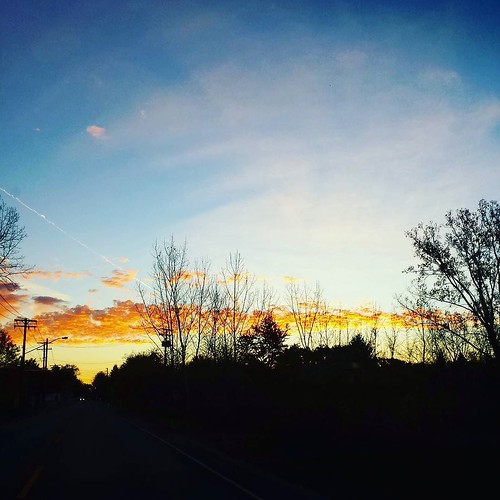
This is the photo I took on the morning of Election Day, 2016. It seemed like a bright and optimistic day. I captioned it on Instagram: “Looks like a nice morning to make some history happen!”
Democracy: I Did It

Specifically, I did the democracy thing the other day, on Saturday, when early voting started in New York State. I got to the polling place (a local community center) about ten minutes before it opened, and at that point there was already a line, which extended into the parking lot. This was strange; the building is big and is surrounded by very ample sidewalks, and yet the people queued up in the parking lot. It took a cop to come along and tell everyone to queue on the sidewalk instead of the parking lot. People are weird.
I waited in line for probably about half an hour before I finally got inside. The attendants looked up my name and printed my ballot on the spot (hooray to New York for not passing some dumb-assed Voter ID law!), and then I voted. It definitely felt a little bit strange to vote early. With the exception of my very first election, when I was in college and thus had to vote via absentee ballot, I have always voted on Election Day at my designated polling place. It does seem odd, having joined with millions of my fellow citizens in having already voted, and yet we won’t have any idea how this all turns out for at least another five days. Here’s hoping it’s only five days, and here’s hoping that we Americans are sweeping the forty-sixth President of the United States into office on the strength of numbers too big to challenge.
We’ll see.
Oh, and this was the first time I ever got an “I voted” sticker, so huzzah for that! That sticker is a nice accessory for my overalls, isn’t it?
Share This Post
“I’ve learned so much”
In Larry McMurtry’s great Western novel Lonesome Dove, for much of the novel the point of view changes between the main story (a group of Texas cattlemen leading their herds north for selling) and a secondary plot in which we follow the nasty adventures of Dan Suggs and his brothers, who are a murderous trio of guys, killing and robbing their way across the prairie. About two-thirds of the way through the book, our lawful cattlemen meet Suggs and his brothers, and they manage to subdue them quickly and make ready to hang them from the nearest tree. But to their surprise, they find that a friend of theirs, a guy named Jake, has fallen in with the Suggs crew.
Jake is not a bad guy, but he’s something of a ne’er-do-well who makes his living lurching from town to town, gambling and drinking and whoring and doing it all some more. It’s been a while since I read the book, so I don’t remember how it is that he falls in with Suggs and his brothers, but he does, and McMurtry captures his disquiet well as he witnesses murder and crime after murder and crime.
But when our heroes, William Call and Augustus McCray, defeat Suggs and company and get them all tied up in order to mete out cowboy justice, this brief conversation transpires:
Call went over to Jake. Deets [one of their companions] seemed hesitant to tie him, but Call nodded and covered Jake with his rifle while Deets tied his hands. As he was doing it Pea Eye and Newt [two more of their companions] came over the hill with the horses.
“Call, he don’t need to tie me,” Jake said. “I ain’t done nothing. I just fell in with these boys to get through the Territory. I was aiming to leave them the first chance I got.”
Call saw that Jake was so drunk he could barely sit up.
“You should have made your chance a little sooner, Jake,” Augustus said. “A man that will go along with six killings is making his escape a little slow.”
I’ve been thinking about that passage ever since our President made a video, aimed at his fans, regarding his experience with COVID-19 and his intention to leave the hospital later today. After having spent the last bunch of months spreading all manner of misinformation about the pandemic that is gripping the world, decided to record a video for his fans last night, in which he said, among other things, that he’s “learned so much” about the disease.
He’s “learned so much”.
Imagine that. This many months after the pandemic began, this many months after lock-downs and scenes of horror in New York City, this many months after case spikes and the death rate never going down to zero, this many months of America just existing with this damned thing, arguing over masks and “mah rights”…now our President has “learned so much”.
The time to learn so much would have been the beginning, sir. The time to learn so much would have been in the very beginning, when you would have learned so much from the pandemic team the previous administration left in place, had you not dismissed it.
You should have made your chance a little sooner, Mr. President. A man that will go along with two hundred thousand deaths is “learning so much” a little slow.
(Comments are off for this post)
Share This Post
2017: Year of the American Nazis
I don’t have anything eloquent or insightful to say on the subject, but I feel that I should say this: to hell with the white-supremacist Nazi subculture that is thriving in my country today, and to hell with anyone who either supports them directly or offers them de facto shadow support by offering arguments like “Sad about what happened but Antifa is worse”, to hell with a major political party that decided that its ensconcement in power was a sufficiently worthy goal to ally with such people, and to hell with a moral midget of a President whose election is manna from heaven to these people and in whom they find a father figure.
Share This Post
A Guide to Making Good Life Choices
Why #ImWithHer
I think that she is genuinely the best choice in this election. I believe that she would and will be a good President, and that she also represents the best chance to avoid electing a truly awful one. Her chief opponent has said almost nothing that has made any sense at all and a whole lot of things that are terrible. The “third party” options — which are generally a giant waste of time anyway — are all laughable in one way or another, whether we’re talking about the loopy Libertarian, the oddball Green, or that other guy who is basically Mitt Romney with a better resume.
That’s it. Maybe not terribly convincing, but I don’t really feel the need to be.
Share This Post
Third Party Madness
One maddening thing about every single Presidential election cycle is the inevitable cries of “We need a third party!” I always find this concept generically annoying, not because I’m in love with my own party (believe me, there have been many times when I wanted to junk-punch the Democratic Party and/or some of its component parts), but because the two-party system is simply baked into our political system. No, the system wasn’t designed for only two major parties, and the Founding Fathers didn’t especially want only two major political parties, but you can’t always foresee the future, and this is what we got: a system that by its very nature allows only two major parties.
This is all explained very effectively by blogger Christoper Bird, who is very astute about American politics. (This is interesting because he’s Canadian. Oh, and that blog is something of a group effort, but he’s the Big Cheese there and posts as MGK.)
So, first this (it’s a slideshow, so you’ll have to, well, slide your way through it):
And then, as follow-up, this (just normal scrolling now):
1. A lot of responses of "well excuse me I believe I will vote THIRD PARTY" and my response to that is always pic.twitter.com/bqmh7u8ykv
— Aaron Bird, Sir (@mightygodking) July 24, 2016
2. The nature of first-past-the-post systems makes third party voting actively detrimental to the goals of people inclined to do it.
— Aaron Bird, Sir (@mightygodking) July 24, 2016
3. If you're disinclined to vote for either candidate *equally*, then sure, third-party voting makes sense. But you almost surely aren't.
— Aaron Bird, Sir (@mightygodking) July 24, 2016
4. You, like almost everybody, are probably closer in policy preferences to one of the candidates than the other.
— Aaron Bird, Sir (@mightygodking) July 24, 2016
5. For sake of argument, let's say you're likely closer to Clinton than Trump. (If not, why are you reading this? Go watch monster trucks.)
— Aaron Bird, Sir (@mightygodking) July 24, 2016
6. Now let's say "you" is actually "a subset of voters like you, say 1% of the electorate."
— Aaron Bird, Sir (@mightygodking) July 24, 2016
7. If you vote third-party instead of Clinton, there is a set of possible outcomes. *None of them include the third party winning.*
— Aaron Bird, Sir (@mightygodking) July 24, 2016
8. Because FPTP systems are two-party systems, by definition. It's not because of corporate collusion. It's because of *math*.
— Aaron Bird, Sir (@mightygodking) July 24, 2016
9. You are not the first person in history to say "well gosh how about a third party." This is not an original thought you have had.
— Aaron Bird, Sir (@mightygodking) July 24, 2016
10. The reason third parties don't work in FPTP systems is because the system creates two parties with broad bases.
— Aaron Bird, Sir (@mightygodking) July 24, 2016
11. Aside: Canada is a two-party state (the Tories and Liberals) with two smaller parties that split left-wing votes https://t.co/QD303rYeq3
— Aaron Bird, Sir (@mightygodking) July 24, 2016
12. Anyway, mathematically speaking, it makes sense for parties to capture as much of the popular vote as possible.
— Aaron Bird, Sir (@mightygodking) July 24, 2016
13. So FPTP usually creates a political landscape with both parties trying to ensure the support of "51% of the electorate" as possible.
— Aaron Bird, Sir (@mightygodking) July 24, 2016
14. Whatever the reason, conservatives usually all line up in one major party; liberals are more inclined to subdivide.
— Aaron Bird, Sir (@mightygodking) July 25, 2016
15. (This is pretty reliable for FPTP systems across the world, incidentally. It happens again and again.)
— Aaron Bird, Sir (@mightygodking) July 25, 2016
16. (Australia is the major outlier, and their "two" right parties are really just one party for all intents and purposes.)
— Aaron Bird, Sir (@mightygodking) July 25, 2016
17. The result of this is a steady worldwide progression towards more conservative policies, because *conservatives don't split their vote*.
— Aaron Bird, Sir (@mightygodking) July 25, 2016
18. Because conservatives vote with "their" party reliably, the conservative party in Country X With FPTP caters to their preferences more.
— Aaron Bird, Sir (@mightygodking) July 25, 2016
19. And because center-left parties across the world know that the far left is not a reliable vote, they dismiss them to chase the center.
— Aaron Bird, Sir (@mightygodking) July 25, 2016
20. So: if you're voting Green because you don't like Hillary, my posit to you is this:
— Aaron Bird, Sir (@mightygodking) July 25, 2016
21. Voting Green will mean the following things WILL happen.
— Aaron Bird, Sir (@mightygodking) July 25, 2016
22. Firstly, the Democrats are less likely to win, because a voter who is largely aligned with their policy goals isn't voting for them.
— Aaron Bird, Sir (@mightygodking) July 25, 2016
23. Which in turn means: secondly, you increase the odds of a Trump victory, which I assume you *don't* want even more.
— Aaron Bird, Sir (@mightygodking) July 25, 2016
24. Thirdly, if Hillary *does* win, she will be less likely to pursue policies you *would* like, because *you did not vote for her.*
— Aaron Bird, Sir (@mightygodking) July 25, 2016
25. So, by voting third party, you're making every outcome you actually want *less likely*. Which is why voting third party is stupid.
— Aaron Bird, Sir (@mightygodking) July 25, 2016
26. The one thing you *will* get from voting third party, to be sure, is a feeling of satisfaction. (Remember what I said about narcissism?)
— Aaron Bird, Sir (@mightygodking) July 25, 2016
27. Anyway that's enough, I wanna watch wrestling now, Bayley is wrestling and that's very exciting
— Aaron Bird, Sir (@mightygodking) July 25, 2016
Comments on this post are deactivated.
Share This Post
Conventional Reactions
My reactions to the Republican National Convention have been pretty evenly divided between these two videos:
That’s about all. This is just about the weirdest damn thing I’ve ever seen. I can’t even fathom how one whole segment of American politics has become like this.
And just think — if trends continue, and they don’t somehow win with this shitshow this year, in 2020 they’ll come back even crazier.
UPDATE: I wrote this post before I read the leaked text of Trump’s acceptance speech, and jee-sus, that is some messed up shit. That speech may be the single most twisted thing I’ve ever read, full of half-truths, twisted facts, and outright lies all used in service of maintaining the notion that white Americans should be cowering beneath their beds in the face of the dystopic hellscape this country has become.
I thought Atlas Shrugged was the most twisted thing I’d ever read, but whoever wrote this speech has topped it. My prayer now is that this election represents the death-throes of a particularly ugly strain of thinking on the American right, and after this they’ll start swinging back toward rationality and reality again. A country cannot prosper when so many of its people think like this.
Share This Post
Gummint Bad. Oogh.
Politics below the fold.
As I tweeted earlier:
I will under no circumstances vote for you, or even listen to a single thing you have to say, if you are in any way anti-vaccine.
— Kelly Sedinger (@Jaquandor) February 3, 2015
Being anti-vaccine is for me equivalent to global-warming denialism. It automatically disqualifies you from serious consideration.
— Kelly Sedinger (@Jaquandor) February 3, 2015
What brought this on? Here’s Rand Paul saying that vaccinations should be voluntary because of freedom, some other GOP lackwit saying that we shouldn’t have an “oppressive government” enforcing vaccination, and that as a hypothetical example against “regulation”, restaurants should be able to opt out of mandated handwashing, because “the Market will sort it out.“
I always love stuff like that last one. The libertarian/rightwing types always make the Market’s sorting-process sound like the most benign of forces, as if everyone considering attending the no-handwashing restaurant will find out about it beforehand and choose accordingly. Those of us in the real world know that in a case like this, “the Market sorting it out” would involve a bunch of people with shigellosis, but as ever, the Market is an inherent good that must be preserved even in the face of avoidable and unnecessary human suffering.
And yes, vaccinations should be required by law, with all that entails.
No candidate who thinks otherwise will ever get my vote, or even a hearing, on any issue. Period.
Share This Post
Pursuing Capital
A bit of politics here, after the break. Keep scrolling if you don’t want one of my rare bursts of liberalism in this space!
On we go….
I’ve seen three articles online in the last week that have really expressed well my increasing trouble with the idea that we need to rely on free-market capitalism, and only free-market capitalism, to solve all of our various problems.
First, this by Henry Blodgett, speaking against the notion of rich people as “job creators”:
As America struggles with high unemployment and record inequality, everyone is offering competing solutions to the problem.
In this war of words (and classes), one thing has been repeated so often that many people now regard it as fact.
“Rich people create the jobs.”
Specifically, by starting and directing America’s companies, entrepreneurs and rich investors create the jobs that sustain everyone else.
This statement is usually invoked to justify cutting taxes on entrepreneurs and investors. If only we reduce those taxes and regulations, the story goes, entrepreneurs and investors can be incented to build more companies and create more jobs.
This argument ignores the fact that taxes on entrepreneurs and investors are already historically low, even after this year’s modest increases. And it ignores the assertions of many investors and entrepreneurs (like me) that they would work just as hard to build companies even if taxes were higher.
But, more importantly, this argument perpetuates a myth that some well-off Americans use to justify today’s record inequality — the idea that rich people create the jobs.
[snip]
The prevailing story that justifies tax cuts for America’s entrepreneurs and investors is that the huge pots of gold they take home are supposed to “trickle down” to the middle class and thus benefit everyone.
Unfortunately, that’s not the way it actually works.
First, America’s companies are currently being managed to share the least possible amount of their income with the employees who help create it. Corporate profit margins are at all-time highs, while wages are at an all-time low.
Second, as Hanauer observes, America’s richest entrepreneurs, investors, and companies now have so much money that they can’t possibly spend it all. So instead of getting pumped back into the economy, thus creating revenue and wages, this cash just remains in investment accounts.
Read the whole thing.
Second, this by David Simon, creator of the highly-regarded teevee series The Wire (which I have not seen). This article is a nearly pitch-perfect summation of what I believe.
Labour doesn’t get to win all its arguments, capital doesn’t get to. But it’s in the tension, it’s in the actual fight between the two, that capitalism actually becomes functional, that it becomes something that every stratum in society has a stake in, that they all share.
The unions actually mattered. The unions were part of the equation. It didn’t matter that they won all the time, it didn’t matter that they lost all the time, it just mattered that they had to win some of the time and they had to put up a fight and they had to argue for the demand and the equation and for the idea that workers were not worth less, they were worth more.
Ultimately we abandoned that and believed in the idea of trickle-down and the idea of the market economy and the market knows best, to the point where now libertarianism in my country is actually being taken seriously as an intelligent mode of political thought. It’s astonishing to me. But it is. People are saying I don’t need anything but my own ability to earn a profit. I’m not connected to society. I don’t care how the road got built, I don’t care where the firefighter comes from, I don’t care who educates the kids other than my kids. I am me. It’s the triumph of the self. I am me, hear me roar.
That we’ve gotten to this point is astonishing to me because basically in winning its victory, in seeing that Wall come down and seeing the former Stalinist state’s journey towards our way of thinking in terms of markets or being vulnerable, you would have thought that we would have learned what works. Instead we’ve descended into what can only be described as greed. This is just greed. This is an inability to see that we’re all connected, that the idea of two Americas is implausible, or two Australias, or two Spains or two Frances.
[snip]
We have become something other than what we claim for the American dream and all because of our inability to basically share, to even contemplate a socialist impulse.
Socialism is a dirty word in my country. I have to give that disclaimer at the beginning of every speech, “Oh by the way I’m not a Marxist you know”. I lived through the 20th century. I don’t believe that a state-run economy can be as viable as market capitalism in producing mass wealth. I don’t.
I’m utterly committed to the idea that capitalism has to be the way we generate mass wealth in the coming century. That argument’s over. But the idea that it’s not going to be married to a social compact, that how you distribute the benefits of capitalism isn’t going to include everyone in the society to a reasonable extent, that’s astonishing to me.
And so capitalism is about to seize defeat from the jaws of victory all by its own hand. That’s the astonishing end of this story, unless we reverse course. Unless we take into consideration, if not the remedies of Marx then the diagnosis, because he saw what would happen if capital triumphed unequivocally, if it got everything it wanted.
And one of the things that capital would want unequivocally and for certain is the diminishment of labour. They would want labour to be diminished because labour’s a cost. And if labour is diminished, let’s translate that: in human terms, it means human beings are worth less.
[snip]
Mistaking capitalism for a blueprint as to how to build a society strikes me as a really dangerous idea in a bad way. Capitalism is a remarkable engine again for producing wealth. It’s a great tool to have in your toolbox if you’re trying to build a society and have that society advance. You wouldn’t want to go forward at this point without it. But it’s not a blueprint for how to build the just society. There are other metrics besides that quarterly profit report.
The idea that the market will solve such things as environmental concerns, as our racial divides, as our class distinctions, our problems with educating and incorporating one generation of workers into the economy after the other when that economy is changing; the idea that the market is going to heed all of the human concerns and still maximise profit is juvenile. It’s a juvenile notion and it’s still being argued in my country passionately and we’re going down the tubes. And it terrifies me because I’m astonished at how comfortable we are in absolving ourselves of what is basically a moral choice. Are we all in this together or are we all not?
Read that whole thing, too.
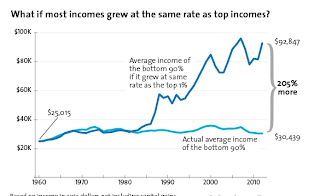
Finally, local blogger and friend Alan Bedenko provided a bit of graphical information yesterday demonstrating pretty conclusively that America’s thirty-plus year experiment with supply-side economics has simply not produced the kind of overall economic prosperity that’s been promised. What has happened instead is a relentless upflow of money that is causing less social mobility than ever before.
The libertarian response would be one of two answers: first, we just haven’t made the markets free enough yet and only by remaining the final shackles will we create a tide that really lifts all boats, or second, the freedom of the markets is so inherently good and important that they actually supersede the real economic problems they create. Quite the bit of doublethink there: “Our prescription will solve a problem that in our hearts we don’t really believe is a problem at all.”
The worst thing is that there is now an entire generation of Americans who have grown up and internalized this bullshit and who think that this is the natural order of things, the way it’s supposed to run. Huge amounts of economic inequality and instability? Features, not bugs.
Will it ever change? Of course it will. The pendulum always swings. I just hope I get to see it start to swing back in my lifetime.