And now, some Cosmic Perspective

Here’s a photo from the Hubble Space Telescope:

From NASA’s Flickr stream:

In this image, the NASA/ESA Hubble Space Telescope captures a side-on view of NGC 3568, a barred spiral galaxy roughly 57 million light-years from the Milky Way in the constellation Centaurus. In 2014 the light from a supernova explosion in NGC 3568 reached Earth – a sudden flare of light caused by the titanic explosion accompanying the death of a massive star.

Photos of entire galaxies always blow my mind a little…and that photo contains many galaxies. What an amazingly grand universe!


Share This Post

January Reading (From the Books)

I’m going to try, in 2022, to write a monthly recap of the books (and other things) I read each month. I had a good reading month and am well on my way to meeting my annual goal of 52 books! I track this on Goodreads, and I feel no qualms in including graphic novels in my reading; a good graphic novel is its own challenge and reward because the art demands attention as much as the words. I will also admit that I’m trying to get ahead of my Goodreads challenge a bit because I have some long “doorstop” kinds of books that I’d like to read this year, and those can really get time-consuming. (We’re talking Brandon Sanderson-sized epic fantasies and space operas later this year.)

So here’s what I read in January (or, a few items I started in December but only finished in January):

::  The God Equation: The Quest for a Theory of Everything, Michio Kaku. I’ve become a big fan of Kaku’s science writing over the last few years. As a science fiction writer (even one who tends to play at the George Lucas end of the pool, rather than the Arthur C. Clarke end), I feel it important to read some science every year, and Kaku’s work always keeps the “sensawunda” flowing. He writes big-scale, wide-eyed books about the Really Big Questions, and this one is no exception. If you want the kind of optimistic science writing that gives you the kind of feeling you might have had as a kid when you emerged wide-eyed from the planetarium show, Michio Kaku is your writer. (I confess that at times in his books I really can’t quite understand the more esoteric details of the things he writes about.)

::  Salt, Fat, Acid, Heat: Mastering the Elements of Good Cooking, by Samin Nosrat. This is the best kind of cookbook. Only about half of it is an actual collection of recipes; the rest is like a textbook in Cooking 101, in which Nosrat writes extensively about the how and why these four facets of cooking work the way they do to make food taste good. Reading this gave me much greater appreciation and insight into how to salt my food, why and when to add acid, what I can do with fat to enhance flavor, and the ways heat, applied in different ways, impacts flavor.

The book is richly illustrated, and it has fold-out charts that show how various ethnic cuisines around the world approach each individual element of cooking. Nosrat writes wonderfully, with a strong personal element in which she brings her personal experiences from working in the food world to bear. If you cook, you should check this book out.

::  For Small Creatures Such As We: Rituals for Finding Meaning in Our Unlikely World, by Sasha Sagan. Sagan is the daughter of Carl Sagan, who is one of my all-time heroes for many reasons: his scientific curiosity, his unyielding skepticism which was also bonded tightly to his unending ability to find wonder in what really is. Maybe some people were disappointed to learn that the surface of Mars is not segmented by great canals whisking water around the planet, but is instead rocky and thus far barren of liquid water and life; not Carl Sagan, who found the fact of the Martian surface even more wondrous than the dreamed-up version from the Edgar Rice Burroughs novels he read as a kid.

One common objection to atheism, especially the rigorously empirical version of atheism as endorsed by Carl Sagan, is the idea that absent any kind of spiritual force, our lives are directionless and meaningless. This is false for any number of reasons, but Sasha Sagan answers that objection in this book, and more than that, she endorses the embracing of rituals in our lives, even the ones that have religious origins, as a way of giving our lives meaning, direction, and purpose. Sasha Sagan is every bit as skeptical as her parents (her mother is Carl Sagan’s former wife, scientist and writer Ann Druyan) were as far as religion and spirituality go, but she writes refreshingly that skepticism need not mean a life devoid of ritual and the comfort that ritual provides.

Ms. Sagan writes with a lyricism that at times echoes Carl Sagan so strongly that it does feel, occasionally, like he is writing from “the beyond”. Of course, he isn’t…but his influence lives on, which is one of the points Ms. Sagan makes here.

A few quotes:

We all deserve holidays, celebrations, and traditions. We all need to mark time. We all need community. We all need to bid hello and goodbye to our loved ones. I do not believe that my lack of faith makes me immune to the desire to be part of the rhythm of life on this planet.

An old tradition is not intrinsically better than a new one. Especially when it is such a joy to make new ones up—ones that reflect exactly what you believe, ones that make sense of your life as you experience it, ones that bring the world a little closer to the way you wish it could be.

Gifts were exchanged, but the biggest gift was the idea that celebrations could be invented, that we could choose to honor what was most meaningful to us, that and the knowledge that spring was finally here.

On the scale of our human history, rituals like putting up Christmas trees, lighting menorahs, reading Hafiz, and baking rice dumplings are new. We humans have celebrated the earthly repercussions of our orbit longer than we’ve celebrated virtually anything. Before Christmas and Hanukkah, before monotheism or any other kind of theism, our ancestors were staring up at the stars, trying to gather clues about the changing of the seasons, the passing of time, and what the darkness might bring. The idea of marking the longest, coldest night with the knowledge that the warmth and light is not too far off, that is ancient. And no matter where we’re from, what religion we are, or to what ethnic group we belong, we can be sure that our ancestors, all of our ancestors, contemplated Earth’s place in the universe with awe. For them, it was sacred. And it still can be for us. Even more so because science has brought us a deeper understanding of the mystery and beauty of nature than our ancestors could have ever dreamed.

Sasha Sagan is not a scientist by trade, but she shows how you don’t have to be a scientist by trade to allow science and the rational approach to life govern you and guide you toward meaning that isn’t based on superstition or religion.

::  Eve’s Hollywood, by Eve Babitz. I read this on the strength of Sheila O’Malley’s paean to Babitz on the occasion of her passing last year. I really had no idea what I was getting into with this book, but after reading this by Sheila:

Let’s hear it for the outlaws of this world, particularly women outlaws. Let’s hear it for the swashbuckling romantics, the adventuresses dancing outside the perimeter of the picket fence, unprotected but free. Eve Babitz was their patron saint.

had to read something by Babitz.

I started this book, actually, on the plane to Hawaii, the last leg of that journey, which stared from LAX, so I think it fitting that I started Babitz’s memoir about growing up in LA while I was however-so-briefly in LA. My first hint that I was in for something very different was the dedication. There isn’t just one. Or two. Or three. Babitz dedicates her book to a cast of hundreds, in a dedication section that spans pages. Here is just one of her dedications:

And to the word, brouhaha.

Wow.

I wouldn’t dream of trying to sum up what Babitz writes about here. All of it is personal remembrance of a woman whose parents were friends with Igor Stravinsky, among others. (That’s the part that kept catching my eye. My entire life, Stravinsky is a genius composer who helped classical music kick Romanticism to the curb and embrace Modernism, the composer whose ballet The Rite of Spring cause a riot when it was premiered, but for Eve Babitz, he was a guy whom Dad knew and who showed up at parties.) Babitz’s Los Angeles isn’t a glitzy Beverly Hills experience, but it’s not the gritty place of Jake Gittes, either. It’s an interesting combination of the two, along with other incarnations of the same place. I’ve certainly never had the sense of LA that this book gives me. As the introduction (by Holly Brubach) states:

With a father who was a baroque musicologist and violinist under contract to Twentieth Century-Fox, a mother who was an artist, and a godfather who was Igor Stravinsky, Babitz grew up surrounded by a circle of illustrious family friends that included Edward James, Joseph Szigeti, Eugene Berman, Marilyn Horne, Kenneth Rexroth, and Kenneth Patchett, with poetry readings in the living room and premieres of works by Arnold Schoenberg under the palms.

A few quotes:

Studio musicians and musicians in general, men who have grown up practicing minute things their whole lives, are special. The general rules accepted by the players are that violin players are all lovers of women to an extravagant extent, oboe players are crazy and French horn players are sexy. Everyone else is square as square can be as far as I’m concerned, and if you go to an L.A. Philharmonic rehearsal you’ll see a bunch of accountants sitting around in plaid shirts and you’ll realize that musicians are the most innocent benders to Art there are. Imagine binding yourself into the confines of an orchestra, under the stick of a conductor, having to play what someone has written 200 years ago!

Stravinsky himself was Stravinsky. He was tiny and happy and brilliant and drank. He used to slip glasses of scotch to me underneath the coffee table when my mother wasn’t looking when I was 13. At my 16th birthday party, I wore white (very low necked white, of course) and he slipped rose petals down my top when my mother wasn’t looking.

Of course, gym teachers being what they are, they couldn’t just let us alone, they had to tell us what to do so they used to have “dance contests” with processes of elimination and envy and all that other stuff they have. The idea was to applaud who you thought was best—judgment by your peers, it’s called—and the ones who got the loudest applause won. Only the gym teachers decided which applause was loudest and it was never for the Pachuco couple no matter how obvious it was. Because how could kids who weren’t white and who’d been sent to Le Conte because they’d been expelled from other schools win? So the runner-up always won.

We were hot, the sea was one long wave to be ridden in, our skins were dark, and time even stopped now and then and let things shimmer since time, too, is affected by beauty and will stop sometimes for a moment. We didn’t know, as kids in other schools seemed to, what we were supposed to be, but we knew that somehow we were being taught something about life and that it couldn’t get much better. And when the sun began to set and we’d gather our things and walk silently back to the cars, we only wondered how the waves would be tomorrow in baked, half-conscious curiosity.

I remember reading something George Carlin wrote once, in which he talked about how much he loved and adored the New York City of his home; he closed by saying something like, “So why do I live in Los Angeles, then? Because the sun sets across the street from my house!” That’s the kind of sense I get of LA from Eve Babitz, only she’s kicking over rocks to see what’s underneath, and honestly, what’s underneath those rocks is utterly fascinating. I loved this book and I savored reading it.

::  The 13 Clocks, by James Thurber. I’m an old fan of Thurber’s, though I confess I’ve not read him in a very long time. I found this hardcover…someplace. I don’t honestly recall where: maybe a used bookstore in Ithaca, maybe one of the library book sales, I’m not sure. The story is a fantasy fable about a Princess whose father is an evil wicked Duke who promises her hand to the Prince who can complete the impossible quest set by the Duke. The book abounds with Thurber’s wordplay, so much so that it reads like a prose poem or actual formal verse, complete with rhyme schemes, set in type to look like verse. It’s frankly a delightful read, and it might be a good gateway for younger readers to Thurber’s kind of urbane wit that bites a little bit harder than you realize. I loved it.

If you can find a copy with the illustrations, please do so. The text is available in the Library of America’s Thurber volume, but without the illustrations, alas. (Thurber was also an artist who famously illustrated his own works, but apparently by the time he wrote this his eyesight had deteriorated too far for him to be able to do it himself.) Here’s an example of the illustration (by Marc Simont) in The 13 Clocks:

::  The Starship and the Canoe, by Kenneth Brower. Billed on the cover as “In the spirit of Zen and the Art of Motorcycle Maintenance, this is an exploration of the lives of two men, astrophysicist Freeman Dyson and his son, George. The elder Dyson is transfixed by the idea of the Orion Project, a proposal from the 70s for an interplanetary (or even interstellar) spacecraft that would use nuclear bomb detonations for propulsion. Basically the ship would have a very large shielding plate on its back end, and every once in a while a nuclear bomb would be chucked behind the ship to explode, giving the ship a kick forward. There’s something about that idea that sounds a bit absurd, but it would actually work and was seriously studied (Carl Sagan himself noted its potential in Cosmos) before international treaties banned the detonation of nuclear bombs in space.

Orion is the “Starship” of the title; the “Canoe” is a project of George Dyson’s. The Younger Dyson lives in the Pacific Northwest, as something of a quasi-hermit who builds a treehouse and uses paddle-boats (canoes, kayaks) to get around the hundreds of islands and island communities off the coasts of Alaska and British Columbia. As Brower gets to know him, Dyson the Younger is building a large sea-canoe that will accommodate six adults; Brower follows Dyson on various journeys up and down that coast as he meets people and acquires raw materials for his project.

The Dysons were somewhat estranged for many years, while Brower traces their lives in parallel, highlighting the ways their respective journeys mirror each other even while seeming wildly divergent. I found myself enjoying the chapters focusing on George more, mainly because of Brower’s nature writing, but Brower also does a good job of highlighting the ways these two men are very much alike.

There is very much a kind of 1970s “Search for oneself” vibe here, the kind of thing that makes me think of John Denver songs (not disparagingly, either, I love John Denver), but nevertheless, I was surprised at how much I liked this one.

Not a day passed without whales. The sound of their blowing was always around us, like the respiration of gods. We were trespassing, but with indulgence, I felt. We were like small boys who have sneaked into Neptune’s room and hear him breathing in his sleep.

::  The Sea of Trolls, by Nancy Farmer. I read this aloud to The Daughter years ago, and I remember enjoying it greatly. In fact, it might be the last book I ever read aloud to her, before she declared that she wanted to read herself at night–a wish I granted, though it made me sad to do so!–and we never finished reading the trilogy of which this is Book One. I found all three books on the Used Books section at Savers a while back (I always find something of value in the Used Books at Savers!), so I snapped up all three, and I’m reading the entire trilogy this year. It’s a Young Adult fantasy about a boy named Jack in Dark Ages Britain, who is learning from the local mystic when the Vikings come raiding. Jack and his little sister Lucy are abducted by the Vikings and proceed to have adventures and quests.

The Sea of Trolls is an exciting book, full of violence and magic and ghastly creatures and evil Queens and trolls and magic wells and enemies who become allies and allies who become enemies. It’s a complex tale full of memorable characters, and Farmer doesn’t sugarcoat things while also maintaining a sense of youthful fun. It reads like a more violent, slightly-more-adult Lloyd Alexander novel. I’m looking forward to the next two books.

::  Sergei Rachmaninov: An Essential Guide to His Life and Works, by Julian Haylock. I read this as part of my perparation for this coming April, during which I plan to do a bit of a “deep dive” into the music of Rachmaninov. This book is a short (under 100 pages) bio of the composer, well written but obviously not terribly deep. It’s a good starting point for exploring Rachmaninov’s life and world. (The book carries a label reading “Classic FM Lifelines”, so I assume there’s a whole series of these for various classical composers, to fill the need for bios longer than a single chapter in, say, The Lives of the Great Composers but shorter than long-form biographies.)

::  Firefly graphic novels: Watch How I Soar and The Unification War, vols 1 and 2. I love and adore the Firefly universe, and I’ve long had the sense that if further teevee or film tales from that universe are not forthcoming (and at this point, short of a straight reboot, the moment has probably passed), comics were the ideal medium for further storytelling in The ‘Verse. And lo, that’s exactly what’s happened! After some fits-and-starts, there has been a steady stream of Firefly comics tales over the last couple of years, which I’ve started exploring.

Watch How I Soar is a story, or rather a collection of vignettes, involving our beloved pilot Hoban Washburn (or “Wash”), as his life flashes before his eyes in the moments before…what happens to him toward the end of the movie Serenity takes place. This one might not be rewarding for anyone who isn’t already a fan of this universe.

The Unification War is the kind of tale Firefly did best: a story in which our heroes, who are just trying to keep on flying in the present, find their past deeds still coming back to haunt them. The story alternates between the present day and flashbacks to the “Unification War”, the big conflict that took place a decade or so before our “present day” in which the overbearing Alliance secured victory over the freedom-loving “Browncoats”. (I admit that as much as I love Firefly and its universe and characters, sometimes the whole thing feels like Star Trek for libertarians.)

Part of the delight of The Unification War is in the way the story keeps getting more and more complicated as things progress. Writer Greg Pak splits the crew up, sending each person into various perils that spin more and more out of control, until…well, there’s my problem. I thought that The Unification War was a two-part story. Turns out…it’s three. And I don’t have the third volume yet.

Sigh.

::  Alice in Sunderland by Bryan Talbot. I can barely describe this book. It’s billed on the cover as “An Entertainment”, and it certainly is that: a lone reveler wanders into a seemingly abandoned theater, whereupon he is present with a one-man show that incorporates a literary history of Alice in Wonderland, a biography of Lewis Carroll, a travelogue of Sunderland (a city in the UK), a meditation on stories and storytelling, and an exploration of history and meaning and the intersection of art and life. Alice in Sunderland is a staggering work where you never have any idea what’s around the next page turn: a tale about the ghosts that haunt old theaters? a tour of a tavern that’s a couple hundred years old? the life tale of an industrial robber-baron whose fingerprints are still on the landscape of this old city? a comics creator’s ruminations on the famous illustrations of John Tenniel? Who knows!

Talbot writes an immersive and dizzying work here, and the art–comprising traditional comics art, photographic collage, and other styles–is first-rate. I hold Alice in Sunderland as a masterpiece of the graphic novel form and a stunning example of the very best possibilities of the format.

Here is one spread from the book:

(Go here to embiggen.)

That’s all for January for me. What have you been reading?


Share This Post
Bon voyage, James Webb Space Telescope!

I haven’t mentioned this, but the rocket bearing the James Webb Space Telescope blasted off the other day. The telescope is headed for the L2 Lagrange Point, a spot in space where it will orbit the Sun in such a way that it maintains its relative position to Earth. This telescope will have stunning visual capabilities that will put Hubble to shame, which is a bold statement considering the decades of astonishing imagery and science produced by the Webb Telescope’s predecessor. I cannot wait to see the images that come back and to learn the things that Webb helps us discover.

Here’s a handy guide on the Webb Telescope’s mission. Even in times such as these, we keep learning about the universe. It’s part of what keeps us going, even in times such as these!

Mirrors of the James Webb Space Telescope.

(photos via)

Share This Post

Behold….

As I continue to struggle to plow the rocky soil in which the plot to The Song of Forgotten Stars V is supposed to grow–and more on that later on, at some point–I still take inspiration in space photos, like these from the NASA Goddard Space Flight Center. This is all just amazing stuff, via Hubble. Remember how everyone laughed when Hubble was launched and deployed in orbit, only for a slight flaw in its main lens to be discovered? Well, we fixed it and thirty-one years later, Hubble still entrances. (And for me, Hubble also remains an outstanding rejoinder to people who claim that governments can’t do anything right.)

You can click through each of these to each photo’s NASA Goddard Flickr page, if you want to embiggen them for better viewing!

Hubble Uncovers a Burst of Star Formation
Hubble Captures a Sparkling Cluster
Hubble Peers Into a Dusty Stellar Nursery
Hubble Spots a Cosmic Cloud’s Silver Lining
Hubble Revisits the Veil Nebula
Hubble Beholds a Big, Beautiful Blue Galaxy
We live in an amazing universe, don’t we?

Share This Post

From the Books: “Surely You’re Joking, Mr. Feynman!”

 Richard Feynman was an American physicist who contributed greatly to the field of quantum mechanics, eventually winning a Nobel Prize for his work. He also worked on the atomic bomb project and wrote a number of books about his colorful life and his views on science and technology, and in his time he was nearly as well-known a scientist as Carl Sagan. Toward the end of his life he notably served on the panel that investigated the explosion of the space shuttle Challenger, most notably bringing focus to a hypothesis that a failed O-ring seal led to the shuttle’s demise–a hypothesis which went on to become the generally accepted idea of the disaster’s cause.

Feynman’s memoir Surely You’re Joking, Mr. Feynman! (Adventures of a Curious Character) is a collection of anecdotes from Feynman’s life, drawn from recorded conversations he had with a friend, Ralph Leighton. The book is a fun, entertaining, and lively look at various episodes from Feynman’s life, though there are sober moments throughout, such as Feynman’s experiences with the educational system in Brazil, which is the passage I quote below.

But we’ll return to Feynman in a moment. First, though, the thing that made me think of this passage at all.

I recently saw a video on social media, shared by someone who has an axe to grind with the way arithmetic is taught to children these days under the guidelines of the “Common Core” curriculum. The video was a split-screen of a multiplication problem. I don’t recall the exact problem, but it was something along the lines of 36×52.

On the left side of the video, there was a teacher and she was teaching her students (who we never see, so I have no idea what age group or learning level she was teaching) to solve this particular problem. Having never undergone the Common Core pedagogy, I can only summarize it in unfair terms: she was saying things like “OK, we start by figuring out how many groups of tens we have, and then we draw a big box so we can start to group it all together.” But on the right side of the video, someone (we don’t see who, we only see their hand holding a pencil) solves the math problem using the method familiar to probably most people: “2 times 6 is 12, put a 2 down here, carry the one, 2 times 3 plus the one we carried, put a 7 down here….” And so on. The person on the right whips through the calculation and has the answer before the teacher on the left has even started processing through the problem.

The point of the video, obviously, is to show how much more obviously superior the “old” way of teaching arithmetic is to the “new” way. Of course, anyone looking at this knows, or should know, that the video is utterly dishonest. Showing a person who has developed a proficiency on one hand is not remotely an indictment of showing someone teaching the thing on the other, for one thing. For another, I can remember by grade school math classes, and I can tell you with a high degree of confidence that the proficiency demonstrated by someone just whipping off the correct answer using the “Multiply the ones digit, carry the tens digit, multiply the tens and add what was carried, lather rinse repeat” method did not come as a result of a few minutes’ instruction by a math teacher followed by an hour of doodle time. We spent days on that shit, and we got to take home page upon page of homework problems to practice the concept: “All right, we’ve spent an hour doing multiplications, so tonight do problems 1-50 in your workbook.”

(An honest admission: more often than not I did enough problems to assure myself that I knew what I was doing, and then I blew off the rest. This strategy was not always successful, in several ways. First, I got caught by teachers not having done all the problems; second, my self-assessment as to my grasp of the material was not always as accurate as I hoped.)

A fair version of this video would show a teacher doing the Common Core method on one side and a teacher actually teaching the old method on the other, but I strongly suspect that wouldn’t be as compelling, would it? Or maybe an adult doing the problem who learned via the Common Core method versus an adult who learned via the “old” method…but I expect that wouldn’t be all that interesting, either. As always it would boil down to who was faster with math. I knew plenty of kids who weren’t very fast doing sums in their heads, versus others who could glance at a problem and tell you the answer without even opening their pencil box. Again, this would not demonstrate anything at all.

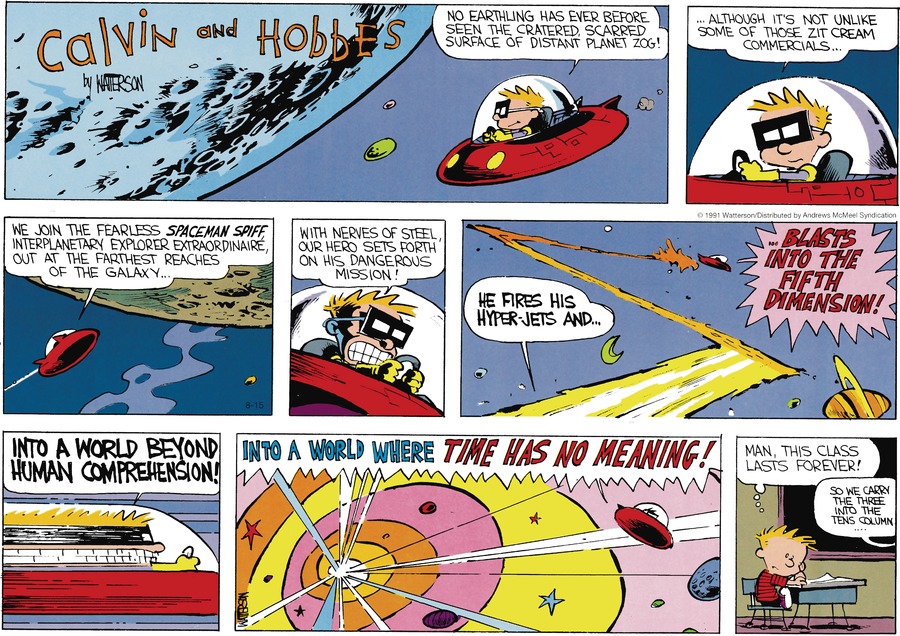
(As I’ve been working on this post, this Sunday’s Calvin and Hobbes repeat from many years ago managed to be relevant here:

Yes, that’s what it felt like.

But here’s the thing with the Common Core method as I understand it, versus the “old” method (and I promise we’re getting to a book excerpt eventually): the “old” method was a teaching of a rote algorithmic process to arrive at an answer. You learned multiplication first by being drilled until you know all your single-digit products: 7 times 9, 4 times 5, et cetera. Then you used those to work through a process that would give an answer. That’s what an algorithm is, after all: a sequence of steps that, executed correctly, will yield the same result, each and every time. Kids in my day were being taught algorithms to complete multiplication assignments.

Today, though, it’s clear to me that the idea is to teach a more conceptual approach, a way to think about what numbers are, what they mean, and what is actually happening mathematically when one does multiplication. (Or division, or whatever.) We were taught a process whereby we could calculate 36 times 52, but it appears to me that kids today are being taught what it means to multiply 36 by 52. Those are not the same thing. In my day, the “conceptual” stuff would come into play with annoying word problems (“Suzie has to give one toothpick to 52 kids every day for 36 days, how many toothpicks does Suzie need?”), but even that was more an applicative thing than a conceptual thing.

My father, who taught mathematics in college, got frustrated a lot of the time when students would arrive in his collegiate classes with good algorithmic skills but little ability to conceptualize just what it all meant in terms of mathematical concepts. In calculus classes he’d ask “What’s the derivative of x,” and students would say, “Oh, the derivative of x is [insert whatever the derivative is].” Then he’s ask, “Good! Now what does that mean?”

Crickets.

And that is where we get to Dr. Feynman. One of the chapters in Surely You’re Joking, Mr. Feynman relates Feynman’s experiences in traveling to Brazil to see science education in action in that country, which at the time of his visit was just starting to really develop. Here is Dr. Feynman:

In regard to education in Brazil, I had a very interesting experience. I was teaching a group of students who would ultimately become teachers, since at that time there were not many opportunities in Brazil for a highly trained person in science. These students had already had many course, and this was to be their most advanced course in electricity and magnetism–Maxwell’s equations, and so on.

The university was located in various office buildings throughout the city, and the course I taught met in a building which overlooked the bay.

I discovered a very strange phenomenon: I could ask a question, which the students would answer immediately. But the next time I would ask the question–the same subject, and the same question, as far as I could tell–they couldn’t answer it at all! For instance, one time I was talking about polarized light, and I gave them all some strips of polaroid.

Polaroid passes only light whose electric vector is in a certain direction, so I explained how you could tell which way the light is polarized from whether the polaroid is dark or light.

We first took two strips of polaroid and rotated them until they let the most light through. From doing that we could tell that the two strips were now admitting light polarized in the same direction–what passed through one piece of polaroid could also pass through the other. But then I asked them how one could tell the absolute direction of polarization, for a single piece of polaroid.

They hadn’t any idea.

I knew this took a certain amount of ingenuity, so I gave them a hint: “Look at the light reflected from the bay outside.”

Nobody said anything.

Then I said, “Have you ever heard of Brewster’s Angle?”

“Yes, sir! Brewster’s Angle is the angle at which light reflected from a medium with an index of refraction is completely polarized.”

“And which way is the light polarized when it’s reflected?”

“The light os polarized perpendicular to the plane of reflection, sir.” Even now, I have to think about it; they knew it cold! They even knew the tangent of the angle equals the index!

I said, “Well?”

Still nothing. They had just told me that light reflected from a medium with an idex, such as the bay outside, was polarized; they had even told me which way it was polarized.

I said, “Look at the bay outside, through the polaroid. Now turn the polarois.”

“Ooh, it’s polarized!” they said.

After a lot of investigation, I finally figured out that the students had memorized everything, but they didn’t know what anything meant. When they heard “light that is reflected from a medium with an index,” they didn’t know that it meant a material such as water. They didn’t know that the “direction of the light” is the direction in which you see something when you’re looking at it, and so on. Everything was entirely memorized, yet nothing had been translated into meaningful words. So if I asked, “What is Brewster’s Angle?” I’m going into the computer with the right keywords. But if I say, “Look at the water,” nothing happens–they don’t have anything under “Look at the water”!

[Feynman has several more experiences like this, after which he is to give a talk to students, professors, administrators, and government officials about his year in Brazil’s science education system.]

The lecture hall was full. I started out by defining science as understanding the behavior of nature. Then I asked, “What is a good reason for reaching science? Of course, no country can consider itself civilized unless…yak, yak, yak.” They were all sitting there nodding, because I know that’s the way they think.

Then I say, “That, of course, is absurd, because why should we feel we have to keep up with another country? We have to do it for a good reason, a sensible reason; not just because other countries do.” Then I talked about the utility of science, and its contribution to the improvement of the human condition, and all that–I really teased them a little bit.

Then I say, “The main purpose of my talk is to demonstrate that no science is being taught in Brazil!”

I can see them stir, thinking, “What? No science? This is absolutely crazy! We have all these classes.”

So I tell them that one of the first things to strike me when I came to Brazil was to see elementary school kids in bookstores, buying physics books. There are so many kids learning physics in Brazil, beginning much earlier than kids so in the United States, that it’s amazing you don’t find many physicists in Brazil–why is that? So many kids are working so hard, and nothing comes of it.

Then I gave the analogy of a Greek scholar who loves the Greek language, who knows that in his own country there aren’t many children studying Greek. But he comes to another country, where he is delighted to find everybody studying Greek–even the smaller kids in the elementary schools. He goes to the examination of a student who is coming to get his degree in Greek, and asks him, “What are Socrates’s ideas on the relationship between Truth and Beauty?”–and the student can’t answer. Then he asks the student, “What did Socrates say to Plato in the Third Symposium?” and the student lights up and goes, “Brrrrrrr-up”–he tells you everything, word for word, that Socrates said, in beautiful Greek.

But what Socrates was talking about in the Third Symposium was the relationship between Truth and Beauty!

What this Greek scholar discovers is, the students in another country learn Greek by first learning to pronounce the letters, then the words, and then sentences and paragraphs. They can recite, word for word, what Socrates said, without realizing that those Gr eek words actually mean somthing. To the student they are all artificial sounds. Nobody has every translated them into words the students can understand.

I said, “That’s how it looks to me, when I see you teaching the kids ‘science’ here in Brazil.”

This, it seems to me, is largely the difference between teaching the “old” way of arithmetic, with its rote memorization of times-tables and all that “Multiply the tens digit, carry the other number into the hundreds column” stuff, and the likely approach to however the Common Core method works. It’s teaching what is actually happening in the mathematics, as opposed to teaching a method that can be robotized.

Here’s some bonus Richard Feynman content, by the way: Ever wonder how a train stays on the tracks? Feynman answers, and it’s not the answer everyone thinks:


Share This Post

Wow….

 A fascinating astronomy image today! Behold:

NASA explains:

A spectacular set of rings around a black hole has been captured using NASA’s Chandra X-ray Observatory and Neil Gehrels Swift Observatory. The X-ray images of the giant rings have revealed new information about dust located in our Galaxy, using a similar principle to the X-rays performed in doctor’s offices and airports. 

The black hole is part of a binary system called V404 Cygni, located about 7,800 light-years away from Earth. The black hole is actively pulling material away from a companion star — with about half the mass of the Sun — into a disk around the invisible object. This material glows in X-rays, so astronomers refer to these systems as “X-ray binaries. 

 … 

In a new composite image, X-rays from Chandra (light blue) have been combined with optical data from the Pan-STARRS telescope on Hawaii that show the stars in the field of view.

Amazing!

Share This Post

Recent Reading!

 It’s been a while since I posted an update on books I’ve been reading, so here’s a bit of catch-up!

::  Edge of Sundown is a noir-mystery set in Chicago, by indie writer Jennifer Worrell. A writer who was once a fixture on the bestseller lists for his genre potboilers has spent the better part of a decade in the creative doldrums, until he starts writing what is a marked departure for him: a dystopian thriller in which alien beings are ridding the city streets of “undesirable” elements. But when real-world events start to mirror those in his novel, our hero starts to wonder where the boundary between fiction and reality lies…and that boundary blurs even more when the murders start.

I don’t often read this sort of thing, so I was surprised how compelling it was. There is a palpable sense of dread hanging over the story, even as the climax nears, and Worrell really creates a sense of dark place as she explores Chicago’s seedy underbelly. Highly enjoyable!

::  For my ongoing project of listening to (and writing about) the music of Jean Sibelius, I figured I should bone up on the composer’s life and times. I got a book out of the library, called Finlandia: The Story of Sibelius, by Elliott Arnold. This is an older book, published in 1941 while the composer was still very much alive (and, in fact, Sibelius himself appears to have had input into Arnold’s book). As such, the writing style is very much a throwback, and the tone of the book is one of somewhat relentless praise. If you are looking for a critical study of Sibelius and his music, you won’t find that here. But I just wanted a readable treatment of the composer’s life and times, and this is certainly that. In fact, I found the book valuable for its descriptions of the historical events in Sibelius’s homeland, Finland, a country which wasn’t even an independent nation when Sibelius was born. Sibelius was a highly nationalistic composer (even if he denied ever using actual Finnish folk material in his works), so this book gives a good sense of the events that shaped Sibelius’s attitudes and patriotic fervor.

::  Two rival sea-faring clans try to put their long feud behind them by marrying their two youngest nobles in Daughter of the Deep, a fantasy novel by Lina C. Amarego. The problem is that our heroine, Keira Branwen, is convinced that her new husband, Ronan Mathonwy, is the one who murdered her father. She is expected to push those feelings aside in the name of peace on the seas, but obviously that isn’t about to happen, and Ronan relentlessly insists on his own innocence. There’s no way that peace between the Branwens and the Mathonwys is going to be easily attained by any marriage, and so unfolds a novel full of character and conflict. I enjoyed this one immensely! Daughter of the Deep is the first volume of a duology called The Children of Lyr, and I absolutely intend to read the follow-up. Recommended!

::  For the Love of Music: Invitations to Listening by Michael Steinberg and Larry Rothe is a collection of essays that ran in the magazine of the San Francisco Symphony Orchestra, along with that magazine’s shorter program notes for specific concerts. As such, the book can be dipped into at will, which I recommend doing. There are chapters on Erich Wolfgang Korngold and on Sergei Rachmaninov and the great Chicago impresario Theodore Thomas, along with many more. The essays are often personal reflections on the part of Steinberg and Rothe, informed by many years of love of and listening to classical music. It’s an excellent collection of recent classical music writing.

::  A sadly necessary book, Under a White Sky: The Nature of the Future by Elizabeth Kolbert looks at the state of science today, in this time of climate change and the threats it poses to the natural world and to human civilization in general. This is not a general look at climate change, but rather an examination of a number of “case studies” in which scientists are working on very specific environmental issues, such as preserving a fish that only lives in tiny pools in caves in the Mojave Desert. In another example, Australian researchers are trying to engineer a coral that can thrive in the hotter oceans to come, hoping to somehow preserve the Great Barrier Reef. She ultimately arrives at the folks who are studying the possibilities of direct geoengineering to combat the ongoing warming of our planet, in such ways as dispersing huge quantities of reflective aeresols into the upper atmosphere, hopefully increasing the planet’s albedo in hopes of putting the brakes on continued absorption of solar heat. Who knows if that will work, but the fact that it’s being more seriously analyzed is itself an indictment of humanity’s utter failure to take any major steps to alleviate the problem. Under a White Sky isn’t an optimistic book, that’s for sure…but oddly, it’s not exactly pessimistic, either. My overwhelming feeling is that we’ll just keep not making things exactly better, but just continuing to make things different and figure out how to live with it down the road.

More reading notes to come!

Share This Post

And now, some space art!

 I saw this on the NASA Goddard Space Flight Center’s Flickr stream. It’s a cool illustration of the formation of a planet. All that lightning and whatnot is, I must admit, somewhat inspirational as “sensawunda space opera” pictures go.

Hubble Watches How a Giant Planet Grows

Description from the photo page:

Five million years might sound like a long time, but it’s a young age for a planet!


Hubble studied an exoplanet that’s grown up to five times the mass of Jupiter over a period of about 5 million years.


This illustration of the newly forming exoplanet PDS 70b shows how material may be falling onto the giant world as it builds up mass. By employing Hubble’s ultraviolet light (UV) sensitivity, researchers got a unique look at radiation from extremely hot gas falling onto the planet, allowing them to directly measure the planet’s mass growth rate for the first time.

Cool!

Share This Post

Recent reading: Space wizards, zombie apocalypses, reflections of Paris, universes ending, and a LOTR-but-not-LOTR fantasy

 A few more books I’ve read of late:

::  I can’t possibly keep up with the eternal flood of new books that is Star Wars publishing, but I do try to pick and choose the ones that sound good or come with good referrals. Last year, Lucasfilm announced a new project in their Star Wars publishing empire: a new series within the larger overall tale that focuses on life in our favorite galaxy far, far away two hundred years before the rise of the Sith, the fall of the Republic, and the arrival on the scene of a couple generations of Skywalkers. This series is called The High Republic, and it depicts the Republic at is height and the affairs of the Jedi as they act as the guardians of peace and justice and all that.

Light of the Jedi, Charles Soule

The High Republic is going to play out in books, comics, and who knows what else (no filmed entertainment set thusly has been announced yet, but who knows what the future may bring, as currently Star Wars is changing directions on an almost monthly basis). It all starts with Light of the Jedi by Charles Soule, and…well, it’s not bad, but it’s got a lot of room to get better.

Light of the Jedi has to do a lot of heavy lifting: it has to establish the time period we’re in, which means that it has to show all the ways this time period contrasts with the one with which we’re most familiar. It also has to establish the new threat that the Jedi are going to be facing through all this, which can’t be the traditional Sith because canon has already established that the Sith have been gone for centuries and they stay gone until Darth Sidious steps into the open around the time of The Phantom Menace. Light also gives us a lot of viewpoint characters, probably too many, all having adventures that play out over relatively short chapters.

The sad result is that Light of the Jedi ends up feeling overstuffed and underfocused, so that in its attempt to be really exciting it ends up under-engaging. I have to admit that I came close to DNFing this book halfway through, and ended up skimming a lot of the last act. It’s a shame, because there is interesting stuff here and it does set up some possibly exciting story possibilities to come. The book does the job of getting The High Republic out of the gate, but it’s not the galloping start it should have been.

::  I’m reading more indie books of late, which I should do because I’m an indie author myself, and which everybody should do because there’s a lot of great writing out there beyond the world of the standard publishers. I’ve been following author Anna Vera on social media for a while, and I finally got around to reading her book When Stars Burn Out, a dystopian science fiction novel about the zombie apocalypse and the human response to it.

When Stars Burn Out, Anne Vera

I freely admit that this genre is not generally my cup of tea, which is to say, it’s almost never my cup of tea. But I do enjoy it on a selective basis when it’s handled well, and Vera is one of the ones who handles it well. There is darkness and grim death here, because how could there not be, but for once it’s not wildly overdone with spectacular deaths just for the sake of deaths (like in, say, The Walking Dead). There are intriguing mysteries and an interesting society of people trying to live without becoming zombies themselves, and the character work is particularly good. Heroine Eos Europa is a fascinating person, and I hope to read more of her adventures soon.

::  I’ve had Paris to the Moon by Adam Gopnik on my shelf for years, and I finally got around to it. I have to admit to finding it slightly disappointing. I was expecting a travel book, but it’s really not that; it’s a collection of essays Gopnik wrote in the 1990s for The New Yorker about his and his family’s experiences in Paris when they packed up and moved there. It’s all well-written and all, but unlike the best travel writing, Paris to the Moon‘s essays feel distinctly rooted in a particular time and place, and from a particular vantage point. I felt an odd disconnect while reading it, like perusing the mundane dispatches from someone’s life decades ago.

Paris to the Moon, Adam Gopnik

It’s not bad, though! Not at all, and if life in Paris interests, there’s much here that’s interesting. I cite one passage, which I found particularly amusing:

Late last year the French government assembled a committee to choose a name for the vast new stadium that’s being built in a Paris suburb. The committee included an actor, and “artiste”, some functionaries, and even a few athletes. It took a long time deliberating over its choice. Names were submitted: Some people liked the idea of naming the stadium after Verlaine or Saint-Exupery, and lots of others liked the idea of calling it Le Stade Platini, after Michel Platini, the great French soccer player. At last, late in December, the committee announced that it had come to a decision, and the government decided to broadcast the verdict on television. The scene was a little like the end of the Simpson trial: the worried-looking jurors filing to their seats, the pause as the envelope was handed to the minister of youth and sports, the minister clearing his throat to read the decision to the nation. The stadium that would represent France to the world, he announced, would be called (long, dramatic pause) Le Stade de France. The French Stadium. “Banal and beautiful at the same time,” one journalist wrote. “Obvious and seductive. Timeless and unalterable.”

I suppose there is something oddly comforting, albeit in a kind of depressing way, in learning that the bureaucratic way of spending a lot of time and money coming to a perfectly boring decision isn’t something unique to the United States.

::  Katie Mack’s The End of Everything (Astrophysically Speaking) is a book about the end of our universe.

The End of Everything, by Katie Mack

Apparently the current state of science has a handful of scenarios by which our brightest minds think our universe will end, and Dr. Mack has written this helpful, clearly-written, and humorous (given the subject matter) book summing it all up. If you like a bit of science to help back up your low-level existential dread, The End of Everything is the book for you! Yes, there are passages that I didn’t entirely understand, but Mack does a very good job of explaining how we came to our current theories of how the universe began, and given our understanding thereof and of how the universe works now, how we might expect it to end. Her ultimate takes aren’t terribly optimistic (for ideas on what the end of the universe might look like from the standpoint of sentient starfaring civilizations, Michiu Kaku is the author to seek out), and there’s something particularly chilling about what’s called the “Heat Death” of the universe, as ultimately the unending expansion of space results in our skies growing ever, ever darker as the stars become too far from us for light to ever arrive. But, as Dr. Mack writes:

In fact, the one thing that all the universe-ending scenarios we’ve already discussed have in common is that they definitely aren’t coming around anytime soon. As far as we can tell from our best understanding of physics, we have at least tens of billions of years before even the most extreme version of a sudden Big Crunch reversal could occur, and no Big Rip could be less than a hundred billion years off. A Heat Death, considered by most to be even more likely, would be so far into the cosmic depths of the future that we hardly have terms to describe it.

So there’s that. Of course, she writes this just before sequeing into a chapter about a “Vacuum Decay”, in which a bubble of true vacuum forms someplace and expands at the speed of light, destroying everything it takes in as it expands. This, apparently, is a thing that can happen at any time, and since the horizon of the destructo-bubble’s edge moves at the speed of light, we’d never know it was coming. For all we know, there could be a universe-destroying bubble right now someplace, expanding toward us at the the speed of light…and depending on where it is, that’s how much time we’d have left. So…sleep tight, I guess!

::  Finally, a re-read of a book I liked a lot as a kid. Between 7th and, I think, 9th grades, I went on a huge epic fantasy reading kick. I read a lot of epic fantasy back then, between roughly 1982 and 1986. (After that I fell into spy and espionage fiction in a big way.) In those years, epic fantasy was far more dominated by the JRR Tolkien model than it is now, thankfully. I love JRRT, but wow, did the genre need some new thinking for a long time. Luckily that new thinking has long since arrived and the genre is healthier for it…but for years fantasy novels seemed really stuck in the same trope wonderland, and the biggest title in the post-JRRT swords-and-dwarves-and-elves type of fantasy was Terry Brooks’s The Sword of Shannara. I read Sword once, back in my junior-high days (along with its two immediate sequels, The Elfstones of Shannara and The Wishsong of Shannara), but I’ve never revisited them since…until now. A while back I was shopping at my local Savers store and I found the original three Shannara books in the Used Books section*, so I picked them all up. Last week I finally re-read Sword, and…well, it was like dipping my toes in Heraclitus’s river. It’s not the same river it was when I was thirteen.

The Sword of Shannara, by Terry Brooks

It’s close to forty years since I read Sword all the way through, so I don’t remember much of it at all from back then, except that I do remember finding it kind of padded back then. Nothing specific, but I definitely recall skimming through chapters I didn’t really care that much about. And lo and behold…that happened again.

In Sword you have the Tolkien model almost in its entirety: a malevolent Dark Lord is threatening the existence of everything, while the races of Man (it was the 70s, so yes, it’s called “Man”), Dwarves, and Elves don’t really get along terribly well. There’s a single magical weapon, though, that can prove the Dark Lord’s undoing, and it can only be wielded by a specific individual who happens to be a member of a peaceful, pastoral people who live about as far away from the Dark Lord’s palace as you can get. A wizard-like figure who is known all over the world for his strange comings and goings arrives to send our young hero on his quest, which after many dangers leads him to a single quest to find the magic weapon. On this quest he is joined by a…what should we call it? A “fellowship”?…helpful team comprising men, Elves, Dwarves, and our hero and his pastoral buddy.

Off they go to deal with the weapon and the Dark Lord, but eventually their “fellowship” is forced to break apart, and the others go off to deal with specific wars and stuff while Our Hero proceeds to his ultimate journey into the Dark Lord’s realm, which is a barren desolate wasteland of dust and sharp mountains.

I don’t want to sound dismissive, but Sword really really does read like a Tolkien clone for people who wanted more Tolkien but who didn’t want to re-read Tolkien for the 80th time. All the tropes are here, with just about all the story beats; what Sword seems most to accomplish is reducing the Lord of the Rings from its 576,000 words down to about 226,000. This isn’t always a good thing, as I found it very hard to care about some of the “side adventures” that Brooks takes us on in the back half of the book. We meet a guy named Balinor early on, but we get little of his backstory until much later, which we get right before the book diverts us to his struggles against his crazy jealous brother. I found it nearly impossible to care about any of that.

Ultimately I found Sword a slog to get through this time. Brooks overwrites and overdescribes to an amazing degree, and from a stylistic standpoint, his paragraphs are way too long, sometimes lasting entire pages. And look, I know he wrote this in the 1970s, but still: it’s a 726 page book, and our first (and only) female character doesn’t show up until we’re well past page 400.

I do plan to read the other two books in the trilogy at some point. I remember liking Wishsong most of all from these, and I’ve also heard that Brooks’s various explorations in the Shannara universe after these initial volumes perk up quite a bit. I don’t know if I’ll go any farther past Wishsong, but…you never know.

* I don’t know about anybody else’s Savers location, but the Used Books section at my local one almost always has something worth grabbing. I never leave that place without a book or two. Not huge hauls, but there’s always something!

Share This Post

I raise a glass to you, Dr. Vishniac

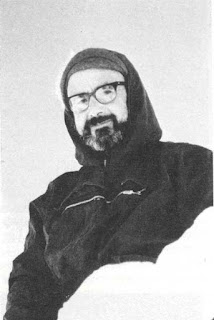
 It’s amazing what stories stay with us through the years. Some stick for obvious reasons, but some do not; some just stick all on their own. When I was in fourth grade, more than forty years ago, I watched the first broadcast of Carl Sagan’s science show Cosmos. In the fifth episode, entitled “Blues for a Red Planet”, Sagan discussed at length Mars and our human relationship with that planet, up to and including the Viking Lander.

In the midst of that episode, while discussing the possibilities for life on Mars, Sagan related a story about a friend of his, a microbiologist named Wolf Vishniac, who developed experiments that a robot ship sent to Mars might be able to perform, testing the soil for the presence of microbial activity.

Here is the excerpt in question. I have remembered this story, the sad story of Wolf Vishniac, to this day. I think of Dr. Vishniac, a man born almost a hundred years ago and dead almost fifty, often when I am reading or thinking about the current state of Martian exploration. On this day, when NASA landed another rover on the Red Planet whose primary mission involves testing for evidence of life, I honor his contribution to the quest for an answer to a simple, but profound, question: Was there ever, or is there now, life on Mars.

Share This Post