Boldly going?

I’ve just watched the new trailer for Star Trek, and I’m still troubled. On the one hand it looks like a trailer for a kick-ass space opera action movie, which would be right up my alley, except they’re calling it Star Trek and using the names of characters I’m already deeply familiar with. Yes, it bugs me that they’re changing everything. No, I don’t know why it doesn’t bother me that the producers of the James Bond movies are doing roughly the same thing — but then, the Bond series is a different animal, which never came to grips with the fact that the world was constantly changing and yet their character was staying the same. I don’t know — but the new Trek movie looks like it might be kinda-sorta cool, but I still hate what they’re doing with Kirk and company.

To me, it’s like if the Bond people not only did a reboot of the Bond movies, but invented a completely new backstory for him — maybe make him the son of an IRA leader or something. But every single bit of new Trek promotional material that comes along makes me think one thing: this might be cool if they’d just change the names of the people involved. How about not making it a Trek movie? Just for kicks?

Anyway, here’s the trailer:

See, right off, there’s what bugs me. Kirk is apparently the delinquent doofus who gets pushed into enlisting by someone else. And the Kirk in my imagination would never utter something like “Why are you talkin’ to me, man?” Ugh.

UPDATE: Spurred on by Belladonna in comments, I came up with what I think is a better analogy: what they’re doing with Kirk strikes me as if somebody made a movie of Oliver Twist in which Oliver was not an orphan but a runaway from home. I like it when I get challenged to explain myself better!

Share This Post

Mr. Data, set a course — for love!

Sometimes you feel like reading a romance novel, right?

OK, I’ll assume by the chirping crickets I just heard that I’m wrong here. But anyway, sometimes I want to read a romance novel. But not just any romance novel, mind you; I’m not looking for those books with the titles printed on the covers in flowery script over a picture of some long-haired guy whose chest is just a-heavin’ in the wind. No, I want at least some modicum of muscle in my romances! So I was happy to discover Linnea Sinclair, writer of space opera romances. Yes, you read that right: space opera romances. Games of Command is the first of her books that I read, and damned if I didn’t enjoy the hell out of it. Looking for a science fiction beach read? This is it.

In the wake of a war, at the end of which a tenuous truce exists and a shaky government is holding power, former combatant Tasha Sebastian is assigned to the ship commanded by her former adversary Admiral Branden Kel-Paten, a cybernetically enhanced man who is a hard, cold, by-the-books kind of commander. His big, dark secret is that he’s desperately in love with Tasha Sebastian, a love which he dares not show because cybernetics are not supposed to show emotion and can be deactivated if they do. They take into their custody a wanted man, Jace Serafino, who happens to be telepathic, and is able to learn of Kel-Paten’s feelings; and in the course of trying to figure out what to do about the potentially explosive situation, Tasha breaks into Admiral Kel-Paten’s personal records, hoping to learn something definitive about his intentions and loyalties, but instead finds his personal journals where he has written extensively of his unrequited love for his second-in-command.

Yeah. Hilarity ensues, along with lots of action: adversaries trapped in shuttlecraft stranded in deep space; potential lovers who are also former enemies finding themselves relying on each other on a mysterious planet that’s not what it seems; races against time; all the usual complications in a book that makes you want to read it over a big bowl of buttered popcorn. The story here is pretty much paper thin, but Sinclair is able to keep things moving pretty briskly, her dialog tends to crackle, and her characters are sharply drawn and sympathetic. In terms of SF, there’s nothing here that you wouldn’t find in a better episode of Star Trek (in fact, I kept visualizing the book’s main ship, the Vaxxar, in terms of the good old NCC-1701-D. Recommended, even if it’s not terribly good for you.

Share This Post

The universe is a spherical region seven hundred and five meters in diameter.

That’s my favorite “Computer Voice” line from Star Trek: The Next Generation, given in response to Dr. Crusher’s query: “Computer, here’s a question you shouldn’t be able to answer: What is the nature of the Universe?”

Anyway, Majel Barrett Roddenberry, the actress who played the Computer Voice as well as Nurse Christine Chapel, Number One, and Lwaxana Troi in various Trek series, has died. A shame.

Share This Post

Boldly Geeking

I wanted to highlight a few nice geek-posts I’ve seen the last week:

:: First, Jason takes note of some possible reason for optimism regarding the Star Trek relaunch by JJ Abrams:

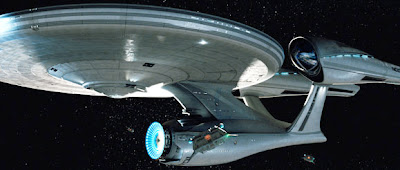
So, here we’ve got a good look at the unfortunate vessel that’s only glimpsed in fast cuts and in between explosions during The Trailer. It’s instantly recognizable as a Federation starship with its saucer-shaped primary hull and the blue-glowing deflector dish. But wait, you might be saying if you’re familiar with the usual Star Trek vehicle architecture, there’s something screwy here: the secondary hull (that’s the bit that sports the deflector dish and the shuttlecraft hanger in the back) is on top of the ship, not below as on pretty much every other Starfleet vessel ever seen in a Star Trek TV series or movie. And there’s only one engine nacelle? Has J.J. Abrams gone insane? Is this the sign we’ve all been looking for, the proof that he’s abandoned all the established Trek lore and is waving his private parts at the existing fanbase? (Can you tell I’ve been hanging out on the fanboy message boards again?)

Well, no… in fact, I take the Kelvin‘s layout as a very positive sign of exactly the opposite. But you’ve probably got to be a real old-timer like me to recognize the clues. You see, the Kelvin is highly reminiscent of the very earliest design sketches for the good old Enterprise herself, which were upside-down relative to the way we’re familiar with her looking. You can see one of these sketches on this page (scroll down to the section labeled “Artwork”), and several more in the old book The Making of Star Trek, if you can track down a copy of that. I think they were reprinted in the excellent book Inside Star Trek, as well (for my money, that one is the best volume ever written on the history of the original series).

As for the single-engine controversy, it’s more-or-less understood nowadays that in the Trek ‘verse, you need to have two nacelles, but that wasn’t always the case. Way back in the ’70s, even before Star Trek: The Motion Picture — the Golden Age of original series fandom, in my opinion — one of the primary sources for young nerds was a book called The Star Fleet Technical Manual by Franz Joseph. This volume was considered official “canon” for years until Gene Roddenberry decided it wasn’t, and as I recall, it contained several one-nacelle ship designs.

Ah, the Star Fleet Technical Manual…I really should track down a copy of that book one of these years. It was a lot of fun to dig through, back when I was a kid. I never owned it, but one of the libraries we used to frequent had a copy in its collection. I remember looking at the lists of all the ships in Starfleet, and also noting the interesting designs of the ships as well. Sometimes the warp nacelles were on top of the ship, sometimes underneath; some ships had only one nacelle with no secondary hull, and so on. The USS Reliant from The Wrath of Khan was a nice throwback to these other formulations of Starfleet ships, and Jason’s right to note that at least in this aspect of his visual design, Abrams is taking his cues from established Trek history.

Of course, this was never in much doubt. Abrams has always been good at injecting his projects with lots of small details for the segments of fandom that live for the small stuff. Witness all the people who devote time to digging through the inner details of LOST, and similar factors were at play in Alias. I’m not worried about that aspect of this project; I remain worried that Abrams is going to screw up the character dynamic of Trek.

Second, SamuraiFrog decides that he’s a Star Wars fan after all:

Recently, Becca and I sat in front of our new, big widescreen TV and watched, in a single day, all six Star Wars films, from The Phantom Menace to Return of the Jedi. And it turns out I’m still a Star Wars fan. It was hard to be one for the last decade plus of humorless Star Wars fandom whining its overly entitled little head off about the thing it professes to love but openly hates (and, like an abused housewife, keeps returning to because no one understands it in that special way that they do). But I still dig it, and watching all six parts at once makes for a more unified experience than I thought it would. It all makes sense, and it all holds together. And it’s surprisingly easy to get emotionally involved.

I still haven’t watched the complete Star Wars saga in one go, although a few times in college we watched all three of the Original Trilogy at once. My constant hope that the backlash against Star Wars eventually fades continues to hold sway in my mind.

Share This Post

The Operas of SPACE!!!

My leading light, reading-wise, continues to be the wonderful SF subgenre of space opera. I’ve done some more reading along that line the last few months.

Margaret Weis wrote a space opera trilogy called Star of the Guardians back in the early 1990s, of which I recently read Book One, The Lost King. Weis is far better known as half of a writing duo, the other half being Tracy Hickman, that produces in prolific fashion the Dragonlance novels. For this series Weis went it alone, although Hickman provides an introduction wherein she declares that Star of the Guardians is not science fiction but rather “Galactic Fantasy”. What’s the difference? Well, it’s pretty much the same difference that’s always illuminated between space opera and hard science fiction, although Hickman seems to hold hard SF in some disdain, saying that SF is about our love of technology while “Galactic Fantasy” is about our hopes and dreams in the future.

I’m not sure what to make of that, but The Lost King is a pretty fun and breezy read. It’s fairly obviously indebted to Star Wars, using a lot of tropes from that “universe”, which at the time of Weis’s writing consisted of the movies and little else. The story takes place in the aftermath of a Galactic Civil War, in which a benevolent if inept monarchy was replaced by a dictatorial Republic, which is led by a harsh and controlling President who rules through the actions of his military and his Warlords. One of these Warlords, Derek Sagan, is tasked with tracking down the last living heir of the deposed Starfire dynasty, a young man named Dion, who is being protected by the last of the Royal Guardians. Dion flees with a mercenary ship captain named Tusk, and on the way they make the acquaintance of another Guardian named Lady Maigrey. Warlord Sagan, it turns out, does not wish to kill Dion Starfire outright; instead he has plans of his own (which aren’t totally revealed in this first book of the trilogy).

The story of The Lost King is nothing that anybody who’s read this sort of tale. As Weis notes, her story is far more reliant on the tropes of epic fantasy than SF, and what SF tropes are present are straight out of space operas like Star Wars, which many SF fans don’t even admit as SF in the first place. It’s not the most notable book I’ve read by a long shot, but it’s got some things to recommend it; most notable are the character interactions between Warlord Sagan and Lady Maigrey (who have a long history that wasn’t always antagonistic), and between the mercenary Turk and young Dion Starfire. Weis does a good job creating a cast of characters who have history behind them that explains their actions and motivations.

The Lost King is a promising beginning to a potentially nice space opera trilogy. It’s not a great book, by any means, but it’s worth seeking out for a breezy, entertaining “beach novel” kind of space opera.

Share This Post

“If I ever kill you, you’ll be awake, you’ll be facing me, and you’ll be armed.”


A few months back I finally addressed a monstrously huge hole in my science fiction, space opera loving resume: I watched all of Firefly, every bit of it, including the movie Serenity. I realize I’m very much late to the game on this, but hey, late to the game still means I’m a player. Or something like that.

Firefly, for those who haven’t paid attention, is a show that Joss Whedon created back in 2002, after Buffy the Vampire Slayer ended. It’s an SF show set something like five hundred years in the future where humanity has colonized a distant star system that consists of, well, lots of planets and whole ton of moons that have been terraformed for human colonization. The “Core Worlds” are the rich and powerful planets of the system, and these worlds form the basis of “the Alliance”, which is the somewhat despotic government. The outlying worlds and moons are a mix of independent planets and moons and some dependent on the Alliance. The show takes place several years after the end of a civil war in which the “Independents” fought unsuccessfully against the encroaching Alliance; the spaceship that serves as the main location of the show, Serenity, is a Firefly-class freighter named for the deciding battle in the war, Serenity Valley, in which our lead character, Captain Malcolm Reynolds, fought on the side of the Independents. Got all that? (Yes, it’s weird that the show is titled for the class of ship rather than the title ship itself. By that logic, Star Trek should have been titled Constitution, because the Enterprise is a Constitution-class vessel.)

So, when the show starts, Reynolds (often called “Mal” for short) is commanding his beat up old ship with its small crew as they go from job to job to pay their way, with many of these jobs being of the less-than-legal sort. This can mean smuggling illegal goods from one world to another, or salvaging valuable cargo from spacewrecked ships, or stealing valuable medicines from Alliance hospitals for sale on the challenged outer worlds. This also leads Mal and company into the employ and/or business association with all manner of unsavory characters, some of whom are very dangerous people indeed.

In looking about online for commentary about the show, much has been made about the show’s atmosphere. I’ve often heard Star Wars described (at least A New Hope, not so much the rest of the series) as a Western set in space, but I’ve frankly never seen that as being a fair or accurate label. In the case of Firefly, it’s entirely accurate, not only in the fact that everyone dresses like they’re in a Western, Mal’s preferred weapon is a six-shooter, everyone talks in that Western way (you’ll know what I mean if you see the show), everyone dresses in a Western way (long coats, wide-brimmed hats, lots of facial hair all over the place), the main mode of transportation on many of the poor worlds the show visits is the horse, and many of the settlements on those worlds are exactly the kinds of dusty towns you’d see in any Western. This appears to be a problem for some viewers, but it never really bugged me all that much. I would have liked to have seen a little more variety in the kinds of settings on the show, but I there was some of that, after all (one world has rich people living in floating cities that hover above an ocean), and lodging such complaints about a show that was only around for fourteen episodes and a movie seems a bit churlish. The obvious rejoinder from Whedon and company is, “Yeah, yeah, we’d have got round to that if Fox hadn’t canceled us after jerking us around for half a season.”

OK, as to that last: FOX’s shabby treatment of certain shows and not others is something of infamous legend in teevee fandom circles, but FOX’s record in the case of Firefly is particularly bad. About the only thing they could have done to show less confidence in the show and to guarantee its eventual demise would have been to simply not have greenlighted it in the first place. FOX execs weren’t overly enthusiastic about the show’s two-hour pilot episode (which in itself is astonishing, as that pilot could have been transposed to the movie screen as-is for one hell of a SF movie), so they ordered the pilot shelved and another hastily shot, which is why the show’s second episode, “The Train Job”, was aired first. Then FOX continued to air the episodes in whatever screwy order they felt like airing them in, which in turn screwed the show because, while it wasn’t exactly a serial, Whedon and company were creating quite a bit of continuity with recurring characters and storylines. The wonderful pilot episode wasn’t aired until the show’s fate was already sealed, and the show’s timeslot was a disaster: FOX took a show that was heavy with continuity and in a genre that traditionally has to struggle to gain an audience and put it on Friday nights at 9:00. Now, maybe FOX was thinking back to the earlier days of the network when they had The X-Files in that timeslot and they kept it there since they didn’t have much of anything else to air anyplace, but those days were long gone by the time Firefly came along. (Remember, NBC in the 60s was able to finally drive the final nails into Star Trek‘s coffin by giving it a Friday time slot.) In any case, FOX’s treatment of Firefly makes ABC’s treatment of Once and Again look like the very picture of network support. Again, I think of Jon Lovitz’s bitter quip to David Letterman some years ago when FOX canceled his own critically-loved but ratings-challenged show The Critic: “FOX? They should spell it with a ‘U’.”

But back to the show. One claim I’ve heard is that lots of fans find Malcolm Reynolds compelling because he’s what Han Solo might have been if he hadn’t been “softened” in Return of the Jedi. I don’t see that, actually. First, I never thought Solo was “softened” at all. But what happened is that Reynolds’s character arc is pretty much Han Solo’s character arc in reverse.

When we first meet Han Solo, he’s a pirate and a smuggler, making his living by using his ship to transport the goods belonging to one criminal low-life or another. In fact, when we meet him, he’s just earned himself the anger of one of his “clients” because he’s lost cargo belonging to one of his criminal bosses. But as the Star Wars story progresses, Solo falls in with the Rebellion, hangs with them for a while, and while aching to return to his former life, eventually finds himself converting to their cause and becoming a true believer. The cynical criminal becomes an idealist. Mal Reynolds, however, started out as the idealist hero, fighting a losing fight with the side he believes in. (When an Alliance officer questions him about it, saying “You fought on the wrong side”, Mal replies, “I fought on the losing side. I’m still not convinced it was the wrong side.”) The opening scenes of the pilot show the last moments of the Battle of Serenity Valley, when Mal believes that his side in on the verge of victory, just as soon as his air support arrives – when word comes that his commanders have decided to throw in the towel and those fighting are ordered to lay down arms. Just like that, Mal’s cause is defeated, and he becomes bitter and cynical. Han Solo is the criminal who finds something to believe in and fight for; Mal Reynolds loses the thing he had to believe in and fight for, and thus becomes a criminal.

(Now, when I say that Mal Reynolds is a “criminal”, I’m saying that some of what he does is illegal. He’s not afraid of doing things that are illegal, but he’s not at heart a criminal in the sense that he lives to break the law. Robin Hood and Ernst Stavro Blofeld are both “criminals”, if you take my meaning.)

This all changes a bit in the feature film Serenity that somehow managed to get made after the show’s cancellation; the major theme of the film is everyone around Mal trying to figure out what, if anything, he actually believes. The film gives us an answer, but it’s not an easy answer at all, and Mal’s actions in the film are as consistent with one set of beliefs (that someone must stand up to the Alliance) as with another (that Mal’s days as a fighter-for-something are over, and all he wants now is freedom).

But anyway. Firefly has become as beloved in SF fandom as anything I can remember, and it’s truly a bummer to note that the lackluster box office of the follow-up Serenity movie likely means that we’re unlikely to ever see another Firefly show or movie again. There have been a few comics series taking the story further, and that to me is probably the best format we can expect for continued Firefly goodness (if not actual novels; I’d read original Firefly novels if they existed). So, for the time being, what we’ve got is what we’ve got. That being the case, Firefly as it stands is a surprisingly complete body of work.

In just fourteen episodes, Firefly creates an SF universe that feels plausible and real, populates it with characters we can know and care about, and tells involving stories using all that in the mix. Watching the show’s episodes in the correct order, via the DVD set, I noticed how fully-imagined the show was right from the beginning. Firefly stands in marked contrast to any of the Star Trek series, each of which required a season or two to really settle into a rhythm. The characters’ voices are all established from the first moments, which is something you don’t often see. Thus, there’s nothing in Firefly that reminds people of, say, Mr. Spock in the early episodes of Star Trek emoting all over the place since it hadn’t yet been decided that Vulcans suppress their emotions. This is a show that really learned the lessons of Star Wars in that it made all its technology look like it does something. I particularly appreciated the episode “Out of Gas”, where Serenity is crippled by the failure of an engine part that’s about the size of a can of coffee. That may have struck some as implausibly, but being a maintenance worker myself (but not quite up to the level of a Keylee or a Montgomery Scott), I’ve seen lots of big machines felled by comparatively tiny parts. Remember: the space shuttle Challenger was doomed by a piece of rubber that wasn’t even part of the ship itself, and the Apollo 13 mission was nearly destroyed by a faulty wire.

Also of interest was the show’s approach to establishing its universe. Lots of SF shows, like the Star Treks, insist on showing us one new world after another, and only start to use recurring characters when the show is established. (DS9, by virtue of its stationary setting, broke this habit, much to its credit; I still hold it as the best post-TOS incarnation of Trek.) Firefly, however, gives us recurring characters right off the bat: con-woman Saffron, criminal boss Niska, low-grade but ambitious hood Badger. This is more evidence of how well-designed the show was, and another reason to be annoyed at the show’s ultimate failure.

In terms of casting, Firefly was, as far as I can tell, perfectly cast, at least in its leads. Everybody seems to not be playing their roles so much as inhabiting them, and the chemistry amongst this crew is established very early on. Other touches are equally pleasant: the swearing in Chinese (and the constant hints that China became the dominant culture of Earth before the diaspora), and it only took a few hearings before my ears accepted the word “Goram” as a surrogate for “goddamn”. Fictional expletives are always tricky (“Felgercarb!” being a notable example, from BSG), and using Chinese and one made-up English one is a nifty way to solve that particular problem.

Was Firefly perfect? Of course not, but its general level of quality was astonishing for a show that never had the full backing of its network. What might have been! I can’t believe that we’ve seen the last of this crew or heard the last of their stories. It’s too promising a world, and its existing canon is too high-quality to languish forever. Or so I can hope.

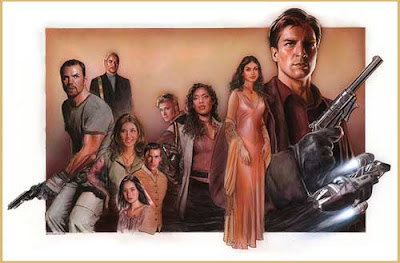
(Image above via.)

Share This Post

To Boldly Geek

The official first trailer for JJ Abrams’s Star Trek reboot is out. Having watched it, I can say once again regarding this project: Meh. I’m still not sold on the idea of rebooting Trek in the first place (If we’ve gotta have Trek, surely we can tell lots of new stories without tossing aside established continuity, and why do we even gotta have Trek in the first place? It’s a wide wonderful SF world out there, let’s go see some uncharted planets!), and as far as this particular project goes, I’m still less than enthusiastic. Here’s the trailer:

It’s a nice looking trailer, especially the space battle stuff, although I do pine for the days when every Trek tale on the big screen didn’t need to have the Big E out there, phasers and photon torpedoes a-blastin’ away. I’m more concerned with the character stuff. The trailer alternates a bit between Kirk and Spock, first showing a Kirk who’s apparently a hothead kid who is constantly flouting the rules. Then we see that Spock’s main trouble is the fact that he’s half-human and half-Vulcan.

As to the latter, well, duh, and frankly, after the entire run of the Original Series and six feature films with the original cast, I don’t think there’s a whole lot of more interesting comment to be made about this. Yeah, Spock is the product of two worlds, and not entirely comfortable in either. If Abrams really reboots everything, resetting the entire Trek continuity to zero (as some rumors have him doing), then the entire arc of Spock’s life as a character is gone too, and that bugs me a bit. In the last two “Original Cast” Trek movies, we get to see a Spock who finally figured out his place in both of his native cultures, and the character didn’t suffer for the lack of all that angst. Maybe this can be handled interestingly, but I fear that it will seem like a trip into familiar territory.

And then there’s the former, James T. Kirk. The popular concept of this character is that he’s a womanizing rule-breaker, but I’ve always thought that the rule-breaking idea of him is overdone a bit. Kirk is a man who takes rules seriously at times, sidesteps them at others, but he’s a guy with a fearsomely strong moral compass. I’m worried that Abrams’s movie will defuse this a bit, turning Kirk into the archetypal hothead who learns to tamp it down a little. I saw somewhere online the analogy that the trailer looks like “Top Gun in space”, and that’s not off the mark. In truth, I hated the Kirk-as-a-kid-driving-the-hotrod bit. How does that square with the notion, established in the original series, that Kirk as a young man was incredibly straight-laced, so much so that his best friend (and future first officer) Gary Mitchell would describe Academy Cadet Kirk as “a stack of books with legs”, or that one particularly gleeful troublemaker named Finnegan would decide that Kirk was such a stick-in-the-mud that he made Kirk the butt of all of his jokes? What was always so interesting to me about James T. Kirk was that underneath the veneer of a handsome young man who had an eye for the ladies, who had the bright smile and the twinkle in his eye, and who would always err on the side of what he thought was right even if the regulations said something different, one could find beating the heart of a very serious man. A man who took duty extremely seriously. The trailer doesn’t really suggest that’s what Abrams is doing with Kirk, and that potentially bothers me.

(Now, of course, we are just talking about a trailer here, and trailers are notorious for not accurately showing what movies are really like. Maybe Abrams has a very serious Kirk indeed, but it’s hard to square that with Kirk engaging in life-threatening stunts like driving a car to the brink of a cliff, and it doesn’t help the impression I have of Abrams’s Kirk that every production still that’s been released so far has Abrams’s Kirk making a very smug facial expression.)

Finally: where the Hell is Dr. McCoy in this trailer?! I think I got a glimpse or two of him, but that’s about it. And if that’s any indication of the role McCoy plays in Abrams’s reboot, then he can have his reboot and I’ll keep my eight bucks next summer when this comes out. The key dynamic that made the Original Cast work so well wasn’t the chemistry between Kirk and Spock, but the triple-chemistry between Kirk, Spock, and McCoy. These three men have an extremely deep friendship that survived Edith Keeler, an extremely deep friendship that compelled two of them to set aside their entire lives to go after the one they thought dead but still in need. Dr. McCoy is every bit as important in Original Cast Trek as Kirk and Spock. If Abrams moves him into the background at all, making him more along the lines of Scotty and Uhura and the rest, I’ll be irritated.

Again, I’m basing this all on a two-minute trailer, so maybe I’ll end up full of bird poop on all this. That would be fine with me, but to the extent that past performance indicates future results on stuff like this, I’m still not enthused, because I’ve just never found the JJ Abrams Kool-aid to be my cup of tea. Alias was mildly entertaining, but it never grabbed hold of me, and for my money, LOST is just a bunch of people brooding on an island. I’m certainly not thrilled about a state of affairs where Firefly is dead outside of comics but we’re getting JJ Abrams’s take on Star Trek.

We’ll see.

Share This Post

The Great Bird

It appears that we now know what the Enterprise will look like when Star Trek reboots next year:

Well…I don’t know. I can’t decide yet if I like it or not. It certainly sticks to the classic shape, and the primary hull (the saucer section) looks fine, but the secondary hull (the engineering section) looks too small, squashed even, and the warp nacelles don’t look right to me at all, being too far forward (like you could step off the primary hull and step down onto the nacelles) and sporting that oddly-shaped flare at the front. Plus, the pylons connecting the warp nacelles to the secondary hull are bowed outward, making the ship look bow-legged. I do like the sleeker, wider pylon connecting the primary and secondary hulls, and the deflector dish looks nifty, too. From the presence of shuttlecraft in the picture and the fact that the fronts of the nacelles are dark, I assume this pic is from the ship in a drydock situation. I wonder what color the fronts of the nacelles will be once the ship is flying.

I don’t hate it, but it ain’t this, either:

We’ll see. It took me a long time of watching ST:TNG before I got really used to the Enterprise-D, which I always thought looked awesome from some angles and ridiculous from others. The Enterprise-E looked okay, although I haven’t seen the movies it appeared in enough to have a strong opinion.

Share This Post

Some Thoughts on Contemporary Popular Culture

That’s actually a pretentious title for a post in which I’m going to geek out a bit. Huzzah! Back to the geekiness!

:: It did excite me that another attempt to bring everyone’s favorite Cimmerian, Conan the Barbarian, back to the big screen was in the offing. That excitement became past tense, however, when the big name most likely on board to direct turned out to be Brett Ratner, who has made a nice living out of making dull movies.

:: I’m actually enjoying Grey’s Anatomy this season, although I still think the show desperately needs another character or two. They’ve already added one — the new emergency medicine chief, who’s also an Iraq war vet with a penchant for maverick thinking — but another, cardiologist Dr. Erica Hahn, is about to depart, so that’s a wash. But the show’s generally been more interesting this year, what with backing off the constant fluctuations of the Meredith-and-Derek romance a bit, in favor of other characters. And Izzy Stevens hasn’t even gotten on my nerves yet, strangely enough, even after Katherine Heigl’s classless “Boy, did our writers suck last year!” rant last offseason.

:: I’m also really enjoying The Office, which has turned up the whole “office romance” thing about three notches, supplementing to the eternal sweetness of the Jim-and-Pam romance with Michael and the new HR woman, and the hilarious Dwight-Andy-Angela “triangle” (with Andy blissfully unaware that he’s even in a “triangle” to begin with).

There was a wonderful scene a few episodes ago that had Jim and Pam call each other on their cell phones at the exact same time, so each got the other’s voicemail, and they proceeded to leave each other messages that reflected the other, almost as if they were actually conversing. I love that show again.

:: My Name is Earl is still funny, but not side-splitting and not nearly as clever as it once was. I don’t think it’s done, but it’s definitely losing steam.

:: That Kath and Kim thing is awful. It reminds me of all those crappy sitcoms that NBC would trot out, one after the other every year, to take the timeslot between Friends and Seinfeld.

:: For campy fun, CSI: Miami is still your best bet. There’s not a thing to take seriously in that show. I love it.

:: On The Amazing Race, I picked out two teams to root for in the first minutes of the season premiere. So wouldn’t you know it: one of those teams got eliminated in that first show, and the other fell two weeks later. Oh well. There’s only one team that bugs me, and I don’t even hate them all that much. As far as who I’m rooting for, I’m not really sure. Maybe the Mom and her son. There’s certainly nothing like the Hippies to root for, or the Barbies to hate. And there’s certainly no Mirna, alas. This year’s edition did take us to New Zealand, home of host and gamerunner Phil, who introduced his dad to the contestants at that leg’s pit stop. Phil’s dad turns out to be a bit of a dirty old man, because when the team of pretty blonds arrived (eliminated later on), he gave them each a nice, lllooonnnggg hug. That’s how it’s done!

:: Wow, that covers just about all the regular teevee viewing I do anymore. Another few years, and unless I pick up some shows, I might be done with network stuff altogether. What else is there to look forward to? More boring lawyer shows from David E. Kelley?

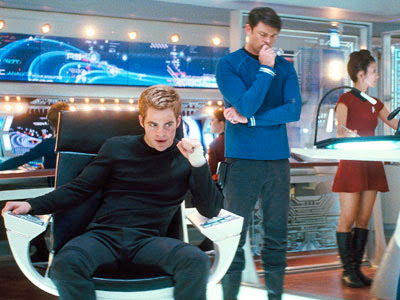
:: Some photos arrived online from the set of the new Star Trek movie. I’m still not excited about this at all, given how tired Trek became in its last years as a going concern and also given my general lack of enthusiasm for JJ Abrams. And this isn’t helping: the new bridge of the Enterprise.

That looks to me like what I imagine Steve Jobs’s bedroom to look like, not the bridge for the Federation’s greatest starship. That’s not a place where you lock phasers on target, it’s where you go to upgrade your iPod. Ugh.

:: Apparently a fourth Pirates of the Caribbean movie is in the works, with Russell Brand said to be joining the cast as Captain Jack Sparrow’s brother. Who’s Russell Brand? Well, I dunno, but I’m game for more Pirates stuff, since I greatly dug the first three (even At World’s End, which a lot of people thought wasn’t so good). I do hope that the new film moves into a new story or set of stories for Captain Sparrow and the rest of the Black Pearl gang, since it seems to me the tale of Will Turner and Elizabeth Swann is wrapped up nicely.

:: Michael Crichton died last week. I never read any of his books, but I did see a number of movies made from them (I liked the first Jurassic Park, and not so much the second), and I was a big fan for many years of ER (which Crichton created) until it managed the impressive feat of jumping the shark twice in one year. Crichton’s global warming skepticism was disappointing, but nobody’s perfect.

That about covers it for right now.

Share This Post