

In other news….
Two developments:
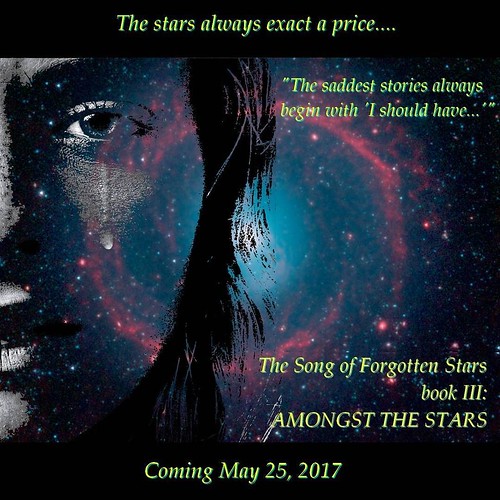
:: Amongst the Stars: The Song of Forgotten Stars Book III will be available on May 25! As is my usual practice, the book will be in paperback first with e-books to follow a couple of weeks later. And I am planning to start selling signed copies of all my books through ForgottenStars.net!
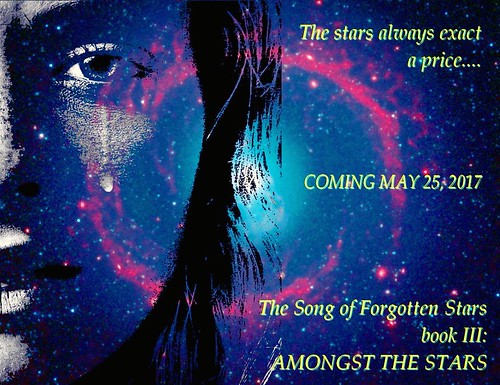
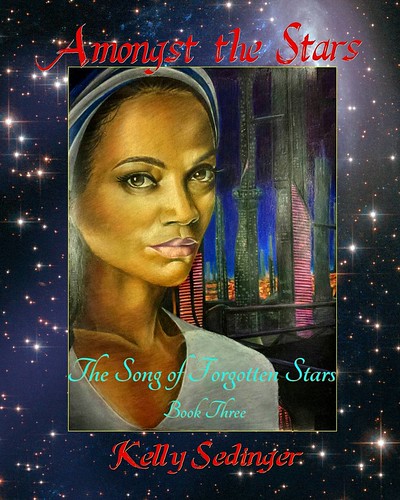
Front cover:
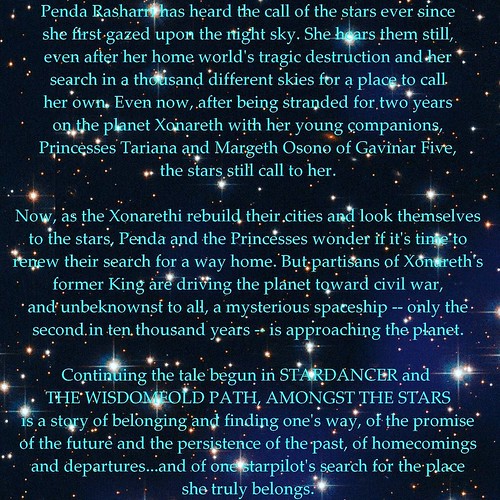
Back cover copy:
I’ve already posted the first two chapters to ForgottenStars.net, and there will be a third chapter up later this week, probably Thursday.
:: The jury is still out on this particular development on the home front. I’m sure we’ll get it all figured out, but for now, things are a bit of a whirlwind at Casa Jaquandor.
Meet the source of the whirlwind: Carla, aka Dee-oh-gee 2.0.


So there we are.
Share This Post
How revealing!!!
I’ve revealed the full cover art for Amongst the Stars, otherwise known as The Song of Forgotten Stars, book III! It’s over at ForgottenStars.net, so go have a look!
The third volume is coming soon, folks!
Share This Post
“It’s time for the Jedi to end”
So last week the first trailer for Star Wars Episode VIII: The Last Jedi hit. Here it is!
I actually don’t have a whole lot to say about it. This isn’t out of any lack of excitement for the movie, although I was admittedly less thrilled than most with The Force Awakens. This trailer doesn’t really do much more than it absolutely has to. It’s a pretty middle-of-the-road, safe trailer, isn’t it? It pretty much hits all the points that this movie needs to hit. We hear Luke Skywalker’s voice, we see him doing a little bit of training Rey, and then we see some space battle stuff and some flying ships and the back of Leia’s head and a brief shot of Kylo Ren. Oh, and Poe and BB-8. And Finn! Only one shot of Finn and he looks like he’s still in the coma in which he ended The Force Awakens. Finn was huge in the previous film, so I wonder why there’s so little of him here.
Assuming that the trailer is representative of the film, this movie has potential to end up being the most beautiful Star Wars movie yet, in terms of the visuals. There are some gorgeous shots here, my favorite being the distant shot of Rey practicing with her lightsaber on the island.
Luke is also apparently not faking his whole “depressed Jedi teacher” thing, as hinted in The Force Awakens. From what little we see or hear, Luke Skywalker sounds old, tired, and weary of the whole thing. I still don’t know that I like this turn of events, and I remain convinced that surely the writers crafting this part of the story could have figured out a way to engage the emotions and have danger without undermining all the victories of the original trilogy. There’s a sense here of, oh, as if Victor and Ilsa’s plane at the end of Casablanca had to turn around and land again, due to engine trouble.
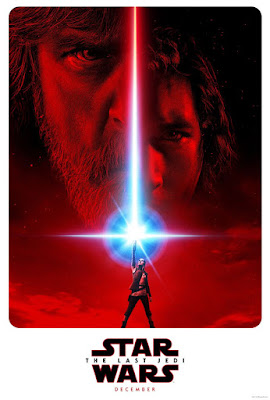
Also released was the first poster for The Last Jedi:

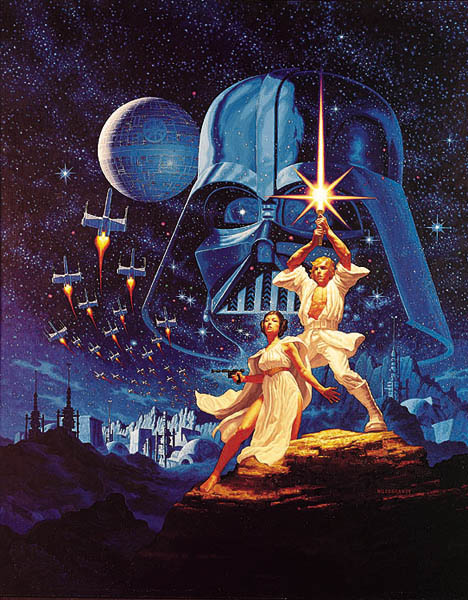
It’s OK as well. Nothing earth-shaking. The lightsaber blade, with the starburst right at the pommel, is a callback to the famous Brothers Hildebrandt poster for Star Wars, way back in the day. The faces of Luke and Kylo Ren, looming over Rey, seem to indicate that they will be battling for Rey herself; she appears to be caught in the middle of these two men. This is all a lot of tea-leaf reading, I admit, but I’m not really wild about the notion of these films making us wonder if Rey will tumble to the Dark Side or stay with the Light. Again, we’ve seen that story before. But I could be wrong, and I’m willing to see.
I also find it fitting that Kylo Ren’s face is notably smaller than Luke’s, because Luke is the ultimate hero of much of Star Wars, and frankly, as a villain Kylo Ren is simply not that interesting to me. Finally, as a visual note from the poster, that starburst at the lightsaber blade’s base is surrounded by a multi-ringed halo that seems suggestive to me of Captain America’s shield.
So, a nice trailer and a nice poster. Red seems to be a dominant color this time out, with the red lettering of the Star Wars logo and the red background in the poster and even the planet in the trailer whose soil seems to be a red dust. Red is typically the color of the Sith lightsabers, so…well, again, we’ll see.
Meantime, we’re two weeks out from Guardians of the Galaxy v. 2….
Share This Post

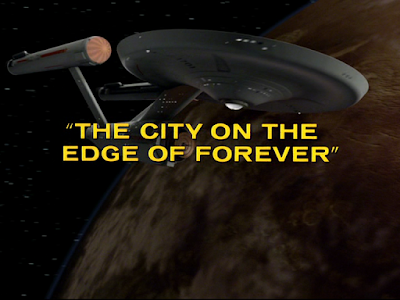
“Let me help” (Thoughts on “The City on the Edge of Forever”, on its 50th anniversary)

Edith Keeler: And you, um, don’t want to talk about it? Why? Oh. Did you… did you do something wrong? Are you afraid of something? Whatever it is, let me help.
Capt. Kirk: “Let me help.” A hundred years or so from now, I believe, a famous novelist will write a classic using that theme. He’ll recommend those three words even over “I love you.”
Fifty years ago today, “The City on the Edge of Forever” aired for the first time. This episode of Star Trek is, for me, not only the best episode of any Trek series ever filmed, but it’s also the best Trek story of all time. It’s one of the great science fiction stories, one of the great science fiction romances, one of the great time travel stories, and its ending packs one of the greatest gut-punches ever.
If you’ve never seen it…you should. Really. The story doesn’t really require a huge amount of knowledge of Trek. The Enterprise is investigating strange “ripples in time” that are emanating from a particular planet, and during one such jolt, Dr. McCoy accidentally injects himself with an enormous overdose of a drug that drives him temporarily insane. He flees to the planet surface, and Kirk follows, with Spock and some others. They find themselves in the ruins of an ancient city, with one functioning artifact remaining: a giant portal which is actually a portal through time itself. McCoy, still mad, jumps through and into history, and suddenly the members of the landing party realize that the Enterprise is gone. McCoy has changed history so that the Federation never happened.
With no choice but to try and put things right, Kirk and Spock follow, and find themselves in 1930s New York City. While trying to figure out what McCoy did and where he is, they enter the employ of a woman named Edith Keeler, a visionary who runs a soup kitchen. Kirk falls in love with her…only to have Spock discover that what McCoy did was prevent Edith Keeler from dying in a car accident. If she survives, she lives to found a peace movement that prevents America’s entry into World War II, allowing the Nazis to win and take over the world.
Spock: Jim, Edith Keeler must die.
The story unfolds so organically that the episode feels longer, heftier, than its 50-minute or so running time. The episode feels large, and yet all of its key moments play out on an intimate stage, such as when Jim Kirk and Edith are walking along the street at night and Kirk tells Edith some things about the future, things that don’t even strike her as strange to be hearing from this man she’s just met. And the way she sizes up Kirk and Spock’s relationship:
Edith Keeler: [to Kirk] I still have a few questions I’d to ask about you two. Oh, and don’t give me that “Questions about little old us?” look. You know as well as I do how out of place you two are around here.
Spock: Interesting. Where would you estimate we belong, Miss Keeler?
Edith Keeler: [to Spock] You? At his side, as if you’ve always been there and always will. [to Kirk] And you… you belong… in another place. I don’t know where or how… I’ll figure it out eventually.
Spock: [to Kirk] I’ll finish with the furnace.
Edith Keeler: [to Kirk] “Captain.” Even when he doesn’t say it, he does.

“The City on the Edge of Forever” involves relatively little action. It relies on its character work, showing us that Kirk is falling in love with Edith Keeler before Spock’s discovery that she is the key focal point around which history will pivot. William Shatner, Leonard Nimoy, and Joan Collins likewise turn in amazing work in this episode. Collins’s Edith Keeler is probably the woman in James T. Kirk’s history, the one he could not save even though he desperately wanted to. Her death is the memory that he will carry with him forever. Shatner sells every single minute of this, never once over-emoting, never once going too far. His Kirk doesn’t just fall for a pretty woman. Shatner portrays a Kirk who has just discovered, hundreds of years in his past, a kindred spirit. He has found someone whom he can understand and who can understand him. And when he realizes that he may well have to stand by as she dies…Shatner’s portrayal of a man torn on both sides of the awfullest of dilemmas is so stark, so aching, that it always moves me nearly to tears.
And then the moment arrives.
The script’s other masterstroke is that Spock can’t determine when the awful event will occur. There is no “She dies on November 12, 1937.” This isn’t like Stephen King’s (masterful) 11-22-1963, when we know exactly when the events are going to occur. Kirk has no idea it’s happening, even as we do. He sees her coming back across the street. He starts out to help her…and then he stops. He knows. The moment is upon him, and it unfolds as quickly as it has to. No slow-motion here, no long-held gazes. It comes so quickly that for us, the viewers, it’s almost like–what? Was that it? Oh my God, that was it. Over, that quickly.
But Kirk not only had to let Edith die, his choice — his only choice — was more awful than that. Because Dr. McCoy was there too, and he didn’t know. They had just found him, seconds before, and now McCoy too is watching Edith Keeler walk into the path of the truck. Kirk can’t just stand aside, or stand still, and watch Edith die, because if the script allowed him that much, he’d be able to say later, “I couldn’t have saved her. She was too far away.”
The script doesn’t pull its punches. It doesn’t give Jim Kirk that one possible out, that one possible way he can morally justify it all to himself.
Jim Kirk doesn’t just passively allow Edith Keeler to die. Jim Kirk grabs McCoy and holds him back. Jim Kirk stops McCoy from saving her.
Kirk’s choice is an active one.
McCoy doesn’t know this. He doesn’t know any of it. He only knows that he could have saved her. His voice fills with rage.
McCoy: You deliberately stopped me, Jim! I could have saved her. Do you know what you just did?
And then Spock, summing it up so logically, so heart-breakingly, in a line that no actor other than Leonard Nimoy could have delivered:
Spock: He knows, Doctor. He knows.
One thing about Star Trek II: The Wrath of Khan that has always bothered me was the idea of the Kobayashi Maru test, the idea that a false scenario could somehow test a cadet’s approach to a situation in which there is no possible “victory”. In that movie, Kirk openly says “I don’t believe in the no-win scenario,” and later on, after Spock’s death, he says that he has never really faced death. But in “The City on the Edge of Forever”, he faces both a no-win scenario, and he faces death. The idea that Kirk can later on claim otherwise has always seemed deeply false to me. Maybe he’s blocked the memory of Edith Keeler? Maybe it’s so painful that he doesn’t admit it in either case? Certainly Kirk never mentioned her again in any filmed episode or movie, which isn’t that surprising given the tendency of teevee shows back in that period to not mention previous events much. But the story here, this love between starship captain and soup-kitchen owner three hundred years before his time, is so iconic, and it carries so much weight, that it’s almost offensive to me to think that a James T. Kirk can exist who isn’t carrying her memory around. Maybe better, then, if in reply to his son David’s accusation that he never has faced death, Jim Kirk were to say, “There was one. She died saving us all, too.”
But then, you can’t have too many mentions, either. Trek would never again visit that City on the Edge of Forever, except in one episode of the animated series, and with good reason. No story involving the Guardian of Forever could possibly stand up to comparison with this one. Trek would not eschew time travel, by any means, but this particular means was left as a singular part of Trek mythology. I wonder if any Next Generation writers were tempted to visit it. I’m glad they didn’t. It is interesting, though, that Jean-Luc Picard would get his own kind of iconic time-travel story in “The Inner Light”, as would Benjamin Sisko in “The Visitor”.
James T. Kirk is an explorer at heart, and an adventurer. But his experiences in the past, via the Guardian of Forever, have a profound effect on him. At episode’s end, when he and Spock and McCoy return to the present with everything restored, the Guardian appeals to that part of his soul, offering to guide him and the others through history. What an offer to someone whose life is charged with boldly going! And yet, all Kirk can muster in that moment is a gruff, “Let’s get the hell out of here.”
“The City on the Edge of Forever” is the kind of story I dream of writing. For a single one-hour episode of a teevee show to hit so many emotional highs and lows? To linger in the memory as it does? I wonder if, as they were shooting it — maybe at the first table read — anyone either thought or muttered, “They’ll still be talking about this one in fifty years.”
Who knows? If my health permits, I’ll still be talking about this episode when it hits one hundred.

Share This Post

“I am one with the Force and the Force is with me”


So there’s a new STAR WARS movie in town.
Yup, we finally saw Rogue One, on the day after New Year’s. This was not due to any lack of enthusiasm, mind you, but simply the travails and tribulations of trying to find large blocks of time for seeing movies around the Holiday season. Rogue One thus turns out to be the first Star Wars movie that I did not see in its opening weekend since The Empire Strikes Back.
No, none of that matters or has any bearing on what I thought about the movie. So, what did I think of the movie?
Short version: I liked it, quite a bit. I had some complaints and quibbles along the way, but there was nothing in this movie that I found disturbing or annoying (well, almost nothing). So I liked it a lot more than I liked The Force Awakens.
Nothing in this movie is necessary, which an interesting place to start. When Disney bought Lucasfilm, and Star Wars with it, the lay of the land very quickly became clear. Disney was not going to be content with the six existing movies, and they immediately greenlit Episode VII. They soon thereafter made clear that they weren’t going to be content with the old model, either, wherein the new Star Wars movies were spaced three years apart. No, they wanted at least a movie a year, in order to make the Star Wars “cinematic universe” almost as much a going concern as the Marvel one. Now, I’m not sure we’ll ever get to multiple Star Wars movies a year, but until these things stop making money, we’re getting at least one a year.
However, Disney knew that they couldn’t get Episode VIII done that quickly, so they announced a series of stand-alone films that would alternate with the “Saga episode” films. Rogue One is the first of these, and we learned very early what it would be about. Remember back to the opening crawl of the very first Star Wars movie ever? Episode IV: A New Hope (once known, quaintly enough, simply as Star Wars) starts off by giving us this bit of background:
It is a period of civil war. Rebel spaceships, striking from a hidden base, have won their first victory against the evil Galactic Empire.
During the battle, Rebel spies managed to steal secret plans to the Empire’s ultimate weapon, the DEATH STAR, an armored space station with enough power to destroy an entire planet.
Pursued by the Empire’s sinister agents, Princess Leia races home aboard her starship, custodian of the stolen plans that can save her people and restore freedom to the galaxy….
Rogue One is the story of those Rebel spies, the ones who manage to steal the secret Death Star plans while the Rebel ships are busy winning their first victory against the Empire.
In all honesty, when I heard that this was what Disney was doing with this movie, I wasn’t terribly thrilled. This is simply not a story that anyone has ever wanted to hear, is it? Has anyone ever wondered about those spies and how they stole the Death Star plans? I certainly haven’t. It’s like wondering why no one has ever made a movie telling the story of those ill-fated German couriers with the letters of transit in Casablanca, the ones whose murder by Ugarte (Peter Lorre) is reported in that film’s first minute. We don’t need a movie about how a single scientist on the planet Krypton diagnosed that world’s doom; what matters is that world’s single survivor, the baby Kal-el. Nobody needs to see the tale of how Ben and May Parker came to be the guardians for young Peter.
But someone decided that the theft of the Death Star schematics was a story that needed telling, so tell it, they have.
In truth, I still wonder about that. I wonder if this film isn’t partly an attempt by Disney to have the cake and also eat it, by making a standalone Star Wars film that is nevertheless pretty safe. The Star Wars story is so well-known by this point that not much background needs established in Rogue One, and indeed the film gets started and off to the races pretty quickly. There is apparently some technical problem with building the Death Star, and the Empire needs the services of one of its geniuses to fix it. The genius, however – a guy named Galen Erso – is living in seclusion on some planet someplace – hiding, in fact – and the Empire goes to get him, sending Director Krennic himself to fetch the genius. Krennic is the officer who is actually in charge of building the Death Star. After some stuff in which Galen’s wife is killed and his daughter Jyn goes into hiding, Galen is taken anyway.
Flash forward fifteen years or so, when young adult Jyn finds herself targeted by the newly forming Rebel Alliance, because of her father’s position as designer of this new “giant weapon” that they’ve heard the Empire is building. The rest of the film is mostly about that: the coming together of a team of ragtag rebels, each with a different specialty or skill, as they set out to steal the plans for this new super weapon, called “the Death Star”. Somehow Galen has coded a message to Jyn, and when she plays it, he tells her that he has built a weakness into the armored space station.
So basically Rogue One is a kind-of The Guns of Navarone in space, with all the various trappings of Star Wars. For the most part, the film is gripping and entertaining. It’s on the long side – maybe a little too long, especially during the ending sequence which pretty much abandons the main story in favor of some straight-up fanservice, but more on that in a bit. And somehow, despite maybe being a little too long, I felt like we never really got a good feel for the characters aside from Jyn and the droid K-2SO. Even Cassian Andor, the Rebel agent who gets the whole thing rolling by busting Jyn out of Imperial prison, is something of a cypher.
We learn even less about the rest of our ad-hoc strike team. There’s an Imperial pilot who has defected, although we never really learn why. We likewise don’t learn a whole lot at all about our blind warrior-monk or his mercenary friend, aside from the fact that we need some bit of mysticism in a Star Wars movie, and these two provide it. This is actually interesting: Chrrit Imwe, the blind monk, is nevertheless apparently a Force-user of some sort – or at least, he is someone whose life evidences a certain devotion to the Force. He keeps saying “I am one with the Force and the Force is with me,” almost as a mantra, and it’s hard to make the case that he’s not using the Force at points. Again, we have a broadening of the idea of Force-users – begun in The Force Awakens (although it may have begun earlier, in the cartoon shows that I haven’t watched) – who don’t fall into the Jedi-Sith dichotomy.
I don’t think it’s entirely a flaw that the characters in this film are generally fairly broadly sketched. This is a long story, with a lot of moving parts, and there’s not really a great deal of extra time to be dealing with characters backgrounds. A little more would have been helpful, though. There’s a reason why these kinds of movies, like The Guns of Navarone, tend to run on the long side. You need to establish the characters so that when they inevitably start dying, it matters. And I did feel something when some of the characters began expiring during the final battle, so there’s that. I don’t think Rogue One is fatally flawed by inattention to character, at all. I just would have liked a little more.
I was concerned during the film’s production about the tone that was promised. The filmmakers, in various statements, seemed to be indicating a very dark and gritty film was in the offing, so much so that I was worried about the Battlestar Galactification of Star Wars. This hasn’t really happened. The film is substantially darker in tone than most of the Star Wars entries – although it’s nowhere near as grim as Revenge of the Sith – but there is still heroism and even fun to be had along the way. For the most part, the movie earns its emotional beats. In fact, the film earns its emotional beats much more satisfactorally than did The Force Awakens. While I don’t think we get to know the characters as well as we should have, we do still get to know them better than we did in TFA, so when the price for victory starts getting paid, there is real emotion there.
More broadly, the film is darker than many of its predecessors, and it’s dark in a pretty interesting way. There are more shades of gray here than usual in a Star Wars movie, and the shades of gray that we see are those presented to desperate people who are presented with awful choices, as opposed to the shades of ever-increasing darkness we see in people who are moving from the Light Side toward the Dark. Rogue One gives us characters who aren’t in it for the goodness of the cause, but who aren’t motivated by money or power either.
My biggest complaint with Rogue One lies not with the heroes but with the villains. I’ve read a lot of praise for the film in this department, so maybe I’m in the minority here, but I don’t think the movie is entirely successful with the villains. Director Krennic, who is supervising the building of the Death Star, is pretty uneven. At times he is a technocrat, seemingly interested only in what he’s building as an intellectual exercise. This is the most interesting version of him: the man who wants to build this appalling weapon mainly to see if he can do it at all. He doesn’t seem terribly interested in the Empire itself, or vested with any special loyalty to the Emperor. However, at other times he is presented as mustache-twirlingly as every other Star Wars villain, most notably in the film’s opening scenes when he visits ruin about Galen Erso’s family in order to secure his assistance in his project.
Krennic is at times a fearsome commander, and at other times a fearful lackey himself. We meet Governor Tarkin who bosses Krennic around left-and-right, and we also have Krennic visiting Darth Vader himself on what I assume to be Vader’s “home” (a castle-like fortress built over a literal river of molten lava on what looks kind of like Mustafar). A lot of people were thrilled to see Vader in this movie, but in none of his scenes did he seem necessary to me. Vader’s inclusion felt like it was stuffed into the movie almost as a means of “rehabilitating” the image of Vader. The most common trope I’ve heard is that Rogue One made Vader “scary again”, and that it was finally cool to see Darth Vader cut loose with a lightsaber and do evil shit. I point out that we saw exactly that in Revenge of the Sith, just that back then it was his pre-black suit days. A lot of fans don’t seem to consider Vader Vader until he’s ensconced in the black armor and the iron lung, which seems wrong to me.
Likewise, the film’s last few minutes don’t work for me. Again, lots of people love those last few minutes, but for me they feel wrong somehow. Vader chasing Rebels through the corridor with his lightsaber, while they are doing a relay-race thing to get the Death Star plans onto the Tantive IV, was kind of a reach. Likewise, Princess Leia’s appearance in the very last scene didn’t work for me at all. In fact, it pretty much kicked me out of the movie entirely. Part of that, I’m sure, was the jolt of having had Carrie Fisher die just a week or two earlier, which cast a pall over the scene that there’s no way the filmmakers could have predicted.
But in terms of story, that bit doesn’t work for me either. This implies that the beginning of A New Hope takes place literally minutes after the ending of this movie, for one thing. For another, it doesn’t fit with what’s established at that film’s beginning. When Vader takes over the blockade runner at the beginning of A New Hope, Princess Leia protests that she is a member of the Imperial Senate on a diplomatic mission to Alderaan. Vader knows that he claim is bullshit – “If this is a consular ship, where is the ambassador?” – but Leia wouldn’t even be able to make that claim with a straight face if she has just literally fled the scene of the Battle of Scarif. Likewise, Vader’s lines to Leia – “Several transmissions were beamed to this ship by Rebel spies” – doesn’t work at all if the plans weren’t transmitted but rather somehow run by a series of heroic-but-doomed Rebel soldiers who just manage to hand it through the blast door before it seals.
There is also too much Tarkin in this movie. I have to admit that I lost some interest in the various political machinations between Tarkin and Krennic as the film progressed. A little of this stuff went a long way, and Rogue One has too much of it. It takes focus off Krennic a bit, and worse, it lessens him. Krennic becomes something of a pathetic figure by the film’s end, not a fearful one, and in honesty, he’s not even essential, is he? We have him on Scarif at the end, giving us the confrontation that it seems we have to have – villain and hero in a mutually precarious spot – but I have to admit, by the time we got the Battle of Scarif really rolling, I’d lost interest in Krennic. His worst moment has to be the way it takes him a very odd length of time to realize that the Rebels are here to steal the Death Star plans, and this ends up feeling to me like Die Hard’s Deputy Police Chief Dwayne T. Robinson: “I think they’re goin’ after the lights!”
I don’t want to rip on this stuff too much, but I do think this points up a certain structural flaw with this story as it’s conceived. It’s The Guns of Navarone in Star Wars, but we can’t end with the destruction of the guns, can we? Our big victory here is the acquisition of the plans, which we know happens during a big battle. For me, everything that comes after our heroes have won – after Jyn and Cassian die, having beamed the plans out – is pretty much filler.
I also don’t want to be too hard on the movie for its big action climax, because aside from the very last moments, it’s a fantastic battle. I love that the stakes keep rising as more and more ships get involved, until the Death Star itself shows up. The “limited power blast” from the Death Star’s superlaser is a good touch. I did find the digital re-use of battle footage from A New Hope distracting, but…well, when you’ve seen a movie as many times as I’ve seen A New Hope, there’s not really a way to avoid that, is there? This battle is hectic and violent and thrilling, it’s edited together beautifully, and I like that there are real objectives, not just The Force Awakens’s final battle which boils down to “Hit it as hard as you can!”
Oh, and I’d be remiss if I didn’t address the fact that Rogue One fixes a major plot hole in A New Hope – or at least, that’s what a lot of people say it does. Luke Skywalker is able to destroy the Death Star by taking advantage of a tiny weakness in the battle station, and this film gives us an explanation as to why the Empire was dumb enough to leave that weakness in there (it was actually planned sabotage by Galen Erso). It’s ridiculous, the idea seems to be, that the Empire’s ultimate weapon can be destroyed so easily, by firing a torpedo down a thermal exhaust port.
Here’s my problem with this line of thinking: This is not a plot hole and it never has been.
The complaint always seems to be along the lines of, “Why would the Empire build such a huge weapon with such an obvious design flaw?” Or, “Why is the Death Star so easy to destroy?”
Well, in the first place, let’s consider the kind of story that Star Wars is. For all its spaceships and planets and rockets and laser guns and whatnot, it’s a mythic story, and most of its tropes come from mythic fantasy, not from science fiction. And in mythic fantasy, the trope of the Immense Villain with the Tiny Weakness is a very, very old one. We’re talking David-and-Goliath here, or Beowulf-and-Grendel. Odysseus versus the Cyclops. Bard versus Smaug.
The Death Star’s weakness, small and unnoticed, is perfectly in keeping with these kinds of stories. Complaining about it years later is to misunderstand the whole nature of the tale.
But here’s the other thing: the Death Star is not easily destroyed! Consider the Battle of Yavin. General Dodonna briefs the pilots:
The Empire doesn’t consider a small one-man fighter to be any threat, or they’d have a tighter defense. An analysis of the plans provided by Princess Leia has demonstrated a weakness in the battle station.
The approach will not be easy.
You are required to maneuver straight down this trench and skim the surface to this point. The target area is only two meters wide. It’s a small thermal exhaust port, right below the main port. The shaft leads directly to the reactor system. A precise hit will start a chain reaction which should destroy the station.
Only a precise hit will set up a chain reaction. The shaft is ray-shielded, so you’ll have to use proton torpedoes.
Remember all that? And remember the room full of pilots murmuring at the inherent difficulty of the task? Remember Wedge protesting that it was “impossible, even for a computer”?
No, the Death Star was not easily destroyed. Thirty ships made up the attack force. Only three end up returning. Of the thirty that flew, only two actually got to take a shot at the exhaust port, and only one actually hit it, and that was because that pilot had decided to use the Force instead of his computer when making the shot, and he only got to do that much because of the timely intervention of a particular space pirate.
Destroying the first Death Star was not “easy” at all, and when people imply (or state outright) that it was, it seems to me that they’re cheapening one of the great action sequences in all of movies. And that, I cannot abide.
(No, this isn’t just me defending the honor of my favorite movie, either. I can admit flaws in my favorite movies. See the Fixing the Prequels posts, or note my admission that my love of Casablanca aside, the letters of transit really are complete bullshit.)
I also think that there was probably a bit too much fanservice in Rogue One. We have Darth Vader, of course, and Governor Tarkin shows up (more than I expected, to be honest). But there are walkers in battle, and a Mon Calamari commander of the Rebel fleet. Bail Organa shows up very briefly, referring to his need to enlist an old friend of his (Obi Wan Kenobi, we assume) before saying that he has to get back to Alderaan. (We, of course, know that he will never leave.)
Some fanservice is fine, but there does get to be too much. An unnamed Rebel pilot with the Red Five call sign is shown dying, explaining how Luke Skywalker gets to have that same call sign at Yavin. Footage from A New Hope shows us Red and Blue Leaders. A land battle involves Imperial walkers. Earlier in the film, Jyn Erso bumps into someone on a crowded street, who turns out to be the very ruffians that Luke Skywalker bumped into in the cantina in A New Hope. I found a number of the callbacks distracting, and I do hope that future Star Wars films have less of that, moving forward. (The Force Awakens also had way too much fanservice for my taste.)
What does all this mean for Rogue One, then? Well, I’m not sure that the movie really needed to address the “weakness” in the Death Star at all. It really only serves to give Galen Erso a more sympathetic nature, I suppose. If not for that whole business, I wonder if audiences would have been nearly as invested in Jyn’s search for her father. I’m not sure, because the movie would be different without it. How to make Galen sympathetic if he goes along with building the Death Star? I’m honestly not sure. But anyway….
I don’t want to seem like I’m being too negative on Rogue One, because it really is an engaging movie, and probably the most directly satisfying trip to the galaxy far, far away in some time. I do wish the villains had been a bit more even, and I’m not at all sure that we needed Darth Vader at all. Those are not major complaints, though, because the movie mostly gets the story with its heroes right. It’s a long movie, but I really wasn’t much conscious of the running time, and as the final battle unfolded, seeing the fates of the characters unfold was still highly effecting. (None of this can possibly be a surprise, can it? In this subgenre of the war movie, it’s gotta be a given that most of the heroes are going to die.)
It will be interesting to see how the future “standalone” Star Wars movies fare. The next one is the Han Solo movie, which I maintain still must be titled, Never Tell Me The Odds.

Share This Post

STAR TREK and me
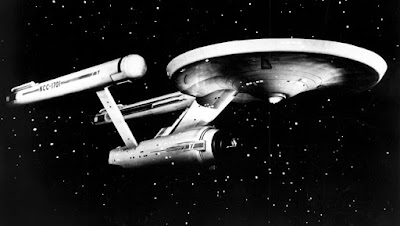

And you people, you’re all astronauts on…some kind of star trek?
–Zefram Cochrane, Star Trek First Contact
Wow. Star Trek made its official US debut fifty years ago today. That’s…amazing. (The show aired for the first time anywhere on September 6, 1966, in Canada.)
Star Trek came and went and was already in syndication when I was born, but my sister loved it, so I quite literally do not remember a time when Star Trek wasn’t a thing. One of my earliest teevee memories is, in fact, the brief bit at the end of the episode “Friday’s Child”, when Dr. McCoy is saying “Oochie woochie coochie coo” to a newborn baby, to Spock’s great confusion.

It’s often taken as an article of faith in the geek universe that one is either a Star Wars fan or a Star Trek fan, and I can kind of see why. It’s a Yankees-Red Sox kind of thing, I suppose. Or Bears-Packers. But for me, it’s complicated. I have to be honest: push me to answer, hold a gun to my head, and I will almost certainly choose Star Wars. But the margin of victory is not large, and in truth, there’s no way I’m the writer I am now without both of them.
“Let me help.” A hundred years or so from now, I believe, a famous novelist will write a classic using that theme. He’ll recommend those three words even over “I love you.”
–James T. Kirk, “The City on the Edge of Forever”
Star Trek shaped my view, in a lot of ways, of what the future can and should be. It should be a time when humans are not afraid to explore the universe and, in fact, do so with enthusiasm. It should be a time when the diversity of humanity should be celebrated and not resisted. It should be a time when beautiful ships fly the stars, instead of rusting dingy hulks. It should be a time of wonderful cities, not dystopic nightmares. It should not be a time of universal peace without conflict, because that’s almost certainly impossible, but it should be a time when we approach conflict from a much more mature standpoint than we do now.

Of course, when I was a kid, Star Trek was none of that. It was just a show about nifty adventures in space, a way for me to scratch that particular itch in the years between releases of Star Wars movies. It didn’t ever occur to me back then that I was supposed to like one over the other; they were different things, and I liked ‘em both. If Star Wars hit me like a bolt from the blue, Star Trek was the thing that was there, day in and day out. Star Trek was what was on during the afternoon hours after school. I’d get home and watch it and thrill to the adventures of Captain Kirk and crew on the black-and-white teevee set I had in my room. This was before the Internet, obviously, and I didn’t have any access to an episode guide, so the only way to learn the episodes was to watch and watch and rewatch them as they came. I got pretty good at recognizing the episodes by sight, usually within seconds. (Often I had to wait until the first shot after the obligatory opening shot of the Enterprise.)
I don’t know if the station had some kind of plan for airing the episodes in any particular order, but I recall that you could go upwards of a year without seeing “Mirror, Mirror” or “The Trouble with Tribbles”, but other episodes – “The Return of the Archons”, “Errand of Mercy” – would show up more frequently. A certain “This one again?!” factor crept in at times, especially with some of the crappier episodes. (I can live the rest of my life to a rich old age and never watch “The Alternative Factor” again.) But the great episodes? Those live on forever. I still laugh at “The Trouble with Tribbles”, and I live for a moment when someone near me uses the phrase “storage compartments”, so I can respond as Kirk does: “STORAGE compartments? STORAGE compartments?!” And I still feel that sense of doom slowly unfolding as “The City on the Edge of Forever” spins its tale, toward the awful moment when, in order to fix history after it has been changed, James Kirk must stand and watch as a 20th century woman with whom he has fallen in love is killed.
MCCOY: You deliberately stopped me, Jim! I could have saved her. Do you know what you just did?
SPOCK: He knows, Doctor. He knows.
–”The City on the Edge of Forever”
As a kid, I attended two Star Trek conventions with my older sister – or at least, one Trek convention and one general sci-fi convention. At the latter, “The Trouble with Tribbles” was aired, followed by 2001: A Space Odyssey. Those were fun. George Takei was the guest of honor at the first one, in 1977 or 1978. I was in first grade at the time. I remember Takei wearing a gleaming white suit. (Peter Mayhew was guest at the next one.)
I eventually lost track of daily Star Trek reruns by the mid-1980s, but also by this point, the movies were a thing. I remember being terribly excited for The Motion Picture, and even though I didn’t quite understand all of the plot, I have never – not once – disliked that often-maligned film. I recall being mildly disappointed that the Enterprise never fires its phasers once in that film, and in fact it only dispatches a single photon torpedo, and that’s at an errant asteroid that’s about to collide with the Great Bird. I didn’t realize it at the time, but I think The Motion Picture is the first real science fiction story I saw on the big screen that wasn’t about a galactic war or some other action-based adventure. I wasn’t thinking in those terms, but yes, the movie primed that particular pump.

I liked all of the movies that came, and I saw every one in the theater over the next decade. This was an odd time for Trek, when a movie every couple of years was all there was. Sure, every once in a while there would be a tidbit in Starlog (the late, great SF fandom magazine) about how somebody somewhere wanted to make a new Trek teevee series, but it never amounted to much until we learned that we were finally getting The Next Generation. This was for several reasons, not the least of which was that Paramount wanted to keep making money off Trek but the original cast was starting to show its age.
Through the 1980s, as Star Wars seemed to fade away, Trek was still there, churning out a movie every couple of years and then a new teevee show. That’s what Trek always was for me. It didn’t fuel my imagination in quite the same way that Star Wars has always moved me at a very basic level of storytelling taste, but Trek has always been around. Always, always there. In fact, it was always there to such an extent that in the late 1990s, I started letting Trek go…but I’m getting ahead. During this time I read a number of Trek novels, and there was a fanzine called Trek that would annually publish a paperback book filled with its best articles. These I read with zeal, and I’ve lately started regathering them all via eBay. Maybe this winter I’ll spend some time reliving some fine old fan writing.

I loved The Next Generation, and watching it religiously formed a tradition in college among my mates and I. TNG aired reruns every weeknight, and the new episodes ran every Sunday night after the 10:00 news. That station even went so far, as TNG’s popularity grew, of including a very brief astronomy segment in its 10:00 Sunday newscast – “Tonight you can see Mars in the eastern sky!”, that sort of thing – complete with an Enterprise fly-by animation. And then, in our senior year, the next show, Star Trek: Deep Space Nine, arrived. That premiere was an event, and I still think that premiere was an amazing episode.
Never trust ale from a god-fearing people, or a Starfleet Commander that has one of your relatives in jail.
–Quark, Star Trek: Deep Space Nine
It took a little while for TNG to really get going, but once the writers had the chemistry down, the show was more than ready to carry on the Trek tradition, with many a fine and thought-provoking story, about love and loss and what it means to be human even as we take to the stars.
If you can’t take a little bloody nose, maybe you ought to go back home and crawl under your bed. It’s not safe out here. It’s wondrous, with treasures to satiate desires both subtle and gross. But it’s not for the timid.
–Q, Star Trek: The Next Generation
And still the movies came. The Wrath of Khan and The Search for Spock, which I saw with school friends. The Voyage Home, with its goofy and infectious joy. Even the much-maligned (and mostly deservedly so) The Final Frontier had its charms for me. That poor movie may have failed, but I really give it credit for trying to be about something.
The Undiscovered Country came along in 1991, when TNG had hit its stride. We saw it in the theater the night it opened, which happened to be the same night as our annual Christmas concert performance at a big church in Cedar Falls, IA. We did the concert, quickly changed clothes, and bolted down the street to catch the show. I loved that movie, and in fact, to this day Star Trek VI is my favorite Trek film. I remember a lump in my throat at the closing scene, which boiled down to just the classic crew onscreen (minus Sulu, who finally got his promotion to Captain and got to fly away on his own ship, the Excelsior), followed by the animated signatures of the original cast. Their time was done. (Although, in classic Trek and science fiction fashion, not quite.)
CHEKOV: Course heading, Captain?
KIRK: (smiles) Second star to the right…and straight on ‘til morning.
—Star Trek VI: The Undiscovered Country
College ended and the real world began, and there was still Star Trek, even as Star Wars started making rumblings again. The TNG crew graduated to movies, and DS9 soared in quality. Another series began, Voyager…which is when I started to lose a bit of energy with respect to Trek. For one thing, I had a lot of other interests by this time, but for another, it was pretty clear as Voyager got going that the creative folks behind Trek were starting to lose steam. I stopped watching Voyager about the fourth season, and the next series? Well, to this day, I have never watched a single episode of Enterprise.

But now Trek is coming back. Three new movies, with varying degrees of success. A new series on the way, reimagined to seasons of thirteen episodes each. The Trek continues. (I haven’t seen Star Trek Beyond yet. It came and went from the theaters too quickly this summer, and it came out during our busiest time of the summer as well, so I simply was never able to squeeze it in. Beyond and Nemesis are, to date, the only Trek films I did not see in the theaters.) Will Trek eventually reach similar heights again? Are there more stories in the offing to match tales like “The Devil in the Dark,” “The Doomsday Machine,” “A Piece of the Action,” “The Best of Both Worlds,” “Yesterday’s Enterprise,” “Tapestry,” “The Visitor”? Who knows…but I look forward to finding out.

Star Trek is, was, and has been many things. It will continue to be many things, too. I don’t know that I’ll ever have the same old investment in it that I did in the late 70s and through the 80s. I don’t know that I’ll ever feel that same enthusiasm for Star Wars either, so the two tentpoles of my science fiction life have that much in common, don’t they? But I’ll always owe a debt to Star Trek. It shone a bright light on a future that doesn’t have to be awful, and it showed beautiful space ships. It put a new light on the idea of space adventure, and it showed a military organization that was devoted truly to peace. Star Trek did time travel better than just about anybody else. Star Trek gave us amazing characters, and it let those characters do amazing things.
They used to say if man could fly, he’d have wings, but he did fly. He discovered he had to. Do you wish that the first Apollo mission hadn’t reached the moon, or that we hadn’t gone on to Mars and then to the nearest star? That’s like saying you wish that you still operated with scalpels and sewed your patients up with catgut like your great-great-great-great grandfather used to. I’m in command. I could order this, but I’m not because Doctor McCoy is right in pointing out the enormous danger potential in any contact with life and intelligence as fantastically advanced as this, but I must point out that the possibilities – the potential for knowledge and advancement – is equally great. Risk! Risk is our business. That’s what this starship is all about. That’s why we’re aboard her.
–James T. Kirk, “Return to Tomorrow”
Star Trek is fifty. Amazing. Long live Star Trek.
Space: the final frontier. These are the voyages of the starship Enterprise. Her ongoing mission: to explore strange, new worlds; to seek out new life and new civilizations; to boldly go where no one has gone before.

Share This Post

“You can type this shit, George, but you can’t say it.”
I recently read a fascinating book about the Star Wars phenomenon, titled How STAR WARS Conquered the Universe: The Past, Present, and Future of a Multibillion Dollar Franchise. Written by journalist Chris Taylor, the book traces the history of Star Wars, not as purely a “making of” story, but as a cultural phenomenon. It’s a terrific book that I reviewed on Goodreads, but I wanted to revise and extend those remarks a bit.
This book is one of the most even-handed accounts of Star Wars and the work of George Lucas that I have read. There isn’t much axe-grinding here, which I greatly appreciate. Taylor is interested in just how this thing called Star Wars came to be one of the dominant pop-culture forces today, tracing the influences that led a young George Lucas to think more and more obsessively about his “little space movie”, and then tracing its own influences on those who came after and showing some of the many and surprising ways that Star Wars has enhanced and influenced the lives of several generations of fans, geeks, and whatever else has come afterwards.
Star Wars started as one movie that wasn’t even supposed to be 20th Century Fox’s big picture for 1977, but it became an enormous force, as everyone knows. It is certainly, along with Star Trek, likely the single biggest influence on my creative life, and it’s inspired an astonishing amount of activity over the years, from comics to music to books to fan films to cosplayers, some of whom have organized into the largest amateur costuming group in the world after the Society for Creative Anachronism. All that, from the imagination of a filmmaker from Modesto, California who only became driven to succeed after he nearly died in a car crash in his youth.
From my perspective, the best parts of the book are those that home in on George Lucas’s creative process. A lot of ink and a lot of pixels have been deployed over the years in discussing Lucas, many times in derision. What emerges in this book – and in others I’ve read, such as Rinzler’s wonderful Making of… books for each of the original Star Wars films – is a man with a deeply non-linear creative process. Lucas’s approach seems to be to generate ideas by the dozen, and then mix-and-match them in various ways until something coherent begins to emerge. Sometimes his earliest ideas are set aside only to return many years later, and sometimes his early ideas stick around through most iterations of story.
The genesis of Star Wars, as it went from being an enormous and ungainly thing bogged down in dozens of names and jargon terms, was a very messy process, and it’s always amazing to me to see the long litany of notions that came and went. There are ideas that Lucas entertained in 1975 that would not show up on film until thirty years later (such as the planet Utapau, present in the earliest drafts of Star Wars, when it was called The Star Wars, and which would not actually show up on film until Revenge of the Sith). In this way, Lucas reminds me of some favorite artists of mine, like composer Hector Berlioz, who would think nothing of using a melody in an early work and then using it again many years later, if he felt that he still had use for it.
The messiness of Lucas’s storytelling process stands at odds with things he says later about his own process, which is something that a lot of people have used as a source of criticism. Lucas is often thought to have promised a nine-episode Star Wars saga back in the days of the Original Trilogy, but his actual statements were that he had written an enormous story and then cut it in half, resulting in the Original Trilogy being the second half; the seventh, eighth, and ninth episodes were only conceptual in nature. This seems to be partly true, but Lucas didn’t so much cut an original story in half as he kept reducing his focus. The “Star with Episode IV” approach seems to be more emergent than intentional, which is not a bad thing.
Here, from the book, is just such an example of one of Lucas’s old ideas resurfacing much later on:
The moment Lucas decided to add a kind of rational, scientific component to Jedi knowledge of the Force, in Episode I – the infamous “midi-chlorians,” microscopic organisms that are supposed to help the Force bind to living beings – long-time fans revolted. It didn’t matter that, as Lucasfilm protested, the midi-chlorians are not supposed to be what the Force is actually made of – just a biological indication of its presence. If you dig deep enough into the Lucasfilm archives, you’ll find Lucas talking about midi-chlorians as early as August 1977. “It is said that certain creatures are born with a higher awareness of the Force than others,” he said during a role-playing exercise designed to help him flesh out Star Wars concepts after the original movie. “Their brains are different; they have more midi-chlorians in their cells.” This didn’t matter either. What fans actually want, it seems, is as little detail as possible. They want twenty-eight words, and nothing more.”
The twenty-eight words Taylor refers to is the simple description of the Force given by Ben Kenobi in A New Hope, and nothing more. Without rehashing the whole midi-chlorian thing, it’s certainly interesting that Star Wars fans seem to want to leave things open and mystical and unexplained in a lot of cases. They certainly stand in contrast to, say, fans of JRR Tolkien, who want as much detail as humanly possible, to the point of learning to speak fictional languages and developing their grammars beyond what Tolkien created. (I still maintain that the midi-chlorians are not a category error but a storytelling one. Their existence adds exactly nothing, story-wise, to the Star Wars saga.)
This book also provides some evidence in favor of an oft-cited notion, that Lucas functions best when he has a strong voice to tell him “No.” By the time of the production of the Prequels, Taylor describes Lucas as so revered that literally no one goes against him in any way at all. I’ve never been totally convinced of this, and I’m still not. Producer Rick McCallum doesn’t come off terribly well, being shown as mainly a yes-man, but still: Lucas brought in script help for all three Prequels, in acknowledgment of his own weaknesses in the writing department. (Which are, in my view, a bit overblown.) Taylor’s own negative opinion of the Prequels stands, but to his credit, he does give voice to some pro-Prequel voices, and he acknowledges that they are not the irredeemable films that many have deemed them. (I’d rather he hadn’t even mentioned that awful Red Letter Media guy at all, though.)
Taylor seems fairly bemused, in the closing chapters, by the fact that Star Wars fandom has only strengthened over time, even in the face of three Prequel films that are, shall we say, less than beloved. As the book closes, Lucas has sold it all to Disney, but even then he was starting to knock around ideas for Episodes VII through IX, the ones he had previously said he’d never do. One ends up wishing that George Lucas would simply come out and admit that Star Wars has been his life. That wouldn’t be so bad a thing, would it?
Ultimately, Taylor’s book does a wonderful job of tracing the growth of Star Wars in our cultural life, and he also shows how it came to utterly dominate the life of its creator, a complex man whose own skills, great as they are, were not always a match for what was in his head. I’m grateful for the book’s portrayal of a George Lucas who is flawed genius, instead of a hack who just happened to get lucky a couple of times. I hope Taylor gets to revise the book in five or six years, once the Saga again stands complete. Unless, of course, Disney decides to fire up production on Episode X in due course….
Share This Post
ROGUE ONE and other thoughts on the state of STAR WARS
So, the first trailer for ROGUE ONE: A STAR WARS STORY dropped last week, and…well, it looks good. How good? I won’t hazard a guess, but it does look like a Star Wars movie. Felicity Jones as the heroine looks fine, although the trope of the good guys having to trust everything to a rogue whose methods or motivations are questionable isn’t the freshest thing in the universe. Also, I’m a little turned off by the apparent gritty tone of the film, which looks to me like Star Wars melded with Battlestar Galatica. Maybe it’s not full-on grimdark, but the film’s producers have noted in past interviews that their story isn’t as morally unambiguous as the main-line Star Wars story, which isn’t something I’m thrilled about. There’s a place for morally ambiguous stories of war in science fiction, but Star Wars to me is about mythic storytelling, so I’m not sure how the tone will fit.
More troublesome to me is that we’re going to the Death Star well again, this time to tell the story of how the Rebellion got the “complete technical readouts of that battlestation” in the first place. I’m not sure this is a story I’ve ever really cared about hearing, especially since this will be the fourth movie in the Star Wars universe where a big spherical planet-destroying space station is a major plot point. This, coupled with the derivative story in The Force Awakens, and with the coming films centering on young Han Solo and young Boba Fett, seems to indicate that Star Wars is heading into a period of self-referential self-milking. And it’s not just the movies: we’ve had numerous novels and comics over the years that told versions of what happened in between the movies, and Disney’s first act of business upon acquiring Star Wars was to strike all that from the record and then…immediately start producing more novels and comics that tell versions of what happened in between the movies.
Frankly, I’m starting to get a sense of Lather, rinse, repeat from Star Wars. It’s the feeling I had during the second season of Star Trek: Voyager, when it became clear that we weren’t going to see exciting new stories but just more TNG-flavored tales told on a new ship with a blander crew. Maybe I’m wrong and these movies will be great, but I want new stories, not constant revisitings of the old ones. I’m not interested in Star Wars as ritualistic theater where the same stories are told all the time.
:: Something crystalized for me a few days ago, via a post on Tumblr, regarding the approach Disney is taking to Star Wars as a whole, and the misgivings I had about the characterizations in The Force Awakens. Someone wrote this:
There are posts about Finn that come across my dash frequently that really concern me.
It’s not that I don’t think musings about what a sweet innocent soul he is and imagining what his humble life must’ve been like are coming from a loving place, but Finn’s character has already been filled in via a canon source, and it was not humble.
Read the novel “Before the Awakening,” where you will learn that while FN-2187 may have pulled shifts as a janitor just like any military trainee has to work some shit jobs, he was actually the absolute rock star of his elite band of Stormtroopers. He was the natural leader, the best of them all, the highest scores in every possible measure, someone Phasma and Hux were well aware of as the shining example of what their pet Stormtrooper program could accomplish. He was everything they’d worked for for years.
The only problem was, he cared too much about his fellow Stormtroopers, even though they didn’t return the feeling, due to indoctrination and some envy of his superiority. It is pretty obvious, reading BtA, that Finn is Force sensitive. It is that Force sensitivity that set him apart, and made him the one who could overcome a lifetime of indoctrination and get out.
I know it’s the fault of the film for sketching him so lightly, but guys, it is crucial that we start acknowledging who Finn is, and his strengths. Which, canonically, are leadership, strategy, all the skills a commander must have. I worry that there is too much PRECIOUS PURE CINNAMON ROLL going on and not enough shared knowledge of his *canon character background and gifts*.
Please spread the word about Finn. This sort of thing shortchanges him horribly. When the FO lost FN-2187, they lost more than just another Stormtrooper. They lost a future general, and the Resistance picked one up.
There are so many ways this makes me crazy (none of which are the poster’s fault), but at the crux of it is this:
NONE OF THIS IS IN THE MOVIE.
And I’m not exaggerating here. There is not ONE thing in the movie that supports any of this. The Tumblr poster says that the movie “sketches Finn lightly”, but I think that’s drastically understating things. The film strongly suggests that Finn is a space-janitor who is seeing his first space action. There’s no other reasonable reading of what we see in the film: the way Finn is stunned by the single death of a single stormtrooper, the way Finn lowers his weapon when he’s supposed to be killing innocents, the way he just stands there slackly as Kylo Ren wanders through, the way he has to rip off his helmet to try and regain his composure…sure, Finn’s training comes through at times, just by virtue of his knowing stuff (“Fly low! It’ll screw up their scanners!”), but mostly, there isn’t one thing in The Force Awakens that establishes Finn as “the absolute rock star of an elite band of stormtroopers”. There really isn’t one thing that clearly establishes him as being Force-sensitive. There isn’t one thing that establishes that Finn is held in any particular esteem by Hux and Phasma (who are still awful, terrible characters). As far as the movie is concerned, Finn is just some random stormtrooper who inexplicably develops a conscience one day. Nothing of his background is established in the movie, no context is given at all for his change of heart, and to be told “Well, you gotta read this other novel to get it” is incredibly weak tea.
And that’s what makes me crazy about how Disney is approaching Star Wars now.
First of all, it’s simply not reasonable to expect people to be up on the minutiae of every single thing out there that has been declared to be “Star Wars canon”. I’m not planning to read any of these novels; at most I’ll read some of the comics. Most people who see the films will do even less than that, but now we’re leaving crucial bits of information out of the films entirely. That bit about Maz saying “That’s a story for another time!” when she’s asked how she got Luke’s original lightsaber? Well, there’s no doubt in my mind we’ll get that tale in some other media format, and that’s a ridiculously cynical approach to storytelling. “We’ll just leave crucial stuff out, so people who want a coherent tale will be forced to indulge all this other stuff!” Ugh.
The movies have to be coherent, and if they’re not going to be, then I have a problem. I’m not going to sit back and enjoy Daisy Ridley and John Boyega and the others if the story they’re wandering through is leaving out key details as a selling point for books, comics, and video games. In truth, I’m going to find it hard to care. If the movies can’t tell the entire story — and that means playing fair with the characterizations and explaining the presence of major items like Luke Skywalker’s first damn lightsaber — then the movies are at best lazy and at worst they are reduced to marketing devices. And wouldn’t that be an irony? To see Star Wars movies reduced to pushing other media tie-in stuff so that fans can learn what the hell is going on? Years after people were busily accusing George Lucas of selling out and using his creation to sell stuff, we’ll cheerfully look the other way because now Disney is doing it.
So yeah, I call bullshit — utter, complete bullshit — on the idea that if I didn’t read some novel, I don’t really understand Finn as a character. That is the job of the movies, and if they’re actually not going to do it, well then, I for one will pine for the days of George Lucas being in charge.
Share This Post
Thoughts on THE FORCE AWAKENS, episode V: The Praise Awakens!
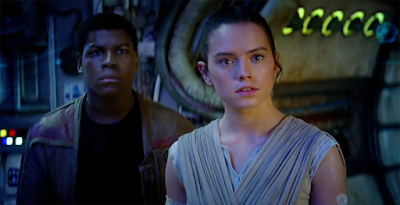

By this point, it probably sounds like I hate The Force Awakens and want to excise its memory from every human mind. Not so. My complaints are real, and they frustrate me to no end, because…dammit, there is just so much that this movie gets right. The Force Awakens feels to me like the filming of the third draft of a script, when it really needed a fourth.
I also suspect, in terms of the film’s refusal to explain things, that this is part of a New Media strategy for Star Wars. Remember, Disney specifically declared that the old “Extended Universe” material is no longer canon, and that everything else from now on would be. Not just the stuff in the new movies, but all of the comics now being produced, all of the novels, all of the animated teevee series, all of the events depicted in games. If all this is canon, then it’s clear that Disney can now relegated background material and its explanation to other media formats. Thus The Force Awakens can plow ahead and not tell us anything at all about this old geezer who just happens to have the piece of Luke’s map that will solve the puzzle, and then later on, they can come out with a novel or comic that explains it.
Well, I hate that. I don’t want to have to do extra research to enjoy a movie, or the reverse. If I read a novel, I shouldn’t have to go see some other movie to explain just what’s going on. I’ve no doubt that a lot of this stuff is going to be fleshed out, and I’ve little doubt that a lot of it will be in other media. And I find that incredibly irritating.
But anyway, let’s talk about what’s good with The Force Awakens, starting with the cast.
With one exception, the cast of this film is brilliant and does an amazing job. (The exception is the guy playing General Hux, with his weird blend of Hitler and Anglo-Shatner. I frankly hope that Hux is killed in the first scene of Episode VIII. Along with Captain Phasma…but her failure is one of writing, not acting. Hux is both.)
Seriously, aside from Hux, nobody in this movie turns in a bad performance. In fact, the performances are so good that they really do lift the movie above what I see as its pretty significant problems in the script. Daisy Ridley plays Rey with a nearly perfect blend of confidence in her short-term planning (once she decides to do something, she’s ruthlessly competent and very skilled at sizing up exactly what needs done), and lack of confidence in the big picture. Whenever she’s confronted with the “larger world” beyond her crappy little hole on Jakku, her confidence disappears, because she doesn’t know what she’s supposed to do or want. Ridley’s performance in this movie is as perfect as it gets. I love her strength, her emotion, and her refusal to give up or withdraw into a shell when things get bad. Rey never loses her agency, and that’s really a great thing. Not even when she’s a prisoner does she lose her agency.
Likewise, John Boyega delivers a powerfully skilled performance as the “little stormtrooper who could”. It’s clear that Finn should never have been on that mission to Jakku, but he was, and that’s how a lot of stuff gets started. Finn has skill and training, but he lacks confidence and has to keep doing things like telling himself to be calm and grabbing Rey’s hand, more for his own comfort than hers. Finn is naïve, and in some ways he’s even a child, but he also has a lot of training and is able to call on it in a lot of situations. Best of all, when he realizes that his training is useful, there’s always this little hint of surprise in his eyes: “Hey, guys, I’m contributing!” Even when it’s something simple like “Fly low! It screws up their sensors!” or “Stormtrooper masks filter smoke, not toxins.”
Oscar Isaac is perfect as Poe Dameron. I do wish the script had given him a little more to do during the final battle than just keep saying “Hit it with everything you got!” and then deliver so supremely melodramatic a line as “As long as there’s light, we got a chance!” I don’t have any idea if they plan to go any deeper into Poe Dameron, or if he’s going to be Wedge Antilles with a bit more screentime, so we’ll see.
And yes, I know that Han had to die, because of reasons and structure and Hero’s Journeys and all that stuff. But dammit, Harrison Ford and Carrie Fisher are just so damned perfect together. It’s a bummer that they’ll never be together again on the Star Wars stage. I love the scene when they meet each other again – “Same old jacket.” “No! New jacket.” Harrison Ford really brings his A-game here, and it’s nice to see. His self-satisfied smile as he stands in the Falcon cockpit, his look of dismay as he realizes he’s about to go right back into his old world of Luke and the Force and the rest of it…and my favorite little Solo moment, when after Kylo Ren leaves that one planet with Rey in captivity. Finn runs up to Solo and says something like “They took her! They’ve got Rey!” and Han, who has just seen his son in action and is realizing just how bad things are likely to get and knows that he’s about to be face-to-face with Leia, waves Finn off with a gruff “Yeah, yeah, I know.”

The Force Awakens is also a beautiful film. All the Star Wars movies are beautiful, really; one thing that I’ve always loved about Star Wars is that the eye candy is always beautiful and real, whether it’s the miles-high cityscapes of Coruscant or the dawn clouds of Bespin or the forests of Endor. The Force Awakens keeps this tradition going. We get a desert planet, to be sure, but this movie makes Jakku different enough that we know we’re not just on a Tatooine stand-in; this film’s forest planet is entirely different from ones we’ve seen before, and the Starkiller Station planet is icy without being Hoth again. Abrams has a strong gift for visual flare, and I’m glad that he actually made this movie look like a Star Wars movie, with ships that move with weight and with nifty things like the X-wing assault coming from low across the lake and the Millennium Falcon exploding from the trees.
I also like the film’s implications regarding Force users. The previous six films have all focused on the Jedi and the Sith, but it’s pretty much a matter of faith that there are Force users who are neither. Even the Jedi are prepared for this: in The Phantom Menace, when they learn of this kid who might have more Force-potential than anybody else ever, they’re prepared to send him back to Tatooine and be done with him. The Force, remember, is originally described to us as an energy field that surrounds us and penetrates us and binds the Galaxy together, which ought to make it much bigger than just the Jedi-Sith divide. In fact, what if the Force’s moral “sides” turn out to be less rigid than both Sith and Jedi have always thought? If so, then maybe the “awakening” of the Force, referenced in the film’s title, represents the Force itself starting to shake off the dominant narrative regarding its nature for the last thousand generations. Maybe, just maybe. And maybe not…but The Force Awakens does make some interesting leans in that direction.
What else is good in The Force Awakens? Every action sequence. I’ll give Abrams his due here: he is a very good action director. He manages kinetic energy on the screen very well, and it’s almost always easy to figure out exactly what’s going on. He also manages to make his camera do the right thing from one shot to the next, such as one time when we’re swooping around the sky with Poe, and then we cut to Finn, with the camera still swooping (albeit in closeup) as Finn cheers and shouts, “That is one hell of a pilot!” The first Millennium Falcon sequence, with the TIE Fighters in the desert, is brilliantly done, as is every action sequence in the film. This is no surprise: JJ Abrams managed the hectic action very well in both Star Trek movies (say what you will, the action sequences in those films were not poorly shot or directed) and in his Mission: Impossible movie.
What I love most about The Force Awakens will surely not come as a surprise to anyone familiar with me. John Williams’s score is fantastic. It might not be quite The Empire Strikes Back good, but it’s right up there with every other Star Wars score to date. There’s the undeniable thrill that comes with that magnificent opening fanfare and the opening crawl, but then we start getting the new dark music right off the bat, with the opening sequence – the attack on the Jakku village – culminating in a powerfully bleak motif for Kylo Ren. Next, though, comes the theme that is the heart of this film’s score: Rey’s Theme.
For Rey, John Williams spins some particularly wonderful magic. The theme is lyrical, but not in the usual Star Wars sense. The theme is beautiful, but it is also yearning and hopeful, and it bears some melodic resemblance to the famous Force Theme; more than that, Williams imbues Rey’s theme with a rhythmic sense of urgency and unrest, first with a repeating ostinato that is, in itself, quite the ear worm but later on with a churning under-rhythm that gives Rey’s theme its sense of forward motion.
The score also revisits a number of themes from the Original Trilogy: Leia’s Theme, the Love Theme for Han and Leia, and even the Imperial March, quoted when we see Vader’s wrecked mask. Williams brilliantly repurposes the old Rebel Spaceship Fanfare to stand for the Millennium Falcon herself, and the Rebel Resistance Fighters get their very own march, which is brassy and thrilling. The use of this march lends a sense of legitimacy to the Resistance: this isn’t a group of rag-tag Rebels anymore. Williams does not repurpose the Imperial March for the First Order; neither does he use the Emperor’s old theme in reference to Supreme Leader Snoke. Maybe this is by design, maybe not (recall, the old Imperial March didn’t show up until The Empire Strikes Back). The music from The Force Awakens is one of the most exciting and listenable scores I’ve encountered in years.
With all my complaints about the film’s execution in its details, I do think that it leaves things in a very intriguing place. Everything depends on the next two Episodes, obviously, but there are lot of amazing places to which Episodes VIII and IX can go, based on what’s been established here. I’m not going to make any “educated” guesses – or the other kind – as to the major questions left behind by The Force Awakens. I’m not sure if I hope Rey turns out to be a major relative of one of the beloved heroes and central families, or if I hope Rey’s parentage is similar to Taran’s in Lloyd Alexander’s Prydain Chronicles (we never do find out who his parents are). There needs to be an explanation for who Supreme Leader Snoke is and where he came from, and if Finn is Force-sensitive, that needs explained and fleshed out as well.
What I hope does not happen is any kind of redemptive arc for Kylo Ren. We’ve gone down the “Good side to the Dark side to the Good side” road again, and somehow it will just seem a bit repetitive to do that for Kylo Ren. Besides, quite frankly…I’m not really interested in seeing the guy who killed Han Solo get any kind of reprieve, even if it is something like “Somebody has to say aboard and pilot the Death Star III into the sun! Tell my mother I love her!” or some such. Kylo Ren is not a menacing villain; he’s a pathetic one, and pathetic villains need to stay pathetic until the moment their pathetic nature takes them to ruin. Kylo Ren is no Darth Vader. He is Gollum with a better hair cut, and that’s how he needs to stay.
So, there we have it: The Force Awakens, a fun film to watch that has a lot of great things going for it and which also has a lot of things about it that are maddening. Which, I think, makes it what it is: a pretty decent Star Wars movie.

Next up: Rogue One this winter, then Episode VIII next year, and then (I think) the Han Solo “origin” movie. That could be fun, but I do hope it’s not too much origin – I wouldn’t mind just a straight-up young-Han adventure. In any case, I think a major opportunity will be missed if that film isn’t called Never Tell Him The Odds: A STAR WARS Story.
Until the next movie, Star Warriors!
