The Many Faces of Monti Carlo

UPDATE 5-23-13: Thanks to the ever-wonderful Monti Carlo for linking this bit of silliness on Twitter and Facebook! And welcome to everyone dropping by. I hope you enjoy, feel free to look around a while, the furniture’s old so don’t worry about putting your feet up or putting coasters under your drinks! Yes, I’m weird, but I’m harmless. Really!

Spoilers for Master Chef, and mainly a tribute to contestant Monti, below the fold….

Well, I will find whatever episodes of Master Chef remain a lot less interesting, because my favorite contestant, Monti Carlo (yes, that is her real name), has been eliminated. Her departure was pretty upsetting: it was the first time in the whole season she ever found herself in the Bottom Two, and the other one there, Josh, had managed to completely screw up the assigned dish despite having won the earlier challenge and thus having literally been handed a box of the exact ingredients for the dish they were supposed to replicate.

Oh well. I thought Monti was just terrific. She was smart, skilled, and funny. She clearly didn’t know as much about food as some of the other contestants, but she made up for it with an adventurous spirit and a self-confidence that grew as the season went on. I loved the episode where she was given a John Dory fish to filet and cook, and she’d never even heard of that fish before, much less cooked one. The judges noted how long it was taking her to start fileting it, but when she did, she took the knife right to it and muttered, “I’m gonna figure you out.” I loved that.

I don’t think she was destined to win, really; I expect the finale to boil down to Frank (the Italian stockbroker with mad kitchen skills) and Christine (the blind woman with mad kitchen skills). Becky is annoying with her oddly inflated sense of self-worth, and so is Josh, with his pouting whenever he doesn’t get what he wants. I don’t think Monti was going to win, but I think she should have come closer than this. And if Graham (the fat judge) was going to offer the last guy to get eliminated a job in one of his restaurants, why no offer to Monti? Why didn’t Gordon Ramsay offer her the money for a down payment on the food truck that she wants to run?

Oh well.

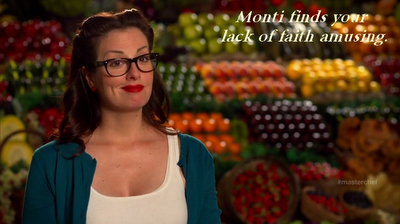
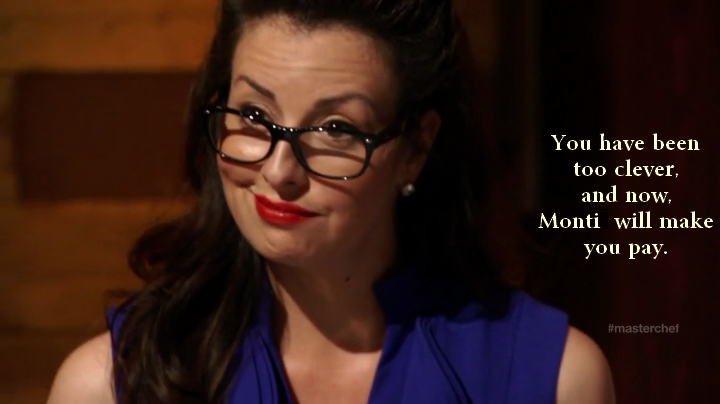
I also loved Monti because she had fantastic facial expressions. She mugged for the camera wonderfully, so I took some screengrabs and captioned them…as if Monti was the heroine in some kind of cheesy Asian martial arts/fantasy flick. At least, that’s the notion….

Best of luck, Monti…and regards to Danger!

(Monti’s son is named Danger. Really. In the first episode, she noted that he’ll thank her for that one day.)

Share This Post

“So say we all!”

I’ve mentioned more than once, over the years, that I have a tendency to not be up on the big pop-culture things when they’re big, or up on what’s the cutting-edge thing in my favorite genres right when it’s at the cutting edge, and so on. For four years back during the 2000s, I heard nothing but good things about the ‘reimagined’ Battlestar Galactica series – well, nothing but good things, that is, until the show ended, at which point I heard some divisive stuff. But since I didn’t have cable, I had to file BSG away for future reference.

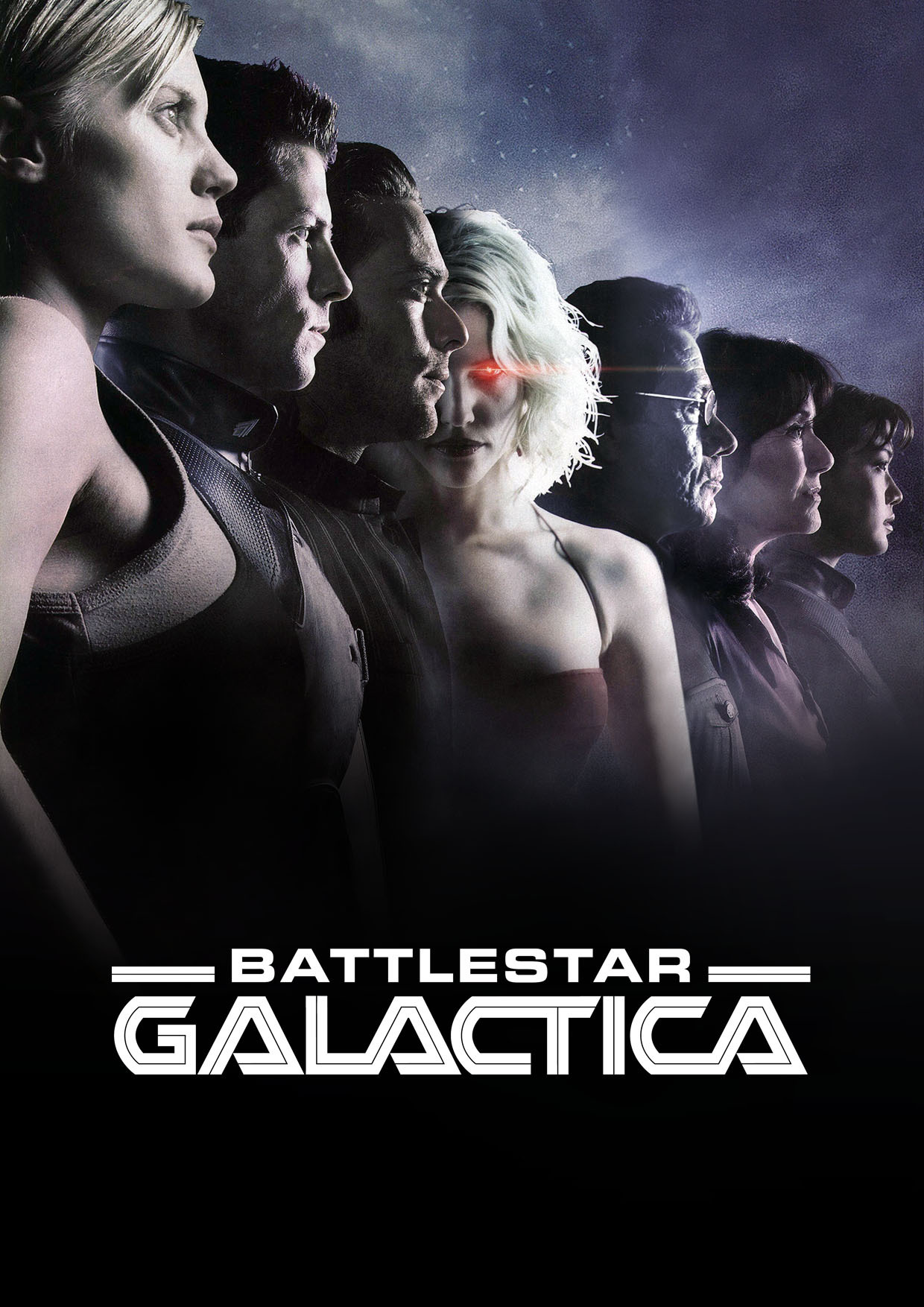
Well, ‘future reference’ is now, and last week I finished watching the first season of BSG. I would post things to Facebook about it, and I’d hear a pretty uniform response each time: fans of the show telling me how jealous they are of my coming to the series for the first time. That’s pretty high praise…which the show has, to my mind, equaled. At least in the first season. I’ve got three more to go. (I think.)

Anyway, Battlestar Galactica famously launched way back in 1978, on the ABC network. Even though it most definitely owed its network pick-up and investment (the show was very expensive) to the incredible success the year before of Star Wars, BSG had actually been under development by creator Glen Larson since the early 1970s. He’d had this notion for a show in his head for a while, and when SF space opera suddenly became wildly popular, his show got its chance.

The story had humans existing on twelve worlds, called the Colonies, and living in peace, until they are viciously attacked at the planet Caprica by the robot race called the Cylons. Caught unawares, the humans are smashed, and end up fleeing their planet with a ‘ragtag fleet’ of various ships, under the protection of the giant battleship – called a ‘Battlestar’ – named Galactica. As the tattered remnants of humanity begin to make their way across the galaxy, the leader of the Colonial fleet, Commander Adama, reveals their destination: the mythical, lost 13th colony, called ‘Earth’.
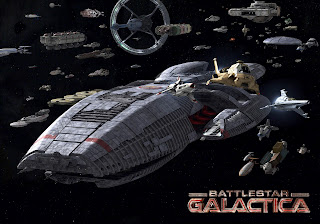
This same background applies to the new BSG, although some of the details have been changed, as befitting a ‘reimagination’ of the idea. Larson’s original series was not just a kind of “Wagon Train to the stars” (and was, in fact, probably a better exemplar of this idea than Star Trek, even though that’s how Gene Roddenberry originally described his iconic show); he also infused it with a lot of veiled references to his own religion and its beliefs, the LDS Church. But for all that, the original BSG has gained a pretty unfair reputation through the years as a cut-rate Star Wars rip-off. I suppose this is partly due to its short run (a single season, due to the ratings not being quite good enough to justify sufficient advertising charges to cover the show’s large budget) and to the follow-up series two years later, Galactica 1980, which was…well, it was, in BSG parlance, frakking awful.

In the years since, there was occasional interest in a revisitation of the BSG franchise, including a project that actor Richard Hatch (Captain Apollo on the original series) spearheaded. It was producer Ronald D. Moore, however, who got the new version off the ground. Moore had a strong grounding in genre teevee, having worked on Star Treks TNG and DS9. The reimagined series, when announced, caused some consternation amongst fans of the original series; I remember one fellow on the FSM boards who would get quite incensed whenever the subject of a new BSG would come up.

So, anyway, as of this writing, I’ve watched all of Season One and about a quarter of Season Two. I’m coming to this with little knowledge of what is to come, although I’ve heard some fairly uncomplimentary things about how the series ends. I suppose I’ll find out soon enough on that score…but what do I think for now?

Generally, this series is amazing.

The main hook is delivered in a pilot miniseries that’s about three-and-a-half hours long. There we open with a deep space station where a human delegate and a Cylon delegate are to meet, once a year, to discuss relations. Or that’s how it’s supposed to go…but what really happens is that the human delegate basically shows up, sits in a room, and reads the paper while no Cylons come. This time, however, the Cylons arrive: two menacing-looking robot types, and a Cylon who looks, for all the world, like a stunningly beautiful blond woman. She asks the delegate if he is alive, and then…the Cylon basestar (the term for a Cylon flagship) destroys the station.

It turns out that the blond woman, ‘Number Six’, is one of many copies, and whenever one of the human-appearing Cylons dies, their memories are instantly transferred to an identical and new body. This simple fact allows the same Cylons to appear in numerous places in the story, and there are quite a few scenes where a human sees a Cylon that he or she has previously killed.

Meanwhile, the crew of the Battlestar Galactica is preparing the ship for a decommissioning ceremony, with all that entails – goodbyes being said, press members being led on a tour, the eventual revelation that one of the launch bays has been converted to a gift shop – when the Cylons launch their dreadful attack on Caprica. Almost immediately this ship, with its commander who is preparing for retirement and a crew mostly made up of young recruits who have never seen any kind of action before, are the leaders of the war effort.

As in the original series, the Cylon attack is staggeringly successful, to the point that all of the Twelve Colonies are destroyed, and all of humanity is reduced to around 50,000 people on a bunch of spaceships, only one of which – the Galactica — is a warship. The rest are tankers and passenger liners and resort ships and the like. They quickly form up into the Colonial Fleet, and take to the stars, fleeing the pursuing Cylons lest humanity be wiped out forever. There’s a deeply chilling scene where it becomes clear that only a portion of the Colonial ships have FTL drives, and as the Cylons launch an attack on the fleet, only those ships can escape, which they do – leaving thousands behind to perish.

The new BSG takes a much more realistic and serialized approach to dealing with this central story notion. Episodes tend to pick up where the last one left off, and problems from one episode are rarely solved in the allotted 60 minutes. Problems of supply, such as water and fuel, are addressed in ways that I don’t recall the original series dealing with in great detail (not that the original ignored all that, by any means).

BSG, like all great science fiction, succeeds or fails based not only on its premise, but on its characters who are living that premise out. This version of BSG is full of interesting characters, with the line often blurred between who is villain and who is not. Alliances form and dissolve as various people find that at times their individual agendas align, while at others, they clash. Aside from the Cylons, there is no one on this show who stands out as purely good or purely evil. Even Commander Adama, who may be the most effective teevee starship commander since Jean-Luc Picard, has moments when he succumbs to his own inner demons and allows them to control his actions. The show is masterful at creating flawed people, but also people whose flaws aren’t so debilitating that we can never sympathize or understand.
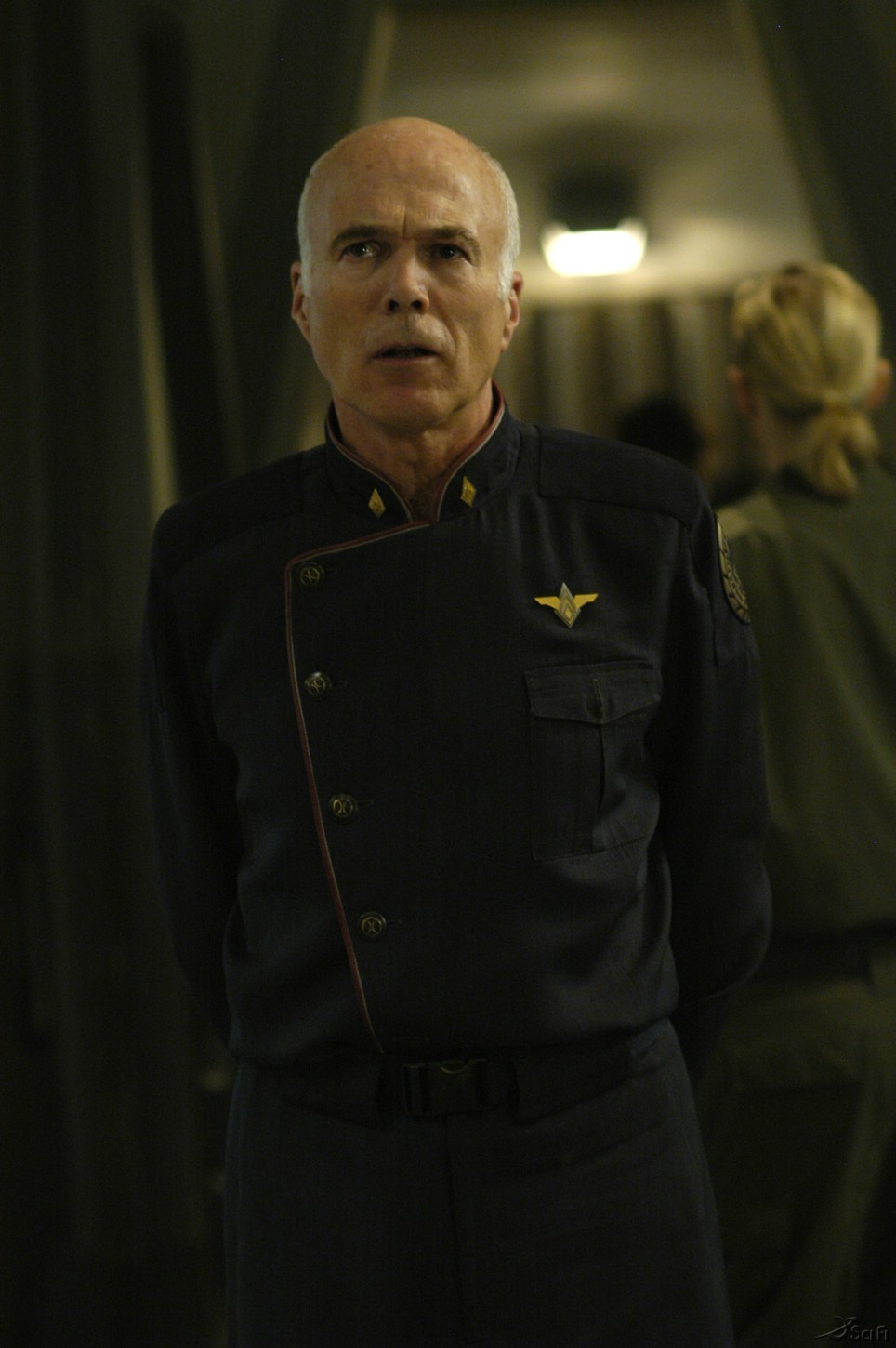
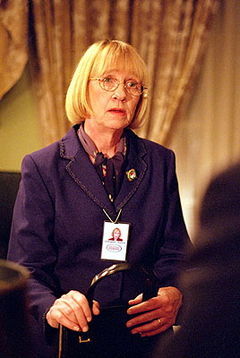
Even better, the flaws of the characters make sense. Colonel Tigh is an alcoholic who suffers from crippling self-doubt about his own abilities to command or make correct decisions – so much so that he often doesn’t even realize it when he makes the right ones because he has to. He’s the one who calmly makes the decision to seal off a section of the Galactica that is on fire and vent that section into space, even though this will mean the instant death of dozens of crew, because it’s the only way to deal with the problem.

And then there is Kara Thrace, the brilliant cigar-chomping Viper pilot with a penchant for breaking the rules and who goes by the call-sign “Starbuck”. I remember a lot of consternation when the show was announced that they were making Starbuck (Dirk Benedict’s role in the original series) into a woman, but it really works here. This Starbuck is arrogant and skilled and resourceful and brilliant, but also brash, disrespectful, and racked with deep guilt that exists on several levels. At the point I’ve reached in the series, there have been some indications that Starbuck has a deeper level of significance in some way, but I haven’t gotten there yet. She is a fantastic character, though. Nothing dull ever happens when she is onscreen.

And the roster of the show’s best characters marches on. Laura Roslin is the Secretary of Education in the Colonial Government, and as such, she is 43rd in the line of succession to the Presidency…until the Cylons kill, in one fell swoop, the 42 people ahead of her, so this prim schoolteacher finds herself President of the Colonials during their greatest time of struggle in history. This, in fact, turns out to be one of the show’s most frequent themes: the way in which history often forces the least likely of people to rise to the occasion and do what must be done to survive. The obscure cabinet member who works on education policy becomes President. The commander of the ship that’s being mothballed becomes the leader of the entire war effort. The maintenance workers who repair the ships suddenly find their duties the difference between life and death. And so it goes.
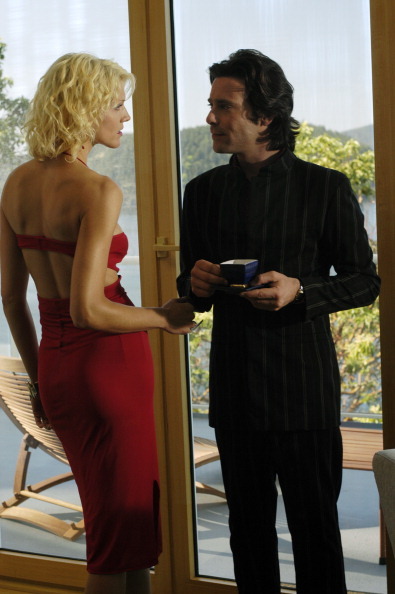
BSG‘s moral ambiguity is most centered on Gaius Baltar, the brilliant scientist who is seduced into giving access to defense computers on Caprica to the stunning woman he’s dating…who happens to be Number Six, the gorgeous human-looking Cylon. In many ways, it’s his fault that the Cylons are so able to destroy Caprica so quickly, so utterly, and so decisively. But is he a villain? It’s hard to see him as such, even though his agenda, to the extent that he even has one, doesn’t really line up to the rest of the Colonial fleet’s. As the series unfolds, Baltar is visited over and over again by Number Six, who may or may not be a figment of his imagination…or a vision placed via a chip in his brain. She is able to stoke his ego to enormous degree, first by getting him elected Vice President, and then by convincing him that he is an ‘instrument of God’.

The BSG writers excel at creating situations where the moral course is not at all clear. In just this one season, we have the fleet having to rely on convicted criminals to form a work crew to acquire water; we have a decision made on incomplete information whether or not to destroy a Colonial ship that may have been taken over by Cylons; and we have the increasing evidence that what is happening to the Colonials has been foreseen in their scriptures, so that they must decide whether to continue fleeing or stop and retrieve an artifact from their once-lost home planet of Kobol. BSG provides its characters with few easy decisions – in fact, it’s almost as if the writers delight in creating situations where their people are in a really bad spot and their only courses of action available basically constitute a grab-bag of suck. “Pick your poison” seems to be the general order of the day on this show…or the choice between the devil you know and the devil you don’t.

I don’t want to give the impression that the updated BSG is all dystopic depressing stuff, because it’s not. It’s intense and dark and a lot of bad stuff happens, but there are real moments of happiness along the way, and a couple of moments of outright triumph. This is a show that makes a major victory out of when the running tally the President keeps of the to-the-number population of the human race actually increases by one, and there are moments of humor along the way. Small moments, to be sure, but there’s a constant sense that when a triumph comes, it is earned. Prices are paid for victories, but hope remains.
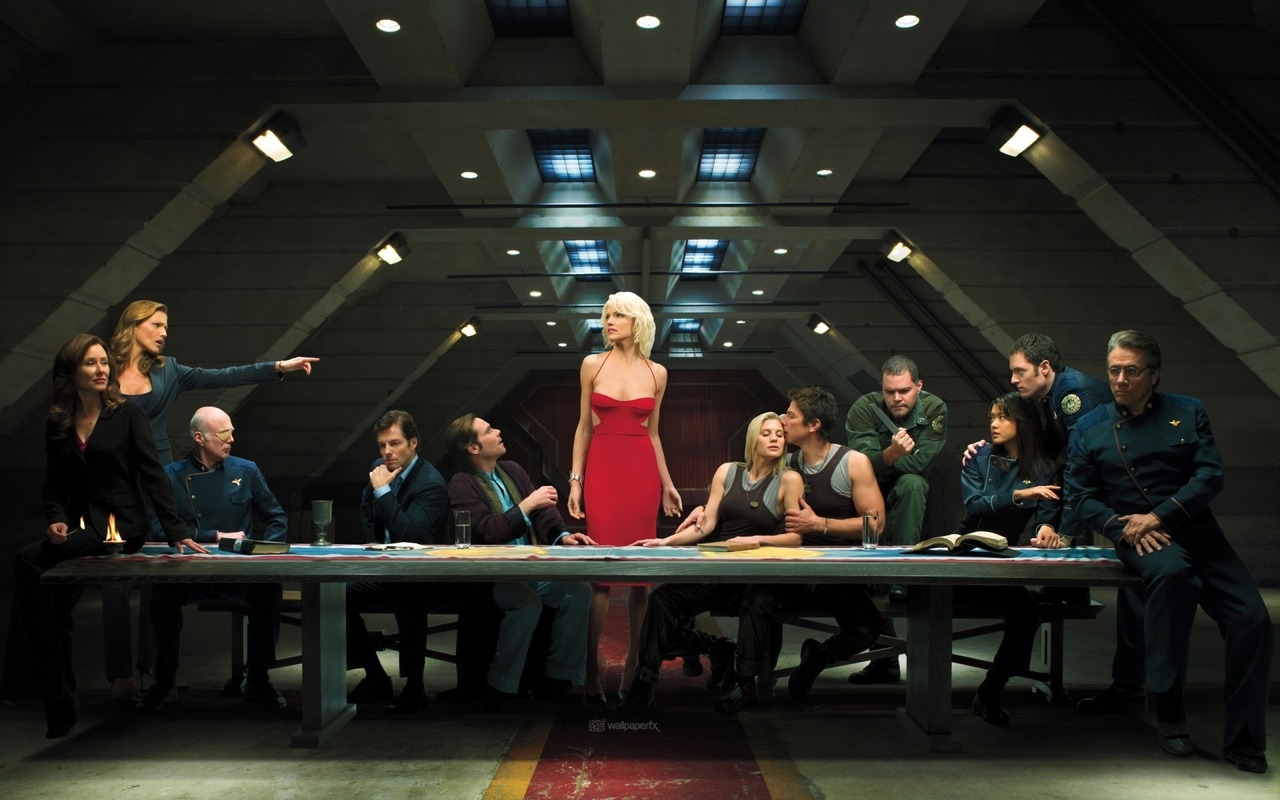
This brings me to the show’s mystical and religious themes. The Colonials seem to be polytheistic, believing in gods who are modeled on the Greek pantheon of deities. Reference is made to Apollo and Athena, as well as others. The Cylons, however, are particularly interesting because they are not just a race of robots, as in the original series. The Cylons believe in a monotheistic God, to the point where Number Six, in her talks with Baltar, speaks to him in ways that are so spiritual that it’s possible to wonder if she is some kind of angel and not a Cylon at all. The original series had its religious content as well, being famously shaped by Glen A. Larson to reflect the theology of the Mormon church. The BSG update doesn’t quite do that, but it does address some of the big spiritual questions. Characters are said to be meant to do certain things, and there is the constant repetition of a single spiritual idea, used almost as a kenning in the show: “All this has happened before, and all this will happen again.”

In terms of production design, BSG is top-notch. The Galactica itself is only mildly updated in design, as are the Colonial Viper starfighters – they are still long and sleek, with their tri-thrusters, but they’re deadlier now. Interestingly, early in the show’s pilot miniseries, there’s a touching scene where the flight crew on Galactica provides Adama with a restored ‘vintage’ Viper, which is, of course, one of the ships from BSG 1978. There are other, small nods to the original series: the gold-plated Cylons of the original show are revealed to be an earlier model in this one, and the Colonial Anthem turns out to be the Stu Philips theme from the original show. These are all small nods of respect toward the earlier show. (The ultimate such nod is, of course, the casting of Richard Hatch — who played Apollo on the original show — as Tom Zarek, a criminal-turned-politician, who is one of the more interesting characters on a show that is loaded with them.)

There are other things about the production design that might seem a bit odd at first, but I quickly became used to them. The clothes on the show are contemporary – and by that, I mean, you could pluck just about any civilian character out of BSG, plunk them in the middle of any city in America, and no one would look twice at them. Suits with neckties, women in pants suits and the like…in truth, I found this aspect of the show easiest to swallow. Nobody really has any idea what would be in fashion in some future (or past) society, so why not just use fashions from right now and have done? It was no harder for me to get used to this than it was to get used to all the Western tack in Firefly. One design element in the show that I really like is how every piece of paper, every book, every bit of printed matter, is printed on octagonal paper. That little detail goes so far to make clear that this world, these people, look like our and us, but they’re not.

And the music? There’s some wonderful music on this show, and it uses a lot of different styles, from slashing synths to action cues that are nothing but percussion to a Celtic-theme for the father-son relationship of Adama and Apollo.

I will continue to report on BSG as I make my way through the series, but for now – what a great, great show.

Share This Post

“We don’t have time to do one thing at a time!”

The New Yorker‘s Emily Nussbaum reviews the new Aaron Sorkin show, The Newsroom. Surprise, surprise:

“I’m affable!” Will McAvoy yells in the pilot of “The Newsroom,” Aaron Sorkin’s new HBO series. McAvoy (played by Jeff Daniels) is an irascible anchor whose brand is likability, and it’s a good line, delivered well. It is also a rare moment of self-mockery—and one of the last sequences I was on board for in the series. In “The Newsroom,” clever people take turns admiring one another. They sing arias of facts. They aim to remake television news: “This is a new show, and there are new rules,” a maverick executive producer announces, several times, in several ways. Their outrage is so inflamed that it amounts to a form of moral eczema—only it makes the viewer itch.

This is not to say that “The Newsroom” doesn’t score points now and then, if you share its politics. It starts effectively enough, with an homage to “Network” ’s galvanizing “I’m mad as hell” rant, as McAvoy, a blandly uncontroversial cable big shot whom everyone tauntingly calls Leno, is trapped on a journalism-school panel. When the moderator needles him into answering a question about why America is the greatest country on earth, he goes volcanic, ticking off the ways in which America is no such thing, then closing with a statement of hope, about the way things used to be. This speech goes viral, and his boss (Sam Waterston) and his producer, MacKenzie McHale (Emily Mortimer), who’s also his ex-girlfriend, encourage him to create a purer news program, purged of any obsession with ratings and buzz.

Wow, did I call it or what. I hate to go on and on about how Sorkin annoys me, but dammit, I used to be a huge fan of his. But he hasn’t had a single new idea in more than a decade, as far as I can tell. And worse, he hasn’t found any new ways to write about the same old ideas. Reading the review pretty much confirms what I’ve been thinking about Sorkin for years. A Network-style live rant? Sorkin’s never done that before! (Except in the first five minutes of Studio 60.) Someone saying that what they are doing is totally new and they’re gonna rewrite the rulebook? Sorkin’s never done that before! (Except in The American President and in The West Wing.)

I recently watched the first three or four episodes of Studio 60 on the Sunset Strip again (they’re on YouTube), and my God, that show is even worse now than I remember it being during the first airing. I really think that Aaron Sorkin is utterly convinced of his own genius, and that people will line up to hear the same lines and same tropes in the mouths of new actors playing out the same stories. Maybe they will…but yeesh, why?!

BTW, here are a couple of scenes from The West Wing, during the seasons after Sorkin left. The show was particularly uneven in the fifth season, although it did hit some real high points (the episode detailing the nomination of two Supreme Court justices was fantastic).

Here is Bartlet sitting down for some late-night ice cream with the Republican nominee for President, Senator Arnold Vinick, after rumors of Vinick’s possible atheism have come to light:

Here’s a beautiful scene between Toby Ziegler and CJ Cregg, from the second-to-last episode ever. Toby has been fired from the White House and is on his way to prison in a few days for leaking classified information to the press; CJ is finishing up her service in the Bartlet White House (as Chief of Staff after more than four years as press secretary), and she is wondering what to do next with her life: she has job offers from an extremely wealthy philanthropist and from Matthew Santos, the incoming President-elect.

And finally, here’s a good scene between Matt Santos, the Democratic nominee, and his running mate, Leo McGarry. These two men don’t know each other well, having been thrust together by Santos’s surprise winning of the nomination at a brokered convention and subsequent hasty selection of Leo as his VP. Here they are still feeling each other out…and start to come together as a team.

Post-Sorkin West Wing took a bit of time to find its voice again, but when it did, it was often just as good as ever.

Share This Post

The Final Teevee Report

So, with perhaps a couple of exceptions, the entirety of the 2011-2012 teevee season is now in the books. How was it? It was like all teevee seasons, it turns out: a mixed bag. Here are thoughts on specific shows.

:: OK, might as well start with Castle. In general, I liked this season, although it honestly felt like they were deliberately stretching the main story out as long as possible. Here I’m referring to the ongoing investigation, such as it is, of the murder of Joanna Beckett, mother of Detective Kate Beckett. It was my firm belief going into this season that this storyline really needed to get wrapped up this year. Did it? No. And worse, the ball barely got moved. So now we drag it onto next season, when my hope will still be the same: that this tale gets closed out and done, so we can move into more interesting territory. The murder of her mother is what has defined Kate Beckett, it’s the event that has motivated her life more than any other. So what will she be like when it’s done? What will that mean for her? That’s a fascinating question, and I hope the writers embrace the chance to find out. I’m afraid they won’t, however.

The season also kept the “will they or won’t they” nature of Castle and Beckett’s relationship going for far too long, as I complained about in my open letter to Castle a while back. I was willing to see where they went with the season finale, on the assumption that maybe the obstacles thrown in between them would turn out to just be ways for the writers to postpone any major developments to the finale episode, because many such shows are total captives to the teevee season schedule and will only do BIG events on the final episodes of a particular sweeps period. And yet, that does seem to have been the case, as the finale ended with Castle and Beckett finally coming together. (Well, it almost ended that way. More on that in a bit.)

Anyway, yes, I’m very glad that they finally stopped playing coy and making sly references to feelings they both know the other has and all that rot. And you know what? The scenes where that happened were actually very well written and superbly acted. So why they felt the need to postpone it and put it off with all manner of goofy “I’m mad at Kate so I’m not gonna talk to her and I’m gonna play around with a flight attendant instead, neener neener neener!” stuff really does seem to have been what I called it back then: a Love Boat third act, a fake complication designed to do nothing more than drag things out. That was awful writing, but at least it resulted in a well-done outcome. Nathan Fillion’s acting in the final confession was great; he made Castle’s simultaneous anguish at trying to pound his way through Beckett’s determination and his relief at finally ripping off this stupid Band-aid very real. And I continue to think that Stana Katic plays Beckett very well, with relentless focus. Her mindset is very much “one thing at a time”, and when life does its thing of forcing her to confront more than she wants to confront, she tends to want to shut it down. This time it led to (for her) disastrous results, but it also forced her to a place where she finally had to admit what she’s felt for Castle. This was all very well handled, and I hope that the preceding nonsense was just an aberration born of the rigid mindset of American teevee that you can only do Really Big Things in season finales.

As for the developments in the Joanna Beckett case, I’m not sure what to think. On the one hand, the tale is still out there, waiting to be resolved. On the other hand…when I really think about it, Andrew Marlowe and company actually didn’t muddy the waters much more than they already have. They didn’t introduce yet another element or layer to the case; they simply put a face on an old one (the sniper who nearly killed Beckett last year) and gave a tiny bit of revelation about another one that’s been around a bit (the shadowy figure who’s been informing Castle). So, even though nothing has been resolved, I’m at least glad that we didn’t peel away another layer of this story’s onion just to find yet one more layer.

My Open Letter actually got quite a bit of attention from several Castle fan forums across the Interweb, which I was interested and sometimes amused to follow along. Two forums in particular gave it quite a bit of discussion, and interestingly, I was right in the middle of the prevailing opinions of each forum! On one forum, I was “too caught up in my own idealism” to see that Castle’s reaction to learning that Beckett had heard what he’d said months before, as she was bleeding in the grass, was totally realistic and respectable and consistent with who he was, as if my desire to have seen some kind of character growth over four years of storytelling was just too much to ask! But on the other forum, I was giving the writers too much credit; over there, the Castle showrunners are little better than the million monkeys at the typewriters, hoping to use their infinite time to produce the works of Shakespeare. Clearly, I was in between those extremes…although I found the former more disappointing than the latter, because the folks there struck me as being insufficiently critical. But who cares? I’m just me.

Anyway, I’m glad that Castle ended on at least some of the notes it did, and I’m not entirely annoyed that it ended on some of the other notes it did. But really, guys: wrap up the Joanna Beckett murder mystery. Trust me, it’s just not that interesting anymore. They’ve already promised a return to the more ‘fun’ atmosphere of the first few seasons, so here’s hoping. One thing I noticed this year that if he wasn’t saying it outright once in a while, there was almost no real mention of use of the fact that Castle is a writer. I liked it back when he would have a poker game with his mystery writer buddies and bounce his theories off them about his current case. They should get back to doing that sort of thing.

:: You know what else isn’t interesting? Patrick Jane’s quest for Red John on The Mentalist. And to be honest, the show itself isn’t that interesting anymore. This was a really down year for that show…I’d always found it entertaining, before, but this season just did not produce too many memorable episodes, and the Red John storyline is starting to get ridiculous. I read an interview the other day with the show’s creator, in which he indicated that Red John has become more of a ‘Moriarty’ figure than an elusive serial killer, which is fine, but the show’s writing staff just doesn’t seem to have the chops to pull this off. It continues to be increasingly unbelievable that a violent murderer like Red John could continue to command the utter, unwavering loyalty of so many underlings. If they could explain that, then maybe it would be believable. But really, this show needs to wrap up its long mytharc, too…but we all know it’s not going to. Sigh.

:: House had a fairly uneven season, I thought, but overall it was a satisfying last year, and I for one really liked the way the show ended – it was bittersweet (Wilson’s cancer), but also optimistic (House finally finds a way, albeit drastic, to put all of his demons behind him).

:: The king of uneven seasons, however, was turned in by The Office. Wow, was this year a mixed bag. Sometimes it was as great as ever, but other times it was cataclysmically bad. Just…weird. I generally liked the dynamic of Andy Bernard as the boss, but the show got away from that too quickly, with goofy shit like Dwight’s possibly being the father of Angela’s baby, the Robert California character, and in the last third of the season, a very strange character named Nellie who took over the office despite having apparently no business acumen whatsoever. It was just a terribly odd year, and I think that’s mainly because the writers have almost totally run out of ways to make the show a satire of the soul-crushing world of just-getting-the-work-of-business-done. (Plus, Dwight should never, ever, ever, get the upper hand on Jim. Any time Dwight scores a victory, it feels completely false.)

:: CSI: Miami is canceled. This disappoints me, but what are you gonna do. The other CSI shows have been off my radar for years.

:: Not too many new shows captured my interest. I followed Two Broke Girls, not terribly religiously, as it’s a show with an appealing concept but whose sense of humor tended to stay in the Two and a Half Men end of the pool, and that’s a show I’ve never been terribly warm about. I mainly like Two Broke Girls for the two leads, one of whom is Kat Dennings (otherwise known as the Newest Love Of My Life). But the show is just OK.

So, too, is The New Girl, the Zooey Deschanel vehicle that puts Her Quirkiness at the service of three bachelor dudes in an apartment. It’s not a bad show. Nor is it a great one. It’s rarely better than mildly amusing, and the quirky Deschanel effect is hit or miss. There were moments when I loved it – an episode where the cast all joined on the dance floor at a wedding and slow-danced the ‘Chicken Dance’ together to ‘Groovy Kind of Love’ was a nice moment – but the show rarely rises above being a vehicle for occasionally-endearing quirkiness. (The pilot was, for me, an enormous tease, showing Zooey Deschanel I decked out in a wonderful pair of overalls that, as far as I could tell, she never donned again. Aieee!)

The best new show this year at Casa Jaquandor? That would be Person of Interest, which has rapidly become a big favorite of ours. We love this show. It’s exciting, its stories tend to be character driven, its characters are interesting people with pasts and histories and motivations, its humor is character driven which shows the high degree to which the creators understand the people with whom they’ve populated their show. Sometimes the action and intrigue is a bit hard to believe, but mostly, I’m willing to go with it, and even the show’s backstories are complex in a welcome way. There isn’t one central ‘mystery’ to the show, a la Red John or Beckett’s Mom’s Murderer, but instead we have several characters whose shadowy pasts are threatening to rear their ugly heads again. The finale episode gave us a cliffhanger, as expected, but I was truly excited that the cliffhanger we got wasn’t even close to the one that I expected. Person of Interest is a terrific show.

:: I pretty much abandoned Hawaii Five Oh, or however it is they actually type it out. The show’s still what it is – a reasonably entertaining cop show that takes itself too seriously – but it generally lost my interest, and I found myself with the show on but not paying any attention whatsoever. Not a good sign for a show’s longevity as a going concern of mine. And its own long mytharc, why Jack Lord Jr.’s father was killed, is still unresolved as they continue to chase ‘Wo Fat’. I have a goofy conspiracy theory that Wo Fat, Red John from The Mentalist, and whoever is ultimately responsible for Joanna Beckett’s murder on Castle are all the same person! I think that would be funny. Weird, but funny. But anyway, the show itself just doesn’t command my interest in a big way, and that’s even with the addition to the cast of Terry O’Quinn, who is starting to develop a pretty depressing track record of being my favorite actor on shows I don’t much care for.

:: Boy, has Bones descended into self-parody and soap opera silliness, hasn’t it? Ye Gods. It’s The Daughter’s favorite show, so we still watch it, but it’s been incredibly cheesy. That said, the season finale was actually excellent, as it dialed down the goofiness and focused instead on the mystery, which has led to Dr. Brennan having to go on the run and Agent Booth having to clear her name for a murder she didn’t commit. I hope they keep to that episode’s tone more next season.

:: We really enjoyed The Finder, which was a quirky and fun and entertaining. And canceled, because apparently we were the only ones watching it in its shitty Friday timeslot. I’ll never understand why networks greenlight shows that they don’t believe in and have no intention of supporting.

:: I finally gave up on American Idol. I couldn’t take it anymore. The ship has sailed. And f*** X-Factor, while we’re at it. It’s time for these competition shows to go away. This season of Idol was excruciating, and the end came the night of the Final Two and their performances. I turned on the show, and The Daughter said, “Gee, Dad, what’s the worst thing that happens if we don’t watch this?” I thought, and then I said, “Nothing, I suppose,” and turned off the teevee. Thus do I leave Idol behind. Oh well. Seacrest, out!

:: The Amazing Race was boring this last time out. The final three teams were two teams I didn’t care about, and one team I hated. So the rooting interest wasn’t much, there. But at least they managed to avoid what’s happened in a lot of recent seasons, when one of the final three teams is basically done in by a crappy cab driver who can’t find where he’s supposed to go. Other reality shows? Kitchen Nightmares quickly becomes same-old, same-old; ditto Undercover Boss. I’m still annoyed with Survivor for the Boston Rob fiasco (and I remain utterly convinced that we haven’t seen the last of him or Russell), and The Amazing Race‘s new habit of casting people from other CBS reality shows (a couple from Big Brother being the last) is incredibly irritating. Hell’s Kitchen and Masterchef return soon; I’m hoping for a bit of a break from formula in the former, which has become all-too-predictable the last several seasons, to the point where I can actually predict the challenges each week. Still, I hope for fun watching from both.

We’ve been watching Cake Boss on Netflix, which is kind of fun, although I always wonder how people eat those cakes. (Another bonus is that, being as it takes place in a bakery, there’s an occasional pie in the face, which is always nice.) There’s a barbecue challenge show (whose name I don’t remember) that we’ve watched a bit. And I really wish that Pawn Stars would get more episodes on Netflix, but that’s not up to me.

:: Finally: kudos to The Big Bang Theory, which showed signs of creakiness but has managed to reinvigorate things by actually allowing its characters to grow a bit. The final episode of this season, which combined the wedding of Howard and Bernadette and Howard’s space launch, was as good an example of ensemble-cast comedy as I’ve seen in recent memory. I still love this show!

:: So, what about summer teevee? I’m already watching Battlestar Galactica (the new one), and I need to get back into rewatching The X-Files. We also plan to watch Once Upon a Time and Grimm, now that the seasons are complete. I’m wondering if I should try out stuff like Mad Men, Downton Abbey, and The Wire, as well as some SF stuff like Farscape, and frankly, I wouldn’t mind doing a Star Trek re-watch one of these years, as it’s been over a decade since I’ve seen many, if not most, of the episodes of all the series. I am not watching Game of Thrones; re-reading the books has been trial enough for me, thank you very much.

And that’s the state of teevee at Casa Jaquandor.

Share This Post

On the cancellation of CSI:Miami

EXTERIOR: A Miami street.

Standing beside a dead body on the ground, but facing ninety degree away from it, is HORATIO CAINE. His cop buddy FRANK approaches.

HORATIO: What have we here, Frank?

FRANK: Single victim. White male. Gun shot wound to the chest.

HORATIO: We need to investigate this, Frank.

FRANK: We can’t, Horatio. It seems that we’ve been put to pasture. They’ve cancelled us, Horatio.

HORATIO: Oh, that’s all right, Frank. Because we[puts on sunglasses]…are gonna cancel them.

SMASH CUT to THE WHO, with Daltrey screaming YEEAAAAHHHHHWWWW!

I’m really going to miss CSI:Miami. It’s not a good show at all, but it’s so gloriously fun in its campiness, it’s so insistent on putting its goofy heart on its sleeve, that I can’t help but love it. It’s been a truly unique show to have around, and my Sunday nights will be a bit emptier without David Caruso, Emily Procter, and the rest of the gang. Thanks for the fun, Horatio Caine! May your Hummer speed around the highways of Miami forevermore!

Share This Post

A to Z: Old People of Wisdom

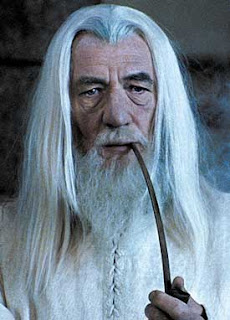
Gandalf. Loren Silvercloak. Mrs. Potts. Obi Wan Kenobi. Boothby the gardener. Sarek. T’Lar. Dumbledore and McGonagall. The Oracle. Jor-El. Maester Aemon. Mrs. Landingham. And, of course, Merlin.

What do all these folks have in common? They are Old People of Wisdom.

In the Campbellian Monomyth, the Old Person of Wisdom is the mentor-figure who provides the Hero with magical aid that he or she will need, going forward, to complete the adventure. It is also often the Old Person of Wisdom who provides the Hero with their initial ‘Call to Adventure’. So this figure is often the catalyst for the story.

“If you’re referring to the incident with the dragon, I was barely involved. All I did was give your Uncle a little nudge out the door.” –Gandalf the Grey, The Lord of the Rings: The Fellowship of the Ring (film)

Of course, those familiar with ‘the incident with the dragon’ know that Gandalf did a lot more than that. Yes, he showed up on Bilbo’s doorstep and introduced him to a bunch of dwarves who wanted to hire him to be their burglar, but how did it come to that? How did Gandalf settle on Bilbo, and not, say, some Bolger or Bracegirdle or Proudfoot? It’s often the role of the Old Person of Wisdom to see something in the hero that they don’t see in themselves. Gandalf sees in Bilbo a stalwart burglar. Obi Wan Kenobi sees in Luke Skywalker a future Jedi knight. (We’ll learn, of course, that he has a lot of reasons for seeing that.) Loren Silvercloak sees in five young University of Toronto students qualities that will prove essential in the final war with the darkness of Rakoth Maugrim.

One of the interesting things about the Harry Potter books is the way that multiple characters fulfill the function of the Old Person of Wisdom. Albus Dumbledore is the key of them all, but he doesn’t do it all. The Call to Adventure comes from Hagrid. Supernatural aid comes not just from Dumbledore but from McGonagall, Sirius Black, Remus Lupin…a whole host of people. Of course, JK Rowling didn’t blaze this trail on her own; in the James Bond movies, what are M and Q but Old People of Wisdom?

Why does this trope have so much power? It seems pretty obvious to me. Age implies experience and wisdom. We look to the mothers and fathers of our communities for wisdom. And we know that eventually they move on, into death, and that eventually the story will be ours and ours alone…until we have to serve as Old People of Wisdom ourselves.

I’m reminded of the wonderful closing speech that Sir Anthony Hopkins delivers in the movie Amistad:

The other night I was talking with my friend, Cinque. [The African man who was kidnapped into slavery and who is suing for his freedom in the film.] He was over at my place, and we were out in the greenhouse together. And he was explaining to me how when a member of the Mende — that’s his people — how when a member of the Mende encounters a situation where there appears no hope at all, he invokes his ancestors. It’s a tradition. See, the Mende believe that if one can summon the spirits of one’s ancestors, then they have never left, and the wisdom and strength they fathered and inspired will come to his aid.

James Madison, Alexander Hamilton, Benjamin Franklin, Thomas Jefferson, George Washington, John Adams: We’ve long resisted asking you for guidance. Perhaps we have feared in doing so we might acknowledge that our individuality which we so, so revere is not entirely our own. Perhaps we’ve feared an appeal to you might be taken for weakness. But, we’ve come to understand, finally, that this is not so. We understand now, we’ve been made to understand, and to embrace the understanding that who we are is who we were.

We desperately need your strength and wisdom to triumph over our fears, our prejudices, our-selves. Give us the courage to do what is right. And if it means civil war, then let it come. And when it does, may it be, finally, the last battle of the American Revolution.

What’s wonderful about this particular cinematic moment is that in the film, Hopkins’s John Quincy Adams is himself an Old Person of Wisdom…and yet here he is, citing the eternal need in our species for Old People of Wisdom. (You can watch the speech here.)

It’s almost impossible, I think, to avoid the trope of the Old Person of Wisdom. It’s not just ingrained in our storytelling. It’s ingrained in us.

Share This Post
Extruded Aaron Sorkin Product #19

Here’s a teaser-trailer thing for the new show Aaron Sorkin’s writing for HBO, about…a news anchor. I honestly can’t fathom why anyone still thinks Sorkin is a genius. Watch this and tell me it doesn’t sound exactly like every other thing he’s ever done.

Right there, in two minutes, is nearly every single annoying Sorkinism that exists. Ugh.

Share This Post

Teevee Notes

Some random thoughts on teevee:

:: I just post this on Facebook:

Some of you might be tempted to dismiss the new Rob Schneider sitcom as total crap that appeals to the lowest denominator. Some of you might just assume, without watching it, that it’s a typically awful sitcom with cookie-cutter plots, ethnic stereotypes substituted for wit, and shrill characters who think that you overcome an awful punchline by shouting it. Some of you might assume these things…and you’d all be right!

Seriously, this show is bad.

:: The last couple episodes of Big Bang Theory have really brought the funny. Here’s my current working hypothesis on Sheldon Cooper: what makes him a great character isn’t just his neuroses that allow him to clash with other characters over anything at all. It’s that sometimes he’s right, and the social conventions he genuinely doesn’t understand really are pretty goofy, when you think of it.

:: Oh, Castle…you know I love you. Really. But the “Beckett’s mother” thing really needs to end, and I’m starting to worry that instead of moving things toward conclusion, you’re ratcheting it up…and that’s not good. Now we have Castle having shadowy meetings in parking garages with unnamed contacts whose allegiances we don’t know? And that this guy is manipulating things so that Castle will remain able to assist the NYPD and thus protect Beckett? Geez. I just don’t know about this…especially since it’s obviously being set up so that at some point Castle will have to steer Beckett in the wrong direction, thus driving another wedge between them. Be careful here, Castle. You can do this well…but even the greatest players drop the ball once in a while.

:: The recent dearth of new episodes of House is getting annoying.

:: A few weeks back, GLEE did a song called “Red Solo Cup”, which is a country song by Toby Keith. If you haven’t heard this song, I suppose it’s worth a listen as what it is: a mildly-amusing novelty song. Second time, though, it stinks. What does this have to do with GLEE? Not much, except it’s a terrible show. Moving on:

:: I kind of like The Finder.

:: Shows I’m sitting on until a time when there aren’t new episodes of anything: Once Upon a Time and Alcatraz.

That’s about it for now….

Share This Post

You never know WHAT is gonna come through that door.

A few months ago we subscribed to Netflix, so we could watch streaming shows and movies now that we had high-speed interweb. Netflix has been something of a mixed bag – more on that another time – but we found some shows to watch on Netflix that we’ve missed owing to our not being a cable teevee household. One such show is the History Network’s Pawn Stars.

This show, for those unfamiliar with it, takes place in Las Vegas, at a pawn shop owned by a guy named Rick Harrison. Working with him is his father (called “the Old Man”) and his son (called “Big Hoss”) and a guy who is mostly played for comic relief (called “Chum Lee”). And what happens on the show is pretty straightforward: people come in with stuff that they try to sell, leading to some work identifying the items, and then the price haggling (if Harrison and company are interested in buying it). Basically it’s Antiques Roadshow with some more personality to it, where money actually changes hands. Instead of someone being told that the gewgaw they’ve just brought in is really valuable and then they say, “Wow, I’m gonna keep it forever!”, here we have people saying, “Great! That guy said I could get $10,000 for it, so I want $10,000 for it.”

Pawn Stars is a lot of fun on several grounds – the guys on it are an entertaining bunch, the haggling is entertaining, and the items themselves are often fascinating. There are also “before-after” things, too, when Harrison and company buy something that’s a wreck and then get it restored. These segments are so fascinating, actually, that their preferred guy for restoration now has his own show. (We haven’t seen this yet, but it’s called American Restoration. When this shows up on Netflix, we’re there.) Where the focus in Antiques Roadshow is on the stuff, here the focus is more on the people and the connection they have with their stuff. Sometimes there are sad little vignettes, when people who are clearly down on their luck are trying to make a buck by hawking their stuff, and they get less than they clearly want; sometimes there are triumphs when someone discovers that an item they got someplace for very little is worth a whole lot. And then there are the people who don’t know that what they’ve got are fakes. (One guy, in an early episode, has promised his wife that he’ll make a lot of money selling his antique gun…which turns out to be fake and worth about fifty bucks. Ouch. Lots of curse-word beeping on that guy’s reaction!)

Firearms of all sorts seem to be the most common types of items brought in on the show, but this is all very interesting – you learn a lot about the history of firearms by watching this show, and they seemingly never buy an old gun without taking it out to the wilderness and firing it. Exploding stuff is cool! For me, the most amazing item was a guy who came in with a big hunk of gold coins all melded together – it was part of the treasure from a shipwreck off the coast of Sri Lanka, discovered by Arthur C. Clarke and a diving buddy of his years ago, that turned out to be one of the richest treasure ships ever found. Harrison did not end up buying the treasure lump, but this whole transaction was amazing. (Clarke wrote a wonderful book on the finding of the ship, The Treasure of the Great Reef.)

This particular transaction raised the standard question: is Pawn Stars for real, or is it staged? I suspect that it’s a mix of both; there’s no way it could be one hundred percent ‘real’ and look as professional a production as it does. There are times when the influence of producers shows a little too much (such as when the second season starts and suddenly every episode had to have at least one conspicuous reference to Subway restaurants). But really, I don’t care – the personalities are engaging (Harrison and company come off like a terribly fun bunch to hang out with), the show is fun, and the stuff is real. Well, usually, anyway.

Rick Harrison has a new book out about the whole pawn shop experience, called License to Pawn. The book is a fast, breezy, and extremely entertaining read. It’s worth noting that Harrison and his family have been in the pawn shop business for years, and that what’s seen on the show is just a small part of what really goes on in a pawn shop. The Harrison family has seen its share of seedy characters throughout the years, and there are a lot of wonderful anecdotes in the book that detail the colorful people who have come through on occasion. The show never depicts the dark underbelly of Las Vegas, but it’s clear that Harrison and company have seen a lot in their years. There are even some haunting tales, including one poor fellow, socially awkward, whose main hangout in life was the pawn shop until he finally had to be forbidden to return after he sexually harassed a female employee and died soon after. And there’s probably a fascinating show in itself to be made from the life of the person who has to staff the shop’s overnight window (bulletproof glass, of course).

The book has chapters by the Old Man, Big Hoss, and even one by Chumlee, which strongly implies that Chumlee’s not quite the big dumb lug the show makes him out to be. Each one is refreshingly up front about their own strengths and weaknesses; Harrison himself is proud of how smart he is, but he’s also willing to admit that he was an awful student in school and that he can’t resist some particularly crackpot schemes to make a quick profit. (One such scheme involves nickels. Lots of nickels. Believe it or not, Rick Harrison thought he’d make money by investing in nickels.) There’s something about Harrison that is inherently likable; he comes off as the kind of guy whom you could consider a great friend even if you disagree with everything that comes out of his mouth. (Could be the fact that at one point in the book, he admits to being completely uninterested in fashion and declares a preference for…overalls!) Big Hoss and Chumlee have had drug-related struggles in their past, which they write frankly about, and my personal favorite anecdote in the book comes from Big Hoss’s chapter. Here it is:

I’m sitting on the stool inside the shop at the night window and a woman walks up and asks me, “Do you buy gold teeth?”

“Yes, ma’am, we do,” I tell her.

She’s looking at me through the window, and she doesn’t look like a drug addict or a desperate person. She’s in her fifties. She’s dressed reasonably well, her hair is groomed, she’s not dirty. (Those three descriptions qualify as high class for the night window.)

She says, “OK, good. Do you have a pair of pliers I can borrow?”

Stupid me, I think the two questions are unrelated. I think she’s asking to borrow pliers for reasons that have nothing to do with the question of the gold teeth. I’m thinking maybe she needs to fix her car, or maybe give them to a guy she’s with so he can fix the car.

It was late. I probably wasn’t thinking straight.

I grabbed a pair of pliers from under the counter and told her I’d need a driver’s license to hold so I make sure I get my pliers back. She nods and hands her license through the slot. No big deal to either of us.

About a half an hour later, she’s still nowhere to be seen. I’m thinking it’s awfully strange that someone gave up their driver’s license for a pair of pliers at three in the morning in a pawn shop in Vegas. Then again, it is three in the morning in a pawn shop in Vegas, so maybe it’s not so strange.

Anyway, she finally shows up at the window with her mouth full of toilet paper. She drops a gold tooth and the pliers through the slot.

A gold tooth covered in blood.

For $40.

So now I’m wishing I hadn’t given her the pliers. If I had been thinking, I would have realized why she wanted the pliers. The idea wasn’t to refuse the pliers out of any moral judgment – she’s got to do what she’s got the do. I just shouldn’t have supplied her with the means to do that.

I’m looking at the tooth, thinking, “Well, Big Hoss – now you’ve got to buy it.” After all, she did go to the trouble to bring it to me.

Somehow this one vignette tells you so much about what happens at a pawn shop in the middle of the night in Vegas. You have it all – desperation, weariness, and a certain moral recognition that the desperate need to be afforded whatever dignity is in our power to spare.

Now I just wish Netflix would get some new Pawn Stars episodes available for streaming….

(images via)

Share This Post

Teevee

I tend to write teevee reports at regularly irregular intervals. What this means is that I generally wait until SamuraiFrog writes one, which then reminds me that I need to write one, too. Hooray for lemming-like blogging practices!

But anyway, most shows (minus a few FOX shows that were put behind due to baseball and lots and lots of X-Factor) are now anywhere from one-quarter to one-third of the way through their seasons, so it’s a good time to see what’s going on.

:: The gold standard for teevee at Casa Jaquandor continues to be Castle, which has lost exactly none of its touch. I was a bit afraid that after last season’s grim and intense (but great) finale, that this year the show would veer too strongly in the direction of that tone, but they’ve still been able to maintain their just-right mix of seriousness and goofball comedic cops-and-criminals that made the first three seasons so great. I just love this show to absolute pieces.

Now, having said that, I am still concerned about the ongoing storyline about Detective Beckett’s pursuit of her mother’s killer(s). I continue to believe that for best effect, the Castle producers really need to put that storyline to bed this season. They’ve gone to the well infrequently enough that it hasn’t become old hat yet, but in my view, they are getting ever closer to the point where it just won’t be believable to keep having Castle and Beckett pull back the curtain only to find another curtain. There is now no possible way that Castle and Beckett themselves don’t end up together in a romantic capacity, and I don’t think that can really feel right as long as there’s this very dark and tragic loose end dangling out there.

Still, Castle continues to be just fantastic. The Halloween episode was incredibly well-done, and I loved the episode that had Castle and his mother as hostages in a bank robbery, a very nicely-done break from the show’s usual routine.

:: Sticking with the “police procedural” thing, The Mentalist has been a slog this year. Last season ended with Patrick Jane shooting Red John to death right in the middle of a shopping mall, which promised for some possibilities for really interesting storytelling. How would a guy like Jane react to having achieved his revenge? How would he find it at all satisfying? How would he react to now being a killer himself (no matter how justified)? How would his cop friends react to him? How would that affect his investigative skills? And as for Red John, how is this serial killer able to inspire so many disparate followers who are literally willing to die for him with nearly religious intensity of belief?

Alas, The Mentalist explored none of these possibilities. They instead took the lazy path that I had feared all along: that the guy Jane gunned down wasn’t Red John at all. Which means that we’ll get more Red John murders (which involve very bloody killings and a red smiley face drawn on the wall in the victim’s blood), more Red John followers, and more lathering, rinsing, and repeating.

Even worse, The Mentalist has now, in the space of eight episodes or so, managed to completely waste two wonderful guest stars in Bradley Whitford and David Paymer. Whitford played the guy that Jane gunned down. It was a terrific scene, but what if Whitford had lived to stand trial as Red John? They could have really used that…but instead it was ten minutes or so of neat character interaction, and then, BANG! As for Paymer, he played a blogger whom Jane came to believe was a serial killer, and again, there was some potential for some great cat-and-mouse stuff with a recurring character. Instead, Jane taunts Paymer’s character into badmouthing Red John (whom everyone believes to be dead) on live television, an act which leads to Paymer getting to be the victim Red John uses to announce to the world that he’s very much alive. (Now, I must admit, this last was a twist that I genuinely didn’t see coming and it was really quite well done.)

So, the Mentalist writers are in a similar position to the Castle writers: they need to wrap Red John up this year, or else it’s just going to get boring. Their problem, though, is that they simply aren’t as good a bunch of writers as the Castle bunch, so I have a lot less confidence that they can pull it off. We’ll see.

:: I recently decided that The Wife and I needed a new show to watch, so I downloaded a few episodes of Person of Interest, the James Caviezel show that has him playing an Iraq War vet who is recruited by a mysterious guy who has developed a computer program that can crank so many numbers that it can predict when crimes are about to take place…but it can’t predict how or when. All it can do is spit out the social security number of someone who is somehow involved in something bad, whether they know it or not, whether they’re the criminal or not. We’ve watched two episodes and we’re intrigued enough to keep watching.

And I, for one, would love to see Caviezel one day try to star in some kind of goofy, dopey sitcom. That would be hilarious.

:: I’m still watching New Girl, but subsequent episodes have not lived up to the promise of the pilot. It’s almost like the producers put all of their effort into the pilot, and now, having been picked up, are now saying, “Oh geez, now what?!” It didn’t help that they had to recast one character right out of the gate (an actor from the pilot had to bow out of the show when his old show got a surprise renewal, so his contract was still in effect). The show is still good for a few laughs each week, but…well, it’s just slightly above “Meh” right now. (Of course, from my perspective, New Girl could restore some goodwill by having Zooey Deschanel don the overalls from the pilot episode again. Seriously, she may be the single cutest woman to ever wear overalls in history.)

:: The Big Bang Theory continues to be fantastic, although their (apparent) conclusion of Leonard’s fling with Priya was pretty ham-handed. I have a hypothesis about that…but for now, the show’s strength continues to be the simplest of all models: they’ve created an entire group of interesting and memorable and whacky characters, and they just stick them into interesting and memorable and whacky situations. Big Bang Theory is the most character-driven show I know of right now, and I still love it. The gentle implications that Amy Farrah Fowler is actually quite a bit more interested in sex than Sheldon generate tons of hilarity, and the slow morphing of Bernadette into Howard’s mother is a masterstroke, as Howard clearly loves his mother but also clearly can’t figure out how to get away from her.

As for Leonard’s breakup with Priya: it really wasn’t handled well at all (assuming that it’s a done deal and Priya’s gone), and in watching some reruns, I note that his earlier breakup with Penny wasn’t handled all that well either. I really think that the Big Bang Theory writers have a high level of distaste for writing “bummer news” stories like breakups, and when they find they have to write one, they do the minimum amount of work required and surround the breakup with all manner of other farce (which is why the Leonard-Penny breakup happened during an “Evil Wil Wheaton” episode). Plus, Priya never came off…well, I’m not even sure how she was supposed to come off. They obviously couldn’t write her super-nice, but they weren’t able to really pull off writing her as a bitch, either.

:: I really want to like How I Met Your Mother more than I do. It’s funny, it makes me laugh, and I like all of its characters but one. The one I don’t like, though, is the main character. I just have zero interest in Ted Moseby and I don’t give a crap if he ever meets those kids’ mother.

:: Two Broke Girls, however, amuses me greatly. It’s just a basic “odd couple” kind of sitcom, and those always hinge on the characters and their actors. Here it works pretty well.

:: For dumb fun, I still turn to CSI: Miami and Hawaii Five-0. They’re really pretty much the same show – they even look the same, with the same styles of photography. The CSI: Miami premiere, which had Horatio Caine staggering through an entire crime investigation despite a bullet wound in his stomach (sustained in the last moments of last year’s finale), was over-the-top fun, as was the “Miami hit by a tornado” episode. I love these shows, even though neither is to be taken the slightest bit seriously.

:: Reality shows? I’m pretty much down to The Amazing Race, which is the same as always. I was annoyed that they brought in two Survivor winners as a team, but those folks got eliminated very early on, so it didn’t bother me much at all. They’ve also thrown in some bizarre twists to mess with the racers, like the one where at the roadblock (the second of each episode’s two challenges), they had to earn some money and then donate it to an orphanage. At the donation table, there’s this little sign off to the left – incredibly easy to miss – that reads, “You MUST donate ALL of the money in your possession.” Team after team missed the sign, donated just the money they’d earned in the roadblock, and then walked a mile or so to check in at the Pit Stop…only to have Phil tell them, “Go back and give them ALL of your money.” Oops.

:: X-Factor is American Idol with a different black guy in Randy’s chair, a different fourth person in Kara/Ellen’s chair, a less-drugged Paula in Paula’s chair, Simon in Simon’s chair, Pepsi cups instead of Coke ones in front of the lot, and some British guy instead of Ryan Seacrest presiding over the whole thing, as we judge acts of wider age ranges and including groups. That’s it. I watched two episodes or so and then said, “Yeah, I’ve seen enough of this.” If these kinds of singing competitions are your thing, then rock out, but I’ve had my fill by now. I’m still undecided as to whether or not I’m even watching the upcoming season of Idol.

:: Still enjoying this go-round of The Office; I think that being freed of Michael Scott has in some ways reinvigorated the writing. James Spader’s corporate boss guy is really weird, though.

:: As for the various highly-touted shows that run on cable networks, I watch exactly none of them. Frankly, they all sound really grim and dour and I just don’t want that all that often, which is why I’m unlikely to ever bother with stuff like Breaking Bad or The Wire or Sons of Anarchy. I just don’t much feel like watching that sort of thing.

OK, that’s about it. I’ll report back later in the season….

Share This Post