Crap on toast.

This morning I had one of those “Ohhhh!” moments of writerly epiphany, when I realized why I’ve been finding the last three or four chapters of the Work-In-Progress something of a struggle, where the run up to that point had been really fairly easy. It’s because I screwed up and shouldn’t have written those chapters. I took the story in entirely the wrong direction, and I’ve ended up in this awful spot where nothing’s been happening; just a whole lot of exposition and introducing my main characters to new people for four chapters.

The good news about the epiphany is that I know exactly what I did wrong and where I did it. The bad news? I’ve been working on Chapter 13…and now, tonight, after I re-read the thing to refresh certain details in my head and prime the pump, I’ll be back on Chapter 9. Oh well.

Share This Post

A picture, in words

The woman was probably, oh, forty-ish. Her face was just lined enough to show that she’d been through some years, but not enough to make her look like all of her youthful days were behind her just yet. She sat at the cafe table, an unopened book and two coffee cups in front of her. She drank from one; the other was empty. She took an uninterested sip as she looked off, toward the front door of the place; then she put down the cup and ran her fingers through her shoulder-length brown hair. Her bangs were mostly held back by the sunglasses she had perched atop her head, but a few strands hung down, low and loose over her eyes; these she occasionally pushed aside but she mostly didn’t seem to care. And so she kept looking around, looking down, looking at her book, but mostly looking toward the cafe door. She would stir her coffee, even though she hadn’t put anything in it. Then she would look again toward the door.

On this went, until she finished her coffee. Then she waited five more minutes before she got up, put on her coat, and filled the empty cup that she had bought for her unmet companion before she left, book in hand and sunglasses lowered back over eyes that were filling with tears.

(Inspired by, and embellished from, a woman I saw today.)

Share This Post

Pay to Play (or not play)

I rarely enter writing contests — in fact, the only one I recall entering was the Buffalo News‘s once-annual short story contest, which they held three or four years in a row. Why not? Because if and when I get published and embark on a life of writerly riches and fame (heh!), I want to do it the old fashioned way: because an editor says, “Hey, not bad. I’d like to pay you for this.”

Contests like this, which reek of being run by folks who would make off with the coins from a dead man’s eyes, are a big reason why. To boil it down: you pay an entrance fee of $149, after which the people running the contest own all rights to your work, whether you win the contest or not. And if they decide that not enough people entered, then no prize is offered…but they keep your $149, and the rights to your work. So basically, they expect you to pay them to take the rights to your work.

Don’t fall for this, folks. Please oh please.

Here’s another response to the contest, where the person actually running it shows up to defend herself. This made me laugh:

So to post our rules and a link telling people that this is a contest to avoid is both self-serving and misleading. Are there issues with the rules, yes. But I think you should wait until the contest officially launches on Feb. 11, 2011, before you tell people to not join it. That’s the fair thing to do.

Er…ummm…if it’s not fair for someone else to call people’s attention to a contest that hasn’t started yet, then why did they post the information about the contest already themselves? “We’re going to post our contest rules! But it’s not fair for anyone else to call attention to us!” Yeah, right.

There’s a rule that often gets cited on Websites and discussion fora and anywhere else where such things are discussed: Money should always flow TO the writer. If anyone tells you that you need to pay prior to being published, go deal with someone else. And don’t bother with contests like this.

Share This Post

Saturday Centus

My second week of participation! This week, Jenny Matlock gives a normal writing prompt — but this week, she cranks down the word count to a mere 25 words, not the usual 100. Aieee!

Anyway, the prompt is “the lottery ticket…”. Here’s what I did with it.

The scraggly 7-11 guy
takes my dollar,
hands me the lottery ticket.

Next day I check the numbers.

New life, here I come!

…or not.

And there we have it.

BTW, working at The Store, I have come to loathe the lottery in all its forms. The scratch-off ones are annoying as all hell, because there are a couple of spots where people like to scratch them off, leaving that gray powdery crap all over the place, and for some reason, lots of folks don’t bother throwing them out when they’re done. They just leave their worthless, non-winning scratchoffs sitting in the exact place where they were when they scratched them off to reveal their non-winning glory, so it falls to the employees to throw them out. Back when I was the guy who had to clean the bathrooms, I would frequently find stacks of worthless scratch-off tickets in the bathroom stalls, left on the toilet paper dispensers, this despite the fact that if just exiting the bathroom and returning to the sales floor of The Store took you past at least two garbage cans. Some people even threw them in the toilet.

And there are few sights as generically depressing as watching old ladies in threadbare coats standing in line to put five or ten of their limited-income dollars into a damned lottery ticket dispensing machine. That, in its way, is even more depressing than watching young people buying cigarettes.

Yeah, I don’t like the lottery very much.

Share This Post

Saturday Centus

This is a weekly meme-thing that I always want to do on a Saturday, but which I always forget about. I suppose I could do it a day or two later anyway, but for some reason that always feels wrong somehow. Anyway, it’s a simple little writing game where Jenny Matlock provides a brief writing prompt, and participants write a 100-word entry using the prompt in some way.

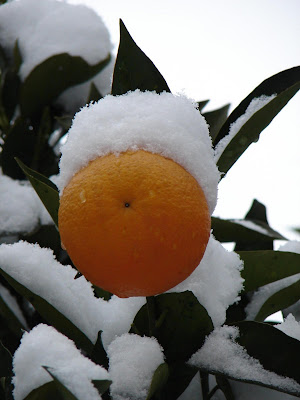
This week’s prompt is actually a photo:

My entry:

“When Life Hands You Frozen Oranges”

“Whoa!” said the Cheerful one.

“Yeah,” replied the Grumpy one.

“It snowed, eh?”

“Yeah.”

“All over our oranges.”

“Yeah.”

“That’s tough.”

“Uh-huh.”

“We moved from Canada to be orange growers, and look what happens.”

“Yeah.”

“Sucks, eh?”

“M-hm.”

“Snows in Canada, eh?”

“Yeah.”

“Not supposed to in Florida.”

“Nope.”

“Sure a shame.”

“Yup.”

Silence as two formerly-Canadian would-be farmers look over their snow-covered orchard.

“Back home they crush frozen grapes to make ice wine….” said the Cheerful one.

Beat…

“Yesss….” said the Not-as-grumpy-as-before one.

Thus was born Ice Orangeade. Which was very successful…in Canada.

I hope my liberal use of hyphens — hyphenated words being counted as one word by OpenOffice’s word count tool — doesn’t constitute cheating! (I’m also not sure if the title counts toward the word count, either. If it does, then I’m disqualified.)

Share This Post

I was hoping to write like George Lucas.

Here’s a fun little tool that analyzes a piece of your writing and tells you what famous writer you write like. I did it twice, and here are my results:

I write like
Stephen King

I Write Like by Mémoires, Mac journal software. Analyze your writing!

And:

I write like
Edgar Allan Poe

I Write Like by Mémoires, Mac journal software. Analyze your writing!

Funny thing? I put in two extracts from the same piece of writing (my current space opera project). So apparently I’m writing a “Stephen King meets Edgar Allan Poe…in space!!!” type of thing.

Which is pretty cool, because now that I think about it, I’d love to read a “Stephen King meets Edgar Allan Poe…in space!!!” type of thing!

Share This Post

“I am Darth Vader. From the planet Vulcan.”

I haven’t talked about writing in a while, so here’s a brief note about it. My main energy lately has been going to the space opera project I’ve had in my head for seven or eight years now; it’s an idea that’s been kicking around and kicking around and kicking around, until I finally decided that hell, it was just time to start writing the thing. The entire long-form story involves two princesses from some planet who leave their world to take their first trip to the Galactic Capital, or something like that. But on the way, their starship experiences some [ahem] technical difficulties and they end up on a strange planet they’ve never heard of before.

All the set-up and such took me through eight chapters, all well and good. All the while I’ve maintained two files, in which I keep lists of my characters as I introduce them (or merely mention them), and lists of the locations I either use or mention. This way I’m not scrounging about later, wondering what star systems I needed names for, or who lives where, that sort of thing. I’m not one to make big encyclopedia-type profiles for my characters — my theory is that if the character’s favorite movie or preferred sleepwear comes up in the course of the story, my character will fill in the blanks when we get to that point — but I do want to be able to keep things straight.

So anyway, my two princesses have just arrived on Planet Whosis, which is ruled by A Guy, who has A Son.

And I don’t have names for any of them. Not the Planet, not the Guy, not the Son (actually, I do have a name for the Son), not the Possibly Evil Councillor, not the Leader of the Rebel Faction, and certainly not the Odd Looking But Extremely Lethal Weapon They Use On This Planet.

Why don’t I have the names? Well, I figured they’d come to me, sooner or later. That’s part of the problem. The other part is that I’m actually recycling a plot that I had started to use in an old Star Wars fanfic project years and years ago, and in that fanfic, I had the habit of just stealing names outright from anywhere I could get my hands on, seeing as how I was just writing it “for the love” and nobody aside from a certain co-conspirator was ever gonna read that stuff. So, in my fanfic, the world where this weird stuff takes place was called Veridian III — which is the name of the ill-fated planet in Star Trek Generations. I stole a raft of other names, too; only a handful of names in that whole thing were ones I coined myself.

For my purposes, I want names that sound a bit more fantasy than science fiction, if that makes sense. Lately I’ve been reading some of the short fiction of Leigh Brackett — why the hell isn’t she ever in print, by the way? — and that woman had a wonderful way with names. Her Mars and Venus abound with places and people with beautiful names: Shandakor! Astellar! Shuruun. Sinharat. Llyrdis. Her names are evocative and fit in with her worlds of adventure. That’s the kind of thing I want…and it’s the hardest thing in the world for me to come up with.

Enter, then, this Fantasy Name Generator. I’m not going to lie, folks — I spent a chunk of today generating lists of names and copying down the ones I like. Some I’ll use, some I may not; and some I like as “starter” names but will undoubtedly tweak a bit here and there. (In the book, I’ve already tweaked the names of two of my three major characters.) Hey, you have to start somewhere.

Naming is not a trivial thing. It’s not a matter of just making up some random name, assigning it to a character, and moving on. I’m not one to believe that names necessarily define people, but there are limits to that. It would take a pretty good writer indeed to turn a character named “Dudley Bose” into a heroic figure, but luckily for Dudley, Peter F. Hamilton is a good writer. But then, as we get to know characters, names kind of take on the qualities of the characters, don’t they? Ian Fleming was looking for a boring name for the secret agent he wanted to write about, since his original notion was that the agent was a boring guy to whom exciting things happened, and when he spotted the name “James Bond” on the cover of a book on birdwatching in the Caribbean, he thought, “Wow, there’s a boring name! Giddyup!” Only now, years later, the name “James Bond” has connotations that are anything but boring. You can use names that connote something about a character — Fleming did this a lot, actually — but I like to go a middle road: names that don’t define anything literally about a character, but maybe suggest something. A little.

Anyway, yes, I’m using a randomizer to name characters and planets and who knows what else. Sue me!

Share This Post

A Quiz on Writing

Steph hit me with this, and it’s pretty interesting, so:

1. What’s the last thing you wrote? What’s the first thing you wrote that you still have?

The last thing I finished? One of the two short stories I wrote last year. I don’t recall which came first, but I ran both on this blog (“Only Begotten Son” and “Partita for the End of the World”). As for the first thing I wrote that I still have? Ye Gods, let me look and see if it’s still here…yup, it is. The Star Wars fanfic I wrote in high school is still around. I really should burn that thing one of these years.

2. Write poetry?

Rarely, although I like to think I’m not awful at it.

3. Angsty poetry?

Well, gee whiz, what’s the point otherwise? I’m not entirely sure what counts as “angsty” poetry, but I do like my poetry to contain emotion. Actually, I like all of my art to contain emotion.

4. Favorite genre of writing?

It varies, really, but usually I’m either doing fantasy or horror. I’ve written exactly one story that would qualify as SF (the above-linked tale from last year). I’m writing a space opera now, but, like Star Wars, it’s really a fantasy set in space.

5. Most annoying character you’ve ever created?

My characters rarely annoy me. I always kind of like them, even the villains.

6. Best plot you’ve ever created?

Hmmmm. I rather like the plot of the space opera I’m writing now, actually. I’m not going to say anything about it, though.

7. Coolest plot twist you’ve ever created?

I like the little twist at the end of “Twelve Presidents”. It’s not really a twist, actually, but I like it.

8. How often do you get writer’s block?

Not often. More often is the general lack of enthusiasm for writing in the first place.

9. Write fan fiction?

I wrote Star Wars fanfic as a kid, in screenplay form. What I did was create new characters and put them through the basic Star Wars plot, with some changes along the way.

10. Do you type or write by hand?

I used to love writing longhand; now I mainly type. But longhand is enjoyable.

11. Do you save everything you write?

Yes, except for some stuff I wrote in my college years that is only saved on 3.5 inch diskettes in whatever file format the Macintosh was using in 1990. Yeah, I’ll never see those files again.

12. Do you ever go back to an abandoned idea?

Kind of, on occasion. I don’t so much resurrect an old idea as sometimes incorporate an old idea into something new. My current space opera project actually recycles a subplot I had in mind for one of my proto-Star Wars tales.

13. What’s your favorite thing you’ve ever written?

I honestly can’t name one. I tend to be overly impressed with the sound of my own writing.

14. What’s everyone else’s favorite story you’ve written?

Relatively few people have read anything I’ve written, with the exception of “Twelve Presidents”, so I guess that’s the answer here.

15. Ever written romance or angsty teen drama?

No teen drama, but I do include romance as an angle in most things I write.

16. What’s your favorite setting for your characters?

I’m not sure I have one. I have some settings I like — the Buffalo-like city of New Mowbray, Michigan, for one; the rural Appalachian town of Corley’s Crossing, Pennsylvania for others. Setting depends on story.

17. How many projects are you working on now?

Too friggin’ many, that’s what. I have: the space opera project, a story that takes place on the peripheries of the life of Jesus, a long-abandoned horror novel project that I’m trying to turn into a screenplay, a story about a maritally-troubled couple on a whitewater kayaking expedition in Alaska, and several essays I’ve started and abandoned. Oh yeah, and The Promised King is always lurking out there, waiting to strike me.

18. Have you ever won an award for your writing?

Unless winning the Buffalo News‘s short story contest two years ago counts, then no.

19. What are your five favorite words?

I couldn’t possibly name five favorite words, so here are five words I like: Misty, Golden, Ice, Byzantine, Calliope.

20. What character have you created that is most like yourself?

Hmmmm. Not sure, really. I don’t do roman a clef much, except for a screenplay I wrote as an exercise a year ago that is based on incidents from my life.

21. Where do you get your ideas for your characters?

My story ideas tend to suggest their own characters. I rarely create characters before the story idea comes to me; most of my tales have their genesis of the form “A person finds him or herself in this position….”

22. Do you favor happy endings?

I’m not sure, really. Bittersweet, I suppose — my endings are rarely completely happy or sad. Some are deeply sad, though.

23. Are you concerned with spelling and grammar as you write?

Somewhat. But not a whole lot. I tend to do well with spelling and grammar along the way, but when I edit, I tend to trap lots of passages that aren’t grammatically wrong but just awkward.

24. Does music help you write?

Immensely. I’ll listen to lots of things, but I find film music my general favorite kind of music for writing, since good film music tends to be inherently dramatic.

25. Quote something you’ve written. Whatever pops in your head.

OK, here’s the opening of the whitewater kayaking story I mentioned earlier — that is, here’s the opening of that story in its current incarnation.

The seaplane banked sharply as it came round the last of the mountains and then dropped toward the surface of the icy blue lake. Stephanie Cooper closed her eyes and dug her fingers into her thighs as her stomach struggled to right itself; her husband Eric leaned as far forward as he could, rubbed his temples, and swallowed again and again, trying to keep from throwing up by sheer force of will. Their pilot, a wiry woman named Rhoda, merely reached into the seat beside her and grabbed another triscuit.

“Almost down,” Rhoda called back.

“We’re almost down,” Stephanie said to Eric.

“I heard her the first time,” Eric quickly replied, as if his wife’s voice might distract him from his work of avoiding vomiting.

Stephanie turned her head away. She’d long since given up trying to figure out how a man like Eric, who paddled the harshest rapids like he owned them, could get airsick.

The cabin suddenly went dark as the plane dropped into the shadow of the deeply forested mountains that ringed Fire Moon Lake, and beyond those mountains rose even higher mountains where the forests gave way to peaks of ice that sired the glaciers that flowed, a foot or two per year, toward the Arctic Ocean. Someday those peaks would feel the bite of the chainsaws and the tread of the logging trucks, but not now, not yet. The Yukon still had places deep in its interior that were unsullied, and for now, this would still be the realm of the elk and the mountain goats and the bears and the wolves and the salmon.

Stephanie and Eric hadn’t come for the mountains or the glaciers, though. They’d come to meet Paul Sydon, the greatest river runner in the world or so it was said, who lived on the banks of Fire Moon Lake and who, once a year, would invite someone to follow him down the River Persephone.

This river was only runnable for about four weeks a year, when its banks were filled with just enough snowmelt to make for a river but not too much to turn that river into a hundred-mile-long raging torrent. It was such a remote and unknown river that it didn’t even appear on any known maps of the region. Maybe that was because it was only a river at all for less than half the year, or maybe there was another reason. Those who had run this river before spoke of the Persephone in hushed tones. To run it was to become a member of a secret society as exclusive as any, and this club required no knowledge of arcane rituals or secret handshakes. To ask directly to run the Persephone was to guarantee that one would never have the chance, and no one who had run it would ever discuss it with those who hadn’t. All a paddler could do was dream, and hope, that one day he might find a letter in the mailbox sent from this far-off place, a letter which read simply, “If you accept, I will guide you down the Persephone. We shall depart on the date written below. Paul Sydon.” Eric still had that letter, carefully folded and kept in a drawer at home. As proud as he was to have finally been invited to run the Persephone, it wouldn’t do to post the letter to the front of the fridge. All that was ever said was that the Persephone was the hardest river in the world, harder even than the streams of the Himalayas. And Eric had run a few of those already.

And there you have it!

Share This Post

Appearing in Print

I’m in the Buffalo News today, here. It’s a rumination on my mother-in-law’s recent passing.

As usual, I make my leaping-off point an item from a movie, in this case, Steven Spielberg’s slavery film Amistad. Here’s the John Quincy Adams speech from the film in its entirety, even though the part that inspired me doesn’t come until around seven minutes in, near the end:

“Who we are is who we were.” I might want that on my tombstone.

Share This Post