From the Books: THE BOYS OF SUMMER, by Roger Kahn


My years with the Dodgers were 1952 and 1953, two seasons in which they lost the World Series to the Yankees. You may glory in a team triumphant, but you fall in love with a team in defeat. Losing after great striving is the story of man, who was born to sorrow, whose sweetest songs tell of saddest thought, and who, if he is a hero, does nothing in his life as becomingly as leaving it.

–Roger Kahn, The Boys of Summer

I was once a huge baseball fan, mainly during the 1990s. It started with the Pittsburgh Pirates’ string of three consecutive National League Eastern Division championships (they were in the NL East back then, before the realignment that created the NL Central), each of which was followed by a heartbreaking loss in the NLCS. Those three years gave my father and I a lot to talk about and a rooting interest in common, which was a lovely thing. (It’s not like we especially needed that; it’s not as if we had a wounded relationship that was somehow healed by baseball or some shit like that. But a shared interest and joy is always good!) Looking back, it’s amazing how my college years were grounded by sports heartbreak: I’d watch the Pirates lose an NLCS in October, and then three months later I’d watch the Bills lose a Super Bowl.

As the 1990s came to an end, I still loved baseball even though by this time the Pirates had become bad (in an epic stretch of badness that would go on for twenty years), but as the 2000s arrived I had less and less opportunity to watch baseball on teevee, because we didn’t have cable. I never lost my admiration for the game itself, though. I loved its rhythm, I loved how it created moments of fantastic tension without the breakneck pace that lots of people seem to think is essential to an exciting sporting event. And I loved how baseball, for some reason, lent itself to wonderful writing. Good sports writing abounds all over the place, I have to admit, but there’s just something about baseball that makes it fodder for great writers.

I think it has to do with how much baseball there is. Each season lasts for six months, with games nearly every single day; unless there’s a no-hitter or a perfect game or some other kind of highlight, few individual games linger in the mind, which means that an entire season can take on the feel of a long epic struggle that feels sad when it ends, whether your team finishes as World Champion, or a pennant winner, or as just another also-ran along the way.

And it’s not just that the seasons are long; baseball itself has been around seemingly forever, too. The history of baseball lasts to around the time of the Civil War, if not before that, and its rise echoes evolutions of so much of America: the urbanization of our society, our ongoing struggles to find some semblance of racial justice, and the desire so many feel to hang on to aging traditions as our society seems to relentlessly speed up.

Baseball careers last a long time too, at least compared to other sports. A typical football career lasts, on average, only four or five seasons. A good baseball player, who manages to avoid catastrophic injury, can play ten, fifteen, even up to nearly twenty years before the inevitability of age takes its toll. And there’s also the progression from the minor leagues to the Majors to take into account: a poetic questing nature seems to apply to players who toil on and on, always chasing the dream.

Roger Kahn, regarded as one of the finest of all baseball writers, died in 2020 at the age of 92, and when he passed, many paeans to his most famous book, The Boys of Summer, showed up online and elsewhere. I had never read Boys, so I added it to my reading list, and I finally got to it just a couple of weeks ago. (Hooray for borrowing e-books from the library–but that’s for another time!) I finished Boys just a couple days ago, and it really is every bit as good as its admirers claim.

Kahn’s book is billed as a chronicle of the Brooklyn Dodgers over a remarkable period in which they were always very good and yet only won it all a single time, but the book is more than that. It opens with a long reminiscence of Kahn’s family life, of how he learned and grew and learned some more and eventually came first to writing and then to writing baseball. We don’t arrive with the Dodgers until some time in the book, and if you expect the kind of long telling of a great team’s championship season, well…that’s not what Kahn is up to here. He writes about baseball in the larger sense, with baseball’s dual feeling of being something unending, through which individual men come and go. In the book’s latter half, Kahn catches up with many of the stars from those Dodgers teams, the last ones to play in Brooklyn before the team’s eventually forsaking of Ebbets Field and Brooklyn for Chavez Ravine in Los Angeles.

Kahn doesn’t draw much attention to the way time is a constant theme in his book, but it is always there. Everyone whom Kahn profiles here is now dead, and the first edition of The Boys of Summer came out in 1972. The oldest players in baseball today were not even born when this book came out, chronicling baseball events that were already decades old. Baseball keeps on keeping on, doesn’t it?

Toward the end of the book Kahn discusses, almost in passing, the team’s move to Los Angeles. Though he doesn’t underline the point, it’s hard not to sense a disapproval on Kahn’s part of what he might describe as the corporatization of baseball. Even that, however, must be viewed through the lens of time. When Kahn was writing, Ebbets Field was still a living memory. Now, the Dodgers have been in Los Angeles over half a century, and the then-shiny and new stadium at Chavez Ravine is one of baseball’s oldest and most beloved venues. Baseball keeps on keeping on.

Finally, I close with a few specific passages that struck me. Roger Kahn is, among other things, a hell of a storyteller and wordsmith. An anecdote about Gil Hodges, who played first base for the Dodgers before becoming a manager:

A sense of strength stays with a man. When Hodges managed the Washington Senators, he learned once that four players were violating a midnight curfew. Hodges believes in curfews and he convened his ball club and announced: “I know who you were. You’re each fined one hundred dollars. But a lot of us are married and I don’t want to embarrass anyone. There’s a cigar box on my desk. At the end of the day, I’m going to look into that box and I want to see four hundred dollars in it. Then the matter will be closed.” Hodges gazed. At the end of the day, he looked into the cigar box. He found $700.

As Kahn travels around the country to meet personally with the retired stars of those great Dodgers teams, he finds himself often well off the beaten paths in towns that were once something but which are now just doddering along. The town that I grew up in is one of those, a onetime “city” in New York’s Southern Tier that is now just another small town with a lot of closed factories and empty buildings, but still enough people to keep the place being a place. Interestingly, my town–Olean, NY–is name-checked in The Boys of Summer, as the location of a tryout camp for guys who maybe wanted to play baseball. I have trouble imagining such a thing now, but that camp was Gil Hodges’s route to the big leagues.

This passage, about Newport, PA, rings very true to me. The towns of my youth were very much like this town.

The reasons for which Newport was built died along with the tannery and ironworks. A river bend no longer makes a town and jobs are so short at the Penn Central that only men with twenty years’ seniority survive recurrent layoffs. But Newport is not dying; the petrified village may even grow. It is a refuge for certain whites, raising young families, who talk about “the niggers stealing America.” No black man lives in Newport, Pennsylvania. None wants to come and none is asked. A few blacks who work for Bethlehem Steel have built a cabin near Lost Creek Gap, but the Newport elders say these aren’t bad ones.

And finally, a quote about the inevitable shifting of the world and how it appears to those living in as it shifts:

There is only so much space on the planet. Fathers perish to make room for sons. At the end, some go with grace, but the middle years–and these Dodgers are striding through middle years–shake with contention. Jack and Jackie Robinson; Clem and Jay Labine, father and son circling one another in a spiky maze of love.

It is too easy to lay griefs on the end of summer. Once I wrote the poet Robert Graves, asking, among other questions, how it felt to be seventy years old. He could not tell me, Graves responded, because in his own mind he was still twenty-one.

In The Boys of Summer Roger Kahn writes about the lives of baseball, and the way that baseball looms larger in those lives than maybe it should, since the baseball part takes up, what, one fifth or one-sixth of a life? Baseball isn’t a bad way to mark the time, though.

(Photo via)

Share This Post

When the House had a filibuster (a Repost)

Since the filibuster is back in the news–and hopefully because it’s about to die, once and for all–I’m reminded of the passage from Barbara Tuchman’s THE PROUD TOWER, which I excerpted back in 2009. Here it is again.


A number of the liberal-leaning blogs I read have been arguing of late that the filibuster in the US Senate needs to be done away with, as it is a fundamentally undemocratic thing whose use has become so frequent and entrenched over the last few years as to render the Senate into a body which de facto requires a supermajority in order to pass anything. (Example.) I tend to agree with this argument; the filibuster’s main virtue seems to be that it’s been that way forever, and that, in itself, is never much of a reason to keep doing anything.

But I’m reminded of a historical episode I read about in a wonderful book by Barbara Tuchman, The Proud Tower, in which she describes a similar problem faced once by a Republican Speaker of the House named Thomas B. Reed, at the end of the nineteenth century.

He [Reed] was determined, on taking up the gavel as Speaker, to put into effect a plan on which he had long deliberated, consulting no one, and on which he risked his entire political future. He knew that the fight would focus upon him the nation’s attention and also that if he failed his Congressional career would be over. The stakes were high: he would either break “the tyranny of the minority” by the which the House was paralyzed into a state of “helpless inanity”, or he would resign. 

The system Speaker Reed had decided to challenge was known as the silent – or disappearing – quorum. It was a practice whereby the minority party could prevent any legislation obnoxious to it by refusing a quorum, that is, by demanding a roll call and them remaining silent when their names were called. Since the rules prescribed that a member’s presence was established only by a viva voce reply to the roll, and since it required only a majority of the whole to constituted a quorum, the silent filibuster could effectively stop the House from doing business.

… 

To Reed the issue was survival of representative government. If the Democrats could prevent that legislation which the Republicans by virtue of their electoral victory could rightfully expect to enact, they would in effect be setting aside the verdict of the election. The rights of the minority, he believed, were preserved by freedom to debate and to vote but when the minority was able to frustrate action by the majority, “it becomes a tyranny”. He believed that legislation, not merely deliberation, was the business of Congress. The duty of the Speaker to his party and country was to see that that business was accomplished, not merely to umpire debate.

He reached his decision to attack the silent quorum, and planned his campaign, alone, partly because no one else would have thought there was a chance of success and partly because he was not sure that even his own party would support him. There were indications that they might not. Because of Reed’s known views on the silent filibuster it was clear that quorum-counting would be an issue in the new Congress. REED WILL COUNT THEM, predicted a headline in the Washington Post, and the story beneath it said that even Mr. Cannon, Reed’s closest lieutenant, was, opposed to the attempt. The Democrats were manning their defenses. Ex-Speaker Carlisle let it be known that any legislation enacted by a quorum which had not been established by a “recorded vote” would be taken to court as unconstitutional. 

Reed, however, had satisfied himself that he would be upheld if it came to law, and on the attitude of his own party he was prepared to gamble. He shrewdly judged that the Democrats in their rage would provoke the Republicans to rally to his support. When the first of the contested elections appeared on the schedule for January 29 he was ready. As expected, the Democrats raised a cry of no quorum and demanded a roll call. Reed’s moment had come. Without a flicker of expression on the great white moon face, “the largest human face I ever saw”, as a colleague described it, without any quickening of the drawling voice, he announced, “The Chair directs the Clerk to record the names of the following members present and refusing to vote,” and began reading off the names himself. Instantly, according to a reporter, “pandemonium broke loose. The storm was furious…and it is to doubted if ever there was such wild excitement, burning indignation, scathing denunciation and really dangerous conditions as existed in the House” during the next five days. Republicans were wildly applauding, all the Democrats were “yelling and shrieking and pounding on their desks” while the voice of their future Speaker, Crisp of Georgia, boomed, “I appeal! I appeal from the decision of the Chair!” The explosion was “as violent as any ever witnessed in any parliament,” a member recalled later. “Mr. Blanchard, Mr. Bland, Mr. Blount, Mr. Breckinridge of Arkansas, Mr. Breckinridge of Kentucky…” 

Up jumped the Kentuckian, “famous for his silver hair and silver tongue.” “I deny the power of the Speaker and denounce it as revolutionary!” he called. 

The resonant twang from the Chair continued unregarding, “Mr. Bullock, Mr. Bynum, Mr. Carlisle, Mr. Chipman, Mr. Clement, Mr. Covert, Mr. Crisp, Mr. Cummings” – through hisses and catcalls and cries of “Appeal” irresistably rolling down the alphabet – “Mr. Lawler, Mr. Lee, Mr. McAdoo, Mr. McCreary…” 

“I deny your right, Mr. Speaker, to count me as present!” bellowed McCreary. 

For the first time the Speaker stopped, held the hall in silence for a pause as an actor hold an audience, then blandly spoke: “The Chair is making a statement of fact that the gentleman is present. Does he deny it?”

It’s a fascinating tale. It doesn’t end there with that one act of Reed’s, of course; few things of this nature ever do. The Republicans would later lose Congress so badly that the Democrats were able to raise a quorum by themselves, and they then restored the silent quorum. This backfired after the next election cycle, however; the Democratic majority was greatly reduced such that now-Minority Leader Reed was able to frustrate Democratic legislative aims by using the silent quorum himself, until the Democrats finally relented and allowed the silent quorum to end forever.

(The Proud Tower is one of my favorite history books, by the way. It is a large-scale picture — a historical snapshot, if you will — of the state of the the world as it was moving inexorably toward World War I.)

ADDENDUM FOR 2021: If my views aren’t clear enough, here it is: To hell with the filibuster. It was never a great wonderful thing to begin with, and now it has become something utterly perverse. Democrats should kill it, pass their legislative agenda, and then let Republicans try to run in 2022 not on Democrats’ failure to pass anything, but on promising to repeal what they passed.
Oh, and the prospect of Mitch McConnell being rendered impotent is a truly delicious one.

Share This Post

Dear 45 (an Open Letter to the President of the United States)

As I write this, you are still President, for another 47 minutes. I guess it’s time to reflect a bit. Here’s part of what I wrote to you four years ago today

I do not support you, and I do not expect good things from you. I do not expect good policy choices, nor do I expect good outcomes. My expectations for you are astoundingly, confounding low, because that’s where you put them. You did it by appealing, day in and day out, to the very worst instincts in the American psyche, right from your campaign’s opening address when you warned us all about the steady stream and rapists and murderers surging into our country from across the Rio Grande.
You did it by lying day in and day out, so much that reporters had trouble figuring out how to report that you were lying. You lied so much that you were eventually lying about having lied in the first place. You ran the most dishonest presidential campaign I have ever seen, and yet somehow you managed to reap the benefit of an opponent whom most people seem to think is also a huge liar, even though she isn’t.
You did it by cheering on the expulsion of people from your events of people who don’t like you or who say things about you that you don’t like.
You did it by several years ago making your first big claim to political fame by pursuing the stupid fiction that Barack Obama was not a natural-born American citizen.
You did it by showing on FOX News repeatedly to scoff at the very idea of global warming and climate change.
You did it with idiotic policy proposals like building a wall between the United States and Mexico, and then compounding this stupidity with the idea that Mexico will somehow be forced to pay for it.
You did it by filling your administration with people who are clearly on the take, people who are clearly going to make out like bandits, people who are obviously going to set to the tasks of destroying the missions of the agencies they are heading, and people who are simply downright ignorant (an Energy Secretary who didn’t know what the department even does, or a HUD secretary who believes that the Egyptian pyramids are grain silos).
You lowered my expectations by attacking people left and right on Twitter, by egging on your bizarrely rabid followers, by threatening your opponent with investigations and prosecutions, and by scoffing at one’s obligations as a citizen by saying “It makes you smart” that you managed to avoid paying income taxes at one point.
There is literally nothing you have said or done over the last eighteen months that gives me the smallest reason to think that you might be a good President. You have shown no curiosity about issues or insight into them. You have shown zero respect for the work of the job or the norms that surround it. You have demonstrated no foreign policy acumen aside from chest-thumping and Russo-philia. I can think of no issue that stands to improve for your having addressed it, and I can think of no aspect of American life that will be better for your having been President.
And the thing is? You’re going to fail. No matter what. You’re going to be able to do a lot of damage, and you’ll ruin a lot of lives. Hell, if you and your cohorts in Congress repeal the ACA without a “replacement” (and let’s be honest, none of you has the slightest idea what kind of “replacement” you’ll offer), you might just kill people. But it won’t matter. Not in the long-run, it won’t. You’re not going to reignite American manufacturing so that towns once more have big factories employing ten thousand people. You’re not going to be able to push all of the queer people back into their respective closets. You’re not going to make the young people like you.
Ultimately, though, I don’t even think you care that much, and that may bother me most of all. You seem to expect the Presidency to be this easy thing that you can almost do on a part-time basis, and that your business experience is one hundred percent applicable to the challenges you will confront as President. As to the latter, your business experience isn’t the unbroken run of amazing success stories that you often say it is, and that experience is not always applicable. What might be OK in a board room is not OK in a cabinet meeting.
In short, I expect your Presidency to be a time of awful policy making combined with amazing levels of corruption. The last administration that paired deep disengagement in policy and facts with willingness to profit from events did not result in good results. Your judicial appointees will be terrible people, and our Congress will rubber-stamp your stuff and you’ll rubber-stamp their stuff. The idea of national government in the hands of you, Paul Ryan, and Mitch McConnell fills me with many emotions, none of them happy and most of them angry.

Not only was none of this wrong, you somehow managed to be even worse than I expected. I expected George W. Bush levels of incompetence, disengagement, and bad policy, but not only did you manage to crank up the settings on all of those, you added to the mix a casual type of cruelty that wasn’t terribly surprising, but it was still unnerving. You seemed to take actual delight in the sufferings of the American people whom you were elected (if only by the deeply bizarre set-up we Americans have where someone with fewer votes can still be elected) to lead and serve.

I never had any expectation of you growing in office, but damned if you didn’t seem to shrink to the occasion, each and every time. I knew that your general approach to policy would be terrible, and my only real hope was that things would somehow manage to not get super bad in America by the time we got our chance to vote you out.

Of course, this hope was in itself dangerous, since Americans don’t tend to take a very long view of policy, which made it a very real risk that we’d hit 2020 with things just king of bubbling along, like they were for the first three years of your term, and Americans would look at the state of affairs and say, “Meh, he’s doing OK, I guess.” The inertia of history takes a long time to shift, and it often takes bad governance years to manifest in terrible results that hurt millions. Likewise, it takes good governance years to repair terrible results, which is where America often gets into trouble: we get frustrated when the Democratic Presidents we elect to get America out of the ditch that Republican Presidents like you steered it into don’t quite get the job done in 18 months, and then we fill Congress with Republicans who have zero investment in doing anything other than keeping us in the ditch.

But here we are: you put the country in a calamitous position, by pursuing things that were unimportant and ignoring things that were. You ignored the warnings about likely pandemics, and then when one actually arrived, you dithered and you dallied and you ignored experts who were telling you what you didn’t want to hear and you installed charlatans who told you what you did, and now here we are, four hundred thousand deaths and counting later, and we’re a country that can’t get on the same page about something so simple as wearing masks to protect each other.

No, you didn’t create the climate in America, but you took advantage of it and you poured gas on its embers and fanned the flames at every opportunity you had. You used the power of your office in the most brazenly and transparently transactional way probably in history, and what of that? You’re still heading off to face all manner of legal troubles, and the idea of anyone giving you giant sums of money to build some tall building someplace is laughable. (Maybe Boise will try; you could end up with Trump Tower Boise being the tallest building there, but then, in Boise, twenty floors will get it done.) You gave your ear to the Stephen Millers, Steve Bannons, Seb Gorkas, and Michael Caputos of the world. I expected your administration to be a Rogue’s Gallery of the worst people in America, and you certainly met that expectation, head-on.

Meanwhile, our country’s economic inequality continues to grow, student loans continue to break the backs of millions, our infrastructure (which of all things I expected you to do something about, even if it was a half-assed grifting something) is still crumbling and well behind the rest of the world, and we have lost another four years that we didn’t have to fight climate change. I am not exaggerating when I say that there is no aspect of American life that is better for your having touched it. Yours is a perverse kind of mirror universe Midas touch, in which everything with which you come in contact is either terrible to begin with or becomes terrible because you touched it.

Well, while there is still the enormous problem that many millions of Americans still support you, and that a significant portion of those do so on the basis of irrational nonsense conspiracy crap that wouldn’t even make an interesting X-Files episode, I can still take comfort in the fact that of the many problems America is facing today and in days to come, one of them has been definitively addressed.

You, Mr. Trump, are no longer America’s problem. May the wind be forever in your face, and may the road crumble before you with each step you take.

Sincerely,

–An American citizen who has no more time or inclination to think about you at all.

Share This Post

2021 in the Books: SOULCATCHER and THE WEIRDSTONE OF BRISINGAMEN

 So, this year I’m going to try to do more with regard to writing in this space about the books I read. I’ve set a Goodreads challenge for myself of 52 books read, and as I write this, I’m ahead of schedule, with three books done. Huzzah! Here are capsule reviews of the first two.

::  Soulcatcher, by J.Q. Davis.

Davis is a contact of mine on Instagram, and an indie author whose work I decided to support by buying one of her books. This one is quite an effective thriller, involving a company which employs sales reps whose job is to sell people on the idea of literally selling their souls to the Devil. Our heroine, Frankie, is an alcoholic who is quite good at her job, no matter how creepy her boss is and how deeply she knows that her job is morally repugnant. All she has is her sister, but when that relationship is threatened, Frankie meets a literal angel who is intent on destroying the business of soul-selling forever and freeing Frankie from her own contract which binds her to Hell.

Soulcatcher, JQ Davis

This book is very dark, with a lot of adult content. I also found it a bit slow in the first act, because of a lot of infodumping. But once Davis has her stage set, the book becomes a lot more involving, with a lot of surprises along the way. I was pleased at several junctures to find that what I was sure was going to happen actually was not, and yet, the things that do happen in the book make total sense. I ended up enjoying this one a great deal, even though this kind of story tends to not be my cup of tea more often than not.

::  The Weirdstone of Brisingamen, by Alan Garner.

This YA fantasy novel dates from 1960, which makes it a pleasing throwback for me. Two young siblings, Colin and Susan, are living in England when they are attacked by strange creatures called the “svart alfar” while exploring their wilderness. They are rescued by a wizard who is tasked with overseeing and protecting the enchanted sleep of a small army of knights. Their is a particular item called the Weirdstone (also the Firefrost) that governs the magic behind the sleeping nights, and the Weirdstone has been lost. Now the forces of darkness are rallying to search for it, which leads to a desperate flight across the English countryside to hopeful safety.

The Weirdstone of Brisingamen, Alan Garner

Garner’s writing is dense in a way that a lot of contemporary YA is not, and it was actually a very refreshing read. I also liked his pacing: he takes his time. I do occasionally get frustrated with the idea that stories have to be all-motion, all-plot, all-the-time. This book opens slowly and gets more and more involving and faster paced as it goes, and by the time I got to the third act, I was turning the pages as quickly as I could. This is not a long novel, but Garner packs a lot into it. The book is pretty dense, and Garner’s mythology seems to be more a blend of various elements like Celtic and Norse myth, rather than reflecting specifics of each.

I did find that the book’s characterization isn’t the greatest; if you’re a reader who needs your characters to feel like “real people” with sharply-drawn personalities. I suspect that this is partly the style of the time; it didn’t bother me all that much, really, and the characterization actually improves as more supporting characters arrive on the scene.

Share This Post

Winter at last?

 Except for a few days, winter here in Western New York has been a dingy affair thus far. I like snow, but we’ve had barely any at all. Mostly it’s just been one gray, damp, muddy day after another. Days like what we’ve had thus far tend to be what March and April are like in these parts. But last night we got snow, and more is on tap for tonight, so maybe we’ll finally have some actual winter, the way winter is supposed to look.

Here’s the view of my street when I left for work this morning. It really was quite lovely.

On the street where I live #wny #winter #snow

Share This Post

On fandom, personal attachments, and the Buffalo Bills


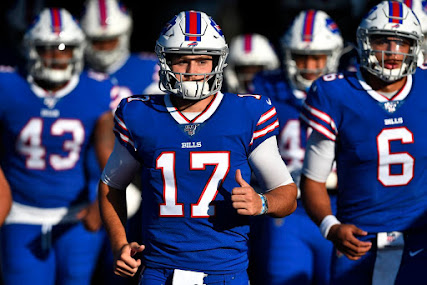
Unless you live in a cave–and a particularly deep, nasty cave with trolls and snakes and giant spiders and whatnot–you probably have heard that in 2020, the Buffalo Bills finally returned to the ranks of the Indisputably Good Teams, after an 18-year stretch of almost unrelentingly bad teams that finally ended with a Pretty Good Team in 2019. This year, the team blossomed in full fire, scoring more points in one season than at any other point in team history. They finished 13-3, and they would have been 14-2 if they had managed to knock down a last-play Hail Mary pass against the Arizona Cardinals. They took the second seed in the AFC, and as I write this, tomorrow night (Saturday night), they play their second playoff game of the year, this time facing the Baltimore Ravens after defeating the Indianapolis Colts last Saturday. That game against the Colts was the Bills’ first playoff win since January 1996.

Longtime readers might remember that I used to be very staunch in my Bills fandom. This began in 1988, to be quite specific. Prior to that, as a kid I’d never been terribly interested in sports, even though my father enjoyed sports quite a lot. I’d root for the Steelers along with him, especially in 1978 and 1979, the final seasons of their 1970s NFL dominance, but once they declined and we moved a few times and both the Steelers and the Pirates went into the doldrums, I stopped caring much at all. Plus, there was probably a bit of the whole “teenage kid doesn’t want to be interested in the same things Dad likes” thing, though I think in my case that was more of getting really into stuff that I loved more than rebelling against stuff that he loved.

I also wasn’t about to get all that interested in football during the mid-80s, when the Buffalo Bills were utterly awful, going 2-14 two years in a row, and drafting a quarterback named Jim Kelly who hated the idea of coming to Buffalo so much that he opted to go play in the USFL instead for a few years, only finally relenting and accepting his Buffalo fate when the USFL folded and he realized that if he wanted to keep on living as a football player, his choices were either Canada or Buffalo. A funny thing happened then, though: the Bills got good, and in 1988, they got really good, and everybody in the region got really happy and excited. I found it hard to be around that and not join in, so that’s about when my football fandom blossomed. Plus it was then that I finally had to ask my father things like “What does ‘first down’ mean?” and “What’s the difference between a field goal and an extra point?” and stuff like that. Took me a while, but I got there. (Likewise, two years later the Pittsburgh Pirates would get good, so all this happened again, with baseball.)

Now, 1988 was the first half of my senior year in high school; in 1989 I went off to Iowa for college, and while it didn’t happen instantly, I did get homesick on occasion. That was when the Buffalo Bills being really good became a godsend: they were on teevee a lot then, because they were really good–four consecutive Super Bowl appearances good. And when they were on teevee, it felt like I was seeing a little bit of home, even if they were playing a road game. I didn’t get to see them on teevee all that much, because they weren’t local, obviously. But they were on a decent amount, and it meant a lot to me at the time, even if they would lose the Super Bowl ever single season.

The Bills stayed good (mostly) through the 1990s, all the way up to the 1999 team, which lost a playoff game on that knife-to-the-heart kickoff return against the Titans, and then they got bad and stayed bad for seventeen years. When I started blogging, though, I was still watching the Bills religiously, and I’d post extensive thoughts about how they played after each game, along with ruminations about how they might improve or…as it happened, not improve. Over time I got less and less interested in blogging about the Bills’ every game, and as the losing mounted, I got less and less interested in watching the Bills. There was a game in the 2009 season where the Bills hosted the Cleveland Browns, and in this game they managed to hold the Browns’ quarterback to just two completed passes. And yet they lost that game, 6-3. Later that same season, they had a game at Atlanta where, having completely fallen out of playoff contention, they decided to start some young quarterback they’d found from somewhere else, and the resulting game was one of the most boring games in football history, a reverse-routing that probably wasn’t even entertaining for Atlanta fans, even though their team beat the Bills 31-7 or something like that.

It was right around then that I started realizing that I wasn’t really enjoying watching the Bills very much, and I likewise started wondering if maybe I shouldn’t stop devoting three hours a week to watching something that didn’t make me happy at all. The next season I decided that I’d watch the games until I started finding them annoying, at which point I’d switch to watching movies or reading or writing. This point came sometime around, oh, week nine or ten of the season (a season is seventeen weeks, with sixteen games played and one week off for each team). The next couple of seasons my point of abandoning the team came earlier each year, until finally I decided to stop watching entirely. Initially I adopted a personal rule of not watching them until they were at least four games over .500, but the last couple of seasons they’ve actually hit that mark, and it turns out that I am so broken of my football-watching habit that I have quite simply stopped watching entirely.

Other fans used to mock this idea; some even called me a “fair weather fan”, as if there’s some kind of obligation involved with being a fan. I continue to resist this notion, as I find the idea that being a “fan” requires that one subject themselves willingly to something that doesn’t bring anyone happiness deeply odd. If watching your football team being bad is making you angry, why keep watching it? I never understood this, and I still don’t

Nowadays, I still root for the Buffalo Bills and I’m glad that they are doing well right now, with a future that as of right now looks very bright. It’s kind of like that 1988 season all over again: it’s hard not to be excited when so many people around me that I love a great deal are themselves really happy and excited about something, and there’s still a part of me that really does consider itself a “Bills fan”, so even as I’m not watching the games, I’m refreshing the box scores online and checking Twitter once in a while to see what’s going on. Am I back on the bandwagon? I have to admit that I am…a little. I still have a lot of problems with the NFL, things that started standing out like sore thumbs to me when I stopped feeling the need to attend upon the NFL’s product on a weekly basis out of fandom obligation. The NFL’s foot-dragging as the reality of repeated head injuries became clear was very disappointing, as was the reaction by some fans to this, along the lines of “So what? They signed contracts, let ’em get jobs if they don’t want to play football.” Wow, really?

I was also troubled by the NFL’s reliance on patriotic military fetishism as a major part of its marketing strategy, and by the collusion the teams engaged in blacklisting Colin Kaepernick; and I continue to be frustrated by cities using public funds to build palaces for football teams to play in, thus ensuring gigantic profits for their owners for years or decades to come, while those same cities plead poverty when it comes to schools, infrastructure improvements, the arts, or anything at all that’s not a shiny weapon for the police department. I doubt I’ll ever again be the football fan I was when I was in college and watching Jim Kelly, Thurman Thomas, Andre Reed, Bruce Smith, Darryl Talley, and all the rest of those guys on television. I haven’t watched a full football game in at least five years, but I’ll still root for the team and look at replays and read boxscores. And what of that? That’s how baseball fans had to follow their teams’ fortunes before they ever invented teevee, after all.

And it does help that the current Bills team is a pretty likeable batch of players, so for what it’s worth, from this occasional bandwagon fan who finds the NFL kind of creepy…Go Bills!

Share This Post

“Common Ground”

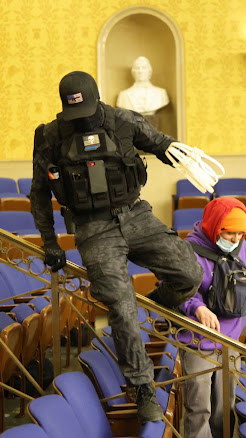
 Of all the images from the failed coup the other day, there’s one that I can’t stop thinking about. I especially think about this image as I consider all the people who keep telling me that we need to “come together” and we need to find “common ground” and that both sides need to figure each other out if we’re to prosper as a nation.

That image is this one:

It’s just one of the rioters, right? Scampering through the House chamber. We’ve seen lots of images like this, and a whole lot of folks have tried passing all of this off as the adult version of the fantasy we all has as kids of getting free and unsupervised access to the school.

But…look closer.

That guy is holding a bunch of cable-tie handcuffs.

This is what law enforcement uses as hand restraints nowadays.

This guy showed up for the riot prepared to take prisoners.

And he wasn’t alone. Among the other images from that day that stick in my mind? One, which I’m not sharing here, is of a gallows that these people set up near the Capitol.

It doesn’t take the creative mind of a writer of space operas to imagine what might have transpired if these people had managed to corner a member of Congress someplace. It doesn’t take a major feat of imagination to think of what might have happened if they’d managed to get hold of, say, Alexandria Ocasio-Cortez. Or Ilhan Omar. Or Nancy Pelosi, or Bernie Sanders, or Adam Schiff. Or, believe it or not, Vice President Pence, whom many of those rioters now view as a traitor for his failure to wave whatever magic wand they think he has to stop Congress from recognizing the Electoral College’s election of Joe Biden as President.

These people stormed the United States Capitol and at least some of them were thinking in terms of violence: capturing lawmakers, and maybe killing them.

There is no common ground to be found here. There is no basis on which they and I can unify so we can work together to build a better nation. These people don’t want a better nation. All they want is their nation, and they literally do not care how much of a shithole their nation is, so long as it’s theirs. Well, they are not welcome in my nation…or in the nation belonging to many, many millions of us.

To hell with “common ground”, and to hell with anyone who showed up in Washington to riot, and to anyone who stayed home to sympathize with them.

(Comments are closed on this post.)

Share This Post

“We are who we were.”

 Longtime readers know that one of my main ways of processing the world is through movies and teevee shows I’ve seen, and books I’ve read. I often find in the creative works of others a prism through which I can crystalize my own thinking on the issues of the day.

Today’s attempted coup* in Washington is no exception.

I found myself thinking about the great John Quincy Adams speech that comes at the end of the movie Amistad. If you haven’t seen the film, it involves a major court case that arose from a property dispute where the property was human lives. The captives aboard a slave ship somehow get control of the ship, but they are soon captured by another vessel, and what ensues is the legal fight for freedom. The legal case, being a bellwether for slavery and property concerns as America is heading toward the Civil War, ends up before the Supreme Court, and one of the lawyers working the case is John Quincy Adams, current member of the House of Representatives and former President of the United States.

It’s quite a movie speech (historically, it’s not terribly accurate, but so what?), and it ends with this remarkable passage after JQ Adams (played by Sir Anthony Hopkins six years after he played Hannibal Lecter, and you can see nothing of the previous performance in this one) has described how in the African tribe to which the man Adams represents belongs, in times of deep difficulty they invoke their ancestors, thinking them as great a force in their lives now as when they were alive.

James Madison; Alexander Hamilton; Benjamin Franklin; Thomas Jefferson; George Washington; John Adams: We’ve long resisted asking you for guidance. Perhaps we have feared in doing so we might acknowledge that our individuality which we so, so revere is not entirely our own. Perhaps we’ve feared an — an appeal to you might be taken for weakness. But we’ve come to understand, finally, that this is not so.

We understand now. We’ve been made to understand, and to embrace the understanding, that who we are — is who we were.

It’s that one quote there that gets me: “Who we are is who we were.” We don’t escape history. Nothing happens without precedent, without its first principles being established years, decades, even centuries past. The road we walk is the one our ancestors paved, for good or ill. It’s a road that leads to amazing things: a nation that helped defeat Fascism on opposite sides of the globe, and a nation that built itself on the stolen labor of some and the stolen land of others. We’re a nation that visited the Moon and questions if we did. We’re a nation that elected a black man President, and then turned around and enabled a four-year tantrum by people who hate that this ever happened.

“Who we are is who we were.” We were racists and white supremacists and violent conquerors of people who lived here before us. We weren’t just those things, but we were those things…and who we are is who we were.

But we were also something else. At least, I hope we were.

In the movie, JQ Adams continues, closing his speech:

We desperately need your strength and wisdom to triumph over our fears, our prejudices, our-selves. Give us the courage to do what is right. And if it means civil war, then let it come. And when it does, may it be, finally, the last battle of the American Revolution.

I suppose now we’d have to rephrase that: Let it come, and when it does, may it be the last battle of the American Civil War.

(You can read the entire JQ Adams speech from Amistad here, and there’s a clip of the whole thing, so you can watch Hopkins deliver one of the best movie speeches in history.)

* Yes, it was an attempted coup. I will entertain no counterargument on this.

(Comments are closed for this post)

Share This Post

ForgottenStars.net

The official site of Kelly Sedinger: Reader, writer, photographer, and dreamer

Skip to content ↓