Chestnut Ridge Park, which lies in the hills just south of Orchard Park, is one of my favorite places on Earth. Here are a few photos from a brief walk The Dee-oh-gee and I took there yesterday.


Chestnut Ridge Park, which lies in the hills just south of Orchard Park, is one of my favorite places on Earth. Here are a few photos from a brief walk The Dee-oh-gee and I took there yesterday.
As noted the other day, conductor and pianist Vladimir Ashkenazy has retired from public performance. Ashkenazy was born in 1937 in Russia, but in the 1960s he emigrated to the West where he has lived ever since, starting with London and then to Reykjavik and then to Switzerland. His output as a pianist and a conductor propel him into thie highest ranks of musicians of the last fifty years. The other day I featured Ashkenazy as a conductor; today I present him as a performer in his natural element.
Thank you for the music, Vladimir Ashkenazy!

So last week I wrote about the various issues that arise when writing not just one novel but a series of novels, and wouldn’t you know it! I am running up against those issues right now.
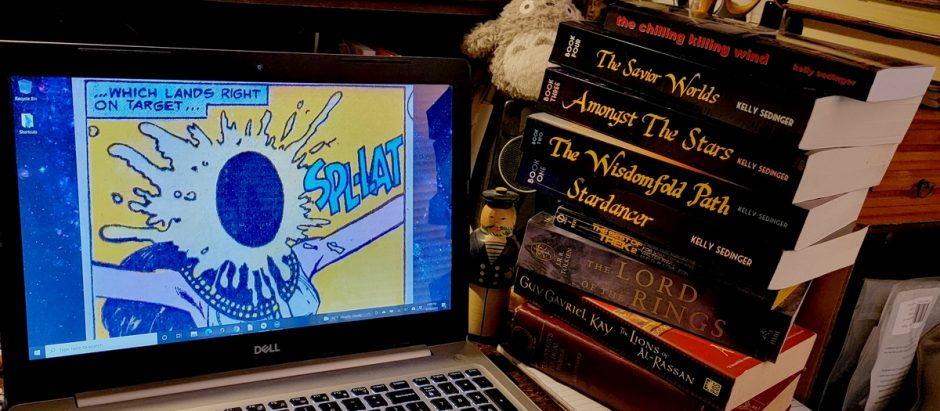
In just a couple of weeks I start doing my next round of revisions for The Savior Worlds (The Song of Forgotten Stars, book 4), which is the volume in the series that kicks the larger story into real motion. That being the case, it’s suddenly clear to me that I need to really codify, if only for my own use right now, the backstory of this saga.
If you’ve read the three currently-published Forgotten Stars books (and why on Earth would you not have read them! They’re terrific, even in my biased opinion!), you know that I drop a lot of small and not-so-small hints and tidbits about the nature and history of the long-lost, long-fallen Arrilori Star Empire. I did this because the main planet of the first three books, Xonareth, was once a member of that empire but was banished and forbidden to travel to the stars until the Arrilori returned to set them free…and there they waited, and waited, and waited, while the Arrilori fell completely and utterly into ruin. Xonareth is, as I’ve mentioned before, the planetary society equivalent of those fabled Japanese soldiers who spent decades on deserted islands in the Pacific, never knowing that World War II ended.
But as the second act of The Song of Forgotten Stars dawns and is now taking shape, it’s starting to become important to hand out more and more information about the Arrilori Star Empire. It’s time to flesh out the backstory.
And all I have of that backstory right now is…hints and tidbits. I have a very “big picture” version of what I know befell the Arrilori and their galactic empire, but I need more than that. This is what I meant in the post about series writing, in that you need to do more ground work when you’re doing a series that tells a single, large story.
You may now be asking, “Hey dummy, shouldn’t you have already done all that work?” Well…maybe, maybe not. That’s where the whole “plotter versus pantser” thing comes into play, after all. But also in this case I knew that I could get away with the first three books in the series without a complete picture of who the Arrilori were and how everything they built came to ruin. I had the luxury of being able to throw in some cool stuff here, a few hints there, a couple of juicy tidbits sprinkled throughout. I was leaving puzzle pieces for myself as a storyteller, and now it’s time to put the pieces together for myself before I go on to do it for the readers.
At least, that’s the plan. Plans can go awry, of course….
See you ’round the Galaxy,
-K.
I’ll have more to say about this later in the week, but for now I learned yesterday that one of my musical heroes, pianist and conductor Vladimir Ashkenazy, has retired from public performance. Ashkenazy has been a giant of the music world for more than sixty years, and his performances–both at the keyboard and on the podium–always have a good deal of excitement behind them. In my opinion, Ashkenazy’s cycle of the three symphonies of Sergei Rachmaninov have never been equaled. (One day I’ll write the long paean to the Rachmaninov Second that’s been in my head for years.)
While Ashkenazy might well be most closely associated with Russian and Slavic music, he was no one-trick pony. Here he is conducting Debussy, about as spiritually far from the heavy Russian Romanticism of Tchaikovsky and Rachmaninov you can get and yet still remain in roughly the same time period. Debussy’s La Mer is a three-part work, called “symphonic sketches” by the composer, who wanted to avoid the associations of the symphony and the symphonic poem. Debussy often worked to throw off formal constraints in a way that is not unlike his earlier countryman, Hector Berlioz. La Mer is deeply evocative and masterful in its use of orchestral textures to convey Debussy’s impressions of the sea.
Here is La Mer by Claude Debussy, performed by the Royal College of Music Symphony Orchestra, conducted by the great Vladimir Ashkenazy.
In more ways than just the political, mind you. My lenses, for one!

Last time I visited the actual eye doctor for an eye exam, though, he indicated that I had in the course of time and age and all that stuff gone from farsighted to being mildly nearsighted, which explained why I’d been noticing that stuff in the distance was increasingly blurry. The worst effect of this was driving and noticing that street signs and such were much harder for me to read than they had once been. So, enter The Wife’s new job with its spiffy vision plan, and off to the optometrist. An hour or so of exam-stuff later (“Which is clearer? 1 or 2? 1 or 2? Read the bottom line…no? the next one up…no? How about now?”), another hour or so of looking at frames and talking about lens options, and a week for the new lenses to be ground, here I am, with new glasses.

I could have chosen basic glasses for distance sight, and then removed them every time I wanted to read or write, but that seemed a pain in the ass, and anyway, I like the way glasses look. It’s much easier to look like your thinking thinkly things if you have a pair of glasses on! So I opted for dual lenses, which brought up the next option: bifocals or progressive lenses. I actually had bifocals for a time when I was in grade school, and while they worked, I really didn’t like the constant sharp line across the lower part of my vision, so I decided to get the progressive lenses where there is a transition between the “reading” section at the lower part of the lens and the “distance” part that takes up the upper half. I’m on Day Three of these glasses as I write this, so I’m still working out the kinks. I’m finding that I can’t really hold a book and my head at the same angles as before, and that I have to actually move my head slightly as I read if I’m holding the book at my usual closeness. This is kind of irritating on its own, so I’m trying to teach myself to hold books farther away from my eyes, which is also an adjustment. I’ll get there, but for now I’m having moments of clarity alternating with moments of wondering why I can’t see my book totally clearly, and figuring out why with a bit of finagling and fidgeting.
It’ll be fine. One thing that makes me a little nervous is only having one pair, now that I’ll be wearing these basically all the time. I figure I’ll be careful this year, and then next year I’ll get another exam and assuming that my prescription doesn’t change much between now and then, I’ll get a second pair and then either rotate them in and out or use one for work or…well, who knows. That’s a year away. Let me just get through the next year without breaking these! Luckily my track record on breaking glasses is…OK. There was the pair that I broke in college when I had them in my backpack and unfortunately landed right on top of them when my feet hit a patch of ice and went right out from under me. And then there was when I was in second grade, and I left my glasses (brown horn-rims, no less!) on the living room floor when I went to get something and then came running back in, having forgotten they were there, and only had time to register my mother screaming “YOUR GLASSES!” before I felt the crunch of eyeglasses under my foot.
Two broken pairs in 48 years isn’t bad, is what I’m trying to say.

The 1957 musical Funny Face is kind of an odd duck of a movie. It seems to me a bit underrated, coming as it did when the musical was likely on the decline, but it’s still an entertaining film loaded with great songs. Every time I see it I’m struck anew by the lack of…well, chemistry between the leads. I yield to no one in my love and admiration for Fred Astaire, and my feelings on Audrey Hepburn border on worship, but in all honesty, the age difference between the two stands out like a sore thumb in this movie. Astaire was thirty years older than Hepburn, and by 1957 Astaire was nearing 60, so the age difference is very noticeable. I’ve often wondered how the movie would be seen today if it had starred Gene Kelly instead of Astaire, but of course, we’ll never know–and it’s not as if this flaw sinks the movie anyway. Astaire at near-60 is still Fred Astaire, after all.
And Audrey Hepburn is still Audrey Hepburn.
Here is Ms. Hepburn with “How Long Has This Been Going On.”

Greetings, Programs!
The other day, the ever-fantastic Briana Mae Morgan asked on Twitter:
I am simultaneously excited and nervous to be writing a series. It’s my first series! How do y’all do this?
— briana morgan PREORDER LIVINGSTON GIRLS! (@brimorganbooks) January 5, 2020
Naturally, I responded, because I have committed or am in the process of committing several crimes of Serial Fiction, and now I’m going to extend my thoughts a bit as to how to write a series.
I tend to think of storytelling, at its most basic, in terms of structure, so naturally my thoughts on writing a series would turn to structure. That means that if you’re considering committing an act of series, you have to ask yourself this question first:
What kind of series am I writing?
The answer to this question will affect how you write your series. So, what kind of series are there? The options, as I see them, are these:
TYPE 1. A single-story series, told serially.
Examples here are many of the long fantasy series out there: The Wheel of Time, The Belgariad, The Expanse, and A Song of Ice and Fire are good examples. Each book tells a part of the larger story, and reading the books out of order can be disorienting or downright confusing for readers who are jumping into the middle of the story.
At first glance, The Lord of the Rings might be thought an example of this, but I don’t think it is. LOTR is better thought of as a single huge book that for publishing reasons was broken down into a trilogy. There is no functional break between The Fellowship of the Ring and The Two Towers and The Return of the King, and each volume is only a part of the larger whole.
I would also file the Harry Potter books here, but they’re a bit of a special case in that each book tells a piece of the larger story while also serving as a self-contained unit. The later volumes have less stand-alone appeal than the earlier ones, but they still have internal structure. Can you read them in any order? Not really–but there’s enough internal structure to each book that it wouldn’t be as disorienting as trying to jump into A Song of Ice and Fire with A Feast for Crows.
TYPE 2. An open-ended series with larger story elements, but not a single larger story.
In a series like this, each novel is mostly independent, but there is character development and larger story development along the way. Events of earlier books have impact on the later ones, but there’s generally less danger in starting such a series somewhere in the middle. The James Bond books are a good example here, or Lois McMaster Bujold’s Miles Vorkosigan books.
TYPE 3. A series of independent stories featuring a starring character or a group of characters.
With this kind of series you can start at any point, because the books (or movies) are for the most part completely unrelated and self-contained from one to the next. The James Bond movies apply here (Ian Fleming’s books have more continuity than the movies, at least up until the Daniel Craig era, which have more continuity than any other sequence of Bond films to date), as do Agatha Christie’s Miss Marple and Hercule Poirot books. I’m not sure if Conan Doyle’s Sherlock Holmes stories work under this definition.
So, once you know what kind of series you have on your hands as a writer, your next course becomes clear. If you’re writing that last kind, you’re golden because you don’t have to do any planning of any kind beyond what you would plan for a single novel. Just finish the current adventure or story, and then move on to the next one. Lather, rinse, repeat for as long as you’re comfortable tracking the adventures of a single character.
Now, with a series like that, you might want to have some continuity as you go: recurring villains, perhaps. Holmes had his Moriarty and Bond his Blofeld, after all. But you don’t have to do that: I don’t recall that John Bellairs had Lewis Barnavelt or Johnny Dixon square off against the same dastardly supernatural baddie more than once (though I may be wrong).
It seems to me that the difficulties with series writing creep in with a Type One or a Type Two series. With these types of series, more planning is needed.
With a Type Two series, in which there are ongoing serial elements but no real larger “story”, a degree of planning is still needed for two reasons. First, all installments must reflect what has come before. If you shatter your protagonist’s heart at the end of one installment, you can’t have them bounce right back into a new relationship in the next. You have to be able to accommodate the changes in your characters over time, and what’s more, you have to let them change over time. In a Type Two series, your character can’t be the same person in the tenth installment that they are in the first.
Second, while leaving room for surprise and discovery is great, you’re better served if you know beforehand what kind of larger arc your characters or your story are going to follow. You need to have at least a partial idea of how you expect your characters to change and grow and what kinds of things are going to change in their world. A series of stories following, say, a sword-wielding warrior for hire as she journeys through various kingdoms and realms, should see the world change as she roams through it. Wars begin, perhaps; or maybe the cities are visited by plagues…whatever. The world should change, and your character should change along with it. And if that happens, you should have a bit of an idea of what kinds of changes might happen.
(Again, none of this should rule out the serendipity of a sudden burst of insightful inspiration that leads you to do something you hadn’t expected!)
This leaves us with the Type One series: the series that tells a single story, beginning to end, but writ large over the course of several individual stories or books. For one of these, you’d better do some planning, or you’ll end up really bogged down once you’re in the thick of it.
The bigger a story is, the more moving parts it has, and these all have to work together. Your cast of characters is likely much larger if you have a big story to tell, and they all have to develop along the way and their actions and choices have to affect the story, or else it feels like the characters are just cogs in a big machine of plot. But here’s the thing: with a big series it can likely be very tempting to just start out and figure out the big plot later, but if you do this, pitfalls await.
Your early books might not end up sufficiently supporting or establishing the larger plot to follow, or crucial things about your characters. If you find yourself needing Mary in Book Four to have a very specific talent that requires years of training to master, and you’ve never hinted in Books One through Three that she has this talent, it can be jarring for the reader or eject them outright from your book.
More importantly, telling a very large story without planning can lead you to losing the story entirely. You can find yourself wandering down tangents, or finding that farther on down the line your entire notion of how the story works has changed, or you might change your mind as to what happens. On the other hand, though, as with any story I feel strongly that outlines or plans should not be constrictive to the point of being a straitjacket, crushing spontaneity. You never know when the next great idea is going to come along, but if you’ve done the groundwork for your series, the great ideas are likely to supplement the work rather than supplant it.
So, those are my thoughts on writing series. Of course, my thoughts might change as I get farther into my own respective series!
Thoughts?
See you ’round the Galaxy,
-K.
I am constantly amazed at the sheer output of Antonin Dvorak. Music poured out of the man, and his gift for melodic drama set with wonderful orchestration never, ever fails to delight. Even so, I was unprepared for the degree to which this piece–which, to my knowledge, I had never heard before a couple weeks ago–forced its way into my imagination. It’s called The Golden Spinning Wheel, and it is based on a Czech folktale that was gathered into a book by Czech poet K.J. Erben. As folktales go, it’s pretty satisfyingly grim, with a young maiden capturing the heart of the king and being murdered by her evil stepmother for her troubles, only to be resurrected by a magician. You can read the entire tale here…but meanwhile, give a listen to Dvorak’s tone poem, which is thrilling and adventurous and romantic in all the wonderful meanings of the word. At times this work is so swashbuckling in its sound that you can practically see Errol Flynn, rapier in hand, as he disposes of the evil soldiers as he fights his way to his love’s side.
Music like this is what keeps me coming back to classical music, year in and year out. I hope you’ll give it a listen. Here is The Golden Spinning Wheel by Antonin Dvorak.


