An Arthurian theme this week!
What was the name of the fattest Knight of the Round Table?
Sir Cumference!
An Arthurian theme this week!
What was the name of the fattest Knight of the Round Table?
Sir Cumference!
Sorry, folks, yesterday was a bit preoccupying, what with a nice visit from my old friends, the Car Repair Gods*.
Here’s something fun.
* They’re not friends. They’re jerks, and when they come by, well — as Ned Flanders noted, I’m obliged to offer them a beer, but it’s mostly head.
There are a lot of ways to separate writers into opposing camps: Are you a plotter or a pantser? Do you write in past tense or present tense? Do you have a daily quota, or not?
One of my favorite such queries is: Do you listen to music when you write, or not?
Some writers don’t listen to music, claiming that they can’t focus on the story when music is playing. Others need music, as a way of setting mood and of shutting out the rest of the world. I fall into the latter category. I can write without music, and I often do, but my preference is to have music going.
Usually I listen to classical, Celtic, or film music while I write. I’m not too insistent on matching my writing music to the mood of what I’m working on, but I do like to use music as writing-mood music at least some of the time. Thus, for my current WIP – the Alexandre Dumas-inspired Hefty Adventure Fantasy novel Seaflame! – I have been listening to some swashbuckling adventure music. Sometimes you just need some good adventurous-sounding music when you’re writing about crossed swords and villains with big hats with feathers in the brim and pounding horse-rides across the landscape and highland clans and all that sort of thing.
The Three Musketeers, music by Michael Kamen. This is the score from the 1993 film of Dumas’s novel, and it’s a terrific score. In fact, it’s almost certainly the best thing about the film.
The Adventures of Robin Hood, music by Erich Wolfgang Korngold. So many wonderful swashbucklers of Hollywood’s Golden Age boast scores by Korngold. I can’t even look at a picture of Errol Flynn without hearing something by Korngold in my head.
The Sea Hawk, Korngold again. See what I mean? This is my favorite Korngold score.
Pirates of the Caribbean, music by Hans Zimmer and Klaus Badelt. I really do love these movies and have never understood the increasingly negative reaction to each one that comes out, and the music is a lot of fun too, for a more modern take on the swashbuckling thing.
Cutthroat Island, music by John Debney. This is not a good movie, although I also don’t think it’s quite as bad as everybody else does. It cost a ridiculous amount to make, the male lead was terribly miscast, and the movie simply wasn’t good enough to overcome being in a genre that simply wasn’t in demand at the time. Debney’s score, though, is amazing – in fact, many film music lovers consider it a classic. Lots of swashbuckling here!
The Mask of Zorro, music by James Horner. Energetic fun here, if you want a Latino flare to your swashbuckling music.
Ivanhoe, music by Miklos Rozsa. Rozsa is another of the great composers of Hollywood’s Golden Age. He’s likely best known for his work on big epics like Ben Hur, but Ivanhoe is a wonderful swashbuckling listen.
Hook, music by John Williams. Here we’re skirting the line between “swashbuckling adventure” and “outright fantasy”, but it’s hard not to get caught up in Williams’s work for this movie (which is, admittedly, not a favorite of mine).
Robin Hood, Prince of Thieves, music by Michael Kamen. Kamen was somewhat underrated during his lifetime, and, well, he might still be a bit underrated. His Robin Hood score is terrific. (I like the movie, despite its well-known faults in the “historical accuracy” department.)
Rob Roy, music by Carter Burwell. This film isn’t quite the standard type of swashbuckler you might expect – it’s more of a historical drama, and Burwell scores it as such. But there are still exciting moments in it, and the score is well-worth hearing.
The Princess Bride, music by Mark Knopfler. Also not your standard swashbuckler, and therefore not the standard type of adventure music you’d expect for one, but it can still fit the mood, especially if part of your swashbuckling story involves Twoo Wuv.
And not just film music! You can hear a lot of thrilling music of the swashbuckling variety in the classical realm. A few examples, which aren’t remotely exhaustive:
Le Corsaire Overture, by Hector Berlioz. Berlioz is one of my favorite composers ever, and there’s a lot of adventure in his music. Especially in this rousing overture!
The Polovtsian Dances, by Alexander Borodin. Exotic and wonderful. The Russian Romantics will sweep you away, if you’re not careful. But come to think of it…let them!
The Flying Dutchman Overture, by Richard Wagner. There’s a lot of overlap between good swashbuckling music and good outright fantasy music, and this is an example. Wagner makes amazing listening for fantasy purposes, actually – but fantasy music is another post.
I could go on, but this post is pretty long already. These are but a starting point, though, so sharpen your rapiers, put on your wide-brimmed hat with giant feather in it, and go buckle your swash!
So a few weeks ago I was hiking with The Dee-oh-gee (at Sprague Brook Park in Colden, NY) and I happened across this strange-looking plant:

A week or so later, I’m hiking with the Dee-oh-gee (at Knox Farm State Park in East Aurora, NY), and I happened across an entire crop of those little plants:
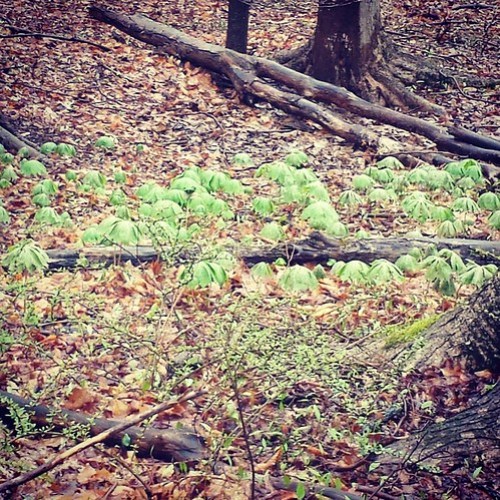

Wikipedia indicates that they are poisonous, but this article indicates that the fruit can be eaten, albeit with preparation and quantity in mind. I’m not sure if I’m quite that curious, but still, a bit of learning is useful — especially when it’s something that I’ve been observing on my own!
My car reached a milestone yesterday:

I very much suspect that there’s no way I’m a writer if not for my mother.
After three consecutive weeks of increasingly lengthy and heavy German symphonies, let’s step back and listen to something shorter and much less dense. What’s needed right now is a French composer, so this week we’ll encounter Vincent d’Indy.
I have heard almost nothing by d’Indy; in fact, it’s quite likely that the work featured in this post is the only work I’ve ever heard by d’Indy. My brief research confirms that his music is little heard today outside of the present piece, although in his Essential Canon of Classical Music, David Dubal does opine that d’Indy is a terribly underrated composer, so perhaps his work is deserving of greater exposure.
This work, the Symphony on a French Mountain Air, is unusual in a number of ways. First, it is in three movements instead of the traditional four; second, its melodic material is mostly derived from a single tune (the “mountain air” of the title, a song d’Indy heard while traveling in the mountains); and third, the work features a prominent (but not quite dominant) part for a solo piano, making it a sort of symphony-concerto hybrid, not unlike Harold in Italy, the symphony by d’Indy’s fellow Frenchman Hector Berlioz, which had featured a prominent part for solo viola.
The Symphony on a French Mountain Air is, to my ears, a delightful listen that always feels fresh and light, especially after a steady diet of heavy Germanic romanticism.

Hey everybody! For one week only, you can get both FORGOTTEN STARS e-books on Kindle for just $.99 each! Two fantastic* space opera novels for the grand total of $1.98! Spaceships! Princesses! Ancient galactic empires! Lost planets! Mysteries! Action! Giant six-legged cats! Enigmatic space pilots! All this and MORE!!!
*This opinion is completely biased.
Hey, folks! It’s me. Below we have a first for this site: a guest post! This entry is by A.B. Keuser, a speculative fiction author who, by her own words, “spends a lot of time making things up and figuring fun ways to kill people.” Here she discusses her methods of tracking her writing progress. Enjoy!!!
——-
I track my writing by day. It’s a practice I took up in 2013 when I decided to write 1,000,000-words in one year, and I’ve kept with it since because it gives me some really great feedback.
Much like Kelly, I keep track of my writing on a spreadsheet. Unlike Kelly, I record my numbers up in a calendar like set-up.
This allows me to pull day counts, week counts, and keep a running total.
Let’s look at March of this year:
This is what my monthly spreadsheet looks like.

The bulk of the sheet is the calendar where I record the actual numbers. I keep 3 lines for each date because I have a main item scheduled and then I’m usually juggling two other back-burner projects that I write on when I’ve met certain goals. This is why I color code them. With one quick glance, I can look at March and tell you what I worked on.
I like to keep track of my weekly w/c and my running total alongside this just to make sure I’m getting on with my bigger goals.
Below the calendar, I keep a running bar graph (At the beginning of the month, I set up the formula to collect the day’s totals and add it to the chart so I don’t have to worry about it later.) This is one of the most visual representations I have of my monthly writing. It’s quick, it’s tidy, and it gets the point across.
Why this works for me
My eyes get bored pretty easily when it comes to numbers. We’ve never really gotten along, so I use this method of spreadsheeting with colors and charts to keep me interested in said numbers.
I’m also a very self-competitive person. This year one of my bigger goals is to beat my totals from 2014 & 2015. It’s going well enough.
But one of the main things it allows me to do is know when I write, and when I should focus on other things and give my brain a break.
Honestly though, the main reason I do this is to hold myself accountable. As Kelly mentioned at the beginning of April, I post my counts every month. I’m not sure anyone really cares to see them outside of myself, but having them out there, in the open really helps me keep from slacking off.
The Big Picture Numbers

2013: 1,000,497
Average: 83k words per month.
Best month: February – 133,329 words
Worst month: December – 0 words
In theory, this sounds awesome, right? So much productivity! But I managed that by ignoring all but two editing projects. Which means I’ve still got some back burner projects from that year that are waiting around to be finished.
If you’re just looking to get words down on paper—maybe you need to empty out your brain because it’s gotten too cluttered—the way I approached 2013 is great. You just write. If something isn’t working, you shove it aside and work on something that does flow. You worry about the rest of the writing stuff later.
2014: 438,943
Average: 36,578
Best month: May 62,965
Worst month: December 5,880
This year was all around tamer. I was working on things with the intention of finishing them and getting them right. That meant I couldn’t shove them to the side until my brain sorted through their issues later. I had to get things done, and I had to get them done when I scheduled them.
I learned, from looking through this year’s records, that I can’t rely on myself to do any writing on Thursdays. For whatever reason, they’re my own personal Mondays, and that day just sucks the life out of me, writing wise. Sure I can force it, but the writing is pretty awful in edits, so I usually just don’t schedule myself any req words that day. I use it for admin things now, like finishing up blog posts and doing marketing backlogs, or outlining etc.
2015: 361,949
Average: 30,162
Best month: November – 63,624
Worst month: June – 3,260
Now, those numbers look okay, but when you look at what happened throughout the year as a whole, you get a different picture. 1/3 of the words from last year were written in the last 2 months of the year. This has a very specific reason. While the first 5 months of the year were incredibly consistent, June through October were weak sauce on the writing.
June has its own excuse, my sister got married in our home state so I spent a lot of time traveling and with everything going on, I didn’t get a chance to write outside of 4 days.
July-Oct shows a different sort of recording. It shows how badly medication can affect your writing. Make sure you’re on the right meds, kids!
What this tells me on the whole
When I look at the numbers I have saved in my yearly spreadsheets, I can see patterns, like the fact that Thursdays just do not work for me. Decembers are (usually) pits of non-writing hell. Weekends are lucky to average 1000-words/day, and usually I just shouldn’t expect myself to get there.
—fin—
And there you have it! Great stuff. How do you track your progress, fellow writers?
And check out A.B. Keuser’s books!


